Showing posts with label whaleshark. Show all posts

Sunday, November 21, 2010

Le Méridien Al Aqah Joins Sharkwatch Arabia targeting the first wild whale shark tagging in the region

Fujairah, United Arab Emirates, 20.11.10- A team of divers and marine scientists will be down under the east coast waters and Musandam region of Oman looking for a suitable whale shark to satellite tag on 21st and 22nd November 2010. This will be the official start for the first ever wild whale shark tagging program in the region.

The sophisticated tag is sponsored by Le Méridien Al Aqah Beach Resort who are supporting the Sharkwatch Arabia research project lead by Chief Scientist, David Robinson. Successful tagging will provide essential data on how these animals utilize the region's waters and beyond.

Sharkwatch Arabia www.sharkwatcharabia.com is a post-graduate study in association with Heriot-Watt University, Edinburgh and part of The Shark Project Oman based at Sultan Qaboos University. Sharkwatch Arabia also runs in collaboration with the Sharkquest Arabia Initiative and Emirates Diving Association. Dive schools have been notified to be on the lookout for sharks in the coming week.


Patrick Antaki, General Manager, Le Méridien Al Aqah Beach Resort, said, "The personal gratification I get from being a part of Sharkwatch Arabia is as important as the CSR involvement of the resort in this continued quest for environmental understanding and protection. Additionally, the conscious support of our team members who are avid divers that support the cause and voluntarily contribute to similar activities is commendable. We wish the dive teams all success in the tagging programme."


Undertaking the initiative to tag a wild and free swimming whale shark is a hard process that requires the fulfilment of several parameters and possibilities of many attempts to attach a satellite transmitter. The Sharkwatch Arabia teams will live up to the challenge and work towards making the tagging of a whale shark successful and play an important role in adding value to the overall programme.


One of the aims of the Sharkwatch Arabia project is to tag five whale sharks each year over the next five years to provide data on the movements of the animals in the region and help understand why they visit these waters and where they migrate to.


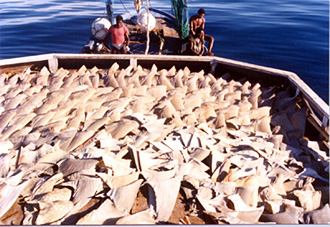
The whale shark is the largest known fish in the oceans, they are listed as vulnerable to extinction partly due to the increased demand for shark products in the Asian markets. The Sharkwatch Arabia project will make a valuable contribution to provide key insights into the ecology of the species and assist in providing necessary steps for their conservation.


Tagging a whale shark with a satellite transmitter helps to track their movements and behaviour in the wild with little interference. The tag that trails behind the animal gathers important information over a 120 day period and subsequently detaches itself from the whale shark. The data involves information of water temperatures, duration of dive, depths, etc. On detachment and touching the surface of the water, the tag begins to transmit the collected data to orbiting satellites that will later be interpreted by ARGOS, the French satellite uplink company who sends the data to research teams for evaluation and further study.

Friday, September 5, 2008

Underwater Photography-Capturing "The Moment"

The world of underwater digital photography is fast becoming an epic horse race. At the front of the pack you have several well known faces and shooters who make a living from the imagery they bring to the world.

For the most part it's stunning stuff. Case in point Ethan Gordons recent work in Scuba Diving Magazine on Chuuk Lagoon. Almost every month new images surface that take your breath away from the pack leaders.

Then there are guys like Derek Heasley who are less well known but shoot with a cool eye towards brilliance. It's not easy to "capture the moment" when it happen with wildlife. But rest assured when the "moment" happens-if Derek is within lens shot of it, he'll nail it.

Here's his website Sea Pixels

Thursday, May 29, 2008

Basking Sharks and Science-Great News

Off the cold dark waters of the U.K a shark mystery is slowly unraveling.

Researchers have recently tagged and tracked giant Basking sharks to discover they are deep water-long migration critters after all. Similar research on Whale sharks is showing the same behaviour patterns.

Isle of Man Britain's biggest shark species has been tracked for the first time for thousands of miles from waters southwest of the Isle of Man to Canada.

Until now little was known about endangered basking sharks (Cetorhinus maximus) when they moved outside British waters, but scientists have confirmed that the animals travel huge distances and plunder deep waters for food. The discoveries were made with the help of two sharks, known as A and B, who were tagged last year.

The detailed pattern of movements will now enable scientists to identify new ways to protect sharks from harm in British waters. There is still a risk of hunting in other waters, however, because of the shark's highly valued fins, which are a delicacy in some countries.

Mauvis Gore, who is involved in the project, said: “Such long-distance migrations have implications for population genetics. Despite protective legislation, the numbers in the northeast Atlantic may show only limited recovery if mature adults are exposed to exploitation in other oceanic regions.”

Wednesday, March 5, 2008

Whale Vomit Gold Rush U.K

Gotta love the Brits. Last week two gents discovered gold on a local beach in the form of 110 pounds of Sperm Whale vomit, and they decided to keep it.

Turns out this disgusting substance called Ambergris is used in France (where else?) for rare perfumes.

Naturally we thought this was as nasty as it gets, grubbing around on a beach in search of greasy balls of whale vomit...that was until we discovered how much these guys stand to make off the stuff-$500,000 pounds, or in depressed American dollars a whopping $996.973.12!

Sean, from Penrhyndeudraeth (try saying this without loosing a tooth) in North Wales, said the pair were on the beach walking a dog at nearby Criccieth when they made their discovery.

"We just came across this white, like waxy lump. I said to Ian: 'It looks a bit like whale sick. He had never heard of anything like it," he said.

O.K, so maybe they have something there, and with the price of homes here in California hovering around $800,000, do not be surprised if you see one of the Shark Diver crew out on that beach in the near future. Too bad this story didn't hit on April 1st.

Tuesday, February 12, 2008

Georgia Aquarium-Calling Bullshit!

Let us be the first of what will probably be many people, eco-groups, and divers to call "Bull-Shit" when we see it.

Recently, the Georgia Aquarium announced to one and all-real live scuba diving experiences and snorkeling experiences with their much coveted Whale Sharks...part two.

You see, the first set of Whale Sharks they had in captivity died mysteriously and they just Fed Ex'ed in another set a few months ago.

Look, this is not the way to run an aquarium, and the good folks in Georgia should know this. Whale Sharks are a unique and amazing shark species. While we are all for wild encounters with these critters, aquarium dives are just plain wrong.

Fact: If you cannot even keep the Whale Sharks you have alive for more than a year, then you absolutely shouldn't be charging "Scuba Yabbo's" to go dive with them.

We had a feeling that something like this was going to happen, after all this corporate aquarium is sponsored by the Home Depot, and what do they know about sharks?

Thursday, December 27, 2007

Whale Sharks-Being Loved To Death?


Gotta hand it to the Australians. While they have quite a few of the best sharks sites on the planet to either cage dive or rodeo sharks in for divers, they still have not quite figured out what to do with their whale sharks.

Whale sharks are the largest fish in the ocean-a quick run over to the good old Shark-Wiki tells us:

"This species, despite its enormous size (40 feet), does not pose any significant danger to humans. It is a frequently cited example when educating the public about the popular misconceptions of all sharks as "man-eaters". They are actually quite gentle and can be playful with divers. There are unconfirmed reports of sharks lying still, upside down on the surface to allow divers to scrape parasites and other organisms from their bellies. Divers and snorkellers can swim with this giant fish without any risk apart from unintentionally being hit by the shark's large tail fin."

So why is it that Australia enacted a series of rules and regulations that almost prohibit diving with these magnificent critters?

"This (code) includes a limit on the number of people in the water at any one time with the sharks, minimum distances that boats and snorkellers must keep from the sharks, and definitely no touching of the sharks".

The ONLY thing that will save the whale shark and sharks in general for the future-is divers seeing these animals in person. Too many sharks worldwide are being hunted for just their fins and the whale shark is on the top of that list. Divers who encounter these animals are 80% more likely to want to voice concern to local governments over issues relating to sharks.

Food, or soup for thought.