Showing posts with label shark protect. Show all posts

Monday, February 1, 2010

Shark Legacy Project - Honduras 100% Shark Fishing Ban Enacted

They say big things come in small packages. In the shark world nothing is bigger then governments who enact bans on shark fishing in their waters.

Palau's recent shark fishing ban and the Maldives decision to ban shark fishing in their waters was met with acclaim both in the tourism and shark conservation worlds.

As it turns out other governments were watching, and taking note.

Thanks in part to the Shark Legacy Project headed up by a small and dedicated team in Roatan, Honduras the government just announced they will ban all shark fishing in Honduran waters while they study the issue of shark fishing and the economics of Honduran sharks which, for a Latin American country, is a simply stunning decision.

The next steps will require resources and help from the shark tourism industry and from the research side as well to make this ban a permanent and regional example.

From Peter Wilcox Director of the Shark Legacy Project:

"Thanks Patric - have a major victory down here. After our meetings with DIGIPESCA they pushed up the passing of a bill that has now gone into practice. It puts a moratorium on the fishing of all shark species in all the waters of Honduras! Think that makes Honduras the first in the Caribbean to have a shark sanctuary! Part of the drive behind this measure was to cease use of sharks as a resource until research can be done to evaluate the population/species of sharks here. So finally, a government willing to step in before the problem gets unmanageable. We met with the government this last weekend to discuss how we can assist in this research (as you may be able to guess they do not have much in the way of funding for their own research). We are travelling to Tegucigalpa this week to discuss further research and affiliations to benefit the goals of protecting sharks here."

We would Like to congratulate the Shark Legacy Project and all those who have worked to this point to get the ban in place.

This is very good conservation news indeed.

Tuesday, October 27, 2009

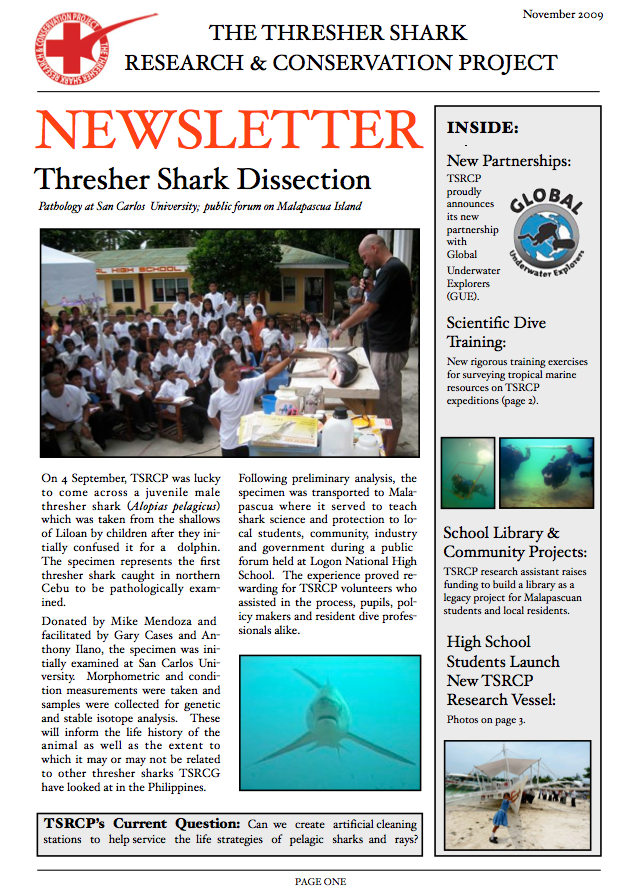
Thresher shark research & conservation project

Of the myriad of shark conservation sites worth visiting, none come better then the Thresher shark research & conservation project.

We have been following this site for the past year and are always happy with the vibrant field updates, images, video and news.

This months newsletter is a must read.

Consider taking the time to get to know the team behind the Thresher shark research & conservation project.

Shark conservation efforts are hard enough to get traction with, in places like the Philippines doubly so.

It's takes determination, good outreach, and a serious research program to make a difference.

Sunday, September 21, 2008

Sharkprotect.com-Jupp Kerckerinck

Jupp Kerckerinck-you probably do not know the name but you should get to know the website www.sharkprotect.com

Outside a few well funded NGO's and commercial shark diving operations few people have the time, energy and finances, to put into web projects that raise awareness and push for shark conservation. This is what makes Shark Protect so extraordinary. We'll let Jupp explain how he came to create a world class shark conservation site and how he is now rapidly becoming a recognized name in the shark conservation field (click links for video)

All it takes is a little time, dedication and a serious love of sharks:

My fascination with sharks began in November 2003, when my daughter Philipa and I went on a shark dive at Isla Guadalupe in the Pacific, with Sharkdiver.com. We were cage diving with Great White Sharks and it was so amazing to see those majestic animals swim very close by. We were together with the Mexican Scientist Dr. Felipe Galvan Magana, who wanted to take DNA samples of Great Whites. Philipa and I offered to help, and together we got 4 samples of the 9 Great Whites we saw. It was awesome and exciting. The sharks were not aggressive, even though we had to scrape off some skin samples for the DNA. When I came home, I tried to read as many books about sharks as I could find and I even started to write one myself, which you can find under Shark Dictionary.

Editors Note: The rest is history. We have a saying here at U.T "One blog, one website, one person at a time".