We have been covering what is now the world's largest oil spill. Ten weeks into the disaster a "blazing middle finger" erupted in the Timor Sea this week as the actual drilling platform caught on fire. No crews were on board at the time and no one from PTTEP the company responsible for the platform knows how it started.
The ongoing disaster is being curiously under reported by main stream media. Estimates of 400 barrels of oil being spilled each day are coming from the oil company and not independent agencies who estimate many more barrels are gushing from this once productive well head many kilometers under the sea bed.
Oil Disaster Week Ten Numbers
70 - Number of days the Montera Oil Platform spill has been sending oil into the Timor Sea.
74,000 - Number of kilometers the spill now covers (the size of Liberia).
11, 760,000 - Estimated number of gallons of crude oil spilled off the coast of Australia.

The shark diving industry blog covering sharks, shark cage diving, shark conservation and things we find "amusing" since 2008 www.sharkdiver.com, www.sharkdivers.com, www.divingwithsharks.com
Showing posts with label deep water. Show all posts
Showing posts with label deep water. Show all posts
Monday, November 2, 2009


Tuesday, October 27, 2009
Thresher shark research & conservation project
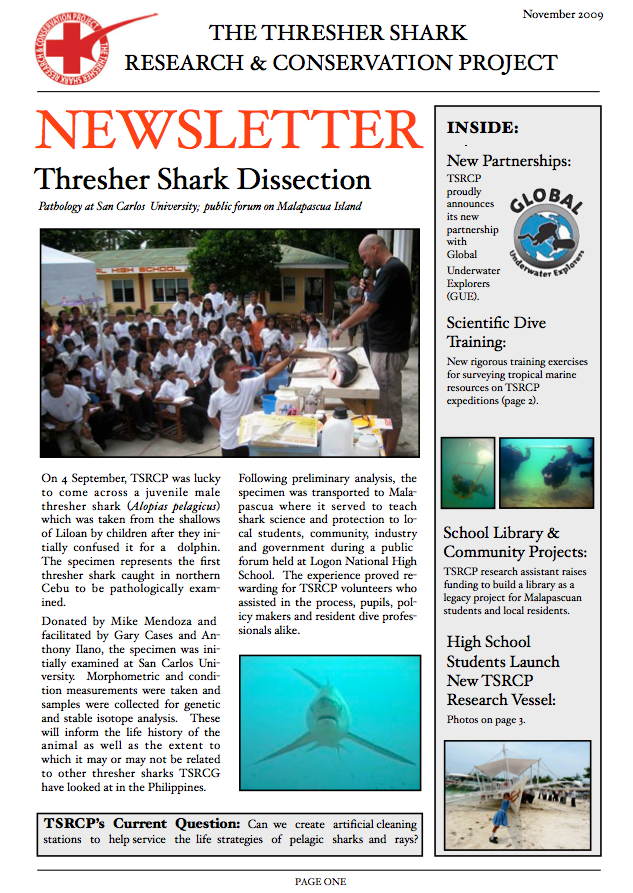 Of the myriad of shark conservation sites worth visiting, none come better then the Thresher shark research & conservation project.
We have been following this site for the past year and are always happy with the vibrant field updates, images, video and news.
This months newsletter is a must read.
Consider taking the time to get to know the team behind the Thresher shark research & conservation project.
Shark conservation efforts are hard enough to get traction with, in places like the Philippines doubly so.
It's takes determination, good outreach, and a serious research program to make a difference.
Thursday, December 4, 2008
Giant Squid vs ROV 0-1
Huzzah! More Giant Squid news this week. Well, unless the ROV in this video is 60 feet across, perhaps not a Giant Squid but squiddy video news none the less...and we'll take it.
A huge squid was caught on underwater camera attacking a ROV at around 1650 ft water depth in the Gulf of Mexico. The ROV hydraulic arm made an attempt to nudge the squid away but it held on firmly to its target until it gave up and left:
A huge squid was caught on underwater camera attacking a ROV at around 1650 ft water depth in the Gulf of Mexico. The ROV hydraulic arm made an attempt to nudge the squid away but it held on firmly to its target until it gave up and left:
Monday, May 5, 2008
Shark Diving-New Website for Six-Gills
 If you were not at the Northwest Dive Travel Expo last weekend you missed one of the most exciting dive operations to hit the West Coast in the past 5 years.
Hydrus has pioneered Six-Gill caged shark feeding encounters in the waters off of the Pacific Northwest. Thus far Team Hydrus has played host to many of the old timers in the film and dive industry who are always first to "sniff out" the next big thing. Howard Hall and company to mention some names.
"We were the first team in history to successfully attract and dive with Six Gill Sharks in shallow water while the animals were feeding. Over a 5-year period we created a one-of-a-kind program to attract Six Gill sharks. During those years we documented animal behavior never seen before by scientists, started documenting the behavior of individual animals, designed and build many custom pieces of equipment to enhance the observation experience, and conducted a “proof of concept” event at the Seattle Aquarium, which helped them start their Six Gill Shark research program."
Dust off those camera housings and seal up that dry suit...it's Six-Gill time!
Thursday, May 1, 2008
Deep Water Sharks-NOAA
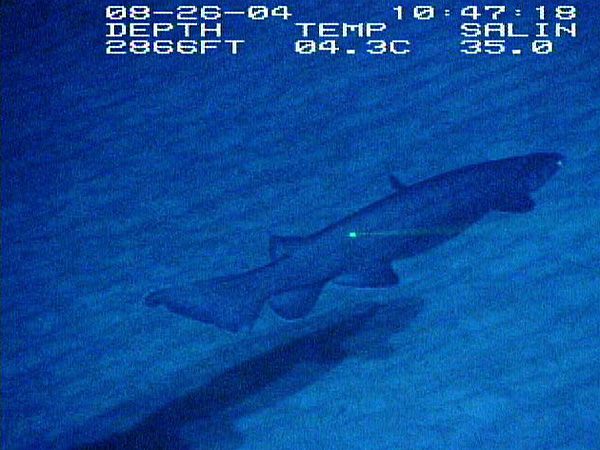 Back in 2004 researchers with NOAA shot this ungainly looking critter around 3000 feet deep.
They think it is a new shark species and is close to 22 feet long. Yes, that is a green laser being used to gauge the size of the animal and the distance from the submarine.
What's fascinating about this fellow is the tail set up-which is completely unlike anything seen previously-even with deep water shark species.
Unfortunately they have not seen another one like this in the past 4 years of deep water exploring. Unlike the Blunt Nosed Six Gill which seems to be everywhere. Some deep water sharks seem to be as rare as some of their top water cousins.
Wednesday, April 30, 2008
Giant Squids-Cool New Research
 And you thought we would never get around to blogging about the Giant Squid again.
The AP reports today that researchers in New Zealand, home to perhaps more giant squids than any other place on the planet (betcha didn't know that) have concluded that their critters have the largest eyes of any animal on the planet.
Take that Mr. Blue Whale.
WELLINGTON, New Zealand (AP) — Marine scientists studying the carcass of a rare colossal squid said Wednesday they had measured its eye at about 11 inches across — bigger than a dinner plate — making it the largest animal eye on Earth.
One of the squid's two eyes, with a lens as big as an orange, was found intact as the scientists examined the creature while it was slowly defrosted at New Zealand's national museum, Te Papa Tongarewa. It has been preserved there since being caught in the Ross Sea off Antarctica's northern coast last year.
"This is the only intact eye (of a colossal squid) that's ever been found. It's spectacular," said Auckland University of Technology squid specialist Kat Bolstad, one of a team of international scientists brought in to examine the creature.
Saturday, April 26, 2008
Strange Sharks-Photoshop? No Way!
 We get quite a few emails from blog readers each week. Some with images like this one, others with offers for cheap V!@gara delivered to your door.
This particular image was sent in from Sarah who lives in the U.K-wanting us to identify this unlikely looking critter.
At first we said "Unicorn Shark?"
Then it occurred that this critter had to be a deep water species, and if there's anything we know about deep water sharks (we know a fair bit) anything is likely down there.
Here's what we found out about this shark:
Almost nothing except about 300 posts, arguments, half stories, wild rumors and the like. Seems this critter has generated a lot of talk and is perhaps from Japan.
Whatever this critter is, we hope it gets to be about 20 feet long and shows up on our chum line one of these days. If that happens we'll probably need a handful of that cheap V!@gara.
Friday, February 22, 2008
Aliens at the Gate?
 The Earth is mostly covered by oceans, we're a blue planet.
For a shark diving company with a cool blog this pretty much gives us an unlimited supply of items to cover, like, for example this latest weird news coming out of NOAA.
NOAA has a series of deepwater microphones listening for any underwater sounds they can hear. These listening stations have recently heard "strange noises" in our oceans.
But don't take our word for it, click this link and have a listen yourself. We're not even going to try a speculate what this sound might be...O.K, maybe aliens?
Saturday, February 16, 2008
India's Cage Diving Industry DOA
 India, the planets fastest growing population and economy has reached a crises point with rampant, unregulated shark finning off it's shores.
As reported by the Daily Star "At least 50 shark processing centres have sprung up along the South Western Coast, employing over 2000 fishermen".
Once again sharks are being harvested for the ballooning fin market and the home cure market which more often than not is driven by hear-say and bogus science. Anyone remember the anti-cancer shark pill craze of the 80's-90's?
We are officially declaring India's cage diving industry DOA. If the global shark slaughter is not halted soon, by 2040 even finding sharks in any ocean will be a rare event. The only way to stop this slaughter is to show local populations another use for these magnificent animals and eco-tourism, so far, seems to be a leading contender.
Wednesday, February 13, 2008
Lava Lamps For Scuba Divers
You had to know this was coming. For all you desk bound scuba fans who would rather be out in the deep blue playing with all manner of big toothy sea critters, here is the ultimate Lava Lamp.
At $169 it gets you where you want to be...at least for 15 minutes. While the promotional video below will put you to sleep, we still think this is pretty cool, and hey, it's a hit in Japan!
O.K, cube dweller, back to $$work$$!
At $169 it gets you where you want to be...at least for 15 minutes. While the promotional video below will put you to sleep, we still think this is pretty cool, and hey, it's a hit in Japan!
O.K, cube dweller, back to $$work$$!
Monday, February 11, 2008
Karl Stanley Goes Big Time

Karl Stanley, owner of the private deepwater submarine in Honduras sent us a link to a new reality movie he's just completed. We have a feeling it's going to be a very popular movie. Before you watch this let us explain Karl to you.
He can be summed up in three words:
1. Genius
2. Real
3. Adventurer
In the end this is what life is all about. One man, one submarine, and a whole undersea world that no one has ever seen before. Think of him as the Columbus of his time...with a crazy sense of humor:
Wednesday, February 6, 2008
Killer Whales+Kayaks=Astounding Video
You gotta hand it to the kayak guy in this next video. Not sure if we would have the right "metal state" to wave to the crowd after getting smashed and rolled by 4 tons of frisky whale. Then again this could just be a Korean commercial with great CGI:
Saturday, February 2, 2008
Cool Great White Shark Video
 We love John West Tuna commercials. O.k, so the actual tuna is pretty basic, comes in a can, and tastes like...tuna.
But their commercials continue to set the bar for shark cool. First we had the guy inside the Mako, then the crazy Alaskan Bear. Here's the latest installment with a focus on what else? South Africa's-Flying Sharks.
In case you were wondering, there's really no tuna in the world that will make Great Whites sit up and act like this. If there was-the crew here at Shark Diver would have bought into this company a looong time ago!
Friday, February 1, 2008
Protecting Great White Sharks
 Baja California, January, 2008 – Isla Guadalupe, Mexico has become the internationally recognized destination for divers seeking unprecedented encounters with Great White sharks (Carcharodon carcharias.) The 90 square mile island located in the Pacific is also home to many rare endemic species of animals and plants.
In 2005 Mexico declared the island a Bio-Sphere Reserve under the watchful eye of CONANP the Comisión Nacional de Áreas Naturales Protegidas.
As is the case with many watch dog and eco enforcement organizations world wide, long term funding for actual on site protections of this resource and the Great Whites that seasonally inhabit these pristine waters do not exist at this time.
Globally, shark aggregation sites like Isla Guadalupe have been decimated in the past few years by poaching, over fishing, and an uncontrolled trade in shark fins that takes an estimated 70 million sharks a year.Recently a concerned group of shark diving operators, vessel owners and researchers stepped in to create and launch the Guadalupe Fund 501(c)3.
Its stated goal is to move much needed cash and donated equipment into the Bio-Sphere for park staff and continued funding for long term white shark science/monitoring.
Nicole Nasby Lucas from the Marine Conservation Science Institute has been involved in ongoing white shark tagging and photo identification research at this site for the past six years. "Our tagging and photo-ID research have shown that the Guadalupe Island white sharks aggregate here in large numbers during the fall and winter, leave the island and travel as far as Hawaii and then come back to the same spot. This makes Guadalupe Island a critical habitat for the white shark in this region and demonstrates the importance of protecting the island and its sharks”.The Guadalupe Fund is being managed by Marinebio.org with assistance from shark diving operator SharkDiver.Com and hopes to generate a minimum of $100,000 a year from concerned divers and shark lover’s world wide. All donations to this fund are tax deductible and gifts ranging from free trips to the island and the opportunity to name a Great White shark after donors exist for interested parties:
Friday, January 25, 2008
TED: If You Don't Know You Should
We know deepwater adventures like few others out there. When it comes to deepwater exploration legends like David Gallo and his talk about Celaphopods-who doesn't have 3 minutes to watch this:
Subscribe to:
Posts (Atom)