Showing posts with label eco news sharks. Show all posts

Thursday, January 19, 2012

Mercury bioaccumulation in elasmobranchs? Study

Conservation sources have been waging a war on shark products for the past five years saying that shark fins and meat for human consumption are loaded with mercury. Here's another first rate study that backs those assertions up.


 Nicholas Kutil and David L. Taylor.

ABSTRACT:

Mercury (Hg) is a toxic environmental contaminant that bioaccumulates in fish tissues,
including numerous marine species. Cartilaginous fish of the subclass Elasmobranchii are important ecological constituents of marine ecosystems, yet the fate of Hg contaminants in their body tissues is largely unknown.

In this study, four species of elasmobranchs: little skate (Raja erinacea), winter skate (R. ocellata), smooth dogfish (Mustelus canis), and spiny dogfish (Squalus acanthias), were collected from the Rhode Island/Block Island Sound, and the Hg content (ppm wet wt) of white muscle tissue was analyzed using automated combustion atomic absorption spectrometry. Diet and feeding habits for each species were also assessed by stomach content and stable nitrogen (δ15N) and carbon (δ13C)
isotope analyses. Mean Hg concentrations differed significantly among species, with highest
levels measured in smooth dogfish (mean Hg = 0.680 ± 0.107 ppm, n = 15), followed by
spiny dogfish (mean Hg = 0.312 ± 0.034 ppm, n = 44) and skates (mean Hg = 0.110 ± 0.008
ppm, n = 78 and 0.069 ± 0.005 ppm, n = 56 for little and winter skate, respectively). The Hg
concentration of skate muscle tissue did not vary by body weight, suggesting that Hg does
not bioaccumulate in these species.

Conversely, smooth and spiny dogfish bothbioaccumulate Hg with respect to body size, although smooth dogfish have a higher Hgcontent relative to spiny dogfish. The elevated Hg concentration of smooth dogfish may beexplained by their higher trophic level status, as determined from δ15N signatures (meanδ15N = 13.29 ± 0.88, 11.82 ± 0.60, 12.33 ± 0.65, and 12.12 ± 1.06 for smooth dogfish, spiny dogfish, little skate, and winter skate, respectively). The enriched δ13C values of skates and smooth dogfish indicated benthic foraging (range of mean δ13C = -16.39 ± 0.32 to -17.42 ±0.46), which was further confirmed by the dominance of decapods and crustaceans in the
stomach contents. Conversely, squid and butterfish were the principal prey of spiny
dogfish, and the contribution of these pelagic prey was reflected in the depleted δ13C
signature (mean δ13C = -21.97 ± 0.83). Future work includes researching the effect habitat
use and prey Hg to better understand bioaccumulation patterns in these species.


Presentation at the 2012 Winter Meeting of the Southern New England Chapter (SNEC).

January 26, 2012

University of Rhode Island
SOURCE and PDF-DOWNLOAD

Tuesday, December 7, 2010

Conservation Video Done Right

Hat Tip to Mark and to Mike for passing this first rate video around. Opening eyes and changing perceptions is what this latest video is all about.

If there was an award for this kind of front line reporting and presentation fact, the team behind this video would get it. Perhaps we should start with something like this?

Sit back and ab-sorb this, once you're done we defy you not to want to "grab a flight to join the fight".


Friday, April 30, 2010

Americas Greatest Ecological Disaster - Oil Spill

What happened in Alaska in 1989 was once termed "Americas Greatest Ecological Disaster."

For Exxon the remote locale of Prince William Sound and low population base made this oil spill a "parachute journalism" affair.

For BP, 30-6000 barrels a day gushing into the Gulf, one of the most highly populated regions in the USA, media coverage will be nothing short of 24/7.

Add to the fact we are going into the summer season of re-run programming and what you have is the perfect media storm.

The Gulf is essentially a bowl, to get the best understanding of what is about to happen to the region over the summer pour 10 quarts of oil into your average Olympic swimming pool. At best it will be three months to drill a relief well in the region and even then there's no assurances that the oil will stop.

That's 2-6 million barrels of oil in the Gulf by the time the oil stops gushing in three months.

We covered a similar spill last fall by the numbers. The final number of spilled barrels will never be known in the East Timor Sea but one thing is for certain, media coverage in the Gulf will be intense and unflinching.

America's finest conservation moment and ongoing challenge is about to happen.

Let's consider putting aside other conservation efforts and instead turn our focus on the Gulf.

Once in a great lifetime conservation is called upon to act as one, to respond as one, and to rise to great challenges that transcend local and regional efforts.

This is that moment, and this is that challenge. Where will you be?

Monday, February 1, 2010

Shark Legacy Project - Honduras 100% Shark Fishing Ban Enacted

They say big things come in small packages. In the shark world nothing is bigger then governments who enact bans on shark fishing in their waters.

Palau's recent shark fishing ban and the Maldives decision to ban shark fishing in their waters was met with acclaim both in the tourism and shark conservation worlds.

As it turns out other governments were watching, and taking note.

Thanks in part to the Shark Legacy Project headed up by a small and dedicated team in Roatan, Honduras the government just announced they will ban all shark fishing in Honduran waters while they study the issue of shark fishing and the economics of Honduran sharks which, for a Latin American country, is a simply stunning decision.

The next steps will require resources and help from the shark tourism industry and from the research side as well to make this ban a permanent and regional example.

From Peter Wilcox Director of the Shark Legacy Project:

"Thanks Patric - have a major victory down here. After our meetings with DIGIPESCA they pushed up the passing of a bill that has now gone into practice. It puts a moratorium on the fishing of all shark species in all the waters of Honduras! Think that makes Honduras the first in the Caribbean to have a shark sanctuary! Part of the drive behind this measure was to cease use of sharks as a resource until research can be done to evaluate the population/species of sharks here. So finally, a government willing to step in before the problem gets unmanageable. We met with the government this last weekend to discuss how we can assist in this research (as you may be able to guess they do not have much in the way of funding for their own research). We are travelling to Tegucigalpa this week to discuss further research and affiliations to benefit the goals of protecting sharks here."

We would Like to congratulate the Shark Legacy Project and all those who have worked to this point to get the ban in place.

This is very good conservation news indeed.

Saturday, January 30, 2010

Ocean Dancer Supports Maldives Shark Research - Smart

Ocean Dancer is 110' of pure luxury and is a labour of love for French owner/operator, David Mesnard who has lived in the Maldives since 1990.

David is a highly regarded Free-diving and Scuba Dive Instructor and also a keen surfer. In his time in the Maldives he has witnessed dramatic changes to the marine environment. Changes that made him realise he needed to do something to help the oceans flourish again.

The MWSRP team first met David and Gaëlle at South Ari Atoll, in December 2008 when they ended up in the water together on what the research team thought to be a whale shark.

A large dark fin had breached the surface amongst a few tourists close by, so the MWSRP sent two team members in to take the ID photographs required to log the encounter. As the guys approached the ‘shark' they were not greeted by the usual large dark shape emerging from the plankton rich water. Instead, David, on scuba gear, was cruising around at around 5 metres, holding a fin he had carved from wood and painted black. The ocean loving French man then surfaced, removed his regulator and took great pleasure in his fooling of the ‘whale shark researchers'.

Ocean Dancer has always supported shark conservation programmes. Now they have become the MWSRP's newest sponsor, and the team is ecstatic to have them onboard. David and his wife Gaëlle are true ocean lovers. They, along with expert crew, are the shark friendly tour operator who encourages their guests to enjoy their holiday responsibly.

For more information about Ocean Dancer please visit here.

Thursday, January 21, 2010

Hammers in Love?

Swim at Your Own Risk blog got the scoop from Perth yesterday featuring a video shot from the air of Hammerheads schooling off the coast.

Local experts think this is high seas shark love in action.

We'll let you decide.

Video Here.

Wednesday, January 13, 2010

Shark Research in Action - Bahamas

Kristine Stump, the current Principal Investigator at the Bimini Biological Field Station, describes the research she is conducting as a part of her PhD studies.

Kristine's doctorate thesis investigates the effects of habitat loss on the juvenile lemon sharks that use Bimini as their primary nursery.

Bimini's mangrove lagoons function as critical habitat for a wealth of wildlife, from seahorses and snappers to stingrays and sharks. Kristine's study aims to quantify the impact that removing these mangrove nurseries will have on Bimini's lemon shark population, and the wider ecosystem as a whole.

Friday, January 8, 2010

Senior Associate, Global Shark Conservation - Job Opening

Senior Associate, Global Shark Conservation

The Organization


The Pew Charitable Trusts is driven by the power of knowledge to solve today’s most challenging problems. Pew applies a rigorous, analytical approach to improving public policy, informing the public and stimulating civic life. Based in Philadelphia, with offices in Washington, D.C., and Brussels, Pew produces fact-based research and develops practical solutions to challenging issues.

We are an independent nonprofit organization--the sole beneficiary of seven individual charitable funds, with assets of $5.2 billion at the end of June 2008, established between 1948 and 1979 by two sons and two daughters of Sun Oil Company founder Joseph N. Pew and his wife, Mary Anderson Pew.

Pew provides an exciting learning environment and the opportunity to work with highly talented individuals. It is a dynamic organization that values creativity and innovative thinking and fosters strong teamwork with mutual respect.


The Pew Environment Group


The mission of the Pew Environment Group is to promote policies and practices that protect the global atmosphere, preserve large intact wilderness ecosystems and conserve living marine resources.


For the past two decades, the Environment group has been a major force in driving conservation policy in the United States, and increasingly internationally. The group’s work is focused on reducing the scope and severity of three major global environmental problems:

  • Dramatic changes to the Earth’s climate brought about by the increasing concentration of greenhouse gases in the planet’s atmosphere;
  • The erosion of large wilderness ecosystems that contain a great part of the world’s remaining biodiversity; and,
  • The destruction of the world’s ocean environment, with a particular emphasis on marine fisheries.

Global Shark Conservation


Sharks roamed the seas for nearly 200 million years before dinosaurs were on the planet. However, due to the onset of industrialized fisheries in the last fifty years, many populations of large sharks have declined globally by approximately 90 percent. The world's increasing demand for shark fins, used for the Asian delicacy shark fin soup as well as other products, is killing up to 73 million sharks a year—a rate that is highly unsustainable. Sharks are highly vulnerable to overfishing, as they are generally slow-growing and reproduce late in life with few offspring. As a result, entire shark populations may disappear within our lifetime.

The Global Shark Conservation is designed to reverse this decline of shark populations through public education, advocacy and research. With overlapping jurisdictions over shark fisheries, the campaign will work within both international governance bodies (such as regional fisheries management organizations and the United Nations) and treaty organizations such as the Convention on International Trade in Endangered Species to secure precautionary, science-based protections for sharks. Domestically, the campaign will work to secure stronger shark management within the U.S. as well as in other coastal nations that still have large populations of sharks left in their territorial waters.


Position Overview


The campaign senior associate will work with the director of the Global Shark Conservation to provide the information and assistance necessary to design and carry out the campaign strategy. The Global Shark Conservation is designed as a two-year effort which begins April 1, 2009 and will run through March 31, 2011. The position may be renewed, pending its progress and the availability of continued financial support. This position will report to the project director and is based in Washington, D.C.


Responsibilities:
  • Assist the project director and other campaign staff in developing and implementing campaign strategy.
  • Work with the Manager of the shark campaign to develop and execute outreach events with coalition members internationally and domestically to educate and influence policy makers.
  • Manage special outreach projects for the campaign that raise public, media and policymaker awareness of the need for shark conservation. These projects could include managing video projects, working with film and television producers to secure “calls to action” in nature programming, or arranging speaking engagements for the campaign with target audiences.
  • Work with PCT and PEG communications to develop and implement a strategy for new media outreach.
  • Assist in developing public, policymaker, and media outreach strategies for the campaign in target regions of the world, such as in Asia, Latin America, or the Pacific.
  • Create compelling materials for the campaign, including website content, fact sheets, coalition letters, etc.
  • Research and write campaign materials, such as reports, booklets, fact sheets and web content.
  • Represent the campaign at meetings and on conference calls within Pew, with partner groups, federal agencies, and Congress.
  • Maintain knowledge of shark management activities worldwide.

Requirements:
  • Four to 8 years of experience in environmental and public policy required. An advanced degree or equivalent experience is required. Expertise in marine issues are strongly preferred.
  • Able to set short- and long-term planning goals in line with program strategy. A task-oriented style, with focus on achieving clear and ambitious goals. Demonstrated ability to meet multiple deadlines by maintaining a high level of organization. Able to develop and move projects forward with a high degree of independence and autonomy.
  • Excellent written and oral communications skills, including an ease in communicating complex concepts in a clear effective manner for a general audience.
  • A detail and results-oriented style with a focus on process and achievement. Recognized ability to meet multiple deadlines by maintaining a high level of organization.
  • Demonstrated strong analytical skills, including an ability to synthesize large amounts of information and to focus quickly on the essence of an issue. A strong commitment to producing measurable results.
  • Strong interpersonal skills, including the ability to develop and manage productive relationships with consultants, partners, grantees and others who contribute to the effectiveness of the project.
  • Able to establish credibility quickly and to develop and maintain effective working relationships with internal and external parties, including grantees.
  • Experience with media and other communications strategies to deliver policy recommendations and/or scientific findings to policy makers and the public desired.
  • Fluency in other languages a plus.
  • Knowledge of shark conservation issues a plus.

Some travel for this position may be required, including attending international meetings impacting shark conservation, as needed, and/or visiting campaign consultants working around the world on domestic shark conservation measures.


Application for job here.


Monday, December 28, 2009

Australia's Tiger Shark Disaster

Tony Ham is happy about it. Vik Hislop is happy about it, and even Queensland Tourism is happy about it.

For Australia when 11 Tigers are killed by nets and drumlines along the Sunshine Coast the media calls it a good thing.

We have long pointed out that nets and drum lines are a 1950's answer to a modern issue of shark conservation.

4 meter Tigers represent breeding populations and their deaths are no cause for celebration.

The only thing in the way of lasting conservation change with drum lines and nets is the will power of local and regional users to demand it.

We know sharks are being taken by these man made, indiscriminate killers, but what is being done about it?

We'll be the first to support any program that offers regional metrics for success and not just the usual rounds of blog posts and Facebook petitions. As far as shark conservation goes there's little time for "awareness" we have now moved into the "decade of action."

Surely there has to be someone on the Sunshine Coast that would like to see an end to the glorification of regional and unnecessary shark slaughters?

Tuesday, December 1, 2009

Whale Sharks - The Nigaloo Papers

In depth industry papers on shark tourism are a must read.The Ningaloo Coast region of Western Australia has been a mainstay for sustainable whale shark tourism for the past decade. A new paper is now out.

Tourism Abstract

Whale shark tourism is an icon industry in Western Australia and a prominent example of successful ecotourism. In 2006, whale shark tour participants spent $6.0 million in the Ningaloo Coast region of Western Australia and added between $2.4 million and $4.6 million to the regional economy in direct expenditure. However, to date no research has been conducted on the predictors of whale shark tour participants' expenditure. In this article, we assess the importance of visitor expenditure for ecotourism, assess the predictors of the expenditure of whale shark tour participants and discuss how this information can contribute towards ecotourism goals. The data analysed here were collected through a survey distributed to participants between April and June 2006.

We assess a range of variables for their relationship to individual expenditure per trip and determine that the duration of stay, household income, age, staying in a hotel, trip motivation and being from North America or Southeast Asia positively correlate with individual expenditure per trip. Group size and originating from Germany or the United Kingdom and Ireland negatively correlate with expenditure. In addition to identifying future steps, we also discuss the relevance of our finding that more motivated participants have a higher expenditure for ecotourism.

Link to report.

Bull Shark Diving in Cuba - Report

From the always interesting Team Sharkbait Blog, comes a quick report from Cuba and bull shark diving adventures in Santa Lucia.

Blog readers here at UT will recognise the name and this site from several of our posts involving the cardinal rule of bull shark encounters...never wear a Speedo.

In fact Speedos are just not considered official shark diving gear at all -anywhere.

Fortunately since 2004 the Santa Lucia bull shark site has matured and Team Sharkbite had a great time:

"One of the most breath taking moments we had in the holiday was the opportunity to go scuba diving with bull-sharks. As we were down 25 meters below the surface at a location called La Boca, it was a marvel to look at the bull sharks being hand fed by the diving master. Of course it’s even better to have seen them in their natural environment, without the help of a human touch… But I think wikipedia also describes the bull sharks as dangerous to humans, so for me this was more than a good chance to see them really close. When I write really close I’m talking about within arm’s reach, but I think ‘don’t touch’ had the upper hand in my mind."

Complete Post.

Thursday, November 5, 2009

Tagging Disaster at Farallons - Foul Hooked Media

For the past few days we have been receiving an ongoing series of emails and phone calls from a variety of sources concerning an invasive SPOT tagging effort at the Farallon islands.

There was an apparent "tagging accident" this week covered in graphic detail by Bohemian Magazine.

SPOT tagging is a white hot issue within both the commercial shark diving community and shark research community. The SPOT tagging technique employs crews to catch white sharks with large hooks and to drill tracking tags into their dorsal fins.

A person identified as "Chris Fischer, owner Mothership Ocean, Expedition Leader," has been refuting and then negating the seriousness of the alleged tagging accident by responding to question asked of him by posters at this blog:

"On the anchor at the Islands now. Happy to report in that the first shark has pinged in 4 times and seems to be doing well. The second shark has also pinged in. Both are still in the area."

"We hooked two sharks this week. We were concerned about the first shark because the hook was a little deep. It was in the back of it's mouth, not gut hooked. We were able to cut the hook in half so it could roll out backwards, and left a part of it in the shark."

The Making Of Media Disasters

This is a classic example of a media disaster in the making for the tagging team at the Farallons and one that could be addressed by getting ahead of the negative and extremely graphic media that is surfacing around this incident.

Two issues need to be addressed immediately.

1. The full extent of the tagging mishap. Images, video, and a full accounting of this event as it transpired with nothing held back.

2. The role film and television productions had in this event if any.

The event was witnessed, photographed, and video taped by multiple sources so it cannot be hidden or downplayed. At stake is the reputation of a well known shark researcher and National Geographic television show about this teams tagging work set to air Nov 16, 9pm Est/Pacific.

The tagged shark is said to be "doing well" by this team. With the abject lack of transparency about the mishap to date we're now asking for "proof of life" to be added to the media list with the inclusion of a recent tracking map of all animals tagged including the first one.

This data should be independently verified by resident shark researchers from TOPP.

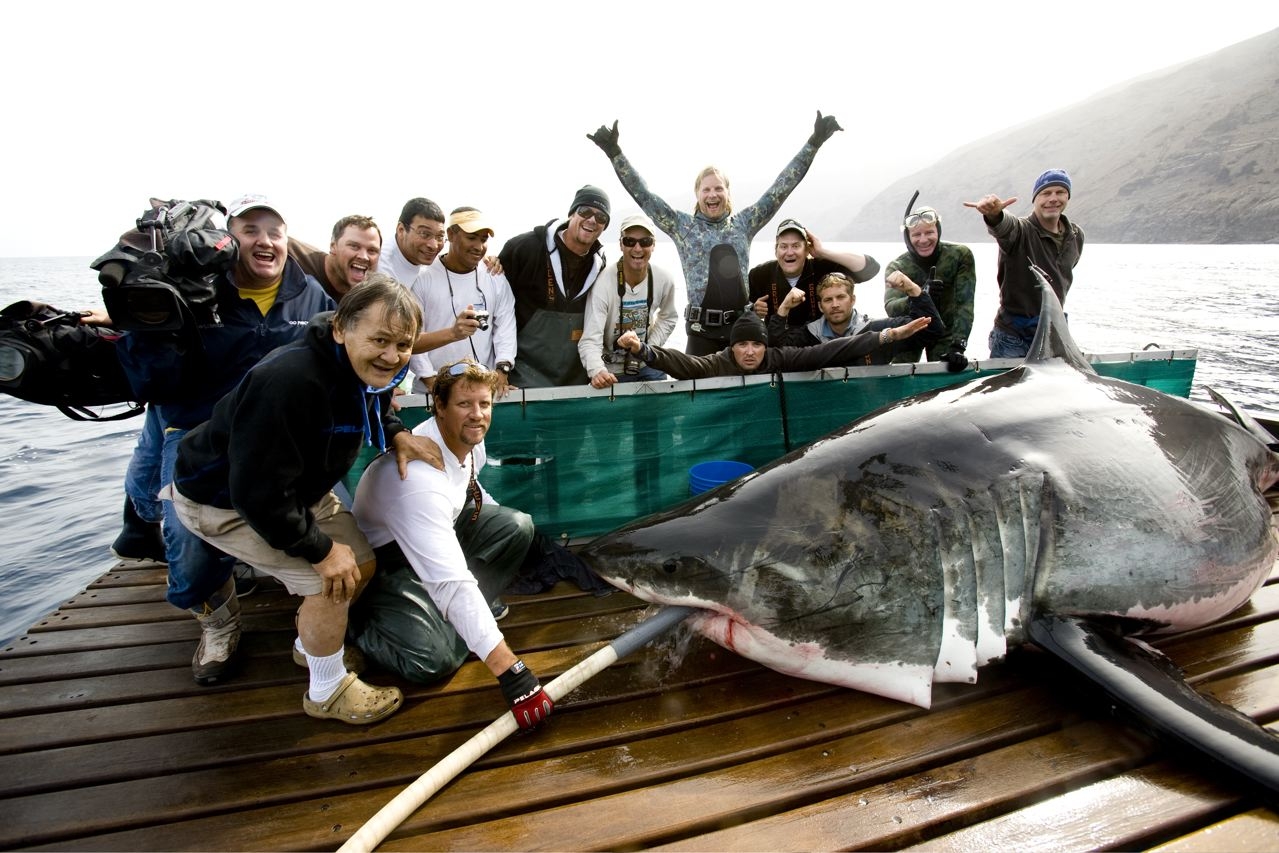
In a moment of media foresight this week we pointed to the unprofessional image of this group "high fiving and smiling" around a grounded shark at Isla Guadalupe and suggested "in the end these images will dog your continuing efforts for years to come."

Shark researchers have as much responsibility for media handling as any group that interacts with charismatic mega fauna and in the case of the team at the Farallons doubly so. We're not the only ones to point this out see also Mark Harding has a point.

Media transparency surrounding this event is critical for the sake of continued research with white sharks and for the public perception of invasive techniques for animal science.

Sunday, November 1, 2009

Mossel Bay Shark Death - New Twist

It would seem there's a new twist in the widely reported story of a "Monster Shark" that was accidentally caught in Mossel Bay, South Africa.

Turns out the shark was caught some 1600 kilometers away from the Mossel Bay location and "trucked in" for a film crews shoot, contrary to multiple mainstream news reports and emails floating around the Internet.

Thanks to writer Martin Hatchuel who wrote us this week to offer the straight story. Martin is a travel writer for Mossel Bay tourism.

Media Release. Immediate. 28 October 2009.

Scientist Dissects KwaZulu-NatalShark in Mossel Bay.

Mossel Bay’s Oceans Research Laboratory last week dissected a massive great white shark which had been trucked into the town from KwaZulu-Natal, where it had drowned after being caught in shark nets.The animal was supplied by the Natal Sharks Board.

“The rumour mill has been working overtime, but the truth is that the shark was brought here so that the dissection could be filmed for a National Geographic television programme called ‘Inside Nature’s Giants’,” said Mossel Bay Tourism’s Marcia Holm.“The series will be shown on both National Geographic and on ’s Channel 4, and features experts from all over the world who trace each animal’s evolutionary history by exploring its internal anatomy.”

According to David Dugan, chairman of Windfall Films, the producers of the series, “When the [first part of] the series aired in the UK, it received universal acclaim in the press and it is now being nominated for many major awards.“A team of researchers and production personnel flew in from New York, London,Durban and to assist scientist Enrico Gennnari, who performed the dissection as part of the requirements for his PhD degree,” said Ms. Holm.

“There are people who want to be frightened by this poor creature, but it really is worth remembering that he was dead by the time he arrived in Mossel Bay,” she said.Mossel Bay has featured in a previous National Geographic production - called ‘Sharkville’ - which showed how, in fact, man and the sharks really do live side by side.“If anything, we’re more of a threat to them than they are to us.”

Ms. Holm said that the risk of shark attack remained low, and that swimmers, surfers and other recreational users of the oceans could mitigate this even further by looking out for - and avoiding - unusually high concentrations of sea birds and fish in the areas in which they were swimming.

“We don’t catch great whites in Mossel Bay as they are protected by the law,” she said.

Wednesday, May 6, 2009

Tunisian White Sharks?

Try even finding Tunisia on a map. Yet, according to recently a released video here is an unmistakable 12-13 foot male white shark. Thanks to Helmut Nickel for the video discovery:

Friday, May 1, 2009

Tiger Sharks - "Wandering About Like Moses"

A four year study on the movement patterns of Tiger sharks in Hawaii has once again surprised the CW folks - opening a new and better understanding of these remarkable critters.

Shark researcher Carl Meyer, a biologist with the Hawai'i Institute for Marine Biology says these animals are not the territorial hunters once thought. Rather, these animals are pelagic wanderers often traveling great distances to find and ambush prey items. Kinda like those 40 lost years Moses spent wandering around the deserts. Except Moses never brought down a sickly Humpback whale calf. We digress.

Great study and better news coming out of Hawaii where local shark diving operators need data like this to bolster claims about chumming and animal behavior. Now if the folks over there can put this data together.