Showing posts with label shark research. Show all posts

Thursday, April 5, 2018

Bull Shark with Cancer?


Instagram 
There are a lot of misconceptions when people talk about sharks. One of them is the myth that they don't get tumors or cancer. We previously talked about sharks with cancer, here and here, but while those 2 blogs were about a Great White Shark, we also have a Bull Shark in Fiji with a tumor growing out of her mouth. Her name is "Ms Jaws".

DaShark from Beqa Adventure Divers thinks it all started when he first saw her swimming around with a fishing popper stuck to her jaw.

                                     Video ©DaShark Beqa Adventure divers, source

Her jaw got progressively worse. This photo shows the progression of her lesion from 2011-2013.
Photos by Sam Cahir, predapix

When I met "Ms Jaws" for the first time in 2014, her jaw already looked like this.


The next time I saw her was in 2016 and she looked a lot worse. Her jaw was hanging down and it looked like it would be impossible for her to feed successfully.


Aside from her badly broken jaw and tumor, she did seem to be OK though. She didn't look skinny or showed any obvious signs of malnutrition. I have to admit that I was worried about her and didn't have high hopes of her surviving much longer.

                                          video ©Martin Graf www.sharkdiver.com

Now we have some good news! DaShark just reported that "Contrary to my dire prediction, Mrs. Jaws is alive and kicking - and judging from her girth and body shape, she is very capable of feeding herself which is real good news indeed!"

He also posted a video of her swimming around on facebook here and you can read his blog here.

If you are interested in more information on this particular shark's tumor, read this paper by Juerg Brunschwiler from the ETH University in Zuerich.

I really hope that she will continue to do well. She is a remarkable animal.

Of course, if you really want to know how she is doing, join us in May on our expedition to Fiji, where you can look for her on our Bull Shark dives. We have a couple of openings left. Call us at 619.887.4275 or email crew@sharkdiver.com for more information.

Let's go shark diving!

Cheers,
Martin Graf
CEO Shark Diver

About Shark Diver. As a global leader in commercial shark diving and conservation initiatives Shark Diver has spent the past decade engaged for sharks around the world. Our blog highlights all aspects of both of these dynamic and shifting worlds. You can reach us directly at staff@sharkdiver.com.

Sunday, November 26, 2017

Great White Mystery?


Instagram 
In 17 years of diving with the Great White Sharks at Guadalupe Island, we have learned a lot about these awesome creatures. From not knowing where they are heading when they leave the Island, to thinking they are heading to an area offshore to mate, to finding out that we were wrong on that and realizing that they are actually mating at Guadalupe, we have come a long way.


What never ceases to amaze me is the fact that we keep learning new things and that things we thought we knew were actually wrong. Observing them over time has given us some insights into their behavior and how the relate to each other and how their personality changes as they grow. The most important thing I have learned is that just when you definitively think you know something about them, you find out that it may not always be true.

First I have to make a disclaimer. I'm not a marine biologist, so most of what I know about their biology and migration I learned from my friends who are biologists and study these sharks. What I know about their behavior comes from literally thousands of hours spent observing them, both in the water and from above.

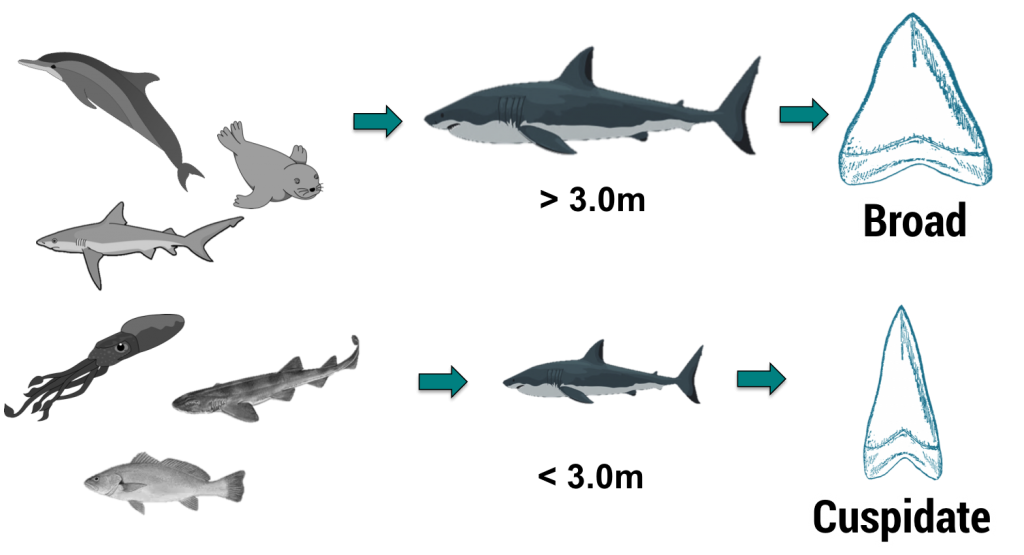
The latest theory that has come into question is how the shape of their teeth changes as they growand the reason for that.

Georgina French, a PhD student at the University of Sussex, published a new study that deals with that theory.

From her paper: Up until now, scientists have accepted that white sharks start out their lives with cuspidate (pointy) teeth, which are thought to be adapted for gripping onto slippery fish. When the sharks hit roughly 3m in length, they’re then thought to develop much broader teeth, which are believed to be adapted for catching and eating marine mammals like seals and dolphins. This shift in diet and tooth shape with age/size is referred to an ontogenetic shift.
 
©Georgina French
Her new discovery seems to be that there is a distinct difference between male and females, something I have never heard before.

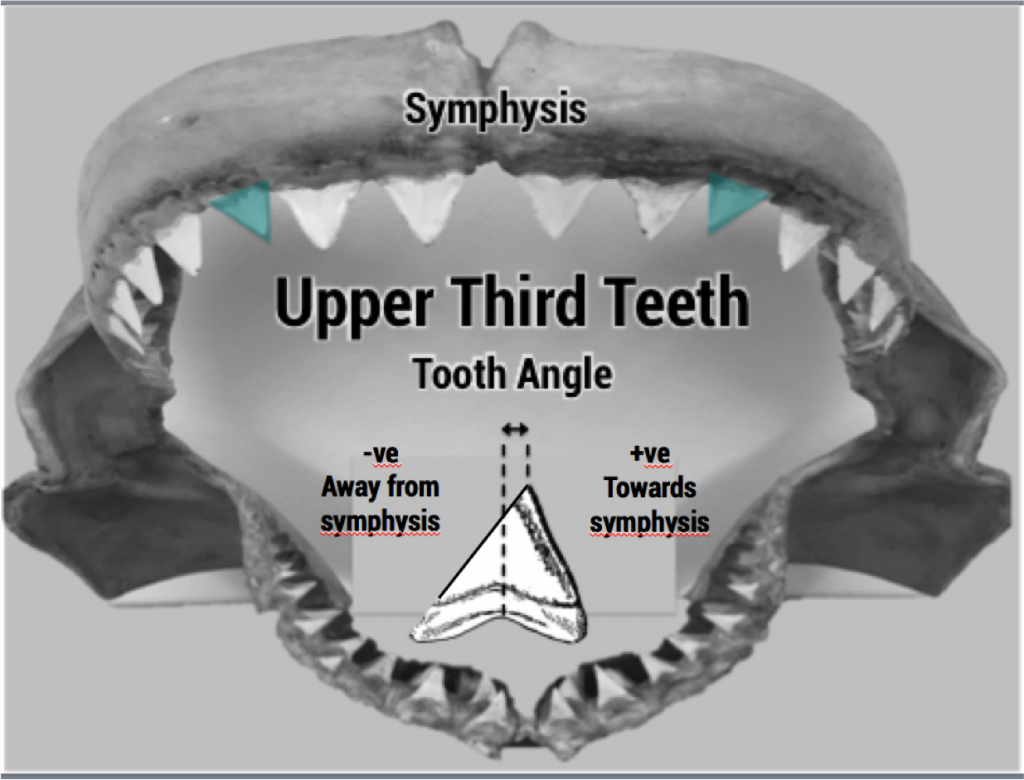
She writes: Previous studies of white shark teeth have always lumped males and females in together, despite the fact that they are quite different in other aspects of their biology and ecology. I decided to explore their tooth shape/shark length relationships separately. When I combined all of the data from the photographs, the literature and the KZN jaws, I found startling differences between the sexes.  While males seem to follow the accepted pattern of broadening teeth when they get to about 3m long, females didn’t. Instead, a female of any size could have either broad, pointed or intermediately shaped teeth. Females also didn’t change the angle of their upper third teeth, while males did.

©Georgina French
As with any new discovery, there are instantly a bunch of new questions. In this case, first and foremost, 

What does this mean?

 Broadly speaking, the results indicate that either males and females are feeding on different things as they grow up, or that the tooth shape change isn’t related to diet.
When sharks mate, males hold onto the females using their teeth. It’s possible that the broadening of the teeth and the change in tooth angle found in males could be an adaptation for mating, rather than for handling different prey. Alternatively, females with broad, pointy and intermediate teeth may be specializing on different types of prey i.e. they are polymorphic. I also found significant variation in the size at which males developed their broad teeth, which combined with other evidence indicates that some individuals mature a lot more quickly than others. Polymorphism and differing rates of maturity among individuals can have pretty big ecological consequences, and these factors need to be taken into account in future studies and white shark management.

This is what I love about working and diving with Great White Sharks. Every question that gets answered opens up a lot more questions. I wonder to what new insights about Great White Sharks this new discovery leads to. Maybe we should call these sharks Great White Mysteries instead.

Let's go shark diving and discover new and exciting things about these awesome animals!

Cheers,
Martin Graf
CEO Shark Diver 

About Shark Diver. As a global leader in commercial shark diving and conservation initiatives Shark Diver has spent the past decade engaged for sharks around the world. Our blog highlights all aspects of both of these dynamic and shifting worlds. You can reach us directly at staff@sharkdiver.com.

Saturday, October 28, 2017

What's eating the brains of sharks and rays in California?


Instagram 
Between February and July, there have been a lot of incidents, where dying or dead sharks and rays have washed up on beaches in San Francisco bay. What is causing them to die?


According to an article in National Geographic, CDFW senior fish pathologist Mark Okihiro, Joseph Derisi, an expert on the genetics of infectious diseases at the University of California, San Francisco and Hanna Retallack, an MD-PhD graduate student have found the answer.

Their headline reads : "Mysterious Brain-Eating Shark Killer Identified, Though Questions Remain"
  
It looks like the culprit is "a well-known fish-killing parasite called Miamiensis avidus."

The article further states: This appears to be the first case, Retallack said, of Miamiensis avidus infecting wild sharks. It’s noteworthy, she added, because sharks are evolutionarily quite different from the bony fish that have previously been known to suffer infections. 

Read the entire article here

Cheers,
Martin Graf
CEO Shark Diver

About Shark Diver. As a global leader in commercial shark diving and conservation initiatives Shark Diver has spent the past decade engaged for sharks around the world. Our blog highlights all aspects of both of these dynamic and shifting worlds. You can reach us directly at staff@sharkdiver.com.

Friday, August 25, 2017

Six new sharks at Guadalupe Island


Instagram 
This season has started out completely different from the last. Where we had lots of juvenile females early last year, this season it has been all males so far. On our last expedition, we saw 30 different Great White Sharks, with 6 of them being first timers.

The Marine Conservation Science Institute marinecsi.org is keeping the photo ID database and you can contact them if you are interested in naming one of these sharks. I don't want to keep referring to them as "Unknown 1" etc. Naming a shark is a great way to support the research and how cool would it be if you see "your" shark on sharkweek?

The only female we have seen so far this season is "Screaming Mimi". She is as active and curious as she was last year and has given our divers many memorable moments.

Aside from all the new sharks, we have also been visited by a lot of our regulars. Bruce, Bite Face, Chugey, Andy, Hunter, Silent Hunter Bolton, Ace, El Diablo, Johnny, Jacques, Mickey, Sad Face, ChumChum, Thor, Atlantis, Drogin, Joker, Monkey, Hooper, Horizon along with a few that are as of now unnamed, have all made an appearance. We had 30 different individuals on our last expedition!

Here are a few of our new sharks.


To sponsor one of these beauties, contact MCSI here.

To join us on one of our expeditions, contact crew@sharkdiver.com or call 619.887.4275

Let's go shark diving!

Cheers,
Martin Graf
CEO Shark Diver

About Shark Diver. As a global leader in commercial shark diving and conservation initiatives Shark Diver has spent the past decade engaged for sharks around the world. Our blog highlights all aspects of both of these dynamic and shifting worlds. You can reach us directly at staff@sharkdiver.com.

Monday, May 4, 2015

Chris Fischer and OCEARCH's feelings are hurt!

Chris Fischer responded to my blog "Celebrities at Guadalupe Island" on our facebook page. Apparently his feelings are hurt, that a blog about celebrities at Guadalupe Island was not about him.

He writes: Chris Fischer Thrilled you are a fan of OCEARCH work. My wife and I personally funded the expedition that tagged Bruce. Amusing how you fail to mention the crew and capacity that created the data you feel is so important. Domeier simply stepped down tagged the shark then got out of the way. The crew did everything else to safely tag and release Bruce! Additionally, you know the sharks are returning now after shedding the tags with their fins healed up doing well yet you continue to let the others bash... We have spoken to the researchers using the 1 bolt method.. they are uncertain how well it's going to work long term as well the increase in bio-fouling from all the different cracks and crevices created by the mount. We have requested Wildlife Computers to try to design a modified mounting system... But as you already know, this is not required as they shed the tags after 5yrs or so and heal up nicely. You should watch Mary Lee on the Global Shark Tracker. She is getting ready to repeat the success we had at Guadalupe Island by documenting the 1st full female mature white shark migration in the N Atlantic. Soon we will know where they are mating/birthing etc... just like out where you profit from cage diving at GI. I figure our work is the best chance you got at being able to own a multi-generational business. Acting like we don't exist is amateurish and rude. We are currently on Expedition off West Australia where we have tagged 20 Tiger Sharks to solve the same puzzle as we did in GI to create a future for sharks here.

Please forgive me Chris, I had no idea that I would hurt your feelings by writing about a celebrity without mentioning you. How rude of me. So since your feelings are hurt by me not mentioning you, let me respond to what you are saying.

1. I don't quite get why you think I'm a fan of OCEARCH

2. Your wife and you financed the expedition that tagged Bruce. I never wrote anything about who financed that expedition, or why that is even relevant, but since you claim you did, let me also state what Dr. Domeier said about that.

From http://fijisharkdiving.blogspot.com/2013/04/fischer-reality-check-comments-by-dr.html
Yes, he paid for 2 trips to Guadalupe, but then struck a TV deal that allowed him to recoup those costs as he was getting $400K/episode. 

We were able to make multiple episodes from a single trip. Furthermore, I tapped two other private foundations to help pay for the tags and research; financial support that he never acknowledges. Fischer was fairly paid for all of the work we did together… this was not a huge philanthropic venture. On the contrary, he made it clear: “no cameras no trips.” The huge $$ figure he throws around must be for the entire operating cost of his ship and production company for each year he was making these television shows. But that’s not a fair way to account for the actual cost of the research (a fraction of the yearly operating budgets were due to the handful of research trips)… and he never discusses the INCOME. Any real accountant would tally just the costs of the specific trips… or think like this: what would it cost to charter a vessel for each research trip, and then subtract the income! Perhaps he took a loss, I don’t know; my organization took a financial loss… but no way did either of us wrack up losses in the millions.
Read more of Dr. Domeier's comments here

3. Domeier simply stepped down, tagged the shark and then got away?

OK, and the research paper appeared out of thin air? My advise to you would be this. Make it about the sharks instead of about you. You and I are not important, saving the sharks is. Your need to be seen as a shark expert is not important. You provide a platform for the researchers, they are the experts. Why do you feel the need to belittle what they do? Catching and tagging the sharks is a means to an end. The end is the research and that is what the researchers do. For example, I collect photos at Guadalupe Island for Nicole Nasby-Lucas. She is doing the research for the photo ID's. I have nothing to do with that. If someone mentions her research, there is no need for them to say anything about me, or anyone else who gave her the pictures.

4. You write that I know that Bruce has been returning safely to Guadalupe every year. Ah, why do you think I don't know that? I have always stated that the second generation tags, that Bruce and Bite Face were fitted with, have fallen off and there is little damage to their fins. I even put a picture of Bruce into the blog, that shows him after he lost the transmitter.


5. I let others bash you? Well, for one, how can I control what others do? Actually, I'm trying to tell others to keep an open mind. I wrote the following in my blog

"All the tagging done in a year, may cause harm to a few hundred sharks. Again, that's a few hundred, vs. 30-100 MILLION sharks killed annually.

If the protests succeed and there is no more tagging, at best we could save a few sharks every year and make life easier (no tags, no deformed dorsal fin etc.) for a few more. On the other hand, we could also loose valuable data, that may help save sharks. You decide, if it is worthwhile to focus on this. Personally I think we need to weigh the importance of the data collected against the potential harm to the sharks."


My beef with you has always been about lifting the sharks out of the water and not improving your methods. It's no longer necessary to lift them out, as Dr. Domeier has shown. I have defended your early work by saying that the Wright brothers didn't invent an A380 either. Pictures like this should only come from the past by now.


Do you have any idea how many people bash me, for not outright condemning anything you do? I hurt your feelings by not defending everything you do and mentioning your name every time I write about something that was connected to you. The blog you are referring to in your comment was about the real celebrities at Guadalupe Island, the sharks, not you. 

5. I am acting like you don't exist? How can you say I act like you don't exist and on the other hand criticize what I say about you?

If you start to improve your methods of catching sharks and attaching the transmitters, I will give you credit for that.  If you start giving some credit to the researchers who are doing the actual studies, instead of promoting yourself as the shark expert, I promise to write an entire blog, promoting the new and improved Chris Fischer.

Cheers,
Martin Graf
CEO Shark Diver

About Shark Diver. As a global leader in commercial shark diving and conservation initiatives Shark Diver has spent the past decade engaged for sharks around the world. Our blog highlights all aspects of both of these dynamic and shifting worlds. You can reach us directly at staff@sharkdiver.com.

Monday, April 6, 2015

Do sharks really mistake humans for seals?

Do sharks really mistake humans for seals? that is the headline of a report in "The Sydney Morning Herald"

The article says that Researchers test 'mistaken identity' theory  by conducting some studies on sharks in a pool.

Photo: Taronga Zoo  

"You can see quite easily how that mistaken identity might come about," Dr Nathan Hart explains. 

Look at these images and it's easy to imagine how a shark might mistake a swimmer or surfer for a seal.

At least that's the premise behind the "mistaken identity" theory that tries to explain why sharks sometimes attack people.

While the idea seems reasonable, even logical, it has never been tested until now.

What? Never been tested? Ever heard of Dr. Peter Klimley, Scott Anderson and many others.

Photo: Taronga Zoo

At Taronga Zoo, researchers have this month run a series of experiments to understand what drives a shark to attack by mimicking what they see and hear underwater.

With this information, they hope to develop specific shark repellents, such as making surfboards less attractive with lights; a feature they'll test on South Africa's white pointer population later this year.

"We know their visual system isn't as good as ours," said lead researcher Nathan Hart, a neuroscientist at the University of Western Australia. 

Sharks are colour blind but they have very sensitive eyes, making them good at detecting objects in low contrast. However, they also have poor spatial acuity, which essentially means their vision is more blurred than humans.

Wait, their visual system isn't as good as ours? They are color blind? Their vision is more blurred? I guess Dr. Hart has never heard of Dr. Gruber's research published way back in 1985! 


Thanks to decades of careful, dedicated work by Samuel Gruber and his co-workers, we now know that many sharks see in color, too

In a revealing 1985 paper, shark biologist Samuel Gruber and anatomist Joel Cohen studied the retina of the White Shark. Gruber and Cohen demonstrated that the Great White retina has both rods and cones, but at a significantly different ratio from most sharks. The small, moderately deep-dwelling Spiny Dogfish has a rod-to-cone ratio of about 50:1, while in the larger, more shallow-water Sandbar Shark (Carcharhinus plumbeus) the rod-to-cone ratio is about 13:1. But in the White Shark, the rod-to-cone ratio is about 4:1 - roughly the same as in human beings. From these results, Gruber and Cohen concluded that the White Shark has the retinal mechanisms necessary for acute, bright-light, color vision. source

I would expect a researcher to 1. not make a general statement about shark's vision, when different species have very different eyesight and 2. know about the fact that white sharks can see color, which has been known for 30 years now.
I can see you! In color :-)


Maybe, if Dr. Hart had done a little research on what is already known about sharks, he would not make statements like these 

"If you now imagine blurring those images, you can see how there'd be even more similarity between them because the details of the arms and the legs get hidden," Dr Hart said. "You can see quite easily how that mistaken identity might come about," he said.

The article states that  The study forms part of a broader project funded by the Western Australian government to assess shark attack deterrents.


Well, knowing what kind of "science" the Western Australian Government used to justify their drum line program, I'm not really surprised that they are funding these kinds of researchers.

Link to the article here

Cheers,
Martin Graf
CEO Shark Diver

About Shark Diver. As a global leader in commercial shark diving and conservation initiatives Shark Diver has spent the past decade engaged for sharks around the world. Our blog highlights all aspects of both of these dynamic and shifting worlds. You can reach us directly at staff@sharkdiver.com.

Monday, February 2, 2015

Do you want to join a researcher at Guadalupe Island?

Every year we get hundreds of emails from people asking us, how they can get involved with shark research. This has lead to Shark Diver teaming up with Nicole Nasby-Lucas from MCSI to offer special science expeditions to Guadalupe Island. These special science expedition give our divers a chance to actively participate in the Great White Shark photo ID project and also learn about the results of various studies, involving our sharks at Isla Guadalupe.

The response from our divers has been overwhelming. Last year's science expeditions filled up in just a couple of weeks and for this season, we already sold out our September and October expeditions. Right now, we do have a a few spaces left on our November 11-16 expedition.

Don't miss your chance to be part of this exciting research, which up to today has resulted in over 160 sharks being identified at Guadalupe Island. Some individuals like "Bite Face", "Jaques", "Thor" and "Chugey" are regular visitors and have been seen every year since we started going to Guadalupe Island. You will learn the differences in behavior and migration between male, female, juvenile and adult sharks along with many other interesting things about Great White Sharks and sharks in general.

Nicole has a wealth of information and is excited about sharing her knowledge with you, our divers and research assistants. She will teach you how to identify the individual sharks and tell you about their history at Guadalupe Island. Just imagine, next time you watch "shark week", you might recognize the shark and realize that it's the one you came face to face with. The one that looked you straight into the eyes!

If you would like to be part of this experience, we recommend that you book now, since this is your last chance to join a scientific expedition in 2015.

The price for this trip of a lifetime is $3300 and it includes a copy of the photo ID book, containing all the identified sharks at Isla Guadalupe. We will also provide digital underwater cameras for you to use and you'll get a DVD of your trip to take home and share with your friends. If we encounter a new shark during your expedition, the group will be offered and opportunity to name the shark!

This special science expedition will run from September 11-16 2015

To book your expedition, or for more information, call us toll free at 855.987.4275 or 619.887.4275. You can also reach us via email at staff@sharkdiver.com or visit http://www.sharkdiver.com/dive-packages/great-white-shark-diving-science-expedition/

Let's go shark diving!

Cheers!

Martin Graf
CEO
Shark Diver
 
About Shark Diver. As a global leader in commercial shark diving and conservation initiatives Shark Diver has spent the past decade engaged for sharks around the world. Our blog highlights all aspects of both of these dynamic and shifting worlds. You can reach us directly at staff@sharkdiver.com.

Wednesday, January 7, 2015

How do we identify the sharks at Guadalupe?

I've been going to Guadalupe since 2002 and have met a lot of great white sharks. When I first saw one of these amazing creatures, I thought it was the most incredible experience of my life. I was thinking "Wow check out that shark!" I thought I was the luckiest guy alive, to be able to work on a boat that gave me the chance to dive with great white sharks. After my third or fourth trip, I was thinking "Wow, another shark" and frankly, I got a little bored and as amazing as these sharks are, I didn't think I would keep doing these trips for much longer.

Dr. Bob!

Just when I had that thought, an incredible thing happened. I was in the cage, looking at this little shark (he was about 9-10' long at the time) coming towards me, when I realized that he was looking me straight into the eyes! Now that got my attention. He swam by the cage and kept hisIn  eye on me, until he focused his attention on the next diver. "This guy is checking me out" I thought. I can't possibly explain the what happened in that instant, but something clicked. While I had no idea at the time, that was the moment my "relationship" with the shark that became known as "Shredder" began.

Shredder!
In the next few weeks, I'm going to write a series about some of the sharks we see at Guadalupe Island, but before I get started on that, I have to tell you how we actually identify the individual great white sharks and how that all got started.

In 2002, we didn't have a database that identified the individuals sharks and we didn't know how to identify the sharks. A lot of operators just made up a name for a shark, based on a bite mark, a behavior, a mutilation, or they simply pulled one out of thin air. Those names were different from boat to boat and changed from trip to trip. We had no idea, how many different individuals we saw or to reliably know what sharks we saw. In general, we knew very little about the sharks.

We found out pretty quickly, that bite marks are not a very good way to identify the sharks, since they have this amazing ability to heal and even some nasty wounds, barely leave a mark. So how did we find a reliable way to identify the sharks?

Chugey with a nasty bite!
 

Enter Nicole Nasby Lucas, a research scientist with the Marine Conservation Science Institute MCSI.
In 2002, Nicole started collecting pictures that were donated by the divers of all the shark diving vessels at Isla Guadalupe and put together a database of every shark that was photographed there. Nicole was using the unique color patterns of the sharks to individually identify them, a method still used today, with the database now including 155 individual sharks. The areas we look at to identify the sharks are the gills, the pelvic fin area and the tail, any mutilations and obviously, the gender of the animal. The photo ID is not just awesome to identify the sharks we are seeing, it goes far beyond that.

From MCSI website: "The data we collect from this project helps to not only track individual sharks but also monitor the status of the overall Guadalupe white shark population calculate an index of abundance to determine if the population is increasing, decreasing or stable. This is important data in white shark management and conservation."

Whether you would like to be able to identify the sharks you may have seen during your visit to Guadalupe Island, want to know who you're going to meet on your upcoming visit, are curious about the sharks you see during "shark week", or simply would like to have an awesome book with pictures of 155 individual sharks in it, you can get your copy of the "Shark ID book" here. With your purchase, you not only get an awesome book, but you also help support the ongoing research


If you would like to come out on a shark trip and hear about this research, Shark Diver has 3 special science trips this season. Nicole is joining us on these trips and will tell you all about the ongoing research and teach you how to identify the sharks. What an opportunity to meet the person responsible for this

The dates for our special science trips this season are: Sept. 14-19 which is already sold out, Oct. 10-15, only 4 spaces available and Nov. 11-16. If you like to join us, please call 855.987.4275 or, from outside the US 619.887.4275 You can also email us at staff@sharkdiver.com for more information.

Let's go shark diving!

Cheers,
Martin Graf
CEO Shark Diver
The data we collect from this project helps to not only track individual sharks but also monitor the status of the overall Guadalupe white shark population calculate an index of abundance to determine if the population is increasing, decreasing or stable. This is important data in white shark management and conservation. - See more at: http://www.marinecsi.org/white-shark/#sthash.ekyZW6ua.dpuf
photo-identification project.  We derived a unique system for identifying individual sharks by their color patterns and currently have a catalog of 154 white sharks from Guadalupe Island.  The vast majority of the sharks in our catalog have been sighted over multiple years, with many of them having been sighted every year since 2001 - See more at: http://www.marinecsi.org/white-shark/#sthash.ekyZW6ua.dpuf
In conjunction with our satellite tagging, we have also been studying the Guadalupe Island white sharks through an extensive Microsoft PowerPoint - photo-idphoto-identification project.  We derived a unique system for identifying individual sharks by their color patterns and currently have a catalog of 154 white sharks from Guadalupe Island.  The vast majority of the sharks in our catalog have been sighted over multiple years, with many of them having been sighted every year since 2001.
Copies of the photo-ID books are now available with donation, get your copy today! - See more at: http://www.marinecsi.org/white-shark/?preview=true&preview_id=143&preview_nonce=f1e3f67228#sthash.gOQOB0Lg.dpuf
Copies of the photo-ID books are now available with donation, get your copy today!
The data we collect from this project helps to not only track individual sharks but also monitor the status of the overall Guadalupe white shark population calculate an index of abundance to determine if the population is increasing, decreasing or stable. This is important data in white shark management and conservation.
- See more at: http://www.marinecsi.org/white-shark/#sthash.ekyZW6ua.dpuf
In conjunction with our satellite tagging, we have also been studying the Guadalupe Island white sharks through an extensive Microsoft PowerPoint - photo-idphoto-identification project.  We derived a unique system for identifying individual sharks by their color patterns and currently have a catalog of 154 white sharks from Guadalupe Island.  The vast majority of the sharks in our catalog have been sighted over multiple years, with many of them having been sighted every year since 2001.
Copies of the photo-ID books are now available with donation, get your copy today! - See more at: http://www.marinecsi.org/white-shark/?preview=true&preview_id=143&preview_nonce=f1e3f67228#sthash.gOQOB0Lg.dpuf
Copies of the photo-ID books are now available with donation, get your copy today!
The data we collect from this project helps to not only track individual sharks but also monitor the status of the overall Guadalupe white shark population calculate an index of abundance to determine if the population is increasing, decreasing or stable. This is important data in white shark management and conservation.
- See more at: http://www.marinecsi.org/white-shark/#sthash.ekyZW6ua.dpuf


About Shark Diver. As a global leader in commercial shark diving and conservation initiatives Shark Diver has spent the past decade engaged for sharks around the world. Our blog highlights all aspects of both of these dynamic and shifting worlds. You can reach us directly at staff@sharkdiver.com.

Friday, August 1, 2014

Shark attack filmed at Guadalupe Island

In November of 2013, the Woods Hole Oceanographic Institution took "our" vessel "Horizon" to Guadalupe Island to do some research on Great White Sharks.

This is a video of the expedition.


REMUS SharkCam: The hunter and the hunted from Woods Hole Oceanographic Inst. on Vimeo.

We are looking forward to our first expedition to Guadalupe Island this year, leaving on Aug. 7

Our season is sold out, but you can reserve a spot for next year. Call us at 855SHARKDIVER or 619.887.4275

Let's go shark diving!

Cheers,
Martin Graf
CEO Shark Diver


About Shark Diver. As a global leader in commercial shark diving and conservation initiatives Shark Diver has spent the past decade engaged for sharks around the world. Our blog highlights all aspects of both of these dynamic and shifting worlds. You can reach us directly at staff@sharkdiver.com.

Wednesday, May 21, 2014

Interesting opportunity for shark researchers.

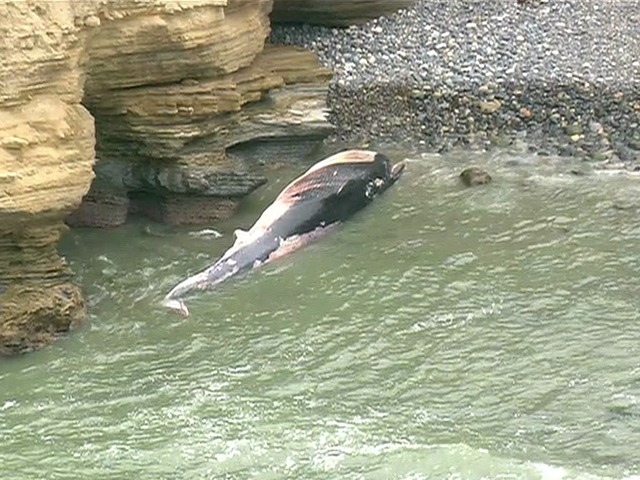
A dead 50' fin whale that washed up on shore at Point Loma in San Diego yesterday, will be towed out to sea by the Marine Conservation Science Institute today. Shark diving, cage diving, swimming with sharks at Isla Guadalupe, with www.sharkdiver.com
source
According to a post on their Facebook page, they will use it to try to attract great white sharks and attempt to tag them. Cage diving,shark diving
This is what they posted. cage diving, swimming with sharks,
"BREAKING NEWS!
If all goes as planned, we will be taking possession of this whale carcass at high tide today. We will tow it offshore and then babysit it while we wait for white sharks to find us. When that happens we hope to tag adult females that are in the area for pupping. This will be the first attempt to tag pupping females in southern California. Popup tags, as opposed to SPOT tags, will be used. We will have a short deployment of 140 days to determine where these pupping females have come from."


This is a unique opportunity to tag some sharks and get valuable information on their pupping grounds. It is also a chance to show that great white sharks are not just fierce predators, but also opportunistic feeders, playing their part in keeping the oceans healthy, by eating these rotting carcases.

We hope that they are successful.and maybe they'll see one of "our" Guadalupe sharks, though we think that they are going farther south to pup.

Cheers,
Martin Graf
CEO
Shark Diver
 
About Shark Diver. As a global leader in commercial shark diving and conservation initiatives Shark Diver has spent the past decade engaged for sharks around the world. Our blog highlights all aspects of both of these dynamic and shifting worlds. You can reach us directly at staff@sharkdiver.com.

Friday, April 25, 2014

A new friend at Guadalupe

We have a new friend at Isla Guadalupe. Meet "Myla" our new addition to the photo ID database. She's a beautiful female!Cage diving with great white sharks at Isla Guadalupe. shark diving,

"Mayla"
I can't wait to go back there this fall and see all our old friends again. If we find a new one, we will add it to our growing list of great white sharks at Isla Guadalupe. So far, we have over 150 sharks identified. All of our new sharks have to get a name. We don't want to say "this is #7", we yell it's "Bruce"! And that would not be possible without the database.

If you would like to support this valuable, ongoing research project, you can do so, by sponsoring and naming a shark. Anyone interested can get more info by clicking here.

All our divers will also be able to participate in this study, by donating the use of their pictures to this database. If we identify a new shark on one of our science expeditions, (we have only one space left on Nov.11) our divers will get to name it. How cool is that?!

Other than that one space on Nov. 11, we only have a few spaces left on Aug. 12, 17 and 23. All the other expeditions are sold out.

Welcome to the family "Mayla" I hope we'll see you in the fall.

Cheers,
Martin Graf
CEO
Shark Diver

About Shark Diver. As a global leader in commercial shark diving and conservation initiatives Shark Diver has spent the past decade engaged for sharks around the world. Our blog highlights all aspects of both of these dynamic and shifting worlds. You can reach us directly at sharkcrew@gmail.com.

Monday, March 31, 2014

Is everything what it seems?

My last blog sure has stirred up some emotion and sparked some debate. Some people have taken it very personal and have ripped, not just the activity, but also the character of Jean-Marie Ghislain. I always try to be fair and tell things the way I see them. If someone does something that I think is stupid, like riding a great white shark at Guadalupe Island, I call them out. When someone is lying to me, about what they did, I call them out on that, but I try not to question their character.Shark diving, cage diving, shark adventure, diving with sharks, swimming with shark, seeing sharks,
So what do I do when someone I called out for doing something stupid and lied about it,  does something good?...... I give them credit, obviously! I stand by everything I said about the activity at Guadalupe. What I'm about to write here, has nothing to do with it. It doesn't justify or change anything that happened there, but neither does what happened at Guadalupe take anything away from it.

Ironically, one of the actual pictures that we talked about, has been used to promote a new technology that could save thousands of sharks around the world.

Mike "da shark" has made me aware of that new technology "Aquatec" is developing. It could mean the end of drum-lines and nets, if successful. Jean-Marie Ghislain is one of the guys behind that company! I don't know, if ultimately this technology will be successful and replace drum-lines and exclusion nets, but I sure hope it does. Regardless, I applaud Jean-Marie for this effort!

Here is a pretty cool video, showing the Aquatec technology.


What we do have to keep in mind is this. Most of us really have the best interest of the sharks at heart. Some of us may do something that others disagree with. We may have different reasons for doing what we are doing. In order to accomplish our goal of saving the sharks and making sure that generations from now, divers will have the opportunity to see these magnificent creatures in the Ocean, we have to keep in mind that we will all make mistakes. If we see something we don't like, ask them why they are doing it and be willing to listen to what they say. Even if you disagree, don't vilify them. It's rarely black and white and by seeking a dialog we are much more likely to get results, than by vilifying those we disagree with. Just look at how much doesn't get done in politics, by playing the blame game.

To Jean-Marie Ghislain, thanks!

Cheers,
Martin Graf
CEO
Shark Diver

About Shark Diver. As a global leader in commercial shark diving and conservation initiatives Shark Diver has spent the past decade engaged for sharks around the world. Our blog highlights all aspects of both of these dynamic and shifting worlds. You can reach us directly at sharkcrew@gmail.com.

Wednesday, March 12, 2014

Last day to bid on a scientific Guadalupe expedition!

Today is your last chance to bid on a scientific expedition with Nicole Lucas Nasby.

Here are the links for the bidding.

http://cgi.ebay.com/ws/eBayISAPI.dll?ViewItem&item=261413040920

http://cgi.ebay.com/ws/eBayISAPI.dll?ViewItem&item=261413042322

You can find more info on the trip here. All proceeds go to the Marine Conservation Science Institute, the organization that puts together and maintains the Guadalupe photo ID project.

Good luck bidding!

Cheers,
Martin Graf
CEO
Shark Diver

About Shark Diver. As a global leader in commercial shark diving and conservation initiatives Shark Diver has spent the past decade engaged for sharks around the world. Our blog highlights all aspects of both of these dynamic and shifting worlds. You can reach us directly at sharkcrew@gmail.com.

Are sharks apex predators? Does it matter?

We commonly refer to sharks as apex predators. Are they really? If they are not, does it matter? A few Australian researchers have come up with some answers to both questions.

First, are sharks apex predators? According to their findings, the answer is yes .... and no.

Example of an apex predator!
Here is what they found. "While size can be important in terrestrial ecosys- tems, size is crucial in marine ecosystems — which tend to be dominated by indeterminate organisms that grow continuously throughout their lives (Trebilco et al. 2013). Individual function changes due to onto- genetic diet shifts as organisms grow in size (Karpouzi
& Stergiou 2003, Pinnegar et al. 2003). The conse- quence is that size-structuring within communities, rather than species identity, is an important factor in determining the strength of competitive and predatory interactions (Dickie et al. 1987, Kerr & Dickie 2001). For example, studies have shown high overlap in diet between similar-sized sharks regardless of maturity state and species identity (e.g. Bethea et al. 2004). Therefore, designation of marine species into apex and mesopredator categories should consider the life stage and size of individuals."

I'm not a scientist, but what I'm getting is, size matters!
But so, why should we care? We are not scientists, (well, you may be, but I'm not) so what does a classification matter? 
Here is what they have to say to that. 
Example of a meso predator!
"Our size-based view of the classification of predatory roles raises important questions about what objectives to manage, and how these objectives can be best achieved. Protection of reef communities through marine protected areas (MPAs) or fisheries regulation (or indeed, naturally on those few locations far from human population centres) would ensure the mesopredator sharks on these reefs are sheltered from fishing pressure. However, the same may not be true for apex predators because their broad movement patterns and large home ranges (Meyer et al. 2009) would expose them to a greater diversity of fishing fleets and gears, and thus a greater overall mortality than the smaller-ranging, reef-dwelling mesopredators. Hence, the apex pred- ators of coral reefs may be silently eliminated by offshore pelagic longline fisheries, unbeknownst to those managing reef diversity and function (Cox et al. 2002). Therefore, reef-based MPAs are not adequate to protect these species"

So basically they are saying that we need to do more than establish MPAs to adequately protect apex predators.

Here is a graphic that may be a bit more clear on the subject.
 

This graphic shows, that without MPAs prey species would greatly increase, while both mesopredators and apex predators decrease. With reef scale (small, local) MPAs, the mesopredators thrive, keeping the prey species in balance, but the apex predators still decline.

 
In practical terms, this means that we have to protect apex predators on a much larger scale than the less migratory mesopredators. In order to do that, we need to know both where they are and when they are there. With that knowledge we can push for local and/or seasonal protection for these migratory apex predators. In order to get that data, we need data that shows the migratory behavior of the various species of apex predators. 
You can read the entire paper here.

Cheers,
Martin Graf
CEO


About Shark Diver. As a global leader in commercial shark diving and conservation initiatives Shark Diver has spent the past decade engaged for sharks around the world. Our blog highlights all aspects of both of these dynamic and shifting worlds. You can reach us directly at staff@sharkdiver.com

Wednesday, March 5, 2014

Do you want to see the big "girls" at Guadalupe in November?

Our 2 science trips for this September have sold out in just a couple of weeks and we have been getting a lot of interest in doing another trip in mid November, when the truly enormous females dominate the waters off Guadalupe Island. 

That interest and the fact that our Great White Shark database is in need of pictures of the big, late season females, we have decided to add a special science expedition from November 11- 16.

We are proud to announce, that  Nicole Nasby-Lucas from the Marine Conservation Science Institute, the scientist that started the Great White Shark photo Id database at Isla Guadalupe, will again be joining us on this special expedition to photograph and identify the large females. She will also be sharing her research with our divers and showing everyone how to identify the sharks. So far the database has over 150 individual sharks identified and some of those individuals have visited Guadalupe Island every year since first being identified in 2001. It is amazing to see how those sharks change in size and behavior.


This expedition is a unique opportunity to participate in growing our database. Should we find a new shark, which is fairly likely during that time of the year, the group will get the opportunity to name the shark. Imagine seeing a shark on a future television documentary, knowing you were there when we first encountered it. All the participants will also get a copy of the photo ID book, containing all the identified sharks at Isla Guadalupe.

The price for this special expedition is $3300 and is limited to 18 divers. We recommend that you book early, since our last two science expeditions sold out in just a couple of weeks.


To book or for more information, call us toll free at 855.987.4275 or 619.887.4275. You can also reach us via email at staff@sharkdiver.com

I hope you can be part of this exciting expedition!

Cheers,
Martin Graf
CEO
Shark Diver


About Shark Diver. As a global leader in commercial shark diving and conservation initiatives Shark Diver has spent the past decade engaged for sharks around the world. Our blog highlights all aspects of both of these dynamic and shifting worlds. You can reach us directly at staff@sharkdiver.com

Friday, February 28, 2014

How can you save sharks?

Picture BBC
The recent actions by the SW Australian government, deciding to use drum lines to cull sharks, have generated huge protests, with literally thousands of  people rallying against that policy.

Over the last couple of years, there have also been a myriad of shark conservation related groups and posts that have popped up on facebook and the internet, protesting various things, relating to shark conservation.

I looked at a lot of these groups and posts and have noticed, that there are a few main targets, that these groups are focusing on.

1. With the recent media attention, it comes as no surprise that the most attention is paid to the Australian shark cull program.

2. Then there are the posts, generally opposing shark finning, shark fin soup etc.

3. There are some that target specific organizations like OCEARCH, shark fishing tournaments and scientists that catch and tag sharks, because of the harmful effect it has on the individual sharks. 

4. Who can forget the bikini clad women that are hanging on to the dorsal fins and riding great white- and tiger- sharks, or the "shark experts" flipping sharks upside down, claiming that the sharks treat them as one of their own?

Are these protests effective? Do they stop the killing of sharks?

Before we get to that, let's establish a few things first.

Fact: In the first 3 weeks, the SW Australian shark cull program has resulted in 17 sharks, longer than 3 meters (12.9 ft) killed. The sharks caught and killed were Tiger Sharks, which have only been responsible for one death since 1980, according to "sharksmart" a website of the Australian government. They have caught zero Great White Sharks, believed to be responsible for the recent attacks. 

Fact: Although estimated numbers of sharks killed every year vary widely from as few as 30 million to as many as 100 million, even at the 30 million rate, it means that every week, 600'000 sharks are killed worldwide.

OK, lets look at the things that are protested and the effect it has on the sharks.

1. The shark cull. I'm completely opposed to that policy and have written about it here and here and here. I think the program is useless, targets the wrong sharks and does absolutely nothing to prevent attacks on humans. The fact that they killed mainly Tiger sharks that have only been responsible of 1 death in the last 34 years and not one Great White, which has been responsible for the recent deaths, clearly shows that the program is worthless. But let's put the whole thing into perspective. In the first three weeks, the shark cull killed 17 sharks vs. at least 1'800'000 and maybe as many as 6'000'000 that are killed by the fishing industry, during the same period.

If the protests succeed in stopping the program, it would directly save around 300 sharks a year. Even if unsuccessful, the protests still raise awareness for the cause, which is definitely a good thing. It is difficult to assess the actual effect that publicity has on helping sharks, but like I said, it's definitely a good thing.

2. General opposition to shark finning, fishing, shark fin soup etc.

These protests are mainly raising public awareness and may have resulted in a reduction of shark fin soup consumption in China. As with any publicity campaign, the actual effects on saving sharks are hard to determine, but they definitely have an impact.

3. Shark tagging. All the tagging done in a year, may cause harm to a few hundred sharks. Again, that's a few hundred, vs. 30-100 MILLION sharks killed annually.

If the protests succeed and there is no more tagging, at best we could save a few sharks every year and make life easier (no tags, no deformed dorsal fin etc.) for a few more. On the other hand, we could also loose valuable data, that may help save sharks. You decide, if it is worthwhile to focus on this. Personally I think we need to weigh the importance of the data collected against the potential harm to the sharks.

4. The sharks are harmless and our friends approach.

I have to admit, my blood pressure tends to go up, when I see some idiot riding a shark or flipping it upside down, trying to convince me that sharks are harmless with some actually claiming that the sharks accept them as one of their own. Why do I think these actions are such a bad idea? Well, I've been diving with Great White Sharks for the last 13 years and around Tiger- and Bull- Sharks for a long time. The one thing I can say with certainty, sharks are NOT harmless and NOT our pets. We don't need to fear them, but they are apex predators and need to be respected! For those that claim that the sharks treat them as one of their own, I can only say, I hope not! I have seen how large sharks treat smaller sharks, biting them, if they don't get out of the way. Any human would be a very small shark, compared to a Great White, or Tiger Shark. Great White Sharks are not touchy feely with each other. There is no casual touching. When they get to close to each other, or actually touch, there is usually a violent reaction. Even when the are mating, the bite on to each other, definitely not something you would want a shark to do to you.

These stunts do nothing to help the sharks and are purely a means of self promotion for the individuals doing them. "Look at me! I'm so cool!"

You notice, all the efforts that seem to get the most publicity are focused on something other than the fishing industry. Have you seen anyone protesting Triatun Inc., or Sea Venture Inc.? Those are just 2 of many companies, trading in shark fins. It seems to me, that most efforts are directed at things that are relatively minor in the big picture.

With all the efforts mentioned above, even if they are all successful, they are saving a few thousand sharks a year at best! So what can we do to really make a difference? First of all, we have to decide what our goal really is. Do we care more about saving sharks, or do we care more about what other "conservationists" think about us.

If your answer is, saving sharks, here are some things you can do. I have to warn you though. Nobody on the internet will know what you did. There are not going to be a lot of people slapping you on the back and tell you what a good job you did. Aside from very few people acknowledging your efforts, your only reward is going to be the knowledge that your efforts helped save some sharks. Instead of thousands of people saving a few sharks, you as an individual can save many.

You can contact, or visit a local marina and sign them up as a shark free marina. You can volunteer with a local group that maintains or creates estuaries, MPA's, breeding programs etc. If you live far from an ocean, you can still volunteer for or support groups like shark savers, shark foundation or projects abroad.

Maybe you don't have a lot of time. There are still a few things you can do. Write a letter to your local legislator, asking to support or enact laws, banning the trace of shark fins. Is there a restaurant in your area that serves shark fin soup? You can visit and make them aware of the problems associated with shark finning. Just because we are aware of all the problems, doesn't mean that they are. They are not necessarily the bad guys, they may just be unaware. Last year at DEMA, there was a restaurant serving shark fin soup, not too far from the convention. A few of us that went there, asked to speak to the manager and the next day, they had removed the soup from the menu. Here is another idea. This is the contact info for Triatun Inc. Maybe their president, Francisco Valdez, would like to hear from you. Would you like to get in touch with Sea Venture Inc. and let their CEO William Haley know what you think?

The bottom line is this. You CAN make a difference! Even if you are the only one that know what you do, the sharks will benefit. Isn't that the only thing that counts?

Cheers,

Martin Graf
CEO
Shark Diver


About Shark Diver. As a global leader in commercial shark diving and conservation initiatives Shark Diver has spent the past decade engaged for sharks around the world. Our blog highlights all aspects of both of these dynamic and shifting worlds. You can reach us directly at staff@sharkdiver.com