Showing posts with label Beqa Adventure Divers. Show all posts

Friday, August 7, 2020

Guadalupe Great White Sharks in danger.

I started SCUBA diving and spear-fishing at Guadalupe Island in 1996, 5 years before we started shark diving there. It is during that time that we discovered the Great White Sharks that are aggregating at there. At first it was just the occasional encounter, mainly while spear-fishing, but over the years those encounters grew in frequency and it was not unheard of to see a GWS while SCUBA diving. 
 
My first encounter with a GWS happened at the south end of Guadalupe, while working as a divemaster, watching some divers. I noticed something moving behind me and when I turned I was face to face with a Great White Shark. It calmly swam by me, continued away from me for about 100' or so and slowly turned around, swimming right back towards me and passing just inches from my body. Strangely, it was not a scary experience, but rather a "wow!" kind of moment. It wasn't at all what I expected from seeing a GWS up close and personal and it started my love for (some people might say my obsession with) these awesome animals.


In 2001 we started our first season of cage diving at Guadalupe. At the time the Island was not a biosphere and there were no rules and regulations regarding diving with sharks and even fishing for Great White Sharks was legal. The operators of the cage diving boats got together and created the Guadalupe Island Conservation Fund, a non profit organization with the goal of helping create protections for the sharks and fund research that is critical for their protection.

In 2003 a young graduate student by the name of Mauricio Hoyos started studying the sharks at Guadalupe. He was living on the Island for 3 months at a time and the shark diving boats supported him with money, supplies as well as a hot meal and warm bed for the night when we were at the Island. Of course the world now knows him as Dr. Hoyos from various shark programs on TV as he continues to do research at Guadalupe.


In 2005 Guadalupe Island became a biosphere, the equivalent of a national park in the US. That designation allowed the government to establish rules and regulations for using the Island and also created revenues from the sale of permits for the boats and entrance fees for everyone visiting the Island. Every year thousands of shark enthusiasts visit Guadalupe to admire these animals up close and personal. The popularity of the White Sharks, combined with the typically crystal clear waters at the Island, have established Guadalupe as the premier White Shark diving site in the world. Numerous TV programs filmed there also made Guadalupe a household word for anyone watching Shark Week or Nat. Geo's Shark Fest on TV.


It wasn't until 2007 that the Great White Shark became a protected species in all of Mexico. Unfortunately, the enforcement of that ban was difficult, since there is only a small naval detachment at the south end of Guadalupe and poachers were still trying to catch these sharks. During the early years of the ban on White Shark fishing the shark diving boats "discouraged" more than a few boats that were illegally targeting these sharks. Over the years, the wannabe poachers have learned that they can't easily get away with poaching at Guadalupe because all the shark boats were keeping a watchful eye on the area.


That brings us to the present. Because of covid-19 the Island has been closed. That means that right now, with the Great White Shark aggregation season underway, there is no deterrent for any poacher that wants to kill these sharks. We already know from other locations like the Galapagos where a Chinese fishing trawler poached 300 tons of fish and Fiji, where poachers used the covid-19 shutdown of the shark diving activities to go and poach in the Shark Reef Marine Reserve, that when there is no effective barrier for illegal fishing, that the poachers have free reign. 
 
Can you imagine what would happen if a Chinese fishing vessel is targeting the Great White Sharks at Guadalupe? Fins from Great White Sharks are highly prized and that is without the value of the jaws and teeth that can fetch as much as $1k PER TOOTH! An action like this could wipe out the entire population of Great White Sharks at Guadalupe in a week!

For me these sharks are more than just another fish. Over the last 20 years of diving with them, I've gotten attached to not only Great White Sharks in general, but to numerous individuals, some of which I've seen every year since 2001. Lucy, Chugey, Scarboard, Tzitzimitl, Bruce, Geoff Nuttal, Luca Arnone, Slash Fin, Screaming Mimi, Crazy Tryss, Mau, Jacques, Thor etc. etc. I worry about them.

We have over 360 individual Great White Sharks in our database that is maintained by Nicole Lucas from the Marine Conservation Science Institute That database is maintained with photos from the cage divers and Shark Diver even has 4 trips a year that are specifically designed as a fund raiser to help keep that database up to date.

We hope that the Mexican authorities will reopen the Guadalupe biosphere as soon as safely possible, so that we can go out there once more and keep and eye on our sharks. Their lives may literally depend on it!

Cheers,
Martin Graf

About Shark Diver. As a global leader in commercial shark diving and conservation initiatives Shark Diver has spent the past decade engaged for sharks around the world. Our blog highlights all aspects of both of these dynamic and shifting worlds. You can reach us directly at crew@sharkdiver.com.

Friday, June 14, 2019

Are you an Activist or a Slacktivist?


InstagramWhat makes a person a real Shark/Ocean Activist/Conservationist? Is it commenting on social media? Is it freediving with a shark, touching it to show how "friendly" these animals are, is it calling anyone who is fishing for sharks names? If you're only doing the things avobe, are you an Activist or a Slacktivist?

Most exchanges on social media happen in an "echo chamber"! If you are commenting on a post in a shark related group, you are not talking to anyone who is not already "saved" and not the ones killing sharks? Do you think that calling out fishermen in those forums is going to change something? You may feel good about other people agreeeing with you and think you really achieved something by telling off a person who in all likelyhood will never even see your comment, but did that really make a difference? Did you really change someones mind?

Real activism involves hard work, doesn't usually yield immediate results and most of the time happens far away from the eyes of the social media conservation groups. Take the example of the lady who keeps freediving with Great White Sharks to "proof" that these animals are harmless and to raise "awareness". How many people, outside of her adoring fans will actually look at those pictures and think the sharks are harmless? Most who don't already love sharks will think "this lady is crazy" or something similar. Besides, is raising awareness really helping to save sharks?

Is this conservation?
Most fishermen don't kill sharks because they hate them or are afraid of them. They kill them for food or money. If we want fishermen to stop fishing for sharks, we have to find alternative ways for them to make a living and feed their families. We always hear that a live shark is worth many times more than a dead one, but WHO is making more money from it? Is it a tourist operation, or do the fishermen themselves profit from the live sharks as well?

There are operations that have successfully managed to get the fishermen involved in saving the sharks. One example is what Beqa Adventure Divers did. They work with the fishing village who is the traditional owner of a reef and in exchange for a levy that is paid by their divers and hiring some of their fishermen to work for the dive operation, they created a national marine park in Fiji. They continue their conservation work with the Myfijishark adoption project. Their mission is the protection and conservation of all of Fiji's shark species and their natural habitats through ecotourism, research, advocacy and education. They also support and cooperate with local communities.


How many of you have seen their video "Celebration"? How many of you are aware of what they are doing? Do you think they have a lesser impact on saving sharks than someone getting 12 million views of a video with them touching sharks?

Shark Diver started the Shark Free Marinas initiative, a program for marinas to pledge that they will not allow their tenants to bring back a shark to their marina.

We also work with shark fishing tournaments to get them to have a catch and release division, instead of catch and kill. This has actually lead to a lot of backlash on social media. We've been accused of consorting with the enemy, especially after they started doing catch, tag and release.  The scientists involved with it have been accused of glorifying those tournaments. People tell me that catch and release is not OK, because of post release mortality. I agree that there is a substantial post release mortality, especially with sharks like the Hammerheads, but catch and release is still a heck of a lot better than an all kill tournament. The fact that we know about the higher post release mortality for Hammerheads is due in part to the catch, tag and release program. After being told that Hammerheads are more likely to die after being released, a bunch of fishermen now cut the lines when they realize they have a Hammerhead on the line and don't fight it to exhaustion.

So here is my question to you, are you an Activist or a Slacktivist? Tell us what you do to help save the sharks and their habitat and you might even win a free shark trip. Check out Ocean Championships for more info on how doing some real conservation work gives you a chance to win a free shark trip.

Let's do something to save our sharks!

Cheers,
Martin Graf
CEO Shark Diver


About Shark Diver. As a global leader in commercial shark diving and conservation initiatives Shark Diver has spent the past decade engaged for sharks around the world. Our blog highlights all aspects of both of these dynamic and shifting worlds. You can reach us directly at crew@sharkdiver.com.

Wednesday, April 10, 2019

15 years of BAD is awesome!


Beqa Adventure Divers, known as BAD, is celebrating it's 15th anniversary. We want to congratulate BAD for being one of the most awesome dive companies in the world. Their moto, "We are a conservation group, masquerading as a dive shop" is more than a mere slogan. What they have accomplished in their 15 year history is simply amazing.

Bull Shark at the Shark Reef Marine Reserve
If you ever heard of what Valerie Taylor called the best shark dive in the world, she was referring to the dive at the Shark Reef Marine Reserve, operated by none other than BAD. And speaking of the Shark Reef Marine Reserve, it was created by BAD in 2004. Initial fish counts at the reef showed about 280 different species of fish, which is very bad for the south pacific. After 10 years of protecting the reef, the number of species increased to 480! As of November, 2014, Shark Reef Marine Reserve has been designated Fiji’s first National Marine Park and BAD was being entrusted with its day-to-day management. To my knowledge, this is the first national park in the world that was created due to the efforts of a single private entitiy.

There are a few sharks to be encountered
But creating a national park is not all that BAD has accomplished. They also partnered with Projects Abroad to create Mangroves for Fiji, a project designed to combat global warming and now their latest, My Fijishark a shark adoption program benefitting protection and conservation of the sharks in Fiji.


Congratulations to BAD for being the best conservation shark diving operation! Keep up the good work!

The BAD boys and girls, celebrating!
Shark Diver is proud to be using BAD for our Bull Shark diving expeditions to Fiji. We are heading there in May, and we can book a Bull Shark dive for you anytime of the year.


For more information on our Bull Shark diving adventures, call us at 619.887.4275 or email crew@sharkdiver.com for more information.

Let's go Shark Diving!

Cheers,
Martin Graf
CEO Shark Diver

About Shark Diver. As a global leader in commercial shark diving and conservation initiatives Shark Diver has spent the past decade engaged for sharks around the world. Our blog highlights all aspects of both of these dynamic and shifting worlds. You can reach us directly at staff@sharkdiver.com.

Thursday, April 5, 2018

Bull Shark with Cancer?


Instagram 
There are a lot of misconceptions when people talk about sharks. One of them is the myth that they don't get tumors or cancer. We previously talked about sharks with cancer, here and here, but while those 2 blogs were about a Great White Shark, we also have a Bull Shark in Fiji with a tumor growing out of her mouth. Her name is "Ms Jaws".

DaShark from Beqa Adventure Divers thinks it all started when he first saw her swimming around with a fishing popper stuck to her jaw.

                                     Video ©DaShark Beqa Adventure divers, source

Her jaw got progressively worse. This photo shows the progression of her lesion from 2011-2013.
Photos by Sam Cahir, predapix

When I met "Ms Jaws" for the first time in 2014, her jaw already looked like this.


The next time I saw her was in 2016 and she looked a lot worse. Her jaw was hanging down and it looked like it would be impossible for her to feed successfully.


Aside from her badly broken jaw and tumor, she did seem to be OK though. She didn't look skinny or showed any obvious signs of malnutrition. I have to admit that I was worried about her and didn't have high hopes of her surviving much longer.

                                          video ©Martin Graf www.sharkdiver.com

Now we have some good news! DaShark just reported that "Contrary to my dire prediction, Mrs. Jaws is alive and kicking - and judging from her girth and body shape, she is very capable of feeding herself which is real good news indeed!"

He also posted a video of her swimming around on facebook here and you can read his blog here.

If you are interested in more information on this particular shark's tumor, read this paper by Juerg Brunschwiler from the ETH University in Zuerich.

I really hope that she will continue to do well. She is a remarkable animal.

Of course, if you really want to know how she is doing, join us in May on our expedition to Fiji, where you can look for her on our Bull Shark dives. We have a couple of openings left. Call us at 619.887.4275 or email crew@sharkdiver.com for more information.

Let's go shark diving!

Cheers,
Martin Graf
CEO Shark Diver

About Shark Diver. As a global leader in commercial shark diving and conservation initiatives Shark Diver has spent the past decade engaged for sharks around the world. Our blog highlights all aspects of both of these dynamic and shifting worlds. You can reach us directly at staff@sharkdiver.com.

Saturday, October 15, 2016

Is shark diving beneficial for the sharks?


Instagram
With the recent coverage of the cage diving accident at Guadalupe, a lot of people have commented that shark diving should be banned.


Obviously my view on that may be biased, since I own a shark diving business, but I have some facts that may change your view on shark diving.

Did you know that shark diving operations have prevented poachers from fishing for sharks at Guadalupe? At this point, everyone knows there are great white sharks at Guadalupe Island, including the poachers. If we would stop shark diving there, the poachers would have easy access.


Did you know that shark diving created a National Marine Park in Fiji? The efforts of Beqa Adventure Divers, have directly led to the creation of the Shark Reef Marine Reserve. When they started diving there, they went to the local fishing village that were the traditional owners of that reef and made a deal with them. They would receive a levy from every shark diver in return for a promise from the village to not fish on that reef. Beqa Adventure Divers also hired and trained their Divemasters, Instructors and boat Captains from that village. After 10 years of diving there, the number of fish species on the reef increased from around 280 to over 480. In 2014 that reef became an official National Marine Park, the equivalent of a National Park in the US.

Shark Reef Marine Reserve
Did you know that Shark Diver donates a significant portion of it's proceeds to research? We primarily support the Marine Conservation Science Institute who created and maintains the photo ID database of all the sharks at Guadalupe Island.

Did you know that Shark Diver started Shark Free Marinas?

Did you know that Shark Diver works to get fishing tournaments to have catch and release divisions, instead of all kill? This is actually something we have been criticized for by people who don't want to see shark fishing tournaments at all. Well, I don't like them either, but catch and release is far better than catch and kill. One step at a time!

Shark Diver is just one company among many operators who actively uses the business to support conservation. We try to emulate our buddies in Fiji. Beqa Adventure Divers who state that they are a "Conservation project, masquerading as a dive operation" We have a long way to go, but we are working on catching up.

So how about the issue of conditioning the sharks, by providing them with food? I leave the answer to that question to DaShark who wrote a blog about that issue a while back.
The late Rusi feeding his sharks.

He writes:
Conditioning via Positive Reinforcement, the big no-no.
Yes, I confess, this is precisely what we do!
We reward the Sharks whenever they approach, very much in the hopes that over time, more and more of them will turn up for a meal - which of course, being smart Apex Predators, they do!
We do so in order to show them to our clients - as opposed to, as I shall never tire to repeat, Fishermen who do exactly the same thing in order to catch and then kill them.
Get the hint? Who has the way biggest, and most negative impact on the animals? Are we going to abolish fishing as a consequence? I wish!


Just to remind you, this comes from the guy who was largely responsible for creating that national marine park I mentioned above.

There are many, many more reasons I could list that show that shark diving, when done properly can greatly benefit not only the sharks, but the ocean in general. It is easy to just oppose shark diving with often unsubstantiated claims, without taking into consideration what the alternative would be.

How many of you would be interested in sharks, or aware of them, without all the pictures and videos on TV and social media? None of those would be around, if not for shark diving?


Weather you agree with my stand on shark diving or not, let's agree on something. Just offering our opinions on social media and criticizing others is not saving a single shark. Only actions can do that. Let's be activists, not slacktivists and keep in mind who is killing sharks. It's the fishing industry, not shark divers!

Let's go shark diving! Or clean up a beach or.....

Cheers,
Martin Graf
CEO Shark Diver
   
About Shark Diver. As a global leader in commercial shark diving and conservation initiatives Shark Diver has spent the past decade engaged for sharks around the world. Our blog highlights all aspects of both of these dynamic and shifting worlds. You can reach us directly at staff@sharkdiver.com.

Tuesday, August 30, 2016

I was surrounded by bull sharks!


Instagram 
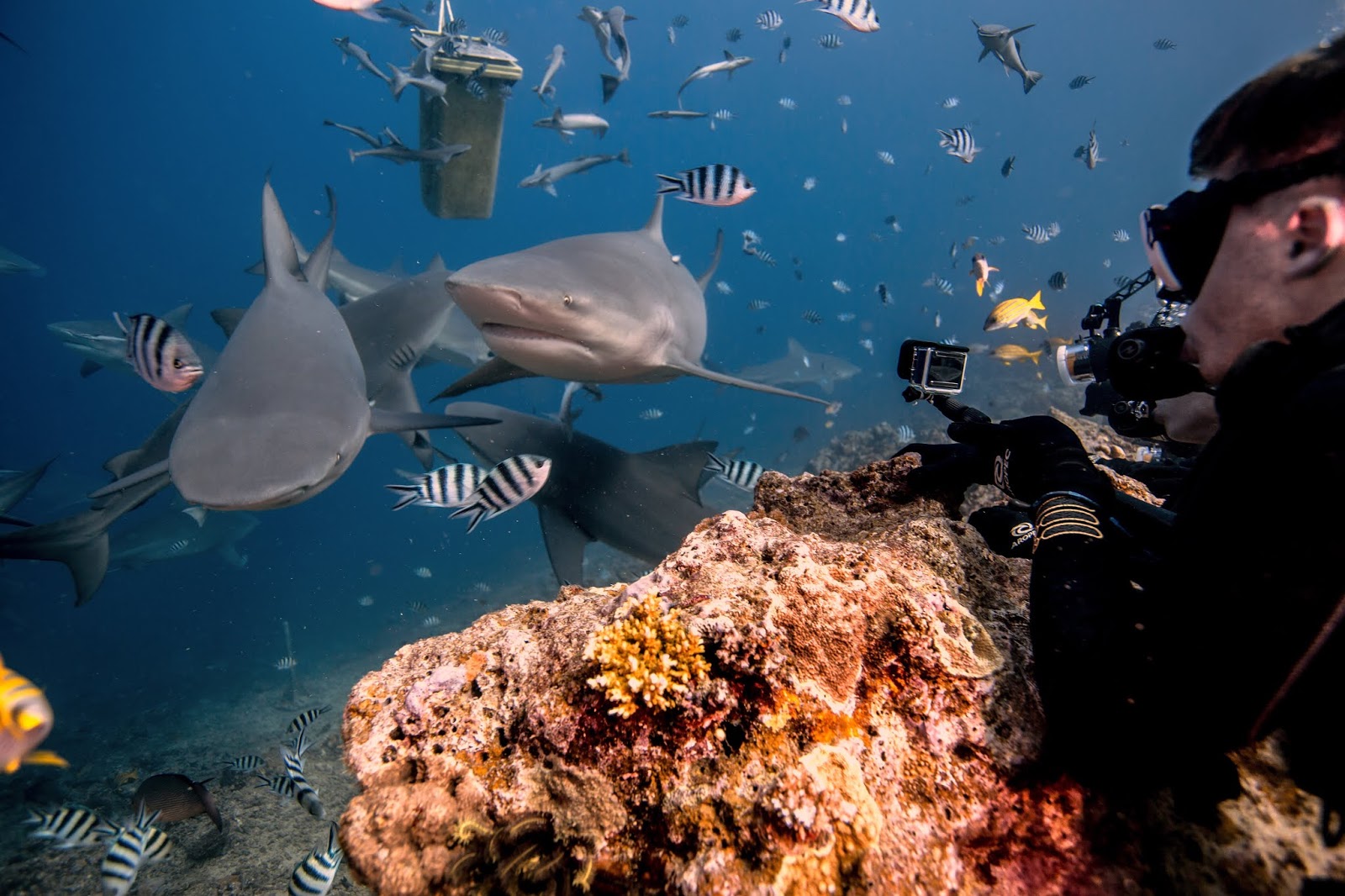
I just got back from my 4th annual trip to Fiji, diving with the "BAD" (Beqa Adventure Divers') bull sharks of the Shark Reef Marine Reserve. It is an unbelievable experience to be surrounded by lots of these awesome predators.


We saw a shark or two
What really fascinates me is not the sheer number of sharks though.  The really interesting part is that I'm starting to recognize some individual sharks, not only by distinctive marks on them, but by their behavior.

Doing a lap, showing everyone that she got a tuna head.

Anyone thinking that "a bull shark is a bull shark" should come to this place and see for themselves. These sharks have very different "personalities", some very mellow and cautious, others not so much. Of course you need to do more than just one or 2 dives to notice these differences. The first few dives your are simply going to be blown away by the sheer number of sharks and and by how close they'll get to you.

Up close and personal!
Common wisdom holds that when it comes to sharks, size matters. The big shark always wins over a smaller shark. What I found is that this is not always the case. Some sharks think they are a lot bigger than they really are and compete with the bigger sharks for the tuna heads on offer. "Top Sail" for example is not one of the bigger sharks, but is very adept at getting more than her fair share of tuna heads.

Top sail getting a tuna head.
Another thing that totally surprised me is how cautious these sharks are, even when food is offered to them. Some sharks will not approach the feeder who's holding a tuna head and some sharks will only take a tuna head from a specific feeder. I would have thought that these bull sharks would pretty much go for any tuna head that is offered to them.


If all the bull sharks are not enough for you, just when you think the dive is over, there is the safety stop. Far from a boring hanging on to a line, waiting for the 3 minutes to pass, you are face to face wit a bunch of hungry white- and black-tip sharks, being fed by one of the divemasters.


I'm still very partial to "my" white sharks at Guadalupe, but I'm getting more and more taken by the bull sharks of the SRMR and can't wait for next year.

Sam face to face with a hungry white tip shark.
Thanks to all the guys at "BAD", (Beqa Adventure Divers) for your hospitality and another unforgettable trip. You are simply the best! Vinaka vakalevu!

Blacktip shark at the safety stop
In the coming weeks we'll be posting a special offer for next year's Fiji trip. My descriptions and pictures don't do these sharks justice. You'll have to come and experience them yourself.


Cheers,
Martin Graf
CEO Shark Diver


About Shark Diver. As a global leader in commercial shark diving and conservation initiatives Shark Diver has spent the past decade engaged for sharks around the world. Our blog highlights all aspects of both of these dynamic and shifting worlds. You can reach us directly at staff@sharkdiver.com.

Wednesday, June 15, 2016

I was surrounded by bull sharks!


Instagram 
I just got back from my 4th annual trip to Fiji, diving with the "BAD" (Beqa Adventure Divers') bull sharks of the Shark Reef Marine Reserve. It is an unbelievable experience to be surrounded by lots of these awesome predators.


We saw a shark or two
What really fascinates me is not the sheer number of sharks though.  The really interesting part is that I'm starting to recognize some individual sharks, not only by distinctive marks on them, but by their behavior.

Doing a lap, showing everyone that she got a tuna head.

Anyone thinking that "a bull shark is a bull shark" should come to this place and see for themselves. These sharks have very different "personalities", some very mellow and cautious, others not so much. Of course you need to do more than just one or 2 dives to notice these differences. The first few dives your are simply going to be blown away by the sheer number of sharks and and by how close they'll get to you.

Up close and personal!
Common wisdom holds that when it comes to sharks, size matters. The big shark always wins over a smaller shark. What I found is that this is not always the case. Some sharks think they are a lot bigger than they really are and compete with the bigger sharks for the tuna heads on offer. "Top Sail" for example is not one of the bigger sharks, but is very adept at getting more than her fair share of tuna heads.

Top sail getting a tuna head.
Another thing that totally surprised me is how cautious these sharks are, even when food is offered to them. Some sharks will not approach the feeder who's holding a tuna head and some sharks will only take a tuna head from a specific feeder. I would have thought that these bull sharks would pretty much go for any tuna head that is offered to them.


If all the bull sharks are not enough for you, just when you think the dive is over, there is the safety stop. Far from a boring hanging on to a line, waiting for the 3 minutes to pass, you are face to face wit a bunch of hungry white- and black-tip sharks, being fed by one of the divemasters.


I'm still very partial to "my" white sharks at Guadalupe, but I'm getting more and more taken by the bull sharks of the SRMR and can't wait for next year.

Sam face to face with a hungry white tip shark.
Thanks to all the guys at "BAD", (Beqa Adventure Divers) for your hospitality and another unforgettable trip. You are simply the best! Vinaka vakalevu!

Blacktip shark at the safety stop
In the coming weeks we'll be posting a special offer for next year's Fiji trip. My descriptions and pictures don't do these sharks justice. You'll have to come and experience them yourself.


Cheers,
Martin Graf
CEO Shark Diver


About Shark Diver. As a global leader in commercial shark diving and conservation initiatives Shark Diver has spent the past decade engaged for sharks around the world. Our blog highlights all aspects of both of these dynamic and shifting worlds. You can reach us directly at staff@sharkdiver.com.

Thursday, February 25, 2016

Update from our friends in Fiji


Instagram 

This is a reblog from Mike in Fiji. http://fijisharkdiving.blogspot.com/2016/02/cyclone-winston-images.html

It looks like they made it through the Cyclone OK, but that can't be said for other parts of Fiji.


Just amazing.
I've just come back from Suva.
Insiders know the route which leads through several villages and settlements with plenty of ramshackle dwellings, and then through the suburb of Lami and finally, Suva proper. I was expecting to see some signs of the devastation but... nothing! 
Everything is clean and tidy, and all I could discern were a total of three missing roofs where repairs were already well underway.
Like I said, just amazing!
But in the North and in the islands, things are completely different.
This is yesterday's local News bulletin.


These poor people need urgent help.
Should you want to contribute, please re-read this  - and should you want to use other channels, you may want to first ascertain whether the funds will be ultimately disbursed to the National Disaster Management Office  and then, the District Disaster Management Committee (DISMAC) that are coordinating the efforts, and what portion of your funds will be wasted on overheads as is too often the case. Like the PM said, this is really not the moment for waste, duplication let alone obstruction!
Thank you very much!

If you would like to help out, Mike is recommending the following ways.
The Prime Minister's disaster relief fund  http://www.fiji.gov.fj/Media-Center/Press-Releases/FIJIAN-GOVERNMENT-ESTABLISHES-DISASTER-RELIEF-FUND.aspx

The Fiji Red Cross: http://www.fijitimes.com/story.aspx?id=342687

I'm glad that our friends have made it through the Cyclone OK and I urge you to help the less fortunate one in Fiji via one of the above means.

Cheers,
Martin Graf
CEO Shark Diver

About Shark Diver. As a global leader in commercial shark diving and conservation initiatives Shark Diver has spent the past decade engaged for sharks around the world. Our blog highlights all aspects of both of these dynamic and shifting worlds. You can reach us directly at staff@sharkdiver.com.

Monday, February 22, 2016

Our friends in Fiji made it through the cyclone!


Instagram 

It looks like our friends in Fiji made it through Cyclone Winston, the worst in history.

Here is Mike's first hand report. http://fijisharkdiving.blogspot.com/2016/02/back-in-business.html?spref=fb

A picture of the devastation.

Back in Business!

We're opening tomorrow.

But first.
This has been the worst cyclone to ever hit the SoPac, and one of the very worst globally.
Our thoughts go to the families of the deceased and missing, to the many who got injured, to the countless displaced, many of whom have literally lost everything.

But this is Fiji.
Yes the widespread stoicism in the face of the onrushing onslaught may have seemed peculiar - but the flip side is that after the event, there is no drama whatsoever as instead of lamenting and waiting for others to help, we get up, dust ourselves off and carry on. 
Case in point, the power and water are miraculously back on, and everybody is busy cleaning up and helping friends and neighbors to get back on their feet. And a big bravo to Government who has been handling this admirably right from the get go, and who continues show leadership by being proactive, efficient and effective all throughout the country.

I also want to thank our friends.
Your outpouring of support has been frankly humbling, and we all thank you for that. No we really don't need anything - but should you want to make a valuable contribution, please make a donation to the Fiji Red Cross or to the Prime Minister's Disaster Relief and Rehabilitation Fund as right now, those are by far the most effective venues for quickly getting the right help to the affected people.
Thank you very much.
 

Anyway, we're open for business.
Can't wait to have my first look at Shark Reef that has been battered by phenomenal seas. We've recently established a shallow nursery for different endangered Giant Clams, and I'm fearing the worst - but who knows, we here are resilient.

Keep watching this space! 

We are all glad you made it through OK and are looking forward to diving with you in May.

Cheers!
Martin Graf

About Shark Diver. As a global leader in commercial shark diving and conservation initiatives Shark Diver has spent the past decade engaged for sharks around the world. Our blog highlights all aspects of both of these dynamic and shifting worlds. You can reach us directly at staff@sharkdiver.com.