Showing posts with label ocean. Show all posts

Thursday, July 29, 2021

How do we identify the Great White Sharks?


We have over 370 individual Great White Shark identified at Guadalupe Island. The Marine Conservation Science Institute has been keeping track of these awesome animals since 2001. 

Lets look at what makes these unique and the methods we use to identify them. The first thing we determine is the sex of the sharks. Male sharks have claspers and Females don't. 

Female Shark, no claspers


Male shark, claspers


Once we know the sex of the shark, we look at the pattern of the transition from the white belly to the grey top. This transition is like a fingerprint. We primarily look at 3 different areas of the Shark. The gills, pelvic area, and the tail. 


Lets look at this picture of a Great White Shark and identify it.


First we need to determine the sex of the shark. So lets take a closer look at the pelvic area. We can see that there are no claspers, so it is a female.

No claspers, = female shark.

Now that we know that is a female, we look through our database and try to match up the color pattern to the females we have in our database.

#262, Deb


I think we found a match #262, Deb, looks like a perfect match. What if we are not convinced? In that case we look at another area. How about the gills?


Left is our photo, right is our databese

As you can see, the color pattern on the gills matches as well, so we have a confirmed match. The shark in our picture is #262 "Deb"

Aside from the color pattern, we also look for mutilations. We have previously talked about the amazing healing ability of our sharks here, so we have to be careful to not use regular injuries as a sole means of identification. Here is a picture of"Bruce" with a big bite from another shark.


Just a year later, he barely showed any sign of that injury.

Unlike flesh-wounds, mutilations are permanent. We have many sharks that have some unique mutilations, like the famous "Lucy" with her mangled tail.

Lucy

However, even with mutilations we have to be careful. There are multiple sharks who may have similar mutilations, so we still have to make sure that we positively identify those sharks. At Guadalupe, "Andy", "Chugey", "Tzitzimitl", and "Cori B" all have the top of their tail missing


There are other mutilations, like missing pieces of a pectoral, pelvic, or dorsal fin that can all be used as a preliminary identification, but like mentioned above, it's never a sole means and always has to be confirmed by looking at the color pattern.

Many people, especially on social media are using "birth marks", black spots on typically the white belly of the shark, to identify the sharks. Those are actually not birth marks at all, but rather copepods, a parasite that can move around and may disappear from a shark, so they are not a good way to identify our sharks. 

"Tzitzimitl" with copepods.

All of our divers receive a copy of the entire Photo ID Database witch contains every shark we have identified at Guadalupe Island.


Now that you know how to identify the sharks, you are ready to come shark diving with us. How great will it be when you watch "Shark Week" the next time and you're able to say "this is the shark that swam right by me". Our goal is not to simply get you face to face with Great White Sharks, but to also share everything we know about all the individual sharks we encounter. Some individuals we have known for 21 years and watched the grow from "little" 12 footers to well over 16 feet.

Some of our trips are hosted by Nicole Nasby-Lucaas, the scientist who keeps the database, where she shares her vast knowledge from years of researching Guadalupe's Great White Sharks with our divers.

Call us at 619.887.4275 or email crew@sharkdiver.com for more information on our expeditions.

Let's go shark diving!

Cheers,

Martin Graf

CEO Shark Diver

About Shark Diver. As a global leader in commercial shark diving and conservation initiatives Shark Diver has spent the past decade engaged for sharks around the world. Our blog highlights all aspects of both of these dynamic and shifting worlds. You can reach us directly at staff@sharkdiver.com.


Wednesday, June 23, 2021

Special Great White Shark Expedition to Guadalupe Island.


Shark Diver is excited to announce that we will have a very special expedition to Guadalupe Island this fall. From Sept. 8-13 we will have both Nicole Nasby-Lucas, the scientist responsible for the Guadalupe Photo ID database and Tanya Houppermans, a world renowned underwater photographer on board.


Nicole Nasby-Lucas

Nicole has been studying the white sharks of Guadalupe Island, Mexico since 2001. Her research includes satellite tagging and tracking studies to examine migration patterns and behavior. She also manages the Guadalupe Island white shark photo-ID program and maintains a database of all sharks sighted at Guadalupe Island since 1999. The photo-ID program is important for tracking the visitation patterns of individual sharks as well as monitoring the overall status of the population. By using the unique coloration of these sharks, she’s been able to identify over 360 individuals to date. This project started in 2001 and some of these sharks have been seen every year since. All of this research is crucial for the management and conservation of northeastern Pacific white sharks.

All our guests will receive a copy of the official Guadalupe Shark Photo ID database. How awesome would it be if you can say "this is the shark that swam right next to me" the next time you watch Shark Week?

Tanya Houppermans is a world renowned underwater photographer and conservationist best known for her images depicting the grace and beauty of sharks.


Tanya Houppermans
 

A former mathematician and research operations analyst, she left the corporate world behind in 2015 to concentrate full time on conservation after learning that over 70 million sharks are killed every year with many species being on the verge of extinction. Her articles and images have been published around the world, and she is the recipient of several prestigious awards for her photography including her photo "Harmony" which won:

First Place awards in the ‘Sharks’ category in the World Shootout in 2017, First Place in the ‘Portrait’ category in the Underwater Photographer of the Year competition, and the Grand Prize in the California Academy of Sciences Big Picture Natural World Photography Competition. 

"Harmony"
 

A prominent public speaker, Tanya has shared her experiences in the underwater world with international audiences in locations such as Singapore, Shanghai, Paris, and Washington D.C. She is actively involved in cutting-edge shark research and helped to develop the citizen science program Spot A Shark USA to study sand tiger shark populations along the east coast of the Unites States. Tanya can be seen in the program ‘Shark Gangs’ that highlights her work with the sand tiger sharks of North Carolina as part of National Geographic’s SharkFest 2021.

Sand Tiger aggregation
 

On our expedition Tanya will share her vast knowledge of underwater photography, giving tips and advise to our guest as well as talk about her work in conservation.

Having both Nicole and Tanya on board will give our guests the unique opportunity to get to know our sharks, some of which we have known for over 20 years now, participate in the research and learn how to take awesome pictures and videos or our toothy "friends". 

We only have a limited number of spaces left on this special expedition. Call us at 619.887.4275 or email crew@sharkdiver.com for more info.

Let's go shark diving!

Cheers,

Martin Graf

CEO Shark Diver

About Shark Diver. As a global leader in commercial shark diving and conservation initiatives Shark Diver has spent the past decade engaged for sharks around the world. Our blog highlights all aspects of both of these dynamic and shifting worlds. You can reach us directly at crew@sharkdiver.com.

Wednesday, April 8, 2020

Introducing Screaming Mimi, a very unique Great White Shark at Guadalupe Island


Instagram 
During our confinement at home due to the coronavirus, we are introducing you to a few of our favorite characters you might meet when you visit Guadalupe Island through a series of blogs. Today we'd like you to meet "Screaming Mimi"!

At Shark Diver, our goal is to not just take you to Guadalupe to see some Great White Sharks, we want you to get to know these awesome creatures individually. They all have different character traits and behaviors. How awesome would it be when the next time you watch shark week you can say "this is the shark that swam right next to me!"? So that you can identify the individual sharks when you come home from your trip, every one of our divers will receive a copy of our Photo ID to take home.

 We met "Screaming Mimi" a couple of years ago. When I first encountered her, I nicknamed her "Kinky".  She has a very distinct kink in her tail. I have no idea what caused that kink, since she doesn't have any obvious scars or signs of injury. She was named "Screaming Mimi" by someone through the "Sponsor a shark" program of the Marine Conservation Science Institute. That sponsor program is one of the ways they raise funds for the Photo ID database at Guadalupe Island.


Mimi is a very active and curious shark. When she encounters something new in the water, she exhibits a typical white shark trait. Unlike what most people think, white sharks don't just attack when they encounter something they don't know. They swim by close to check it out. It is actually quite funny some times. A couple of years ago, a beach towel blew overboard and started to drift down. 3 white sharks came by to investigate it. 2 of them jerked away and rapidly swam away when the towel moved a little in the current. The 3rd. one kept swimming close to it, jerking away, and getting closer again. I don't know if it eventually bit the towel or not, as I lost sight of both the shark and the towel in the distance.


Watch the video below of Mimi checking out my GoPro camera that was attached to a long pole and handled from the boat.


You can see that they don't just attack something they don't know. The swim by and check things out first.
Screaming Mimi ©Tim Peterson

Mimi also likes to swim really close to the cages and makes eye contact with the divers.


Mimi is around 14' long and not quite mature yet. It is amazing how big these sharks have to be, before they are mature and able to reproduce.

I hope we'll see her again this year. She loves to swim around the cages, sometimes for hours. It never ceases to amaze me that we keep seeing the same individual sharks year after year. It's not like they are resident sharks. They migrate thousands of miles each year but come right back to the same spot at Guadalupe Island.

If you want to come face to face with a great white shark and would like to learn how to identify these sharks, join us on one of our "science" expeditions. We do have some spaces open and would love to introduce you to our sharks.

Call 619.887.4275, email crew@sharkdiver.com or visit www.sharkdiver.com for more information.

Let's go shark diving!

Cheers,

Martin Graf
CEO Shark Diver

About Shark Diver. As a global leader in commercial shark diving and conservation initiatives Shark Diver has spent the past decade engaged for sharks around the world. Our blog highlights all aspects of both of these dynamic and shifting worlds. You can reach us directly at crew@sharkdiver.com.

Monday, April 6, 2020

Introducing "Chugey" an iconic Great White Shark at Guadalupe Island.

Since most of us are still staying at home during this corona crisis, I'll continue to bring some "shark joy" to everyone by introducing you to our great white sharks at Guadalupe. Today I'd like you to meet Chugey. He is one of the iconic sharks at Guadalupe. We first encountered him in 2004 and he's been regularly sighted ever since. One of his characteristics is his cut caudal (tail) fin. It pretty much resembles the tail of an airplane, with a flat top.

Chugey is a very active shark, to say the least. Being cautious doesn't seem to factor into his actions. He's had numerous injuries throughout the years, but seems to be just fine despite of it.

Just how rough a life does he have? We have talked about the amazing healing power of these amazing Great White Sharks here and it looks like they really need that ability to heal. Chugey, the shark we were talking about in that blog, was back at Guadalupe Island in 2018 and it looked like that he hadn't gotten any more careful since he got his face bit the first time. While his original wound closed quite nicely, he was sporting some brand new bite marks.

As a reminder, here is what he looked like 2 years earlier.


Here is what he looked like with his old scar and new bite marks.


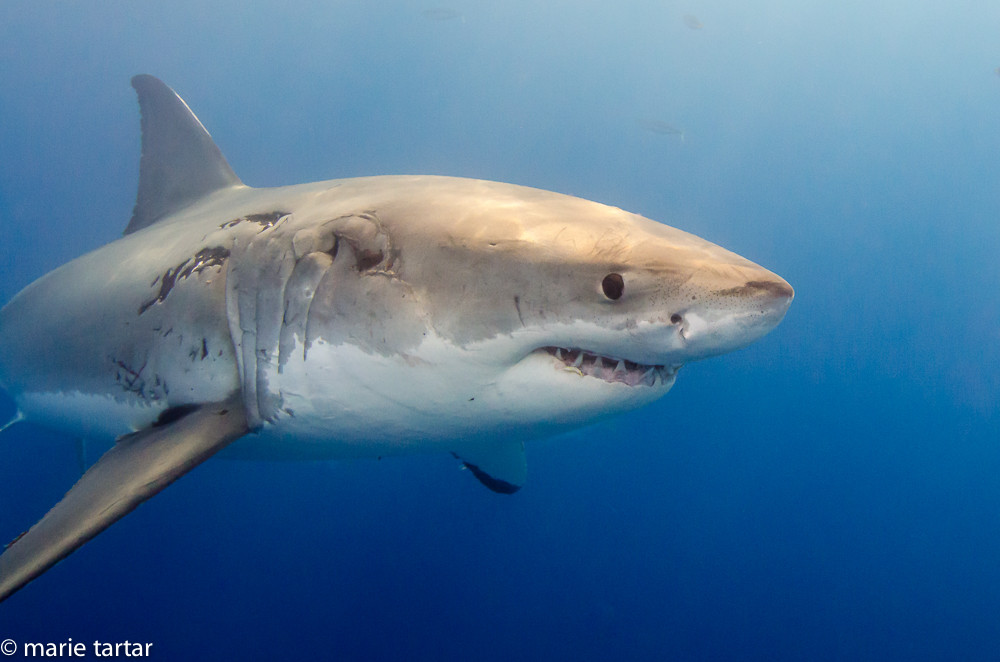
This is another picture of Chugey, taken by one of our divers, Marie Tartar.


It's great to see him back at Guadalupe every year, acting like nothing happened. I continue to be blown away by both their ability to heal and never showing any signs of discomfort or indication that they are in pain, when swimming around with severe bite injuries.

Once this corona virus pandemic is over in the fall, we are heading back to Guadalupe Island for our 20th season of diving with our Great White Sharks. Nicole Nasby-Lucas, who is the person responsible for our photo ID database, will be coming out with us on 4 of our expeditions.  Thanks to her database, we can individually identify the sharks and also have a history of when they visited Guadalupe Island. In 2019 we added over 60 new sharks and are now over 360 individuals that have been sighted since we first started diving there in 2001.

How many new sharks will we encounter this season? I can't wait to get back there and find out.

What will he be named?


If you would like more information on our expeditions once this corona virus pandemic is over, Call 619.887.4275 or email us at crew@sharkdiver.com

Hopefully soon we'll be able to once again say "Let's go shark diving!"

Cheers,
Martin Graf
CEO
Shark Diver


About Shark Diver. As a global leader in commercial shark diving and conservation initiatives, Shark Diver has spent the past decade engaged for sharks around the world. Our blog highlights all aspects of both of these dynamic and shifting worlds. You can reach us directly at crew@sharkdiver.com.
Instagram

Thursday, April 2, 2020

Introducing Bruce, one of the biggest male Great White Sharks at Guadalupe.


Instagram
Continuing to bring you some positivity during our home confinement due to the Coronavirus,  I want to introduce you to "Bruce", another regular Great White Shark at Guadalupe Island. Bruce has been around since we started shark diving at Guadalupe in 2001. When we first encountered him, he was just a "little" teenager, probably not much longer than 11-12'. Of course we had no idea that we would see him year after year and that he would grow into one of the larger males at the Island. He is now on the north side of 16' and one of the dominant shark at the site. Despite his size, he is one of the more mellow sharks around. He keeps swimming around with, what seems to be, a grin that looks like he stole something and got away with it.

Bruce saying hello to Whitney, one of our divers!

Bruce is also the shark who got me interested in shark research. I have to admit, that reading scientific papers held about as much excitement to me as watching grass grow. It simply wasn't my thing. When Dr. Domeier tagged Bruce with a satellite transmitter and used some of the data it produced for his paper on white shark migration, Nicole Nasby-Lucas, who works with Dr. Domeier and is responsible for the Guadalupe photo ID database, gave me a copy of the research paper. I started reading it, and realized that this paper was not just a research paper, but more like Bruce's travel journal. It was exciting to find out where he was going, when not at Guadalupe and what he was doing. Who knew that he was vacationing near Hawaii?! I mean, who wouldn't want to vacation there? Did you know that Great White Sharks can go deeper than 3000'? Well, I didn't, until I read that paper.

Even though he is one of the more mellow sharks around, being a great white shark and male, Bruce was not averse to a little fighting here and there. I remember one particular morning. I was just getting into the cages to sort out all the regulators when I noticed some movement behind me. I turned and saw Bruce who looked me straight into the eyes. He sported a huge bite injury, just in front of his gills, with a hole that let me look straight through it and out his mouth. The amazing thing was, it didn't seem to bother him. He just kept swimming around and stayed active, like nothing had happened.

Bruce about a week after the bite.

Just like Chugey, when he came back the following year, his wound was closed and there was barely a scar to indicate that he was ever injured.

Bruce with his closed bite injury.


So that is Bruce.

Since we started shark diving at Guadalupe Island, we have met over 360 different individual sharks. Who is going to be back this year? Who is going to make its first appearance? Hopefully by the time we are ready to go back to Guadalupe, this coronavirus will be a thing of the past and we will find out! Maybe you'll be able to join us and get to meet them up close and personal. They do pose for pictures with you! Next time you watch shark week, you can say, "Hey, I know that guy!"


Hopefully, we will start our expeditions in August.  4 of our trips are research trips. On those trips, you'd get to meet the researcher who knows all about those sharks, Nicole Nasby-Lucas, along with all the rock-star white sharks of Guadalupe Island. Call us at 619.887.4275 or email crew@sharkdiver.com for more information.

Let's go shark diving!

Cheers,
Martin Graf
CEO Shark Diver

About Shark Diver. As a global leader in commercial shark diving and conservation initiatives Shark Diver has spent the past decade engaged for sharks around the world. Our blog highlights all aspects of both of these dynamic and shifting worlds. You can reach us directly at crew@sharkdiver.com.

Friday, June 14, 2019

Are you an Activist or a Slacktivist?


InstagramWhat makes a person a real Shark/Ocean Activist/Conservationist? Is it commenting on social media? Is it freediving with a shark, touching it to show how "friendly" these animals are, is it calling anyone who is fishing for sharks names? If you're only doing the things avobe, are you an Activist or a Slacktivist?

Most exchanges on social media happen in an "echo chamber"! If you are commenting on a post in a shark related group, you are not talking to anyone who is not already "saved" and not the ones killing sharks? Do you think that calling out fishermen in those forums is going to change something? You may feel good about other people agreeeing with you and think you really achieved something by telling off a person who in all likelyhood will never even see your comment, but did that really make a difference? Did you really change someones mind?

Real activism involves hard work, doesn't usually yield immediate results and most of the time happens far away from the eyes of the social media conservation groups. Take the example of the lady who keeps freediving with Great White Sharks to "proof" that these animals are harmless and to raise "awareness". How many people, outside of her adoring fans will actually look at those pictures and think the sharks are harmless? Most who don't already love sharks will think "this lady is crazy" or something similar. Besides, is raising awareness really helping to save sharks?

Is this conservation?
Most fishermen don't kill sharks because they hate them or are afraid of them. They kill them for food or money. If we want fishermen to stop fishing for sharks, we have to find alternative ways for them to make a living and feed their families. We always hear that a live shark is worth many times more than a dead one, but WHO is making more money from it? Is it a tourist operation, or do the fishermen themselves profit from the live sharks as well?

There are operations that have successfully managed to get the fishermen involved in saving the sharks. One example is what Beqa Adventure Divers did. They work with the fishing village who is the traditional owner of a reef and in exchange for a levy that is paid by their divers and hiring some of their fishermen to work for the dive operation, they created a national marine park in Fiji. They continue their conservation work with the Myfijishark adoption project. Their mission is the protection and conservation of all of Fiji's shark species and their natural habitats through ecotourism, research, advocacy and education. They also support and cooperate with local communities.


How many of you have seen their video "Celebration"? How many of you are aware of what they are doing? Do you think they have a lesser impact on saving sharks than someone getting 12 million views of a video with them touching sharks?

Shark Diver started the Shark Free Marinas initiative, a program for marinas to pledge that they will not allow their tenants to bring back a shark to their marina.

We also work with shark fishing tournaments to get them to have a catch and release division, instead of catch and kill. This has actually lead to a lot of backlash on social media. We've been accused of consorting with the enemy, especially after they started doing catch, tag and release.  The scientists involved with it have been accused of glorifying those tournaments. People tell me that catch and release is not OK, because of post release mortality. I agree that there is a substantial post release mortality, especially with sharks like the Hammerheads, but catch and release is still a heck of a lot better than an all kill tournament. The fact that we know about the higher post release mortality for Hammerheads is due in part to the catch, tag and release program. After being told that Hammerheads are more likely to die after being released, a bunch of fishermen now cut the lines when they realize they have a Hammerhead on the line and don't fight it to exhaustion.

So here is my question to you, are you an Activist or a Slacktivist? Tell us what you do to help save the sharks and their habitat and you might even win a free shark trip. Check out Ocean Championships for more info on how doing some real conservation work gives you a chance to win a free shark trip.

Let's do something to save our sharks!

Cheers,
Martin Graf
CEO Shark Diver


About Shark Diver. As a global leader in commercial shark diving and conservation initiatives Shark Diver has spent the past decade engaged for sharks around the world. Our blog highlights all aspects of both of these dynamic and shifting worlds. You can reach us directly at crew@sharkdiver.com.

Monday, February 11, 2019

Get to know "Lucy" a Great White Shark at Guadalupe


Instagram 
I love "Lucy", and I'm not referring to the popular TV show of the 50ies. "Lucy" is a large female Great White Shark, that is regularly visiting Guadalupe Island. Most mature females are only seen every other year. They mate at Guadalupe Island and then stay away from the Island until after they give birth off the coast of Baja and in the Sea of Cortes, about 18 months after they get pregnant at Guadalupe.


In 2008 she suffered and injury to her tail, most likely from a bite by another shark. Her tail is pretty much mangled and it probably affects her speed. Even though she is definitely a mature female,  we saw her every year until 2014, which meant that she didn't get pregnant, since pregnant females stay away from Guadalupe for a season and return every other year. I don't know if the mangled tail was the reason she didn't seem to get pregnant for all those years, but fortunately she has started showing up every other year since then. Hopefully this means that she is indeed getting pregnant now. We last saw her in 2018, so most likely we won't see her again until 2020.


"Lucy's" tail makes it very easy to identify her. Usually we identify the individual sharks by their coloration. The transition from the white underbelly to the grey top is unique for every individual. Some people try to identify the sharks by their scars. That is how "Bite Face" got his name. The problem with scars is that they heal and if that is the only identifying characteristic you have, you would not recognize that same shark when it comes back the following year. Mutilations, like Lucy's tail don't change and can be used in conjunction with the markings to identify her. We have a photo id database that is managed by Nicole Nasby-Lucas from the Marince Conservation Science Institute, with over 220 individual sharks in identified.

If you are coming out on one of our "science" expeditions, you'll get a chance to learn how to identify these sharks from Nicole herself. You will also get the complete photo ID database, so you can identify all the sharks you encountered and what's really cool, you will then be able to identify the sharks you see on TV. How awesome will it be, when you see a shark on TV and realize that this is the individual that swam inches from your face at Guadalupe?


Even with her tail slowing her down, she seems to be healthy in every other way. She is definitely getting enough food and is holding her own among all the sharks at the Island. Lucy is a very curious shark and she swims very close to the cages, making eye contact with our divers as she is gliding by slowly.


I hope to see Lucy when we return in the fall. I do have mixed emotions though. While I would love to see her, it would of course mean that she didn't get pregnant last season.

If you would like to join us, or just get more information, call 619.887.4275, email crew@sharkdiver.com or visit our website www.sharkdiver.com

Let's go sharkdiving!

Cheers,

Martin Graf
CEO Shark Diver

About Shark Diver. As a global leader in commercial shark diving and conservation initiatives Shark Diver has spent the past decade engaged for sharks around the world. Our blog highlights all aspects of both of these dynamic and shifting worlds. You can reach us directly at staff@sharkdiver.com.
Instagram

Saturday, June 10, 2017

Get to know "Lucy" Great White Shark at Guadalupe Island


Instagram 
I love "Lucy", and I'm not referring to the popular TV show in the 50ies. "Lucy" is a large female Great White Shark, that is regularly visiting Guadalupe Island. Most mature females are only seen every other year. They mate at Guadalupe Island and then stay away from the Island until after they give birth off the coast of Baja and in the Sea of Cortes, about 18 months after they get pregnant at Guadalupe.


Unfortunately "Lucy" doesn't seem to get pregnant. In 2008 she suffered and injury to her tail, most likely from a bite by another shark. Her tail is pretty much mangled and it probably affects her speed. I don't know if that's the reason she doesn't seem to get pregnant, but we have seen her every season, for the last 9 years.


"Lucy's" tail makes it very easy to identify her. Usually we identify the individual sharks by their coloration. The transition from the white underbelly to the grey top is unique for every individual. Some people try to identify the sharks by their scars. That is how "Bite Face" got his name. The problem with scars is that they heal and if that is the only identifying characteristic you have, you would not recognize that same shark when it comes back the following year. Mutilations, like Lucy's tail don't change and can be used in conjunction with the markings to identify her. We have a photo id database that is managed by Nicole Nasby-Lucas from the Marince Conservation Science Institute, with over 220 individual sharks in identified.

If you are coming out on one of our "science" expeditions, you'll get a chance to learn how to identify these sharks from Nicole herself. You will also get the complete photo ID database, so you can identify all the sharks you encountered and what's really cool, you will then be able to identify the sharks you see on TV. How awesome will it be, when you see a shark on TV and realize that this is the individual that swam inches from your face at Guadalupe?


Even with her tail slowing her down, she seems to be healthy in every other way. She is definitely getting enough food and is holding her own among all the sharks at the Island. Lucy is a very curious shark and she swims very close to the cages, making eye contact with our divers as she is gliding by slowly.


I hope to see Lucy when we return in the fall. I do have mixed emotions though. While I would love to see her, it would of course mean that she didn't get pregnant again last season.

If you would like to join us, or just get more information, call 619.887.4275, email crew@sharkdiver.com or visit our website www.sharkdiver.com

Let's go sharkdiving!

Cheers,

Martin Graf
CEO Shark Diver

About Shark Diver. As a global leader in commercial shark diving and conservation initiatives Shark Diver has spent the past decade engaged for sharks around the world. Our blog highlights all aspects of both of these dynamic and shifting worlds. You can reach us directly at staff@sharkdiver.com.

Friday, September 18, 2015

Talking about Sharks, Feeds the Frenzy

A Growing Attraction

Some might say diving with sharks is the last thing they would ever want to do...until they do it! For many, it has become an addiction and more and more repeat divers are getting their yearly thrill with Shark Diver, based out of San Diego. For 14 years, Shark Diver has been introducing the public (those who are dive certified and not certified) to the underwater world of great white sharks. They don't plan to stop. Why? Because people keep coming to get their 'fix.' The shark phenomenon has continued to rise for the last few years, due to local and national television news and social media coverage, cable television programming, and of course, silly movies. The 'News' has put us in touch with shark sightings off the coasts of Australia, South Africa, the Eastern and Western United States, and Guadalupe Island in Mexico; all right at our fingertips. The more we talk about sharks, the more popular they become.

Photo: Cindy Michaels
Every year, starting the first week of August, Shark Diver takes more than 200 divers to Guadalupe Island to see these misunderstood creatures, up close. During a 5-day adventure, divers fulfill their bucket list items, unique wedding anniversary or honeymoon celebrations, birthday milestones, or childhood dreams. In 2014, Shark Diver's sold out season saw a record number of divers wanting to see great whites, but it was also one of the biggest years for shark encounters at the cages. Things were only going to grow after that. Already, since the company's first dive this year on August 9th, there have been more than 120 great white shark sightings and it is expected that the same amount, if not more, will be seen by the time the 2015 season ends in November.


Get to Know Your Sharks

Shark Diver has worked with the Discovery Channel for some of its Shark Week episodes as well as countless other operations that partner for filming. But the company's greatest passion is to bring those who have never seen a shark...to the sharks, themselves. For the past 2 seasons, a researcher from the Marine Conservation Science Institute (MCSI) in San Diego has joined Shark Diver in educating divers about specific markings, migratory habits, and all the fun stuff you don't learn in school or on television. On the hosted adventures, divers have the opportunity to name any new shark that is spotted, while in the cages. That named shark is then registered in MCSI's photo database, which features more than 150 already identified sharks, such as Bite Face, Shredder, and Bruce. By naming and identifying the new great white, the divers are helping out with MCSI's research; dedicated to conserving and protecting marine resources. Shouldn't naming a shark be on your bucket list?


Photo: Cindy Michaels
What to Expect without Expecting

Like other highly feared fish, great whites are unpredictable. There may be curious juveniles that try to bite delicately on the cages, or a large adult that just wants to stroll by slowly to check you out. There is no expecting one behavior or another from these boys and girls. Divers prepare themselves for a scary time, but walk away awe-inspired by what they just witnessed. Every trip reveals something different. 


When you decide that life is too short to only watch sharks on television, venture out on a dive with Shark Diver. You will see a great white shark while on your trip or the crew will take you back to Guadalupe Island at no extra charge. It is the company's guarantee. Whether or not Shark Diver sees you year after year, there is a good chance you will never view great white sharks the same way, again.


~Cindy Michaels 
   Shark Diver


About Shark Diver. As a global leader in commercial shark diving and conservation initiatives Shark Diver has spent the past decade engaged for sharks around the world. Our blog highlights all aspects of both of these dynamic and shifting worlds. You can reach us directly at staff@sharkdiver.com.