Showing posts with label shark diver. Show all posts

Wednesday, April 1, 2020

Introducing "Scarboard" one of the biggest Great White Sharks at Guadalupe


Instagram


"Scarboard" is another one of my favorite sharks. You're probably beginning to see a pattern here. I have a lot of "favorite" sharks. It's is amazing how all these sharks have different behaviors. Some are a bit skittish, others are seemingly relaxed without a care in the world. Observing them for 16 years, I have grown attached to these guys and girls. However, as I always point out, I absolutely love these sharks, I'm crazy about them, but it is NOT a mutual feeling. As much as some people want you to believe that they just want to be hugged, they really don't. They are awesome predators, not out to get us, but they are not harmless pets either.

"Scarboard"

Scarboard is a massive female shark, one of our biggest at Guadalupe Island at around 19'. When we first met her in 2002, she was already huge. As most of our adult females, she shows up at Guadalupe Island every other year. After mating at Guadalupe, she is spending the year in between offshore, before giving birth off the coast of Baja or in the Sea of Cortez. She doesn't have any mutilations, like "Lucy" and so many others, but she does have a very unique characteristic that makes identifying her easy. She has a very distinct line from her nose halfway to her dorsal fin. Where most Great White Sharks' lines have a continuous curve, Scarboard's is straight.

"Scarboard"
After we first encountered her in 2002, she came back in 04 and 06, but then we didn't see her again until 2011. We don't know, if we simply didn't see her, or if she stayed away from Guadalupe for 5 years.

When we don't see a shark during the season we expect to see them, we always worry that something might have happened to them. Luckily, sometimes, like in Scarboard's case, we worry about nothing. Where do they go during that extended time away from the Island, what do they do? There is so much we don't know about those sharks.


The first time we saw Scarboard, after her 5 year absence, I was in the middle of our 2 cages, she slowly swam by the first cage, checking out each individual diver and when she came to me, she looked me straight into the eyes, stopped and did a 180-degree turn, looked at me again, swam off, turned and swam back at me, stopped again, turned and swam off. It looks like that she recognized me, even after a 5-year absence.

2 seasons ago, "Scarboard" was being used for protection by some baitfish. I've never seen anything like that before. When she swam by, she looked like the "Bearded Lady".

Scarboard the "Bearded Lady"
 
A lot of people are surprised to learn that Great White Sharks recognize individual divers. The fact that they do is not as strange as it seems. We know of lots of fish that recognize divers. Groupers that have a favorite individual they follow around, moray eels that come out of their holes when they recognize a diver, Wolf eels that wrap themselves around the neck of an individual etc. It's important to remember though, just because White Sharks recognize individual divers, doesn't mean that they "love" us, want to be petted, or have any feelings towards us. We need to respect them for what they are, amazing predators, neither mindless killers nor harmless pets.


For me there is nothing quite like seeing a familiar shark and realize it recognizes me as well. It still amazes me that we keep seeing the same individuals on a regular basis. They migrate thousands of miles but come right back to the same spot.

If you want to find out for yourself what it's like to come face to face with a great white shark and want to learn how to identify these sharks, join us on one of our "science" expeditions. We do have some spaces open and would love to introduce you to our sharks.

Call 619.887.4275, email crew@sharkdiver.com or visit www.sharkdiver.com for more information.

Let's go shark diving!

Cheers,

Martin Graf
CEO Shark Diver

About Shark Diver. As a global leader in commercial shark diving and conservation initiatives Shark Diver has spent the past decade engaged for sharks around the world. Our blog highlights all aspects of both of these dynamic and shifting worlds. You can reach us directly at crew@sharkdiver.com.

Wednesday, April 10, 2019

15 years of BAD is awesome!


Beqa Adventure Divers, known as BAD, is celebrating it's 15th anniversary. We want to congratulate BAD for being one of the most awesome dive companies in the world. Their moto, "We are a conservation group, masquerading as a dive shop" is more than a mere slogan. What they have accomplished in their 15 year history is simply amazing.

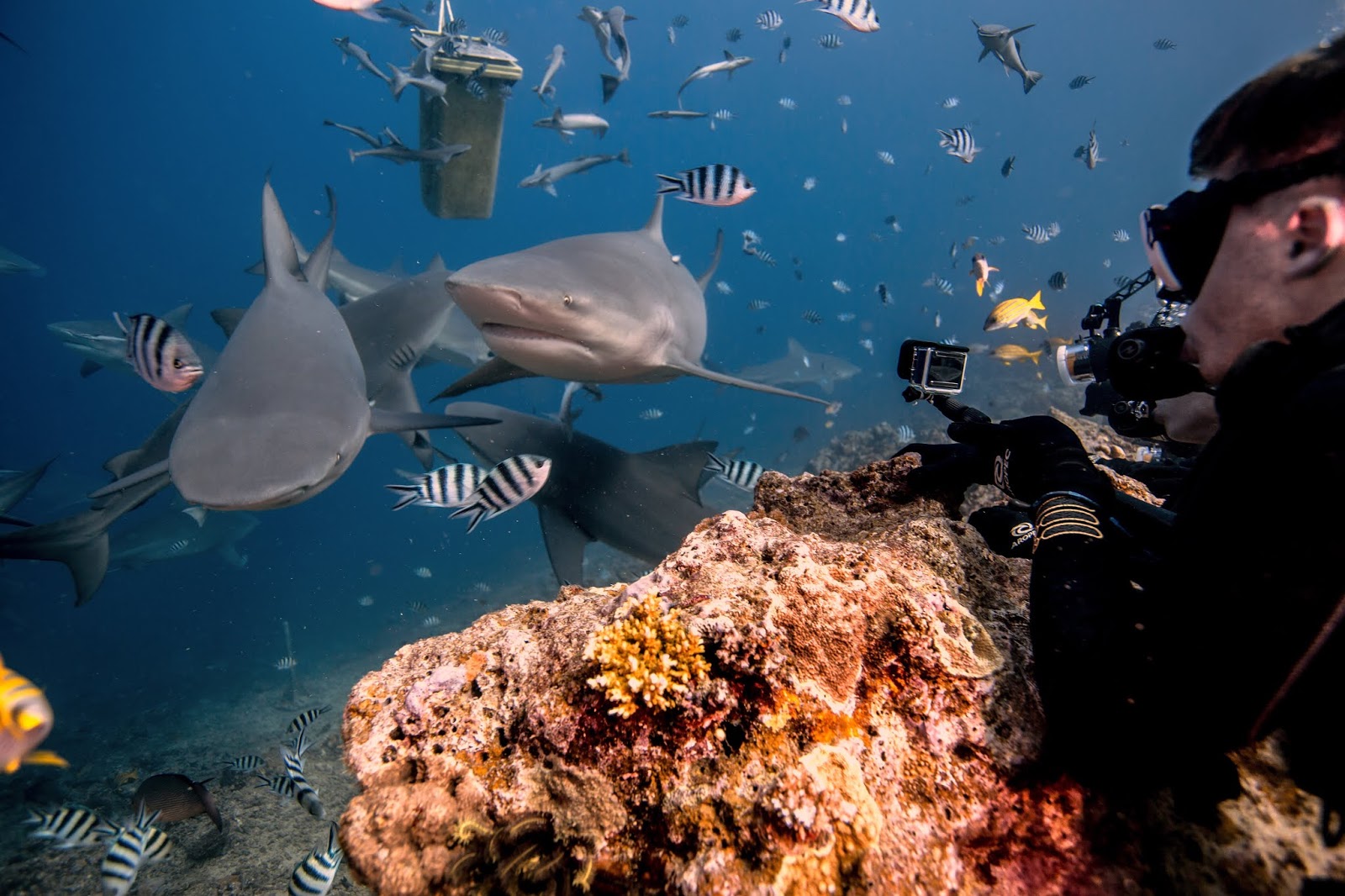
Bull Shark at the Shark Reef Marine Reserve
If you ever heard of what Valerie Taylor called the best shark dive in the world, she was referring to the dive at the Shark Reef Marine Reserve, operated by none other than BAD. And speaking of the Shark Reef Marine Reserve, it was created by BAD in 2004. Initial fish counts at the reef showed about 280 different species of fish, which is very bad for the south pacific. After 10 years of protecting the reef, the number of species increased to 480! As of November, 2014, Shark Reef Marine Reserve has been designated Fiji’s first National Marine Park and BAD was being entrusted with its day-to-day management. To my knowledge, this is the first national park in the world that was created due to the efforts of a single private entitiy.

There are a few sharks to be encountered
But creating a national park is not all that BAD has accomplished. They also partnered with Projects Abroad to create Mangroves for Fiji, a project designed to combat global warming and now their latest, My Fijishark a shark adoption program benefitting protection and conservation of the sharks in Fiji.


Congratulations to BAD for being the best conservation shark diving operation! Keep up the good work!

The BAD boys and girls, celebrating!
Shark Diver is proud to be using BAD for our Bull Shark diving expeditions to Fiji. We are heading there in May, and we can book a Bull Shark dive for you anytime of the year.


For more information on our Bull Shark diving adventures, call us at 619.887.4275 or email crew@sharkdiver.com for more information.

Let's go Shark Diving!

Cheers,
Martin Graf
CEO Shark Diver

About Shark Diver. As a global leader in commercial shark diving and conservation initiatives Shark Diver has spent the past decade engaged for sharks around the world. Our blog highlights all aspects of both of these dynamic and shifting worlds. You can reach us directly at staff@sharkdiver.com.

Monday, February 11, 2019

Get to know "Lucy" a Great White Shark at Guadalupe


Instagram 
I love "Lucy", and I'm not referring to the popular TV show of the 50ies. "Lucy" is a large female Great White Shark, that is regularly visiting Guadalupe Island. Most mature females are only seen every other year. They mate at Guadalupe Island and then stay away from the Island until after they give birth off the coast of Baja and in the Sea of Cortes, about 18 months after they get pregnant at Guadalupe.


In 2008 she suffered and injury to her tail, most likely from a bite by another shark. Her tail is pretty much mangled and it probably affects her speed. Even though she is definitely a mature female,  we saw her every year until 2014, which meant that she didn't get pregnant, since pregnant females stay away from Guadalupe for a season and return every other year. I don't know if the mangled tail was the reason she didn't seem to get pregnant for all those years, but fortunately she has started showing up every other year since then. Hopefully this means that she is indeed getting pregnant now. We last saw her in 2018, so most likely we won't see her again until 2020.


"Lucy's" tail makes it very easy to identify her. Usually we identify the individual sharks by their coloration. The transition from the white underbelly to the grey top is unique for every individual. Some people try to identify the sharks by their scars. That is how "Bite Face" got his name. The problem with scars is that they heal and if that is the only identifying characteristic you have, you would not recognize that same shark when it comes back the following year. Mutilations, like Lucy's tail don't change and can be used in conjunction with the markings to identify her. We have a photo id database that is managed by Nicole Nasby-Lucas from the Marince Conservation Science Institute, with over 220 individual sharks in identified.

If you are coming out on one of our "science" expeditions, you'll get a chance to learn how to identify these sharks from Nicole herself. You will also get the complete photo ID database, so you can identify all the sharks you encountered and what's really cool, you will then be able to identify the sharks you see on TV. How awesome will it be, when you see a shark on TV and realize that this is the individual that swam inches from your face at Guadalupe?


Even with her tail slowing her down, she seems to be healthy in every other way. She is definitely getting enough food and is holding her own among all the sharks at the Island. Lucy is a very curious shark and she swims very close to the cages, making eye contact with our divers as she is gliding by slowly.


I hope to see Lucy when we return in the fall. I do have mixed emotions though. While I would love to see her, it would of course mean that she didn't get pregnant last season.

If you would like to join us, or just get more information, call 619.887.4275, email crew@sharkdiver.com or visit our website www.sharkdiver.com

Let's go sharkdiving!

Cheers,

Martin Graf
CEO Shark Diver

About Shark Diver. As a global leader in commercial shark diving and conservation initiatives Shark Diver has spent the past decade engaged for sharks around the world. Our blog highlights all aspects of both of these dynamic and shifting worlds. You can reach us directly at staff@sharkdiver.com.
Instagram

Sunday, February 10, 2019

Get to know "Scarboard" a Great White Shark at Guadalupe


Instagram


"Scarboard" is another one of my favorite sharks. You're probably beginning to see a pattern here. I have a lot of "favorite" sharks. It's is amazing how all these sharks have different behaviors. Some are a bit skiddish, others are seemingly relaxed without a care in the world. Observing them for 16 years, I have grown attached to these guys and girls. However, as I always point out, I absolutely love these sharks, I'm crazy about them, but it is NOT a mutual feeling. As much as some people want you to believe that they just want to be hugged, they really don't. They are awesome predators, not out to get us, but they are not harmless pets either.

"Scarboard"

Scarboard is a massive female shark, one of our biggest at Guadalupe Island at around 19'. When we first met her in 2002, she was already huge. Like most of our adult females, she shows up at Guadalupe Island every other year. After getting mating at Guadalupe, she is spending the year in between offshore, before giving birth off the coast of Baja or in the Sea of Cortez. She doesn't have any mutilations, like "Lucy" and so many others, but she does have a very unique characteristic that makes identifying her easy. She has a very distinct line from her nose halfway to her dorsal fin. Where most Great White Sharks' lines have a continuous curve, Scarboard's is straight.

"Scarboard"
After we first encountered her in 2002, she came back in 04 and 06, but then we didn't see her again until 2011. We don't know, if we simply didn't see her, or if she stayed away from Guadalupe for 5 years.

When we don't see a shark during the season we expect to see them, we always worry that something might have happened to them. Luckily, sometimes, like in Scarboard's case, we worry about nothing. Where do they go during that extended time away from the Island, what do they do? There is so much we don't know about those sharks.


The first time we saw Scarboard, after her 5 year absence, I was in the middle of our 2 cages, she slowly swam by the first cage, checking out each individual diver and when she came to me, she looked me straight into the eyes, stopped and did a 180 degree turn, looked at me again, swam off, turned and swam back at me, stopped again, turned and swam off. It looks like that she recognized me, even after a 5 year absence.

2 seasons ago, "Scarboard" was being used for protection by some bait fish. I've never seen anything like that before. When she swam by, she looked like the "Bearded Lady".

Scarboard the "Bearded Lady"
 
A lot of people are surprised to learn that Great White Sharks recognize individual divers. The fact that they do is not as strange as it seems. We know of lots of fish that recognize divers. Groupers that have a favorite individual they follow around, moray eels that come out of their holes when they recognize a diver, Wolf eels that wrap themselves around the neck of an individual etc. It's important to remember though, just because White Sharks recognize individual divers, doesn't mean that they "love" us, want to be petted, or have any feelings towards us. We need to respect them for what they are, amazing predators, neither mindless killers, nor harmless pets.


For me there is nothing quite like seeing a familiar shark and realize it recognizes me as well. It still amazes me that we keep seeing the same individuals on a regular basis. They migrate thousands of miles, but come right back to the same spot.

If you want to find our for yourself what it's like to come face to face with a great white shark and want to learn how to identify these sharks, join us on one of our "science" expeditions. We do have some spaces open and would love to introduce you to our sharks.

Call 619.887.4275, email crew@sharkdiver.com or visit www.sharkdiver.com for more information.

Let's go shark diving!

Cheers,

Martin Graf
CEO Shark Diver

About Shark Diver. As a global leader in commercial shark diving and conservation initiatives Shark Diver has spent the past decade engaged for sharks around the world. Our blog highlights all aspects of both of these dynamic and shifting worlds. You can reach us directly at staff@sharkdiver.com.

Tuesday, November 27, 2018

Shark Diver and Great White Shark research.


Shark Diver has been running trips with Great White Sharks at Guadalupe Island since 2000. Our owner, Martin Graf, encountered these sharks while SCUBA and freediving there for about 10 years prior to the first shark dive. Mostly while spearfishing, he, along with many  other divers, started to encounter more and more great white sharks, which led us to explore the possibility of specific shark diving there. Little did we know that we discovered arguably the best place in the world to observe these awesome creatures. Typically crystal clear waters, with male and female sharks of all sizes in abundance, Guadalupe Island has become the premier place to dive with Great White Sharks.

Lucy

A couple of years after we started shark diving, the Marine Conservation Science Institute, MCSI, began putting together a photo ID database, to keep track of all the sharks sighted at Guadalupe Island. Our ability to identify the individual sharks is what really got me hooked on shark diving. After a few expeditions, I started to get a little bored with watching the sharks seemingly doing the same thing over and over. Luckily for me, just before I decided to stop going there, something amazing happened. A shark, later named "Shredder" swam really close to the cage and made eye contact with me. I realized that he was as much interested in us, the divers, as we were in him. He made eye contact with each individual as he swam along our cage. Realizing that he was checking me out instantly fascinated me. Knowing that they look at us as individuals made me realize that they are all individually different as well. For a lack of a better word, they all have different "personalities".  Thanks to the Photo ID database, we have the ability to keep track of all the different individuals we encounter at Guadalupe. We use the transition from the white belly to the grey top, which is like a fingerprint, along with mutilations and individual characteristics to identify the sharks. So now, after diving with the Great White Shark for 18 years, I'm more excited than ever to go back. I don't care if it is the last dive of the last trip, I'm always eager to go into the water. Who is back? Who is new? What are they up to now? I can't wait to go back.

Scarboard

Of course maintaining a database involves some expenses. It is time consuming work to look through literally thousands of pictures and videos, to determine who all the sharks that were sighted are. Initially the research was funded through grants, but after about 2012, those funds ran out. When Nicole Lucas from MCSI told me that the research was no longer funded, we decided that we had to do something to keep financing that important database. Shark Diver specializes in identifying each individual shark and giving our guest all the information about them. What year did we first see it, what has this shark done in the past, is it a brand new individual that we have never seen before? These are the things we like to share with our guests and that would of course be impossible without an updated and maintained database. The need to maintain this database is why we came up with the concept of our "Science Expeditions". Our expeditions are designed to raise funds for MCSI and specifically for the maintaining of the database. Shark Diver donates a spot on the expeditions hosted by Nicole to MCSI, and our divers on all of our trips get a copy of that photo ID database. On the expeditions where Nicole Lucas acts as the host, she shares the results of her research with our divers. Not only do you support the ongoing research by joining us on our expeditions, but you'll learn how to identify the individual sharks you see. How cool will it be when you watch shark week the next time and you can say "This is the shark that swam right by me!"? All of our expeditions are either hosted by Nicole or by our owner Martin Graf, who has been diving with these sharks since before there was shark diving at Guadalupe Island. He probably has more hours observing these sharks than anyone at the Island.

Slashfin

Shark Diver is committed to not only give you an experience of a lifetime, but to also foster a personal connection to the sharks you encounter, all while supporting conservation. Shark Diver also started the Shark Free Marinas, which has since been taken over by the Humane Society.

 Let's go shark diving!

About Shark Diver. As a global leader in commercial shark diving and conservation initiatives Shark Diver has spent the past decade engaged for sharks around the world. Our blog highlights all aspects of both of these dynamic and shifting worlds. You can reach us directly at staff@sharkdiver.com.

Thursday, April 5, 2018

Bull Shark with Cancer?


Instagram 
There are a lot of misconceptions when people talk about sharks. One of them is the myth that they don't get tumors or cancer. We previously talked about sharks with cancer, here and here, but while those 2 blogs were about a Great White Shark, we also have a Bull Shark in Fiji with a tumor growing out of her mouth. Her name is "Ms Jaws".

DaShark from Beqa Adventure Divers thinks it all started when he first saw her swimming around with a fishing popper stuck to her jaw.

                                     Video ©DaShark Beqa Adventure divers, source

Her jaw got progressively worse. This photo shows the progression of her lesion from 2011-2013.
Photos by Sam Cahir, predapix

When I met "Ms Jaws" for the first time in 2014, her jaw already looked like this.


The next time I saw her was in 2016 and she looked a lot worse. Her jaw was hanging down and it looked like it would be impossible for her to feed successfully.


Aside from her badly broken jaw and tumor, she did seem to be OK though. She didn't look skinny or showed any obvious signs of malnutrition. I have to admit that I was worried about her and didn't have high hopes of her surviving much longer.

                                          video ©Martin Graf www.sharkdiver.com

Now we have some good news! DaShark just reported that "Contrary to my dire prediction, Mrs. Jaws is alive and kicking - and judging from her girth and body shape, she is very capable of feeding herself which is real good news indeed!"

He also posted a video of her swimming around on facebook here and you can read his blog here.

If you are interested in more information on this particular shark's tumor, read this paper by Juerg Brunschwiler from the ETH University in Zuerich.

I really hope that she will continue to do well. She is a remarkable animal.

Of course, if you really want to know how she is doing, join us in May on our expedition to Fiji, where you can look for her on our Bull Shark dives. We have a couple of openings left. Call us at 619.887.4275 or email crew@sharkdiver.com for more information.

Let's go shark diving!

Cheers,
Martin Graf
CEO Shark Diver

About Shark Diver. As a global leader in commercial shark diving and conservation initiatives Shark Diver has spent the past decade engaged for sharks around the world. Our blog highlights all aspects of both of these dynamic and shifting worlds. You can reach us directly at staff@sharkdiver.com.

Sunday, November 26, 2017

Great White Mystery?


Instagram 
In 17 years of diving with the Great White Sharks at Guadalupe Island, we have learned a lot about these awesome creatures. From not knowing where they are heading when they leave the Island, to thinking they are heading to an area offshore to mate, to finding out that we were wrong on that and realizing that they are actually mating at Guadalupe, we have come a long way.


What never ceases to amaze me is the fact that we keep learning new things and that things we thought we knew were actually wrong. Observing them over time has given us some insights into their behavior and how the relate to each other and how their personality changes as they grow. The most important thing I have learned is that just when you definitively think you know something about them, you find out that it may not always be true.

First I have to make a disclaimer. I'm not a marine biologist, so most of what I know about their biology and migration I learned from my friends who are biologists and study these sharks. What I know about their behavior comes from literally thousands of hours spent observing them, both in the water and from above.

The latest theory that has come into question is how the shape of their teeth changes as they growand the reason for that.

Georgina French, a PhD student at the University of Sussex, published a new study that deals with that theory.

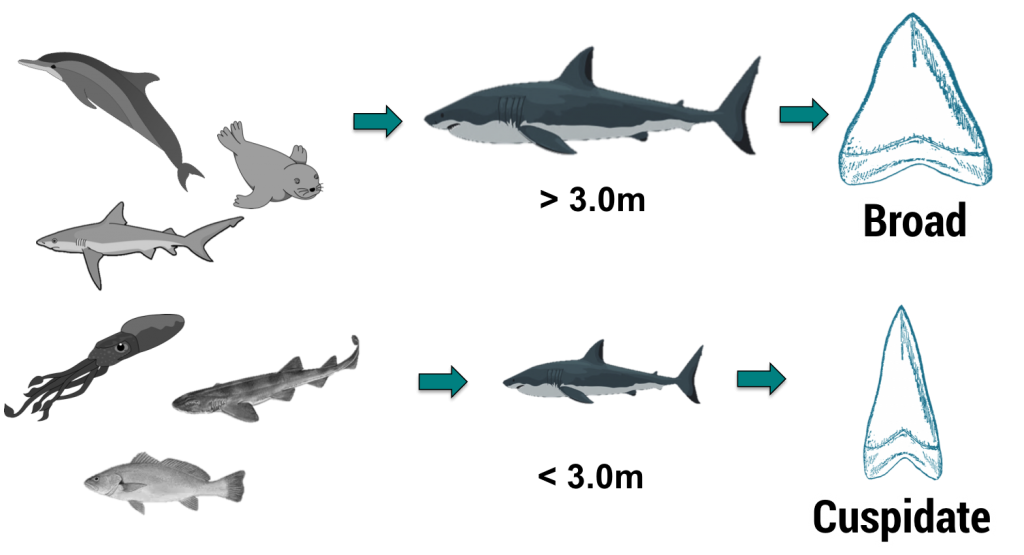
From her paper: Up until now, scientists have accepted that white sharks start out their lives with cuspidate (pointy) teeth, which are thought to be adapted for gripping onto slippery fish. When the sharks hit roughly 3m in length, they’re then thought to develop much broader teeth, which are believed to be adapted for catching and eating marine mammals like seals and dolphins. This shift in diet and tooth shape with age/size is referred to an ontogenetic shift.
 
©Georgina French
Her new discovery seems to be that there is a distinct difference between male and females, something I have never heard before.

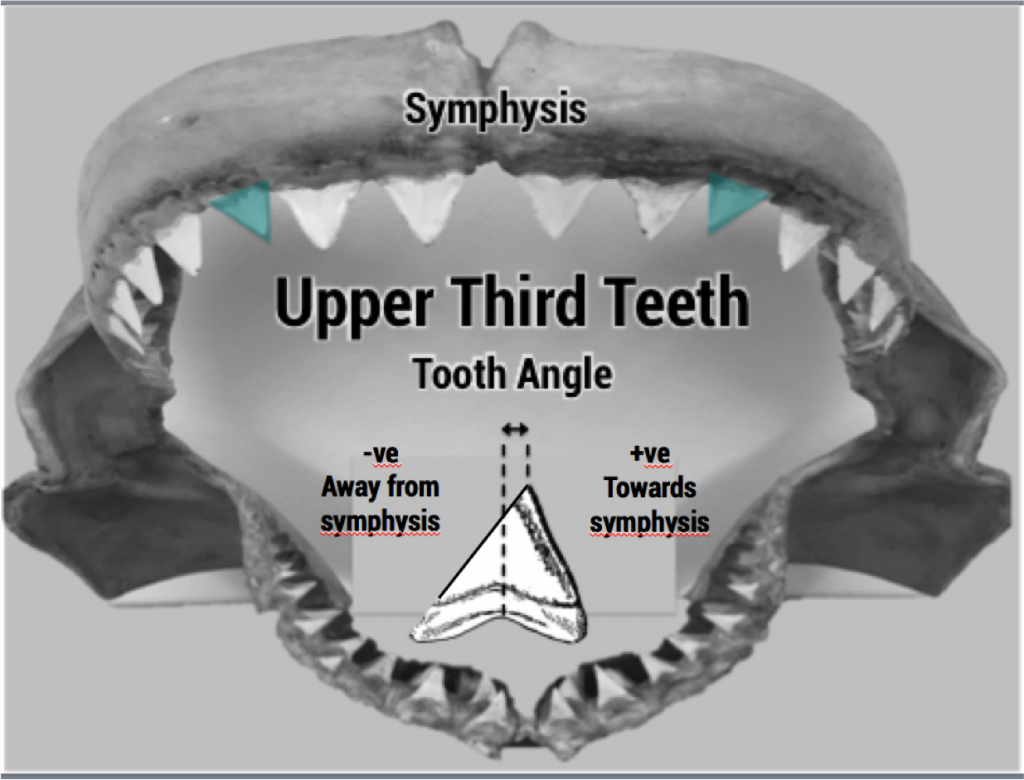
She writes: Previous studies of white shark teeth have always lumped males and females in together, despite the fact that they are quite different in other aspects of their biology and ecology. I decided to explore their tooth shape/shark length relationships separately. When I combined all of the data from the photographs, the literature and the KZN jaws, I found startling differences between the sexes.  While males seem to follow the accepted pattern of broadening teeth when they get to about 3m long, females didn’t. Instead, a female of any size could have either broad, pointed or intermediately shaped teeth. Females also didn’t change the angle of their upper third teeth, while males did.

©Georgina French
As with any new discovery, there are instantly a bunch of new questions. In this case, first and foremost, 

What does this mean?

 Broadly speaking, the results indicate that either males and females are feeding on different things as they grow up, or that the tooth shape change isn’t related to diet.
When sharks mate, males hold onto the females using their teeth. It’s possible that the broadening of the teeth and the change in tooth angle found in males could be an adaptation for mating, rather than for handling different prey. Alternatively, females with broad, pointy and intermediate teeth may be specializing on different types of prey i.e. they are polymorphic. I also found significant variation in the size at which males developed their broad teeth, which combined with other evidence indicates that some individuals mature a lot more quickly than others. Polymorphism and differing rates of maturity among individuals can have pretty big ecological consequences, and these factors need to be taken into account in future studies and white shark management.

This is what I love about working and diving with Great White Sharks. Every question that gets answered opens up a lot more questions. I wonder to what new insights about Great White Sharks this new discovery leads to. Maybe we should call these sharks Great White Mysteries instead.

Let's go shark diving and discover new and exciting things about these awesome animals!

Cheers,
Martin Graf
CEO Shark Diver 

About Shark Diver. As a global leader in commercial shark diving and conservation initiatives Shark Diver has spent the past decade engaged for sharks around the world. Our blog highlights all aspects of both of these dynamic and shifting worlds. You can reach us directly at staff@sharkdiver.com.

Monday, October 23, 2017

Deadly tiger shark stalks stranded diver?


Instagram 
The sensationalist media is at it again, or should I say still at it? This time it's an outlet not normally prone to sensational headlines. Sky News has a headline that reads "Deadly tiger shark stalks stranded diver four miles back to shore"
 
Tiger Shark
Turns out that a spearfisherman got separated from his boat and had to swim back 4 miles to shore. What they describe as "A diver who became separated from his boat has said he is lucky to be alive after swimming miles back to shore while being stalked by a large tiger shark." and "He swam…in shark-infested waters. I just can't believe anybody could do that. It's such a massive effort.", was in reality just a really long swim, where he encountered a couple of sharks.


That "deadly" shark was just checking him out and the diver even says that "For about 500 metres the shark swam on the same path as me towards the shore and then in a moment banked and disappeared completely as if to say 'you're OK now, I'll leave you alone'. So the real danger to the diver were not the sharks, but the fact that he had to swim for 4 miles to reach shore.
 
Tiger Shark coming close to a diver
Maybe a headline that says "Diver lost at sea has to swim 4 miles to reach shore" or something similar would be more appropriate than making the sharks out to be those mindless killers again, would be more appropriate.
 
Me with a Tiger Shark ©Rene Buob
We dive with Tiger Sharks in various places around the world and learned that we have to respect them, but there is no need to fear them. They are neither mindless killers, nor harmless pets, but awesome predators that are curious, but in most cases not interested in attacking us.

Cheers,
Martin Graf
CEO Shark Diver


About Shark Diver. As a global leader in commercial shark diving and conservation initiatives Shark Diver has spent the past decade engaged for sharks around the world. Our blog highlights all aspects of both of these dynamic and shifting worlds. You can reach us directly at crew@sharkdiver.com.

Thursday, July 27, 2017

How can you have your own private "Shark Week"?


Instagram 
Next week we start our 17th season at Guadalupe Island, diving with Great White Sharks.

Kinga Phillips has been coming out with us twice so far, and she's written an excellent blog about her experience and how you can have your own private shark week.


I like how she described the Great White Shark: "The highlight of the trip is spending cage time face to face with one of nature’s most incredible examples of the perfect predatory form. So perfect evolution took one look at her design roughly 100 million years ago, dropped the mic and walked away."


She provides a lot of insight, not just about the actual experience of diving with Great White Sharks, but about conservation and eco tourism as well.

Read her entire blog here

For more information on how you can experience your own "real sharkweek", call us at 619.887.4275, email crew@sharkdiver.com or visit www.sharkdiver.com

Let's go Shark Diving!

Cheers,
Martin Graf
CEO Shark Diver
About Shark Diver. As a global leader in commercial shark diving and conservation initiatives Shark Diver has spent the past decade engaged for sharks around the world. Our blog highlights all aspects of both of these dynamic and shifting worlds. You can reach us directly at staff@sharkdiver.com.

Monday, June 26, 2017

Get to know the Great White Sharks of Guadalupe Island


Instagram 
Over the last couple of weeks I wrote about a few of the Great White Sharks we encounter at Guadalupe Island. Before I introduce you to more of those, I want to tell you a bit about the sharks we are less familiar with. While we have a lot of sharks we see every year, or every other year for the females, there are many that don't follow that pattern. Some sharks we have only seen during one season, while others visit Guadalupe at irregular intervals.

"Geoff Nuttall" was a regular from 2003 until 2011, then he wasn't seen for 2 years, before returning to his annual returns in 2014.

"Geoff Nuttall"
Quezalcoatl, #58 in our database was first seen in 2005 and then didn't appear until 2013, an absence of 8 years. Where did he go during those 8 years? While we have really good tracking data from the sharks that were outfitted with satellite tags, showing the migration pattern of the sharks we see regularly, we have no data on where the shark we see infrequently are going. There is so much we don't know.

#56 Quetztalcoatl
Dr. Bob, a very curious and active 13" sub-adult shark only visited in 2014, the now world famous "Deep Blue" was seen in 1999 and then again in 2012. "Lou", "Oscar" and "Hefe" all had absences of 6 or more years, before showing up again. Some of these absences may simply be due to them not showing up at the cages during those years. We simply don't know.

Below is a video of "Dr. Bob". Check out his bite marks on the right and look at his eyes as he swims over the camera. He's looking straight down at the divers.


My favorite shark, "Shredder" has not been seen since 2011, after 11 continuous years at Guadalupe. I hope that his absence is just like those of the other sharks that were taking a break from visiting Guadalupe, but I have to say that I'm worried about him. He's never been the most careful individual in the first place, as evidenced by his many scars and mutilations.

Anyway, I can't wait to go back to Guadalupe and see who's back. I'm equally excited to meet some new sharks. In the last 2 years we added over 50 new individuals to our database! Are they going to be back? Come join us for a real "sharkweek" and find out!

Call us at 619.887.4275, email crew@sharkdiver.com or visit www.sharkdiver.com for more info.

Let's go Shark Diving!

Cheers,
Martin Graf
CEO Shark Diver

About Shark Diver. As a global leader in commercial shark diving and conservation initiatives Shark Diver has spent the past decade engaged for sharks around the world. Our blog highlights all aspects of both of these dynamic and shifting worlds. You can reach us directly at staff@sharkdiver.com.

Tuesday, June 20, 2017

Get to know "Luca Arnone" Great White Shark at Guadalupe Island


Instagram 
"Luca Arnone" listed as #163, is one of our recent additions to the photo ID database at Guadalupe Island. We first met him in 2013 and he has been coming back every year since.


Last year "Luca" looked a bit rough. He was partially wrapped in a thick rope, which fortunately was being removed by Dr. Mauricio Hoyos, the local researcher at Guadalupe Island. The cut caused by the rope was not too deep and since white sharks have an amazing ability to heal, it should not cause him any permanent harm.


"Luca" is a fairly small shark, probably just shy of 12', but he doesn't seem to mind the bigger sharks and is a frequent visitor to our cages. 


Luca was named by one of our diver, who named 2 different sharks, one after his son, Luca and the other after his daughter Milana. Naming a shark is one way you can support the ongoing research at Guadalupe Island. The Marine Science Conservation Institute, "MCSI" who maintains the photo ID has various levels of sponsorship available, including naming a shark.


Another way you can support "MCSI" is by coming on one of our "science" trips. A portion of these expeditions goes to fund the research and Nicole Lucas-Nasby, the researcher maintaining that database is coming along as the host. She is sharing the results of her research with you and if we encounter a new shark, you'll also have an opportunity to name that shark. How cool would it be, if you see a shark that you named on "Sharkweek"?

If you want to find our for yourself what it's like to come face to face with a great white shark and maybe name one of these sharks, come join us on one of our expeditions. We do have some spaces open and would love to introduce you to our sharks.

Call 619.887.4275, email crew@sharkdiver.com or visit www.sharkdiver.com for more information.

About Shark Diver. As a global leader in commercial shark diving and conservation initiatives Shark Diver has spent the past decade engaged for sharks around the world. Our blog highlights all aspects of both of these dynamic and shifting worlds. You can reach us directly at staff@sharkdiver.com.

Thursday, June 15, 2017

Get to know "Scarboard" Great White Shark at Guadalupe Island


Instagram 
"Scarboard" is another one of my favorite sharks. You're probably beginning to see a pattern here. I have a lot of "favorite" sharks. It's is amazing how all these sharks have different behaviors. Some are a bit skiddish, others are seemingly relaxed without a care in the world. Observing them for 16 years, I have grown attached to these guys and girls. However, as I always point out, I absolutely love these sharks, I'm crazy about them, but it is NOT a mutual feeling. As much as some people want you to believe that they just want to be hugged, they really don't. They are awesome predators, not out to get us, but they are not harmless pets either.

"Scarboard"

Scarboard is a massive female shark, one of our biggest at Guadalupe Island at around 19'. When we first met her in 2002, she was already huge. Like most of our adult females, she shows up at Guadalupe Island every other year. After getting mating at Guadalupe, she is spending the year in between offshore, before giving birth off the coast of Baja or in the Sea of Cortez. She doesn't have any mutilations, like "Lucy" and so many others, but she does have a very unique characteristic that makes identifying her easy. She has a very distinct line from her nose halfway to her dorsal fin. Where most Great White Sharks' lines have a continuous curve, Scarboard's is straight.

"Scarboard"
After we first encountered her in 2002, she came back in 04 and 06, but then we didn't see her again until 2011. We don't know, if we simply didn't see her, or if she stayed away from Guadalupe for 5 years.

When we don't see a shark during the season we expect to see them, we always worry that something might have happened to them. Luckily, sometimes, like in Scarboard's case, we worry about nothing. Where do they go during that extended time away from the Island, what do they do? There is so much we don't know about those sharks.


The first time we saw Scarboard, after her 5 year absence, I was in the middle of our 2 cages, she slowly swam by the first cage, checking out each individual diver and when she came to me, she looked me straight into the eyes, stopped and did a 180 degree turn, looked at me again, swam off, turned and swam back at me, stopped again, turned and swam off. It looks like that she recognized me, even after a 5 year absence.

Last season "Scarboard" was being used for protection by some bait fish. I've never seen anything like that before. When she swam by, she looked like the "Bearded Lady".

Scarboard the "Bearded Lady"
 
A lot of people are surprised to learn that Great White Sharks recognize individual divers. The fact that they do is not as strange as it seems. We know of lots of fish that recognize divers. Groupers that have a favorite individual they follow around, moray eels that come out of their holes when they recognize a diver, Wolf eels that wrap themselves around the neck of an individual etc. It's important to remember though, just because White Sharks recognize individual divers, doesn't mean that they "love" us, want to be petted, or have any feelings towards us. We need to respect them for what they are, amazing predators, neither mindless killers, nor harmless pets.


For me there is nothing quite like seeing a familiar shark and realize it recognizes me as well. It still amazes me that we keep seeing the same individuals on a regular basis. They migrate thousands of miles, but come right back to the same spot.

If you want to find our for yourself what it's like to come face to face with a great white shark and want to learn how to identify these sharks, join us on one of our "science" expeditions. We do have some spaces open and would love to introduce you to our sharks.

Call 619.887.4275, email crew@sharkdiver.com or visit www.sharkdiver.com for more information.

Let's go shark diving!

Cheers,

Martin Graf
CEO Shark Diver

About Shark Diver. As a global leader in commercial shark diving and conservation initiatives Shark Diver has spent the past decade engaged for sharks around the world. Our blog highlights all aspects of both of these dynamic and shifting worlds. You can reach us directly at staff@sharkdiver.com.