Showing posts with label bull shark. Show all posts

Thursday, January 31, 2019

Is shark diving good for conservation?


InstagramConservation and Shark Diving are often seen as opposites and not compatible. Let's look at some of the concerns raised and see how valid they are.


The biggest issue a lot of people have with shark diving and specifically feeding dives is that "It conditions sharks to associate people and divers with food!" While it does indeed condition sharks to associate divers with food, it definitely doesn't condition those sharks to associate divers AS food. The sharks at the Shark Reef Marine Reserve are being fed 5 days a week and I dove on a non feeding day. I got to about 45 ft when a few Bull Sharks sharks approached me, clearly looking for food. After they swam around me for a little bit, they realized that I didn't bring any food and they left. At no point did they show any indication that they looked at me as food or made any attempt to bite me. I actually think that being around divers at feeding sites makes the sharks less likely to attack. If I would be approached by a bunch of Bull Sharks at a non feeding site, I would be a lot more concerned, since it is unusual for them to approach divers without being attracted by some kind of food or chum source.

Another argument against feeding sharks is that it alters their feeding and migration behavior. Since I'm not a scientist that has studied this issue,  my experience comes from observing and diving with sharks, I defer to those who actually studied this issue. There are a few good papers out that are addressing this.

This one is from 2013 by Juerg Brunnschweiler and Adam Barnett: https://fijisharkdiving.blogspot.com/2013/03/feeding-bull-sharks-in-fiji-paper.html 

Or this one: http://fijisharkdiving.blogspot.com/2010/06/does-shark-feeding-influence-shark.html 

Essentially they are saying that it has no real impact on their migration and hunting behavior. Click on the links above for more detailed information.

OK, so shark feeding is not as bad as people think, but is it actually good for conservation? While there are certainly some outfits that don't have conservation in mind when they do their shark dives, there are also responsible operators who care deeply about conservation and who have accomplished some amazing things.

We all know about the problem associated with the overfishing of sharks. If we want to protect sharks, we have to find a way for the shark fishermen to make a living doing something else.When we argue that a life sharks is worth hundreds of times the amount of a dead shark, we have to make sure that a life shark is worth more to the fishermen as well and not just to the tourism industry.

This is what Beqa Adventure Divers (BAD) has accomplished in Fiji. They got a fishing village to agree to not fish on a reef in exchange for a fee paid by all the divers. "They also hired people from fishing villages and trained them to be Divemasters, Instructors and Boat Captains. When they started diving at that reef, an initial fish count netted about 280 different species of fish, which for the south pacific is very dismal. Ten years later, another fish count showed over 480 different species. The number of sharks seen at the feeds also increased from a handful to sometimes over 100.


The efforts of BAD has resulted in the reef the shark dive takes place on being declared a national underwater marine park, the Shark Reef Marine Reserve. To my knowledge this is the first time a private entity managed to create a national park. Not only does the fishing village continue to receive money from the divers, which they use for educating their children, creating opportunities outside of fishing for them, but the ones who are still fishing now catch more fish outside of the reserve than they ever caught in and outside. This is clearly a win win situation, where the sharks, the divers and the fishermen all profit.


So clearly, operating a shark feeding dive has benefited not only the sharks, but the reef as a whole. Shark Diver is proud to support BAD by taking a group of divers to dive with them every year. This year we are heading there in May. Since we are based out of a hotel, the dates are flexible. Call Cindy at 619.887.4275 or email crew@sharkdiver.com for more info.

Here is a little video of what you can expect to see on your trip.


Let's go Shark Diving!

Cheers,
Martin Graf

About Shark Diver. As a global leader in commercial shark diving and conservation initiatives Shark Diver has spent the past decade engaged for sharks around the world. Our blog highlights all aspects of both of these dynamic and shifting worlds. You can reach us directly at staff@sharkdiver.com.

Thursday, April 5, 2018

Bull Shark with Cancer?


Instagram 
There are a lot of misconceptions when people talk about sharks. One of them is the myth that they don't get tumors or cancer. We previously talked about sharks with cancer, here and here, but while those 2 blogs were about a Great White Shark, we also have a Bull Shark in Fiji with a tumor growing out of her mouth. Her name is "Ms Jaws".

DaShark from Beqa Adventure Divers thinks it all started when he first saw her swimming around with a fishing popper stuck to her jaw.

                                     Video ©DaShark Beqa Adventure divers, source

Her jaw got progressively worse. This photo shows the progression of her lesion from 2011-2013.
Photos by Sam Cahir, predapix

When I met "Ms Jaws" for the first time in 2014, her jaw already looked like this.


The next time I saw her was in 2016 and she looked a lot worse. Her jaw was hanging down and it looked like it would be impossible for her to feed successfully.


Aside from her badly broken jaw and tumor, she did seem to be OK though. She didn't look skinny or showed any obvious signs of malnutrition. I have to admit that I was worried about her and didn't have high hopes of her surviving much longer.

                                          video ©Martin Graf www.sharkdiver.com

Now we have some good news! DaShark just reported that "Contrary to my dire prediction, Mrs. Jaws is alive and kicking - and judging from her girth and body shape, she is very capable of feeding herself which is real good news indeed!"

He also posted a video of her swimming around on facebook here and you can read his blog here.

If you are interested in more information on this particular shark's tumor, read this paper by Juerg Brunschwiler from the ETH University in Zuerich.

I really hope that she will continue to do well. She is a remarkable animal.

Of course, if you really want to know how she is doing, join us in May on our expedition to Fiji, where you can look for her on our Bull Shark dives. We have a couple of openings left. Call us at 619.887.4275 or email crew@sharkdiver.com for more information.

Let's go shark diving!

Cheers,
Martin Graf
CEO Shark Diver

About Shark Diver. As a global leader in commercial shark diving and conservation initiatives Shark Diver has spent the past decade engaged for sharks around the world. Our blog highlights all aspects of both of these dynamic and shifting worlds. You can reach us directly at staff@sharkdiver.com.

Friday, October 27, 2017

What causes sharks to have crooked spines?


Instagram 
Earthtouchnews has an article describing a bull shark with a crooked spine. That shark was found by the shark lab in Bimini. They named him "Quasimido" and are speculating on what caused that deformity.

The Bimini Shark Lab team secures "Quasimodo" for workup (a short checkup that includes taking various measurements of the animal). Image: Chelle Blais/Bimini Biological Field Station
Sarah Keartes writes: "Dr. Natalie D. Mylniczenko, a veterinarian who has spent time with the Shark Lab beforepresented several possible explanations for the bull shark's strange skeleton. It's possible that a deep abscess, granuloma, or slow-growing cancer is to blame – but Quasimodo's overall state seems to suggest otherwise. If disease were at the root of the deformity, we would expect to see at least some abnormal behaviour. The more likely culprit, according to Mylniczenko, is either a congenital or traumatic incident. In either case, this would have occurred when the shark was very young, and over time, his body would have compensated and healed in a skewed position."

Read the full story here: https://www.earthtouchnews.com/oceans/sharks/meet-quasimodo-the-bull-shark-with-a-very-crooked-spine/
 
Image: Chelle Blais/Bimini Biological Field Station

This Bull Shark is not the only shark with a deformed spine. At Guadalupe Island, we have our own Great White Shark with the same deformation. When we first met her a couple of years ago, I nicknamed her "Kinky" because of the very distinct kink in her tail. I have no idea what caused that kink, since she doesn't have any obvious scars or signs of injury. She was named "Screaming Mimi" by someone through the "Sponsor a shark" program of the Marine Conservation Science Institute. That sponsor program, is one of the ways they raise funds for the Photo ID database at Guadalupe Island.
 
"Screaming Mimi"

Just like the "Quasimodo" in Bimini who was seen swimming around a couple of weeks after the people from the Shark Lab examined it, "Screaming Mimi" also seems to be doing well and has been very active around our cages at Guadalupe Island.


If you want to meet "Screaming Mimi", or any of our other sharks at Guadalupe, contact us at 619.887.4275, crew@sharkdiver.com or www.sharkdiver.com

Let's go shark diving!

Cheers,
Martin Graf
CEO Shark Diver
 
About Shark Diver. As a global leader in commercial shark diving and conservation initiatives Shark Diver has spent the past decade engaged for sharks around the world. Our blog highlights all aspects of both of these dynamic and shifting worlds. You can reach us directly at staff@sharkdiver.com.

Tuesday, August 30, 2016

I was surrounded by bull sharks!


Instagram 
I just got back from my 4th annual trip to Fiji, diving with the "BAD" (Beqa Adventure Divers') bull sharks of the Shark Reef Marine Reserve. It is an unbelievable experience to be surrounded by lots of these awesome predators.


We saw a shark or two
What really fascinates me is not the sheer number of sharks though.  The really interesting part is that I'm starting to recognize some individual sharks, not only by distinctive marks on them, but by their behavior.

Doing a lap, showing everyone that she got a tuna head.

Anyone thinking that "a bull shark is a bull shark" should come to this place and see for themselves. These sharks have very different "personalities", some very mellow and cautious, others not so much. Of course you need to do more than just one or 2 dives to notice these differences. The first few dives your are simply going to be blown away by the sheer number of sharks and and by how close they'll get to you.

Up close and personal!
Common wisdom holds that when it comes to sharks, size matters. The big shark always wins over a smaller shark. What I found is that this is not always the case. Some sharks think they are a lot bigger than they really are and compete with the bigger sharks for the tuna heads on offer. "Top Sail" for example is not one of the bigger sharks, but is very adept at getting more than her fair share of tuna heads.

Top sail getting a tuna head.
Another thing that totally surprised me is how cautious these sharks are, even when food is offered to them. Some sharks will not approach the feeder who's holding a tuna head and some sharks will only take a tuna head from a specific feeder. I would have thought that these bull sharks would pretty much go for any tuna head that is offered to them.


If all the bull sharks are not enough for you, just when you think the dive is over, there is the safety stop. Far from a boring hanging on to a line, waiting for the 3 minutes to pass, you are face to face wit a bunch of hungry white- and black-tip sharks, being fed by one of the divemasters.


I'm still very partial to "my" white sharks at Guadalupe, but I'm getting more and more taken by the bull sharks of the SRMR and can't wait for next year.

Sam face to face with a hungry white tip shark.
Thanks to all the guys at "BAD", (Beqa Adventure Divers) for your hospitality and another unforgettable trip. You are simply the best! Vinaka vakalevu!

Blacktip shark at the safety stop
In the coming weeks we'll be posting a special offer for next year's Fiji trip. My descriptions and pictures don't do these sharks justice. You'll have to come and experience them yourself.


Cheers,
Martin Graf
CEO Shark Diver


About Shark Diver. As a global leader in commercial shark diving and conservation initiatives Shark Diver has spent the past decade engaged for sharks around the world. Our blog highlights all aspects of both of these dynamic and shifting worlds. You can reach us directly at staff@sharkdiver.com.

Wednesday, June 15, 2016

I was surrounded by bull sharks!


Instagram 
I just got back from my 4th annual trip to Fiji, diving with the "BAD" (Beqa Adventure Divers') bull sharks of the Shark Reef Marine Reserve. It is an unbelievable experience to be surrounded by lots of these awesome predators.


We saw a shark or two
What really fascinates me is not the sheer number of sharks though.  The really interesting part is that I'm starting to recognize some individual sharks, not only by distinctive marks on them, but by their behavior.

Doing a lap, showing everyone that she got a tuna head.

Anyone thinking that "a bull shark is a bull shark" should come to this place and see for themselves. These sharks have very different "personalities", some very mellow and cautious, others not so much. Of course you need to do more than just one or 2 dives to notice these differences. The first few dives your are simply going to be blown away by the sheer number of sharks and and by how close they'll get to you.

Up close and personal!
Common wisdom holds that when it comes to sharks, size matters. The big shark always wins over a smaller shark. What I found is that this is not always the case. Some sharks think they are a lot bigger than they really are and compete with the bigger sharks for the tuna heads on offer. "Top Sail" for example is not one of the bigger sharks, but is very adept at getting more than her fair share of tuna heads.

Top sail getting a tuna head.
Another thing that totally surprised me is how cautious these sharks are, even when food is offered to them. Some sharks will not approach the feeder who's holding a tuna head and some sharks will only take a tuna head from a specific feeder. I would have thought that these bull sharks would pretty much go for any tuna head that is offered to them.


If all the bull sharks are not enough for you, just when you think the dive is over, there is the safety stop. Far from a boring hanging on to a line, waiting for the 3 minutes to pass, you are face to face wit a bunch of hungry white- and black-tip sharks, being fed by one of the divemasters.


I'm still very partial to "my" white sharks at Guadalupe, but I'm getting more and more taken by the bull sharks of the SRMR and can't wait for next year.

Sam face to face with a hungry white tip shark.
Thanks to all the guys at "BAD", (Beqa Adventure Divers) for your hospitality and another unforgettable trip. You are simply the best! Vinaka vakalevu!

Blacktip shark at the safety stop
In the coming weeks we'll be posting a special offer for next year's Fiji trip. My descriptions and pictures don't do these sharks justice. You'll have to come and experience them yourself.


Cheers,
Martin Graf
CEO Shark Diver


About Shark Diver. As a global leader in commercial shark diving and conservation initiatives Shark Diver has spent the past decade engaged for sharks around the world. Our blog highlights all aspects of both of these dynamic and shifting worlds. You can reach us directly at staff@sharkdiver.com.

Wednesday, February 24, 2016

Who is more aggressive, a Bull Shark or a Great White?


Instagram 
We hear a lot about how aggressive shark are. Some people think that if they encounter a shark in the ocean, they will get bit. This kind of thinking is at least partially fueled by the media that seems to portray any encounter with a shark as a near death experience.

I've been diving with Great White, Bull and Tiger Sharks for over 15 years now and have found that most sharks are actually pretty shy and not very aggressive. Despite the fact that shark bites and attacks are extremely rare, the common perception is that they are dangerous. When it comes to what species is most dangerous, people tell me that because they have more testosterone than any other shark, Bull Sharks are the most aggressive and therefore the most dangerous to humans.

It is true, that since Bull Sharks can swim and hunt in very shallow, brackish and even fresh water, they tend to be in much closer proximity to humans than Tiger or Great White Sharks. This obviously leads to a greater chance of an encounter with them, which can result in an occasional bite or attack. Such bites however remain extremely rare. Last year there were 96 shark bites with 6 fatalities reported worldwide. These numbers include all species of shark.

I think that a lot of people confuse feeding with aggression. Biting that is related to hunting or feeding has nothing to do with the testosterone level, but is simply and indication that the shark is hungry. Aggression has to do with defending their territory, establishing dominance and is usually directed toward another shark or a perceived competitor. So if we look at it that way, who is more aggressive, the Bull Shark, or the Great White Shark?

Well, let me show you a couple of pictures.


These pictures all show Great White Sharks with bite marks from their own kind. It is rare to see an adult Great White Shark that doesn't have some kind of scar or fresh bite mark on them. These sharks are very much into keeping their "personal space" and it is rare for them to touch each other, without there being some biting involved. Typically when 2 White Sharks encounter each other, they pass each other head on, to establish who is bigger. If that doesn't settle it, they tend to come back together and swim parallel with each other, to get a closer look. Now if that still doesn't settle it, the more dominant sharks usually shows the other who's boss by biting it on the head or in the gill area.

Now I want to stress that the aggression I have observed on White Sharks is shown towards other shark and not humans, or other animals in the ocean. Just like any other "dangerous" shark, they are not very likely to attack a human.


Add caption
2 of these sharks just got a tuna head, they show no aggression.

In the pictures above, you can see lot's of Bull Sharks swimming very close together and there doesn't seem to be any aggression. I've seen over 70 of those sharks, without noticing any that had bite marks on them. This is something that definitely can't be said about Great Whites.

It never ceases to amaze me, how little we know about sharks and how much of what we "know" is actually wrong. We tend to think that something like testosterone will have the same effect in sharks as it does in humans. On the flip side of the "sharks are mindless killer" attitude, there is the "sharks want to be hugged" crowd, that is trying to show how harmless these sharks are by riding, grabbing, flipping and hugging them.

Let's appreciate the sharks for who and what they are. They are not mindless killers, but neither are they harmless pets. As I always say, "I absolutely love "my" sharks, but it is not a mutual feeling and that is perfectly fine with me". I don't feel the need to assign human emotions to them, I love em just they way they are.

Cheers,
Martin Graf
CEO Shark Diver


About Shark Diver. As a global leader in commercial shark diving and conservation initiatives Shark Diver has spent the past decade engaged for sharks around the world. Our blog highlights all aspects of both of these dynamic and shifting worlds. You can reach us directly at staff@sharkdiver.com.

Friday, December 18, 2015

Conservation shark diving in Fiji

This is the 4th year Shark Diver is going to Fiji to dive with Bull Sharks at Beqa Shark Reef Marine Reserve. In the last 3 years, we have been diving with more than 70 Bull Sharks at a time, with Black Tip-, White Tip-, Grey Reef-, Nurse- and Lemon-Sharks also being seen on almost every dive. Occasionally we even got a visit from a Tiger Shark.


While I love "my" Great White Sharks, I have to say that it is hard to beat the excitement of what Ron and Valery Taylor called "The best shark dive in the world".


Our partner in Fiji is Beqa Adventure Divers "BAD". BAD is truly an exceptionally GOOD dive operation who was instrumental in creating the Shark Reef Marine Reserve, which is now officially a national marine park and fully protected.

Celebration - BAD Cut from Beqa Adventure Divers on Vimeo.

BAD is so good that the government of Fiji has designated them to be the official caretakers of the park, with their staff being the designated fish wardens, empowered to enforce the rules of the park.


BAD is also a carbon neutral operation that supports the Mangroves for Fiji, a vital project that not only helps to offset carbon emissions, but also provides a crucial habitat for many marine creatures, including sharks.


BAD describes itself as "a conservation project masquerading as a dive shop" and they really mean it. They are a prime example for how conservation and business can not only coexist, but actually be mutually beneficial. One of the ways they make sure that the project works is by not only paying a levy to the fishing villages in exchange for them to not fish at the reef, but also by hiring their staff from those villages to provide an alternative income to the villagers. All the dive staff at BAD is from those local fishing villages. To see how the project works, click here.


Shark Diver is diving in Fiji from May 8 - 29. A 7 day stay (5 days of shark diving), is starting at $1800 p/p double occupancy. The price includes 7 nights accommodation in a 4 star hotel, with a breakfast buffet edaily, 5 days of 2 tank shark diving and rt. airport transportation from Nadi airport. We can customize your dates and length of stay and also add some dives in the soft coral capital of the world. Cost of airfare from LA to Fiji varies from $1000 to about $1300, depending on day of departure.

We can also book your shark dive with "BAD" anytime of the year, with or without a hotel. Call us at 619.887.4275 or email staff@sharkdiver.com for more info, or to book.


Let's go shark diving!

Martin Graf
CEO Shark Diver


About Shark Diver. As a global leader in commercial shark diving and conservation initiatives Shark Diver has spent the past decade engaged for sharks around the world. Our blog highlights all aspects of both of these dynamic and shifting worlds. You can reach us directly at staff@sharkdiver.com.

Tuesday, March 3, 2015

Dead Sharks, Selfies, and Shark Fin Soup?

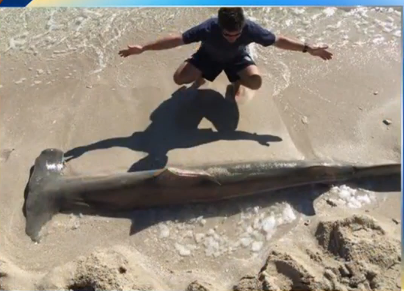
What is our obsession with taking pictures of ourselves with subjects that seem just a bit inappropriate? Now that smart phones have turned us all into photog wannabes, the rush to get pictures published on social media sites has also lead us to be wannabe reporters, as well.  Recently two sharks, a bull and a hammerhead, washed up dead on the shore of Miami Beach. One was bloated, the other with its fin cut off.  Once beach-combers saw the poor creatures, the camera phones came out and the snap-shot taking crowds were enough to make any paparazzi, surrounding a Hollywood celebrity, pale in comparison.  There was even a grown adult who pulled up on the head of one shark to get its mouth to open. What a photo op! "Hey kids, come gather around!"


Where is the respect? It’s just an animal. Who cares, right? WRONG! Are we another 'Me Generation' or have we never left it?  This is 2015 folks.  We've scratched our way out to escape the errors of our ways. After fighting for equality in several different arenas, freedom of religion, the push to reuse, reduce and recycle, ‘save our planet,’ ‘plant a tree’…have we not arrived? What has happened to the rights and respect for those with which we share this slowly, dying planet?

http://cdn.inquisitr.com/wp-content/uploads/2015/02/Bull-Shark-670.jpg
Source: Inquisitr.com

Back to these dead sharks: No one knows what caused their deaths, and apparently no one is investigating.  A fin was cut off! I was told by an authority at the Florida Fish and Wildlife Conservation Commission that maybe if there was a bunch of these guys washing up on the shore with their fins hacked, there might then be an investigation. How many have to lose their lives in order for that to happen? Maybe this is just a prelude of what is to come. Since shark fin soup is served in restaurants throughout Florida, and yes, Miami, maybe this was the result of someone trying to cash in on the evil craze. Does that mean finless carcasses are on their way to shore like a message in a bottle? Are we going to read it and do something about it or are we going to throw it back in for the next generation to deal with? Did you know that 24 states according to the Animal Welfare Institute, serve up the controversial delicacy, shark fin soup?  You can find it on the menu at South Garden Chinese Restaurant in Miami for $12 a bowl.

Source 

It’s a shame; it’s a crying shame that an 8 foot animal is tortured for its 8 inch body part and left to die, rotting in its ocean home, only to float to the shore to be mocked as part of social media fodder. To the person(s) who did this: "At least, eat the rest!" I discourage anyone from killing these animals and it pains me to see their fins cut off and then the shark dropped back in the water to try and survive. Would the same thoughtless individual do that to their pet? They’d be put in jail.

These sharks are intelligent, beautiful, and are an integral part of our oceans and were here way before you and I. Respect them. Wouldn't a picture of you with a live shark be cooler to take?


Join us for live shark selfie-taking starting this August at Guadalupe; Bahamas starting in April and Fiji year-round.

Let's go shark diving!
'Ocean'
Shark Diver

About Shark Diver. As a global leader in commercial shark diving and conservation initiatives Shark Diver has spent the past decade engaged for sharks around the world. Our blog highlights all aspects of both of these dynamic and shifting worlds. You can reach us directly at staff@sharkdiver.com.