When you own your own submarine, life at depth can be pretty sweet:
A 10 foot long Smalltooth sandtiger shark charges the Idabel submarine at 900' depth off Roatan, Honduras on Aug 15, 2010. Passengers are Peter Etnoyer and Fred Boltz.
Pilot is Karl Stanley of Roatan Institute for Deep-sea Exploration.

The shark diving industry blog covering sharks, shark cage diving, shark conservation and things we find "amusing" since 2008 www.sharkdiver.com, www.sharkdivers.com, www.divingwithsharks.com
Showing posts with label deep sea news. Show all posts
Showing posts with label deep sea news. Show all posts
Wednesday, August 25, 2010


Monday, May 10, 2010
Getting Your Squid On - Ambush or Active?
 The colossal squid (Mesonychoteuthis hamiltoni) is the stuff of legends and popular myth. It is also one of our favourite deep sea critters.
Often depicted as active hunters of the deep researchers are scaling back this view, proposing that Mesonychoteuthis hamiltoni is more of a passive hunter. Similar perhaps to Magnapinna and a video that made the Blue Blogger rounds in 2007/8.
The BBC had great coverage of this ongoing discussion as does RTSea Blog.
Taking into account the depth at which these critters reside and water temperatures, researchers now think the colossal squids hunting technique is like a many branched upside down tree with prey items blundering into spiked tipped arms, only to be pulled into a two foot beak and ripped to pieces...very slowly of course.
Here's a video of Magnapinna. Watching this critter in action you'll get the idea. Ironically this video comes from a Shell Oil deepwater exploration ROV:
Tuesday, December 1, 2009
Whale Sharks - The Nigaloo Papers
 In depth industry papers on shark tourism are a must read.The Ningaloo Coast region of Western Australia has been a mainstay for sustainable whale shark tourism for the past decade. A new paper is now out.
Tourism Abstract
Whale shark tourism is an icon industry in Western Australia and a prominent example of successful ecotourism. In 2006, whale shark tour participants spent $6.0 million in the Ningaloo Coast region of Western Australia and added between $2.4 million and $4.6 million to the regional economy in direct expenditure. However, to date no research has been conducted on the predictors of whale shark tour participants' expenditure. In this article, we assess the importance of visitor expenditure for ecotourism, assess the predictors of the expenditure of whale shark tour participants and discuss how this information can contribute towards ecotourism goals. The data analysed here were collected through a survey distributed to participants between April and June 2006.
We assess a range of variables for their relationship to individual expenditure per trip and determine that the duration of stay, household income, age, staying in a hotel, trip motivation and being from North America or Southeast Asia positively correlate with individual expenditure per trip. Group size and originating from Germany or the United Kingdom and Ireland negatively correlate with expenditure. In addition to identifying future steps, we also discuss the relevance of our finding that more motivated participants have a higher expenditure for ecotourism.
Link to report.
Monday, September 21, 2009
Deep Sea News - Architeuthis Caught
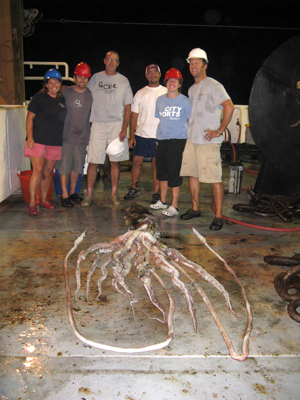 Quick, what's 19.5 feet long and over 109 pounds of raw muscle?
The answer to that question can be found this week at Deep Sea News , one of the coolest blue blogs running right now. A place for all things "deep sea discovery":
Scientists from NOAA’s Fisheries Service have captured a giant squid while conducting research off the Louisiana coast in the Gulf of Mexico. This is only the second known giant squid obtained from the Gulf of Mexico – the first was collected in 1954 off the Mississippi Delta where it was found floating dead at the surface.
This giant squid was collected on July 30, during a 60-day scientific study where scientists from NOAA’s Southeast Fisheries Science Center and the Department of the Interior’s Minerals Management Service were studying the availability and diversity of sperm whale prey. The scientists were aboard the NOAA research vessel Gordon Gunte when the squid was caught in a trawl pulled behind the research vessel at a depth of more than 1,500 feet.
Thursday, March 12, 2009
Why marine biology is hard
 I just finished reading "Mapping the Deep: The Extraordinary Story of Ocean Science" by Robert Kunzig. I would recommend this book to anyone interested in the oceans themselves, but it doesn't include much about marine biology. The book did, however, have one passage that summarizes very well why it is so difficult to study life in the oceans. It specifically is referencing the deep sea, but the same principles apply to studying sharks. Much of the general public is flabbergasted when they hear scientists say that we don't know the answers to so many basic questions. I hope this passage helps clear up why marine biology is hard.
~David
"Trying to find out what lives on the ocean floor, and how it lives, is hard. Think about what it would be like to study our own world the way biologists must study the deep sea. Imagine that a race of space aliens, discover Earth and, being scientifically inclined, set out to understand life on its surface. These unfortunate aliens, however...cannot wishstand the crushing pressure of our atmosphere. It is utterly opaque to their eyes... they decide to blindly drag a large, sturdily framed net from their spacecraft as it cruises safely above the clouds.
The net touches down one evening in Tyler, Texas, where it first clips a flagpole off the top of the courthouse. Next it bounces through a playground in Bergfeld par, scattering children and parents without snaring a one; collects a dog that is studying a soup bone on college street, and swoops into a backyard a few blocks later, picking up an azalea bush, a clothesline bearing assorted lacy underwear, and a patch of lettuce with its associated rabbit. Finally it nearly comes to grief in a dark corner of the Sears parking lot, where the weight of a 1979 Chevy Nova and the teenagers in its backseat cause the net cable to groan audibly. The aliens quickly reel in their catch- one quadrupedal carnivore, one quadrupedal herbivore with food, assorted mysterious shell fragments, and a large metal crusted animal (the Nova) whose source of food remains obscure, but which seems to be serviced by remarkably sophisiticated intestinal endosymbionts.
Sunday, January 18, 2009
Deep Sea News Moves-Again!

The guys over at Deep Sea News have moved (again). Turns out the relationship with Discovery was not to be, we think the boys needed some breathing room to be "all they could be":
"Discovery pursued new terms in December. The terms were unacceptable to us, so we terminated the contract. What can I say? We're on to better things. :)"
Here's the new home of Deep Sea News. See you there.
Monday, December 15, 2008
RTSea on the Undersea Voyager Project
 From RTSea Blog today:
I had the pleasure of attending a press event for the Undersea Voyager Project that was held at one of my regular stomping grounds, the Aquarium of the Pacific in Long Beach, CA. It's great to attend these events as you get to meet new people with similar interests, concerns, and passions for marine conservation.
The Undersea Voyager Project is headed up by Scott Cassell, who has done considerable study and research on the Humboldt Squid - a particularly voracious predator typically found in deeper water but makes more local appearances from time to time. The primary thrust of the Project is an ambitious program involving submersibles and a variety of different marine science projects, culminating in the development of a larger submersible that will act as an undersea classroom bringing science to the general public in a very real and as-it-happens way.
I find this very exciting because throughout my involvement in marine conservation as a filmmaker and giving screenings and lectures, I have found that there is a tremendous amount of scientific data that does not get effectively translated into issues, implications and solutions for the general public to understand and appreciate. As an example, we have decades of data documenting climate change - and yet there are still many people who refuse to accept it.
Organizations like the Undersea Voyager Project can be of tremendous benefit in enlightening the public, young and old, to important issues regarding our oceans. Marine conservation must not be obscure or vague; it must be made real and tangible to all people: to the general public, to the decision-makers, and to the future generations of scientists-in-the-making.
Check out the Undersea Voyager Project web site and give it your support.
Editors Note: We would also like to lend our weight to Scott Cassel. He's one of the genuine articles.
Monday, September 29, 2008
We loves our Cephalopods
To never pass up a good Cephalopod story, image, video, or bathroom joke is the "other madate" of Underwater Thrills:Swimming With Sharks. Today we complete that mission and with the Dow Jones currently sitting at 777% below normal take a brief moment to loves your Cephalopods with us:
Hat Tip: The guys over at Deep Sea News
Hat Tip: The guys over at Deep Sea News
Friday, September 5, 2008
Deepsea Expeditions-Needs Your Email Today
 Eco Tourism Under Siege- Honduras
Friend and fellow eco-adventurer Karl Stanly reported some bad news this month. Seems the state of eco tourism in Roatan, Honduras has quite a long way to go with "small island politics".
The good news is that you can help with an email today:
I am sorry to report at this time I am not able to operate my submarine.
In a nutshell, the vice mayor of the island attempted to create a berth for her new yatch in front of my family's land. The situation escalated completely out of control to the point where my life was threatened by her husband, both verbally and by showing a gun. Despite doing everything required legally, I have been unable to obtain an operating permit and cannot get a straight answer out of anyone in government as to when (or why not) this may occur.
I want you to know that I am doing everything in my power (including hiring three lawyers and a massive PR campaign) to rectify this situation and am confident I will once again be able to provide affordable direct access to the deep ocean for all interested.
How can you help?
Wish you could book an expedition to explore the unknown? Don't want to see my mission to provide the public with cost-effective, direct access to the deep water environment come to premature end? Please contact the following departments of tourism and let them know. I greatly appreciate any help I can receive during this difficult time. Thank you.
Honduras
Col. San Carlos, Edificio Europa
Tegucigalpa, Honduras
Apodo. Postal No. 3261
PBX: (504) 222-2124 Ext 502, 503
FAX: (504) 222-2124 Ext 501
E-mail: tourisminfo@iht.hn
United States
Honduras Institute of Tourism
2828 Coral Way
Suite 305, Miami, Fl. 33145
Tel.: (305) 461-0601/02
Fax: (305) 461-0602
E-mail: hondurastourism@aol.com
Tel.: 1-800-410-9608 (USA/CANADA toll free)
Editors Note: As we have mentioned many times in the past this submarine is the only one of it's kind allowing everyday adventure seekers into the wild world of deepsea sharks. We urge you to send an email today to keep Karl in business. Thanks!
Sunday, June 22, 2008
Werner Herzog-Bottom of the Planet
 Like him or not the always interesting filmmaker Werner Herzog has just completed another wildlife film at the bottom of the planet. You'll remember his last work covering the mishaps and missteps of Tim Treadwell in Grizzly Man.
From the guys over at Deep Sea News:
New York Times reviews Werner Herzog's Antarctic documentary "Encounters at the end of the World" calling it 'hauntingly beautiful'. The film is set at McMurdo Station, and features 'melancholy' scientists, extended landscape shots, Weddell seals, and jellyfish.
NYT reviewer Manohla Dargis credits the director for avoiding the trappings of "casual talk about global warming and other calamities might cast shadows across this bright expanse" through artistic beauty and an "unshakable faith in human beings".
It would be thrilling to see Werner Herzog sit down with Wallace Broecker in the SEED Salon, to discuss his recent remarks favoring carbon sequestration in the deep-sea. That's an art and science conversation I would certainly not want to miss.
Werner Herzog directed many documentaries, including "Grizzly Man" and "Klaus Kinski". He was a teacher of Errol Morris. He is known as an auteur, with a unique personal style.
From Internet Movie Database:
His films contain long, extended landscape shots.
His films contain animals doing unusual things.
Hm. Sounds like a good date movie. "Encounters at the end of the World" opened yesterday in New York City. What are the chances it will make it to Texas? Not good. More likely I will have to find a way to New York.
Sunday, April 13, 2008
Blow Your Mind-Shark/Sea Horse Pics
 A few weeks ago intrepid underwater explorer Karl Stanley took his submarine down the Cayman Trench with some Nat Geo guys for another deep water shark adventure.
Let's back up a bit...
What would you do with a dead racehorse in Roatan, Honduras?
If you're Karl, someone "donates it" to you and you quickly drop it down 1700' and then drop your home made submarine down 1700' to see what arrives to feed on it. Karl wrote:
"National Geographic came down to shoot Six Gill sharks for a special on them- I sank a horse and we saw 5 sharks- we were actually in the middle of a Six Gill feeding frenzy, and they bit the sub".
The next series of images are nothing short of amazing. Like we told you years ago-the animals at this site are simply huge. Last time we got to see these monster Six Gills all we had were a couple of pigs heads...and don't ask us how we got them!
Friday, April 11, 2008
Deep Sea News-Davidson Sea Mount
If you have not checked out our links section do so today. You'll find a great selection of weblinks with videos and images that will most likely blow your mind. Case in point the Davidson Sea Mount.
When possible, I like to keep close tabs on the world of octopuses, for two reasons: 1. Everybody has their hobbies, mine just involves cephalopod mollusks and don't you judge me, and 2. I often get the feeling that they're plotting something:
When possible, I like to keep close tabs on the world of octopuses, for two reasons: 1. Everybody has their hobbies, mine just involves cephalopod mollusks and don't you judge me, and 2. I often get the feeling that they're plotting something:
Subscribe to:
Posts (Atom)