Showing posts with label shark divers. Show all posts

Friday, August 10, 2012

Tiger Beach Expeditions 2012 Three Spaces Going...Fast

Christy Fisher at Tiger Beach w lemon friends
The 2012 Tiger season in the Bahamas has been a busy one this year and we are looking at the last three spaces of the entire fall season on:

September 2-8
September 9-15

The fall season is when we get the really big gals on site and yes, you will see sharks, that's an absolute guarantee.

After a decade Tiger Beach has proved the world over to be one of the top shark diving sites.

These last three spaces will be gone soon, come and join us with the fine crew of the M/V Kate, the water is fine.

Let's go shark diving!

About Shark Diver. As a global leader in commercial shark diving and conservation initiatives Shark Diver has spent the past decade engaged for sharks around the world. Our blog highlights all aspects of both of these dynamic and shifting worlds. You can reach us directly at sharkcrew@gmail.com.

Monday, January 16, 2012

Shark Diving, Why Choose Sharkdiver.com?

There are two types of vacation seekers. Those who are content with the ordinary, the explored, and the predictable.

Then there are the vacation seekers who look for the extraordinary. The unique off-the-beaten-track adventure experiences that create lasting vacation memories.

This is who we are. This is Shark Diver, and for the past decade we have prided ourselves in offering destinations and guaranteed big shark encounters that attract real adventure seekers.

Our newly minted Shark Divers are unique in so many ways, but they tend to share one distinct feature, they are the people that you meet at parties, backyard BBQ's and friends houses, the ones you always say, "I can't believe you did that!"

Yes they did, and each year we enjoy reading the flood of trip reports that come back from our boats and from our first time Shark Divers.

2011 was another banner year for us and we have chosen a just few of our diver trip reports for your review. Written by our divers in their own words you can begin to understand why so many people are beginning to seek extraordinary travel destinations.

Maybe 2012 will be your year, or maybe after reading these trip reports you will add one more item to your bucket list. Either way we'll be here when you decide that this is your year for extraordinary adventures:

Sarah Fuller 2011 - Living The Dream


Michelle M 2011 - Bucket List Scratched 


James Woodhead 2011 - From U.K to Mexico


Bev Downie 2011 - Sharks and More Sharks


Tammy and Wayne - Getting Their Shark Groove


Friday, September 30, 2011

Welcome to Facebook the place for sharks

It doesn't take a rocket scientist to realize the raw networking power of Facebook to effect lasting conservation change for sharks.

And you don't have to travel far on Facebook to discover a plethora of shark groups, petitions, posts and pro shark media that have reached millions of potential activists.

Without a doubt one of the main drivers to broad based shark conservation efforts around the globe over the past three years has been Facebook, a revolution for sharks.

Here's a "small sampling" of the Facebook Shark Revolution from groups and sites as small as 1500 members to groups as large as 300,000 plus.

Without Facebook sharks do not have a voice, and the oceans do not have the army of voices, creativity, and focus to effect lasting change for the environment. Kudos.

Stop Shark Finning 

Divers For Sharks

Bite Back Shark Conservation

Shark Fin Free Auckland

The Australian Anti Shark Fin Alliance

Stop Eating Sharks Now

Save the Sharks of the Maldives

Save the Sharks

Save our sharks from a bowl of soup

Shark Tsunami U.K


Stop Shark Abuse


Ban Shark Finning USA

PangeaSeed 

Oceanic Defense

Stop Serving Shark Fins in Vegas

Stop Shark Fishing

Support Our Sharks Europe

Shark Alliance

Shark Rescue

Shark Defenders

Shark Truth

Protect the Sharks of the Bahamas

And the list goes on, and on, and on...

Thursday, June 30, 2011

White Shark Spotted in Florida at 170' - Confirmed!

Any time you can spend a quality moment in the water with an animal like this is a good day. For a spearfishing diver just hoping to get his limit on Amberjack in the green waters off Sebastian Inlet this weeks encounter with a sizable white shark was nothing but amazing!

Tuesday, January 4, 2011

Shark-Safe Beaches: testing aerial spotters and dismissing electro-magnetics

Starting 2011 out right with this report from RTSea Productions.

If you want concise industry thought and analysis this is your go to daily blog.

From RTSea:

When people enter the ocean - to swim, surf, dive, or just frolic about at the water's edge - they are entering a different wilderness. In doing so, they expose themselves to a measure of risk from interaction with other animals, from a sea jelly sting or an urchin spine all the way up to an interaction with a larger animal like a shark.

To protect people from unwanted shark interactions, several methods of prevention have been tried over the decades. In Australia, there is an extensive network of netted beaches. The steel mesh nets are designed with openings small enough to ward off large sharks but large enough to allow smaller fish to pass through. The nets have been used for many years and, in combination with lifeguards acting as shark spotters, the process has been fairly successful. But not infallible.

Sharks can get through the nets on occasion due to the nets being moved about from currents or storm action, so to maintain a big picture overview, spotter planes are being deployed in New South Wales (south eastern Australia) as part of a test program during peak months of swimming activity. And the NSW government in Australia has deployed a novel method to keep their spotter pilots' skill sharp. Decoy or replica sharks will be placed in the water to check the effectiveness of the surveillance program. Lifeguards will be made aware of the days and times for the placement of the replica sharks, but not the pilots. Results of the tests will be included in the final evaluation as to the aerial surveillance program future.

Far to the west, following a recent series of shark attacks in Sharm El-Sheikh, Egypt, a variety of safety measures are being considered. Nothing has been confirmed as yet because the government is weighing an appropriate response that also recognizes the probable causes for the attacks - reportedly everything from unregulated chumming to overfishing of the shark's usual preying to the dumping of dead sheep from a passing freighter.

One approach that apparently will not be used is something akin to electrified fencing. An organization, the Shark Academy, has proposed installing an electro-magnetic shield along the Egyptian coastline of Sharm El-Sheikh in the Red Sea, but the idea has been totally dismissed by the Governor of South Sinai, General Abdel Fadeel Sousha.

"He (the company's owner) showed us a video in a meeting in Sharm El-Sheikh on devices used to protect beaches from sharks and made verbal and purely theoretical proposals that didn't persuade me on a personal level," said General Sousha. "I asked him for a practical demonstration in front of a committee of experts so we could be sure the devices work effectively. This still hasn't happened."

A pretty far-fetched notion when you think about it. I have worked with divers who have used a protective device called a Shark Shield which emits a strong electro-magnetic pulse when needed and seems to be quite effective with medium-size sharks like lemon or blacktip sharks. But I've been told it also "rattles the teeth" of the diver when its discharged. So the idea of having something that strong running constantly across a beach seems rather unlikely.

Apparently, previous attempts at using electro-magnetic fields along beaches in Natal, South Africa and in Australia have been a dismal failure, not preventing the sharks from entering enclosed swimming areas but giving bathers a nice little shock instead.

Rather than rely on Rube Goldberg devices, common sense should prevail. Non-life threatening measures - such as nets and shark spotters - along with a better understanding and acceptance of the wild world we are venturing into is what's called for. While many of us hear the call to return to the sea, we must remember that we enter it as interlopers and strangers on someone else's turf.

Sunday, September 26, 2010

Shark Free Marinas - Jillian Morris

As a marine biologist, diver and videographer I have the good fortune of routinely travelling to the most wondrous locations. When I stop to think about where my favorite places are, I realize that many of them – the best places on the planet – are right here in the Bahamas.

These islands offer beauty and adventure – including a diverse range of shark encounter opportunities, such as the world famous Tiger Beach – which is a Mecca for shark enthusiasts. People travel from around the globe to catch a glimpse of the big beauties that inhabit the waters at Tiger Beach.

Film crews, television hosts and scientists alike revere this site as the ideal location to film, observe and conduct research. I have been blessed to spend quite a lot of time at this special place and I must confess that each time I visit it is completely different. Tiger Beach is really an irreplaceable, one-of-a-kind natural resource. Tiger sharks and lemon sharks are the primary species, but great hammerheads, Caribbean reef sharks and nurse sharks are also known to make appearances. Part of the excitement lies in never knowing what you might find when you slip beneath the surface!


As Jacques Cousteau astutely once said “people protect what they love,” and so I got involved with the Shark Free Marina Initiative because I love sharks. This campaign was designed to reduce the worldwide shark mortality rate by working with cooperating marinas. In the Shark Free Marina Initiative making the commitment means that no caught shark can be landed within the marina for any reason. There is no processing of meat, removal of the jaws of stringing up of the animals for photographs. Fishing for sharks within the participating marina is also prohibited. (This encourages fisherman to catch and release if they do insist on catching sharks at all.)


The program also works to teach proper techniques for catch and release, in order to increase the chance of survival for a caught shark. And while they have been historically, albeit incorrectly, perceived as monsters, sharks are extremely sensitive to being caught on a line. Just because they are released and not killed at the time of that release, does not guarantee they will survive at all. The Shark Free Marina Initiative also encourages fisherman to tag the animals with simple dart tags, as a means of increasing data collection.


Complete Post.

Tuesday, December 1, 2009

Whale Sharks - The Nigaloo Papers

In depth industry papers on shark tourism are a must read.The Ningaloo Coast region of Western Australia has been a mainstay for sustainable whale shark tourism for the past decade. A new paper is now out.

Tourism Abstract

Whale shark tourism is an icon industry in Western Australia and a prominent example of successful ecotourism. In 2006, whale shark tour participants spent $6.0 million in the Ningaloo Coast region of Western Australia and added between $2.4 million and $4.6 million to the regional economy in direct expenditure. However, to date no research has been conducted on the predictors of whale shark tour participants' expenditure. In this article, we assess the importance of visitor expenditure for ecotourism, assess the predictors of the expenditure of whale shark tour participants and discuss how this information can contribute towards ecotourism goals. The data analysed here were collected through a survey distributed to participants between April and June 2006.

We assess a range of variables for their relationship to individual expenditure per trip and determine that the duration of stay, household income, age, staying in a hotel, trip motivation and being from North America or Southeast Asia positively correlate with individual expenditure per trip. Group size and originating from Germany or the United Kingdom and Ireland negatively correlate with expenditure. In addition to identifying future steps, we also discuss the relevance of our finding that more motivated participants have a higher expenditure for ecotourism.

Link to report.

Wednesday, September 16, 2009

Fiji - Evolving Shark Tourism 2

Object lessons in shark tourism media are what the folks at Beqa Adventure Divers seem to be about these days - as they continue with a brilliant 2009 shark year rolling out conservation initiatives for Fiji's sharks, pro shark PSA's, and now a short series for local television on sharks.

Once again we tip our hats to an operator who, working in third world conditions, has managed to promote sustainable shark diving and conservation locally, regionally and internationally.

Note: This blog, Shark Divers and Shark Divers have no formal affiliation with the operators in Fiji, the owners, or staff. We do not book their shark tours and receive no compensation from them in any form as has been "discussed" by members of the dive community.

When we see something that works within the shark diving industry, we blog about it.

Thursday, July 2, 2009

Oceans Magazine - Shark Diver

This month Oceans Magazine featured Shark Diver and a first encounter story told by one of our shark divers Steve Hutchings.

DIVING WITH SHARKS

Written by Steve Hutchings, Courtesy of Shark Diver, www.sharkdiver.com

Photographs by Derek Heasley, www.scubabreaks.com


I saw Jaws when I was eleven, after which I was so petrified of the water I wouldn't go in the bathtub for a year. This is one of many thoughts swimming through my head as I step off the stern of the MV Islander and onto the top of a cage suspended three meters below the surface of shark infested waters. Our dive master, Luke Tipple, hands my mouthpiece to me, from which I'll be breathing surface-supplied air. I insert the mouthpiece and grab my underwater camera. With a deep breath, I slide into the cage below.

I share the cage with Jim, an American scuba instructor, and Leigh and Lisa, an English couple on a working holiday. Although I swam with reef sharks in Thailand three years previous, we're all rookie shark divers in these waters, having endured several months of comments like "Shark Bait"!? from our peers, united by our desire, and each of us having plopped down three thousand U.S. dollars with San Diego based Shark Diver to experience the oft-vilified, yet enigmatic great white shark.

We move around the cage for the first five minutes, searching for any signs of a great white. Scores of mackerel cloud our view, attracted to the two tunas that the crew set out to attract the sharks. Then, amidst the fish below our cage, I see a shark. He's smaller than I anticipated. About two meters long, he propels himself with slow, side-to-side movements of his tail. I watch, mesmerized as he disappears from sight.

Several more sharks appear sporadically over the next ten minutes before disappearing for half an hour. We begin to think we've seen our last shark on this dive. Luke taps the other cage with a metal bar, indicating the end of the hour long dive. I watch as the divers in the other cage ascend and wait for a new set of four divers to replace them. Nothing. I climb out of our cage, and when I reach the surface, Luke, in his Australian accent, says, "Steve, mate, do me a favor and go back under. There are sharks all around you and it's too dangerous to come up."

I panic, thinking there are too many sharks around the boat for our crew to handle and that the situation has deteriorated to dangerous. I let go of the ladder and fall back into the cage, dragged down by the forty pound diving belt, and land on my rear end. I'm still struggling to get off my backside, when a large female shark swims past our cage, two meters in front of us. The other three divers clamor to get their cameras in position. I'm still trying to get on my feet. That's when I see another shark, swimming directly toward me. My heart races as his snout gets bigger, and closer. Just as I'm convinced he's going to attack our cage, at less than a meter away, he veers to his right and swims past me, and I notice something about him that I've never seen in any pictures of a great white - a purple ring around his pupil. We stare at each other, eye to eye, until he's past our cage and disappears into the background.

I just made eye contact with a great white shark.

Such was our first dive at Guadalupe Island, off Baja California, about three hundred kilometers south of San Diego, on a five day, live-aboard diving expedition arranged by Shark Diver. Great whites congregate here, off Guadalupe, between August and December each year. The sharks seen here are resident sharks. Much like the resident orcas off Vancouver Island, marine biologists have named about sixty of the estimated two hundred sharks. Chica, Bruce, and the ever popular Shredder are some of the well-known sharks at Guadalupe, the latter being a favorite of many divers for his consistency and his aggressive attitude. On a subsequent dive he veered towards a male diver in the cage, who retreated backward. A female diver later recounted that she watched Shredder's pupil following the male diver as he swam past the cage, seemingly pleased that he intimidated the man.

I guess boys will be boys, no matter what the species.

Editors Note: Shark Diver takes interactions with great whites seriously. We always defer to the animals. Once in a while when the situation is deemed necessary by our dive operations manager we keep divers in cages when it is time for rotation. Distracting the deck crew when 5-7 animals are on site and "hot" is a recipe for disaster, as such such we have a standard policy of animals first.

Shark Diver remains an industry leader of safe shark encounters with a 100% safety record, no sharks in cages, no animals hurt. It's an industry record we're proud of.

Friday, May 22, 2009

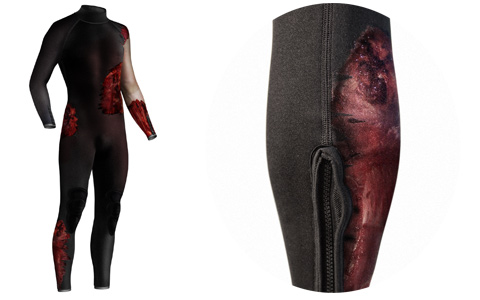
Shark Divers - New Wetsuit Fashion

Oh, the horror. It took a Dutch fashion designer to do away with wetsuit design as we know it and create this (click image):

The wetsuit - created by Dutch designer Diddo Velema - makes it look like the wearer has been savaged by a shark thanks to a unique printing process.

Custom inks are used to add the gory textures which appear like a torn wetsuit, ripped skin and wounds going down to the bone.

Diddo, who has a design studio in Amsterdam, said: "Wetsuits are both functional and protective, but why must they all look the same?"

Note: They all look the same to keep you warm, not make a fashion statement.

Monday, November 17, 2008

Whale Shark Poo "Scientific Gold"...Oh Yeah?

We loves the Internet, especially on days like these.

Turns out filmmakers and researchers have shot (for the first time) a whale shark doing what comes naturally...and even scooped some up for "analysis".

This would be a good time to point out why we did not becomes shark researchers.

Anyway, an article in U.K's Metro Magazine calls this finding "Scientific Gold". Which leads us to a blog post about another drive by "pooing" many years ago with a great white shark we got on camera.

If a whale sharks excrement can be termed "Scientific Gold" this stuff's gotta be at least "Research Platinum". Unfortunately none of the crew or our divers had the foresight to grab a sample...we were too busy trying to get out of the cages.