Unless you have been sitting under a rock then you might not be aware that James Cameron has arrived at the deepest part of the planet in his all too cool submarine today 35,756 feet down on the Challenger Deep.
Well done sir, and on behalf of the Oceans Community, "Welcome Back!"
About Shark Diver.
As a global leader in commercial shark diving and conservation initiatives Shark Diver has spent the past decade engaged for sharks around the world. Our blog highlights all aspects of both of these dynamic and shifting worlds. You can reach us directly at sharkcrew@gmail.com.

The shark diving industry blog covering sharks, shark cage diving, shark conservation and things we find "amusing" since 2008 www.sharkdiver.com, www.sharkdivers.com, www.divingwithsharks.com
Showing posts with label submarine. Show all posts
Showing posts with label submarine. Show all posts
Sunday, March 25, 2012


Wednesday, April 21, 2010
"Trieste" by any other name
 While the rest of the planet went about its daily business last week a small but dedicated group of explorers joined together in celebration in Washington.
There were gathered to celebrate mans first descent to 35,800 feet and Don Walsh who is the only surviving member of that stunning dive. A groundbreaking exploration he accomplished with dive partner Jacques Piccard...50 years ago.
Luminaries from James Cameron to Sylvia Earl were on hand to congratulate the man, the submarine, and the achievement. They were also on hand to ruminate about the possibilities of going back.
50 years ago deep water technology did not include composite materials, lightweight carbon, and newer composite viewing windows.
As the Washington Post wrote last week, Don Walshes descent almost ended before it began:
At 31,000 feet, they echo-sounded for the bottom. There was no return. At 32,400 feet, a thick window cracked with a bang. Farther down they went. Into the bleak hadal zone, named for Hades, the ancient Greek underworld. Finally, at 35,800 feet, then-Navy Lt. Don Walsh, 28, phoned the surface: "This is Trieste. We are on the bottom of Challenger Deep. . . . Over."
Complete story and video.
Thursday, March 12, 2009
Why marine biology is hard
 I just finished reading "Mapping the Deep: The Extraordinary Story of Ocean Science" by Robert Kunzig. I would recommend this book to anyone interested in the oceans themselves, but it doesn't include much about marine biology. The book did, however, have one passage that summarizes very well why it is so difficult to study life in the oceans. It specifically is referencing the deep sea, but the same principles apply to studying sharks. Much of the general public is flabbergasted when they hear scientists say that we don't know the answers to so many basic questions. I hope this passage helps clear up why marine biology is hard.
~David
"Trying to find out what lives on the ocean floor, and how it lives, is hard. Think about what it would be like to study our own world the way biologists must study the deep sea. Imagine that a race of space aliens, discover Earth and, being scientifically inclined, set out to understand life on its surface. These unfortunate aliens, however...cannot wishstand the crushing pressure of our atmosphere. It is utterly opaque to their eyes... they decide to blindly drag a large, sturdily framed net from their spacecraft as it cruises safely above the clouds.
The net touches down one evening in Tyler, Texas, where it first clips a flagpole off the top of the courthouse. Next it bounces through a playground in Bergfeld par, scattering children and parents without snaring a one; collects a dog that is studying a soup bone on college street, and swoops into a backyard a few blocks later, picking up an azalea bush, a clothesline bearing assorted lacy underwear, and a patch of lettuce with its associated rabbit. Finally it nearly comes to grief in a dark corner of the Sears parking lot, where the weight of a 1979 Chevy Nova and the teenagers in its backseat cause the net cable to groan audibly. The aliens quickly reel in their catch- one quadrupedal carnivore, one quadrupedal herbivore with food, assorted mysterious shell fragments, and a large metal crusted animal (the Nova) whose source of food remains obscure, but which seems to be serviced by remarkably sophisiticated intestinal endosymbionts.
Thursday, August 21, 2008
Isla Guadalupe-Submarine?
 One of the hottest rumors sweeping through the 2008 season is the arrival of a private submarine sometime in October to Isla Guadalupe.
We'll be curious to see the bubble sub when it arrives. These items are fast becoming the hottest ticket for the wealthy:
Hat Tip: Born Rich
It is always great to own a yacht and have those parties by the deck. However, after a while, the yachts just get, well, monotonous and you need something more exciting. That is when U.S Submarines comes to your rescue. They have developed a sub for 2 people. Called the Triton 1000, it is lightweight, and can function as an additional feature to your existing yacht. You can just go ahead and deploy the sub from your medium-large yacht. If you still don’t own a yacht, you can attach the sub behind a truck or a SUV and just negate the need to buy a yacht. With excellent visibility and luxurious interiors, the pilot of the sub will have a very comfortable journey under the water. The submarine is built specifically for the enjoyment of piloting one and hence the operations are easy. At about $1.69 million, Triton 1000 may be a little too heavy on the pockets, but you can do what no other yacht owner can do, view corals and the amazing underwater life or just have a romantic sub-ride with your partner. Or just have a look at some of the most luxurious private submarines you could own. You may find that interesting as well!
Wednesday, June 18, 2008
Shark Diving Next Generation-Super Submersibles
Shark diving as we know is about to change. A few months ago the crew of Shark Diver visited with the owner/builder of the world's fastest submersibles-Hawkes Ocean Tech.
Locally operated they were reeling from the loss of adventure pioneer Steve Fosset, who's sub Deep Flight was 90% completed and ready to make diving history with the world's deepest flight. They were currently in talks with Virgin Airlines CEO Richard Brandson to do the flight.
Here's why the future of wild oceanic animal encounters is going to change, and shark diving will never be the same. Strap yourself in:
Thursday, May 1, 2008
Deep Water Sharks-NOAA
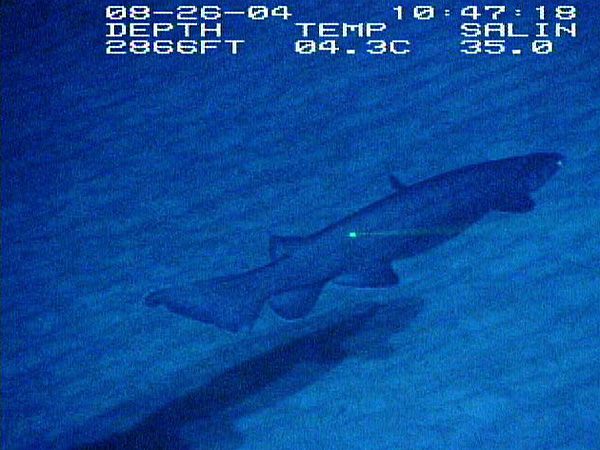 Back in 2004 researchers with NOAA shot this ungainly looking critter around 3000 feet deep.
They think it is a new shark species and is close to 22 feet long. Yes, that is a green laser being used to gauge the size of the animal and the distance from the submarine.
What's fascinating about this fellow is the tail set up-which is completely unlike anything seen previously-even with deep water shark species.
Unfortunately they have not seen another one like this in the past 4 years of deep water exploring. Unlike the Blunt Nosed Six Gill which seems to be everywhere. Some deep water sharks seem to be as rare as some of their top water cousins.
Wednesday, February 6, 2008
Molokai Shark at 3300'
 Score one for for the science guys this week. A video surfaced of one of our all time favorite underwater "denzines of the deep" the Six Gill Shark.
What makes this critter interesting is it's ability to flourish in water temps hovering in the 40's and less, and at a depth of over 5000'. This one was filmed at 3300' and with his 18 foot profile we were not surprised to hear the normally laid back deep water guys saying "Holy Crap!".
Friday, January 25, 2008
TED: If You Don't Know You Should
We know deepwater adventures like few others out there. When it comes to deepwater exploration legends like David Gallo and his talk about Celaphopods-who doesn't have 3 minutes to watch this:
Subscribe to:
Posts (Atom)