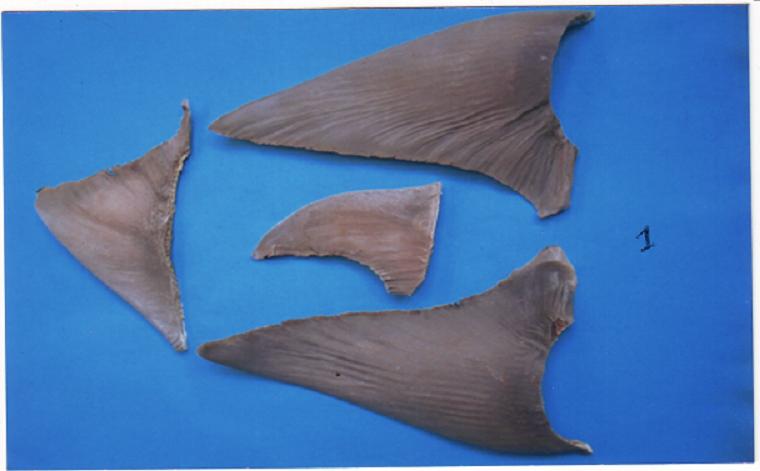
Showing posts with label illegal shark finning. Show all posts

Wednesday, May 23, 2012

Is Shark Finning OK?

Finned Reef Shark
According to an article in "Forbes":
  
Just this week, four of the five largest Chinese-language newspapers in shark fin capital Hong Kong rolled out a high-profile ad campaign that blasts the global anti-shark fin campaign as groundless, and intended “to incite the public to discriminate our own eating culture.”  It claims Western conservation groups “use the shark issue as a fund-raising gimmick.  We now we made a vow to voice out and unveil those lies.”


I have to admit that I've become a bit cynical with the media when it comes to how they portray anything to do with sharks. It seems that they're mostly interested in shocking headlines and have very little substance in the article themselves. So that's why today's article in Forbes came as a pleasant surprise. It is very informative, doesn't use hype and is well written.

In 10 years of working with Great White Sharks this is one of the best articles I've read on the complex subject of shark finning.

Well done Forbes.


Cheers,

Martin Graf
Dive Operations Manager
Shark Diver/Horizon
Isla Guadalupe, Mexico

About Shark Diver. As a global leader in commercial shark diving and conservation initiatives Shark Diver has spent the past decade engaged for sharks around the world. Our blog highlights all aspects of both of these dynamic and shifting worlds. You can reach us directly at sharkcrew@gmail.com.

Saturday, October 15, 2011

Shark Fin Workaround - Where There's a Market

The shark fin legal game - fins attached?
"Foreign fishing ships are bringing in shark skeletons – the flesh shaved away – with just their fins attached to the body. Local fishermen see this as another way that fishing fleets are evading shark finning laws."

This mornings news from San José, Costa Rica is a lesson in real world shark fin management with an apparent workaround to new shark fin laws that require the fins remain attached to the shark.

But what constitutes a whole shark?

That questions will have to be decided by the court system in Costa Rica while Taiwanese ships find creative ways to continue the shark fin trade unabated and it's not the first time this has happened:

"After Incopesca and the Agriculture and Livestock Ministry finally ruled in December 2010 that foreign fleets must unload at public docks subject to inspection, the first boat to unload was caught with illegal fins onboard. Shortly afterward, the fleet started showing up at the dock with only other species and no sharks. At the same time, huge shipments of shark fins began being imported to Costa Rica from Nicaragua."

The news from Costa Rica serves as an abject lesson to shark conservationists worldwide, we have to be looking a better ways to enact laws as seen through the lens of fishing fleets whose livelihood depends on shark fin. Additionally conservation groups need to refocus on recent vast tracks of declared shark sanctuaries around the world.

While these sanctuaries look great on paper only a small percent have any capability to actually monitor or enforce these areas. The new focus should be for long term funding and enforcement by outside agencies and NGO's.

Fisheries laws are made to be circumvented, and ignored.

Phase two in the global race for sharks begins now with this wake up call.


Thursday, April 28, 2011

Sharks and DNA Zip Codes - Hope?

An international team of scientists, led by the Institute for Ocean Conservation Science at Stony Brook University, has used DNA to determine that groups of dusky sharks (Carcharhinus obscurus) and copper sharks (Carcharhinus brachyurus) living in different coastal regions across the globe are separate populations of each species. Both are large apex predators that are heavily exploited for the shark fin trade, which claims tens of millions of animals every year to produce the Asian delicacy, shark fin soup.

Many of these species are declining as a result of this fishing pressure for their fins.

DNA research projects were conducted by a collaborative international team of scientists from the United States, Australia, South America, Asia, New Zealand and southern Africa. The scientists collectively analyzed part of the mitochondrial DNA in nearly 400 sharks sampled from all over the globe.

This research was funded by The Pew Charitable Trusts through a grant to the Institute for Ocean Conservation Science at Stony Brook University. Sequence data were collected in the Field Museum's Pritzker Laboratory for Molecular Systematics and Evolution, operated with support from the Pritzker Foundation. Additional sequence data were collected at the Guy Harvey Research Institute with operational funds and a grant from the Save Our Seas Foundation. Funding was also provided by the Turner Fellowship Program and the Tinker Foundation.


For more information on "Global phylogeography of the dusky shark, Carcharhinus obscurus: implications for fisheries management and monitoring the shark fin trade," visit here.


For more information on "Phylogeography of the copper shark (Carcharhinus brachyurus) in the southern hemisphere: implications for the conservation of a coastal apex predator," visit here.

Tuesday, August 3, 2010

Serendipity - Two Shark Crises Media Reports

Two news reports on sharks and the ongoing shark crises today that made front page news worldwide.

CNN covers Matt Rand from PEW explaining how the crises is unfolding:

"At one time, shark fin soup was considered a delicacy for the elite. But as Asia grows in population and wealth, the demand for shark fins has gone through the roof. According to the United Nations, shark fin imports to Hong Kong and Taiwan alone rose 214 percent from 1985 to 1998. This has had a disastrous impact on shark populations globally."

The Sydney Morning Hearld covers a company accused of illegally killing 280,000 sharks:

"A conservation watchdog accused a Brazilian company of illegally fishing 280,000 sharks which were killed to feed Asia's appetite for sharkfin.The Environmental Justice Institute, a Brazilian group, on Monday lodged a suit against seafood exporter Sigel do Brasil Comercio demanding $US800 million ($A883 million) in environmental damages."

Friday, January 9, 2009

Humane Society International-Loophole closure

The Humane Society of the United States and Humane Society
International issued a statement today applauding Guam Delegate
Madeleine Bordallo for introducing legislation that would close a
loophole on shark finning.

Bordallo introduced the Shark Conservation Act, H.R. 81, which
provides increased protection for vulnerable shark species from the
disgusting practices of “finning” and overfishing.
“Each year, tens of millions of sharks worldwide have their fins
cruelly cut off at sea and are then thrown back overboard to die a
lingering, painful death,” said Patricia Forkan, president of Humane
Society International. “Shark finning threatens the survival of
essential marine species, and we commend Congresswoman Bordallo for
addressing this cruel and wasteful practice.”

Although shark finning was banned in the U.S. by the Shark Finning
Prohibition Act of 2000, enforcement is complex and a major loophole
allows circumvention of the law. Last summer, the U.S. Department of
Commerce implemented regulations in the U.S. Atlantic Ocean and Gulf
of Mexico requiring that sharks be landed with fins attached to their
bodies, to prevent shark finning. However, the Pacific Ocean has no
comparable regulation, leaving these expansive waters wide open to
abuse.

Last year, the previous version of the Shark Conservation Act (H.R.
5741) passed the House in the 110th Congress, but did not advance in
the Senate before the session was adjourned. The new legislation
contains the same language closing a loophole that currently permits a
vessel to transport fins that were obtained illegally as long as the
sharks were not finned aboard that vessel. The act also requires that
all sharks be landed with their fins naturally attached to their
bodies, creating a clear enforcement mandate applicable in both
oceans.

Thursday, December 18, 2008

Shark Fin Du Jour-Sponsored by Yahoo! Inc

Our weekly feature on Underwater Thrills:Swimming With Sharks is the "Shark Fin Du Jour".

It's a weekly look at Alibaba.com the NYSE of Shark Fin Products and sales on the Internet-Sponsored by Yahoo! Inc.

We will take you to the individual sellers listed on that site and introduce the top companies, what species they sell, and how many thousands of pounds of shark fins they have for sale on the global market.

Today our Shark Fin Du Jour is UMS Enterprises who can source a staggering 500 kilograms of sharks fin per week:

Place of origin: Pakistan
Model No: SF 1173
Fob Price: US$ 30~180 Karachi (Air/Port)
Port: Karachi (Air/Port)
Payment Terms: L/C
Minimum Order Quantity: 500 Kilogram
Supply Ability: 500 Kilogram per Week
Package: 15kg - 30kg Polypropylene Bags
Delivery Time: Minimum 10 Working Days

Tuesday, October 7, 2008

Magnuson-Stevens Fishery Conservation Act

How about some good news about Shark Finning? Seems the US Coast Guard is on the ball in Alaska:

JUNEAU, Alaska - The Coast Guard Cutter Acushnet temporarily terminated a fishing voyage approximately 30 miles northeast of Kodiak at approximately 2 p.m., Monday.

A boarding team from the Acushnet, a 213-foot medium endurance cutter homeported in Ketchikan, Alaska conducted a routine fishing vessel inspection and found a shark fin hanging from the rigging of the fishing vessel Arctic Wave. Having a shark fin without the carcass is a violation of the Magnuson-Stevens Fishery Conservation and Management Act of 1996.

Upon further inspection of the vessel, it was found that the Arctic Wave had an insufficient number of immersion suits. (Editors Note: If you read through the lines here, this vessel is under suspicion of doing bad things with sharks but only has one fin on board so gets cited for the suits instead). The Acushnet contacted Coast Guard Marine Safety Detachment Kodiak and National Marine Fisheries Service personel and terminated the fishing trip. The Acushnet escorted the Arctic Wave back to Kodiak.

The fishing vessel was met in Kodiak by Marine Safety Detachment Kodiak and National Marine Fisheries Service personnel. The captain of the Arctic Wave was able to acquire a sufficient number of immersion suits while in port. After the Coast Guard reinspected the fishing vessel and found no other violations, the Arctic Wave was allowed to continue their fishing voyage. The fishing vessel left Kodiak at approximately 9 p.m. Monday.

Wednesday, October 1, 2008

Shark Fin Du Jour-Sponsored by Yahoo! Inc

Our new weekly feature on Underwater Thrills:Swimming With Sharks is the "Shark Fin Du Jour".

It's a weekly look at Alibaba.com the NYSE of Shark Fin Products on the Internet-Sponsored by Yahoo! Inc.

We will take you into the individual sellers listed on that site and introduce the top companies, what species they sell and how many thousands of pounds of shark fins they have for sale on the global market.

Today our Shark Fin Du Jour is BTrade International who can source a staggering two tons of sharks fin per month:


Place of origin: Bangladesh
Model No: B.T
Fob Price: FOB Chittagong, Air / Sea USD 1000~100000
Port: Chittagong, Air / Sea
Payment Terms: L/C,T/T
Minimum Order Quantity: 1 Ton Fish maws
Supply Ability: 2 Ton per Month 1
Package: p.p bags
Delivery Time: As soon Possible
Brand Name: Shark Fin