Showing posts with label shark finning. Show all posts

Sunday, February 18, 2018

Is Shark finning the only threat to Sharks?


Instagram 
We all know that shark finning is a huge problem and a threat to global shark populations, but is it the only threat? Is the demand for shark meat an equal threat?


There is a new publication by Project AWARE® that addresses this issue.

It is not only the fins that makes sharks the target of the fishing industry. The demand for their meat is also a factor. From the Project AWARE® article:

"The appetite for shark fin soup has played a major role in shark overfishing and is often positioned as the main threat to sharks today. Recent data on international trade in shark fins and meat analyzed in the report however, reveals a global, interdependent market for a variety of shark products across scores of countries, including several in South America and Europe, whose demand for shark meat places them among the world's top shark consumers."

They have an interactive infographic that shows the different issues. The infographic can be found by clicking on the picture below.

https://www.projectaware.org/publication/state-global-market-shark-products


From their article: "With so many shark species and products in trade, it can be difficult to get your head around what is really happening,” says Dr. Shelley Clarke, co-author of the FAO shark trade report and renowned shark fisheries scientist. “Understanding sources and trends is a critical step toward making sure the trade is sustainable and traceable, and the underlying fisheries are properly managed.”

 The infographic reveals the significant growth in markets for shark and ray meat, as well as the countries and inadequately restricted fisheries associated with this largely under-the-radar trade.
“The shark fin trade is at long last receiving worldwide attention from the media, conservationists, and law-makers, but we must urgently broaden our horizons to also consider other threats to sharks and closely related rays,” said Sonja Fordham, President of Shark Advocates International, a project of The Ocean Foundation. “We hope that Project AWARE’s initiative will shine light on these emerging issues and channel public concern toward workable solutions before it’s too late.”
The interactive infographic and related information can be found here: www.projectaware.org/globalsharktrade

Here is a provocative thought. Could the demand for shark meat actually be a good thing? You might think that's a ridiculous thing. How could demand for shark meat actually be good for the shark population? Could it be possible that a growing market for shark meat might increase the price of shark meat and thus give an incentive to the fishermen to keep the entire shark, instead of finning it and throwing the body back into the ocean? Since there is only so much space on a fishing vessel, this could actually mean that a vessel is killing fewer sharks to fill it's holds, than if they fill it with fins only.

This might be wishful thinking, but if shark meat would become as priced as say blue fin tuna, a lot of fishermen might actually catch fewer sharks for the same profit.


What Project AWARE®'s paper documents is the fact that shark conservation involves a lot more than just shark finning!

What are your thoughts? I would love to hear your thoughts.

Cheers,
Martin Graf,
CEO Shark Diver

About Shark Diver. As a global leader in commercial shark diving and conservation initiatives Shark Diver has spent the past decade engaged for sharks around the world. Our blog highlights all aspects of both of these dynamic and shifting worlds. You can reach us directly at staff@sharkdiver.com.

Wednesday, February 3, 2016

Can our loving sharks be bad for them?


Instagram 


How could our loving sharks possibly hurt them? After all, we want to protect them and are fighting those who are hurting them. Why would I even suggest such a ridiculous thing?shark diving, cage diving, swimming with sharks, Guadalupe Island, Great White Shark, shark conservation
OK, lets look at what is going on. I have written about what various conservation  groups are doing here. This time I want to focus on how they are doing it.

Most of us are interested in shark conservation because we love sharks. This love is a powerful motivator to get us to act and and actually do something, instead of just standing on the sidelines. That same love for the sharks is also what can make our efforts ineffective. We tend to argue from the heart and demonize the ones that don't agree with us.

Take this post on Eco Phuket's facebook page. It shows a spearfisherman who shot a shark, cleaning his catch. The comments range from "That is shocking behaviour bloody Neanderthal" to "We got to get this killer consumer out of the water!" How do you think this spearfisherman is going to react to being called a "Neanderthal" and "killer consumer"? Do you really think that will help him see your side and stop fishing for sharks?

Movies like "The cove" show the slaughter of dolphins and pretty much chastise the Japanese for hunting dolphins. They don't just criticize the way they slaughter them, but  the fact that they are killing them in the first place. How do you think the Japanese feel about the way they are portrayed in that movie?

When it comes to shark fin soup, there are plenty of people who just blame the Chinese for the shark finning that is going on. Again, we are demonizing a culture and it is us (the good guys) vs. them (the bad guys) Aside from the fact that it is not just the Chinese that are to blame, ( watch the video below) it is simply not helpful.


Guang Zhou Market for Sea Shepherd USA from Gary Stokes on Vimeo.

I think the first thing we have to do is realize that a shark is just a fish and a dolphin is just an animal. The issue is not weather we love them or not, but rather is the taking of these animals sustainable, is the killing humane etc.  To give you an example, most of you who read this are probably living in the western world and being used to its customs. So when we attack the Japanese for eating dolphins, the Chinese for eating shark fin soup and the Koreans for eating dogs, because it's just not cool to eat those animals, we don't consider what other cultures, e.g: India, must think about our custom of eating "holy cows".

I know, it hurts to see a shark killed, a dolphin slaughtered or a dog eaten, but if we demonize the ones that are doing it, we won't really get them to change. It's just like in politics each side is just blaming and demonizing the other and nothing gets done.

It's easy to get fellow conservationists to agree with us, but how do we get those who don't agree with us, to see our way? As painful as it might be, we actually have to seek a dialogue with those who don't see things our way. There are many individuals and organizations that get it and are doing exactly that.

In Fiji, Beqa Adventure divers helped establish the shark reef marine reserve, which included involving 3 fishing villages who's fishermen agreed not to fish in that area in exchange for receiving a fee from all divers, diving in that area. After 10 years of protecting shark reef, a fisherman told Mike Neumann that before the shark reef marine reserve was established, he could not catch any fish from shore, but now there are plenty of fish there, a spillover effect. This is a great example of conservationist seeking a dialogue with the fishermen and working together to make changes.

Another example is the shark friendly marinas project. By talking to marinas that are home to many sportfishermen, it got some of those marinas to agree to not allow any caught sharks to be landed there. Again, this project is relying on seeking a dialogue with those who are fishing for sharks and make them aware of the problem associated with shark fishing.

Yet another example are fishing tournaments. Guy Harvey is someone well known in the fishing industry and a sponsor of many fishing tournaments. It's easy to condemn shark fishing tournaments, and demonize the fishermen participating in it. But here is how I see it. Instead of having a tournament that catches and kills the sharks, they now catch, tag and release the sharks. Is this ideal? Do all the released sharks survive? No, of course not. But it is way better than the catch and kill tournaments and it makes the fishermen involved in the conservation efforts. Also Guy Harvey, a fisherman, supports many other ocean related conservation efforts.

And who would have thought that the consumption of shark fin soup in China could decline by 70%? Efforts by various groups and Chinese celebrities have turned the tide and it's no longer considered fashionable to serve shark fin soup in China. Again, education and working with a culture instead of against it, has shown results.

It is perfectly fine to love and care about the sharks! I do! We just have to remember that in order to change things, we should seek a dialogue with those who don't see things our way and not just condemn and demonize them. If we only accept a world where nobody kills any sharks and we are not willing to compromise, we will never get things to change. We also have to be prepared to be attacked and ridiculed by our fellow conservationists, for working with the "enemy". Personally, if I can do something that saves just one shark, I don't care what anyone thinks. If they call me a traitor for supporting a catch and release tournament, so be it. For me it's not about the praise of my fellow shark lovers, but about saving the sharks.

OK enough of my rant, I just had to get this off my chest.

Cheers,
Martin Graf
CEO
Shark Diver


About Shark Diver. As a global leader in commercial shark diving and conservation initiatives Shark Diver has spent the past decade engaged for sharks around the world. Our blog highlights all aspects of both of these dynamic and shifting worlds. You can reach us directly at staff@sharkdiver.com.

Tuesday, March 3, 2015

Dead Sharks, Selfies, and Shark Fin Soup?

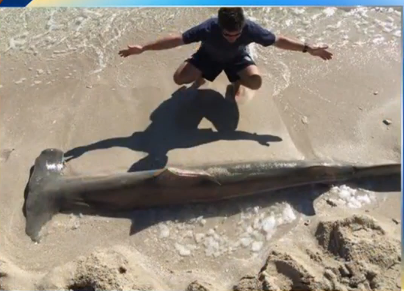
What is our obsession with taking pictures of ourselves with subjects that seem just a bit inappropriate? Now that smart phones have turned us all into photog wannabes, the rush to get pictures published on social media sites has also lead us to be wannabe reporters, as well.  Recently two sharks, a bull and a hammerhead, washed up dead on the shore of Miami Beach. One was bloated, the other with its fin cut off.  Once beach-combers saw the poor creatures, the camera phones came out and the snap-shot taking crowds were enough to make any paparazzi, surrounding a Hollywood celebrity, pale in comparison.  There was even a grown adult who pulled up on the head of one shark to get its mouth to open. What a photo op! "Hey kids, come gather around!"


Where is the respect? It’s just an animal. Who cares, right? WRONG! Are we another 'Me Generation' or have we never left it?  This is 2015 folks.  We've scratched our way out to escape the errors of our ways. After fighting for equality in several different arenas, freedom of religion, the push to reuse, reduce and recycle, ‘save our planet,’ ‘plant a tree’…have we not arrived? What has happened to the rights and respect for those with which we share this slowly, dying planet?

http://cdn.inquisitr.com/wp-content/uploads/2015/02/Bull-Shark-670.jpg
Source: Inquisitr.com

Back to these dead sharks: No one knows what caused their deaths, and apparently no one is investigating.  A fin was cut off! I was told by an authority at the Florida Fish and Wildlife Conservation Commission that maybe if there was a bunch of these guys washing up on the shore with their fins hacked, there might then be an investigation. How many have to lose their lives in order for that to happen? Maybe this is just a prelude of what is to come. Since shark fin soup is served in restaurants throughout Florida, and yes, Miami, maybe this was the result of someone trying to cash in on the evil craze. Does that mean finless carcasses are on their way to shore like a message in a bottle? Are we going to read it and do something about it or are we going to throw it back in for the next generation to deal with? Did you know that 24 states according to the Animal Welfare Institute, serve up the controversial delicacy, shark fin soup?  You can find it on the menu at South Garden Chinese Restaurant in Miami for $12 a bowl.

Source 

It’s a shame; it’s a crying shame that an 8 foot animal is tortured for its 8 inch body part and left to die, rotting in its ocean home, only to float to the shore to be mocked as part of social media fodder. To the person(s) who did this: "At least, eat the rest!" I discourage anyone from killing these animals and it pains me to see their fins cut off and then the shark dropped back in the water to try and survive. Would the same thoughtless individual do that to their pet? They’d be put in jail.

These sharks are intelligent, beautiful, and are an integral part of our oceans and were here way before you and I. Respect them. Wouldn't a picture of you with a live shark be cooler to take?


Join us for live shark selfie-taking starting this August at Guadalupe; Bahamas starting in April and Fiji year-round.

Let's go shark diving!
'Ocean'
Shark Diver

About Shark Diver. As a global leader in commercial shark diving and conservation initiatives Shark Diver has spent the past decade engaged for sharks around the world. Our blog highlights all aspects of both of these dynamic and shifting worlds. You can reach us directly at staff@sharkdiver.com.

Friday, December 20, 2013

John Travolta saving sharks?

John Travolta has joined the fight against finning sharks for shark fin soup. He has posted this on his website. It's awesome to see, that celebrities are lending a hand in raising awareness to this great cause. 

Thanks John!

I would also like to thank Li Na,  and Yao Ming for their help in turning the public perception of shark fin soup in China. They are huge celebrities in their country and their compatriots seem to be paying attention, consumption of shark fin soup is down by 70%

Cheers,

Martin Graf

CEO
Shark Diver

About Shark Diver. As a global leader in commercial shark diving and conservation initiatives Shark Diver has spent the past decade engaged for sharks around the world. Our blog highlights all aspects of both of these dynamic and shifting worlds. You can reach us directly at staff@sharkdiver.com.
Monday, October 21, 2013

No more shark fin soup in China?

Have the Chinese seen the light and stopped eating shark fin soup?

According to an article in the Washington Post that is exactly what is happening in China. The report states that  "consumption of shark fin soup in China is down by 50 to 70 percent in the last two years,” 

It goes on to state  "Thanks to a former NBA star, a coalition of Chinese business leaders, celebrities and students, and some unlikely investigative journalism, eating shark fin soup is no longer fashionable here. But what really tipped the balance was a government campaign against extravagance that has seen the soup banned from official banquets"

We talked about this a few months back, when China first announced that they would stop serving shark fin soup at state dinners and we are happy to see that the changes are happening faster than anyone anticipated.

We are always happy to report when things are changing for the better and want to thank the Chinese people for caring about our Oceans and the sharks that are such an important part of it.

Cheers,

Martin Graf
CEO Shark Diver


About Shark Diver. As a global leader in commercial shark diving and conservation initiatives Shark Diver has spent the past decade engaged for sharks around the world. Our blog highlights all aspects of both of these dynamic and shifting worlds. You can reach us directly at staff@sharkdiver.com

Monday, January 14, 2013

Can One University Student Save Sharks?

The idea of shark conservation has been around for many years but are we winning?. Shark finning seems to keep going, despite efforts to ban it. Poachers catch sharks illegally and few countries have the will or means to enforce their own protection laws for sharks.

Don't get me wrong great strides have been made to protect sharks over the years but I get the nagging feeling we're not quite there yet.

So what is the answer? Do we need more laws? Do we need more sanctuaries?

Of course we do, but will that solve the problem? What can we as individuals do?

Chelsea Stephens, a student at the University of Rhode Island came up with an novel idea made with 49cents worth of pvc pipe.

She developed a "hook-blocker", a device that reduces the chances of a Sand Tiger Shark, a protected and rapidly declining species, getting gut hooked and dying.

The device is a simple pvc pipe attached to the fishing line about 7 inches above the hook, preventing Sand Tiger from swallowing baited hooks.

In my view, that's how to do conservation. Real world and immediate solutions that save sharks now.

It's frustrating sometimes to look at the big conservation picture and intuit progress, but if we look at many small and regional things that we can change, we can all make a difference.

Hopefully these kind of pictures become a thing of the past
Last year China announced that it will stop serving shark fin soup at state dinners - starting in 2 years.

At first I thought, why do they have to wait 2 years?

But after a little reflection I realized that even though it's just a small step, and those state dinners don't exactly use a lot of shark fins, it signals a change in attitude. Maybe if the government stops serving shark fin soup, then the people will follow suit and stop serving it at weddings and little by little, the demand for shark fins will get smaller.

Sharks conservation is a muti headed hydra of ideas and conservation programs for sharks.

I guess I am old school when I believe that many small, smart conservation efforts can actually lead to big changes for sharks. Chelsea Stephens showed us how, with a piece of pvc pipe and an imagination, you can be part of the progress.

Cheers,

Martin Graf
Managing Director
Shark Diver


About Shark Diver. As a global leader in commercial shark diving and conservation initiatives Shark Diver has spent the past decade engaged for sharks around the world. Our blog highlights all aspects of both of these dynamic and shifting worlds. You can reach us directly at sharkcrew@gmail.com.

Monday, December 17, 2012

Good shark news out of China?

Hopefully this sight will soon disappear!
It seems like the tide is slowly, slowly turning. According to "Chinadaily.com.cn" About 6 percent of luxury hotels in three major Chinese cities have stopped serving shark fin.

The article further states that In Beijing, 132 hotels completed the phone questionnaire between Nov 20 and Dec 12. Only 12 hotels, 9 percent, said they do not serve shark fin. A similar survey of 131 Beijing hotels conducted a year ago found only one hotel that did not serve shark fin, Wang Xue, chief coordinator of the survey, said on Saturday.

Granted, it's a very small step, but especially viewed together with the recent announcement by the Chinese government that they will stop serving shark fin soup at state dinners, it's a sign that the Chinese are becoming aware of the international view on shark finning and are starting to respond.

You can read the whole story here.

We at Shark Diver hope that by sharing this article and acknowledging the positive steps they take, we also send a signal to China that we don't just criticize them, but also give credit when they do something right.


Cheers,

Martin Graf
Managing Director
Shark Diver


About Shark Diver. As a global leader in commercial shark diving and conservation initiatives Shark Diver has spent the past decade engaged for sharks around the world. Our blog highlights all aspects of both of these dynamic and shifting worlds. You can reach us directly at sharkcrew@gmail.com.

Wednesday, July 4, 2012

No more Shark Fin Soup in China?

Yesterday the New York Times reported that China said Tuesday that it would prohibit official banquets from serving shark fin soup, an expensive and popular delicacy blamed for a sharp decline in global shark populations.

Will pictures like this soon be a thing of the past?
Alex Hofford/European Pressphoto Agency
 It looks like years of efforts to raise awareness about Shark Finning is starting to pay off. This news comes just a couple of months after the media in Hong Kong struck out against the global anti shark fin campaigns, characterizing them as "anti Chinese" and "discriminating against their eating culture". While official state dinners use just a tiny fraction of all Shark Fins consumed, this announcement still sends a signal, that China is starting to change it's attitude towards Shark Conservation 

Cheers,

Martin Graf
Dive Operations Manager
Shark Diver/Horizon
Isla Guadalupe, Mexico

About Shark Diver. As a global leader in commercial shark diving and conservation initiatives Shark Diver has spent the past decade engaged for sharks around the world. Our blog highlights all aspects of both of these dynamic and shifting worlds. You can reach us directly at sharkcrew@gmail.com.

Saturday, June 2, 2012

A poor 3rd world country fighting shark finning? You betcha!

Burning the poachers loot!
Honduras has taken the fight against illegal shark finning to a new level.

According to an article on Science 2.0:

Hondurans Burn Shark Fins To Stick It To Poachers

So when the fins, mostly from nurse sharks, were seized in April by the Honduran navy, it was a safe assumption the fins were obtained illegally. Still, with 14% inflation and 22% of the country below poverty levels surely something could have been done with the hundreds of shark fins, worth that $300 per pound as mentioned. The poachers were already penalized but actual law-abiding poor people could have been helped with the money for a product perfectly legal in plenty of other countries.

Instead, President Porfirio Lobo joined the country's top law enforcement officials yesterday in a bit of political theater, to watch the burning of the illegal shark fins.


I personally applaud president Porfirio Lobo for this action and wouldn't characterize it as "political theater" I think this action sends a clear message to the poachers that Honduras is serious about shark conservation and will not allow anyone to profit from the sale of shark fins. Suggesting that the Honduran Government should have sold the fins to help the poor, is a little like saying our DEA should sell the pot they confiscate to help fund programs for the poor here.

Well my friends, that's my take on it. Feel free to let me know if you have a different take on this.

Cheers,

Martin Graf
Dive Operations Manager
Shark Diver/Horizon
Isla Guadalupe, Mexico


About Shark Diver. As a global leader in commercial shark diving and conservation initiatives Shark Diver has spent the past decade engaged for sharks around the world. Our blog highlights all aspects of both of these dynamic and shifting worlds. You can reach us directly at sharkcrew@gmail.com.

Wednesday, May 23, 2012

Is Shark Finning OK?

Finned Reef Shark
According to an article in "Forbes":
  
Just this week, four of the five largest Chinese-language newspapers in shark fin capital Hong Kong rolled out a high-profile ad campaign that blasts the global anti-shark fin campaign as groundless, and intended “to incite the public to discriminate our own eating culture.”  It claims Western conservation groups “use the shark issue as a fund-raising gimmick.  We now we made a vow to voice out and unveil those lies.”


I have to admit that I've become a bit cynical with the media when it comes to how they portray anything to do with sharks. It seems that they're mostly interested in shocking headlines and have very little substance in the article themselves. So that's why today's article in Forbes came as a pleasant surprise. It is very informative, doesn't use hype and is well written.

In 10 years of working with Great White Sharks this is one of the best articles I've read on the complex subject of shark finning.

Well done Forbes.


Cheers,

Martin Graf
Dive Operations Manager
Shark Diver/Horizon
Isla Guadalupe, Mexico

About Shark Diver. As a global leader in commercial shark diving and conservation initiatives Shark Diver has spent the past decade engaged for sharks around the world. Our blog highlights all aspects of both of these dynamic and shifting worlds. You can reach us directly at sharkcrew@gmail.com.

Tuesday, March 27, 2012

Dr Rachel Graham - How To Shark Media 101

Finally, a real shark conservationist who is unafraid to place at the alter of mainstream media a bountiful trove of balanced sound bytes and realistic shark numbers.

Are you paying attention Sea Shepherd, Shark Angels and United Conservationists?

Yeah, you can stop your collective conservation fog machines for just one second here because this is important.

Numbers matter in the shark conservation game and when you quote 70-80-90% of all shark species facing extinction, or when you try and get New Yorkers to sign a petition  that suggests the worlds entire oxygen supply is somehow hinged on the continuation of all shark species you make the conservation world as a whole looks like a bunch of rank amateurs playing at conservation for reasons that boggle the imagination.

100 million sharks killed for their fins? You still peddling that garbage? Seriously?

Have you read this?

What started with a dubious shark movie and some gal with a pizza box lid in South Africa that said, "Save the Sharks" written in lipstick, has metastasized into media fog factory of pulled from the arse conservation misquotes lead by some pretty awful street corner doom criers.

But back to Dr Graham, read her article in the NY Times today and start writing numbers as fast as you can. 17% of 1,200 species of the worlds sharks threatened, oxygen has nothing to do with sharks, no mention of the 100 million sharks killed each year for their fins, and yes we can reverse the declines.

This is how you do shark conservation media folks.

You can try and scare the general populace into signing your petitions and donating money to your various shark causes but the real conservation numbers are stark enough. Real facts are in fact quite actionable without the added made up conservation fantasy that far too many are peddling out there.

Thanks Dr.Graham.

Wednesday, October 19, 2011

Myth vs Reality - Images and Google

We're asking a question here.

Why is it if the shark fin industry is so vast that we see so few images of the industry in action?

A Google image search for shark finning reveals 98,500 results.

A Google image search for Bigfoot? 2,380,000 results.

If you asked folks on the street if they believed in Bigfoot you'll probably get at least a 98% awareness of the Bigfoot myth.

And shark finning?

Food for thought.

Sunday, April 25, 2010

Palau Shark Sanctuary - Video Interview

We follow a number of blogs one of which is The Palau Shark Sanctuary Blog Shark Talk.

For those that do not know the inspiring story of Dermot Keane there's a new video interview out that makes for fascinating watching:

When Irishman Dermot Keane visited Palau for the first time, he wasn’t aware of the disruptive fishing techniques, or the shocking shark finning that was going on around the island. But once he did, he decided to do something about this.

Big time!

Saturday, January 23, 2010

Taiwan civic groups protest chain stores selling shark-fin soup

Smart direct action protests begin with indigenous populations. The issue of sharks fin soup has been a tricky one with the perception of Westerns trying to influence a primarily Asian cultural issue.

Asians, for good reason, are resistant to heavy handed direct action eco push by outsiders. A fact many within the Western shark conservation community have discovered first hand over the years.

So, how do you change destructive indigenous cultural practices?

The IUCN has an idea, protesting and messaging with local populations:

"Lured by high profits, fishermen kill sharks only for their fins. They cut off shark's fins and dump the sharks into the sea and let them bleed to death," said Wang Yu-min, director of the Environment & Animal Society of Taiwan. "Each year, some 4,000 to 7,000 sharks are killed for their fins. The International Union for Conservation of Nature warned that 111 species of shark are being threatened, of which 20 species are seriously threatened and 25 species face
extinction," she said.


Complete Story.

Thursday, January 21, 2010

Fuchsia Dunlop BBC - Refusing Sharks Fin

The BBC has a first rate story today on the culture of shark fin soup and one woman's determination to end it's acceptance at the dinner table.

It is a classic tale of east vs west mentalities with a surprising twist at the end. The shark conservation movement may just end the practice of eating sharks fin soup "one table sized international incident" at a time:

"There was an awkward silence. My dinner companions had not heard this kind of stuff before and certainly not from me, who they know as the Englishwoman who eats everything."


Complete Story.

Wednesday, December 23, 2009

Oceanic Whitetip Sharks - Hawaii

If you have not yet discovered iDive Sharks consider this an "insiders tip." This week Mark Oronzio shared his Oceanic Whitetip footage from Hawaii.

Increasingly rare due to fishing pressure and sought after for their overlarge fins these remarkable critters make better close encounter video.

Kudos:


Sunday, June 28, 2009

Businessman charged over alleged shark fin haul

A 35-year-old man could face up to $14 million in fines for commercial shark fishing offences following his arrest at Perth Airport yesterday.

Fisheries and Marine officers arrested Fu-Hsin Chen at Perth Airport as he was preparing to board a flight to Taiwan yesterday morning.

Chen was charged in relation to the alleged seizure of approximately 10 tonnes of shark products from a commercial fishing vessel at Broome Wharf almost a year ago.

Chen is the owner manager of Shine Year Fisheries (Aust) Pty Ltd. The company’s vessel Fortune was authorised to fish off the northern coast of WA.

Both Chen and his company have been charged under the Fish Resources Management Regulations, which state commercial fishing boats can only carry or unload whole shark.

Under the regulations sharks may have their fins cut from their bodies but only the head and parts removed during gutting can be disposed of at sea.

Fisheries northern region manager Peter Godfrey said the regulations were in place to prevent the unsustainable practice of “finning”, where the high value fins are retained and the low-value trunks are thrown overboard.

“The demand for shark fins from markets in Asia has resulted in worldwide concern over the future sustainability of shark stocks,” Mr Godfrey said.

Chen and his company face two charges which carry a maximum of $10,000 each and additional fines of up to $14 million.

If convicted the total fines imposed are at the discretion of the magistrate who may chose one of two mandatory penalties – to charge per weight of the sharks taken, or per individual shark.

PERTH
LISA CALAUTTI

Tuesday, June 16, 2009

Shark Conservation Film - Requiem

Kudos!

We have been waiting for a shark film to come along that balances the horrors of shark finning, loss of shark populations, and the public's ongoing negative perception of sharks...without a hidden eco agenda or media hype.

The wait is over, welcome to Requiem a shark conservation film launched in 2007.

"Recent research using computer modeling has shown that the removal of sharks from their ecosystems could have devastating and unpredictable consequences for the abundance of commercially important fish stocks. Sharks, as apex predators, regulate the abundance of other fish and are therefore keystone species in the health of our ocean ecosystems. The practice of shark finning is capable of removing entire stocks of sharks in a very short space of time"

Wednesday, March 18, 2009

Palau's Shark Conservation Under Siege?

With the good news from the Maldives this month of island wide shark protections, comes disturbing news from Palau about an attempted policy shift away from shark protections in favor of commercial shark fining.

The story was broken by the Shark Talk blog this week and has a list of contact emails to voice your opinion on this shift from conservation to one time take.

A good friend once said, "Shark conservation is like playing a global game of Whack-a-Mole, just when you think you got it hammered down, another disaster surfaces".

Please take a moment from your day to read up on this latest game changer in Palau and send a few emails to speak out against against the proposed Senate Bill 8-44:

Belau Tourism Association: bta@palaunet.com
Palau Chamber of Commerce: pcoc@palaunet.com
Palau Visitors Authority: pva@visit-palau.com

Kudos to the Shark Talk blog for this concise and well researched post.

Friday, January 9, 2009

Humane Society International-Loophole closure

The Humane Society of the United States and Humane Society
International issued a statement today applauding Guam Delegate
Madeleine Bordallo for introducing legislation that would close a
loophole on shark finning.

Bordallo introduced the Shark Conservation Act, H.R. 81, which
provides increased protection for vulnerable shark species from the
disgusting practices of “finning” and overfishing.
“Each year, tens of millions of sharks worldwide have their fins
cruelly cut off at sea and are then thrown back overboard to die a
lingering, painful death,” said Patricia Forkan, president of Humane
Society International. “Shark finning threatens the survival of
essential marine species, and we commend Congresswoman Bordallo for
addressing this cruel and wasteful practice.”

Although shark finning was banned in the U.S. by the Shark Finning
Prohibition Act of 2000, enforcement is complex and a major loophole
allows circumvention of the law. Last summer, the U.S. Department of
Commerce implemented regulations in the U.S. Atlantic Ocean and Gulf
of Mexico requiring that sharks be landed with fins attached to their
bodies, to prevent shark finning. However, the Pacific Ocean has no
comparable regulation, leaving these expansive waters wide open to
abuse.

Last year, the previous version of the Shark Conservation Act (H.R.
5741) passed the House in the 110th Congress, but did not advance in
the Senate before the session was adjourned. The new legislation
contains the same language closing a loophole that currently permits a
vessel to transport fins that were obtained illegally as long as the
sharks were not finned aboard that vessel. The act also requires that
all sharks be landed with their fins naturally attached to their
bodies, creating a clear enforcement mandate applicable in both
oceans.