Showing posts with label martin graf. Show all posts

Wednesday, June 23, 2021

Special Great White Shark Expedition to Guadalupe Island.


Shark Diver is excited to announce that we will have a very special expedition to Guadalupe Island this fall. From Sept. 8-13 we will have both Nicole Nasby-Lucas, the scientist responsible for the Guadalupe Photo ID database and Tanya Houppermans, a world renowned underwater photographer on board.


Nicole Nasby-Lucas

Nicole has been studying the white sharks of Guadalupe Island, Mexico since 2001. Her research includes satellite tagging and tracking studies to examine migration patterns and behavior. She also manages the Guadalupe Island white shark photo-ID program and maintains a database of all sharks sighted at Guadalupe Island since 1999. The photo-ID program is important for tracking the visitation patterns of individual sharks as well as monitoring the overall status of the population. By using the unique coloration of these sharks, she’s been able to identify over 360 individuals to date. This project started in 2001 and some of these sharks have been seen every year since. All of this research is crucial for the management and conservation of northeastern Pacific white sharks.

All our guests will receive a copy of the official Guadalupe Shark Photo ID database. How awesome would it be if you can say "this is the shark that swam right next to me" the next time you watch Shark Week?

Tanya Houppermans is a world renowned underwater photographer and conservationist best known for her images depicting the grace and beauty of sharks.


Tanya Houppermans
 

A former mathematician and research operations analyst, she left the corporate world behind in 2015 to concentrate full time on conservation after learning that over 70 million sharks are killed every year with many species being on the verge of extinction. Her articles and images have been published around the world, and she is the recipient of several prestigious awards for her photography including her photo "Harmony" which won:

First Place awards in the ‘Sharks’ category in the World Shootout in 2017, First Place in the ‘Portrait’ category in the Underwater Photographer of the Year competition, and the Grand Prize in the California Academy of Sciences Big Picture Natural World Photography Competition. 

"Harmony"
 

A prominent public speaker, Tanya has shared her experiences in the underwater world with international audiences in locations such as Singapore, Shanghai, Paris, and Washington D.C. She is actively involved in cutting-edge shark research and helped to develop the citizen science program Spot A Shark USA to study sand tiger shark populations along the east coast of the Unites States. Tanya can be seen in the program ‘Shark Gangs’ that highlights her work with the sand tiger sharks of North Carolina as part of National Geographic’s SharkFest 2021.

Sand Tiger aggregation
 

On our expedition Tanya will share her vast knowledge of underwater photography, giving tips and advise to our guest as well as talk about her work in conservation.

Having both Nicole and Tanya on board will give our guests the unique opportunity to get to know our sharks, some of which we have known for over 20 years now, participate in the research and learn how to take awesome pictures and videos or our toothy "friends". 

We only have a limited number of spaces left on this special expedition. Call us at 619.887.4275 or email crew@sharkdiver.com for more info.

Let's go shark diving!

Cheers,

Martin Graf

CEO Shark Diver

About Shark Diver. As a global leader in commercial shark diving and conservation initiatives Shark Diver has spent the past decade engaged for sharks around the world. Our blog highlights all aspects of both of these dynamic and shifting worlds. You can reach us directly at crew@sharkdiver.com.

Monday, February 2, 2015

Do you want to join a researcher at Guadalupe Island?

Every year we get hundreds of emails from people asking us, how they can get involved with shark research. This has lead to Shark Diver teaming up with Nicole Nasby-Lucas from MCSI to offer special science expeditions to Guadalupe Island. These special science expedition give our divers a chance to actively participate in the Great White Shark photo ID project and also learn about the results of various studies, involving our sharks at Isla Guadalupe.

The response from our divers has been overwhelming. Last year's science expeditions filled up in just a couple of weeks and for this season, we already sold out our September and October expeditions. Right now, we do have a a few spaces left on our November 11-16 expedition.

Don't miss your chance to be part of this exciting research, which up to today has resulted in over 160 sharks being identified at Guadalupe Island. Some individuals like "Bite Face", "Jaques", "Thor" and "Chugey" are regular visitors and have been seen every year since we started going to Guadalupe Island. You will learn the differences in behavior and migration between male, female, juvenile and adult sharks along with many other interesting things about Great White Sharks and sharks in general.

Nicole has a wealth of information and is excited about sharing her knowledge with you, our divers and research assistants. She will teach you how to identify the individual sharks and tell you about their history at Guadalupe Island. Just imagine, next time you watch "shark week", you might recognize the shark and realize that it's the one you came face to face with. The one that looked you straight into the eyes!

If you would like to be part of this experience, we recommend that you book now, since this is your last chance to join a scientific expedition in 2015.

The price for this trip of a lifetime is $3300 and it includes a copy of the photo ID book, containing all the identified sharks at Isla Guadalupe. We will also provide digital underwater cameras for you to use and you'll get a DVD of your trip to take home and share with your friends. If we encounter a new shark during your expedition, the group will be offered and opportunity to name the shark!

This special science expedition will run from September 11-16 2015

To book your expedition, or for more information, call us toll free at 855.987.4275 or 619.887.4275. You can also reach us via email at staff@sharkdiver.com or visit http://www.sharkdiver.com/dive-packages/great-white-shark-diving-science-expedition/

Let's go shark diving!

Cheers!

Martin Graf
CEO
Shark Diver
 
About Shark Diver. As a global leader in commercial shark diving and conservation initiatives Shark Diver has spent the past decade engaged for sharks around the world. Our blog highlights all aspects of both of these dynamic and shifting worlds. You can reach us directly at staff@sharkdiver.com.

Friday, March 14, 2014

Man attacks shark! Sharks are demanding "man cull" to mitigate the danger!

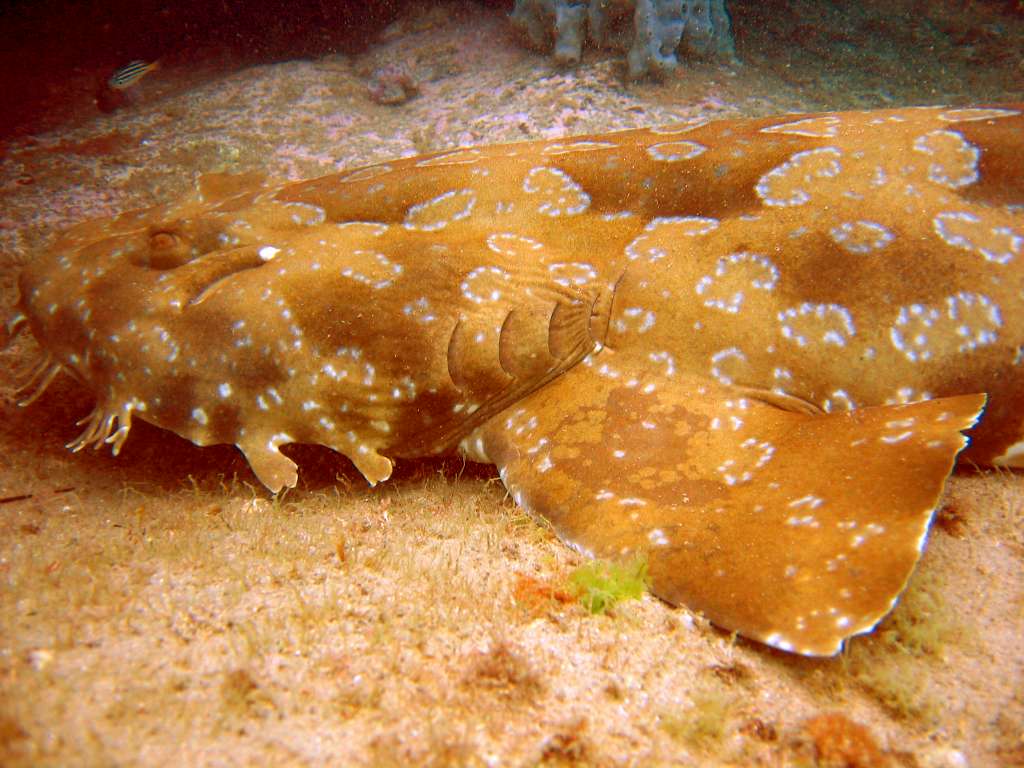
According to an article in the Daily Telegraph, a man was attacked by a wobegong shark. The article states that "Mr Porter had no advance warning when he was attacked.
“I had no idea what was happening — it just clamped on and that was the first I knew about it,” Mr Porter told The Daily Telegraph today. “It sort of bit through the flipper and went through to my foot.”Shark diving is fun. Diving with Great white shark. Swimming with Bull sharks, cage diving with Tiger sharks
Wait a second, the shark "attacked" Mr. Porter? Wobegong sharks are carpet sharks, that usually rely on their camouflage to hide from prey, so they can ambush it. So most likely what happened is that Mr. Porter stepped on the shark, which bit him in return.

Wouldn't it be more accurate to have a headline that says "Port Macquarie shark bites man after being attacked by him"? Shark had no advanced warning, when Mr porter viciously stepped on it's head!

Injuries caused by shark bite
And the injuries to the man you ask?  Here is a picture of the "severe" wound the "shark attack" has left on the "victim"

Now this type of human/shark interaction is really what I call worthy of newspaper headlines. There are thousands of people who step on a stingray each year and get stung in return, in some cases causing injuries more severe than the ones caused by this shark bite.  Do you recall any newspaper headlines describing those incidents? As soon as a shark is involved, there are headlines, it's always characterized as an "attack" and it almost never states that it was provoked.

Where is the harm in having headlines like this? You may be aware of the shark cull that is going in Australia right now. It is mostly based on the public's fear of sharks and has very little to do with actually protecting the people. Headlines like these, perpetuate that fear and can cause real harm, not only to the sharks, but the entire ocean Eco system in turn.

I know I'm banging my head a against a wall, but had to get this off my chest.

Cheers,
Martin Graf
CEO
Shark Diver

 About Shark Diver. As a global leader in commercial shark diving and conservation initiatives Shark Diver has spent the past decade engaged for sharks around the world. Our blog highlights all aspects of both of these dynamic and shifting worlds. You can reach us directly at staff@sharkdivercom.

Wednesday, March 12, 2014

Last day to bid on a scientific Guadalupe expedition!

Today is your last chance to bid on a scientific expedition with Nicole Lucas Nasby.

Here are the links for the bidding.

http://cgi.ebay.com/ws/eBayISAPI.dll?ViewItem&item=261413040920

http://cgi.ebay.com/ws/eBayISAPI.dll?ViewItem&item=261413042322

You can find more info on the trip here. All proceeds go to the Marine Conservation Science Institute, the organization that puts together and maintains the Guadalupe photo ID project.

Good luck bidding!

Cheers,
Martin Graf
CEO
Shark Diver

About Shark Diver. As a global leader in commercial shark diving and conservation initiatives Shark Diver has spent the past decade engaged for sharks around the world. Our blog highlights all aspects of both of these dynamic and shifting worlds. You can reach us directly at sharkcrew@gmail.com.

Are sharks apex predators? Does it matter?

We commonly refer to sharks as apex predators. Are they really? If they are not, does it matter? A few Australian researchers have come up with some answers to both questions.

First, are sharks apex predators? According to their findings, the answer is yes .... and no.

Example of an apex predator!
Here is what they found. "While size can be important in terrestrial ecosys- tems, size is crucial in marine ecosystems — which tend to be dominated by indeterminate organisms that grow continuously throughout their lives (Trebilco et al. 2013). Individual function changes due to onto- genetic diet shifts as organisms grow in size (Karpouzi
& Stergiou 2003, Pinnegar et al. 2003). The conse- quence is that size-structuring within communities, rather than species identity, is an important factor in determining the strength of competitive and predatory interactions (Dickie et al. 1987, Kerr & Dickie 2001). For example, studies have shown high overlap in diet between similar-sized sharks regardless of maturity state and species identity (e.g. Bethea et al. 2004). Therefore, designation of marine species into apex and mesopredator categories should consider the life stage and size of individuals."

I'm not a scientist, but what I'm getting is, size matters!
But so, why should we care? We are not scientists, (well, you may be, but I'm not) so what does a classification matter? 
Here is what they have to say to that. 
Example of a meso predator!
"Our size-based view of the classification of predatory roles raises important questions about what objectives to manage, and how these objectives can be best achieved. Protection of reef communities through marine protected areas (MPAs) or fisheries regulation (or indeed, naturally on those few locations far from human population centres) would ensure the mesopredator sharks on these reefs are sheltered from fishing pressure. However, the same may not be true for apex predators because their broad movement patterns and large home ranges (Meyer et al. 2009) would expose them to a greater diversity of fishing fleets and gears, and thus a greater overall mortality than the smaller-ranging, reef-dwelling mesopredators. Hence, the apex pred- ators of coral reefs may be silently eliminated by offshore pelagic longline fisheries, unbeknownst to those managing reef diversity and function (Cox et al. 2002). Therefore, reef-based MPAs are not adequate to protect these species"

So basically they are saying that we need to do more than establish MPAs to adequately protect apex predators.

Here is a graphic that may be a bit more clear on the subject.
 

This graphic shows, that without MPAs prey species would greatly increase, while both mesopredators and apex predators decrease. With reef scale (small, local) MPAs, the mesopredators thrive, keeping the prey species in balance, but the apex predators still decline.

 
In practical terms, this means that we have to protect apex predators on a much larger scale than the less migratory mesopredators. In order to do that, we need to know both where they are and when they are there. With that knowledge we can push for local and/or seasonal protection for these migratory apex predators. In order to get that data, we need data that shows the migratory behavior of the various species of apex predators. 
You can read the entire paper here.

Cheers,
Martin Graf
CEO


About Shark Diver. As a global leader in commercial shark diving and conservation initiatives Shark Diver has spent the past decade engaged for sharks around the world. Our blog highlights all aspects of both of these dynamic and shifting worlds. You can reach us directly at staff@sharkdiver.com

Saturday, February 22, 2014

How to get work as a "shark diver"?

It's the time of the year, when we get a steady stream of emails and letters, asking for advise oh how to become a "shark diver"  Do you need a biology degree? Do you have to be a divemaster or diveinstructor? I'm a student, interested in sharks, how do I get a job with you? Shark diving, diving with Great White Sharks, Bull Sharks, Tiger Sharks and hammerheads.
How do I answer these questions? After 13 years of diving with sharks for a living, I can't give you a good, general answer. There are so many variables. Where are you from? Where do you want to work? Do you have a work permit for the country you want to work in? These are all things that may be more important than the education you have. Cage diving, swimming with sharks at Guadalupe Islandis our specialty
The most important thing to know is this. You really, really have to want it. There are very few jobs available and thousands of people who want them. Don't be discouraged by the bad odds, in my case, I grew up in Switzerland, failed biology in school and used to be afraid of sharks, so how difficult can it be?

When you do get a job, it may not be exactly what you pictured it to be.  If you work for us, you will be working on a boat. There are long hours, typically 12 hrs. per day. You will be making chum (not as glamorous as it sounds), cleaning heads and pulling midnight watches. There is very little privacy and your quarters on the boat are cramped. How about time off? Ahhh, not so much. We do back to back trips and you may only have a couple of hrs. off, between trips. You could work 30 days, without a day off. Shark week, bucket list, shark adventure, cage diving, Tiger shark, Hammerhead
Still interested? I can't speak for any other shark diving companies, but here is what you need, if you would like to work with us.

First of all, you have to be reliable, safety conscious and mature! We are working with Great White Sharks and we can't afford to have someone goof off! We specialize in safe and sane shark diving! Guadalupe Island, Shark diving mexico, swimming with sharks,
You have to be able to legally work in the US. We will not be able to get you a work permit.   

You need the physical ability to handle cages, lines, weights, anchors etc.

Previous work experience on a boat, a DM or SCUBA Instructor rating and a marine biology degree are a plus.

We are working closely with SEACAMP San Diego and have hired many of their staff members in the past. Getting a recommendation from them is a huge plus! Generally, the more experience you have, the better your chances.

When we have an opening, we will post it here and let you know, what the specific qualifications are. Good luck!

Cheers,
Martin Graf
CEO
Shark Diver


About Shark Diver. As a global leader in commercial shark diving and conservation initiatives Shark Diver has spent the past decade engaged for sharks around the world. Our blog highlights all aspects of both of these dynamic and shifting worlds. You can reach us directly at staff@sharkdiver.com.

Wednesday, February 5, 2014

Who is really saving the sharks?

It seems like there is a new group, or organization, that wants to save sharks, popping up daily. With all these people supposedly having the same goal, why do they all feel that they need to start a new group? Why not join an already established organization? Great White shark, cage diving, swimming with sharks at Isla Guadalupe are specialties of Shark Diver
Just do a search for "shark" on facebook and you get a seemingly endless list of groups that want to save sharks, but most of them do nothing, other than commiserate with each other.Great White shark, cage diving, swimming with sharks
As a company that deeply cares about our oceans and the sharks that live in it, we like to support and work with the organizations we feel are doing a great job, not just talking about conservation, but really doing something about it.

We are proud to say that our Fiji partner, Bequa Adventure Divers, has the same philosophy. They helped establish the Fiji "Shark Reef Marine Reserve" and I love the way they describe themselves as a "conservation project, masquerading as a dive operation". You can read about their philosophy and actions here. Their approach to partner with the local fishermen is awesome and their success proves, that conservationists and fishermen can work together.Great White shark, cage diving, swimming with sharks at Isla Guadalupe are specialties of Shark Diver
Beqa Adventure Divers has also partnered with Projects Abroad a great organization, working, not only to protect sharks, but helping in a lot of different areas. Mike has written an excellent blog about them here.

We are going to Fiji this May, to dive with Bull Sharks and to check out the possibility of organizing a volunteer trip for next year. If you would like to join us on our Fiji adventure, dive with up to 70 Bull Sharks swimming around you and check out what Mike and his crew are up to, call us at 855.987.4275 or 619.887.4275 staff@sharkdiver.comGreat White shark, cage diving, swimming with sharks at Isla Guadalupe are specialties of Shark Dive

Cheers,
Martin Graf
CEO
Shark Diver


About Shark Diver. As a global leader in commercial shark diving and conservation initiatives Shark Diver has spent the past decade engaged for sharks around the world. Our blog highlights all aspects of both of these dynamic and shifting worlds. You can reach us directly at staff@sharkdiver.com

Monday, February 3, 2014

What's the best place to dive with Great White Sharks?

And the answer is........ drum roll please!..... Guadalupe Island!

According to champion free-diver and ocean conservationist William Winram, "Guadalupe Island, 260km off the coast of Mexico is the best place on the planet to see great whites."  He goes on to say "It has the best visibility, and the most animals of all great white diving spots,"

The fact that the article also mentions Shark Diver as the operator to take you there, is a nice compliment! We love our sharks and are always excited to take our divers to visit our toothy friends at Guadalupe Island.

Check out this article that shows him diving with our Great White Sharks a few years ago.

Cheers,

Martin Graf
CEO
Shark Diver

855.987.4275 or 619.987.4275

About Shark Diver As a global leader in commercial shark diving and conservation initiatives Shark Diver has spent the past decade engaged for sharks around the world. Our blog highlights all aspects of both of these dynamic and shifting worlds. You can reach us directly at staff@sharkdiver.com.

Tuesday, January 28, 2014

Shark cull in Australia. Saving lives?

The first shark was caught and killed under the new shark cull policy in Western Australia. According to the ABC in Australia,  Fisherman says animal he shot was threat to public safety.

Photo http://www.abc.net.au
In response to the international outcry, denouncing the policy, Western Australias Transport Minister Troy Buswell, who was one of the architects of the policy while he was fisheries minister, is quoted as saying "I suppose my question is, to those people who are so violently opposed to it (the shark cull) happening in Western Australia, is why do you value a West Australian shark so highly, and why do you value protecting a West Australian life so lowly, compared to the rest of Australia?" 

So my question to you Mr. Buswell is, since you are so concerned about threat to public safety caused by the sharks, who cause about 2 deaths (in all of Australia) a year, what are you going to do about:

Smoking, 17'000 deaths in Australia? Are you going to confiscate cigarettes? ...... Oh no, the pay you taxes on those, sorry, we need the money more than those lives.

Alcohol,  3'200 deaths in Australia? Are you going to outlaw alcohol? ...... Oooops, no can do, they also pay a lot of taxes.

Skin cancer, 540 deaths in Australia? Are you going to ban people from going to the beach? .... Oh no, that way they wouldn't go into the Ocean and we wouldn't need to cull the sharks. Dang, can't do that!!!!

Drowning, 290 deaths in Australia? ...... wait are you saying they are more likely to drown than get bitten by a shark?... Oh no, we have to stop people from going into the water!! Wait, if we do that, we don't need to cull the sharks. Dang, scratch that idea!

So Mr. Buswell, are you caring so little about Australian lives that your are not going to do a darn thing about all those deaths? ..... but you're hellbent on culling sharks, which is not even proven to have any effect on the number of people bitten by sharks?

Ah, Mr. Buswell, you are saying I'm being ridiculous. Well, of course I am! We both are! The only difference you and me isExcept of course, stopping the cull!!!  It's stupid, it doesn't safe lives and can have a devastating effect on the environment.  
, I know I'm being ridiculous and don't for a second believe we should do those things I'm suggesting.

Cheers,

Martin Graf
CEO
Shark Diver
About Shark Diver. As a global leader in commercial shark diving and conservation initiatives Shark Diver has spent the past decade engaged for sharks around the world. Our blog highlights all aspects of both of these dynamic and shifting worlds. You can reach us directly at sharkcrew@gmail.com.

Thursday, December 19, 2013

Do you want to help a shark researcher?

Every year we get hundreds of emails from people asking us, how they can get involved with shark research. This has lead to Shark Diver teaming up with Nicole Nasby-Lucas from the MCSI for a special science expedition to Guadalupe Island next year. This special science expedition gives our divers a chance to actively participate in the Great White Shark photo ID project and learn about the results of various studies, involving our sharks at Isla Guadalupe.

The response has been overwhelming. We have filled the expedition in just a couple of weeks, with many divers still wanting to participate. So we decided to add another special expedition from September 9-14 2014.

This is your chance to be part of this exciting research, which up to today has resulted in over 150 sharks being identified at Guadalupe Island. Some individuals like "Bite Face", "Jaques", "Thor" and "Chugey" are regular visitors and have been seen every year since we started going to Guadalupe Island. You will learn the differences in behavior and migration between male, female, juvenile and adult sharks along with many other interesting things about Great White Sharks and sharks in general.

Nicole has a wealth of information and is excited about sharing her knowledge with you, our divers and research assistants.

If you would like to be part of this experience, we recommend that you book early, since, as with our other research expedition, we expect this one to fill up fast.

The price for this unique expedition is $3300 and it includes a copy of the photo ID book, containing all the identified sharks at Isla Guadalupe. We will also have digital underwater cameras for you to use and you'll get a DVD of your trip to take home with you and share with your friends.

To book or for more information, call us toll free at 855.987.4275 or 619.887.4275. You can also reach us via email at staff@sharkdiver.com 

Let's go shark diving!

Cheers,
Martin Graf
CEO
Shark Diver 

About Shark Diver. As a global leader in commercial shark diving and conservation initiatives Shark Diver has spent the past decade engaged for sharks around the world. Our blog highlights all aspects of both of these dynamic and shifting worlds. You can reach us directly at staff@sharkdiver.com

Tuesday, December 10, 2013

Is Australia killing sharks? Again?

This is getting ridiculous. According to a couple of articles in the Australian, the Western Australian government has again decided to kill great white sharks. According to one article "Large sharks that swim into designated 'kill zones' near popular swimming and surfing beaches in Western Australia will be hunted by professional fishermen." The article quotes the fisheries minister Buswell as saying "This does not represent a culling of sharks. It is not a fear-driven hunt, it is a targeted, localised shark mitigation strategy,'' 

Wait a minute, did Mr Buswell say this is not a culling?  They are baiting hooks to catch and kill sharks, but it's not a cull. Only a politician can say something like that and actually think it makes sense.

A second article in the australian also states that "Treasurer Troy Buswell, who loses the fisheries portfolio on Wednesday, admitted it was likely other marine animals would be caught with the baited hooks, and it was possible tagged sharks used for research could also be caught by the new policy.
But the government insisted public safety came first."
There are a couple of things that don't make sense. Let's look at this a little closer.

1. The director of the Conservation Council of Western Australia correctly states that "This new cull policy amounts to indiscriminate fishing, and will not only cull potentially risky sharks, but we can expect to see dolphins, turtles, seals, nurse sharks and a range of other marine life killed off our beaches." So, since the baited hooks will not only target large sharks that are in the area, but also kill other marine life, the hooks will actually lure sharks into the area, because they will be attracted by the animals caught by the hooks. So how exactly is that going to make the beaches safer?

2. Targeting large sharks doesn't make a lot of sense, since it is actually the younger sharks that tend to be more inquisitive and less cautious than the adult ones.

Once again, politicians cater to the uneducated public and want to be seen as doing something, even if what they are doing isn't going to help and quite possibly could make the situation worse.

Cheers,
Martin Graf
CEO
Shark Diver

About Shark Diver. As a global leader in commercial shark diving and conservation initiatives Shark Diver has spent the past decade engaged for sharks around the world. Our blog highlights all aspects of both of these dynamic and shifting worlds. You can reach us directly at staff@sharkdiver.com.

Thursday, December 5, 2013

Great White Shark Expedition with scientist Nicole Nasby-Lucas

If you have been following us on Facebook, you probably already heard the news. Shark Diver is proud to announce that we are offering a special "Science Expedition" to Isla Guadalupe from September 19-24, 2014.

Nicole Nasby-Lucas from the Marine Conservation Science Institute will be on board, sharing her research with our divers and showing them how to identify the sharks.
So fare the database has over 150 individual sharks identified and some of those individuals have visited Guadalupe Island every year since first being identified in 2001. It is amazing to see how those sharks change in size and behavior.  

This expedition is a unique opportunity to be part of the growing database. Should we find a new shark, which is fairly likely during that time of the year, the group will get the opportunity to name the shark. Imagine seeing a shark on a future television documentary, knowing you were there when we first encountered that shark. All the participants will also get a copy of the photo ID book, containing all the identified sharks at Isla Guadalupe.

The price for this special expedition is $3300. We recommend that you book early, since we are already 60% booked and this is a very unique opportunity to be a part of the ongoing study of our sharks.


To book or for more information, call us toll free at 855.987.4275 or 619.887.4275. You can also reach us via email at staff@sharkdiver.com

I hope you can be part of this exciting expedition!

Cheers,
Martin Graf
CEO
Shark Diver


About Shark Diver. As a global leader in commercial shark diving and conservation initiatives Shark Diver has spent the past decade engaged for sharks around the world. Our blog highlights all aspects of both of these dynamic and shifting worlds. You can reach us directly at staff@sharkdiver.com

Wednesday, December 4, 2013

Good news? Bad news?

Popular wisdom holds that Sharks do not get cancer. That is why shark cartilage is widely used to prevent/treat cancer. Turns out that popular wisdom is once again proven wrong. According to an article in "livescience" sharks can indeed get cancer.


Credit: Andrew Fox and Sam Cahir
The article states Recently, researchers in Australia noticed a large tumor protruding from the mouth of a great white shark, as well as another mass on the head of a bronze whaler shark. The great white's tumor measured 1 foot (30 centimeters) long and 1 foot wide, according to a study describing the tumors published online in November in the Journal of Fish Diseases.

So this is both good news, hopefully fewer sharks are being killed for the cartilage, the bad news, ... sharks can get cancer. I hope that the good news in this case outweighs the bad, since I've only seen a few sharks with cancerous growths.

Cheers,
Martin Graf
CEO Shark Diver


About Shark Diver. As a global leader in commercial shark diving and conservation initiatives Shark Diver has spent the past decade engaged for sharks around the world. Our blog highlights all aspects of both of these dynamic and shifting worlds. You can reach us directly at staff@sharkdiver.com.

Tuesday, December 3, 2013

Paul Walker at Guadalupe

The Marine Conservation Science Institute has named a new great white shark at Isla Guadalupe Paul Walker, in honor of the late actor/director who was a big advocate for shark conservation.

As most of you know, Paul Walker died tragically in a car accident on November 30. MCSI's statement on their Facebook page states. "It is our pleasure to introduce to you a newly named Guadalupe Island White Shark: Paul Walker! Named in honor of our late friend and ocean advocate"

Meet Paul Walker, our newest addition to our Isla Guadalupe photo id database. (photo by Phil Colla)

I've been diving with the great white sharks at Isla Guadalupe for 13 years and definitely developed a special relationship with some of the sharks. I'm happy to see that by naming this young shark in honor of Paul Walker, his name and legacy will live on. Hopefully we'll see him for years to come, watch him grow and remember a great ocean advocate, every time we see him.

Rest in peace Paul Walker!

Cheers,
Martin Graf
CEO
Shark Diver


About Shark Diver. As a global leader in commercial shark diving and conservation initiatives Shark Diver has spent the past decade engaged for sharks around the world. Our blog highlights all aspects of both of these dynamic and shifting worlds. You can reach us directly at sharkcrew@gmail.com.

Sunday, November 24, 2013

Another catch and kill order for a great white shark?

Congratulations Australia! You have done it again. According to "The Australian" a catch and kill order has been issued for what is believed to be a great white shark that killed a surfer over the weekend.

The article states 35-year-old Chris Boyd, was attacked on Saturday morning by what's believed to be a great white shark at the popular surf break Umbries off Gracetown, 270km southwest of Perth. Mr Boyd, originally from Queensland, was killed instantly when he was mauled by a great white shark while surfing at popular break “Umbies” off Gracetown, 270km south of Perth at about 9am WST yesterday

It then goes on to say that The state's fisheries department issued a catch and kill order for the shark, saying there was an imminent threat of more attacks in the area. The fisheries department is quoted as saying they weren't ''just going to randomly kill sharks - it depends on what they see''

This is ridiculous. What exactly are they going to see? Since they say that the shark that attacked Mr. Boyd was "believed" to be a great white shark, how exactly are they going to determine that a particular shark is the right one, if they don't even know the species for certain? 

This is another typical reaction for a government agency. Do something, no matter how stupid, just to appear to be doing something.

Our heart goes out to the family of Mr. Boyd, but indiscriminately killing an animal is neither bringing Mr. Boyd back, nor is it making the ocean any safer for anyone else.

Cheers,

Martin Graf
CEO
Shark Diver


About Shark Diver. As a global leader in commercial shark diving and conservation initiatives Shark Diver has spent the past decade engaged for sharks around the world. Our blog highlights all aspects of both of these dynamic and shifting worlds. You can reach us directly at staff@sharkdiver.com

Thursday, November 7, 2013

Great White Sharks playing cupid?

So what does it mean, when you meet a great white shark at Isla Guadalupe and have it look you straight into the eyes? Well, for 2 of our divers this year, David and Fabiola, it meant something very special. Here is a message I got from them just a few days ago.

Man, it was much more than a good time aboard the horizon... this trip and fulfilling the dream of being with the great whites of Guadalupe was so intense, that Fabiola and I realized we should really be together and got married just 2 weeks ago We'll never forget those moments. Thanks for everything. Cheers, David and Fabiola

Congratulations David and Fabiola! It was awesome, having you on board and I wish you all the best for your future together. I'm looking forward to diving with you again with the tiger-sharks in the Bahamas.

Cheers,
Martin Graf
CEO
Shark Diver

About Shark Diver. As a global leader in commercial shark diving and conservation initiatives Shark Diver has spent the past decade engaged for sharks around the world. Our blog highlights all aspects of both of these dynamic and shifting worlds. You can reach us directly at staff@sharkdiver.com.

Monday, November 4, 2013

Coming face to face with a great white shark. A spiritual experience?

We just finished our 2013 season, diving with Great White Sharks at Isla Guadalupe. We had the pleasure to be able to introduce 173 divers to our smiling friends!

Here is a letter from Jen Saunders, one of our divers, describing her experience.

A Shark Story: The Day I Saw God (He Healed Me)

As the only agnostic member from a devout Protestant household, I was always the black sheep at family reunions and was probably prayed for by aunts, uncles and grandparents more than anyone else in the Saunders clan. I just never bought into the whole “God thing”, but always maintained the highest respect for all walks of faith and those who follow various teachings. 

The year before my father passed away from pancreatic cancer we had a conversation about faith and God. My father, a retired professor of English literature, asked how I could feel complete without knowing and feeling the presence of a higher power. I simply replied by stating that his question was equivalent to one asking how I can sleep at night without having ever seen a space alien. My dad was unwavering in his notion that the little pit of emptiness I had always felt in the back of my soul stemmed from my disassociation with a spiritual deity, but it wasn’t until I journeyed to Isle de Guadalupe and gazed into the eyes of an 18 foot great white shark named Thor that this emptiness was filled with an awe for a god that had been absent all my life. 

As an avid scuba diver and lover of marine life, I had read various books on the great white shark. These creatures are pure perfection of evolutionary art. They boast six thousand pounds of muscle, are the only animal that devours its weaker siblings in the womb, is immune to cancer and is constantly awake. While navigating south from San Diego on the two-day boat ride, I thought about these facts and asked myself if there was a single creature higher than the great white so designed to live forever. 

Before I open the pages into the details of my spiritual awakening, permit me to set the stage: Upon entering the cage it only took about 10 minutes before the first shark appeared. It circled the cage carefully studying each diver. In the movie ‘Jaws’ the rugged shark hunter Quint states that great whites have “lifeless eyes, black eyes, like a doll’s eyes”, but this couldn’t be further from the truth. Great whites have a variety of eye colors that include blue and brown. Additionally, each shark made eye contact with every single diver. Later that day a great white named Thor made eye contact with me. I don’t know if sharks can sense emotions in humans or if our heart rates serve as a language they can understand. I stared into Thor’s eyes and felt a calming wave of warmth wash across the face of my soul. I looked into his intelligent eyes with awe and total respect, as a misunderstood creature, and marveled at his powerful mass. Just then he moved in and slowly approached the cage while never breaking eye contact with me. Then, two feet from the cage bars, he broke his path and headed to the right of the cage. Before he vanished into the blue, he swerved to the side and met my gaze once more, as if he was saying “farewell for now fellow soul”.

We shared a moment. I was sure of this. As a well-travelled individual who has lived and seen enough to fill 10 lifetimes, never had I witnessed something so spiritually moving. I felt the presence of a divine being within this shark. This powerful, sensitive creature that never sleeps imprinted his soul into mine. 

Two months later I can happily report that the emptiness I once felt has been filled. Perhaps my father was right; it may be that my soul simply needed to be filled with the spirit or energy of something ethereal and divine. 


Going face-to-face with a great white shark isn’t just reserved for the thrill-seeker or the curious. This is an excursion I would recommend to anyone who feels a void deep within their being, or someone who is suffering from any number of personal or health issues. The great white shark is a healer; he is the misunderstood shaman of the sea. 

Coming face to face with a Great White Shark can mean a lot of things to different individuals. What is universal is the fact that you will never forget the first time a Great White Shark looked you straight into the eyes.

Let's go shark diving!

Cheers,
Martin Graf
CEO
Shark Diver

About Shark Diver. As a global leader in commercial shark diving and conservation initiatives Shark Diver has spent the past decade engaged for sharks around the world. Our blog highlights all aspects of both of these dynamic and shifting worlds. You can reach us directly at staff@sharkdiver.com

Tuesday, October 29, 2013

Aussie kills Great White Shark in self defense?

According to a report in "The Daily Star" a tuna diver killed a 6 meter long (19.8 ft) great white shark. The article states:

"It was either the shark or him. South Australian tuna diver, Dean Stefanek, 38, battled a 6-meter shark for 30 minutes and lived to tell about it.
Although, he said he regrets having to kill the massive White shark, he said he felt it was either the shark, or him.
He said he volunteered to jump into a tuna pen to try to kill the injured shark."


Now this is complete rubbish. If the report is accurate, how could it have been the shark or the diver, since he is saying that he volunteered to jump into the tuna pen to kill the shark. Since he wasn't in the water to begin with and jumped in specifically to kill the shark, he can't exactly claim self defense!

Cheers,
Martin Graf
CEO
Shark Diver

About Shark Diver. As a global leader in commercial shark diving and conservation initiatives Shark Diver has spent the past decade engaged for sharks around the world. Our blog highlights all aspects of both of these dynamic and shifting worlds. You can reach us directly at staff@sharkdiver.com

Monday, October 21, 2013

No more shark fin soup in China?

Have the Chinese seen the light and stopped eating shark fin soup?

According to an article in the Washington Post that is exactly what is happening in China. The report states that  "consumption of shark fin soup in China is down by 50 to 70 percent in the last two years,” 

It goes on to state  "Thanks to a former NBA star, a coalition of Chinese business leaders, celebrities and students, and some unlikely investigative journalism, eating shark fin soup is no longer fashionable here. But what really tipped the balance was a government campaign against extravagance that has seen the soup banned from official banquets"

We talked about this a few months back, when China first announced that they would stop serving shark fin soup at state dinners and we are happy to see that the changes are happening faster than anyone anticipated.

We are always happy to report when things are changing for the better and want to thank the Chinese people for caring about our Oceans and the sharks that are such an important part of it.

Cheers,

Martin Graf
CEO Shark Diver


About Shark Diver. As a global leader in commercial shark diving and conservation initiatives Shark Diver has spent the past decade engaged for sharks around the world. Our blog highlights all aspects of both of these dynamic and shifting worlds. You can reach us directly at staff@sharkdiver.com

Tuesday, September 10, 2013

Monster Shark in China?

I came across a headline on the shanghaiist website. "JAWS NOW IN SHANDONG" Shandong fishermen haul in horrifically giant shark!

The article states: "Fishermen in Rizhao, Shandong Province, hauled in an utterly massive 10-meter-long (32 foot) whale shark on Sunday, and took plenty of photos as a friendly reminder that oceans are terrifying places full of monsters. The giant fish weighed some 10,000 kilograms and was dead on arrival, but the fishermen brought it back to land where, with the use of a crane, dropped it into a truck." 

The ocean is a terrifying place, full of monsters? Now just in case someone is not clear on this, whale sharks, while indeed massive animals, are feeding on plankton and are NOT a predatory shark! What is terrifying, is the fact that there are still "journalists" out there that write this utter rubbish, without having any understanding of what they are talking about and a newspaper publishing it, without checking any facts about these gentle giants.

The article concludes with:  "This shark, along with that terrifyingly massive beast a few years back, serve as steady reminders to never go into the ocean ever."

The "terrifyingly massive beast a few years back" was also a harmless whale shark, a fact the author actually alluded to a few times in that blog post. Is that journalist, Eric Crouch, actually as stupid as his article suggests or is he just looking to create controversy?

Idiots like these try to scare people, instead of informing them. They never let a good fact get into the way of a headline!

We at Shark Diver are trying to educate people and give them a first hand look at how sharks really are, by taking them to Guadalupe Island, Bahamas  or Bequa lagoon in Fij to dive with and experience sharks first hand. We also started shark free marinas to raise awareness of the declining shark populations. It is frustrating to see, that there are individual "journalists" out there who either don't take the time to research  the subject of their article, or worse, purposely spread misinformation, simply to be able to create a sensational headline.

Cheers,
Martin Graf
CEO

About Shark Diver. As a global leader in commercial shark diving and conservation initiatives Shark Diver has spent the past decade engaged for sharks around the world. Our blog highlights all aspects of both of these dynamic and shifting worlds. You can reach us directly at sharkoperations@gmail.com.