Showing posts with label isla guadalupe. Show all posts

Thursday, July 29, 2021

How do we identify the Great White Sharks?


We have over 370 individual Great White Shark identified at Guadalupe Island. The Marine Conservation Science Institute has been keeping track of these awesome animals since 2001. 

Lets look at what makes these unique and the methods we use to identify them. The first thing we determine is the sex of the sharks. Male sharks have claspers and Females don't. 

Female Shark, no claspers


Male shark, claspers


Once we know the sex of the shark, we look at the pattern of the transition from the white belly to the grey top. This transition is like a fingerprint. We primarily look at 3 different areas of the Shark. The gills, pelvic area, and the tail. 


Lets look at this picture of a Great White Shark and identify it.


First we need to determine the sex of the shark. So lets take a closer look at the pelvic area. We can see that there are no claspers, so it is a female.

No claspers, = female shark.

Now that we know that is a female, we look through our database and try to match up the color pattern to the females we have in our database.

#262, Deb


I think we found a match #262, Deb, looks like a perfect match. What if we are not convinced? In that case we look at another area. How about the gills?


Left is our photo, right is our databese

As you can see, the color pattern on the gills matches as well, so we have a confirmed match. The shark in our picture is #262 "Deb"

Aside from the color pattern, we also look for mutilations. We have previously talked about the amazing healing ability of our sharks here, so we have to be careful to not use regular injuries as a sole means of identification. Here is a picture of"Bruce" with a big bite from another shark.


Just a year later, he barely showed any sign of that injury.

Unlike flesh-wounds, mutilations are permanent. We have many sharks that have some unique mutilations, like the famous "Lucy" with her mangled tail.

Lucy

However, even with mutilations we have to be careful. There are multiple sharks who may have similar mutilations, so we still have to make sure that we positively identify those sharks. At Guadalupe, "Andy", "Chugey", "Tzitzimitl", and "Cori B" all have the top of their tail missing


There are other mutilations, like missing pieces of a pectoral, pelvic, or dorsal fin that can all be used as a preliminary identification, but like mentioned above, it's never a sole means and always has to be confirmed by looking at the color pattern.

Many people, especially on social media are using "birth marks", black spots on typically the white belly of the shark, to identify the sharks. Those are actually not birth marks at all, but rather copepods, a parasite that can move around and may disappear from a shark, so they are not a good way to identify our sharks. 

"Tzitzimitl" with copepods.

All of our divers receive a copy of the entire Photo ID Database witch contains every shark we have identified at Guadalupe Island.


Now that you know how to identify the sharks, you are ready to come shark diving with us. How great will it be when you watch "Shark Week" the next time and you're able to say "this is the shark that swam right by me". Our goal is not to simply get you face to face with Great White Sharks, but to also share everything we know about all the individual sharks we encounter. Some individuals we have known for 21 years and watched the grow from "little" 12 footers to well over 16 feet.

Some of our trips are hosted by Nicole Nasby-Lucaas, the scientist who keeps the database, where she shares her vast knowledge from years of researching Guadalupe's Great White Sharks with our divers.

Call us at 619.887.4275 or email crew@sharkdiver.com for more information on our expeditions.

Let's go shark diving!

Cheers,

Martin Graf

CEO Shark Diver

About Shark Diver. As a global leader in commercial shark diving and conservation initiatives Shark Diver has spent the past decade engaged for sharks around the world. Our blog highlights all aspects of both of these dynamic and shifting worlds. You can reach us directly at staff@sharkdiver.com.


Wednesday, April 1, 2020

Introducing "Scarboard" one of the biggest Great White Sharks at Guadalupe


Instagram


"Scarboard" is another one of my favorite sharks. You're probably beginning to see a pattern here. I have a lot of "favorite" sharks. It's is amazing how all these sharks have different behaviors. Some are a bit skittish, others are seemingly relaxed without a care in the world. Observing them for 16 years, I have grown attached to these guys and girls. However, as I always point out, I absolutely love these sharks, I'm crazy about them, but it is NOT a mutual feeling. As much as some people want you to believe that they just want to be hugged, they really don't. They are awesome predators, not out to get us, but they are not harmless pets either.

"Scarboard"

Scarboard is a massive female shark, one of our biggest at Guadalupe Island at around 19'. When we first met her in 2002, she was already huge. As most of our adult females, she shows up at Guadalupe Island every other year. After mating at Guadalupe, she is spending the year in between offshore, before giving birth off the coast of Baja or in the Sea of Cortez. She doesn't have any mutilations, like "Lucy" and so many others, but she does have a very unique characteristic that makes identifying her easy. She has a very distinct line from her nose halfway to her dorsal fin. Where most Great White Sharks' lines have a continuous curve, Scarboard's is straight.

"Scarboard"
After we first encountered her in 2002, she came back in 04 and 06, but then we didn't see her again until 2011. We don't know, if we simply didn't see her, or if she stayed away from Guadalupe for 5 years.

When we don't see a shark during the season we expect to see them, we always worry that something might have happened to them. Luckily, sometimes, like in Scarboard's case, we worry about nothing. Where do they go during that extended time away from the Island, what do they do? There is so much we don't know about those sharks.


The first time we saw Scarboard, after her 5 year absence, I was in the middle of our 2 cages, she slowly swam by the first cage, checking out each individual diver and when she came to me, she looked me straight into the eyes, stopped and did a 180-degree turn, looked at me again, swam off, turned and swam back at me, stopped again, turned and swam off. It looks like that she recognized me, even after a 5-year absence.

2 seasons ago, "Scarboard" was being used for protection by some baitfish. I've never seen anything like that before. When she swam by, she looked like the "Bearded Lady".

Scarboard the "Bearded Lady"
 
A lot of people are surprised to learn that Great White Sharks recognize individual divers. The fact that they do is not as strange as it seems. We know of lots of fish that recognize divers. Groupers that have a favorite individual they follow around, moray eels that come out of their holes when they recognize a diver, Wolf eels that wrap themselves around the neck of an individual etc. It's important to remember though, just because White Sharks recognize individual divers, doesn't mean that they "love" us, want to be petted, or have any feelings towards us. We need to respect them for what they are, amazing predators, neither mindless killers nor harmless pets.


For me there is nothing quite like seeing a familiar shark and realize it recognizes me as well. It still amazes me that we keep seeing the same individuals on a regular basis. They migrate thousands of miles but come right back to the same spot.

If you want to find out for yourself what it's like to come face to face with a great white shark and want to learn how to identify these sharks, join us on one of our "science" expeditions. We do have some spaces open and would love to introduce you to our sharks.

Call 619.887.4275, email crew@sharkdiver.com or visit www.sharkdiver.com for more information.

Let's go shark diving!

Cheers,

Martin Graf
CEO Shark Diver

About Shark Diver. As a global leader in commercial shark diving and conservation initiatives Shark Diver has spent the past decade engaged for sharks around the world. Our blog highlights all aspects of both of these dynamic and shifting worlds. You can reach us directly at crew@sharkdiver.com.

Sunday, February 10, 2019

Get to know "Scarboard" a Great White Shark at Guadalupe


Instagram


"Scarboard" is another one of my favorite sharks. You're probably beginning to see a pattern here. I have a lot of "favorite" sharks. It's is amazing how all these sharks have different behaviors. Some are a bit skiddish, others are seemingly relaxed without a care in the world. Observing them for 16 years, I have grown attached to these guys and girls. However, as I always point out, I absolutely love these sharks, I'm crazy about them, but it is NOT a mutual feeling. As much as some people want you to believe that they just want to be hugged, they really don't. They are awesome predators, not out to get us, but they are not harmless pets either.

"Scarboard"

Scarboard is a massive female shark, one of our biggest at Guadalupe Island at around 19'. When we first met her in 2002, she was already huge. Like most of our adult females, she shows up at Guadalupe Island every other year. After getting mating at Guadalupe, she is spending the year in between offshore, before giving birth off the coast of Baja or in the Sea of Cortez. She doesn't have any mutilations, like "Lucy" and so many others, but she does have a very unique characteristic that makes identifying her easy. She has a very distinct line from her nose halfway to her dorsal fin. Where most Great White Sharks' lines have a continuous curve, Scarboard's is straight.

"Scarboard"
After we first encountered her in 2002, she came back in 04 and 06, but then we didn't see her again until 2011. We don't know, if we simply didn't see her, or if she stayed away from Guadalupe for 5 years.

When we don't see a shark during the season we expect to see them, we always worry that something might have happened to them. Luckily, sometimes, like in Scarboard's case, we worry about nothing. Where do they go during that extended time away from the Island, what do they do? There is so much we don't know about those sharks.


The first time we saw Scarboard, after her 5 year absence, I was in the middle of our 2 cages, she slowly swam by the first cage, checking out each individual diver and when she came to me, she looked me straight into the eyes, stopped and did a 180 degree turn, looked at me again, swam off, turned and swam back at me, stopped again, turned and swam off. It looks like that she recognized me, even after a 5 year absence.

2 seasons ago, "Scarboard" was being used for protection by some bait fish. I've never seen anything like that before. When she swam by, she looked like the "Bearded Lady".

Scarboard the "Bearded Lady"
 
A lot of people are surprised to learn that Great White Sharks recognize individual divers. The fact that they do is not as strange as it seems. We know of lots of fish that recognize divers. Groupers that have a favorite individual they follow around, moray eels that come out of their holes when they recognize a diver, Wolf eels that wrap themselves around the neck of an individual etc. It's important to remember though, just because White Sharks recognize individual divers, doesn't mean that they "love" us, want to be petted, or have any feelings towards us. We need to respect them for what they are, amazing predators, neither mindless killers, nor harmless pets.


For me there is nothing quite like seeing a familiar shark and realize it recognizes me as well. It still amazes me that we keep seeing the same individuals on a regular basis. They migrate thousands of miles, but come right back to the same spot.

If you want to find our for yourself what it's like to come face to face with a great white shark and want to learn how to identify these sharks, join us on one of our "science" expeditions. We do have some spaces open and would love to introduce you to our sharks.

Call 619.887.4275, email crew@sharkdiver.com or visit www.sharkdiver.com for more information.

Let's go shark diving!

Cheers,

Martin Graf
CEO Shark Diver

About Shark Diver. As a global leader in commercial shark diving and conservation initiatives Shark Diver has spent the past decade engaged for sharks around the world. Our blog highlights all aspects of both of these dynamic and shifting worlds. You can reach us directly at staff@sharkdiver.com.

Tuesday, November 27, 2018

Shark Diver and Great White Shark research.


Shark Diver has been running trips with Great White Sharks at Guadalupe Island since 2000. Our owner, Martin Graf, encountered these sharks while SCUBA and freediving there for about 10 years prior to the first shark dive. Mostly while spearfishing, he, along with many  other divers, started to encounter more and more great white sharks, which led us to explore the possibility of specific shark diving there. Little did we know that we discovered arguably the best place in the world to observe these awesome creatures. Typically crystal clear waters, with male and female sharks of all sizes in abundance, Guadalupe Island has become the premier place to dive with Great White Sharks.

Lucy

A couple of years after we started shark diving, the Marine Conservation Science Institute, MCSI, began putting together a photo ID database, to keep track of all the sharks sighted at Guadalupe Island. Our ability to identify the individual sharks is what really got me hooked on shark diving. After a few expeditions, I started to get a little bored with watching the sharks seemingly doing the same thing over and over. Luckily for me, just before I decided to stop going there, something amazing happened. A shark, later named "Shredder" swam really close to the cage and made eye contact with me. I realized that he was as much interested in us, the divers, as we were in him. He made eye contact with each individual as he swam along our cage. Realizing that he was checking me out instantly fascinated me. Knowing that they look at us as individuals made me realize that they are all individually different as well. For a lack of a better word, they all have different "personalities".  Thanks to the Photo ID database, we have the ability to keep track of all the different individuals we encounter at Guadalupe. We use the transition from the white belly to the grey top, which is like a fingerprint, along with mutilations and individual characteristics to identify the sharks. So now, after diving with the Great White Shark for 18 years, I'm more excited than ever to go back. I don't care if it is the last dive of the last trip, I'm always eager to go into the water. Who is back? Who is new? What are they up to now? I can't wait to go back.

Scarboard

Of course maintaining a database involves some expenses. It is time consuming work to look through literally thousands of pictures and videos, to determine who all the sharks that were sighted are. Initially the research was funded through grants, but after about 2012, those funds ran out. When Nicole Lucas from MCSI told me that the research was no longer funded, we decided that we had to do something to keep financing that important database. Shark Diver specializes in identifying each individual shark and giving our guest all the information about them. What year did we first see it, what has this shark done in the past, is it a brand new individual that we have never seen before? These are the things we like to share with our guests and that would of course be impossible without an updated and maintained database. The need to maintain this database is why we came up with the concept of our "Science Expeditions". Our expeditions are designed to raise funds for MCSI and specifically for the maintaining of the database. Shark Diver donates a spot on the expeditions hosted by Nicole to MCSI, and our divers on all of our trips get a copy of that photo ID database. On the expeditions where Nicole Lucas acts as the host, she shares the results of her research with our divers. Not only do you support the ongoing research by joining us on our expeditions, but you'll learn how to identify the individual sharks you see. How cool will it be when you watch shark week the next time and you can say "This is the shark that swam right by me!"? All of our expeditions are either hosted by Nicole or by our owner Martin Graf, who has been diving with these sharks since before there was shark diving at Guadalupe Island. He probably has more hours observing these sharks than anyone at the Island.

Slashfin

Shark Diver is committed to not only give you an experience of a lifetime, but to also foster a personal connection to the sharks you encounter, all while supporting conservation. Shark Diver also started the Shark Free Marinas, which has since been taken over by the Humane Society.

 Let's go shark diving!

About Shark Diver. As a global leader in commercial shark diving and conservation initiatives Shark Diver has spent the past decade engaged for sharks around the world. Our blog highlights all aspects of both of these dynamic and shifting worlds. You can reach us directly at staff@sharkdiver.com.

Sunday, November 26, 2017

Great White Mystery?


Instagram 
In 17 years of diving with the Great White Sharks at Guadalupe Island, we have learned a lot about these awesome creatures. From not knowing where they are heading when they leave the Island, to thinking they are heading to an area offshore to mate, to finding out that we were wrong on that and realizing that they are actually mating at Guadalupe, we have come a long way.


What never ceases to amaze me is the fact that we keep learning new things and that things we thought we knew were actually wrong. Observing them over time has given us some insights into their behavior and how the relate to each other and how their personality changes as they grow. The most important thing I have learned is that just when you definitively think you know something about them, you find out that it may not always be true.

First I have to make a disclaimer. I'm not a marine biologist, so most of what I know about their biology and migration I learned from my friends who are biologists and study these sharks. What I know about their behavior comes from literally thousands of hours spent observing them, both in the water and from above.

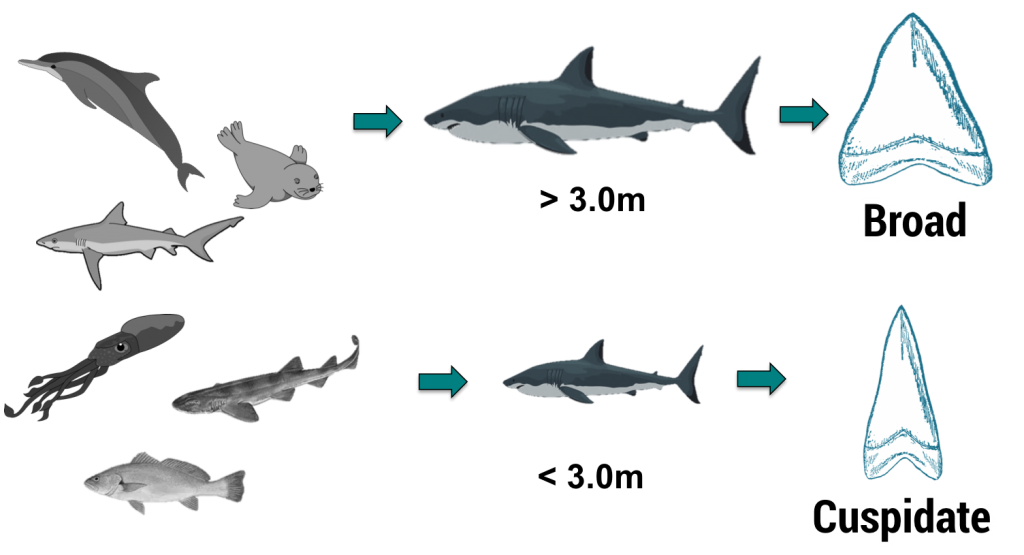
The latest theory that has come into question is how the shape of their teeth changes as they growand the reason for that.

Georgina French, a PhD student at the University of Sussex, published a new study that deals with that theory.

From her paper: Up until now, scientists have accepted that white sharks start out their lives with cuspidate (pointy) teeth, which are thought to be adapted for gripping onto slippery fish. When the sharks hit roughly 3m in length, they’re then thought to develop much broader teeth, which are believed to be adapted for catching and eating marine mammals like seals and dolphins. This shift in diet and tooth shape with age/size is referred to an ontogenetic shift.
 
©Georgina French
Her new discovery seems to be that there is a distinct difference between male and females, something I have never heard before.

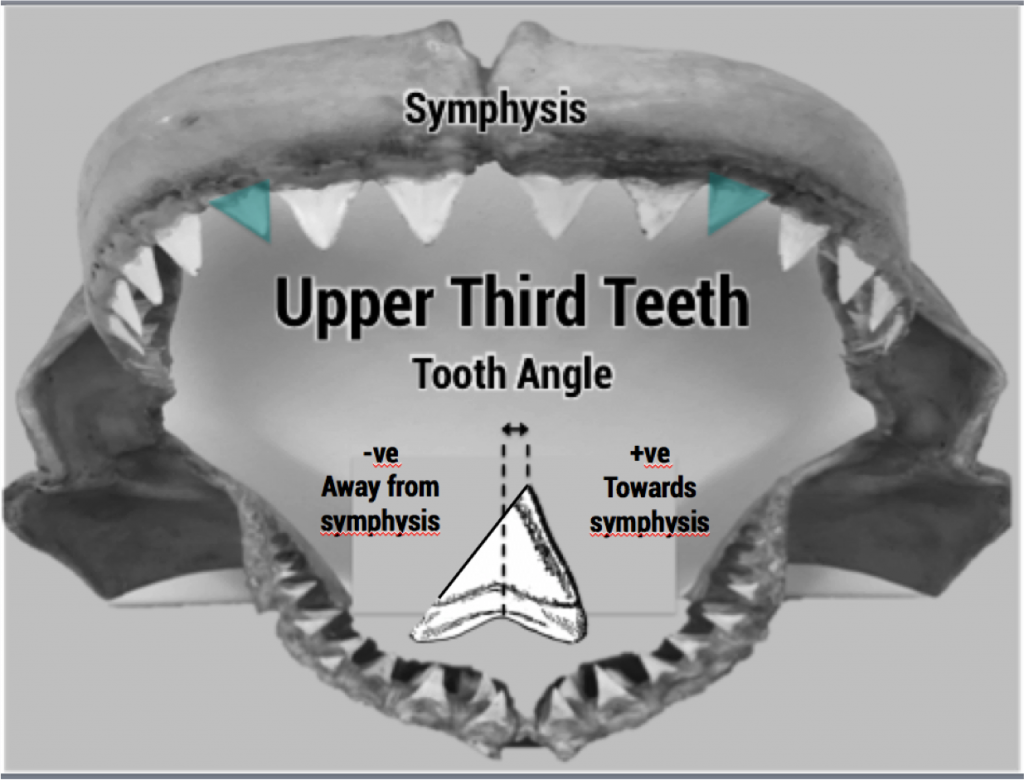
She writes: Previous studies of white shark teeth have always lumped males and females in together, despite the fact that they are quite different in other aspects of their biology and ecology. I decided to explore their tooth shape/shark length relationships separately. When I combined all of the data from the photographs, the literature and the KZN jaws, I found startling differences between the sexes.  While males seem to follow the accepted pattern of broadening teeth when they get to about 3m long, females didn’t. Instead, a female of any size could have either broad, pointed or intermediately shaped teeth. Females also didn’t change the angle of their upper third teeth, while males did.

©Georgina French
As with any new discovery, there are instantly a bunch of new questions. In this case, first and foremost, 

What does this mean?

 Broadly speaking, the results indicate that either males and females are feeding on different things as they grow up, or that the tooth shape change isn’t related to diet.
When sharks mate, males hold onto the females using their teeth. It’s possible that the broadening of the teeth and the change in tooth angle found in males could be an adaptation for mating, rather than for handling different prey. Alternatively, females with broad, pointy and intermediate teeth may be specializing on different types of prey i.e. they are polymorphic. I also found significant variation in the size at which males developed their broad teeth, which combined with other evidence indicates that some individuals mature a lot more quickly than others. Polymorphism and differing rates of maturity among individuals can have pretty big ecological consequences, and these factors need to be taken into account in future studies and white shark management.

This is what I love about working and diving with Great White Sharks. Every question that gets answered opens up a lot more questions. I wonder to what new insights about Great White Sharks this new discovery leads to. Maybe we should call these sharks Great White Mysteries instead.

Let's go shark diving and discover new and exciting things about these awesome animals!

Cheers,
Martin Graf
CEO Shark Diver 

About Shark Diver. As a global leader in commercial shark diving and conservation initiatives Shark Diver has spent the past decade engaged for sharks around the world. Our blog highlights all aspects of both of these dynamic and shifting worlds. You can reach us directly at staff@sharkdiver.com.

Tuesday, October 24, 2017

What 's hurting the Great White Sharks at Guadalupe?


Instagram 
We are coming towards the end of another great season at Guadalupe Island. Just like last year, we added a lot of new sharks to the photo ID database and saw a lot of our regulars that came back. We definitely see an increasing number of sharks, specially for sharks in the 10-12' range. It's great to see that conservation efforts seem to have a positive impact on shark numbers. We regularly see in excess of 20 different sharks on our expeditions, a huge increase over 10 years ago, when we were lucky to see 10 and often went whole days without seeing a single shark.

One thing that I noticed though is the increasing number of sharks with injuries caused by ropes or fishing gear. A couple of years ago it was "Luca" that swam around with a rope around his body. Luckily his rope was cut and he's doing fine. There is just a black scar left that will disappear in a year or so.

Luca with a black scar from a wrapped rope.

This year we saw a few sharks with either fresh wounds from ropes or still having the ropes attached around them. One of these sharks is a new female.

   
New female with rope around her
The rope around her body is embedded in the gills on both sides.


Her underside shows a faint scar from the rope that was digging into her. (It' kind of hard to see, just in front of her pectoral fins) The rope goes around her head and into the bottom of her gills on both sides, so it looks like the rope is still inside and the wound has closed around it. She must have gotten that rope wrapped around her quite a while ago, for it to be completely embedded.


This makes at least 3 sharks now that had a rope wrapped around them. Where do these ropes come from?

I hope that somehow this rope can get cut, otherwise I fear that this shark is not going to survive.  We also need to find out where these ropes are coming from, so that we might be able to stop the sharks from getting entangled in the future.

Cheers,
Martin Graf
CEO Shark Diver

About Shark Diver. As a global leader in commercial shark diving and conservation initiatives Shark Diver has spent the past decade engaged for sharks around the world. Our blog highlights all aspects of both of these dynamic and shifting worlds. You can reach us directly at staff@sharkdiver.com.

Friday, August 25, 2017

Six new sharks at Guadalupe Island


Instagram 
This season has started out completely different from the last. Where we had lots of juvenile females early last year, this season it has been all males so far. On our last expedition, we saw 30 different Great White Sharks, with 6 of them being first timers.

The Marine Conservation Science Institute marinecsi.org is keeping the photo ID database and you can contact them if you are interested in naming one of these sharks. I don't want to keep referring to them as "Unknown 1" etc. Naming a shark is a great way to support the research and how cool would it be if you see "your" shark on sharkweek?

The only female we have seen so far this season is "Screaming Mimi". She is as active and curious as she was last year and has given our divers many memorable moments.

Aside from all the new sharks, we have also been visited by a lot of our regulars. Bruce, Bite Face, Chugey, Andy, Hunter, Silent Hunter Bolton, Ace, El Diablo, Johnny, Jacques, Mickey, Sad Face, ChumChum, Thor, Atlantis, Drogin, Joker, Monkey, Hooper, Horizon along with a few that are as of now unnamed, have all made an appearance. We had 30 different individuals on our last expedition!

Here are a few of our new sharks.


To sponsor one of these beauties, contact MCSI here.

To join us on one of our expeditions, contact crew@sharkdiver.com or call 619.887.4275

Let's go shark diving!

Cheers,
Martin Graf
CEO Shark Diver

About Shark Diver. As a global leader in commercial shark diving and conservation initiatives Shark Diver has spent the past decade engaged for sharks around the world. Our blog highlights all aspects of both of these dynamic and shifting worlds. You can reach us directly at staff@sharkdiver.com.

Tuesday, August 8, 2017

Which sharks are back at Guadalupe Island?


Instagram 
We just came back from our first expedition of the year to Guadalupe Island, where we saw 12 different sharks. As is usual for this time of the year, the smaller males were the most frequent visitors to our cages. On our trip we saw the following sharks that are all in our photo ID database.

#107 Atlantis: He was the first shark that showed up on day one and stayed around all day.


#65 Johnny: He came really close to show off his new mutilation to his tail. He's now sporting a cut in the center of his caudal fin.


#206 Poseidon: He was super active and made may close passes by the cage.


#97 Drogin: Drogin was his usual self. He's a super active shark, coming at the cages from all different directions, trying to steal a hang bait.


#188: We can't leave this shark without a name! How would you like to name him? Contact http://www.marinecsi.org/ and sponsor his name! Make it a cool one! He deserves it!


#149 Kenrick: He was one of the bigger males that showed up and swam around like he's the boss. He's still a sub-adult though and won't be the dominant one, once Bruce, Bite Face, Thor etc. show up.


#168 Sad Face: He was named last year, because he had bite marks that looked like a sad face on his side. This year those marks were barely noticeable, so it's a good thing that we can use the color markings to positively identify him.


#121 Don Julian: He's growing up. Last time I saw him, he was probably close to a foot shorter than he is now. Maybe in a couple of years he'll be mature.


#199 Who wants to name this awesome shark? Contact the Marine Conservation Science Institute to sponsor his name.


#186 He came by with a bunch of pilot fish. He can also be named by contacting http://www.marinecsi.org/


#83 Joker He was pretty shy and didn't come close.


We also saw a young male with a cookie cutter bite on his head, but I didn't get any photos of him, so I couldn't identify him.

Tonight we leave for another trip. I can't wait to see who else is back at Guadalupe and am ready to meet some new sharks. Last year we added 29 new sharks to our database, how many will it be this year?

Come join us and get to know these awesome creatures. How great would it be to know the individual shark, next time you watch shark week? Call 619.887.4275 or email crew@sharkdiver.com for more information on how to join.
www.sharkdiver.com

Let's go shark diving!

Cheers,
Martin Graf
CEO Shark Diver

About Shark Diver. As a global leader in commercial shark diving and conservation initiatives Shark Diver has spent the past decade engaged for sharks around the world. Our blog highlights all aspects of both of these dynamic and shifting worlds. You can reach us directly at staff@sharkdiver.com.