Showing posts with label natgeo. Show all posts

Monday, April 6, 2020

Introducing "Chugey" an iconic Great White Shark at Guadalupe Island.

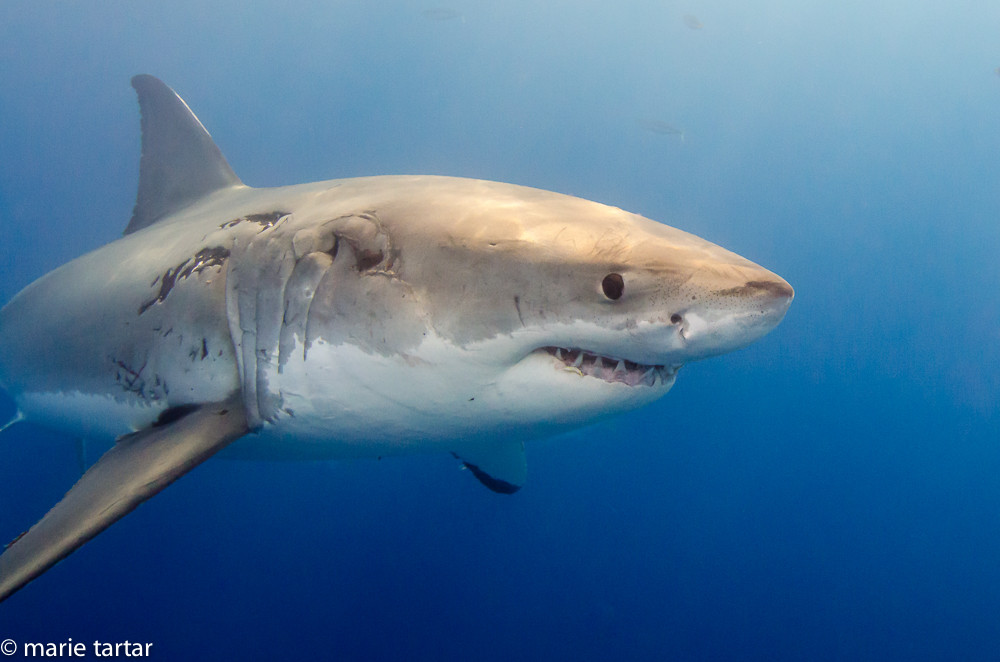
Since most of us are still staying at home during this corona crisis, I'll continue to bring some "shark joy" to everyone by introducing you to our great white sharks at Guadalupe. Today I'd like you to meet Chugey. He is one of the iconic sharks at Guadalupe. We first encountered him in 2004 and he's been regularly sighted ever since. One of his characteristics is his cut caudal (tail) fin. It pretty much resembles the tail of an airplane, with a flat top.

Chugey is a very active shark, to say the least. Being cautious doesn't seem to factor into his actions. He's had numerous injuries throughout the years, but seems to be just fine despite of it.

Just how rough a life does he have? We have talked about the amazing healing power of these amazing Great White Sharks here and it looks like they really need that ability to heal. Chugey, the shark we were talking about in that blog, was back at Guadalupe Island in 2018 and it looked like that he hadn't gotten any more careful since he got his face bit the first time. While his original wound closed quite nicely, he was sporting some brand new bite marks.

As a reminder, here is what he looked like 2 years earlier.


Here is what he looked like with his old scar and new bite marks.


This is another picture of Chugey, taken by one of our divers, Marie Tartar.


It's great to see him back at Guadalupe every year, acting like nothing happened. I continue to be blown away by both their ability to heal and never showing any signs of discomfort or indication that they are in pain, when swimming around with severe bite injuries.

Once this corona virus pandemic is over in the fall, we are heading back to Guadalupe Island for our 20th season of diving with our Great White Sharks. Nicole Nasby-Lucas, who is the person responsible for our photo ID database, will be coming out with us on 4 of our expeditions.  Thanks to her database, we can individually identify the sharks and also have a history of when they visited Guadalupe Island. In 2019 we added over 60 new sharks and are now over 360 individuals that have been sighted since we first started diving there in 2001.

How many new sharks will we encounter this season? I can't wait to get back there and find out.

What will he be named?


If you would like more information on our expeditions once this corona virus pandemic is over, Call 619.887.4275 or email us at crew@sharkdiver.com

Hopefully soon we'll be able to once again say "Let's go shark diving!"

Cheers,
Martin Graf
CEO
Shark Diver


About Shark Diver. As a global leader in commercial shark diving and conservation initiatives, Shark Diver has spent the past decade engaged for sharks around the world. Our blog highlights all aspects of both of these dynamic and shifting worlds. You can reach us directly at crew@sharkdiver.com.
Instagram

Wednesday, April 1, 2020

Introducing "Scarboard" one of the biggest Great White Sharks at Guadalupe


Instagram


"Scarboard" is another one of my favorite sharks. You're probably beginning to see a pattern here. I have a lot of "favorite" sharks. It's is amazing how all these sharks have different behaviors. Some are a bit skittish, others are seemingly relaxed without a care in the world. Observing them for 16 years, I have grown attached to these guys and girls. However, as I always point out, I absolutely love these sharks, I'm crazy about them, but it is NOT a mutual feeling. As much as some people want you to believe that they just want to be hugged, they really don't. They are awesome predators, not out to get us, but they are not harmless pets either.

"Scarboard"

Scarboard is a massive female shark, one of our biggest at Guadalupe Island at around 19'. When we first met her in 2002, she was already huge. As most of our adult females, she shows up at Guadalupe Island every other year. After mating at Guadalupe, she is spending the year in between offshore, before giving birth off the coast of Baja or in the Sea of Cortez. She doesn't have any mutilations, like "Lucy" and so many others, but she does have a very unique characteristic that makes identifying her easy. She has a very distinct line from her nose halfway to her dorsal fin. Where most Great White Sharks' lines have a continuous curve, Scarboard's is straight.

"Scarboard"
After we first encountered her in 2002, she came back in 04 and 06, but then we didn't see her again until 2011. We don't know, if we simply didn't see her, or if she stayed away from Guadalupe for 5 years.

When we don't see a shark during the season we expect to see them, we always worry that something might have happened to them. Luckily, sometimes, like in Scarboard's case, we worry about nothing. Where do they go during that extended time away from the Island, what do they do? There is so much we don't know about those sharks.


The first time we saw Scarboard, after her 5 year absence, I was in the middle of our 2 cages, she slowly swam by the first cage, checking out each individual diver and when she came to me, she looked me straight into the eyes, stopped and did a 180-degree turn, looked at me again, swam off, turned and swam back at me, stopped again, turned and swam off. It looks like that she recognized me, even after a 5-year absence.

2 seasons ago, "Scarboard" was being used for protection by some baitfish. I've never seen anything like that before. When she swam by, she looked like the "Bearded Lady".

Scarboard the "Bearded Lady"
 
A lot of people are surprised to learn that Great White Sharks recognize individual divers. The fact that they do is not as strange as it seems. We know of lots of fish that recognize divers. Groupers that have a favorite individual they follow around, moray eels that come out of their holes when they recognize a diver, Wolf eels that wrap themselves around the neck of an individual etc. It's important to remember though, just because White Sharks recognize individual divers, doesn't mean that they "love" us, want to be petted, or have any feelings towards us. We need to respect them for what they are, amazing predators, neither mindless killers nor harmless pets.


For me there is nothing quite like seeing a familiar shark and realize it recognizes me as well. It still amazes me that we keep seeing the same individuals on a regular basis. They migrate thousands of miles but come right back to the same spot.

If you want to find out for yourself what it's like to come face to face with a great white shark and want to learn how to identify these sharks, join us on one of our "science" expeditions. We do have some spaces open and would love to introduce you to our sharks.

Call 619.887.4275, email crew@sharkdiver.com or visit www.sharkdiver.com for more information.

Let's go shark diving!

Cheers,

Martin Graf
CEO Shark Diver

About Shark Diver. As a global leader in commercial shark diving and conservation initiatives Shark Diver has spent the past decade engaged for sharks around the world. Our blog highlights all aspects of both of these dynamic and shifting worlds. You can reach us directly at crew@sharkdiver.com.

Sunday, February 10, 2019

Get to know "Scarboard" a Great White Shark at Guadalupe


Instagram


"Scarboard" is another one of my favorite sharks. You're probably beginning to see a pattern here. I have a lot of "favorite" sharks. It's is amazing how all these sharks have different behaviors. Some are a bit skiddish, others are seemingly relaxed without a care in the world. Observing them for 16 years, I have grown attached to these guys and girls. However, as I always point out, I absolutely love these sharks, I'm crazy about them, but it is NOT a mutual feeling. As much as some people want you to believe that they just want to be hugged, they really don't. They are awesome predators, not out to get us, but they are not harmless pets either.

"Scarboard"

Scarboard is a massive female shark, one of our biggest at Guadalupe Island at around 19'. When we first met her in 2002, she was already huge. Like most of our adult females, she shows up at Guadalupe Island every other year. After getting mating at Guadalupe, she is spending the year in between offshore, before giving birth off the coast of Baja or in the Sea of Cortez. She doesn't have any mutilations, like "Lucy" and so many others, but she does have a very unique characteristic that makes identifying her easy. She has a very distinct line from her nose halfway to her dorsal fin. Where most Great White Sharks' lines have a continuous curve, Scarboard's is straight.

"Scarboard"
After we first encountered her in 2002, she came back in 04 and 06, but then we didn't see her again until 2011. We don't know, if we simply didn't see her, or if she stayed away from Guadalupe for 5 years.

When we don't see a shark during the season we expect to see them, we always worry that something might have happened to them. Luckily, sometimes, like in Scarboard's case, we worry about nothing. Where do they go during that extended time away from the Island, what do they do? There is so much we don't know about those sharks.


The first time we saw Scarboard, after her 5 year absence, I was in the middle of our 2 cages, she slowly swam by the first cage, checking out each individual diver and when she came to me, she looked me straight into the eyes, stopped and did a 180 degree turn, looked at me again, swam off, turned and swam back at me, stopped again, turned and swam off. It looks like that she recognized me, even after a 5 year absence.

2 seasons ago, "Scarboard" was being used for protection by some bait fish. I've never seen anything like that before. When she swam by, she looked like the "Bearded Lady".

Scarboard the "Bearded Lady"
 
A lot of people are surprised to learn that Great White Sharks recognize individual divers. The fact that they do is not as strange as it seems. We know of lots of fish that recognize divers. Groupers that have a favorite individual they follow around, moray eels that come out of their holes when they recognize a diver, Wolf eels that wrap themselves around the neck of an individual etc. It's important to remember though, just because White Sharks recognize individual divers, doesn't mean that they "love" us, want to be petted, or have any feelings towards us. We need to respect them for what they are, amazing predators, neither mindless killers, nor harmless pets.


For me there is nothing quite like seeing a familiar shark and realize it recognizes me as well. It still amazes me that we keep seeing the same individuals on a regular basis. They migrate thousands of miles, but come right back to the same spot.

If you want to find our for yourself what it's like to come face to face with a great white shark and want to learn how to identify these sharks, join us on one of our "science" expeditions. We do have some spaces open and would love to introduce you to our sharks.

Call 619.887.4275, email crew@sharkdiver.com or visit www.sharkdiver.com for more information.

Let's go shark diving!

Cheers,

Martin Graf
CEO Shark Diver

About Shark Diver. As a global leader in commercial shark diving and conservation initiatives Shark Diver has spent the past decade engaged for sharks around the world. Our blog highlights all aspects of both of these dynamic and shifting worlds. You can reach us directly at staff@sharkdiver.com.

Tuesday, November 27, 2018

Shark Diver and Great White Shark research.


Shark Diver has been running trips with Great White Sharks at Guadalupe Island since 2000. Our owner, Martin Graf, encountered these sharks while SCUBA and freediving there for about 10 years prior to the first shark dive. Mostly while spearfishing, he, along with many  other divers, started to encounter more and more great white sharks, which led us to explore the possibility of specific shark diving there. Little did we know that we discovered arguably the best place in the world to observe these awesome creatures. Typically crystal clear waters, with male and female sharks of all sizes in abundance, Guadalupe Island has become the premier place to dive with Great White Sharks.

Lucy

A couple of years after we started shark diving, the Marine Conservation Science Institute, MCSI, began putting together a photo ID database, to keep track of all the sharks sighted at Guadalupe Island. Our ability to identify the individual sharks is what really got me hooked on shark diving. After a few expeditions, I started to get a little bored with watching the sharks seemingly doing the same thing over and over. Luckily for me, just before I decided to stop going there, something amazing happened. A shark, later named "Shredder" swam really close to the cage and made eye contact with me. I realized that he was as much interested in us, the divers, as we were in him. He made eye contact with each individual as he swam along our cage. Realizing that he was checking me out instantly fascinated me. Knowing that they look at us as individuals made me realize that they are all individually different as well. For a lack of a better word, they all have different "personalities".  Thanks to the Photo ID database, we have the ability to keep track of all the different individuals we encounter at Guadalupe. We use the transition from the white belly to the grey top, which is like a fingerprint, along with mutilations and individual characteristics to identify the sharks. So now, after diving with the Great White Shark for 18 years, I'm more excited than ever to go back. I don't care if it is the last dive of the last trip, I'm always eager to go into the water. Who is back? Who is new? What are they up to now? I can't wait to go back.

Scarboard

Of course maintaining a database involves some expenses. It is time consuming work to look through literally thousands of pictures and videos, to determine who all the sharks that were sighted are. Initially the research was funded through grants, but after about 2012, those funds ran out. When Nicole Lucas from MCSI told me that the research was no longer funded, we decided that we had to do something to keep financing that important database. Shark Diver specializes in identifying each individual shark and giving our guest all the information about them. What year did we first see it, what has this shark done in the past, is it a brand new individual that we have never seen before? These are the things we like to share with our guests and that would of course be impossible without an updated and maintained database. The need to maintain this database is why we came up with the concept of our "Science Expeditions". Our expeditions are designed to raise funds for MCSI and specifically for the maintaining of the database. Shark Diver donates a spot on the expeditions hosted by Nicole to MCSI, and our divers on all of our trips get a copy of that photo ID database. On the expeditions where Nicole Lucas acts as the host, she shares the results of her research with our divers. Not only do you support the ongoing research by joining us on our expeditions, but you'll learn how to identify the individual sharks you see. How cool will it be when you watch shark week the next time and you can say "This is the shark that swam right by me!"? All of our expeditions are either hosted by Nicole or by our owner Martin Graf, who has been diving with these sharks since before there was shark diving at Guadalupe Island. He probably has more hours observing these sharks than anyone at the Island.

Slashfin

Shark Diver is committed to not only give you an experience of a lifetime, but to also foster a personal connection to the sharks you encounter, all while supporting conservation. Shark Diver also started the Shark Free Marinas, which has since been taken over by the Humane Society.

 Let's go shark diving!

About Shark Diver. As a global leader in commercial shark diving and conservation initiatives Shark Diver has spent the past decade engaged for sharks around the world. Our blog highlights all aspects of both of these dynamic and shifting worlds. You can reach us directly at staff@sharkdiver.com.