Showing posts with label shark attack. Show all posts

Thursday, April 23, 2020

Introducing "Luca Arnone" a subadult Great White Shark at Guadalupe


Instagram


In our continuing effort to bring the sharks to you while we are all confined to our homes, let me introduce you to Luca Arnone. He is listed as #163 in our photo ID database at Guadalupe Island. We first met him in 2013 and he has been coming back every year since.


A few years ago "Luca" looked a bit rough. He was partially wrapped in a thick rope, which fortunately was being removed by Dr. Mauricio Hoyos, the local researcher at Guadalupe Island. The cut caused by the rope was not too deep and since white sharks have an amazing ability to heal, it did not cause him any permanent harm. When he swam by me last year, his injury was barely noticeable, with just a faint black mark remaining.


"Luca" was a fairly small shark when we first met him, probably just shy of 12', but he didn't seem to mind the bigger sharks and was a frequent visitor to our cages. He has grown quite a bit in the last seven years but hasn't lost his active behavior. He is still as curious as ever and exhibits a fairly dominant behavior, even towards bigger sharks.


Luca was named by one of our divers, who named 2 different sharks, one after his son, Luca and the other after his daughter Milana. Naming a shark is one way our divers support the ongoing research at Guadalupe Island. The Marine Science Conservation Institute, "MCSI" who maintains the photo ID has various levels of sponsorship available, including naming a shark.


Another way you can support "MCSI" is by coming on one of our "science" trips. A portion of these expeditions goes to fund the research and Nicole Lucas-Nasby, the researcher maintaining that database is coming along as the host. She is sharing the results of her research with you and if we encounter a new shark, you'll also have an opportunity to name that shark. How cool would it be, if you see a shark that you named on "Sharkweek"?

In the video below you'll see "Luca Arnone" with Alyssa and Tristan who named Crazy "Tryss" who we introduced you to earlier here


Our divers can also support the research by letting "MCSI" use their pictures to update the Photo ID database.

If you want to find out for yourself what it's like to come face to face with a great white shark once this virus crisis is over and maybe name one of these sharks, come join us on one of our expeditions. We do have some spaces open and would love to introduce you to our sharks.

Call 619.887.4275, email crew@sharkdiver.com or visit www.sharkdiver.com for more information.

Let's go shark diving!

Cheers,
Martin Graf
CEO Shark Diver

About Shark Diver. As a global leader in commercial shark diving and conservation initiatives, Shark Diver has spent the past decade engaged for sharks around the world. Our blog highlights all aspects of both of these dynamic and shifting worlds. You can reach us directly at crew@sharkdiver.com.

Wednesday, April 15, 2020

Introducing Slash Fin, an iconic Great White Shark at Guadalupe Island


Instagram

Continuing to introduce you to the Great White Sharks of Guadalupe Island during our coronavirus quarantine, I'd like you to meet "Slash Fin",  #213 in our Photo ID database. She is a very active shark, swimming around normally and exhibiting all the typical white shark behaviors.


There is however something very different about this shark. Aside from a big lump on her side, she only has 3 visible gill plates on her left side. When looked at from the top, the left side of her head is pretty straight, while the right side curves out around her gills. It doesn't look like she is getting much water through her left side gills either and she seems to be breathing mainly through her right side gills.


Check out the video below. Aside from a nice bite injury she has, there are only 3 visible gill plates.


 When you look closely, you can see that she has 5 gill slits, but 2 of her gills are completely covered by another gill plate. The bite on her gills has nothing to do with this oddity, since she has looked this way since we first met her and the injury is new.


Aside from her gills, she also has a deformed dorsal fin, with the trailing edge looking all ragged. It could be due to an injury, but I don't see an obvious signs of a trauma there.


On her right side, just behind and below her dorsal fin, she has a growth that is sticking out at least 6 inches. Is it a tumor, or is something embedded in her body?

Watch the video below and check out that growth for yourself.


Slash fin is a subadult female and about 13' in lenght. Despite her deformities, she doesn't exhibit any signs of distress and seems to be doing well.

The longer I dive with these sharks, the more I'm amazed by the new things we discover and learn about them. Are her deformities genetic? Is it a birth defect? Or....? I don't know, I'm just reporting my observations. Any scientists out there want to take a look at this?

Once we leave this coronavirus behind us, come and join us on one of our expeditions to Guadalupe Island and meet our sharks face to face.

Contact us at 619.887.4275 or crew@sharkdiver.com for more info.

Let's go shark diving!

Cheers,
Martin Graf
CEO Shark Diver

About Shark Diver. As a global leader in commercial shark diving and conservation initiatives Shark Diver has spent the past decade engaged for sharks around the world. Our blog highlights all aspects of both of these dynamic and shifting worlds. You can reach us directly at crew@sharkdiver.com.

Monday, April 6, 2020

Introducing "Chugey" an iconic Great White Shark at Guadalupe Island.

Since most of us are still staying at home during this corona crisis, I'll continue to bring some "shark joy" to everyone by introducing you to our great white sharks at Guadalupe. Today I'd like you to meet Chugey. He is one of the iconic sharks at Guadalupe. We first encountered him in 2004 and he's been regularly sighted ever since. One of his characteristics is his cut caudal (tail) fin. It pretty much resembles the tail of an airplane, with a flat top.

Chugey is a very active shark, to say the least. Being cautious doesn't seem to factor into his actions. He's had numerous injuries throughout the years, but seems to be just fine despite of it.

Just how rough a life does he have? We have talked about the amazing healing power of these amazing Great White Sharks here and it looks like they really need that ability to heal. Chugey, the shark we were talking about in that blog, was back at Guadalupe Island in 2018 and it looked like that he hadn't gotten any more careful since he got his face bit the first time. While his original wound closed quite nicely, he was sporting some brand new bite marks.

As a reminder, here is what he looked like 2 years earlier.


Here is what he looked like with his old scar and new bite marks.


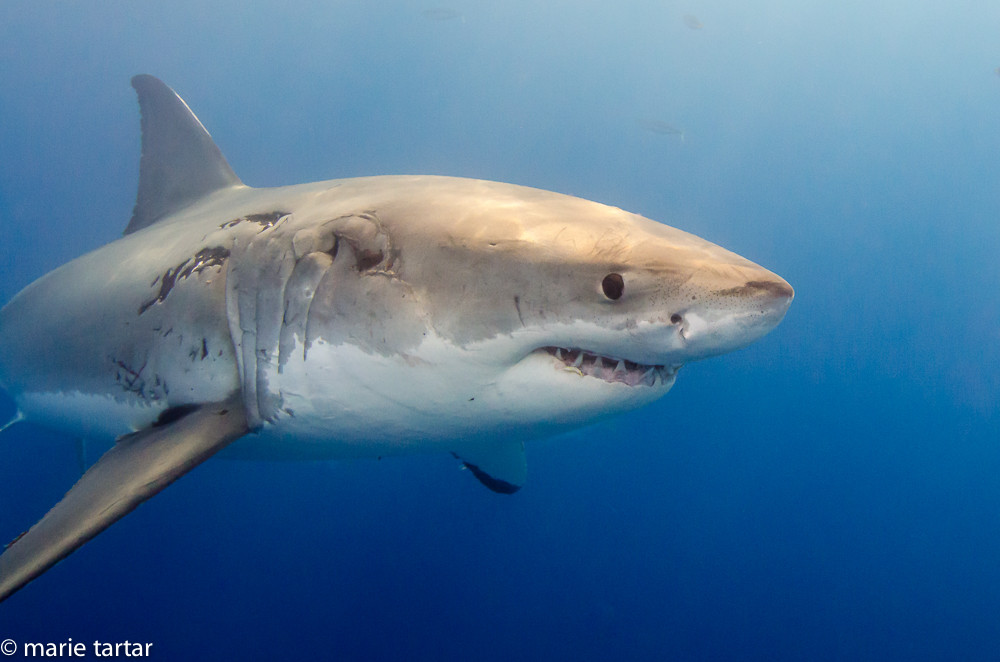
This is another picture of Chugey, taken by one of our divers, Marie Tartar.


It's great to see him back at Guadalupe every year, acting like nothing happened. I continue to be blown away by both their ability to heal and never showing any signs of discomfort or indication that they are in pain, when swimming around with severe bite injuries.

Once this corona virus pandemic is over in the fall, we are heading back to Guadalupe Island for our 20th season of diving with our Great White Sharks. Nicole Nasby-Lucas, who is the person responsible for our photo ID database, will be coming out with us on 4 of our expeditions.  Thanks to her database, we can individually identify the sharks and also have a history of when they visited Guadalupe Island. In 2019 we added over 60 new sharks and are now over 360 individuals that have been sighted since we first started diving there in 2001.

How many new sharks will we encounter this season? I can't wait to get back there and find out.

What will he be named?


If you would like more information on our expeditions once this corona virus pandemic is over, Call 619.887.4275 or email us at crew@sharkdiver.com

Hopefully soon we'll be able to once again say "Let's go shark diving!"

Cheers,
Martin Graf
CEO
Shark Diver


About Shark Diver. As a global leader in commercial shark diving and conservation initiatives, Shark Diver has spent the past decade engaged for sharks around the world. Our blog highlights all aspects of both of these dynamic and shifting worlds. You can reach us directly at crew@sharkdiver.com.
Instagram

Tuesday, February 26, 2019

Get to know "Chugey" a Great White Shark at Guadalupe

Chugey is one of the iconic sharks at Guadalupe. We first encountered him in 2004 and he's been regularly sighted ever since. One of his characteristics is his cut caudal (tail) fin. It pretty much resembles the tail of an airplane, with a flat top.

Chugey is a very active shark, to say the least. Being cautious doesn't seem to factor into his actions. He's had numerous injuries throughout the years, but seems to be just fine despite of it.

Just how rough a life does he have? We have talked about the amazing healing power of these amazing Great White Sharks here and it looks like they really need that ability to heal. Chugey, the shark we were talking about in that blog, was back at Guadalupe Island and it looks like that he hasn't gotten any more careful since he got his face bit the first time. While his original wound closed quite nicely, he was sporting some brand new bite marks.

As a reminder, here is what he looked like 2 years earlier.


Here is what he looked like with his old scar and new bite marks.


This is another picture of Chugey, taken by one of our divers, Marie Tartar.


It's great to see him back at Guadalupe acting like nothing happened. I continue to be blown away by both their ability to heal and never showing any signs of discomfort or indication that they are in pain, when swimming around with severe bite injuries.

This fall we are heading back to Guadalupe Island for our 19th season of diving with our Great White Sharks. Nicole Nasby-Lucas, who is the person responsible for our photo ID database, will be coming out with us on 4 of our expeditions.  Thanks to her database, we can individually identify the sharks and also have a history of when they visited Guadalupe Island. In 2018 we added over 30 new sharks and are now over 300 individuals that have been sighted, since we first started diving there in 2001.

How many new sharks will we encounter this season? I can't wait to get back there and find out.

What will he be named?


If you would like to come out with us, we only have a few spaces open for this season. We are also booking for the next 2 season and some expeditions are almost sold out. Don't miss your chance for an amazing trip of a lifetime. Call 619.887.4275 or email us at staff@sharkdiver.com for more information or to reserve your space.

Cheers,
Martin Graf
CEO
Shark Diver


About Shark Diver. As a global leader in commercial shark diving and conservation initiatives Shark Diver has spent the past decade engaged for sharks around the world. Our blog highlights all aspects of both of these dynamic and shifting worlds. You can reach us directly at crew@sharkdiver.com.
Instagram

Monday, February 11, 2019

Get to know "Lucy" a Great White Shark at Guadalupe


Instagram 
I love "Lucy", and I'm not referring to the popular TV show of the 50ies. "Lucy" is a large female Great White Shark, that is regularly visiting Guadalupe Island. Most mature females are only seen every other year. They mate at Guadalupe Island and then stay away from the Island until after they give birth off the coast of Baja and in the Sea of Cortes, about 18 months after they get pregnant at Guadalupe.


In 2008 she suffered and injury to her tail, most likely from a bite by another shark. Her tail is pretty much mangled and it probably affects her speed. Even though she is definitely a mature female,  we saw her every year until 2014, which meant that she didn't get pregnant, since pregnant females stay away from Guadalupe for a season and return every other year. I don't know if the mangled tail was the reason she didn't seem to get pregnant for all those years, but fortunately she has started showing up every other year since then. Hopefully this means that she is indeed getting pregnant now. We last saw her in 2018, so most likely we won't see her again until 2020.


"Lucy's" tail makes it very easy to identify her. Usually we identify the individual sharks by their coloration. The transition from the white underbelly to the grey top is unique for every individual. Some people try to identify the sharks by their scars. That is how "Bite Face" got his name. The problem with scars is that they heal and if that is the only identifying characteristic you have, you would not recognize that same shark when it comes back the following year. Mutilations, like Lucy's tail don't change and can be used in conjunction with the markings to identify her. We have a photo id database that is managed by Nicole Nasby-Lucas from the Marince Conservation Science Institute, with over 220 individual sharks in identified.

If you are coming out on one of our "science" expeditions, you'll get a chance to learn how to identify these sharks from Nicole herself. You will also get the complete photo ID database, so you can identify all the sharks you encountered and what's really cool, you will then be able to identify the sharks you see on TV. How awesome will it be, when you see a shark on TV and realize that this is the individual that swam inches from your face at Guadalupe?


Even with her tail slowing her down, she seems to be healthy in every other way. She is definitely getting enough food and is holding her own among all the sharks at the Island. Lucy is a very curious shark and she swims very close to the cages, making eye contact with our divers as she is gliding by slowly.


I hope to see Lucy when we return in the fall. I do have mixed emotions though. While I would love to see her, it would of course mean that she didn't get pregnant last season.

If you would like to join us, or just get more information, call 619.887.4275, email crew@sharkdiver.com or visit our website www.sharkdiver.com

Let's go sharkdiving!

Cheers,

Martin Graf
CEO Shark Diver

About Shark Diver. As a global leader in commercial shark diving and conservation initiatives Shark Diver has spent the past decade engaged for sharks around the world. Our blog highlights all aspects of both of these dynamic and shifting worlds. You can reach us directly at staff@sharkdiver.com.
Instagram

Friday, February 8, 2019

Meet "Slash Fin" a Great White Shark at Guadalupe Island.


Instagram

Meet "Slash Fin",  #213 in our Photo ID database. She is a very active shark, swimming around normally and exhibiting all the typical white shark behaviors.


There is however something very different about this shark. Aside from a big lump on her side, she only has 3 visible gill plates on her left side. When looked at from the top, the left side of her head is pretty straight, while the right side curves out around her gills. It doesn't look like she is getting much water through her left side gills either and she seems to be breathing mainly through her right side gills.


Check out the video below. Aside from a nice bite injury she has, there are only 3 visible gill plates.


When you look closely, you can see that she has 5 gill slits, but 2 of her gills are completely covered by another gill plate. The bite on her gills has nothing to do with this oddity, since she has looked this way since we first met her and the injury is new.


Aside from her gills, she also has a deformed dorsal fin, with the trailing edge looking all ragged. It could be due to an injury, but I don't see an obvious signs of a trauma there.


On her right side, just behind and below her dorsal fin, she has a growth that is sticking out at least 6 inches. Is it a tumor, or is something embedded in her body?

Watch the video below and check out that growth for yourself.


Slash fin is a subadult female and about 13' in lenght. Despite her deformities, she doesn't exhibit any signs of distress and seems to be doing well.

The longer I dive with these sharks, the more I'm amazed by the new things we discover and learn about them. Are her deformities genetic? Is it a birth defect? Or....? I don't know, I'm just reporting my observations. Any scientists out there want to take a look at this?

Come join us on one of our expeditions to Guadalupe Island and meet our sharks face to face.

Let's go shark diving!

Cheers,
Martin Graf
CEO Shark Diver

About Shark Diver. As a global leader in commercial shark diving and conservation initiatives Shark Diver has spent the past decade engaged for sharks around the world. Our blog highlights all aspects of both of these dynamic and shifting worlds. You can reach us directly at staff@sharkdiver.com.

Friday, January 18, 2019

Ocean Ramsey and Deep Blue?


For the last couple of days, the internet has lit up with postings of Ocean Ramsey diving with Deep Blue.

source

While Deep Blue was actually spotted and filmed by Mark Mohler and Kimberly Jeffries, the female Great White Shark that Ocean Ramsey was diving with was not Deep Blue, but another massive female named "Haole Girl" by the diver who first reported her. Check out her markings at the pelvic fin vs. the ID picture of Deep Blue. You can clearly see that it is not the same individual.


Right side pelvic area Deep Blue

A lot of people have commented that it really doesn't matter if it was Deep Blue or another shark. So what's the big deal?

While it certainly didn't make a difference in the experience the divers had with this shark, it matters greatly when Ocean Ramsey claims to be a scientist and doing these dives for research. From a scientific perspective, it is far more interesting to know that there are other massive females out there than to "show how harmless these sharks are". The whole reason we do have a database of these sharks is so that we can have population estimates and find their migration patterns. I also find it puzzling that people portray great white sharks as either mindless killers or as harmless. They are neither! Why can't we just love them for what they are? Awesome predators, neither out to get us nor wanting to be our "friends"! I love these sharks and I'm not afraid to say, it's not a mutual feeling!

A completely different problem with the diving taking place around this shark is described by "Doc Domeier", one of the preeminent shark researchers at Guadalupe Island. Doc, along with Nicole Lucas-Nasby are the scientist at the Marine Conservation Science Institute, the first scientists to tag and catalog the great white sharks at Guadalupe Island.

Here is what he has to say on Facebook

Ocean Ramsey has Jumped the Shark...Literally and Figuratively
I was going to let others chastise O. Ramsey for riding the white shark in Hawaii, but then I saw her post this: "I waited quietly, patiently, observing as she swam up to the dead sperm whale carcass and then slowly to me passing close enough I gently put my hand out to maintain a small space so her girth could pass." Take a look at this video and see if you feel her words are consistent with her actions. Years ago she came to social media fame by illegally riding white sharks at Guadalupe Island. Not only is it illegal in Mexico, it is unethical the world over. The number 1 rule of legitimate shark diving operators is DON'T TOUCH THE SHARKS! This is not shark advocacy...it is selfish, self-promotion. Look at all of the other people in the water hoping for a once-in-a-lifetime experience...instead they can't even take a pic of the shark. And lastly...posting selfies with white sharks is really the wrong message..these are very dangerous animals. Yes, in this case they were very satiated and unlikely to bite...but the average person should not be hopping in the water with them. Would you go on a safari and ride the lions? Remember what happened to the bear whisper in Alaska???...he thought he knew them so well that he was part of their family. One day one of the bears killed him and the poor woman that was with him. And FYI, despite what she says, that’s not Deep Blue she’s harassing. It’s a newly discovered shark that has been named Haole Girl by the diver that first reported her to us. 

Before you claim that this is just sour grapes and he simply doesn't like Ocean Ramsey, read his reason for not approving of Ocean's behavior.

Many people who saw my last post may wonder: "Hey, what's the bid deal...the sharks weren't hurt by people riding them." Let me give you a bit of background on white shark life history. Females only give birth once every two years, and sometimes the process is so energetically taxing that they will skip a breeding cycle. All 3 sharks observed feeding on the whale were female...and there's a 50% chance each one was pregnant. In fact, Deep Blue is almost certainly pregnant since she has been pupping on odd years recently. Pupping time is just 4 months away, meaning these big girls are currently feeding about 500 pounds of babies in their uteri! These sharks spend almost their entire 18-month gestation in the deep offshore waters between the mainland and Hawaii, where food is very, very scarce. I led the very first expedition to that area, sometimes referred to the White Shark Cafe or Shared Offshore Foraging Area (our preferred moniker), and we found almost nothing that we would recognize as white shark food. We did find quite a lot of sperm whales, so maybe the occasional encounter with a dead sperm whale is the majority of the caloric intake for these huge sharks! Harassing a pregnant white shark while she is trying to feed could cause her to leave the meal...impacting her ability to successfully carry her pups to term or reproduce the next cycle. Did you know that the very next day after all the videos went viral there were about 60 people floundering around that dead whale in hopes of having their encouter with a white shark? Guess how many sharks were observed: ZERO! Don't you think all those people in the water might intimidate the sharks?? And if they try to come in and feed they have people climbing all over them, all wanting to be like O. Ramsey? Think about that....

You can read all of Doc's posts here
I have to agree with Doc. There are far too many "researchers" who are more interested in getting media exposure than doing actual research. In their zeal to get attention they often do things that not only don't help shark conservation, but actively hurt it. I've been diving with Great White Sharks for over 20 years. We discovered the sharks at Guadalupe while SCUBA and freediving, so I know firsthand what it's like to come face to face with a great white shark and I can say that the experience is no less exciting when you are safely in a cage. Sharkdiver will never allow out of cage divers at Guadalupe Island. It is illegal and dangerous. There is no reason to go outside of a cage, other than to brag to others about having done it. That's why we call what we do "Safe and Sane" Shark Diving.

If you want to experience coming face to face with a Great White Shark, give us a call at 619.887.4275, email crew@sharkdiver.com or visit www.sharkdiver.com for more info.

Let's go Shark Diving!

Cheers,
Martin Graf
CEO Shark Diver


About Shark Diver. As a global leader in commercial shark diving and conservation initiatives Shark Diver has spent the past decade engaged for sharks around the world. Our blog highlights all aspects of both of these dynamic and shifting worlds. You can reach us directly at staff@sharkdiver.com.

Thursday, December 7, 2017

Why do sharks attack?


Instagram 

Why do sharks attack?

Recently there was another shark attack on a spear fisherman in California and a fatal shark bite at Cocos Island in Costa Rica.  Inevitably when someone gets bitten by a shark, there is speculation about why it happened. “Mistaken identity” is a popular explanation, and of course the people arguing “it’s their home” and the “fill in the blank” kills more people than sharks every year are always ready to chime in.

There are statistics on shark bites, like the “international shark attack files” by the Florida Museum of Natural History, and we have a pretty good idea of how many people actually get bitten by sharks each year. Most of those statistics only collect data on what happened and are recording the circumstances of the attack. Since in very few cases was the shark actually seen before it bit the victim, most of the information we have is only about what the victims were doing before they got bit. When we discount the provoked attacks, like someone pulling a nurse shark by the tail, a fisherman getting bit by a shark he hooked, or like in the case of the Manhattan Beach incident, a fishermen hooking a shark and pulling it through a group of swimmers, very little is known about what the sharks were doing prior to biting the victim.

Obviously I don’t know what those sharks were doing or thinking either, nor do I know what lead them to bite. I wasn’t there and don’t have any firsthand knowledge. What I do have is some first hand knowledge of how some of the shark species implicated in attacks on humans behave and how that behavior might determine why they attack.

I have been diving with and observing Great White Sharks for over 17 years at Guadalupe Island and been around Bull-, Tiger- and Hammerhead Sharks for more than 6. What I found is that there are a lot of misconceptions about how these animals behave. Probably the biggest mistake is that people think “A shark is a shark”, pretty much assuming they all behave the same way.

There are well over 400 species of sharks, with most of them absolutely harmless to humans. Think about it this way. We have the top 10 deadliest sharks list. With an average of fewer than 10 fatal shark bites worldwide each year, that means that if a species is listed as #10, it stands to reason that that species is responsible for fewer deaths than #1, it may in fact only be responsible for a death every 30-40 years. Most of the species responsible for deadly bites on humans are the Great White, Tiger and the Bull Shark.

So let’s take a look at a couple of those species.


Great White Shark

The Great White Shark is probably the most feared animal in the world. Movies like “Jaws” and the way the media reports any encounter with them have instilled fear into most people who contemplate going into the Ocean. The thinking that one drop of blood in the water will cause a huge frenzy and pretty much any shark within 10 miles will come and attack you is very common.

The reality looks a lot different. Did you know that Great White Sharks don’t “frenzy”. In 17 years of observing them, I have never seen a bunch of Great Whites buzzing around a food source or a prey animal. When we put tuna heads in the water, or back when we used chum to attract sharks, we sometimes have to wait for hours for a shark to approach the cages. We could see them swimming below, but even though there was fish blood and Tuna in the water, they would not come up. When multiple sharks are around a food source, they typically measure each other up in order to decide who gets first crack at the food, instead of a free for all frenzy.


If that measuring doesn’t settle it, the bigger shark tends to bite the smaller one to assert it’s dominance. It is only after the pecking order is established, that they go after the food. They give each other space, with the smaller ones only going for the food after the bigger shark is a safe distance away.


Another common belief is that Great White Sharks will attack just about anything, even if they don’t know what it is. My observations have actually shown that Great White Sharks are not only very cautious, but seem to be almost timid. For example, a couple of years ago, a beach towel fell overboard and 3 sharks came to investigate it. 2 of them jerked away and took off, like something was chasing them, while the 3rd shark kept approaching it, jerking away repeatedly, until I lost sight of both the towel and the shark. I don’t know if the shark eventually bit the towel to figure out what it was, but it clearly kept checking it out repeatedly, being very cautious in it’s approach. We have actually observed the same timidness in some sharks when they approached a Tuna head. They clearly smelled the tuna, but when it was pulled slightly when they approached, a lot of them jerked away and would not attempt to bite the tuna until the made several passes to inspect it.


Screaming Mimi, a subadult female Great White Shark swam by my go pro that I had on a 20ft. pole 3 times, coming really close and checking it out, before biting it on the 4th pass. Again, she didn't just attack, she first checked out the go pro a few times, before she decided to take a bite at it.


Another interesting observation we made is that Great Whites attack a sea lion differently than a seal. If they are not biting their head off, the bite a seal in the butt, because seals swim with their  rear fins, while they bite sea lions in the pectoral fins, which is the way they swim. So if Great Whites know the difference between a seal and a sea lion, I think it’s unlikely they would mistake a surfer for a turtle or a sea lion.

There is a general belief that if you are bleeding, a shark can smell your blood from miles away and will come and bite you. Did you know that the Great White Sharks can differentiate between the blood from different species of fish? There is a distinct difference in how they react when they smell tuna blood, vs. yellow tail blood. So if they can tell the difference between the blood from different fish, it stands to reason that they can tell the difference between human blood and the blood of a seal or fish. Instead of increasing the chance of an attack, I actually think that if you are bleeding you might be even safer. Since your blood is giving the shark a way to know what you are, it actually might prevent an investigatory bite.

So why do White Sharks attack? There are of course different reasons. In the case of the spear fishermen who got bit in California, I believe that the shark wanted the fish and is was not actually going for the diver. When we were spear fishing at Guadalupe Island, we always put the fish on our float and didn’t attach it to our body, so that if a shark wanted the fish, it would not come for us. With surfers and swimmers, since I don’t believe in the mistaken identity, I think that most bites were actually an investigation. After they checked out the victim for a while, they took a bite, trying to figure out what it is.

However, I don’t want to take away the possibility that some of the bites are actual predatory attacks. Bites on humans by Great White Sharks are extremely rare, and the number of actual predatory attacks even rarer. While Great Whites are not mindless killers, out to get us, they are apex predators and definitely not harmless pets. There is no need to fear these animals, but we have to respect them for what they are.

Bull Sharks

We all heard that Bull Sharks are the most aggressive, because they have more testosterone than any other shark. While the testosterone part may be true, it has nothing to do with them supposedly being aggressive. People mistake aggression with hunger. When a Bull Shark is hungry, it has to eat. Unless it finds some animal that is already dead, that means it has to hunt and kill something. That’s not aggression, that’s just simply feeding. Aggression is fighting for territory, dominance etc. and that is actually something that is strangely absent from my observations. In an environment, where up to 70 bull sharks were competing for food, I’ve seen multiple sharks go for a tuna head, without any of them biting the others to get to the food. It was very rare to see a Bull Shark with a bite mark on them, something that definitely can’t be said about White Sharks.


Something I found out in Fiji really surprised me. DaShark, told me that the Bull Sharks that are taking tuna heads offered by hand from a feeder, are not the same as the ones who go for the tuna heads dropped from a trash can. He even told me that sharks that take a tuna head from one particular feeder would not take it from a different feeder. I would have thought that as soon as the sharks smell and see the tuna, they would go for it and not be picky.


Bull Sharks don’t naturally hunt for prey that is human sized, but they do hunt in brackish water, where the visibility can be quite bad. That is also the place where a lot of humans are in the ocean. So I think it's not the "fact" that they are aggressive and attack anything, but rather their proximity to humans that makes it more likely that they are implicated in an attack. When chasing fish, Bull Sharks are not stalking. They pretty much have to attack at full speed in order to get the fish. When they are hunting, specially around humans, it’s easily possible that a foot flashes in the middle of some fish and the shark bites it by mistake. Also while more common than bites by Great Whites, Bull Shark bites tend to be less severe.

So what does all this mean for anyone going into the ocean? First and foremost, think about the rarity of a shark bite. There are far greater dangers in the oceans than sharks. Currents, waves and heat strokes have killed more people in the ocean than sharks. You are also more likely to get hurt on the way to the Ocean, than by a shark in it. There are however some common sense things you can do though to reduce the extremely small chance of getting bit even further.

1. If you see a potentially dangerous shark, get out of the water while keeping your eyes on it. Since they are stalkers, they are unlikely to attack when they first notice you and since they like to ambush their prey, they are less likely to attack if they know that you see them.

2. Don’t swim at dusk and dawn, when sharks tend to be more active.

3. Avoid shiny jewelry, sharks hunting in shallow water might mistake that for a fish.

4. Don’t go spearfishing or surfing in an area known to have big predatory sharks. In some areas that depends on the time of year.

Again, to put everything into perspective. In California, some of the most famous surf spots are in an area that seasonally has adult White Sharks. The busiest time for surfing is before and after work, dusk and dawn, the time sharks are most likely to hunt. The surfers are on the surface of the water, the most dangerous place in the water, because these sharks tend to attack from below, yet with all that, in 100 years from 1900 to 2000, there were only about a dozen fatal shark attacks. That's about one every 9 years and those happened all over California, not just the area where White Sharks aggregate.

Bull Sharks can not only swim in salt water, but can go from salt to brackish and even fresh water. That fact means that they tend to be in waters that are also frequented by humans, which naturally increases the chances of that species being implicated in an attack. With the ever growing number of people going into the water, we would expect the frequency of bites to go up every year, something that actually hasn't happened.

When it comes to our fear of shark, I keep thinking of a quote by President Roosevelt that says: "the only thing we have to fear is...fear itself".


Go out and enjoy the Ocean. And if you want to observe these awesome animals yourself, let's go shark diving!

Cheers,
Martin Graf
CEO Shark Diver

About Shark Diver. As a global leader in commercial shark diving and conservation initiatives Shark Diver has spent the past decade engaged for sharks around the world. Our blog highlights all aspects of both of these dynamic and shifting worlds. You can reach us directly at crew@sharkdiver.com.

Saturday, October 28, 2017

What's eating the brains of sharks and rays in California?


Instagram 
Between February and July, there have been a lot of incidents, where dying or dead sharks and rays have washed up on beaches in San Francisco bay. What is causing them to die?


According to an article in National Geographic, CDFW senior fish pathologist Mark Okihiro, Joseph Derisi, an expert on the genetics of infectious diseases at the University of California, San Francisco and Hanna Retallack, an MD-PhD graduate student have found the answer.

Their headline reads : "Mysterious Brain-Eating Shark Killer Identified, Though Questions Remain"
  
It looks like the culprit is "a well-known fish-killing parasite called Miamiensis avidus."

The article further states: This appears to be the first case, Retallack said, of Miamiensis avidus infecting wild sharks. It’s noteworthy, she added, because sharks are evolutionarily quite different from the bony fish that have previously been known to suffer infections. 

Read the entire article here

Cheers,
Martin Graf
CEO Shark Diver

About Shark Diver. As a global leader in commercial shark diving and conservation initiatives Shark Diver has spent the past decade engaged for sharks around the world. Our blog highlights all aspects of both of these dynamic and shifting worlds. You can reach us directly at staff@sharkdiver.com.

Monday, October 23, 2017

Deadly tiger shark stalks stranded diver?


Instagram 
The sensationalist media is at it again, or should I say still at it? This time it's an outlet not normally prone to sensational headlines. Sky News has a headline that reads "Deadly tiger shark stalks stranded diver four miles back to shore"
 
Tiger Shark
Turns out that a spearfisherman got separated from his boat and had to swim back 4 miles to shore. What they describe as "A diver who became separated from his boat has said he is lucky to be alive after swimming miles back to shore while being stalked by a large tiger shark." and "He swam…in shark-infested waters. I just can't believe anybody could do that. It's such a massive effort.", was in reality just a really long swim, where he encountered a couple of sharks.


That "deadly" shark was just checking him out and the diver even says that "For about 500 metres the shark swam on the same path as me towards the shore and then in a moment banked and disappeared completely as if to say 'you're OK now, I'll leave you alone'. So the real danger to the diver were not the sharks, but the fact that he had to swim for 4 miles to reach shore.
 
Tiger Shark coming close to a diver
Maybe a headline that says "Diver lost at sea has to swim 4 miles to reach shore" or something similar would be more appropriate than making the sharks out to be those mindless killers again, would be more appropriate.
 
Me with a Tiger Shark ©Rene Buob
We dive with Tiger Sharks in various places around the world and learned that we have to respect them, but there is no need to fear them. They are neither mindless killers, nor harmless pets, but awesome predators that are curious, but in most cases not interested in attacking us.

Cheers,
Martin Graf
CEO Shark Diver


About Shark Diver. As a global leader in commercial shark diving and conservation initiatives Shark Diver has spent the past decade engaged for sharks around the world. Our blog highlights all aspects of both of these dynamic and shifting worlds. You can reach us directly at crew@sharkdiver.com.

Saturday, June 10, 2017

Get to know "Lucy" Great White Shark at Guadalupe Island


Instagram 
I love "Lucy", and I'm not referring to the popular TV show in the 50ies. "Lucy" is a large female Great White Shark, that is regularly visiting Guadalupe Island. Most mature females are only seen every other year. They mate at Guadalupe Island and then stay away from the Island until after they give birth off the coast of Baja and in the Sea of Cortes, about 18 months after they get pregnant at Guadalupe.


Unfortunately "Lucy" doesn't seem to get pregnant. In 2008 she suffered and injury to her tail, most likely from a bite by another shark. Her tail is pretty much mangled and it probably affects her speed. I don't know if that's the reason she doesn't seem to get pregnant, but we have seen her every season, for the last 9 years.


"Lucy's" tail makes it very easy to identify her. Usually we identify the individual sharks by their coloration. The transition from the white underbelly to the grey top is unique for every individual. Some people try to identify the sharks by their scars. That is how "Bite Face" got his name. The problem with scars is that they heal and if that is the only identifying characteristic you have, you would not recognize that same shark when it comes back the following year. Mutilations, like Lucy's tail don't change and can be used in conjunction with the markings to identify her. We have a photo id database that is managed by Nicole Nasby-Lucas from the Marince Conservation Science Institute, with over 220 individual sharks in identified.

If you are coming out on one of our "science" expeditions, you'll get a chance to learn how to identify these sharks from Nicole herself. You will also get the complete photo ID database, so you can identify all the sharks you encountered and what's really cool, you will then be able to identify the sharks you see on TV. How awesome will it be, when you see a shark on TV and realize that this is the individual that swam inches from your face at Guadalupe?


Even with her tail slowing her down, she seems to be healthy in every other way. She is definitely getting enough food and is holding her own among all the sharks at the Island. Lucy is a very curious shark and she swims very close to the cages, making eye contact with our divers as she is gliding by slowly.


I hope to see Lucy when we return in the fall. I do have mixed emotions though. While I would love to see her, it would of course mean that she didn't get pregnant again last season.

If you would like to join us, or just get more information, call 619.887.4275, email crew@sharkdiver.com or visit our website www.sharkdiver.com

Let's go sharkdiving!

Cheers,

Martin Graf
CEO Shark Diver

About Shark Diver. As a global leader in commercial shark diving and conservation initiatives Shark Diver has spent the past decade engaged for sharks around the world. Our blog highlights all aspects of both of these dynamic and shifting worlds. You can reach us directly at staff@sharkdiver.com.