Showing posts with label australia shark. Show all posts

Tuesday, January 8, 2013

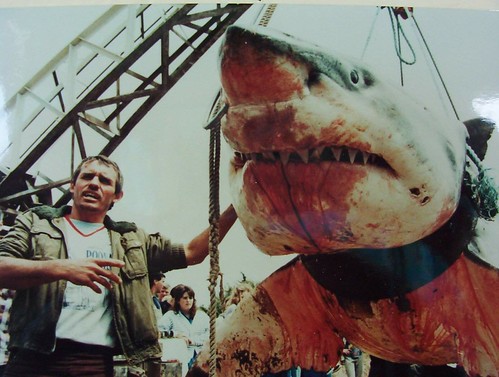
Australia to kill Great White Sharks?

A article in the "Australian" reports that: "WEST Australian Fisheries officers are determined to catch and kill a great white shark suspected of having established itself at unpatrolled swimming beaches along the southwest coast since Christmas."
  
Wow, I guess the shark should know that it is not supposed to swim in an unpatrolled swimming area. They want to hunt and kill the shark simply because it's a shark, not because it has attacked anyone. The article further states:

Tony Cappelluti, from the Fisheries Department's shark response unit, said his team was almost certain they were seeing the same shark. "Our assessment is there's a shark of 3-4m, and it's a white shark, which is high risk, in the area," Mr Cappelluti said.

Almost certain? Well, I'm almost certain that a 3-4 m white shark is a juvenile that's still eating fish. Mr. Capelluti concludes by saying:

"(So) we've deemed it to be an imminent threat under the guidelines because there's possibly going to be people in areas we can't get to or can't guarantee we can mitigate the risk by getting them out of the water and keeping them out of the water."

Wouldn't it be easier to advise people not to go swimming in unpatrolled waters?

I wonder if this has to do with how we portray sharks in the media. "Shark Week" type shows and news outlets seem to cater either to those who find the most creative ways to get a shark to bite a gopro or anything else in sight, or those fools who go and ride the sharks to show how "docile" they are. Reporting how sharks really are seems to be almost non existent.

As I'm writing this I'm watching the local CBS news in San Diego, reporting that a 16 white shark that was tagged on the east coast has been spotted 17 miles off the coast of Florida. Their "expert" says that people have been advised to stay out of the water. ..... they spot a shark 17 miles away and advise people to get out of the water? .... really?!

Maybe, if we want to protect the sharks, we need to focus on educating the media, as well as government and beach safety officials, to give them an accurate description of the sharks. We should respect them for the wild predators they are, but there's no need to fear them!

Cheers,

Martin Graf
Managing Director
Shark Diver 

About Shark Diver. As a global leader in commercial shark diving and conservation initiatives Shark Diver has spent the past decade engaged for sharks around the world. Our blog highlights all aspects of both of these dynamic and shifting worlds. You can reach us directly at sharkcrew@gmail.com.

Wednesday, May 16, 2012

White Shark Cage Diving Australia - Reprieve?

All's well that ends well, sort of.

As you know we have been following the twists and turns of the State Governments decision to cut two commercial shark diving operations from Neptune Island in Australia.

A recent research study that suggested commercial white shark operations were in fact changing the behavior of the animals on site the decision was, as industry observers have noted, not greeted with much enthusiasm.

The good news is all the operations have received five year extended permits, the bad news is they have all been reduced to 5 days a week, dropping 288 collective days from operational calendars.

What makes this decision notable is the shark research component. For years commercial shark diving operations have extended an open door policy towards research teams seeking to study sharks.

Is it time to reconsider this policy when single point research data impacts operations?

About Shark Diver. As a global leader in commercial shark diving and conservation initiatives Shark Diver has spent the past decade engaged for sharks around the world. Our blog highlights all aspects of both of these dynamic and shifting worlds. You can reach us directly at sharkcrew@gmail.com.

Saturday, October 22, 2011

Terry Howson Hates White Sharks - Australia

Terry would like to see inshore white sharks destroyed. Image Perth Now
It's tough if you own a dolphin watching company these days.

Used to be back in the 80's and 90's that dolphins were all the rage, and an operation could make a lot of money interacting with our perennially smiling ambassadors of the oceans.

Then along came a few early pioneers who sought commercial encounters with white sharks. At first these few were considered "crazy", out there, not mainstream.

Crazy has a way of catching on and slowly over the past 30 years crazy became mainstream, refining techniques, adding conservation and research, and growing.

Today, "crazy" is a thriving multimillion dollar global industry called shark diving and the pioneers like Rodney Fox in Australia are now under siege from a variety of sources including this guy, Terry Howson, who runs one of the aforementioned dolphin watching companies and who now is calling for a return to killing white sharks in inshore waters...to keep the public safe.

"We suggest the Department of Fisheries treat sightings of great whites close to shore or aggressively approaching boats in inshore waters as an opportunity to dispatch that individual shark and prevent the risk of future attack."

Of course Terry has absolutely no proof that commercial shark operations are responsible for inshore white shark sightings:

"Common sense suggests that these cage diving operations are unwittingly conditioning great white sharks to associate boats and people with food. I may be wrong, but until proven otherwise I would prefer that we err on the side of caution and follow existing legislation regarding other native wildlife which makes it illegal to feed them."

But that does not stop the Terry's of the world from demanding justice and blaming our industry for wildlife encounters miles away from operations sites. We have seen "The Terry's" from Hawaii to South Africa banging the same media drum, making the same arguments, as if they are all reading from the same script written on the back of a pizza box that still has the cold remains of last nights cheese toppings on it.

Australia's Gold Coast 2009
These are not savvy arguments for killing sharks and shutting down commercial shark diving operations. They lack data, they lack intelligence, and killing big charismatic sharks because they have arrived to a place where we have deemed them unworthy to be is flat out wrong.

It is unfortunate that many ocean agendas come to play when commercial shark diving becomes established in any given region. It is doubly unfortunate that those who hate sharks will use our industry as the reason to kill these magnificent animals.

Blame the industry for conditioning them, then kill them because it makes $ense.

Maybe if you own a dolphin watching company.

Thursday, October 13, 2011

Global shark conservation, and then there's Australia

The head of a gravid Tiger being dumped. Image Michael Ross
A 12 foot Tiger shark (Galeocerdo cuvier) was caught on drumlines off the Gold Coast of Australia this week with authorities "shooing away" photographers in an apparent attempt to conceal the size of the animal.

The female Tiger was found to have 30 pups inside her.

We have covered the ongoing devastating effects of drumlines on shark off the Gold Coast for several years, and it's not just an Australian problem with South Africa employing the same techniques to manage their regional "shark issues".

What makes today's story particularly frustrating from both a conservation and shark diving industry perspective is the apparent shark psychosis that Australian management officials suffer from. On one coast it is o.k to kill white sharks, tigers and just about any other shark species that is unfortunate enough to bite down on baited hooks, while on other coast where tourism with sharks generates million of dollars sustainably, authorities are attempting to shut some operations down and reduce the numbers of days they can operate - all in an effort to protect sharks.

White shark caught on Gold Coast drumline in 2009
Really?

While the rest of the planet marches headlong into new an uncharted territory for shark conservation with the addition of millions of square miles of shark sanctuaries, byzantine hold outs like Australia and South Africa are setting new lows for shark management policies.

Your either protecting sharks, or not.

In Australia it would seem that at least when sharks are commercialized sustainably with conservation minded shark diving operations, sharks need to be studied, protected, and managed. But in areas where humans demand high dollar value for beachfront housing and waters to wade in, shark conservation begins and ends with a baited hook.

Welcome to the world of Australian shark management, if you're a shark, take a left turn at Sydney, because that's the only way you'll survive Gold Coast shark management.

Friday, October 7, 2011

Institutionalized Bias? - Australian Commercial Shark Diving

With some alarm we watched the following ABC news piece this morning on Australia's white shark tourism industry. Well known for "doing things right," leading the rest of the global industry with initiatives that run the gamut from embedded research to advances in cage diving technology.

It would appear that Australian government scientists are now releasing data showing that white sharks are being impacted by these operators and that this data will be used to drop two operations from the area and reduce the number of days the last surviving operations can operate.

Is this institutionalized bias?

We tend to think so as we have seen this same brand of anti-shark diving creep before. Most notably at the Gulf of the Farallones islands off the coast of California where laws and regulations make it impossible to attract white sharks in any manner save static decoys and have enforced a 164 foot rule as of 2009.

Operations must now stay 164 feet away from white sharks at this site at all times.

We will be keeping a wary eye on events as they transpire in Australia as elsewhere with white shark commercial operations. Australia, with folks like Rodney and Andrew Fox remain beacons within an industry often maligned and attributed with all manner of institutional and media bias.

What happens in Australia resonates across the rest of the planet for our industry, and this weeks news is not good.

Monday, December 20, 2010

Bizzare - Shark Nets Used as "Census" Shark Finning Blamed

For the past several years we have been vocal opponents against shark nets and drumlines along the Gold Coast of Australia.

Drumlines and shark nets are antiquated shark protection systems, a 1950's solution to issues between sharks and commercial tourism.

Frankly, we can do better.

The image featured here is a Gold Coast caught white shark from 2009 on a drumline set to "protect" bathers from these animals. Typically these sharks are disposed of at sea, the public is largely unaware that just off their pristine beaches, sharks are being killed indiscriminately.

So you can imagine the head shaking going on after reading an article this week where shark net managers along the Gold Coast are noticing smaller numbers of sharks caught in their nets...and are blaming commercial shark finners for sharks disappearance.

"Startling figures yesterday revealed shark nets had caught 40 less sharks in the past 12 months compared to the same period in 2001/02"

"In the 2001-02 financial year 78 sharks were caught in nets off the Coast but by 2009-10 the number had dropped to 37."

You can files these observations under "WFT".

Perhaps shark finning has something to do with the drop in numbers, or perhaps breeding populations, after close to 50 years of slaughter in the name of shark free beaches, are finally crashing. Perhaps it is an ugly combination of both factors and a few not yet identified.

The point is, this weeks article from shark net and drumline mangers is a bit much, even to the eyes of the most jaded shark conservationist.

Let's start rebuilding local Gold Coast shark populations by removing the shark nets and drumlines, because any data coming from these "merchants of death" is suspect and absolutely not a solution, except for smaller populations of sharks.

Dr.Amy Smoothey - Clarence River Bull Shark Project

Keep your eyes on this shark tagging project on the Clarence River in Australia.

Featuring 25 tagged Bull sharks (Carcharhinus leucas) and one of the most in depth looks into the migration and movement patterns of this unique shark species.

Shark researcher Dr.Amy Smoothey and her team have been on the Clarence River since October of this year catching primarily female sharks and tagging them.

Additional listening stations will be places all over the region to determine the sharks movement patterns over the next decade.

Unlike most sharks, bull sharks tolerate fresh water and can travel far up river systems making this species unique.

More on the project.

More on dead shark discovered in November.

Monday, October 11, 2010

Andrew Fox - Shark Hero

Facebook was center stage last week for a story coming out of Australia and Rodney Foxes operation. A white shark named Strappy became entangled in a packing strap which was slowly cutting the shark in half.

In a first rate PSA by the Foxes they highlighted the need for cleaner oceans by featuring Strappy and the damage being done to him by one industrial packing strap. There was some talk of trying to cut the strap off this animal. No mean feat, as white sharks are notorious for not wanting to be touched.

This week The Dorsal Fin blog has the update on Strappy and a rescue operation that was successful. As it turns out Andrew Fox manged to release Strappy from his confinement and it is hoped that now this shark will live for many more years to come.

Kudos to the Fox operation for:

1. Providing an oceans PSA using Strappy as cause célèbre

2. Helping this animal at great personal risk

This is first rate work by a commercial shark diving operator who has lead the industry over the years.

Monday, September 20, 2010

When One Shark...

Great story from Australia today as one image sets the table for stronger regional shark protections:

A PHOTO of a grey nurse shark with a gang hook protruding from its eye has helped convince the State Government that more needs to done to protect the endangered species on the Mid North Coast.


The government has assured environmental groups it will consider tightening fishing restrictions off South West Rocks where the critically endangered sharks exist.


At the same time, greater protection for grey nurse shark colonies may follow off Coffs Harbour as the government reviews its Solitary Island Marine Park policy.


Environmental groups have welcomed news that Primary Industries Minister Steve Whan will look at tightening fishing restrictions.


Fish Rock and nearby Green Island near South West Rocks were declared as critical habitat for the sharks in November 2002, resulting in fishing and diving regulations.


Complete Story.

Follow up Blog Post.

Sunday, September 5, 2010

Tiger Shark Fin Soup - Australia

Apparently the following video is of hundreds of Tigers off the Queensland coast in what we would like to see more of - Tiger Shark Fin Soup, natures best.

Note:Da Shark was the first to call the suspect Tigers in this clip.

Tuesday, August 3, 2010

Industry News - Commercial Shark Diving Study

Scientists and South Australian cage-diving operators are collaborating in a world-first project to ensure the State’s eco-tourism activities take good care of Australia’s protected white sharks.


The research, led by Flinders University and SARDI shark ecologist, Dr Charlie Huveneers, will provide important information to help the State Government manage the growing industry which relies on the survival of the threatened species. Its outcomes will also help inform similar cage diving operations around the world in places such as New Zealand, South Africa and Mexico.


Dr Huveneers’ team and cage operators are working together over the next year to tag ten white sharks which inhabit the area around Australia’s main cage-diving operations off the remote Neptune Islands, 75 kilometres from Port Lincoln. Two 3.5 metre white sharks have been tagged to date.


“Berleying activities at the Neptune Islands have recently been increasing. However, the impacts of such activities are still poorly understood, and there is a need to investigate how berleying might affect white shark behaviour and movements” Dr Huveneers said.


“Previous studies in South Africa indicated that white sharks became ‘habituated’ to berleying rather than ‘conditioned’. As a result, sharks might become less attracted to berley,” he said.


“The white shark cage-diving industry at the Neptune Islands attracts a large amount of tourism to South Australia and Port Lincoln. It is important to ensure that this industry is sustainable and that it does not negatively impact on the white shark population frequenting the Neptune Islands.


“Sharks also play an important role in the ecosystem with the removal of top predators having shown to cause cascading effects down the food web.”


“Our research will hopefully provide crucial data which will help the Department for Environment and Heritage and PIRSA Fisheries to assess if the current level of berleying undertaken by the white shark cage-diving industry around the Neptune Islands is impacting on shark behaviour.”


Dr Huveneers says the team is using fine-scale positioning technology accurate to within one metre to track the sharks. Sharks are tagged with an acoustic tag as they swim past the boat allowing researchers to record their positions in relation to the cage-diving boats for a period of up to 45 days.

Tuesday, June 1, 2010

Secret shark grotto off Western Australia coast near Exmouth

These kind of shark discoveries make sharks folks excited especially when divers come back with brilliant images.


A 31-year-old marine biologist discovered a secret deep-water grotto, seething with 19 grey nurse shark pups, heavily pregnant females and fully-grown males off the coast of Exmouth.


The grey nurse shark mating cave, or aggregation site, is one of the first of its kind to be documented in WA waters.


Ms O'Callaghan got up close and personal with these docile creatures during a 40-minute recreational dive last month. She surfaced with some amazing photos.


Complete Story.

Tuesday, December 22, 2009

Divers Save Shark - Rescue

Divers acted quickly when a grey nurse shark swam by with a metal collar attached to it. The grey nurse is endangered in Australian waters with a tenuous population hovering around 2000 individual sharks.

Sport fishing and habitat destruction has left these animals with few chances for survival.

Last year another shark was discovered with a gaff jammed in its throat and was successfully caught, saved and released.

Kudos to divers helping sharks.

Full story.

Friday, December 18, 2009

Sharks - Changing Perceptions?

When the shark conservation movement drills down to this level, we will have saved the species.

Until that day there is much work to be done. Please support your regional shark conservation programs. Together, we can "de-demonize" the shark.

Caution: This video contains live fining of a shark.

Tuesday, October 6, 2009

Vic Hislop - Quote of the week 2009

In case you did not know who Vic Hislop was, he's featured this month in Edit International magazine which poses the question "Are Sharks Targeting Humans?"

Vic Hislop Quote:

"When people put down shark cages for their thrill-seeking clients some of the burley (blood and cut up fish bait and meat) travels up to 40 kilometers away, say Hislop. These people would like you to think they are conservationists because they don’t kill sharks – but they are using thousands of edible fish as shark bait.
He adds, Sharks pick up the scent, become aroused and are ready to eat by the time they reach the cage containing a human. If the cages were not strongly made, or fell off to the bottom, those stupid people would be goners in seconds. Meanwhile the sharks are not killed after the event. They are simply being trained to hunt humans.”

Editors Note: It is media quotes like these we are reminded of the commercial shark divers prayer - "Lord protect us from the small minded and the dim."

Tuesday, May 12, 2009

Protesting a Fisheries Minister NSW

Effective protests begin with an effective target. This week was a good week for protesting for sharks:

A NSW Conservation Council protest against shark fin exports at the office of Peter Garrett culminated with a giant shark fin is erected outside the office of Environment Minister this week.

Conservationists are calling on the Federal Environment Minister Peter Garrett to stop shark fin exports from New South Wales.

The minister is currently considering whether to renew the state's shark export license.

The Nature Conservation Council of New South Wales says shark numbers are declining from over-fishing due to increased demand from Asia, where shark fin soup is a delicacy.

It delivered a giant shark fin to Mr Garrett's Sydney office this morning in protest against exports. The Council's director Cate Faehrmann says there has been a large increase in the numbers of sharks targeted simply for their fins.

"We've seen a decline worldwide of about 90 percent in shark numbers since the beginning of the industrial age," she said.

"This is very unsustainable. We have sharks being targeted in New South Wales waters that are listed as internationally threatened."

Complete Story

Friday, May 1, 2009

Australia - Shark Tagging System

A few months ago we posted several stories about the antiquated shark killing system from the 1960's still in use on some beaches in Australia today.

The images of a dead sub adult white shark to us was appalling.

Better news today as a new tagging and early warning system goes into place allowing both researchers and ocean users a real time assessment of predatory threats without killing the animals:

A monitoring system which tracks White Pointer sharks off the coast of Perth could soon be used to warn swimmers if sharks are nearby. A network of acoustic receivers was deployed off metropolitan beaches last year to monitor 100 tagged sharks.

The Department of Fisheries says the aim of the program is to learn more about the behaviour and movement of sharks. Research scientist Rory McAuley says the system could also become a public safety tool.

"We'll be able to provide alerts to public safety agencies and officers when a tagged shark does turn up close to a populated beach," he said.

Complete Story

Tuesday, April 21, 2009

Wayward Hammers - Australia

About the only place on the planet where simply enjoying a morning shower nets you a tub filled with sharks, Australia is one sharky place.

Not surprisingly the news coming from the land Down Under this week is all about Lake Macquarie and an ongoing series of shark sightings that has locals and the media doing what they do best...screaming about it.

This weeks encounters feature a wayward Hammerhead or two that found themselves Easter weekend checking out shore lines filled with families BBQ'ing and waiting for their turn to get into the water:

Glenn Wilson, of Floraville, photographed a three-metre hammerhead from the fly-bridge of a cruiser near Summerland Point on Good Friday.

"We saw it 200 metres from the boat, we cruised in and it came straight up to the boat," Mr Wilson said. "It was looking for a feed. I'd say it was pretty hungry.

"If I had my game-fishing gear, I would have caught it." It was the first time he had seen a shark in the lake, despite cruising almost every weekend. "I've been a bit sceptical about sharks in the lake, but they're out there," he said.

Complete Story

Wednesday, March 11, 2009

4m Croc Eats Leprechaun Shark Study

Barramundi, Australia - Shark researchers at the North West Fisheries Laboratory near the Wildman River, 100km east of Darwin, discovered a 4.2 meter saltwater croc in their ponds today devouring a rare shark species under study.

"We are the only laboratory in the region studying the endemic Leprechaun Shark (Triaenodon Leprechus) and this croc finished off the lot of them", said Ann Roman spokesperson for the lab.

The Leprechaun shark is a native freshwater shark similar to the bull shark and is named after a green bio luminescent gel it excretes. The species was discovered in the Wildman River basin in 1936. Researchers in Australia think the bio luminescent gel might have commercial applications and have been studying this shark at the Wildman River lab for the past four years. It is the only known shark species to excrete a gel.

"When we arrived at the lab this morning we noticed a thrashing around in the 4 hectare pen, that's when this great huge croc reared up with a 1 meter shark in its jaws. By the time we got a team in there the crocs mouth was stained green and it had finished off most of our control group. Given how rare the Leprechaun shark is in Australia, this is a real set back".

Efforts to remove the massive croc by Department of Fish and Resources personnel have met with little success.


The following Underwater Onion was brought to you by Shark Diver. Sometimes the "pot of gold" at the end of a story remains elusive, happy St. Patricks Day;)

Tuesday, March 10, 2009

AU West Bioregion Bans Whaler Catch

More good news for shark conservation this week as Australia's Fisheries banned the taking of large Dusky whaler sharks to commercial fishermen:

Department of Fisheries shark scientist Dr Rory McAuley said WA’s new regulations would assist in the protection and, in some cases, the recovery of at-risk species within the Family Carcharhinidae, which all whaler sharks belonged to.

“Dusky whalers and sandbar sharks have been identified as being over-exploited in the past and are species that are particularly at risk,” Dr McAuley said.


Further details of the new arrangements, with illustrations of how to measure a whaler shark correctly, are now available from the Department of Fisheries’ website at www.fish.wa.gov.au