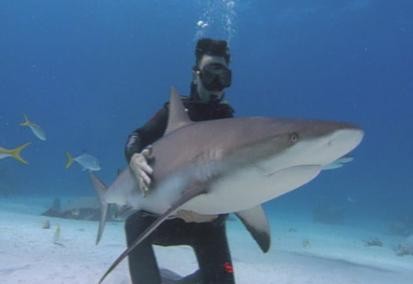
You have to love this guy or hate him. When Sean Van Sommeran of the
Pelagic Shark Research Foundation has something to say...he can usually find someone who'll listen to him.
Casually factual when talking about commercial shark diving and
always controversial when talking about anything else:
From
Santa Cruz Live:
With PSRF set to present its annual shark report this Tuesday at the Santa Cruz Surfrider Foundation’s monthly meeting, now seemed like an appropriate time to catch up with Van Sommeran on some the latest news regarding shark research and shark activity in our local waters…
So Sean, when we’re talking about sharks in the Monterey Bay region, are we primarily talking about great white sharks?
That’s where a lot of people’s interests gravitate toward, just because it’s the big, heavy one. But I spend as much time with other, less grandiose species: leopard sharks, guitar fish. They’re not going to overturn the boat or anything, but I spend a lot of time with those animals too.
A few years ago there was a lot of controversy over shark diving tours chumming the waters and using surfboards as lures to attract white sharks. Surfers were concerned that these tour groups were actually teaching sharks to associate the silhouette of a surfboard with food? Were their concerns valid?
They weren’t just floating surfboards in an effort to get the animal up to the surface where it could be seen, but actually putting a wetsuit stuffed with fish on top of it. It wasn’t just about seeing the animal. It was also like, ‘now watch this!’ It wouldn’t be accepted with other species of protected animals, let alone a big potentially dangerous shark. And we could see people surfing from where they did this stuff. A lot of us were members of Surfrider Foundation anyway. So the Surfrider Foundation actually filed the lawsuit that spurred the Marine Sanctuary (Monterey Bay National Marine Sanctuary) to impose the restrictions that are still in place (against shark cage diving).
The Farallones are less protected to a degree, but there still is no feeding the sharks or using bait allowed. They can still dunk cages in the water. They’re not supposed to chum. There’s little enforcement, but I think most of them don’t. It’s not needed. What’s interesting about the Farallones is there are these big elephant seal predations where the sharks eat these seals. Natural behavior can often times be more interesting than anything you can draw up, so I think they’ve come to the realization that they can just sit by and watch what normally happens without provoking the shark to slam into the cage and all that stuff. They can still sell their $1,100 dollar tickets. Our position is simply that we want to try and remove the hazardous aspects of the industry. We think that shark viewing should be just like bear watching or orca watching or whale watching. It should be enough to see the animal in its environment. To have it come up and “almost get you” is just stupid.
But, in your opinion, did surfers have a legitimate concern?
Yeah, I think so. One of the most basic tenets of wildlife care is “don’t feed the animals.” It’s just like feeding a stray dog, or pigeons, they’ll keep coming back. You can even get a plant to lean toward light and/or water. It’s just the most basic thing: Any animal is going to gravitate towards what it needs. It’s been demonstrated with reef sharks and with white sharks as well that if you repetitively feed the animal in a restricted particular location, they’ll learn to look for that. So we’ve always been strong proponents of limited baiting and no feeding whatsoever. And certainly no deliberate provocations. A lot of the cage diving trips involve getting the sharks to hit the cage or getting the shark to take the bait out of a guy’s hand, just this escalating dangerous proximity that we don’t see as a viable recreational pastime.
What will you be focusing on in your presentation Tuesday?
Well Todd Endris (Monterey Bay surfer who survived an attack from a great white shark at Marina State Beach on August 28, 2007) got injured by a shark off Marina, so we’ll be talking about that. There’s a myth out there that dolphins saved him. There’s an old fable that dolphins will protect people from sharks and can beat up sharks. Because the dolphins were there just prior to (Endris) getting hit and then while he was getting hit there were still dolphins nearby jumping out of the water and stuff–and he didn’t die, like 99 percent of the people who get bitten by sharks don’t die–but because there were dolphins there this time (Endris) was presuming they were the reason (he was saved). I’m glad he’s ok. But one of the potentially alarming aspects of that story was that a lot of people I talked to afterwards were saying, “Oh, that’s cool that dolphins will protect you. So if I see dolphins then I’ll just paddle closer to them and I’ll be safe.” And it’s like “No, no, no.”
Yeah, I’ve been told before that if you see dolphins in the lineup it’s a good sign that sharks aren’t in the vicinity and that sharks are afraid of dolphins because they can gang up on them in pods and will actually ram sharks from all sides. Not true?
No. Dolphins can beat up and don’t have any problem with most species of sharks, but there are also several species that dolphins show up in their stomachs all the time, including great whites. In the Mediterranean one of their primary food items is dolphins and tunas. In fact, our contention is that when you see birds diving and lots of porpoises near shore and stuff, that’s when you don’t want to be in the water. The Bay is kind of like this big revolving Serengeti Plain out there and every once in a while it touches the shore, right? So you don’t want to go swimming out in the middle of that. If there’s any time that there is a likelihood of a big predator being out there—it’s not likely to bite you, but if you’re concerned about that kind of thing—it’s when there’s tons of food there. It’s very likely that the shark was shadowing that group of dolphins anyway and that’s what brought it in the lineup.
So if you see dolphins in the lineup is that actually a bad sign that sharks might also be in the vicinity?
The whole shark attack equation is something that needs to be kind of downplayed. You don’t have to hype it up. If you look at it statistically, there have been just over 100 attacks (on people) on the west coast since the 1920s, so it really is less than lightning strikes. It’s a very rare instance. The proximity of humans and sharks in the water is much greater than a lot of people realize. The good news is that they don’t often bite humans. Now people don’t often get hit by lightning either, but you can have conditions like rainstorms and lightning storms where you can increase your chances. You know, you run out with an aluminum golf club onto a golf course during a thunderstorm…The same thing applies to sharks. I wouldn’t say (dolphins) are bad news. But don’t enter the water, and because you see dolphins, think that you’re going to be protected.
I’ve always recommended not surfing or swimming near “bird whirls,” where the birds and the fish are real close to shore and you’ll have seals and sea lions and porpoises and dolphins and thresher sharks and all kinds of stuff feeding in there. These events are also called “bait boils” or “bait balls,” there are various terms for them. Most of the activity is happening offshore, but every once in a while they move near shore, and that’s when the sharks can be near shore.
What else can surfers do to reduce the risk of a shark attack?
It’s pretty basic. Always surf with a buddy. You don’t have to–I don’t always do that–but when people do surf alone they should come to terms with the fact that a lot of things could go wrong. That’s one of your basic precautions whether your surfing, diving, whatever. The ocean can be a hostile environment, wildlife aside. Pay attention to your surroundings and watch the animals around you and see how they react. I’ve heard so many stories about people surfing up the coast surrounded by birds and harbor seals and all of a sudden all three harbor seals dive into the water all at once. The surfer gets a weird vibe and decides to paddle in and then later sees a shark at the surface eating something, probably one of the seals. If you’re concerned with it, there’s ways to minimize your potential of being the one person who gets hit every year.
Should surfers be wary about surfing at rivermouths?
Yes. But, again, a lot of the rivermouths tend to be factors for wildlife. So it’s just the tip of the food chain there. Seasonal occurrences of fish runs bring the marine mammals, which again bring those big sharks.
According to superstition among many Northern California surfers, late summer and fall, especially “Sharktober,” are the most dangerous times of the year for shark attacks? Is there any scientific basis to this notion?
There’s a little bit of statistical evidence. And just in horse sense, that’s when the waves get good, so there are a lot of surfers in the water. I’d say it has most to do with the fact that that’s when the elephants seals are starting to come ashore to mate and to molt. Not all white sharks eat elephant seals, only the bigger, heavier adults eat those seals. So when those elephant seals come in from the open ocean there’s a certain segment of the adult white shark population that comes to shore with them.
It’s conventionally understood that the season is October through January. But we see activity in September and this time of year as well. We saw our last shark on February 16, two of them actually. But there’s evidence of bitten seals year round, so there’s a year-round presence. The best statistical spike I can find was in fall of 1993 when over thirty otters washed up bitten right around Año Nuevo Island. If you look at just that spike, something happened in October, and I think it was the arrival of a fleet of sharks. They’ll aggregate as opposed to congregate. They don’t travel around as a school. But like fishing boats, they’ll all wind up at certain hot spots to get food.
What are researchers learning about the migratory patterns of sharks?
Basically all the conventional wisdom about white sharks off the coast of California was proven wrong in the year 2000/2001. White sharks were thought to be coastal. And it was our theory as early as 1996 that they were in fact open water and deep-ocean and periodically hitting the coast. The year 2000 was when we put the satellite transmitters on white sharks (at Año Nuevo Island). We put on four transmitters in the year 2000 and ours popped off near Hawaii. It was really a revelation. These sharks were in fact open-ocean, deep sea animals.
Late summer to early winter is the peak time for white sharks returning to our coastal waters. Late winter and spring is when many go off into the deep Pacific. And there’s a lot of variability. Some of these animals will show up late season, a lot of them will show up at the beginning of the season. There are animals arriving in October of 07 that we are still seeing around as late as the middle of last month. There’s some that have gone and left and some that have been there the whole time. So they’re spending four months or more at some of these locations. And then the sharks that go out to Hawaii once they leave here will stay there for three to four months and then come back.
How many shark attacks were there on the California coast in 2007?
It depends on how you want to classify a “shark attack.” In terms of injuries, just the one on Todd Endris at Marina Beach. I don’t know of any other injury from a shark attack last year along the whole California coast.
Have there been any documented shark attacks or incidents between human and shark in California so far in 2008?
I haven’t heard of anything from 2008. The ass end of an elephant seal washed up at the reserve (Año Nuevo) recently, but no sighting of the shark. And then a harbor porpoise was supposed to have washed up near Four Mile within the last three weeks in February. But no eye witness accounts of chases out of the water or anything like that.
Are you seeing any trends as far as shark attacks on people?
There’s a perceived increase. It’s kind of an urban myth that I’ve been hearing since the late 80s. Statistics are rising but if you look at it in totality you’ll see that crime, boating accidents, people falling off coastal cliffs, etc. are all rising. And it’s a product of increased human traffic, period. There’s more people surfing, more surf schools, more people buying scuba gear. There are more water sports like kite surfing and tow surfing. There’s just more people in the water and more people from coming all over to use the coastal waters. And with more crowding there’s increased traffic in formerly isolated and remote areas.
But if you ignore all the little anecdotal accounts of, “Bob saw one off Trestles Tuesday,” and just look at the number of people bitten and injured from shark attacks, there are scarcely over 100 attacks documented since the 1920s. Attacks are rare, injuries are even rarer, fatalities are extremely rare, and consumption is almost unheard of. If you consider how many people are coming in and out of the water on a daily basis, it is just one of the rarest things that could happen.
There’s nothing to suggest (sharks) are actually looking to eat people. I believe that a lot of those attacks on humans are exploratory. I don’t think that it’s a case of mistaken identity, like some have posed, because usually when they hit a seal it’s with tremendous force. So even if it was by accident guys would be much more injured than they are if the shark thought they were a seal. That’s my impression. Usually the rate of closure is relatively slow compared to what we see in the violent hits on seals where the sharks are flying out of the water.
If you see the animal that’s actually good news, because if it was going to attack you, you wouldn’t see the shark until it’s on you. When a shark is at the surface, typically it’s tracking something, trying to pick up a scent. If the shark presents itself to you it’s not looking for you, it’s looking for something else.

 Non-profit organization Iemanya Oceanica today announced their second shark-tagging research expedition to Baja California, set to take place from July 1st-5th, 2010. The organization is actively seeking up to 20 individuals from the general public to swim with and learn about the conservation of the world's largest fish: the giant whale shark.