The shark diving industry blog covering sharks, shark cage diving, shark conservation and things we find "amusing" since 2008 www.sharkdiver.com, www.sharkdivers.com, www.divingwithsharks.com
Some might say diving with sharks is the last thing they would ever want to do...until they do it! For many, it has become an addiction and more and more repeat divers are getting their yearly thrill with Shark Diver, based out of San Diego. For 14 years, Shark Diver has been introducing the public (those who are dive certified and not certified) to the underwater world of great white sharks. They don't plan to stop. Why? Because people keep coming to get their 'fix.' The shark phenomenon has continued to rise for the last few years, due to local and national television news and social media coverage, cable television programming, and of course, silly movies. The 'News' has put us in touch with shark sightings off the coasts of Australia, South Africa, the Eastern and Western United States, and Guadalupe Island in Mexico; all right at our fingertips. The more we talk about sharks, the more popular they become.
Photo: Cindy Michaels
Every year, starting the first week of August, Shark Diver takes more than 200 divers to Guadalupe Island to see these misunderstood creatures, up close. During a 5-day adventure, divers fulfill their bucket list items, unique wedding anniversary or honeymoon celebrations, birthday milestones, or childhood dreams. In 2014, Shark Diver's sold out season saw a record number of divers wanting to see great whites, but it was also one of the biggest years for shark encounters at the cages. Things were only going to grow after that. Already, since the company's first dive this year on August 9th, there have been more than 120 great white shark sightings and it is expected that the same amount, if not more, will be seen by the time the 2015 season ends in November.
Get to Know Your Sharks Shark Diver has worked with the Discovery Channel for some of its Shark Week episodes as well as countless other operations that partner for filming. But the company's greatest passion is to bring those who have never seen a shark...to the sharks, themselves. For the past 2 seasons, a researcher from the Marine Conservation Science Institute (MCSI) in San Diego has joined Shark Diver in educating divers about specific markings, migratory habits, and all the fun stuff you don't learn in school or on television. On the hosted adventures, divers have the opportunity to name any new shark that is spotted, while in the cages. That named shark is then registered in MCSI's photo database, which features more than 150 already identified sharks, such as Bite Face, Shredder, and Bruce. By naming and identifying the new great white, the divers are helping out with MCSI's research; dedicated to conserving and protecting marine resources. Shouldn't naming a shark be on your bucket list?
Photo: Cindy Michaels
What to Expect without Expecting Like other highly feared fish, great whites are unpredictable. There may be curious juveniles that try to bite delicately on the cages, or a large adult that just wants to stroll by slowly to check you out. There is no expecting one behavior or another from these boys and girls. Divers prepare themselves for a scary time, but walk away awe-inspired by what they just witnessed. Every trip reveals something different.
When you decide that life is too short to only watch sharks on television, venture out on a dive with Shark Diver. You will see a great white shark while on your trip or the crew will take you back to Guadalupe Island at no extra charge. It is the company's guarantee. Whether or not Shark Diver sees you year after year, there is a good chance you will never view great white sharks the same way, again. ~Cindy Michaels Shark Diver
About Shark Diver.
As a global leader in commercial shark diving and conservation initiatives Shark Diver has spent the past decade engaged for sharks around the world. Our blog highlights all aspects of both of these dynamic and shifting worlds. You can reach us directly at staff@sharkdiver.com.
About Shark Diver.
As a global leader in commercial shark diving and conservation initiatives Shark Diver has spent the past decade engaged for sharks around the world. Our blog highlights all aspects of both of these dynamic and shifting worlds. You can reach us directly at sharkcrew@gmail.com.
When we got the call from Ed DeVito this year we knew we had a true shark fan on the other end of the line...and a very busy one to boot.
As it turns out Ed is a businessman with not a lot of time to spare (we know the type) and for a while there it seemed that Ed was not going to make this season. Fortunately for us he did and was treated to the seasonal shark train at Isla Guadalupe which he caught on tape.
About Shark Diver.
As a global leader in commercial shark diving and conservation initiatives Shark Diver has spent the past decade engaged for sharks around the world. Our blog highlights all aspects of both of these dynamic and shifting worlds. You can reach us directly at sharkcrew@gmail.com.
A couple of days ago I talked about how I got started at Isla Guadalupe.
Today I'm going to share a couple of things I do during those trips. I'm always collecting pictures and videos from our Shark divers, both for our photo database and a trip video. Our database identifies the sharks, by looking at the transition from the grey to the white, which is like a fingerprint and different for each shark. So far we have identified over 120 different individuals, some of which we have seen every single year for the past 10 years. If we have a new shark that hasn't been identified, the photographer whose picture we use to identify it, gets to name the Shark. How cool is that?
I compile pictures and videos for a slide show/video and burn it onto a DVD for each Shark Diver to take home. The following is an example from last season!
Cheers,
Martin Graf
Dive Operations Manager
Shark Diver/Horizon
Isla Guadalupe, Mexico
About Shark Diver.
As a global leader in commercial shark diving and conservation initiatives Shark Diver has spent the past decade engaged for sharks around the world. Our blog highlights all aspects of both of these dynamic and shifting worlds. You can reach us directly at sharkcrew@gmail.com.
With less than 4000 white sharks estimated to be left on the planet, video of this 12-14 foot animal struggling for life with no hope for anything but a sharp knife is...heart wrenching.
White sharks in Mexico are under siege, making sites like Isla Guadalupe rare safe areas in the life cycle of these magnificent animals. This shark was taken in February of 2010:
One of the more interesting members of the conservation/film and television community is, without a doubt, Scott Cassell.
Recently he's been involved with a front running conservation project called rECOn.
rECOn changes the way the public views conservation initiatives by documenting and then putting in jail poachers in regions where enforcement is non existent.
This is boots on the ground enforcement to effect conservation change.
Scott just got back from Baja with this after action report from his team.
What they discovered in Baja shocked them and will shock you as well.
Warning: Contains language and heartfelt emotion:
Dale and I have just returned from our latest rECOn mission hunting poachers which ran from August 15th to the 20th.This time we were joined by cameraman XXX whom was filming our operation for consideration to produce a series for XXX.
XXX had expectations but he expressed they were exceeded by what he saw and now is a firm believer in what Dale and I do as we hunt and film some of the the worst of humans.
Weeks ago Dale had a tip that somewhere near the city dump was a pile of shark heads. Intrigued we searched around and in short order we found what we were looking for.Frankly, none of us were ready for what we would find.
The first few shark heads we found were tiny. Barely 2.5 inches across indicating the (Silky) sharks were only 10 inches to one foot long. These were just babies! We found 27 heads (20 silky, three hammerhead and four dogfish) and were disgusted with the cowardly act of slaughtering baby sharks for the export of their tiny fins to the Asian markets and the tiny fillets being sold at the local markets.
We decided to lay them all out in neat rows to film them and as I maneuvered to make the line straight my foot slipped into a burn pile opening up the charred surface exposing underneath. Dozens of tiny shark heads showed through... and as Dale, xxx and I looked around with our eyes calibrated to what to look for we began to realize what was all around us.We found an old plastic box-crate and began loading it up with all of the tiny shark heads and the deeper we dug the more we found... then I found the worst of it.A huge pile of of horse shit covered hundreds of baby shark heads.
I love sharks. I love sharks like many folks love dogs and cats.For years I have hand fed and admired sharks. I have tagged them, saved them for net entanglement, and reached out and touched ‘one ton’ white sharks and tigers as they swim by in their full majesty... and my life is greatly enriched because of these unique encounters.
To discover over one thousand disembodied heads of babies in a dump covered in horse shit was almost too much to endure. All of this suffering for sushi and shark-fin soup.
XXX found the heart to keep filming and despite his own emotions... he kept asking me to talk to the camera in order to record my reactions to this display of ‘humanity’.I found myself on the verge of tears as I dug out tiny lifeless heads of shark pups with their vacant eyes staring into man’s world of trash.The anger welling up inside of me had to be focused as I inhaled the dust composed of murdered babies, horse shit and human filth.This illustration of man’s complete lack of respect for the sea and indeed for life itself lowered my faith in Mexican fishermen and mankind overall.
Dale called out to us with another sickening discovery... but at least this one offered a recourse I very much wanted. “Dude! Here are about 25 to 30 poached Totuaba!”XXX and I came over to see for ourselves and confirmed his discovery.Dale had carefully laid out about ten of the dozens of filleted fish carcasses for positive identification. The tell-tale rounded Caudal fin and skull shape offered the positive ID we needed to present as evidence and we carefully video recorded it.
This has special significance to us because the Totuaba were fished to near extinction and are now protected by Mexican law. Having a Totuaba in your possession regardless of how you obtained it is a mandatory 8 year prison sentence.So, if we can find out where the poachers fish the Totuaba we can find WHO they are and bust them.
XXX, Dale and I gathered at the tail gate of the truck and reflected for a moment on what we just found and I glanced across the dump at a strange shape propped-up on a rock. At first I thought it was just a piece of junk like a trash can lid... then I saw a familiar shape along the edge of it. “No Way!” I jumped up and set to look at it with a quick walk.What I thought was junk was a Green Sea Turtle shell with the center kicked in by a poachers boot-covered foot.What I did not know is that I had just found the best way to catch these sick bastards.Dale had a network of friends in the area and they know everything that goes on nearby.They know Sea Turtles are easy to poach.
The next morning we set out on Dale’s panga to the islands we selected to explore for Poaching activity. Upon arrival to Lobos Island we noticed the Sea Lions were afraid of human approach and scrambled off rocks at the sight of us. This behavior is learned, not instinctual. Here humans kill Sea Lions.As most Sea Lions scrambled into the water I noticed on was hesitant to leave her rock perch. We slowly worked our way closer to her and noticed she had a dark ring around her neck. I trained binoculars at her as XXX focused his camera’s long lens on her and we both saw she was gravely injured from a Poachers net fragment cutting through her skin, blubber and muscle into her throat.I took out my knife and asked Dale to close it so I might try to jump-tackle her and cut the net off... but she dove in at the last second closing the window of opportunity on her survival.
Under permit, we landed and began our survey for poaching activity and didn't have to look long. XXX, Dale and I found several dead Sea Lions with either nets on entangled on them, or stab wounds on their head and necks.But the real heart breaker was when Dale discovered a baby Sea Lion corpse with a suspicious head wound and called me over. Upon inspection I discovered it was blunt trauma induced skull fracture. The baby was killed by a rock strike at the base of the occipital of the skull.
Poachers murder the innocent.
We left the island with heavy hearts.
As we arrived back to the storage location for the Dale’s panga we unloaded the gear but Dale quietly disappeared with an old friend of his to chat with him. XXX and I finished unloading the boat and waited in the truck. Upon Dale’s return he looked visibly upset. “GUYS!” He demanded, “You cannot even F___KING believe what just happened! I just got a tip on the Sea Turtle Poachers!”“Some guys want to sell me Sea Turtle meat!”
We unloaded our gear and prepared for what was about to happen. XXX assembled his long-lens with a Night Vision intensifier and I set up a small camcorder to give to Dale. The mission was simple although potentially very dangerous.Dale was going to go into the poacher’s campo and film the Sea Turtle while pretending to want to buy it.
With XXX set up on an observation point to film Dale at long range and Dale’s tiny HDV camcorder ready, Dale jumped into the truck and drove to the Poacher’s campo. XXX was able to film Dale’s entire drive into the campo and even captured outstanding images of him walking to the Sea Turtle’s remains (on a table). At that point it was all up to Dale to film the Sea Turtle’s body and what the Poachers were saying. Much to Dale’s credit he filmed the Sea Turtle, the poacher’s faces and even recorded them saying how they kill up to two Sea Turtles per day, how to cook the meat and even the methods of how and where they set nets to catch them!
Dale politely declined purchasing the dead Sea Turtle and chatted with them about weather, fishing, a cut on a fisherman’s hand and eventually left safely.
So: How much is a Sea Turtle worth?The Sea Turtle was offered to Dale for $100. We decided it would have sold for much less to a Mexican.
Upon his return we watched the film Dale captured and it was incredible!Now we needed to film them in the act of fishing for turtles and (thanks to Dale’s film) we knew exactly where and when to set up the surveillance.Almost on cue, a Poacher carries a huge net on his shoulder to the shoreline in complete darkness... all the while being filmed by XXX’s watchful eye (complete with night vision camera).Once the Poacher dropped the net Dale and I set out on the beach to get close up images of the net to be certain it is the kind used to kill Sea Turtles.Dale set up an over-watch position with an Electrophysics Thermal Camera and radio to keep me informed of Poacher movements, especially if he decided to return to the net while I was there filming it.I used my Sony Z-1 with an Electrophysics Night Vision 9350BRAC Module to film in the darkness like it was daytime.I worked my way out on the beach to the net in a low a profile to avoid detection while Dale looked out for me.XXX was filming us both from a higher more distant vantage point using his night vision module and long lens.
After some sneaking around I found the Poacher’s net and confirmed it was the kind used to kill Sea Turtles. A surge of anger rushed through me and I wanted to destroy the net and wrap it around the Poacher’s neck like the condemned female Sea Lion we saw earlier... but I stayed on the mission profile and departed the area.As soon as I found Dale’s over-watch position and joined him the Poacher was half-way to the net. I luckily missed the Poacher’s return by less than a minute!In my heart I felt it was more lucky for the Poacher than me we did not meet alone in the dark.
We silently filmed the Poacher deploy the net over the course of 45 minutes in the darkness.I felt good about the footage we caught but was seething inside about the innocent creatures this drug-hooked-miserable-excuse of a human was responsible for killing for a few pesos. He was not a man. He was a coward.
The next morning we all loaded Dale’s panga and we went around the point to where the Poacher’s net was set.Dale passed by the cove a few times in order to give me amble opportunity to get a compass course set with my TAC board.I finished putting the Ghuille cover on my O2 rebreather and I donned my new Riffe Cryptic Camo Wetsuit and combat dive gear and slipped into the water. On my TAC board was a HERO HD Camcorder facing me to record my actions during the dive and another was mounted on my helmet facing forward to recordwhat I saw.I descended to 20 fsw and noticed how my body blended perfectly into the water thanks to the Riffe suit.I made a communications call to Dale and then followed my pre-determined course and counted kick strokes right up to the net (which was in full view of the Poacher’s campo... hence the need for stealth).The net was already indiscriminately killing fish while it waited for the illegal targets (Sea Turtle) to wander to close.I filmed the full length of the coward’s technology and called Dale to let him know I was safe and departing the net back to the boat.Once back onboard we left the site to set up another surveillance site to wait for the poachers to recover the net.They never came.Did they get tipped off to our operation?Were they just too high to care about getting their illegal catch out before it spoils?We may never know... but we did collect several nets and placed them into our little bonfire ring.It feels really good to destroy these nets and I hope it financially cripples these bastards so they find it harder to Poach.
Dale, XXX and I were lucky enough to meet with our ‘client’ in Baja as we headed back to the US.We showed him some of our evidence and explained in detail what we found. He was quiet at first... then he offered us some insight to his vast wisdom and experience.He told us he would be able to take our evidence and show an exclusive audience what we have discovered.These powerful people will influence other leaders to design change and encourage new directions of protection.But... before that he will take our evidence and show it to the Mexican District Attorney so he can open an investigation, make arrests and remove these people from the equation.
As of today, four Poachers face 8 years in prison each. A Mexican prison.
Although this is a good result... I am haunted by the vacant eyes of a thousand baby sharks, the dead baby Sea Lions and the complete lack of respect for life and the oceanthese Poachers demonstrated.
As my friend Dale put it:
“The poacher is an international fugitive, not just a mexican one. The mind of a poacher transcends borders and morality, they are of the same mind no matter where you go. Out for fast easy money with no regard for the law, or the world for that matter”.
I will never stop Hunting Poachers. The rECOn Mission has just begun.
So they're not sharks, but they are beautiful, and they were recently shot by shark diver Daniel Botelho who joined us at Isla Guadalupe a few years ago.
Daniel Botelho is well known as a first class underwater photographer in Brazil and Europe.
We have come to know him as a first class guy as well.
In depth industry papers on shark tourism are a must read. IslaHolbox in Mexico has rapidly become a test bed for sustainable tourism with sharks. A new paper is now out.
Tourism Abstract
The whale shark, Rhincodontypus, is the world's largest fish and forms predictable seasonal aggregations at several locations worldwide, which has led to an explosion in whale shark tourism since the early 1990’s. Since 2002, Holbox has established itself as a gateway to the largest known predictable aggregations of whale sharks in the world. It has also experienced the largest growth in terms of visitation and number of licensed tour operators creating an industry worth approximately US$2.72 million in 2008. This rapid growth, along with the whale shark’s listing on the IUCN’s Red List of Endangered Species has led to concerns of the industry’s sustainability in the long-term.
This study was initiated to understand the sustainability of Holbox’s whale shark tourism industry from a social and economic perspective. Tour participants were surveyed regarding their overall satisfaction with their experience, as well as their knowledge of, and compliance with, the interaction regulations. Eighty-five percent of participants were day tourists from mass tourism destinations like Cancun and Playadel Carmen. Approximately thirty percent of the economic gain from the activity is derived off the Island, while on-Island income goes dominantly to two large vertically-integrated operators who are able to bring in visitors directly from the mainland.
Overall, participants experienced high levels of satisfaction but found crowding to be a problem with thirty-three percent dissatisfied with the number of boats. Furthermore, the language barrier between the guides and the tourists resulted in a misunderstanding of the interaction regulations in place to protect the whale sharks and tourists and resulted in a high level of contact with the sharks. The outputs of this study will help inform the future sustainability of the industry, as this relies not only on a returning, healthy population of whale sharks, but also on a satisfied customer base.
At one of the longest running shark lists on the planet, the Shark-l, one poster Helmut Nickel comes up with unique shark media finds. This week his discovery of a dead white shark at a fishing camp in Mexico highlights the needs for stronger protections for these magnificent animals.
We blogged about sport take sharks last month in "One Shark".
We have been beating this drum here at U.T for the past year. We are also huge supporters of Iemanya Oceanica whose local initiatives are changing the face and politics of shark fisheries in Mexico and Latin America.
Tolon has been forced to think of ways to make his craft—and career—more sustainable, increasingly relying on organizations such as Iemanya Oceanica, a U.S.-Mexican nonprofit that is working with 12 Mexican fishing communities to help them find long-term economic security.
Iemanya Oceanica is advising Tolon and other fishers to partially transform their fish-based economies and to start thinking of shark-based ecotourism as a way to make money and preserve stocks for limited fishing.
With the with the MX Navy at Isla Guadalupe now physically enforcing a ban on chumming at the islands North Bay, we're going take a moment to look at this situation in context.
One word comes to mind "unprecedented".
In the 25 year history of commercial shark diving worldwide no navy has ever effectively attempted to shut down sustainable shark diving operations.
Not in Australia, not in South Africa, not in the USA.
Simply put this is a first. The question that comes to mind is why?
Why would the MX Navy, PROFEPA, SEMERNAT and CONANP want to see chumming stopped, or do nothing to help, work with, or effectively direct a nascent $3.1 million dollar, multi vessel, cross border, eco tourism business within Mexico?
You might say "this is not their job", and you would be right. But these agencies all know that this Bio-Sphere is in desperate need of funding and infrastructure. They are also aware this site has a built in and thrivingeco tour machine-based on sustainable shark diving.
Unprecedented yes, with worldwide implications as well. As we have been reporting there's a growing shift within the NGO community from World Wildlife Fund to Ocean Conservancy towards sustainable shark diving as a bridge solution to sustainable shark management. No where has this been demonstrated better than Guadalupe.
Isla Guadalupe, with it's extreme isolation from any human population, stable and seasonal white shark migrations, and ease of site shark research is a perfect test bed area to enable shark diving programs within Mexico. This site could, with some attention, proper management and funding become one of Mexico's undersea jewels.
One might argue this has happened already already.
Mexico, unfortunately, has a terrifically poor record of resource management as seen by a recent illegal 2.5 ton shark fin take at another Bio Sphere the Revillagigedos Archipelago. Anywhere you look Mexico's track record on the oceans shows a failure to support existing laws that quickly enable short term resource takes over the long term sustainable gain.
For Mexico to pull Navy vessels into Isla Guadalupe to essentially "guard" eco tour operators suggests that much larger forces are now involved at this site.
What their intentions are is anyone's guess at this time.
This morning the NEX arrived on site to discover a MX Navy frigate sitting in the North Bay with members of the MX government agency PROFEPA on board. This is the same frigate that boarded the Solmar V yesterday.
The NEX has been informed-by the navy-the 2008 no chumming ban is in full effect. The chum ban stems from a series of EIS (environmental impact studies) submitted by each vessel and now not recognised by the MX Navy.
As we have been reporting this situation is fluidand the NEX is the only vessel on station at this time.
There is some confusion between operations right now as to what the implications are for ongoing operations this year. That is to be expected. We are choosing to bring you updates as they come in from as many sources as we can so you can make informed decisions, and be aware.
The overall implications are very grim. If the MX Navy is successful in essentially banning chumming at this site, the eco tour vessels that act as "shark sentries" here will be gone-opening this robust population up to illegal fishermen who will come to this island for both it's proximity to the mainland of Mexico and ease of animal acquisitions. It is too much to hope that Mexico will leave a navy frigate on site for each season to protect these animals.
Right now hard decisions are being made by the various eco tour operators along with full court conversations within the various governing agencies inside Mexico. This is the latest news. It may change and we will keep you updated.
When it comes to shark conservation in Mexico there's few champions like Dr.Leonardo Castillo. He oversaw and wrote the proposed Isla Guadalupe rules and regulations regarding white shark diving and is a tireless campaigner for sharks.
Recently he and his team were responsible for the averted slaughter of sharks off the coastlines of Ixtapa-Zihuatanejo-after a series of shark attacks this spring that enraged locals and resort owners:
Mexico begins tagging sharks to prevent attacks
ACAPULCO, Mexico (AP) — Scientists say they have begun tagging thousands of sharks off Mexico's Pacific Coast in the hopes of preventing new attacks on humans.
Shark expert Leonardo Castillo says scientists will attach transmitters to two sharks and track them by satellite.
Castillo says that 15 another sharks will get sonar transmitters and 2,000 more will get plastic tags that can be tracked by fishermen.
Sharks recently killed two surfers and wounded a third near the southwestern resort of Ixtapa-Zihuatanejo, about 240 miles (150 kilometers) north of Acapulco.
Editors Note: Just goes to show you how "one person", with enough drive and conviction, and willing to get out ahead of an issue can effect change in a positive way for sharks. Kudo's to Dr. Castillo.
We have been keeping track of the Ensenada Fish Market for the past three years.
The issue here is the sale of white shark pups as "swordfish". We have been documenting each and every trip we take down to this market with images of the animals we find on site.
Typically we are seeing a minimum of up to 3 animals for sale at any given time. We also enjoy the local Baja Fish Tacos (non white shark) while we're here...if you have not yet had a Baja Fish Taco in Ensenada, go here first.
Over the years we have uncovered one family who are the prime shark fishery here. These are hard working folks who know where to find sharks and how to fish them. For them it's a tough livelihood-they barely make a living.
Where some people see a travesty, we see an opportunity. Very little is known about young of the year in Mexican waters. Monterey Bay Aquarium is leading the charge along with TOPP's and a small group from Mexico working the Sea of Cortez.
One of the primary goals for this fish market should be DNA sampling of these sharks. As a ready made sampling site this fish market is more than the final destination for white sharks, it could also be useful to research.
For those of you who will be joining us this year at Isla Guadalupe we thought we would introduce you to some of the "locals" that you'll be meeting this season.
This gal is called "Cuddles". For reasons that are obvious, she's also one of the "nicest" white sharks on site.
We have been lucky enough to dive with her over the past three years, and she's usually the last to join us on any given day, seemingly content just to have divers gaze at her.
Not all animals at this pristine and unique site are the same and many have "distinct personalities" that become evident once you spend enough time with them. It's a strange way to look at Great Whites, purported to be the "ultimate killing machines". One week with this little gal will change the way you look at them, trust us!
Maybe not in the millions, but for an increasing number of divers and tour operators this site has become the defacto "Valhalla for Whale Sharks".
Kind of like finding the lost City of Atlantis, or the fabled African Elephants Graveyard, except this site is in Mexico.
Here's one the the latest operations to join the pile. The cost? $2995...oh and do not forget that $695 Singles Supplement (makes you want to get married, right?) :
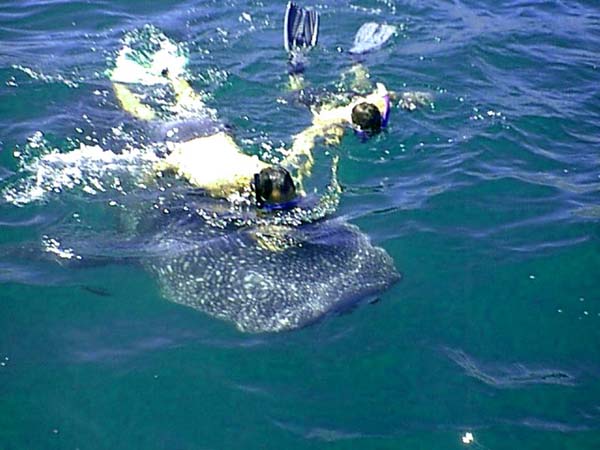
Just off the tip of Mexico’s Yucatan peninsula is a small island largely untouched by tourism, despite its proximity to Cancún. IslaHolbox might go unnoticed entirely, except for some unique visitors who come to its warm ocean waters each summer. Their presence is hard to ignore, since they are 40 feet long and weigh 15 tons. These are gentle whale sharks – not whales at all, despite their size, but actually the world’s largest fish. Docile and unafraid, they allow us to swim close enough to observe the checkerboard pattern of pale yellow dots and stripes covering their thick gray skin.
As we speed to another amazing season at Isla Guadalupe we always spend a few days hunting through old cd's stacked full with images shot by our lucky divers.
In all the years we have been going to this unique site together, we have seen some pretty amazing things. The image you're looking at is one of them.
As far as we know this is the only full shark breach image every captured at I.G...and it was entirely a fluke.
The animals at this pristine site give absolutely no warning when they are going to breach, so it was another extraordinary day when this photographer happened to have her camera resting on the ships rail and this magnificent 14 foot animal came blasting out of the water.
Her finger reflexively hit the trigger and "voila", the perfect shot including the morning sun blazing off this critters belly.
Sometimes being in the right place at the right time can make all the difference. In this case 210 miles off the coast of San Diego-at an island time forgot called Isla Guadalupe.
In our continuing series-The Sharks of Isla Guadalupe we would be missing something if we failed to introduce you to this big gal we call "Scarboard". She's a simply magnificent animal and one of the reasons Isla Guadalupe is so special to us.
What makes "Scarboard" unique are the huge scar patterns on her "starboard side" hence her name. We tend to name sharks by easy names so our crew can quickly identify the animals. Scarboard is about 16+ and well over 2000lbs, she's always followed by a pack of pilot fish.
If you happen to lucky enough to be joining us this season and see a pack of Pilot fish roaming about keep your eyes sharp for this critter, she'll be close behind:
Close to ten days of wall to wall shark media coverage and we still do not know what kind of sharks were involved in these unprecedented attacks.
As far as sharks are concerned knowing what species you're dealing with is 90% of how best to avoid them. IHUATANEJO, Mexico (AP) -- No one could remember a shark attack along this resort-studded stretch of Mexican coast popular with surfers and Hollywood's elite. Many of the large predators had been pulled from the ocean by fishermen. So when sharks attacked three surfers in less than a month, two fatally, it was unthinkable.
The latest attack came Saturday, when a shark chomped down on the arm of surfing enthusiast Bruce Grimes, an American expat who runs a surf shop in Zihuatanejo.
Grimes and a handful of other surfers were out on dark, choppy waters when he felt something lift his board. He managed about five strokes before teeth sank into his arm. "Shark!" he screamed, wresting his arm back. Grimes made it to shore, escaping with a few gashes.
"There wasn't any time to panic," he said. "I thought: 'Don't want to die. Don't want to lose my arm.' "
Only later did the 49-year-old Florida native learn a local surfer had been killed by a shark at a neighboring beach the previous day. Less than a month before that, a visitor from San Francisco, California, was killed while surfing another nearby beach.
Before that, shark attacks were unheard of in Zihuatanejo. University of Florida expert George Burgess was in the area Wednesday interviewing witnesses, going over autopsy reports and checking beaches to find out why the sharks had suddenly become so aggressive.
Bad shark related news from Mexico yesterday as yet another surfer shark attack and death was reported. This time less then 6 miles from a previous fatal attack and death of an American last month.
Incredibly, as we were blogging about that attack, another surfer was attacked in the same area. While environmentalists managed to stave off an all out shark hunt last month up and down the coast...this time we're not so sure they'll be as effective.
ACAPULCO, Mexico -- A shark injured a 49-year-old American surfer Saturday off the Pacific coast of Mexico, in the third attack in a month.
The Mexican Navy deployed personnel to warn people about sharks at beaches in Zihuatanejo, a resort northwest of Acapulco, according to a Navy official who spoke on condition of anonymity because he was not authorized to release the information.
He said authorities have not closed beaches in Zihuatanejo, but people were being advised against swimming. A day earlier (Friday), a 21-year-old Mexican surfer was killed by a shark off a nearby beach. The two attacks came a month after a shark killed a San Francisco man surfing in the same area.
Local Civil Protection director Jaime Vazquez Sobreira said the American attacked Saturday lost his thumb but managed to get to a hospital on his own and was in stable condition. The Guerrero state Public Safety Department identified the man as Bruce Greems but did not give his hometown in the U.S. Vazquez Sobreira said he lived in Zihuatanejo. The U.S. Embassy confirmed an American had been bitten by a shark but did not have additional information.
Mexican authorities used baited hooks to catch sharks last month after the attack that killed 24-year-old Adrian Ruiz of San Francisco. Local conservationists protested the hunt, and it was not immediately clear if authorities would do it again.
Arturo Sabasde la Rosa Camacho, the Guerrero state environment secretary, said the government would hold meetings in Zihuatanejo next week with tourists, environmentalists, shark experts and fishermen to determine what actions to take.
"We need scientific explanations for the shark presence, and if it's because of climate changes," he said.
Cold currents and an abundance of giant squid and other prey may be attracting sharks to the area, said Jose Leonardo Castillo Geniz, a shark expert with the National Fishing Institute. He said a large shark presence was unusual for the region.
Geniz said the authorities should close beaches in Zihuatanejo instead of killing sharks. He also called for aerial surveys to determine what species has been attacking surfers. Aida Navarro, of the environmental group Costasalvaje, urged the government to post warning signs at Zihuatanejo's beaches.
"Killing sharks is not the solution to preventing encounters with humans," Navarro said. She noted that some shark species are under threat from overfishing.