Showing posts with label eco news. Show all posts

Thursday, January 19, 2012

Mercury bioaccumulation in elasmobranchs? Study

Conservation sources have been waging a war on shark products for the past five years saying that shark fins and meat for human consumption are loaded with mercury. Here's another first rate study that backs those assertions up.


 Nicholas Kutil and David L. Taylor.

ABSTRACT:

Mercury (Hg) is a toxic environmental contaminant that bioaccumulates in fish tissues,
including numerous marine species. Cartilaginous fish of the subclass Elasmobranchii are important ecological constituents of marine ecosystems, yet the fate of Hg contaminants in their body tissues is largely unknown.

In this study, four species of elasmobranchs: little skate (Raja erinacea), winter skate (R. ocellata), smooth dogfish (Mustelus canis), and spiny dogfish (Squalus acanthias), were collected from the Rhode Island/Block Island Sound, and the Hg content (ppm wet wt) of white muscle tissue was analyzed using automated combustion atomic absorption spectrometry. Diet and feeding habits for each species were also assessed by stomach content and stable nitrogen (δ15N) and carbon (δ13C)
isotope analyses. Mean Hg concentrations differed significantly among species, with highest
levels measured in smooth dogfish (mean Hg = 0.680 ± 0.107 ppm, n = 15), followed by
spiny dogfish (mean Hg = 0.312 ± 0.034 ppm, n = 44) and skates (mean Hg = 0.110 ± 0.008
ppm, n = 78 and 0.069 ± 0.005 ppm, n = 56 for little and winter skate, respectively). The Hg
concentration of skate muscle tissue did not vary by body weight, suggesting that Hg does
not bioaccumulate in these species.

Conversely, smooth and spiny dogfish bothbioaccumulate Hg with respect to body size, although smooth dogfish have a higher Hgcontent relative to spiny dogfish. The elevated Hg concentration of smooth dogfish may beexplained by their higher trophic level status, as determined from δ15N signatures (meanδ15N = 13.29 ± 0.88, 11.82 ± 0.60, 12.33 ± 0.65, and 12.12 ± 1.06 for smooth dogfish, spiny dogfish, little skate, and winter skate, respectively). The enriched δ13C values of skates and smooth dogfish indicated benthic foraging (range of mean δ13C = -16.39 ± 0.32 to -17.42 ±0.46), which was further confirmed by the dominance of decapods and crustaceans in the
stomach contents. Conversely, squid and butterfish were the principal prey of spiny
dogfish, and the contribution of these pelagic prey was reflected in the depleted δ13C
signature (mean δ13C = -21.97 ± 0.83). Future work includes researching the effect habitat
use and prey Hg to better understand bioaccumulation patterns in these species.


Presentation at the 2012 Winter Meeting of the Southern New England Chapter (SNEC).

January 26, 2012

University of Rhode Island
SOURCE and PDF-DOWNLOAD

Tuesday, December 7, 2010

Conservation Video Done Right

Hat Tip to Mark and to Mike for passing this first rate video around. Opening eyes and changing perceptions is what this latest video is all about.

If there was an award for this kind of front line reporting and presentation fact, the team behind this video would get it. Perhaps we should start with something like this?

Sit back and ab-sorb this, once you're done we defy you not to want to "grab a flight to join the fight".


Wednesday, September 29, 2010

BBC tackles shark finning in Mozambique

In the Indian Ocean, as elsewhere in the world, shark fishing has been increasing at an alarming rate with tens of millions being caught each year worldwide. Visiting a small community in Mozambique, where shark fishing has only recently become an established practice, Philippe Cousteau Jr and his team discover what is driving the trade:

Saturday, January 30, 2010

Ocean Dancer Supports Maldives Shark Research - Smart

Ocean Dancer is 110' of pure luxury and is a labour of love for French owner/operator, David Mesnard who has lived in the Maldives since 1990.

David is a highly regarded Free-diving and Scuba Dive Instructor and also a keen surfer. In his time in the Maldives he has witnessed dramatic changes to the marine environment. Changes that made him realise he needed to do something to help the oceans flourish again.

The MWSRP team first met David and Gaëlle at South Ari Atoll, in December 2008 when they ended up in the water together on what the research team thought to be a whale shark.

A large dark fin had breached the surface amongst a few tourists close by, so the MWSRP sent two team members in to take the ID photographs required to log the encounter. As the guys approached the ‘shark' they were not greeted by the usual large dark shape emerging from the plankton rich water. Instead, David, on scuba gear, was cruising around at around 5 metres, holding a fin he had carved from wood and painted black. The ocean loving French man then surfaced, removed his regulator and took great pleasure in his fooling of the ‘whale shark researchers'.

Ocean Dancer has always supported shark conservation programmes. Now they have become the MWSRP's newest sponsor, and the team is ecstatic to have them onboard. David and his wife Gaëlle are true ocean lovers. They, along with expert crew, are the shark friendly tour operator who encourages their guests to enjoy their holiday responsibly.

For more information about Ocean Dancer please visit here.

Thursday, January 21, 2010

Hammers in Love?

Swim at Your Own Risk blog got the scoop from Perth yesterday featuring a video shot from the air of Hammerheads schooling off the coast.

Local experts think this is high seas shark love in action.

We'll let you decide.

Video Here.

Monday, December 28, 2009

Australia's Tiger Shark Disaster

Tony Ham is happy about it. Vik Hislop is happy about it, and even Queensland Tourism is happy about it.

For Australia when 11 Tigers are killed by nets and drumlines along the Sunshine Coast the media calls it a good thing.

We have long pointed out that nets and drum lines are a 1950's answer to a modern issue of shark conservation.

4 meter Tigers represent breeding populations and their deaths are no cause for celebration.

The only thing in the way of lasting conservation change with drum lines and nets is the will power of local and regional users to demand it.

We know sharks are being taken by these man made, indiscriminate killers, but what is being done about it?

We'll be the first to support any program that offers regional metrics for success and not just the usual rounds of blog posts and Facebook petitions. As far as shark conservation goes there's little time for "awareness" we have now moved into the "decade of action."

Surely there has to be someone on the Sunshine Coast that would like to see an end to the glorification of regional and unnecessary shark slaughters?

Monday, December 14, 2009

Changes to Fisheries Laws - Florida

An extraordinary and diverse group of conservationists, divers, and shark people banded together to effect a change in shark fisheries along the coasts of Florida this year. Kudos to the effort.

We got the final synopsis from Guy Harvey this week:

On December 10th, the Florida Wildlife Commission approved new measures aimed at protecting several distressed shark populations in Florida state waters. Beginning in mid-January 2010, the harvesting of sandbar, silky and Caribbean sharpnose sharks is prohibited within state waters. These species are either currently being overfished or are in danger of being overfished.


In addition, the FWC implemented several other protective measures, including 1) the prohibition against the removal of shark heads and tails at sea, 2) a rule allowing for only hook-and-line gear to harvest sharks and 3) the establishment of a minimum fork length on several shark species.

Another encouraging development at the Dec. 10th meeting was the proposal of a rule that would prohibit both recreational and commercial harvest of lemon sharks from state waters. Lemon sharks are especially vulnerable to overfishing, so conservationists – including representatives of the Guy Harvey Ocean Foundation – have been lobbying the FWC for some time to adopt more aggressive protective measures for lemons. The FWC will hold one more public meeting on this proposal before putting it to a final vote.

All in all, the Dec 10th meeting of the FWC was a great day for shark conservation efforts in the state of Florida. Many thanks to the FWC for taking a leadership role in the protection of our marine ecosystems!

For more information about the new rules, and to view the presentations on shark management and lemon sharks that were used at the meeting, see the official FWC press release published on the FWC web site.

Cheers!


Additional in depth look into Florida shark fisheries here from the Paxton Blog.

Monday, November 9, 2009

SSACN Searches for Shark Officer

The Scottish Shark Tagging Programme is delighted to announce they have been awarded a funding package worth £52,000 to help support their data gathering on species of sharks, skates and rays found in Scottish waters, many of which are at risk.

The funding has been offered by Scottish Natural Heritage (SNH) and the Argyll and the Islands LEADER Programme and will be used to employ a Shark Project Officer who will work with SSACN to further develop the Scottish Shark Tagging Programme (SSTP – www.tagsharks.com) whose objectives are to :

  • Record data on shark, skate and ray species
  • Increase public awareness
  • Highlight the need for species protection
  • Encourage use of “codes of best practice”
  • Showcase conservation methods and efforts

Project Director Ian Burrett "SSACN has long campaigned for programmes aimed at regenerating the stocks of Scotland’s sharks; unfortunately the government and fisheries managers say they are unable to act as they say they lack the necessary scientific data and have no programme in place to gather it."

“Thanks to our funding partners and the many anglers who support our efforts, we shall be gathering that data for them.”

Tagging is the only non-destructive means of gathering the necessary data. It will be undertaken by volunteer sea anglers – fishing from the shore, kayaks or boats – who will catch, tag and release various shark, skate and ray species, either as part of their normal fishing trips or during major tagging events coordinated by the Shark Project Officer and SSACN.

The duties of the Shark Project Officer will also include arranging training workshops for anglers and raising awareness of Scottish sharks, skates and rays by liaising with fishermen, and visiting schools in Argyll.

Jane Dodd, SNH Marine Project Officer for Argyll and Stirling said: “We are hoping to recruit a dynamic project officer to lead this exciting project. Someone with project management skills and at least an interest in sea angling and a willingness to do some boat based field work. Quite an unusual range of skills to be found in a single person but we have our fingers crossed that he or she is out there!


Thursday, November 5, 2009

Tagging Disaster at Farallons - Foul Hooked Media

For the past few days we have been receiving an ongoing series of emails and phone calls from a variety of sources concerning an invasive SPOT tagging effort at the Farallon islands.

There was an apparent "tagging accident" this week covered in graphic detail by Bohemian Magazine.

SPOT tagging is a white hot issue within both the commercial shark diving community and shark research community. The SPOT tagging technique employs crews to catch white sharks with large hooks and to drill tracking tags into their dorsal fins.

A person identified as "Chris Fischer, owner Mothership Ocean, Expedition Leader," has been refuting and then negating the seriousness of the alleged tagging accident by responding to question asked of him by posters at this blog:

"On the anchor at the Islands now. Happy to report in that the first shark has pinged in 4 times and seems to be doing well. The second shark has also pinged in. Both are still in the area."

"We hooked two sharks this week. We were concerned about the first shark because the hook was a little deep. It was in the back of it's mouth, not gut hooked. We were able to cut the hook in half so it could roll out backwards, and left a part of it in the shark."

The Making Of Media Disasters

This is a classic example of a media disaster in the making for the tagging team at the Farallons and one that could be addressed by getting ahead of the negative and extremely graphic media that is surfacing around this incident.

Two issues need to be addressed immediately.

1. The full extent of the tagging mishap. Images, video, and a full accounting of this event as it transpired with nothing held back.

2. The role film and television productions had in this event if any.

The event was witnessed, photographed, and video taped by multiple sources so it cannot be hidden or downplayed. At stake is the reputation of a well known shark researcher and National Geographic television show about this teams tagging work set to air Nov 16, 9pm Est/Pacific.

The tagged shark is said to be "doing well" by this team. With the abject lack of transparency about the mishap to date we're now asking for "proof of life" to be added to the media list with the inclusion of a recent tracking map of all animals tagged including the first one.

This data should be independently verified by resident shark researchers from TOPP.

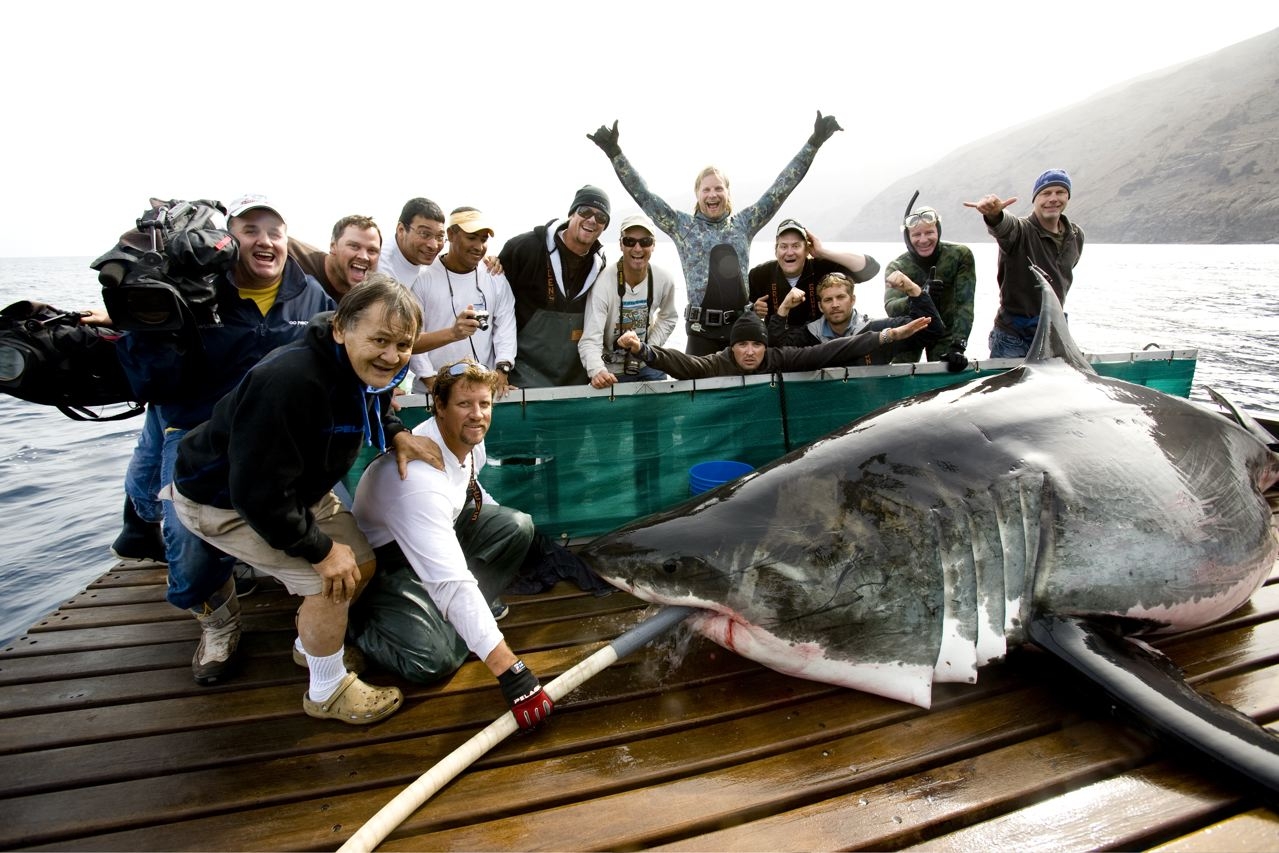
In a moment of media foresight this week we pointed to the unprofessional image of this group "high fiving and smiling" around a grounded shark at Isla Guadalupe and suggested "in the end these images will dog your continuing efforts for years to come."

Shark researchers have as much responsibility for media handling as any group that interacts with charismatic mega fauna and in the case of the team at the Farallons doubly so. We're not the only ones to point this out see also Mark Harding has a point.

Media transparency surrounding this event is critical for the sake of continued research with white sharks and for the public perception of invasive techniques for animal science.

Monday, November 2, 2009

Duncan Brake, Jillian Morris - Shark Free Marinas

The Shark Free Marinas Initiative concept was created by the tragic death of a 15 foot Tiger shark in the Bahamas. We have posted about the power of "One Shark" to become the ambassador for an entire species. To make that happen ordinary people need to be engaged to effect conservation change.

The Shark Free Marinas Initiative sought ways to stop the ongoing slaughter of breeding aged sharks worldwide without becoming entangled in the often byzantine bureaucracy of local governments.

The initiative also looked at ways of empowering locals to take charge of their own regions, to become involved and to become conservation minded.

Lastly, the initiative looked at ways that local business could become green and promote that as a business selling point.

Nowhere are the three main goals of the Shark Free Marinas Initiative more aptly displayed but in the Bahamas and Fiji. This week Duncan Brake and Jillian Morris from Oceanic Allstars, both regional ambassadors of the SFMI in the Bahamas, produced an outstanding PSA for both the SFMI and for Bimini Sands Resort - the very first Bahamian Marina to adopt the SFMI.

Weaving the SFMI concept together brilliantly as a sales and conservation PSA, Oceanic Allstars have shown themselves to be savvy marketers of solid conservation PSA's.

After discussions with Luke Tipple, the Director of the SFMI, it was decided to invite Oceanic Allstars as our official PSA source for our entire marina directory. Now all marinas seeking PSA's for their marketing and sales have a direct and proven source to produce those PSA's.

Kudos again to both Duncan and Jillian for their tireless work as a regional ambassadors.

The Shark Free Marinas Initiative is a "people powered conservation concept." Along with Stuart Gow and Da Shark in Fiji the SFMI has grown exponentially.

Sunday, July 19, 2009

How Sinking Cruise Ships Save Whales

After a series of disastrous cruise ship sinkings and recent vessel groundings the United Nations Antarctic Treaty System is poised to set new limits on vessels operating in Antarctica.

The news rules will ban heavy oil and require vessel hull strength to be doubled.

In a strange twist of fate two of Japans whaling fleet vessels will no longer meet these new requirements and will presumably be banned from Antarctic waters, shutting down whaling for the first time in 20 years.

Presumably, as Japan also has political strength within the U.N.

Full Story

Thursday, July 16, 2009

Alaska's Got "The Goo"

The image you are looking at is "biological" and simply massive in size, currently floating through the Chukchi Sea between Wainwright and Barrow.

Known as "The Goo" scientists and Coast Guard officials do not have a clue to what this 25 mile slick is:

Nobody knows for sure what the gunk is, but Petty Officer 1st Class Terry Hasenauer says the Coast Guard is sure what it is not.


"It's certainly biological," Hasenauer said. "It's definitely not an oil product of any kind. It has no characteristics of an oil, or a hazardous substance, for that matter.

"It's definitely, by the smell and the makeup of it, it's some sort of naturally occurring organic or otherwise marine organism."

Something else: No one in Barrow or Wainwright can remember seeing anything like this before, Brower said.


Complete Story

Friday, June 26, 2009

Op Ed - Ireland Shark Kill

We have been following the eco blow back of a single, record Six Gill take, off the coasts of Ireland this week. When one dead shark becomes an ambassador for change.

Today another pro shark Op-Ed appeared in The Independent summing up the issue of sport take sharks.

Killing a majestic shark just for the ego-massage is plain wrong
By Ian O'Doherty

Friday June 26 2009

So, here's the deal. You like fishing, and while on holidays in County Clare you go out onto the water and before you know it, you get a bite. A big one, maybe even the biggest you've ever had.

So, after hours of battling the beast, you finally reel it in -- and discover that you've just nabbed a record-breaking half-tonne, six-gill shark.

They're incredibly rare off our waters and, for catching it with just a rod and line, Swiss angler Joe Waldis certainly deserves respect.

But to then have the shark killed so he could take it ashore and massage his ego by having his picture taken with this majestic creature was utterly despicable; a classic illustration of what happens to animals when man's ego crosses their path.

It's ironic that Waldis should land the fish in the same week that the International Union for the Conservation of Nature issued an alarming report warning that up to a third of the world's sharks and rays face imminent extinction due to over-fishing and the truly barbarous practise of 'finning'.

As shark fin soup continues to be a prized delicacy in Japan -- where, like just about every other food item they eat over there, it's seen to have aphrodisiac qualities -- thousands of sharks are caught every month.

When they're dragged aboard, their fins are sliced off and then the shark, still alive and in unbelievable pain, is unceremoniously dumped overboard, where it corkscrews down to the bottom, promptly drowning.

And, frankly, there is no difference in what those charming Japanese do to defenceless sharks to what Waldis did.

I'm certainly no vegetarian; indeed I'm a proud carnivore.

And when that creature is as rare and endangered and beautiful as a six-gill, it should be a crime to kill it simply to take a picture of the carcass.

Terrifying and majestic, these incredible creatures have a virtual stranglehold on the imaginations of millions, largely, but not entirely, down to Spielberg's classic Jaws.

That film seared itself into the psyche of several generations and, personally, still remains my favourite film of all time -- the pull shot focusing on Brody's face when the Kintner boy is attacked is still one of best pieces of cinematography in modern cinema history -- and it is certainly responsible for captivating millions of people.

After all, everyone's afraid of the dark and it doesn't get darker than the ocean depths and the creatures concealed within.

The irony of the success of Jaws, both the book and the movie, is that it led to the slaughter of tens of millions of sharks, as idiots everywhere decided they were going to become real-life shark hunters like Quint.

It was a situation which haunted the author, Peter Benchley, who then spent the rest of his life fighting for shark conservation.

The guilt of the unintended consequences of his actions virtually broke the man and, before his death from cancer when he was asked what his biggest regret was, he replied, tragically: "Writing Jaws."

The irony of being haunted by his most famous creation wasn't lost on him, and he spent his life spending the millions he made from the book and movie on shark conservation programmes in a desperate attempt to try and absolve himself of some of the crushing guilt he felt every day.

When asked about the possibility of an updated version of the film, he once commented: "Well, the shark could not be the villain; it would have to be the victim, for sharks are much more the oppressed than the oppressors.

"Interestingly, Ireland is one of the finest shark fishing spots in the world, with the nutrient-rich waters off our West Coast regularly attracting large Blues and Makos.

And earlier this month, there were rumours of a Great White being spotted off Cornwall.

So, when you consider that Whites have been found in the Bay Of Biscay, there's no reason why they shouldn't make it as far as Cornwall. And, if they can get as far as Cornwall then there's no reason why, much to the excitement of Irish shark lovers, they couldn't make it to our waters.

But I would fear for any Great White which would swim through our waters -- you can imagine the media hysteria, the panicked calls to Joe Duffy from parents who are afraid to let their precious children into the water and the general lack of composure that seems to afflict most people when the word 'shark' is mentioned.

But it's not just sharks that are needlessly killed.

Only a few months back, the papers were full of pictures of a woman who had paid to go to Zimbabwe so she could fulfil her rather odd ambition -- to kill an elephant with a bow and arrow.

The pictures of Teresa Groenwald-Hagerman proudly standing over the corpse of that once proud creature, beaming smugly at the camera holding the bow and arrow thankfully blew back into her face and it wasn't long before her personal details were up online and she was bombarded with thousands of abusive emails.

Despite what the lunatics in groups such as PETA would have you believe, there's nothing morally wrong about hunting for meat.

We are, after all, carnivores and are top of our food chain -- as sharks are in their environment.

But if you're going to kill something, kill it for the pot.

Anyone who kills something as beautiful as a shark simply for the ego massage is, frankly, a bit of a bastard.

And bags me first into the water if we ever do see a Great White off our shores ...

iodoherty@independent.ie

- Ian O'Doherty

Saturday, June 6, 2009

Sea Shepherd - Throwing Rocks For Media

Sea Shepherds ongoing international disappointment continues as a recent media tirade slammed South Africa's Marine and Coastal Management (MCM) officials who are now being labeled as "bloodthirsty tyrants" and "mad-dog killers".

Their crime, according to Sea Shepherds titular head Paul Watson, was the unfortunate mass euthanasia of a pod of beached whales.

Watson, whose organization circulated the media tirade, has called MCM a "disgrace to the nation" and said MCM official Mike Meyer had carried out a "savage, merciless, cold-blooded massacre".

Wait a Minute!

This is the same Sea Shepherd who just a few months ago was embroiled in a completely faked whale saving news story that this blog uncovered and then covered again as the story unfolded to its sad conclusion.

Sea Shepherds "Vanessa Pearce" claimed on national news that Sea Shepherd crews were actually on site of a mass Sperm whale standing in Tazmania. She went as far as claiming that Sea Shepherds vessel the Steve Irwin was on site with "actual whale saving gear" but was turned away by Park Rangers leaving the animals to suffer while shadowy figures used chainsaws on recently dead animals.

The entire story turned out to be bogus, but this is Sea Shepherd a direct action eco org that revels in throwing media bombs to maximum audience exposure and little effect.

At the recent tragic stranding in South Africa nothing could be done to save these animals from of lack of resources, ocean conditions, and time. It is to be noted some 120 local volunteers heroically tried to save whales in icy and rough conditions - to no avail. South Africa's Marine and Coastal Management staff are not "bloodthirsty tyrants" and "mad-dog killers" as Paul Watson has publicly charged. They made a tough decision, in tough conditions to put long suffering animals out of misery.

That takes guts, and foresight.

Perhaps Watson and company should spend less time throwing media rocks at glass houses and actually invest in that hypothetical "whale saving gear" his staff claims on Nine-MSN Tazmania to have on board the Steve Irwin.

They could have used it in South Africa recently.

Demand more from your eco org.

Thursday, May 14, 2009

High as a Kite - Climate Change

Where would we be without U.K's award winning daily newspaper - The Sun?

The only news outlet on the planet daring enough, maverick enough, to expose the true face of global warming.

Staring journalistic excellence in the face and not blinking today's Sun exposed the horrors of Sarpa salpa, a small non native fish that will get you higher than a mouthful of Australian Cane Toads in June.

Yes, this native of South Africa has invaded the U.K and now residents are fearful of techno-clubbers with fish hanging out of their mouths, staggering about like Zombies in the dead of night. It could happen.

Fine journalistic excellence known no bounds, you have to go where the story is...thank god for folks over at The Sun for breaking this story. Makes you want to go out and purchase an electric car...but leave your sarcasm at the door.

Sunday, March 29, 2009

Hot Manta Passion - Warning Graphic

It had to happen, eventually. Since 2000 the numbers of divers entering the ocean with cameras has grown exponentially. Thus the chance encounter with two animals enjoying a "moment of bliss" was bound to happen. In this case, turns out these critters are even more graceful when caught in flagrante delicto:

This video footage shows the mating and copulation of manta rays (manta birostris). Shot in HDV 1080i in Rangiroa, French Polynesia. It is the first time that such behavior was filmed in wildlife.

Further information also at:www.underwatercam.tv

Friday, March 27, 2009

Iron CO2 Experiment - Damn Copepods!

What happens when you "seed" a 300 sq km patch of ocean with iron dust?

If you're a scientist you hope it will spur on algae growth and absorb vast quantities of CO2...at least that's what you hope.

Researchers in the southern ocean did just that this month and, as hoped, algae did bloom, but it was quickly digested by non CO2 absorbing Copepods and other marine life that eat algae. BBC News has some great coverage.

Now if we could only get rid of the damn Copepods with the addition of genetically modified fish?

Thursday, March 5, 2009

1000m White Shark - Shark Geek Cool

Let's channel our "inner shark geeks" for a moment and savor the news coming out a small and dedicated group of White shark researchers off Stewart Island, NZ this month.

Data coming back from a series of shark tags are showing these remarkable animals diving to 1000m or 3280 feet:

Up to 70 per cent of the time they are near the surface but this winter one of the whites dived. "We've got what we think is a world record of 1000 metres for a white shark."

They believe it would have gone after a giant squid or phosphorescent fish. At that depth it would be pitch black and the white would have been guided in by the fish glow. A tag on a white shark popped up off Mana Island but its data was partly corrupted. The shark had been north to the tropics for winter and had come back in summer.


Three of six sharks tagged at the Chathams were found to have swum 3000km north to Tongatapu, the main Tongan island.


And you wonder why we love shark science so much?


Complete Story.

Monday, March 2, 2009

The Tasman Question - Stranding Whales

Rescuers are once again frantically at work trying to save stranded whales in Tasmania. This year over 400 whales have stranded. While not uncommon in the region local rescuers are beginning to say this years standing levels are much higher than normal. These are also cross species stranding events involving sperm whales, pilot whales and even dolphins.

Being a shark blog we rarely cover whales - over 400 animals in five months seems like a lot of animals to us making this noteworthy. For more information about Tasman whale stranding and local efforts to help them go to WILDCARE Inc.

Friday, February 27, 2009

Sea Shepherd - Your Money, Farley Mowat

We have been active critics of Sea Shepherd for the past year. What prompted our sudden reversal from donors and supporters to critics, was the realization that Sea Shepherd was wasting our money by Wagging the Conservation Dog.

When you support an eco org you expect results. Your money stands in your stead to effect change, and Sea Shepherd skillfully plays the "results card" when courting donors. From self generated arrest warrants for the entire Japanese whaling fleet, to quotes on websites and in public interviews, Sea Shepherd claims they will protect and save wildlife.

SSCS are well practiced at the trigger wording for well meaning eco donors.

The ugly fact is for the past 31 years Sea Shepherd has failed to stop whaling, the Canadian seal hunt, and shark kills. While other eco orgs have moved wildlife agendas forward and gained legitimacy with world opinion, Sea Shepherd has all but painted itself into a radical corner with fewer governments supporting them and fewer ports to call on.

Sea Shepherds trail of titanic financial missteps and its headlong rush to irrelevance is the direct result of insular 1970's eco thinking, poor judgment, and poor use of new media where the public backlash is immediate and unforgiving.

Case in point Sea Shepherds other "eco enforcement vessel" the Farley Mowat. You do not hear about this multi million dollar debacle because Sea Shepherd has all but abandoned this vessel in Canada, after once again being absolutely ineffective with the ongoing Canadian seal hunt.

The financial loss of this vessel to Sea Shepherds donors is staggering. Currently the Canadian government is demanding well over 3 million dollars in fines from Sea Shepherd and this week put the entire vessel up for auction. Two crew members will be back in Canadian courts in April running up untold and unmentioned legal bills.

These are your dollars being wasted for an unchanging 1970's eco policy and an agenda that went nowhere once more in 2008. Seals are being killed again this season.

As we started to look into Sea Shepherd one other revelation came forth. Sea Shepherd is good at one thing, media and grabbing attention. This is what initially attracted us and many others. Unfortunately the blow back for Wagging the Conservation Dog is literally sucking all the air out of the room.

Legitimate eco orgs are finding it increasingly difficult to get equal media time and financial donations on pressing issues like whaling, sharks and seals. Your financial contribution to Sea Shepherd not only fails to effect change - but damages the global eco movement as well.

Great discussion on this topic here