The most popular farmed fish species in Taiwan may soon help save endangered sharks.
It turns out that the caudal fins of Taiwan tilapia -- a hybrid of Oreochromis mossambicus and Oreochromis niloticus niloticus
-- can replace shark dorsal and pectoral fins in the highly
sought-after shark fin soup, said Wang Yi-feng, general manager of the
Kouhu Fisheries Cooperative in Yunlin County and a Taiwan tilapia
expert.
Just over a year ago, Wang began studying how to turn tilapia tail fins
into something very similar to processed shark fins. Tilapia fins are
already on the market as a substitute and their increasing popularity
could lower the demand that has been driving the overfishing of sharks, Taiwan Today reports.
“Caudal fins of Taiwan tilapia are a perfect stand-in for shark fins
because they have the same appearance and texture,” said Wang. “Most
importantly, the fact that Taiwan tilapia is a farmed fish guarantees
stable supplies of the delicacy, which could prevent sharks from being
wiped out.”
Just like shark fins, tilapia fins are made up primarily of cartilage,
which is flavourless but has a desirable chewy consistency, Wang
explained.
As opposed to shark fins, which can be extremely harmful due to the high
levels of mercury accumulated by sharks, Taiwan tilapia fins pose no
threat of heavy metal poisoning, he explained.
Founded in 1997, the Kouhu Fisheries Cooperative is made up of more than
200 fish farm operators from three southern Taiwan counties with a
combined pond area of 2,300 ha, and represent a fourth of the country’s
total tilapia farming area. Wang specified that the cooperative is
Taiwan’s largest exporter of frozen tilapia fillets and also runs in
compliance with European Union (EU) food standards while offering
traceable product resumes.
Notably, shredded fins cost around USD 120 per kg -- one-quarter the
cost of shredded shark fins. However, tilapia fins can only be used
shredded because they are much smaller than shark fins, Wang pointed
out.
The product is becoming increasingly trendy in Hong Kong, Japan and many five-star hotels in Taiwan.
Currently, the Tilapia fins’ monthly output stands at 1 ton, but this is
expected to double or triple by next year to meet growing market demand
now that the manufacturing process has matured, Wang said.
“I believe there is great market potential for tilapia fins and I’m confident that consumers will love them,” he added.
Wang is now researching the use of hyaluronic acid extracted from the
crystalline lens of the Taiwan tilapia eyes to create cosmetic
products.
Content source FIS.
Tuesday, November 8, 2011
Sunday, November 6, 2011
Dive Sentry - See it. Report it.
1.2 million active divers from around the world are the eyes and ears of Sanctuaries, set aside areas, and Bio-Spheres.
In the beta testing phase.
The main two elements of this initiative will allow divers to anonymously post fisheries violations from around the world to a central RSS media site which in turn allows the major media, conservation groups, and secondary media (blogs, You Tube) free access to all images, content, and video of violations.
The second element will automatically email regional authorities submitted violations including images and video in english and the native language. Reports will automatically be paired to Google Earth coordinates for ease of tracking.
Dive Sentry is fully integrated on primary social media platforms and has a beta iPhone app that allows divers to upload video, content, and images automatically.
Dive Sentry enguages the major media with fresh global conservation content daily.
Dive Sentry provides a timeline and archive for regional repeat violations in a public format.
Dive Sentry engages regional agencies responsible for fisheries protections and mgmt automatically.
Dive Sentry - See it. Report it.
1.2 million active divers from around the world are the eyes and ears of Sanctuaries, set aside areas, and Bio-Spheres.
In the beta testing phase.
The main two elements of this initiative will allow divers to anonymously post fisheries violations from around the world to a central RSS media site which in turn allows the major media, conservation groups, and secondary media (blogs, You Tube) free access to all images, content, and video of violations.
The second element will automatically email regional authorities submitted violations including images and video in english and the native language. Reports will automatically be paired to Google Earth coordinates for ease of tracking.
Dive Sentry is fully integrated on primary social media platforms and has a beta iPhone app that allows divers to upload video, content, and images automatically.
Dive Sentry enguages the major media with fresh global conservation content daily.
Dive Sentry provides a timeline and archive for regional repeat violations in a public format.
Dive Sentry engages regional agencies responsible for fisheries protections and mgmt automatically.
Dive Sentry - See it. Report it.
CNN Sharks: From predator to prey
Shark Diver was asked to help CNN this summer with an investigative report into the state of sharks.
The team, featuring CNN's Kaj Larsen, was introduced to the sharks of the Bahamas by Luke Tipple the Director of the Shark-Free Marinas Initiative. The Bahamas remains one of the most forward thinking governments in the Caribbean when it comes to sharks, conservation, and commercial shark diving efforts.
This is why we do conservation pieces for sharks and when it comes to shark conservation media it doesn't get much better than this. Kudos to everyone who worked on this piece:
The team, featuring CNN's Kaj Larsen, was introduced to the sharks of the Bahamas by Luke Tipple the Director of the Shark-Free Marinas Initiative. The Bahamas remains one of the most forward thinking governments in the Caribbean when it comes to sharks, conservation, and commercial shark diving efforts.
This is why we do conservation pieces for sharks and when it comes to shark conservation media it doesn't get much better than this. Kudos to everyone who worked on this piece:
Saturday, November 5, 2011
Rookery Bay National Estuarine Research and Jeff Corwin
NAPLES --
Shark research at the Florida Department of Environmental Protection’s
(DEP) Rookery Bay National Estuarine Research Reserve (NERR) will have
the national spotlight tomorrow in a segment of Ocean Mysteries with
Jeff Corwin. The new production, launched jointly by the Georgia
Aquarium and Litton Entertainment, is part of the Litton Weekend
Adventure Saturday morning three-hour educational programming block on
ABC. The shark research episode, featuring RBNERR’s fisheries biologist
Pat O’Donnell, along with Mike Hyatt and Paul Anderson, PhD., two of the
other researchers involved in the study, is scheduled to air tomorrow
Saturday, Nov. 5.
“We
are thrilled that the Rookery Bay is being recognized in this
production,” said Rookery Bay NERR Manager Gary Lytton. “Millions of TV
viewers nationwide will have a great opportunity to learn more about
sharks and the importance of mangrove estuaries as shark nurseries
through our collaboration with Corwin and the Georgia Aquarium.”
Five
years ago, Rookery Bay NERR’s long-term shark monitoring program caught
the attention of Florida Aquarium veterinary staff working to improve
captive shark handling techniques. Subsequently, Rookery Bay NERR
entered into a cooperative research effort with the Florida Aquarium,
the Georgia Aquarium and Shedd’s Aquarium in Chicago. The collaborative
shark stress response project required access to wild-caught sharks,
such as those encountered monthly in RBNERR’s project.
As
production plans got underway at the Georgia Aquarium for Ocean
Mysteries, the Rookery Bay shark capture project became the perfect
opportunity to put Corwin in close contact with wild sharks. Filming
took place aboard a Rookery Bay NERR research vessel in the Ten Thousand
Islands in August 2011. The crew encountered four sharks: two
lemon (Negaprion brevirostris), a bonnethead (Sphyrna tiburo) and a
blacktip (Carcharhinus limbatus). While the cameras rolled, the sharks
were measured, weighed and had other data recorded before being tagged
and released with Corwin’s assistance and enthusiastic explanation of
their significance to the ocean ecosystem.
Programming times vary during the Saturday morning Litton’s Weekend Adventure on ABC. Check your local listings.
Friday, November 4, 2011
Shark Fishing with Shotguns?
Yup, once more You Tube has provided us an ugly window into the grunt filled world of lower organisms and the manner in which they fish:
Thursday, November 3, 2011
Hagfish vs Shark - Cool Video
So we all know the Hagfish as a disgusting relic of the Devonian era. They are basically the critters who will consume your mortal remains should you be unfortunate enough to perish at sea.
But there are other deep water critters who also vie for that honor as your mortal remains sitting down at 2000 feet represent a veritable cornucopia in the desert like environment of the cold dark deep.
To combat this underwater arms race and to not become part of the movable feast, Hagfish have developed a unique slime that until very recently researchers didn't know a lot about.
The following video aptly reveals the Hagfish defense mechanism when a deep water shark shows up and thinks it will make an easy meal of the eel like critter it has just discovered at a research bait station.
Great stuff and kudos to the team behind the video from Australia:
But there are other deep water critters who also vie for that honor as your mortal remains sitting down at 2000 feet represent a veritable cornucopia in the desert like environment of the cold dark deep.
To combat this underwater arms race and to not become part of the movable feast, Hagfish have developed a unique slime that until very recently researchers didn't know a lot about.
The following video aptly reveals the Hagfish defense mechanism when a deep water shark shows up and thinks it will make an easy meal of the eel like critter it has just discovered at a research bait station.
Great stuff and kudos to the team behind the video from Australia:
Labels:
cool video,
hagfish,
slime hag,
underwater feast
North Shore pro surfer Jamie O’Brien needs a media team - and a condom
![]() |
| Raising awareness? |
Folks, we have said it before and will say it again, there's something wrong with the media message out there.
First a bit about this image.
Pro surfer Jamie O’Brien is trying to get folks to understand Fibropapillomatosis which is causing an epidemic amongst sea turtles.
Fibropapillomatosis is most likely caused by a herpes-type virus.
He chose this image of him engaged in a sex act with a turtle, no wait, he was just riding the turtle, no, it's a sex act, to convey the conservation message.
Really?
This is on par with, if not as moronic as, recent media hits that were meant to convey important conservation messages such as:
1. Playing a guitar underwater while crooning to white sharks in a protected Bio Sphere Reserve. The message was, "white sharks are not dangerous." Since that video there have been 6 fatal white shark attacks and 11 non fatal predatory events on surfers and divers worldwide.
2. Holding up pizza box lids with lip stick on them to convey complex messaging about shark nets in South Africa. Since that media image over 2000+ sharks have been killed in shark nets all over the world.
3. Placing billboards at recent shark attack sites with the message, "Payback is Hell". We're not even going to go there.
The list goes on.
It's not like we don't know media messaging and complex conservation management. We have been involved in it for the past decade and while images like this one with Jamie O’Brien elicit giggles, web traffic, and a bunch of kudos from your particular tribal group, they don't last, and ultimately they are not effective.
You want to save turtles? This is not the way to do it.
But that does not stop folks from trying. Media messaging is as complex as the issue you are trying to get across and you have to play to a much wider audience than just the folks who reside in your smart phones contact list. It's a point that seems obvious but far too many within the conservation community miss it time and again.
Hits on a You Tube videos do not translate into conservation laws. Quasi-sex turtle images do not translate into grants and funds for long term studies. Awareness is not worth a dime unless it translates, and translate into something that will actually help.
Conservation messaging needs to be done without the "stupid pet tricks with wildlife."
We can do better than we are with smarter messaging that actually translates into conservation gold.
Highlight the issue. Create the solution. Translate into action.
Labels:
condom,
fish sex,
Jamie O’Brien,
media messaging,
sex,
sex tape,
sexual healing,
turtle sex
Wednesday, November 2, 2011
Himalayan Griffon Vulture vs Russians
You know, occasionally we break format here at the Shark Diver Blog to bring you something that defies description, fortunately for you there's a video.
Welcome to Russian para-gliders vs Himalayan Griffon Vultures, a smack down that will leave you wishing you understood Russian swearwords:
Barry Bruce and Russell Bradford CSIRO Industry Study
The effects of berleying on the distribution and behaviour of white sharks, Carcharodon carcharias, at the Neptune Islands, South Australia, August 2011
Research Summary
A study by Barry Bruce and Russell
Bradford of the CSIRO Wealth from Oceans Flagship for the Department
of Environment and Natural Resources South Australia
Cage diving at Neptune Islands
Seas and sealions (pinnipeds) form part
of a white shark’s annual diet, and sharks may spend from days to
months per year at pinniped colonies. Between these visits they travel
to other locations seeking other sources of prey. They can swim
thousands of kilometres, from temperate to tropical waters, and across
the open ocean during these annual travels.Pinniped colonies that are regularly visited by white sharks can be ideal for shark-viewing tourism. White shark cage diving activities are established near to such pinniped colonies in South Africa, Mexico, California and Australia.
In Australia, white shark cage diving occurs only at the Neptune Islands Group Marine Park (60–70 km south of Port Lincoln, South Australia) comprising the North and South Neptune Islands.These islands host Australia’s largest pinniped aggregation.
Commercial tour operators involved in white shark cage diving must be licensed under the National Parks and Wildlife Act 1972 and, if berleying to attract sharks, must have an exemption under the Fisheries Act 1982.
Berleying practices
In South Australia, shark cage diving
provides an opportunity to view white sharks in their environment.The
sharks are commonly attracted to the viewing vessel through the use of
berley (chum), a mix of chopped or minced fish and fish oil.
Berleying attracts sharks that are already present in the area to the
shark cage-dive vessel and increases the chances of a shark being
seen.
Increased frequency of berleying
The shark cage diving industry has
worked under a Code of Practice since 2004 to ensure that its
operations minimise negative impacts on sharks. Permit requirements
also restrict the type of berley than can be used to fish-based
products only and these products must be kept refrigerated prior to
use.Days of berleying activity in the SA shark-cage diving industry had remained reasonably stable at an annual average of 128 days from 2000 to 2007. However, the number of days of berleying activity at the Neptune Islands significantly increased after 2007, reaching 270 days in 2009–2010. Berleying activity increased over this time both within the main bay at North Neptune Island and at a second site outside of the bay.
This increase in berleying activity has caused some concern as wildlife tourism that attracts or rewards the target animals, such as through provisioning (feeding), can cause changes in behaviour.Worldwide experience suggests that such changes in behaviour, if they occur, can often have negative consequences for the target animal.
Increasing interest from potential new operators to enter the SA shark cage dive industry combined with concerns regarding the potential for negative impacts on sharks from berleying operations, prompted the Department of Environment and Natural Resources (DENR) and Primary Industries and Resources South Australia (PIRSA) to set research on the impact of berleying on shark behaviour at the Neptune Islands as a high priority. Such research was also consistent with objectives under the National recovery plan for white sharks as a listed threatened species under Australia’s Environment Protection & Biodiversity Conservation (EPBC) Act.
White shark research at the North Neptune Islands
The North Neptune Islands is a key site
for many white sharks in Australian waters and have been the focus of
CSIRO-based research on white shark movement patterns, behaviour and
habitat use since 1993.Sharks tagged with electronic tags (satellite, archival and acoustic) have been tracked from the Neptune Islands to Exmouth in north-western Western Australia and to Rockhampton in central Queensland. Sharks tagged with other (non-electronic) tags at The Neptune Islands have also crossed theTasman Sea to New Zealand.
A 2001–2003 CSIRO study at the North Neptune Islands found that the level of berleying at that time had a localised and short-term effect on the distribution and behaviour of sharks and that the effects were concentrated in the bay of the main island where most berleying and shark cage diving activities occurred. Having the results of this initial study provided an opportunity to examine if white shark behaviour had changed at the North Neptune Islands since the 2007 increase in berleying effort.
Acoustic monitoring study: 2010–2011
The purpose of the 2010–2011 study was
to see if there had been any changes in the amount of time (residency)
white sharks spent at the Neptune Islands since the previous study in
2001–2003 and if there had been any changes in their movement
patterns or behaviour.The 2010–2011 study observed the movements of 21
tagged white sharks ranging from 2.8 metres to 4.8 m. The sharks
were tagged with acoustic transmitters each of which produces a unique
signal that can be identified by moored acoustic receivers.The presence/absence of individual tagged sharks was monitored by arrays of acoustic receivers at both the North and South the Neptune Islands from December 2009 to April 2011.These receivers were removed at the end of the study so that the data they collected could be examined.These were complemented by monitoring data from a single satellite- linked acoustic receiver maintained inside the main bay at the North Neptune Islands since 2008.The satellite linked receiver automatically sends information on sharks present in the bay each week to researchers at CSIRO in Hobart. Daily logbook records of shark cage dive operator activities from 1999–2011 were also used in the analysis to identify when operators were present and to monitor the number of sharks sighted each day.
Acoustic receivers identical to those used in this study also form a network of stations around the Australian coast as part of the Commonwealth Government funded Integrated Marine Observing System (IMOS).The acoustic receivers form part of the Australian AnimalTracking and Monitoring System (http://imos.org.au/aatams.html) and allow researchers to monitor the long- term movements of tagged sharks after they leave the Neptune Islands.
The tagging procedure
Acoustic tags were attached to a small
stainless steel arrow head by a short tether. Sharks were attracted to
the vessel using fish-based berley and tags were attached externally
to each shark as they swam past by using a tagging pole.What did the monitoring reveal?
General shark movements
As seen in previous research, white
sharks tagged during the study were found to be temporary residents of
the Neptune Islands. Despite berleying, sharks continue to arrive and
leave the Neptune Islands. As in previous years, the number of sharks
present at any one time was highly variable.There were some periods
when no sharks were present.These patterns are probably driven by
differences in the ocean conditions between years and seasons.Increased berleying has not led to sharks taking up patterns of permanent residency and sharks left the Neptunes Group for other destinations across their Australian range during the study period. For example, three tagged sharks were detected by acoustic receivers moving through south-western Western Australia after leaving the Neptune Islands during the course of the study.
When resident to the Neptune Islands area, some sharks made return transits between the North and South Neptune Islands which are 12 km apart. This occurred regardless of berleying activity and appears to be normal behaviour for sharks in this area.
Changes in shark behaviour
Despite sharks continuing to arrive and depart the Neptune Islands during berleying periods, the 2010-2011 study identified some significant changes in shark behaviour at the North Neptune Islands since berleying effort and regularity increased in 2007.
These changes in behaviour were not observed at the South Neptune Islands where berleying effort has not markedly changed since 2007.
The study found the following changes in the way sharks used the Neptune Islands:
- The average amount of time (residency period) that individual sharks spend at the North Neptune Islands has increased from 11 days in 2001- 2003 to 21 days in 2010-2011.
- The average number of consecutive days (visits) spent at North Neptune Island during residency periods has increased from 2 days in 2001-2003 to 6.5 days in 2010-2011.
- The average number of sharks seen by operators has increased from 2.2 per day prior to 2007 to 3.4 per day after 2007.This does not mean that the abundance of sharks has increased but reflects that they are staying for longer periods and that each individual is seen more often.
- The daily movements of sharks has changed to more closely match the arrival and departure of shark cage dive operators, so that now sharks arrive in the berleying areas at about the time operators arrive and leave the area after the operators leave.This pattern now occurs on days where operators are present and also on days when they are not present.
Why is it important to take notice of these changes?
These observations all
suggest that berleying operations have changed the way sharks use the
environment at the North Neptune Islands.
Understanding the impacts of such changes is complicated because each shark is only a temporary visitor to the Neptune Islands and thus is only exposed to berleying for the short time they are there. Also, although berleying provides an attraction for sharks, by itself it provides no reward in the form of food. Small ‘teaser’ baits used by operators to lure sharks closer to the vessel offer some form or reward but this is small compared to the source of natural prey in the area.
Research in other areas of the world has identified that a variety of problems can occur where marine wildlife has been attracted for tourism purposes. For white sharks and their environment at the Neptune Islands, this may include increased aggression between sharks if more sharks remain on site, distraction by tourism activities resulting in fewer opportunities to feed on seals and sealions, changes in predation pressure on seals and sealions, sharks provisioning on a food source (teaser baits) that is not as nutritious as their natural prey and increasing the abundance of fish life that can feed on the small particles that make up berley. These problems can lead to unintentional impacts on the overall health of sharks and to changes in the ecology of the area.
White sharks are a listed threatened species and protected in Australian waters. Minimising identified impacts on them and the environment within which they reside is important, particularly when the implications of such impacts are unknown.
In the case of shark cage diving, all parameters measured in this study suggest that berleying operations have changed the way sharks use the area at the North Neptune Islands. Reducing the impacts of these operations on sharks is thus important to ensure that there are no long-term negative effects on sharks visiting this area or the marine ecosystem of the region.
The challenge for government agencies and the SA industry will be to reduce the impact of shark cage diving on sharks and the ecosystem while maintaining a world-class diving experience that contributes significantly to the local economy and provides a platform for education, research and conservation. Achieving this balance has the potential to provide a benchmark for managing cage-diving tourism worldwide.
RECOMMENDATIONS
Reduce berleying/provisioning effort
The current level of berleying should
be reduced, or at least capped, to minimise further behavioural
changes.‘Teaser’ baits should be of a minimum size required to be
effective and all reasonable efforts should be made to minimise the
number of baits taken by sharks.
On-going monitoring of shark behaviour
Shark residency periods, duration of
visits and daily patterns of movements should continue to be monitored
to evaluate the sharks’ response to any mitigation actions and enable
feedback to managing agencies and industry to ensure such actions are
effective.The most cost-effective monitoring approach would be to maintain the satellite-linked receiver at the North Neptune Islands and to continue to tag sharks with acoustic tags. Additional satellite receivers should be installed at the second berleying site at the North Neptune Islands and at South Neptune Island, (the latter to compare shark behaviour).
Education and awareness program
The shark cage dive industry in South Australia should be provided with educational material for clients that explains:- shark ecology, movements and conservation
- the risks posed to sharks by excessive berleying or provisioning;
- the importance of minimising the impact of shark cage diving on sharks
- the industry and management actions used to achieve this.
Edwar Herreno Great Stuff - Baitball Video
Hat Tip: The folks over at the Guy Harvey Blog for bringing this video to our attention, nature at it's finest and rawest, a video by Edwar Herreno:
Monday, October 31, 2011
Protected White Sharks Targeted in S.A?
.
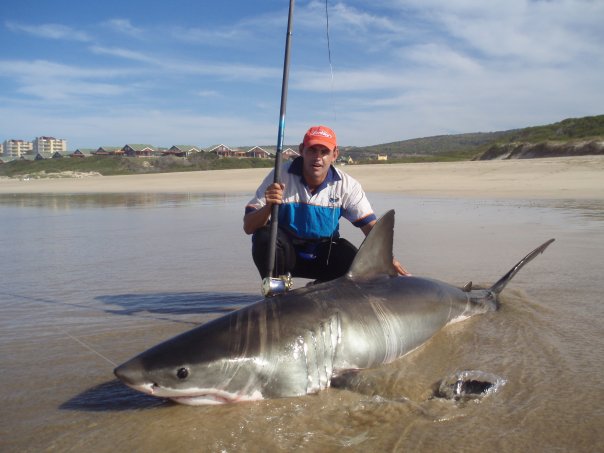
Riaan Engelbrecht has been a very busy South African white shark fishing machine going back to 2009.
He's also the owner of South Africa's Extreme Fishing.
Targeting white sharks in South Africa his Facebook site reads like a one man ecological disaster for animals that are supposed to be protected in his home waters.
As the owner of Extreme Fishing you might think that Riaan is aware of the protected status of white sharks. Perhaps he is, or perhaps the four images he recently posted of different white sharks stranded on local beaches with his smiling face are just a fluke, an accident, and not a targeted trophy fishery.
We have been here before, last month, when the conservation world became outraged at the sight of another white shark harvested by trophy seeking locals with little regard to the health and welfare of the animals they sought.
It's officially a problem when you discover a guy like Riaan Engelbrecht who posts four white sharks with the title "Tight Lines" on his Facebook site with no media backlash, no government intervention, and no conservation push back.
We said it last month when the first locally white shark was caught and photographed, a rally call for local shark conservationists.
Here is our post again and perhaps this time these images can motivate those who claim to love sharks into action:
Wolfgang Leander, the wizened sage of the shark conservation movement, has been raising awareness about the tragic S.A shark disappearing act for several years now and yet it still happens, and now we have the visual proof to back his many blog posts up.
So before one more so called shark conservationist in S.A stands
up to cry about sharks, before we are subjected to another pretty You
Tube video from S.A featuring a bimbette riding the fin of a now dead
and poached Tiger shark, let's get real about shark conservation.
It starts with this guy and a call for prosecution, the ensuing media madness, and a follow through to see that it is done. This cannot stand.
We understand that S.A is a world away from conservation norms, but to those who would claim that they are the leaders of any conservation movement with sharks in S.A we say "show us what you got".
It's your backyard and this guy just took a great big dump in it.
For these many white sharks at least - time has run out.
Update: The South African Shark Conservancy is on the case and looks like they know a range of illegal fishermen, fishing groups and websites promoting illegal white shark catches in South Africa. Their Facebook site has all the details, if you can support or help their ongoing investigations in any way please contact them it is time to put an end to trophy white shark fishing in S.A and it starts with some media pressure.
Riaan Engelbrecht has been a very busy South African white shark fishing machine going back to 2009.
He's also the owner of South Africa's Extreme Fishing.
Targeting white sharks in South Africa his Facebook site reads like a one man ecological disaster for animals that are supposed to be protected in his home waters.
As the owner of Extreme Fishing you might think that Riaan is aware of the protected status of white sharks. Perhaps he is, or perhaps the four images he recently posted of different white sharks stranded on local beaches with his smiling face are just a fluke, an accident, and not a targeted trophy fishery.
We have been here before, last month, when the conservation world became outraged at the sight of another white shark harvested by trophy seeking locals with little regard to the health and welfare of the animals they sought.
It's officially a problem when you discover a guy like Riaan Engelbrecht who posts four white sharks with the title "Tight Lines" on his Facebook site with no media backlash, no government intervention, and no conservation push back. We said it last month when the first locally white shark was caught and photographed, a rally call for local shark conservationists.
Here is our post again and perhaps this time these images can motivate those who claim to love sharks into action:
Wolfgang Leander, the wizened sage of the shark conservation movement, has been raising awareness about the tragic S.A shark disappearing act for several years now and yet it still happens, and now we have the visual proof to back his many blog posts up.
So before one more so called shark conservationist in S.A stands
up to cry about sharks, before we are subjected to another pretty You
Tube video from S.A featuring a bimbette riding the fin of a now dead
and poached Tiger shark, let's get real about shark conservation.It starts with this guy and a call for prosecution, the ensuing media madness, and a follow through to see that it is done. This cannot stand.
We understand that S.A is a world away from conservation norms, but to those who would claim that they are the leaders of any conservation movement with sharks in S.A we say "show us what you got".
It's your backyard and this guy just took a great big dump in it.
For these many white sharks at least - time has run out.
Update: The South African Shark Conservancy is on the case and looks like they know a range of illegal fishermen, fishing groups and websites promoting illegal white shark catches in South Africa. Their Facebook site has all the details, if you can support or help their ongoing investigations in any way please contact them it is time to put an end to trophy white shark fishing in S.A and it starts with some media pressure.
Sunday, October 30, 2011
Shark Diver and CNN Preview
Check out tonight's CNN Presents with Kaj Larsen and the crew of Shark Diver who were tapped to provide the background for this terrific pro-shark, pro-industry media expose.
Luke Tipple, the Director of the Shark-Free Marinas guides Kaj through the world of sharks, shark conservation, and shark fishing tournaments explaining the Shark-Free Marinas concept and its success along the way:
Friday, October 28, 2011
CNN and Shark Diver Airs Sunday Oct 30th
Got the following email this week from the fine folks over at CNN.
This fall we were asked to help with a pro-shark conservation piece covering shark fishing and Shark-Free Marinas.
Over the past year we have done four such programs with various media outlets from the US to Brazil in hopes that positive media for sharks helps folks understand the many complex issues sharks are facing.
With our always ready A-List shark crew we headed out to the Bahamas to highlight a place that is doing shark conservation right and shot reef sharks over two days with their show host.
Luke Tipple was gracious enough to carve out some of his busy conservation and filming schedule to guide CNN around sharks and the Shark-Free Marinas. For the past two years Luke has been the Director of the SFMI and the heart and soul of the program. You not going to find a better media spokesman for sharks, delivering sound bytes and hard facts without the hype.
Thanks to Scotty from Blue Iguana, MoonDog, Capt Rob and the rest of the crew for making this important show work under tough local conditions and chum that was peeling the paint off passing cars.
Thanks as well to Old Bahama Bay Resort for once again providing top notch hotel accommodations to wayward film crews from the mainland.
The story airs Sunday, check it out if you get a chance because this is about as good as it gets for mainstream shark conservation footage and analysis.
Also check out Richard Theiss from RTSea Productions who shot footage for the plastics segment.
Hi Pat,
Hope you're well.
Our shark story premieres this Sunday at 5; 8pm PST. I'm very happy with the story...only wish I had more than 6 minutes to work with!
All is good here. Rich and I just returned from Belize. We went back to dive the reef off Placencia...large scale development going on and it is starting to trash the reef.
Best,
Heather
CNN
This fall we were asked to help with a pro-shark conservation piece covering shark fishing and Shark-Free Marinas.
Over the past year we have done four such programs with various media outlets from the US to Brazil in hopes that positive media for sharks helps folks understand the many complex issues sharks are facing.
With our always ready A-List shark crew we headed out to the Bahamas to highlight a place that is doing shark conservation right and shot reef sharks over two days with their show host.
Luke Tipple was gracious enough to carve out some of his busy conservation and filming schedule to guide CNN around sharks and the Shark-Free Marinas. For the past two years Luke has been the Director of the SFMI and the heart and soul of the program. You not going to find a better media spokesman for sharks, delivering sound bytes and hard facts without the hype.
Thanks to Scotty from Blue Iguana, MoonDog, Capt Rob and the rest of the crew for making this important show work under tough local conditions and chum that was peeling the paint off passing cars.
Thanks as well to Old Bahama Bay Resort for once again providing top notch hotel accommodations to wayward film crews from the mainland.
The story airs Sunday, check it out if you get a chance because this is about as good as it gets for mainstream shark conservation footage and analysis.
Also check out Richard Theiss from RTSea Productions who shot footage for the plastics segment.
Hi Pat,
Hope you're well.
Our shark story premieres this Sunday at 5; 8pm PST. I'm very happy with the story...only wish I had more than 6 minutes to work with!
All is good here. Rich and I just returned from Belize. We went back to dive the reef off Placencia...large scale development going on and it is starting to trash the reef.
Best,
Heather
CNN
Wednesday, October 26, 2011
Commercial Shark Fin Sales and TradeKey.com - Update
![]() |
| Shark fin for sale under another name? |
The move was lauded by the shark conservation community who posted the TradeKey press release and moved on.
Since that time no one has gone back to TradeKey.com to see if they had removed shark fin from their massive B2B listings.
We did, and what we found today after a brief search was shark fin for sale (sourced 10.26.2011) including the image of a dried shark fin from sources in India, Maldives and Mexico.
These sources sell up to 10,000 kgs of shark fin at a time.
But it goes beyond these overt commercial ads on TradeKey. In fact many sellers of "dried fish products" or "fish maw" sell shark fin and TradeKey has no mechanism in place to stop potential buyers from "asking about" dried shark fin from vendors.
In fact TradeKey offers no alerts or internal guidance that we can find at all regarding shark fin, the sales of shark fin, or the trade in shark fin on their site.
As conservationists we cannot be satisfied with partial solutions to the online sales of shark fins, we have to dig deeper and adopt the mindset of the buyers. Shark fin sales are a multimillion dollar global enterprise and the trade does not just vanish because of "a promise and a press release."
It needs to be monitored.
We will say this, TradeKey.com has pulled the vast majority of shark fin ads from their site but that does not make them partners in the war on shark fin sales, more like unwilling conservation participants.
For the dead shark featured in this weeks TradeKey B2B ad from India, that partnership has not fulfilled the promise and TradeKey.com needs to do better.
They can start with the following:
1. Internal guidance for dried ocean product sellers listing the items that cannot be sold on the TradeKey site with a fine or banishment if they are discovered breaking the rules.
2. A "smart search program" that watches internal emails between sellers and buyers for keywords like "shark fin," and an auto email sent to both parties warning them of TradeKey policies.
3. A revocation of all monies for transactions done with shark fin.
4. A public banned list on TradeKey for companies that break TradeKey policies.
The technology and web programming to completely banish shark fin, educate millions of buyers and sellers, and become an online B2B conservation leader exists - and it's cheap.
Additionally TradeKey could consider adopting a top tier conservation partner like Oceana or PEW to develop out long lasting internal shark policies and forward thinking outreach.
TradeKey are not the bad guy here, they just associate with folks that indiscriminately kill sharks for fins. In a global climate where sharks are rapidly becoming protected and even admired, the ongoing sale and trade of shark fin on massive B2B sites is something we all need to pay attention to.
In summation TradeKey has two options, adopt a strong conservation leadership position or continue with their current and "partially effective" effort to stop the sale and trade of shark fin on their site, which as we have seen this week is not meeting up with the press release and conservation hype.
Tuesday, October 25, 2011
Barry Bruce on Shark Culls - Video
![]() |
| Berry Bruce deep inside his subject matter 2009 |
Well you should as he's one of those quiet industry types who does great work with white sharks, shuns the limelight, and occasionally comes forth in the media to knock a few homers out of the park.
In short our kind of white shark biologist.
This week Barry jumped into the political morass of recent shark attacks in Australia with the latest happening at Rottnest Island.
A world on Rottnest if you please. It's no secret that white sharks inhabit this island in the months of Oct-Dec and later each and every year. White sharks have been known in these waters going back to the late 1800's.
We posted this video back in 2008 of whites at Rottnest.
So, we're asking why dive boat operators are dumping divers into white waters in the first place? It's a question that NO ONE has asked and should be asking instead of baiting long lines to kill animals that are just "doing their thing."
Anyway back to Barry, his latest media foray has been picked up by the shark blogs, namely The Dorsal Fin and Da Shark and Andrew Fox and we would like to add our voices to the collective as well. This is great stuff and it's unfortunate that we don't have another three or four dozen Barry's out there to help turn the political tide back from the "kill order" for protected white sharks to a broader understanding that perhaps, just perhaps, during certain months we should just leave the hell alone and not put non caged divers into the world of the white shark.
Monday, October 24, 2011
"We Don't Wanna Hurt Ya" - Cute, Virally So
If cute had a name, it would reside here with this little video. Thanks to Amanda Cotton for the video discovery and to the 7 year old who came up with this concept.
We're seeing a Shark Emmy for this one:
Labels:
amanda cotton,
cute video,
shark news,
shark psa
Exploring the limits of biochemical madness, one bubble of CO2 at a time
![]() |
| Shark Diver Labs 2011 TM |
You might think that that sounds "a bit wonky" coming from a shark diving company but ever since our foray last year into big biochem and the Gulf Oil Spill the basic tenants of biochemical reactions and what they can do for us has stuck around.
This month we're tinkering again with "fundamental creation" and producing what we think might be a hit on the West Coast. What it is we cannot say, just yet. We can say that the basic reactions are happening, all the right elements are in play and this week we watched the first bubbles of creation burst forth.
Keep your fingers crossed.
Like the guys at the CERN reactor in Europe, they don't know what they are doing either, but they have the equipment, the theory, and the drive. We do too and hopefully we'll have something groundbreaking to report in a few weeks from now:
Sunday, October 23, 2011
Positive Shark Encounters vs Longline Culls
While Australia races headlong to hunt down and kill a white shark that recently attacked and killed an American diver last week let's take a moment to see how positive shark interactions can change perceptions, starting with the very young.
Note: If you want to send an email to stop the shark cull here are the folks you need to reach, please be respectful:
Email of Collin Barnett (WA Premier): wa-government@dpc.wa.gov.au Email of Norman Moore (WA Fisheries Minister): minister.moore@dpc.wa.gov.au Email of William Marmion (WA Minister for the Environment): minister.marmion@dpc.wa.gov.au
This video from is Compass Key, Bahamas known as the "Shark Diving Capitol of the World," here at least sharks are sources of tourism revenue and when unfortunate encounters with sharks occur, they are not hunted down with indiscriminate baited longlines.
You might say that the Bahamas carries an enlightened approach to sharks understanding that they inhabit the same oceans with us and that selectively removing them when it is politically expedient to do so does nothing to ensure that these rare negative encounters will not happen again.
Tragedies with sharks will always be just that, tragedies.
Our responsibility to the oceans eco system is to work in harmony with sharks. Rottnest Island has a long and storied history of white shark encounters going back to the late 1800's. If there is blame for a tragedy with sharks let's start by asking why dive operations in the area, who know of white sharks at Rottnest, are taking divers into the realm of the white shark.
There's simply no such thing as a "rogue killer shark".
There is, unfortunately, such a thing as poor decision making:
Saturday, October 22, 2011
Terry Howson Hates White Sharks - Australia
![]() |
| Terry would like to see inshore white sharks destroyed. Image Perth Now |
Used to be back in the 80's and 90's that dolphins were all the rage, and an operation could make a lot of money interacting with our perennially smiling ambassadors of the oceans.
Then along came a few early pioneers who sought commercial encounters with white sharks. At first these few were considered "crazy", out there, not mainstream.
Crazy has a way of catching on and slowly over the past 30 years crazy became mainstream, refining techniques, adding conservation and research, and growing.
Today, "crazy" is a thriving multimillion dollar global industry called shark diving and the pioneers like Rodney Fox in Australia are now under siege from a variety of sources including this guy, Terry Howson, who runs one of the aforementioned dolphin watching companies and who now is calling for a return to killing white sharks in inshore waters...to keep the public safe.
"We suggest the Department of Fisheries treat sightings of great whites close to shore or aggressively approaching boats in inshore waters as an opportunity to dispatch that individual shark and prevent the risk of future attack."
Of course Terry has absolutely no proof that commercial shark operations are responsible for inshore white shark sightings:
"Common sense suggests that these cage diving operations are unwittingly conditioning great white sharks to associate boats and people with food. I may be wrong, but until proven otherwise I would prefer that we err on the side of caution and follow existing legislation regarding other native wildlife which makes it illegal to feed them."
But that does not stop the Terry's of the world from demanding justice and blaming our industry for wildlife encounters miles away from operations sites. We have seen "The Terry's" from Hawaii to South Africa banging the same media drum, making the same arguments, as if they are all reading from the same script written on the back of a pizza box that still has the cold remains of last nights cheese toppings on it.
![]() |
| Australia's Gold Coast 2009 |
It is unfortunate that many ocean agendas come to play when commercial shark diving becomes established in any given region. It is doubly unfortunate that those who hate sharks will use our industry as the reason to kill these magnificent animals.
Blame the industry for conditioning them, then kill them because it makes $ense.
Maybe if you own a dolphin watching company.
Friday, October 21, 2011
Lionfish Invasion? Bring on the Panko Crust!
![]() |
| Guy Harvey "Invasive Gourmet" 2011 |
While the piece elicited a few chuckles and more than a few raised eyebrows the concept behind invasive species and creating markets for them are sound.
It's something that Guy Harvey understands and this week he unveiled his signature Invasive Species Grill in the Bahamas.
Think of it as taking a bite out of an invasive species problem and helping at the same time take the pressure off regional species like Grouper and Hogfish.
It's brilliant, easy to adopt, and the right solution to a regional invasive species epidemic that is harming the Caribbean.
Now all Guy and Co have to do is package these tasty Lionfish Nuggets and get them into Trader Joes all over America.
If you want to try these at home and happen to have a Lionfish problem in your backyard here's the recipe, it's does not stop here, try your own and share them on Facebook, together we can rid the oceans of the Lionfish, one tasty fried nugget at a time:
Lionfish Nuggets:
- 4 oz of Lionfish
- Flour
- 1 cup liquid egg
- Panko breadcrumb
- Salt & Pepper
- Cajun seasoning
In 3 separate bowls place your liquid
egg, flour and breadcrumb. Cut Lionfish into small bite sized pieces and
season with salt & Pepper & Cajun seasoning. Dip pieces into
flour, shake off excess flour, and then dip into liquid egg and then
into Panko breading. Once covered in the breading they are ready to take
a long hot bath in some hot oil at 325 degrees until crispy golden
brown.
Labels:
guy harvey grill,
lionfish invasion,
markets
The Official Shark Divers :: Guadalupe Island 2011
![]() |
| August 2011, Isla Guadalupe |
Once more Isla Guadalupe has delivered the finest combination of animals and education.
Here's a small sampling of the faces and trip reports from the 2011 white shark season. There's more to come and we haven't yet called an end to the fun.
"Day two had gotten off to a great start, but it got even better, when a few hours later, we had a juvenile get a little frisky with our cage. Seeing a great white that close to the cage, mouth open, ready to have a go, was priceless! I could not have asked for more!"
- Michelle M
![]() |
| September 2011, Isla Guadalupe |
"Shredder is definitely the comedian of the shark world! Occasionally he would give a smaller shark the chance to say hello but chased them off the minute he felt he was missing the attention of his adoring public. For eight hours he was cruising around the boat and cages and once the cages had been lifted for the night, he breached next to the boat almost as if to say, ‘hey guys, what are you doing, I’m still here!’ Apparently this was the best ‘sharking’ day of the season so far as 13 different sharks were identified."
- Bev D
"Most importantly, every member of the crew seemed to be there because they love the sharks and love what they do. They made sure we had almost as much fun out of the cages as in them."
- Sarah F
As we wind down 2011 and look forward to 2012 we have to give a big kudo to our divers and the entire crew of the M/V Horizon.
![]() |
| October 2011, Isla Guadalupe |
The first vessel to ever do shark cage diving at this remarkable dive site and we are proud to be working with them still - after all these years.
And to our new minted Shark Divers and to all those who have come before them. It is your good cheer, lust for adventure, and love of sharks that has allowed Shark Diver to be the company that it is today.
We honor all those with a dream and say, "If you dream, dream big".
To those who fly halfway around the world, to those who have saved every penny for the past two years in a jar, and to those whose experience with the white sharks of Guadalupe have lead them to help save sharks around the planet.
You are Shark Diver, and we are proud of you all!
Wednesday, October 19, 2011
Myth vs Reality - Images and Google
We're asking a question here.
Why is it if the shark fin industry is so vast that we see so few images of the industry in action?
A Google image search for shark finning reveals 98,500 results.
A Google image search for Bigfoot? 2,380,000 results.
If you asked folks on the street if they believed in Bigfoot you'll probably get at least a 98% awareness of the Bigfoot myth.
And shark finning?
Food for thought.
Why is it if the shark fin industry is so vast that we see so few images of the industry in action?
A Google image search for shark finning reveals 98,500 results.
A Google image search for Bigfoot? 2,380,000 results.
If you asked folks on the street if they believed in Bigfoot you'll probably get at least a 98% awareness of the Bigfoot myth.
And shark finning?
Food for thought.
Labels:
awareness,
bigfoot,
shark finning,
the game
Bill Wasserman "The Sharkman" 2011
Bill Wasserman and crew joined us at Isla Guadalupe in the fall of 2011 at Isa Guadalupe and captured the full grace and power of the white shark. This is as good as it gets.
Tonight - Working with White Sharks, Ca
"Working With White Sharks."
7p.m. today in the Seminar Room at the Moss Landing Marine Laboratories, 8272 Moss Landing Road, Moss Landing.
John O'Sullivan will be talking about his adventures over the last ten years and his experience as manager of the juvenile field research and exhibit collection program of the Aquarium's "White Shark Project." Free.
Reservations: 771-4464.
7p.m. today in the Seminar Room at the Moss Landing Marine Laboratories, 8272 Moss Landing Road, Moss Landing.
John O'Sullivan will be talking about his adventures over the last ten years and his experience as manager of the juvenile field research and exhibit collection program of the Aquarium's "White Shark Project." Free.
Reservations: 771-4464.
Tuesday, October 18, 2011
Man Catches Protected White Shark?
![]() |
| Image Ocean Research |
Yes he's South African, and yes he's just caught himself a nice healthy white shark so he and his son could pose with this "protected animal" before watching its bleeding carcass come off the rocks and back into the ocean whence it came.
To say that we're angry about this is a disservice to the word angry, and you should be, because this is part of an ongoing pattern of animals killed in S.A that apparently enjoy some measure of conservation protection. On paper at least.
"The unidentified man, who told locals he was from Cape Town, apparently spent nearly an hour getting the shark on to the rocks, where he measured it before posing for pictures on Friday."
![]() |
| Image Ocean Research |
So before one more so called shark conservationist in S.A stands up to cry about sharks, before we are subjected to another pretty You Tube video from S.A featuring a bimbette riding the fin of a now dead and poached Tiger shark, let's get real about shark conservation.
It starts with this guy and a call for prosecution, the ensuing media madness, and a follow through to see that it is done. This cannot stand.
We understand that S.A is a world away from conservation norms, but to those who would claim that they are the leaders of any conservation movement with sharks in S.A we say "show us what you got".
It's your backyard and this guy just took a great big dump in it.
For this shark at least - time has ran out.
Giving Away URL's - For the Sharks
![]() |
We started with the Isla Guadalupe Fund back in 2006 and responding to a Tiger shark killed in the Bahamas were the brainchild behind the Shark-Free Marinas Initiative.
Along the way we acquired a number of first rate URL's for use on shark conservation projects that ranged from a set aside global fund for sharks to a social network for sharks.
Alas, time was not on our side, and as it turned out there's only so much one company can do in any given calendar year. Our time has become increasingly limited as Shark Diver grows and we celebrate a decade of shark diving.
To that end we are offering up three URL's to those who might like them in the service of sharks.
The caveat is these URL's will only go to funded entities with a written game plan. We would like these URL's to work for shark conservation and to ultimately be succesful.
Let us know if you are interested by sending an email to staff@sharkdiver.com:
www.sharkfriends.org
www.sharkfund.org
www.saveshark.org
Labels:
domain name,
grassroots shark conservation,
url's
USA Today Shark-Free Marinas 2011
The revolution continues with 110 marinas now signed up to be Shark-Free and growing.
Not mentioned in this article are the many folks world wide who became early adopters of the Shark-Free Marinas Initiative along with the fine folks from Fiji who saw this initiative and adopted it, creating the first actual Shark-Free Marinas in the world back in 2009.
Additionally kudos to Old Bahama Bay Marina in the Bahamas who went Shark-Free in 2010.
Less than two years after its creation, SharkFreeMarinas.com lists more than 110 marinas and businesses from eight countries — including 78 in the USA— as either shark-free or shark-friendly.
The initiative, organized by the Humane Society of the United States,
the animal-welfare grantor Pegasus Foundation and the Guy Harvey Ocean
Foundation, which raises funds for marine-conservation research, works
to persuade marinas to either refuse to allow sharks to be landed at
their docks or to discourage the recreational killing of sharks. Marinas
are registered as shark-free in the first case, shark-friendly in the
second.
"This is a way to help the shark
population, to save species of fish in our waters," said Tibe Larson,
manager of shark-free Bonita Bay Marina in Bonita Springs, Fla.
Bob
Hueter, a shark specialist at Mote Marine Laboratory in Sarasota, Fla.,
which supports the initiative, said he's not against bringing a shark
in once in a while for food. "I've published recipes for shark," he
said. But, "too often," Hueter adds, "people bring a shark in, hang it
up to show it off, maybe take the jaws, and then dump it."
Without a place to show off a dead shark, fishers are more likely to practice catch-and-release, he said.
"We
used to fish for sharks, but I got out of that business close to 20
years ago, when it occurred to me that sharks were being depleted," said
Phil Lobred, general manager and partner at H&M Landing, a
shark-free sport-fishing landing in San Diego. "Usually, it's the younger crowd who wants to say they caught a shark: It's a macho kind of thing," he said.
In its most recent study on shark depletion, the National Marine Fisheries Service
said that recreational fishermen along USA's Atlantic and Gulf coasts
killed more than 200,000 sharks per year from 2004 through 2008.
SharkFreeMarinas.com
members get signs with their shark-free or shark-friendly status, free
ads on the initiative's website and educational literature.
Initiative
director Luke Tipple, an Australian marine biologist and TV
personality, said he doesn't expect the program to stop the recreational
harvesting of sharks. However, he said he thinks it can have a positive
impact on an important segment of the shark population: big breeding
adults that trophy hunters target.
"They are
selectively removing sharks that can contribute to the recovery of their
species," Tipple said. "It's not how many sharks we save. It's how many
we can protect."
Contributing: Lollar and Ruane also report for The News-Press in Fort Myers, Fla.
Saturday, October 15, 2011
Shark Fin Workaround - Where There's a Market
![]() |
| The shark fin legal game - fins attached? |
This mornings news from San José, Costa Rica is a lesson in real world shark fin management with an apparent workaround to new shark fin laws that require the fins remain attached to the shark.
But what constitutes a whole shark?
That questions will have to be decided by the court system in Costa Rica while Taiwanese ships find creative ways to continue the shark fin trade unabated and it's not the first time this has happened:
"After Incopesca and the Agriculture and Livestock Ministry finally ruled in December 2010 that foreign fleets must unload at public docks subject to inspection, the first boat to unload was caught with illegal fins onboard. Shortly afterward, the fleet started showing up at the dock with only other species and no sharks. At the same time, huge shipments of shark fins began being imported to Costa Rica from Nicaragua."
The news from Costa Rica serves as an abject lesson to shark conservationists worldwide, we have to be looking a better ways to enact laws as seen through the lens of fishing fleets whose livelihood depends on shark fin. Additionally conservation groups need to refocus on recent vast tracks of declared shark sanctuaries around the world.
While these sanctuaries look great on paper only a small percent have any capability to actually monitor or enforce these areas. The new focus should be for long term funding and enforcement by outside agencies and NGO's.
Fisheries laws are made to be circumvented, and ignored.
Phase two in the global race for sharks begins now with this wake up call.
Friday, October 14, 2011
The Man in the Picture - Shark Diver Colin Ball
Colin Ball is the man on our homepage at Shark Diver giving the thumbs up to an experience that, over the past decade, we have offered to divers from around the planet.
We choose this image shot by Derek Heasley from Seapixels as the front page image for Shark Diver for a number of reasons, primarily because it says everything about the dive site, the experience, and the curiosity of our white sharks, seen here checking out the port side floatation pod.
The image was shot way back in 2007, and we're still going strong this season with another group of divers at the island and a sat phone call this morning with a report of a 17 foot female, the largest of the shark diving season, joining our divers for moments that you can only comprehend if you have been in the cage staring a white shark in the eye.
Here's to all the Colin Balls who have joined us over the years. It is because of you that Shark Diver has become the "little shark diving company that could," and we're looking forward to minting a new round of official Shark Divers in 2012.
Let's go shark diving!
We choose this image shot by Derek Heasley from Seapixels as the front page image for Shark Diver for a number of reasons, primarily because it says everything about the dive site, the experience, and the curiosity of our white sharks, seen here checking out the port side floatation pod.
The image was shot way back in 2007, and we're still going strong this season with another group of divers at the island and a sat phone call this morning with a report of a 17 foot female, the largest of the shark diving season, joining our divers for moments that you can only comprehend if you have been in the cage staring a white shark in the eye.
Here's to all the Colin Balls who have joined us over the years. It is because of you that Shark Diver has become the "little shark diving company that could," and we're looking forward to minting a new round of official Shark Divers in 2012.
Let's go shark diving!
Thursday, October 13, 2011
Global shark conservation, and then there's Australia
![]() |
| The head of a gravid Tiger being dumped. Image Michael Ross |
The female Tiger was found to have 30 pups inside her.
We have covered the ongoing devastating effects of drumlines on shark off the Gold Coast for several years, and it's not just an Australian problem with South Africa employing the same techniques to manage their regional "shark issues".
What makes today's story particularly frustrating from both a conservation and shark diving industry perspective is the apparent shark psychosis that Australian management officials suffer from. On one coast it is o.k to kill white sharks, tigers and just about any other shark species that is unfortunate enough to bite down on baited hooks, while on other coast where tourism with sharks generates million of dollars sustainably, authorities are attempting to shut some operations down and reduce the numbers of days they can operate - all in an effort to protect sharks.
![]() |
| White shark caught on Gold Coast drumline in 2009 |
While the rest of the planet marches headlong into new an uncharted territory for shark conservation with the addition of millions of square miles of shark sanctuaries, byzantine hold outs like Australia and South Africa are setting new lows for shark management policies.
Your either protecting sharks, or not.
In Australia it would seem that at least when sharks are commercialized sustainably with conservation minded shark diving operations, sharks need to be studied, protected, and managed. But in areas where humans demand high dollar value for beachfront housing and waters to wade in, shark conservation begins and ends with a baited hook.
Welcome to the world of Australian shark management, if you're a shark, take a left turn at Sydney, because that's the only way you'll survive Gold Coast shark management.
Tuesday, October 11, 2011
Bahamas Sharks, Hooks vs Tourism
Mt Biking in S.A Dangerous? Oh Yeah!
Thanks to Moondog for the video find of the day...week...month:
Labels:
crazy biker,
south africa,
wowza
Subscribe to:
Posts (Atom)