Showing posts with label shark media. Show all posts

Wednesday, February 24, 2016

Who is more aggressive, a Bull Shark or a Great White?


Instagram 
We hear a lot about how aggressive shark are. Some people think that if they encounter a shark in the ocean, they will get bit. This kind of thinking is at least partially fueled by the media that seems to portray any encounter with a shark as a near death experience.

I've been diving with Great White, Bull and Tiger Sharks for over 15 years now and have found that most sharks are actually pretty shy and not very aggressive. Despite the fact that shark bites and attacks are extremely rare, the common perception is that they are dangerous. When it comes to what species is most dangerous, people tell me that because they have more testosterone than any other shark, Bull Sharks are the most aggressive and therefore the most dangerous to humans.

It is true, that since Bull Sharks can swim and hunt in very shallow, brackish and even fresh water, they tend to be in much closer proximity to humans than Tiger or Great White Sharks. This obviously leads to a greater chance of an encounter with them, which can result in an occasional bite or attack. Such bites however remain extremely rare. Last year there were 96 shark bites with 6 fatalities reported worldwide. These numbers include all species of shark.

I think that a lot of people confuse feeding with aggression. Biting that is related to hunting or feeding has nothing to do with the testosterone level, but is simply and indication that the shark is hungry. Aggression has to do with defending their territory, establishing dominance and is usually directed toward another shark or a perceived competitor. So if we look at it that way, who is more aggressive, the Bull Shark, or the Great White Shark?

Well, let me show you a couple of pictures.


These pictures all show Great White Sharks with bite marks from their own kind. It is rare to see an adult Great White Shark that doesn't have some kind of scar or fresh bite mark on them. These sharks are very much into keeping their "personal space" and it is rare for them to touch each other, without there being some biting involved. Typically when 2 White Sharks encounter each other, they pass each other head on, to establish who is bigger. If that doesn't settle it, they tend to come back together and swim parallel with each other, to get a closer look. Now if that still doesn't settle it, the more dominant sharks usually shows the other who's boss by biting it on the head or in the gill area.

Now I want to stress that the aggression I have observed on White Sharks is shown towards other shark and not humans, or other animals in the ocean. Just like any other "dangerous" shark, they are not very likely to attack a human.


Add caption
2 of these sharks just got a tuna head, they show no aggression.

In the pictures above, you can see lot's of Bull Sharks swimming very close together and there doesn't seem to be any aggression. I've seen over 70 of those sharks, without noticing any that had bite marks on them. This is something that definitely can't be said about Great Whites.

It never ceases to amaze me, how little we know about sharks and how much of what we "know" is actually wrong. We tend to think that something like testosterone will have the same effect in sharks as it does in humans. On the flip side of the "sharks are mindless killer" attitude, there is the "sharks want to be hugged" crowd, that is trying to show how harmless these sharks are by riding, grabbing, flipping and hugging them.

Let's appreciate the sharks for who and what they are. They are not mindless killers, but neither are they harmless pets. As I always say, "I absolutely love "my" sharks, but it is not a mutual feeling and that is perfectly fine with me". I don't feel the need to assign human emotions to them, I love em just they way they are.

Cheers,
Martin Graf
CEO Shark Diver


About Shark Diver. As a global leader in commercial shark diving and conservation initiatives Shark Diver has spent the past decade engaged for sharks around the world. Our blog highlights all aspects of both of these dynamic and shifting worlds. You can reach us directly at staff@sharkdiver.com.

Saturday, April 25, 2015

Surfer critically injured by shark off southern Australia; witness reports large great white

 FOX news has this headline today "Surfer critically injured by shark off southern Australia; witness reports large great white"
 
The following is what they report:


I have to say, that I'm usually not a big fan of how the media reports any shark related incident. Take the "Jaws Attack" headline in the UK we talked about yesterday and you can see how sensationalistic the media tends to cover anything shark related.

I like not being described as a mindless killer!

Big kudos to FOX news for reporting an actual incident, where a surfer got seriously hurt by a shark and cover it without any sensationalism.  Maybe the 20 foot size is a bit exaggerated, but people tend to perceive sharks a larger than they actually are. They even pointed out the fact that sharks are common off Australia's beaches and attacks are rare.

Cheers,
Martin Graf
CEO Shark Diver


About Shark Diver. As a global leader in commercial shark diving and conservation initiatives Shark Diver has spent the past decade engaged for sharks around the world. Our blog highlights all aspects of both of these dynamic and shifting worlds. You can reach us directly at staff@sharkdiver.com.

Wednesday, April 15, 2015

Shark sighting in Portugal

Congratulations to the algarvedailynews! You managed to cover a shark sighting near shore without sensationalism, with a simple "Mystery shark spotted near Tavira" headline.

In the article you go on to explaine exactly what happened.

As the build up to the swimming season starts with beaches being prepared and concession soon to open, a reminder that 'we are not alone' when bathing was evident in the waters near Tavira.
A shark at least two metres long was spotted by fishermen on the jetty close to the beaches at the entrance of the river Gilão.

Photo Michael Correia - Correio da Manhã

The shark clearly was in distress and was disorientated, swimming around in the shallow waters.
After an hour the shark headed back out to sea with its identity a mystery as, despite being observed by many fishermen, nobody could identify the species.
The Tavira shark was not a Hammerhead, a species which can come close to the shore but normally feeds at least a mile out mainly on sardines, tuna and mackerel and only when the water is warmer at 20 degrees or more.
In 2013 a three metre shark was spotted close in to the shore near the fortress at Sagres, again the species could not be acertained.
Along Portugal’s coast there are dozens of shark species, the majority of which stay offshore and deep down, venturing closer to the surface only when hunting for fish or looking for a mate.
There is an abundance of sharks in Portuguese waters, a sign of a healthy marine environment, but no recorded incident of anyone being attacked as sharks prefer eating fish of which there are plentiful supplies.

Kudos for reporting a shark sighting without sensationalism and resorting to the use of monster, beast or killer. You informed your readers, without scaring them. Your action shows that covering a shark sighting can be done in an informative manner and no scary headlines. I hope that other media outlets will take note. 

Cheers,
Martin Graf
CEO Shark Diver 

About Shark Diver. As a global leader in commercial shark diving and conservation initiatives Shark Diver has spent the past decade engaged for sharks around the world. Our blog highlights all aspects of both of these dynamic and shifting worlds. You can reach us directly at staff@sharkdiver.com.

Tuesday, March 3, 2015

Dead Sharks, Selfies, and Shark Fin Soup?

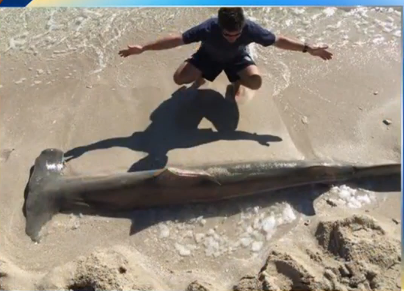
What is our obsession with taking pictures of ourselves with subjects that seem just a bit inappropriate? Now that smart phones have turned us all into photog wannabes, the rush to get pictures published on social media sites has also lead us to be wannabe reporters, as well.  Recently two sharks, a bull and a hammerhead, washed up dead on the shore of Miami Beach. One was bloated, the other with its fin cut off.  Once beach-combers saw the poor creatures, the camera phones came out and the snap-shot taking crowds were enough to make any paparazzi, surrounding a Hollywood celebrity, pale in comparison.  There was even a grown adult who pulled up on the head of one shark to get its mouth to open. What a photo op! "Hey kids, come gather around!"


Where is the respect? It’s just an animal. Who cares, right? WRONG! Are we another 'Me Generation' or have we never left it?  This is 2015 folks.  We've scratched our way out to escape the errors of our ways. After fighting for equality in several different arenas, freedom of religion, the push to reuse, reduce and recycle, ‘save our planet,’ ‘plant a tree’…have we not arrived? What has happened to the rights and respect for those with which we share this slowly, dying planet?

http://cdn.inquisitr.com/wp-content/uploads/2015/02/Bull-Shark-670.jpg
Source: Inquisitr.com

Back to these dead sharks: No one knows what caused their deaths, and apparently no one is investigating.  A fin was cut off! I was told by an authority at the Florida Fish and Wildlife Conservation Commission that maybe if there was a bunch of these guys washing up on the shore with their fins hacked, there might then be an investigation. How many have to lose their lives in order for that to happen? Maybe this is just a prelude of what is to come. Since shark fin soup is served in restaurants throughout Florida, and yes, Miami, maybe this was the result of someone trying to cash in on the evil craze. Does that mean finless carcasses are on their way to shore like a message in a bottle? Are we going to read it and do something about it or are we going to throw it back in for the next generation to deal with? Did you know that 24 states according to the Animal Welfare Institute, serve up the controversial delicacy, shark fin soup?  You can find it on the menu at South Garden Chinese Restaurant in Miami for $12 a bowl.

Source 

It’s a shame; it’s a crying shame that an 8 foot animal is tortured for its 8 inch body part and left to die, rotting in its ocean home, only to float to the shore to be mocked as part of social media fodder. To the person(s) who did this: "At least, eat the rest!" I discourage anyone from killing these animals and it pains me to see their fins cut off and then the shark dropped back in the water to try and survive. Would the same thoughtless individual do that to their pet? They’d be put in jail.

These sharks are intelligent, beautiful, and are an integral part of our oceans and were here way before you and I. Respect them. Wouldn't a picture of you with a live shark be cooler to take?


Join us for live shark selfie-taking starting this August at Guadalupe; Bahamas starting in April and Fiji year-round.

Let's go shark diving!
'Ocean'
Shark Diver

About Shark Diver. As a global leader in commercial shark diving and conservation initiatives Shark Diver has spent the past decade engaged for sharks around the world. Our blog highlights all aspects of both of these dynamic and shifting worlds. You can reach us directly at staff@sharkdiver.com.

Thursday, June 12, 2014

10 ft. white shark being eaten? Mystery solved!

Yesterday we talked about the international headlines of "Great white shark being eaten by sea monster".

Here is a response by CISRO, the organization who placed the tag on the shark in question.

When we looked at its data there was a period of approximately three weeks just before the tag surfaced where the temperature recorded was higher than the surrounding sea, but where the tag continued to ‘dive’ in a pattern consistent with a white shark. During this time, the tag failed to record light. Data before and after suggest the tag was functioning normally. The temperature recorded for these three weeks was consistent with that of the core body temperature of a white shark but too low for something like a killer whale.

They go on to explain, what they think had happened.

At one point the shark that had eaten the tag dived to a depth of 570 m – this is not unusual for white sharks – it is normal behaviour. This dive took place about one week prior to the tag recording the higher temperatures (not immediately before as some have reported) and the two events are not related.

All evidence suggests that the tag had been eaten by another white shark. We have seen white sharks biting each other before, sometimes removing pieces of tissue in the process. We concluded that this was the most likely explanation – One shark bit off a little more than he could chew and ended up swallowing the tag. 

We never concluded that the 3m shark was consumed by another much larger shark.

Yesterday I questioned the "scientists" conclusion, that a sea monster ate the shark. Now we know that there were not even any scientists that concluded that, it was simply the filmmaker ignoring what the group who placed the tag in the first place had to say. Now that's something you'd expect from a Sci Fi channel production, not a Smithsonian "documentary"!

Cheers,
Martin Graf
CEO Shark Diver


About Shark Diver. As a global leader in commercial shark diving and conservation initiatives Shark Diver has spent the past decade engaged for sharks around the world. Our blog highlights all aspects of both of these dynamic and shifting worlds. You can reach us directly at staff@sharkdiver.com.

Saturday, May 24, 2014

Shark scare in Orange County?

A couple of days ago, there was a fake shark scare in Newport Beach, CA.

The Orange County Register reports:  


source
"NEWPORT BEACH – The warning was clear: A big, aggressive great white shark is on the loose along the shores in Newport Beach, and beachgoers are advised to stay away from the water."

Problem was, local lifeguards and the U.S. Coast Guard never heard of any shark danger. 

“I guess it was one of the local guys; someone who wanted to keep the crowds down at a break out there,” Coast Guard search and rescue controller Sandy Needle said about the notice. “There was nothing from the Coast Guard.” 

The warning – which appeared on official-looking letterhead that said “United States Coast Guard” in the notification dated Wednesday – was floating around on Facebook, claiming that three incidents should put beachgoers on high alert.

The article goes on to give the details of the warning which contained the following paragraph:

The third sighting, the notice read, came when two lifeguards got a call about an adult-sized shark that bumped two kayakers and swam away after the boaters struck it “with an oar in the gill area of the fish.”

So far so good, it looks like the media is responsible for once and instead of hyping up a shark scare, are trying to calm the public.

The article then states, how they recognized the warning as fake.

"Although the flier looked official, there were a lot of clues that it was a fake.
“There’s a lot of misspellings, and it called a shark a fish,” Needle said."
Well there you have it. It called the shark a fish!  No self respecting Coast Guard representative would call a shark a fish! Everyone knows it's not a fish, it's a.... hmm, no not that, it's a ...... , I'm stumped! Any of you know?

Maybe I should be asking an expert in these matters.

You can read the entire article here

Cheers,
Martin Graf
CEO
Shark Diver


About Shark Diver. As a global leader in commercial shark diving and conservation initiatives Shark Diver has spent the past decade engaged for sharks around the world. Our blog highlights all aspects of both of these dynamic and shifting worlds. You can reach us directly at staff@sharkdiver.com.
Saturday, October 12, 2013

Superhero Shark Wrangler?

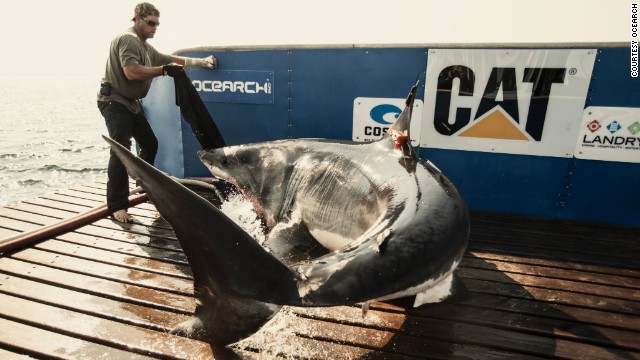
Ocearch seems to be on a publicity campaign to promote their tagging of great white sharks again. This article on CNN is a bit ridiculous, even by OCEARCH standards.

The headline is calling the captain of the Ocearch vessel, Brett McBride, "Shark wrangler who sleeps with the fishes" The article it goes on to say:"Imagine you're sitting at the bottom of the ocean, amidst 500 sharks in a feeding frenzy.Would you: A.) Swim to the surface as fast as your trembling legs could take you. B.) Find a weapon to arm yourself with. C.) Fall asleep. Brett McBride fell asleep. For a minute. While hundreds of three-meter-long Galapagos sharks swarmed around him during a feeding frenzy off the coast of Costa Rica."

Ocearch lifiting shark out of the water.
That should tell you something about the intelligence of the guy. Falling asleep while scuba diving is an act of heroism, but a great recipee for a disaster. The article states "The 46-year-old shark wrangler doesn't suffer from some kind of severe narcolepsy. Instead, he was merely proving a point -- these fearsome predators aren't going to be interested in you, if you're not interested in them." How is falling asleep while SCUBA diving and risking to drown, proving a point that sharks are not interested in you? It's just another stupid stunt to impress an uninformed public and make him out to be a superhero.

Their definition of a superhero seems to be someone who gets his boats lines tangled in the props, which forces him to dive in order to free them. Wow, who knew that this makes one a superhero. I've performed dives like that myself and never felt particularly heroic doing them. Heros are people like firefighters, paramedics, soldiers etc. who risk their lives for the benefit of others, not publicity seeking idiots. Interestingly, most of those real Heros are a lot more humble than these Ocearch publicity seekers.

Dr. Domeier tagging a shark without lifting it.
Mc Bride goes on to offer other words of "wisdom" "When the shark is taken out of the equation, the squid populations explode. They're voracious eaters so every night they'd eat the baby fish -- swordfish, tuna, marlin. The fish are being wiped out, not by man, but by squid. And that's because man took away their main predator -- sharks," said McBride.  Wow, I wonder where he get's that info from. Is that a scientific or a PIDOOMA (Pulled It Directly Out Of My A..) statement? 

The fact that Ocearch still insists on stressing the sharks by taking them out of the water to tag them, when Dr. Domeier has shown that it is no longer necessary, clearly shows that they are much more interested in what makes for good TV instead of good science.

We at Shark Diver support responsible shark research, but we do not condone sharks being abused in the name of sicence, just to get TV ratings.

Cheers,
Martin Graf
CEO Shark Diver

About Shark Diver. As a global leader in commercial shark diving and conservation initiatives
Shark Diver has spent the past decade engaged for sharks around the world. Our blog highlights all aspects of both of these dynamic and shifting worlds. You can reach us directly at staff@sharkdiver.com

Saturday, November 24, 2012

Sharky Boo Boo? WARNING Do Not Drink Hot Liquids While Reading!

We saying we're wiser now, o.k?
We might actually be considered Grey Beards in the shark diving/conservation space after 12 years.

That's a long time in any industry. 

We have been watching with some amusement the antics of an entirely new crop of Shark Kids on the block because you would have to have been living under a rock not to notice the plethora of in-your-face shark shenanigans going on across the world.

These exploits with sharks run the gamut from Speedo wearing daredevils attaching themselves to monster white sharks, to half witted warrior class shark saviors traveling the world to post lip stick written signs at the sites of dead sharks decrying the global harvest.

"Save the Sharks!"

"Buy our T-Shirt!"

"Watch our Show!"

For the most part all of these exploits, stunts, and media moments have been carefully staged under the heading of Shark Conservation. To us older folks who have been around a while, this hyper race to "get noticed," smacks more and more of PT Barnum Hucksterism then actual shark saving.

And so it was with great satisfaction we noticed another Grey Beard in Fiji highlighting the same thing in this weeks blog post - Sharky Boo Boo.

Now a note of caution here. If you have just started in the shark world none of this post will make any sense to you, as this is the world you know filled with wacky folks doing wacky things with sharks. Perhaps to get a series on Discovery Networks, who knows.

If you happen to have been around a while, own your own shark diving company, done a few doco's, then this post should be read without a hot beverage nearby as we have discovered the hard way that posts like these and hot beverages do not mix. 

Thanks Da Shark, welcome back from the DEMA Shark Circus.

Remember a decade ago when there were only two shark booths?

My how time marches on.

About Shark Diver. As a global leader in commercial shark diving and conservation initiatives Shark Diver has spent the past decade engaged for sharks around the world. Our blog highlights all aspects of both of these dynamic and shifting worlds. You can reach us directly at sharkcrew@gmail.com.

Monday, July 23, 2012

Shark Strikes in Australia, a Sheepish Connection?

While the conservation and commercial shark diving worlds mobilize to counter Western Australia's plans for a reversal in white shark protections and a series of limited culls of these magnificent animals in response to several deaths in the region, we came across another interesting sheep/shark connection to this story.

For those who follow this blog we also looked at the sheep/shark connection in Egypt during a series of unprecedented shark strikes last year.

Of course right about now Da Shark, located at his Blogger Bunker somewhere in Fiji, is screaming bloody murder at the very thought of dead sheep thrown into the ocean leading to sharks strikes on humans.

But wait, there's more.

In fact the notion that several hundred dead sheep suddenly dropped into any region might elicit a higher surface predatory response from local sharks is not out of the realm of possibility at all, and even the Humae Society of Australia seems to think this is an issue:

 A spokesperson for the animal protection society, Alexia Wellbelove, said  "thousands of dead sheep ... either whole or minced" were being thrown overboard as ships departed ports for the Middle East "without care or consideration for the consequences".


"It is highly likely that the disposal of animal remains in this way will attract large sharks over a wide distance," Ms Wellbelove said.

So there you have it. All joking aside the real issue as everyone knows are local politicians who will use these unfortunate events to justify more shark nets, a cull structure, and perhaps even a roll back of hard won protections for white sharks in the region.

Kudos to the many hundreds of voices that have jumped on this issue over the past week to say "hell no" and to keep Western Australia white sharks where they belong. In the ocean.

If you want to get involved you can do so here, here and here. 

The sharks thank you.


About Shark Diver. As a global leader in commercial shark diving and conservation initiatives Shark Diver has spent the past decade engaged for sharks around the world. Our blog highlights all aspects of both of these dynamic and shifting worlds. You can reach us directly at sharkcrew@gmail.com.

Tuesday, May 22, 2012

Refreshing Documentary Work - Sandgrains

Almost every week we get asked to post a new conservation documentary trailer on our website and blog. Most never make it, there's a vetting process here as we look for documentaries that are in a word, "refreshing."

We're looking for subject matter that matters. We generally pass on self promoting media foks who have little to offer the wider conservation scene aside from a pretty face, some pablum based conservation talking points, and a website.

Instead we tend to admire and promote those who take the craft of documentary work with all the seriousness it deserves and Sandgrains is one of those well crafted works that deserves a first, second, and third look.

Kudos to the entire team from Matchbox Media who are behind this.


About Shark Diver. As a global leader in commercial shark diving and conservation initiatives Shark Diver has spent the past decade engaged for sharks around the world. Our blog highlights all aspects of both of these dynamic and shifting worlds. You can reach us directly at sharkcrew@gmail.com.

Sunday, May 13, 2012

Cristina Zenato Commercial Shark Divings Great New Voice

Baiting at Isla Guadalupe 2005
Thanks to some simply awful self inflicted media coming out of South Africa this month the world of sharks, commercial shark diving, and yes shark baiting has blown up again.

We go through this cycle once a year, but this time thanks in large part to Chris Fischer and the circus surrounding the tragic death of a young South African at the hands of a white shark, this cycle seems a bit more frantic with anti-cage diving folks finding some wind in their sails to produce an onslaught of hysteria that would make even Peter Benchley cringe.

Thankfully the commercial shark diving world has Cristina Zenato who has begun to post her observations on our industry in a way that's refreshing, to the point, and for those who have an issue with commercial shark diving, informative.

We have been fans of Cristina for quite a few years and watched her quiet rise through the industry with anticipation. She's a smart, edgy, no nonsense kind of person who speaks to the issues surrounding sharks with a compassionate voice.

Read her latest blog post  Shark Diving, Shark Feeding and Common Sense.

This is as good as it get's and for our industry the timing is perfect.

Simply defining the interaction with all sharks as a feeding or a non-feeding situation is too simplistic. It would collect approximately 400 species of sharks under the single umbrella of generalized gray, tubular, finned, toothed creatures who just swim around the oceans behaving as we would want them to behave. Instead we can, and should, take the time to learn how each and every shark species behaves. This can be a controversial and difficult topic to present -- please understand that there will always be unique situations and habitat niches. As with any complex issue, knowledge and understanding are key.

 Kudos Cristina.

Monday, May 7, 2012

Catalina Shark Nibbles and Good Media?

Fortunately when occasional shark attacks occur in Southern California there's a few solid voices out there with ready quotes for the media.

This week was no exception and the quotes given were without the typical "re-branding effort" of top order predators that we are beginning to see in the conservation space.

Sharks are sharks, occasionally they attack things and sometimes those things happen to have a human element to them.

Sharks are not misunderstood, they are not soft and cuddly, and they are toothy.

Accepting the basic tenants of sharks does not make them less viable for conservation, but it does allow people to make "informed decisions" about where they should be when sharks are present.

More from RTSea Blog here.

Saturday, May 5, 2012

Sharks with Frickin' Lasers - The Website

Wait, there's a website?

Of course there's a website, you don't think a new fin clip innovation that will revolutionize shark research as we know it would rely on a few images in three thousand print media outlets plus mainstream media video to make the case did you?

Never.

Oh, and by the way enjoy. No sharks were harmed, inconvenienced, delayed, disrespected, and or annoyed in the making of this video. As it turns out Mr.Biggelsworth has a bit of a thing for our buddy Luke Tipple.

The Mr Biggelsworth Website

The Mr Bigglesworth Facebook Page

The only shark on the planet with this much pro-shark media around him. How's that for amazing?

Thursday, May 3, 2012

Sharks with Frickin' Lasers - The Video

Wait, there's a video?

Of course there's a video, you don't think a new fin clip innovation that will revolutionize shark research as we know it would rely on a few images in three thousand print media outlets to make the case did you?

Never.

Oh, and by the way enjoy. No sharks were harmed, inconvenienced, delayed, disrespected, and or annoyed in the making of this video. As it turns out Mr.Biggelsworth has a bit of a thing for our buddy Luke Tipple:

Sunday, November 6, 2011

CNN Sharks: From predator to prey

Shark Diver was asked to help CNN this summer with an investigative report into the state of sharks.

The team, featuring CNN's Kaj Larsen, was introduced to the sharks of the Bahamas by Luke Tipple the Director of the Shark-Free Marinas Initiative. The Bahamas remains one of the most forward thinking governments in the Caribbean when it comes to sharks, conservation, and commercial shark diving efforts.

This is why we do conservation pieces for sharks and when it comes to shark conservation media it doesn't get much better than this. Kudos to everyone who worked on this piece:

Thursday, August 18, 2011

Any DeHart Spokesman For Sharks - NBC Today

Andy DeHart is the director of biological programs for the National Aquarium, Washington, D.C., as well as Discovery Channel shark adviser. As such we have been rather dubious of Andy's shark motivations after seeing him on Shark Week for a few seasons pitching what amounted to an ongoing and horrific shark attack blood fest in 2009.

But as they say, "you don't know a fellow until you have seen him on NBC's Today Show," at least that's what someone said in our office this morning.

Responding to a recent shark attack and unfortunate death in the Seychelles this week Andy offers up a well balanced, truly fact based assessment of shark and human interactions without the usual strong armed attempts to recast sharks as anything else but what they are, predators.

If you're looking for talking points about sharks, shark attacks, and counter points to the medias persistent bias and 1970's view on sharks, watch this mornings interview, it's about as good as it gets.


Wednesday, December 29, 2010

Meeting the Media: Be Prepared!

Recently the Voice of Russia posted a story "Meeting a Shark: Be Prepared!"

In the annals of sideways media reportage on sharks this particular article got the attention of one Doc Gruber. His article comments serves as a smart, fact filled template, on effective pro-shark media response.

Hattip:Mike over in Fiji.

Doc Gruber on Sharks

Dear Voice of Russia: Thank you for allowing me to comment on your article Meeting a Shark: Be Prepared. In all my 50 years of professionally studying sharks I do not think I have ever read an article so full of clichés and downright misinformation than reporter Yelena Kovachich has produced. Russia is a nation with many experts on shark biology (for example Dr. Feodor Litvanov flit@atlant.baltnet.ru) so it is clear to me that Yelena did not do her homework.

I will give a few examples but one concern is the swindle that the Sochi Aquarium seems to be running. Training divers on how to respond to sharks is just a scam. The explanation given by your reporter shows that the Sochi program directors know noting about swimming with sharks or shark behavior. They seem to be just pandering to the fears caused by such mythical stories as Jaws which irrationally frighten the public. Then they have the nerve to charge them to play right into the fears that they themselves created. Just one more point: thousands of divers spend tens of millions of rubles annually to swim with sharks and they mainly prepare with cameras!!

Ok—on to some of the misinformation: Yelana states that Divers show people how to hide from them among coral reefs—do you think someone could actually hide from a shark? They can sense you sounds and even the electrical signals from you metallic dive gear!! Why would someone need to hide from a shark?

Your chances to survive if attacked by these creatures are slim to none-- Patently untrue. You chances of surviving an attack are better than 100:1 as the three Russian shark attack survivors learned. On the other hand your chances of being attacked while in the water are about 5,000,000:1.

Sharks can sense tiny amounts of blood - even a single drop - in the water up to 5 kilometers away and trace them back to their source. Again patently untrue. Shark can not detect blood at all. They do sense amino acids present in some kinds of blood but do not seem that interested in human blood. In any case sharks detect dilutions of around 1 part amino acid to 1,000,000 parts of water. This means that if you dilute a drop of blood in 1000 liters of seawater a shark could barely detect it. Can you imagine the amount of water in 5 km of ocean? Pure nonsense.

Three people will be enough to scare a shark away. Where did this number come from? There were more than three people in the water when the unfortunate Russians—all three were bitten.

The largest sharks known - the great whites - dwell along the east coast of the USA. They regularly attack people, confusing them with their top menu selection - sea lions and seals. Here is a sentence with four pieces of misinformation. 1 The larger shark is the whale shark Rincodon typus; 2. White sharks being warm blooded dwell pretty much where they want—inshore to open sea, topical or temperate seas. 3. Great whites do not regularly attack people and even considering the tiny number of attacks, are not even in first place. That dishonor belongs to the bull shark, Carcharhinus leucas. 4. Great whites are not confused by people nor is their main food sea lions which incidentally are only found off the west coast of the US, not the east coast. And while they do eat seals and sea lions during the pupping season they also eat many varieties of fish and other sharks.

Need I go on? Here is my thought on the subject: How many citizens of Russia and the Ukraine have enjoyed holidays in Egypt’s Sharm area? Of those how many have been bitten by sharks? Nearly all of them have been exposed to sharks while swimming in the Red Sea with no negative experiences. However when humans enter the sea they enter the realm of the shark as well as myriads of other potentially dangerous species. You take a chance albeit infinitely small when swimming in the ocean. You main concern should be drowning or getting hit by a boat. Enjoy the ocean! Live to the fullest!!

Dr. Samuel H. Gruber
Division of Marine Biology and Fisheries
Rosenstiel School of Marine and Atmospheric Sciences
University of Miami 33149-1098
And
Bimini Biological Field Station
9300 SW 99 St
Miami FL 33176-2050
305 274 0628 fax or phone

Sunday, December 5, 2010

Shark Attacks in Sharm el-Sheikh, Interview with Red Sea Diving College

Another tragic shark attack in the waters off Sharm el-Sheikh, this time fatal, prompted us to interview a local dive shop in the region via SKYPE today.

The mainstream media's coverage has been typical, covering these ongoing attacks with no real background or substance.

Obviously something has changed in the region and with the sharks off Sharm el-Sheikh.

We chose Red Sea Diving College, a 20 year dive industry veteran, and for the past 4 years winner of the "Best Dive Center Award".

We interviewed dive center manager Jochen Van Lysebettens who has been diving Sharm el-Sheikh for the past 5 years to get a better idea of what is happening on the ground level.

Ocean and beachfront based tourism in Egypt accounts for $10 billion dollars of the Egyptian economy. The stakes for these recent shark attacks cannot be understated or underestimated.

Worldwide, shark attacks resonate though the entire shark diving industry, four attacks in one region and in one week are "unprecedented".

Jochen was forthcoming and frank. In his opinion "something must have triggered these attacks". He is also a pro-shark and pro-industry advocate with a deep understanding of conservation and the impact these unfortunate attacks have on the perception of sharks globally.

Interview with Jochen Van Lysebettens

Shark Diver: So, there's a lot of media focus on the shark species responsible for these attacks with Oceanic Whitetips (Carcharhinus longimanus) being the prime culprit here. What's your take, is this the species responsible?

Jochen Van Lysebettens: A diver took a some pictures of Oceanic Whitetips in the area of the first shark attack minutes before it happened, so I am comfortable that is was an Oceanic responsible for the first attacks. There has been no positive identification on the fatal attack yesterday.

Shark Diver: How rare is this for Oceanics to be behaving in this manner in and around Sharm el-Sheikh?

Jochen Van Lysebettens: Very, very rare. Oceanics never attack divers, they are curious in the water, but we just do not see this kind of behaviour, we also don't bait the sharks.

Shark Diver: So what is happening in Sharm el-Sheikh, what's the word on the street, what are the local dive shops talking about?

Jochen Van Lysebettens: There are rumors, Chinese whispers, of sheep floating in the water.

Shark Diver: Sheep in the water? How does a sheep get in the water?

Jochen Van Lysebettens: One instructor from another dive shop says he saw a dead sheep floating in the water a few days before the first attack, could have been transported and fallen into the water. Is it chumming or not, I do not know. But, as I said these are rumors only.

Shark Diver: What about the targeted shark killings by the Egyptian government? Was that necessary? What has been the local response?

Jochen Van Lysebettens: We are against it, all the dive shops are against it. Publicity killings. Public relations. When the shark killings started by another government agency we, along with other dive shops, contacted The Chamber of Diving and Watersports and they put a stop to it right away.

Shark Diver: They killed two sharks looking for evidence of the attacks, what was your alternate plan?

Jochen Van Lysebettens: The CDWS gathered together 40 dive instructors from all the dive shops and conducted a complete dive survey of the attack sites, looking for anything that might indicate a trigger for these attacks. We spent time in the water observing the sharks and looking at everything.

Shark Diver: Did they find anything?

Jochen Van Lysebettens: N0 they didn't, but we did stop the publicity shark killings, we are totally against any shark killings in Sharm el-Sheikh.

Shark Diver: After yesterdays fatal shark attack on a German swimmer, what's the next step?

Jochen Van Lysebettens: Tomorrow we will conduct another complete dive survey, this time with 40+ dive instructors in the water. Something triggered these sharks.

Shark Diver: Is that is what your gut is telling you?

Jochen Van Lysebettens: Yes, I am convinced something is triggering these sharks, the next step is to have a marine biologist come in and have a look at the area, maybe he can get some answers for us.

Shark Diver: In your opinion how has the mainstream media handled these tragic events?

Jochen Van Lysebettens:
The coverage has been good and bad. It's important for the media to include a marine biologist or someone to defend the sharks. People do not have to be afraid of sharks.

Shark Diver: I know you have a lot of work ahead, what's your takeaway quote for now?

Jochen Van Lysebettens: Humans enter into the sharks territory, we want to keep shark encounters natural and safe.

Our impression from this interview was that the dive shops in Sharm el-Sheikh are fully invested in finding out why their sharks are behaving in this manner and are very pro-shark. As time moves forward we will get a better understanding of what, if anything, triggered the sharks. In the meantime dive operations are defending these animals from the kind of knee jerk government response that would have them fished out of the water.

Update Email:

From:Randa

RE:Dead Animals

TO me it is amazing after several reports and testimoney of dive guides, that hardly anything has been mentioned about the dead livestock dumped overboard by a transport ship, which has occurred several times in the past month. The hotel of the diving center where I work in Sharm el Sheikh found dead sheep on the washed up on the beach about 2 weeks ago, and dive guides reported seeing dead sheep in the water in the Strait of Tiran, which is near to the location of the attacks. Although the information about the dead livestock needs to be confirmed, it to me makes the most sense about the behavior of the sharks. Having dead livestock dumped in the water over the course of a 1 month period or more would be equivalent to feeding the sharks. The types of food that people sneak into the water, such as boiled eggs and bread is not attracting sharks, but dead livestock definitely would do the job.

Monday, August 30, 2010

Caught on Tape - Thresher Sharks Hunting

On a scale of cool shark videos this one ranks up there. Purported to have been shot off Pescador Island, it features a Thresher shark hunting with its tail, a unique adaptation and one rarely seen by divers.

Explains why fishermen on the west coast of the U.S, especially off La Jolla shores, often report tail hooking these animals:


Tuesday, August 17, 2010

The Shark Con - Industry Backlash and Opportunity?

The Shark Con.

As predicted it has aroused quite a L'orage du merde among members of the shark diving and shark conservation community.

If the litmus test for industry anger and backlash could be measured in email terabytes, then this "documentary" would win all manner of awards.

Having not seen the film but watched the evolution of it within the industry I am struck at how fast some of those involved with the film are running for the hills. Disavowing their on screen presence and soft pedaling their way out the back door.

You either support a film or you do not. As far as media is concerned you are defined by it.

This is a statement we made about this production team and their circle of friends in 2009, and it still stands to this day.

Far too many within our industry try and have it both ways, acting as conservationists and then wholeheartedly endorsing, supporting, and enabling shark productions that, in a time of a well defined shark crises, do nothing for sharks and everything for those that buy and sell shark productions for profit.

There are persistent rumors that some featured in this film had its intent misrepresented on the front end, thereby were sandbagged for their on screen quotes.

Regardless of the films doco circut run and laurels for "being selected," the current news (?) that has many in a righteous fury is that this film is now going to see a prime time run on a major network.

Opportunity?

The opportunity exists for those involved with this film to step back and reconsider.

It is one thing to produce a well researched, well balanced documentary with serious voices who can speak to the often byzantine and complicated issues of commercial shark diving, shark conservation, and shark media. It is another to Michael Moore your way though a tantamount wildlife issue in the time of crises with "colorful onscreen characters."

The Shark Cons responsibility to a wider uninformed audience is to present real and lasting facts.

As the industry knows, the general public, as far as shark facts are concerned will believe almost anything regurgitating factoids about sharks around office water coolers for years to come. It is conservations greatest challenge surmounting these man made hyper perceptions we often see on Shark Week, making The Shark Con an uncertain commodity in a time of wildlife and oceans crises.

Read Public Knowledge, Attitude, Behaviour Towards Sharks and Shark Conservation.

One year ago this same team enabled this production on the Today Show, leaving many to wonder if they possess the media wisdom to truly pull off - The Shark Con: