In the Indian Ocean, as elsewhere in the world, shark fishing has been increasing at an alarming rate with tens of millions being caught each year worldwide. Visiting a small community in Mozambique, where shark fishing has only recently become an established practice, Philippe Cousteau Jr and his team discover what is driving the trade:

The shark diving industry blog covering sharks, shark cage diving, shark conservation and things we find "amusing" since 2008 www.sharkdiver.com, www.sharkdivers.com, www.divingwithsharks.com
Showing posts with label eco film. Show all posts
Showing posts with label eco film. Show all posts
Wednesday, September 29, 2010


Thursday, November 5, 2009
Tagging Disaster at Farallons - Foul Hooked Media
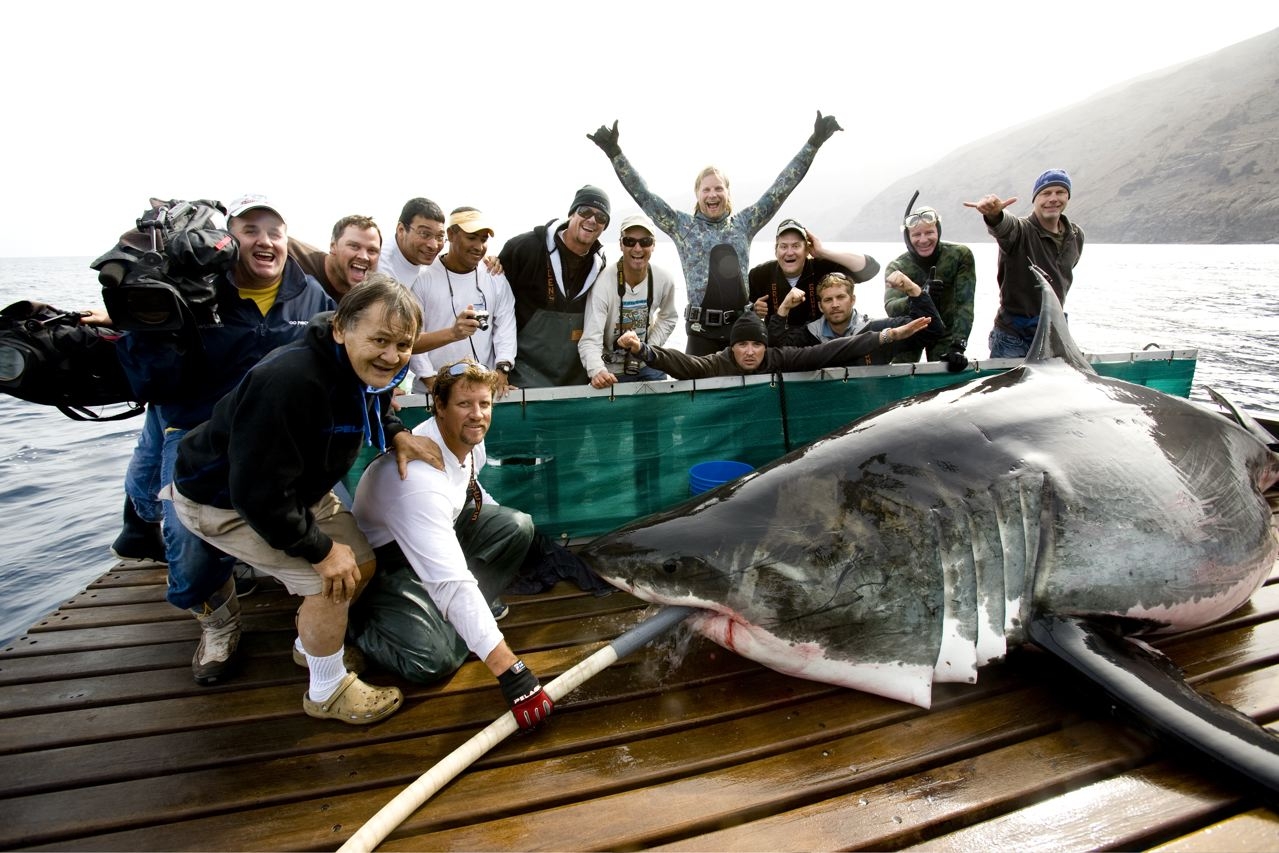 For the past few days we have been receiving an ongoing series of emails and phone calls from a variety of sources concerning an invasive SPOT tagging effort at the Farallon islands.
There was an apparent "tagging accident" this week covered in graphic detail by Bohemian Magazine.
SPOT tagging is a white hot issue within both the commercial shark diving community and shark research community. The SPOT tagging technique employs crews to catch white sharks with large hooks and to drill tracking tags into their dorsal fins.
A person identified as "Chris Fischer, owner Mothership Ocean, Expedition Leader," has been refuting and then negating the seriousness of the alleged tagging accident by responding to question asked of him by posters at this blog:
"On the anchor at the Islands now. Happy to report in that the first shark has pinged in 4 times and seems to be doing well. The second shark has also pinged in. Both are still in the area."
"We hooked two sharks this week. We were concerned about the first shark because the hook was a little deep. It was in the back of it's mouth, not gut hooked. We were able to cut the hook in half so it could roll out backwards, and left a part of it in the shark."
The Making Of Media Disasters
This is a classic example of a media disaster in the making for the tagging team at the Farallons and one that could be addressed by getting ahead of the negative and extremely graphic media that is surfacing around this incident.
Two issues need to be addressed immediately.
1. The full extent of the tagging mishap. Images, video, and a full accounting of this event as it transpired with nothing held back.
2. The role film and television productions had in this event if any.
The event was witnessed, photographed, and video taped by multiple sources so it cannot be hidden or downplayed. At stake is the reputation of a well known shark researcher and National Geographic television show about this teams tagging work set to air Nov 16, 9pm Est/Pacific.
The tagged shark is said to be "doing well" by this team. With the abject lack of transparency about the mishap to date we're now asking for "proof of life" to be added to the media list with the inclusion of a recent tracking map of all animals tagged including the first one.
This data should be independently verified by resident shark researchers from TOPP.
In a moment of media foresight this week we pointed to the unprofessional image of this group "high fiving and smiling" around a grounded shark at Isla Guadalupe and suggested "in the end these images will dog your continuing efforts for years to come."
Shark researchers have as much responsibility for media handling as any group that interacts with charismatic mega fauna and in the case of the team at the Farallons doubly so. We're not the only ones to point this out see also Mark Harding has a point.
Media transparency surrounding this event is critical for the sake of continued research with white sharks and for the public perception of invasive techniques for animal science.
Tuesday, November 3, 2009
"Oceans" That's French for "Beautiful"
 What began five years ago as an undersea voyage to document the blue earth will be on screens January 27th - and those that live on the earth part will never be the same again.
Oceans a film by Jacques Perrin and Jacques Cluzaud will be the defining underwater film of the decade.
The interactive website is a must see, and for those of you lucky enough to see the film release in January just remember we told you so.
Kudos to magnificent blue films.
Monday, March 16, 2009
Sea of Cortez - Production Adventure 8
 Good friend Captain Greg Grivetto of Horizon Charters is on another eco adventure and this time in the company of the BBC as they film their much acclaimed series,“Last Chance to See”. Biologist, naturalist, writer - Mark Carwardine and esteemed actor Stephen Fry host this series and will be aboard as we search for blue, sperm and humpback whales
For the next two weeks he'll be sending us his "notes from the field":
Well howdy sports fans, and welcome to Islas Cedros! After an absolutely beautiful ride north from Cabo San Lucas we made the power decision to stop on the north end of the "Big Island" for a bit of sanity and water sports!

Mark whipped up a scrumptious chowder while Aaron and Kyle jumped in to the briney aquamarine for a couple hours of fun. Aaron just arrived back from his dive sporting a large smile with stories of bullseye rays, huge kelp bass, batrays, octopii and much much more! Kyle is still out paddling about. Captain Greg might even jump into the abyss for a swim about...crazy!

If I sound a little loopy, well it's due to the 48 a** kicking we received after reaching the 24 degrees latitude line. Approximately 280 miles of "Hold on to your hats!" to be exact. I knew that 10 days of beautiful weather on our southern transit and then Sea of Cortez jaunt would be tempered by reality. So now we sit, debating the merits of stabbing forth into the ocean north of Cedros or possibly spending the evening, getting a few hours of normal sleep and then venturing forth en la manana. Hmmm...the second option sounds much better.

I'd like to say we saw a bunch of cool stuff on our way north, but the windows were so wet we couldn't see out so well. The goodship Horizon resembled more of a submarine than a boat! BUT alas, we did see a couple cool sites along the way; marlin on the Golden Gate Bank and then a tremendous amount of life as we ventured up Cedros' leeward side a couple hours ago. Shearwaters by the thousands, Pacific white-sided dolphin, sea lions and now on the beach just to our west, northern elephant seals. Cedros is an amazing island which has me wishing we had the time to venture up the islands Gran Canyon for a trip to the summit. The view from the top is breathtaking and worth the 2 hour trek!

I'll check in at our next calm weather anchorage with a report from Baja's northern Pacific coast!

Adios,

Captain Greg
Sunday, March 8, 2009
Sea of Cortez - Production Adventure 7
 Good friend Captain Greg Grivetto of Horizon Charters is on another eco adventure and this time in the company of the BBC as they film their much acclaimed series,“Last Chance to See”. Biologist, naturalist, writer - Mark Carwardine and esteemed actor Stephen Fry host this series and will be aboard aswe search for blue, sperm and humpback whales.
For the next two weeks he'll be sending us his "notes from the field":
We've all seen video and photo of the aerial majesty of the humpback whale. If you've not heard the song of the humpback you have probably lived in a cave since the invention of the hydrophone. But there is a difference between what you see and hear on television and true life experience.

From dawn to dusk we were surrounded by humpbacks that seemed to be as comfortable out of the water as in! At times we could look north, south, east and west with whales flying in every direction. There was more than one occasion when two to three whales from a pod would be out of the water in unison. It is a tremendous sight watching a 45 foot humpback become airborne!

Late morning we shut down Horizon's powerplant one final time and quietly deployed BBC's hydrophone to give a listen to our aquatic surroundings. The sound that emanated through the speaker system on our back deck...words do not do justice. I found an immediate smile on my face as did all present. Once again, to hear it on the tele and to hear it live are completely different.

The remainder of the day was spent with one pod of whales or another as we enjoyed an aerial ballet, tail lobbing and spy hopping. Time was spent with a cow and calf that produced melancholy results as Mark Carwardine felt that something may have been wrong with mama. She seemed lethargic and the calf was less than pleased, or it so appeared.As the sun dipped below the horizon a huge school of baitfish rose from the depths and with it a hungry school of mobula's, their wing tips breaking the surface as they attacked the frothing baitfish. It would SUCK to be named bait.

Tonight, our final night with BBC aboard, we are anchored off of San Jose del Cabo. After a fun night of name that tune, I'm off to bed with songs from the past swirling in my head and visions of flying humpbacks decorating my thoughts.

Everyday in the Sea of Cortez this past week has been magical. I can't wait to see what tomorrow holds!

Adios,

Captain Greg
Thursday, March 5, 2009
Sea of Cortez - Production Adventure 5
 Good friend Captain Greg Grivetto of Horizon Charters is on another eco adventure and this time in the company of the BBC as they film their much acclaimed series,“Last Chance to See”. Biologist, naturalist, writer - Mark Carwardine and esteemed actor Stephen Fry host this series and will be aboard aswe search for blue, sperm and humpback whales.
For the next two weeks he'll be sending us his "notes from the field":
We rolled into Santa Rosalia right at first light and set about drifting as the sun made it's way over the eastern horizon. Our 130 mile overnight journey to the offshore waters of the town that Eiffel built was in order to come in contact with the oceans ultimate predator...Humboldt squid.

Shortly after our arrival, California based squid researcher Scott Casselle met up with us and proceeded to give us all a valuable lesson on food web in-balance that appears to be a leading factor in the exponential Humboldt squid population explosion. "With the rapid decline in the predatory species, the voracious appetite driven rapidly reproducing squid are expanding unchecked toward a destiny that could lead to the collapse of many of the eastern Pacific Oceans species.", says Casselle. " The salmon stocks have suffered tremendously due to squid predation and rockfish species are not far behind. "

As Horizon's crew set up Scott's squid pen, local fisherman captured numerous squid and deposited them within the pen fastened to the swimstep of Horizon. Scott then donned his wetsuit and protective armor, which today consisted of a fine mesh stainless steel chain mail suit designed by San Diego based Neptonics. This armor is his "light" protection as during dives where he is to encounter large 5 - 8 foot  squid, he dons full protective plates to cover the majority of his body. And even with the heavy armor he has had his shoulder dislocated and his wrist broken on several occasions by the extraordinarily strong squid. "During one dive a squid grabbed my camera from behind me, and as any crazy photographer would do, I held onto the camera at tremendous cost. The squid yanked my arm over my head and dislocated my shoulder. I then had to fend off other squid with my free hand while keeping control of the camera with my bad arm. I was not going to lose my camera!".

Mark and Stephen had a long chat with Scott as he swam with the squid within the pen. As the cameras rolled we all got the sense that even though these animals are truly amazing, a solution to take care of their sudden expansion and overpopulation needs to be devised quickly before it is too late. The lessons learned today during our short stay with Scott will stick with all of us and will sharpen the focus of our message of conservation.

Our afternoon was spent traveling south through the placid waters north of Bahia Conception. It was a quiet afternoon full of thousands of birds foraging on small schools of baitfish. Within two hours of our departure I had spotted pelicans, cormorants, gulls, loons, boobies, shearwaters, petrals and terns. At one point a masked boobie gliding just over the surface of the water suddenly gained attitude as it spotted a small meal of undetermined nature. At that point it, and mind you this bird is cruising at 25 miles per hour, gained 5 feet of altitude and then plunged like a bullet into the Sea...at 25 miles per hour! Approximately 8 feet later it sprung out of the water doing 20 mile per hour, gained enough altitude to keep from dipping its wings, shook off the water with one shake and then started flying like nothing had happened! Absolutely the most crazy thing that I have EVER seen a bird do!

The afternoon only gets better. And "No" I'm not making this stuff up. About 30 minutes after the booby did it's crazy stunt we came upon a huge pod of bottlenosed dolphin, the likes that I in 30 years on the ocean, have never seen. There must have been 400 dolphin within the pod, a number usually reserved for common dolphin not bottlenosed. Mark Carwardine and I looked at one another and stated simultaneously that from a distance we had anticipated the pod to be common dolphin. They put on an amazing show, even better than yesterdays dolphin as up to 6 at a time would launch themselves 20 feet into the air in a side by side formation that would rival the Blue Angels!

I'm truly sorry about the expansiveness of this log, but today was freaking cool. Just thought I would share!

Until Tomorrow from Isla San Jose and the ancient whalebones,

Captain Greg
Friday, February 27, 2009
Sea of Cortez - Production Adventure 3
 Good friend Captain Greg Grivetto of Horizon Charters is on another eco adventure and this time in the company of the BBC as they film their much acclaimed series, “Last Chance to See”. Biologist, naturalist, writer - Mark Carwardine and esteemed actor Stephen Fry host this series and will be aboard as we search for blue, sperm and humpback whales.
For the next two weeks he'll be sending us his "notes from the field":
The M/V Horizon surf board, a true long board by all accounts. We're surfing our way south on a consistently blustery sea. The weather report for today was a bit better than what we are encountering but all in all not too bad as the sun is out, the weather is warming and yesterday afternoon I installed a pumping stereo amplifier for our onboard stereo system. We've got the XM satellite radio fired up on the boat and are rocking out as we finish up our ship board projects.

As I write we are at 25.41 degrees north and 113.17 degrees west or 88 nautical miles north of Bahia Magdalena and 465 miles south of San Diego. This also places us 60 miles offshore, or for those of you that have been to San Clemente Island, the same distance you travel when making the crossing from San Diego to San Clemente.

As the day progressed Mother Nature's attitude improved, the ocean warmed and the sea came to life! We happened upon 3 humpback whales today just north of Bahia Magdalena. The first was an energetic youngster that made itself know by repeatedly breaching, spyhopping and nosing out. The first breach was classic humpback, straight up, 2/3's of it's body out of the water, then twist and extend the pectoral flippers for added flare before flopping and making a big ol' splash!

We spotted the other two at a distance as we were taking a look at Bajo Thetis, an underwater seamount a few miles north of Bahia Magdalena. We're contemplating venturing to this seamount on future Baja dive expeditions and spent some time with the sounder on metering back and forth across the top of the bank getting a feel for it's layout. The water was a bit chilly today, 65 degrees, but there was an amazing amount of life on the bank with baitfish, presumably mackerel, filling the water column and bullet tuna feeding on other small delectables.

As the sun dipped below the horizon we were adjacent to Bahia Santa Maria, just north of Bahia Magdalena. Late tomorrow morning we will be rounding Land's End, Cabo San Lucas as we enter the Sea of Cortez. I'm excited about visiting Gorda Banks north of Cabo. This is the time of year when humpbacks are found there which means we might need to spend a few extra minutes taking in the sites.

Adios,

Captain Greg
Wednesday, January 28, 2009
Keeping and Eye on the "Moveable Feast"
 Something for all you natural predation people out there. Local California white shark hotspot, Ano Nuevo, has installed high definition Elephant Seal Cams on it's island.
As part of a HD failed venture to bring 24/7 wildlife programming to the world the camera system will allow the public and researchers to monitor these ungainly critters from the comfort of your desktop (ours is running right now).
For the shark world, you just may catch a natural predation, if you are lucky.
"I know how much positive correspondence we get from people all around the world who are absolutely captivated by the video. In New York, people said they would leave the video running on their desktop day in and day out because it was so refreshing to hear the sound of the elephant seals chattering," said Alan Friedman, chief information officer for California State Parks.
Click here for HD Seal Cam and good hunting!
Image:Lucky E-seal Isla Guadalupe survives shark attack. RTSea image
David McGuire, Filmmaker, Activist, Thinker
 This morning David McGuire posted an excellent and very well thought out look into the pitfalls of direct action animal campaigns when the greatest divide is cultural.
To distill this thought down, imagine 22 Chinese Americans waving protest signs outside a McDonalds directed at the predominately white customers inside. "Meat is murder" "Cows are killed inhumanely for this meat". You begin to see why this divide becomes almost impossible to bridge while the salient fact of whites telling Asians what they should and should not eat remains on the table for discussion.
That's not to say it cannot be done. Following the masters of the game WildAid and their campaign strategy of mass communication with members of the Asian community is effective. The subtext here is campaign effectiveness:
Having briefly observed and filmed the Chinese Flower Parade kicking of the New Year in San Francisco, I was amazed at the colors, smells and richness of the Chinese community. San Francisco has the largest Chinese Community in the USA, and a walk down Stockton Avenue is a walk into Asia.
A demonstration by the Shark Safe Project and aided by COARE approached shark fin soup restaurants and came out on the streets passing out information, but the shark activists were overwhelmed by the sheer magnitude of Chinese Americans flooding the narrow streets of Chinatown. Most passersby appeared indifferent, a few were angry, most just passed on without making eye contact. Even so, a hard core group of activists, many from out of the area gathered to pass out information for sharks.
Complete Post
Tuesday, January 20, 2009
L.A Times-Island of the Great White Shark
 From this mornings L.A Times Outpost Blog, for shark conservation fans in Southern California:
A reminder that a free screening of the documentary "Island of the Great White Shark," by RTSea Productions, will be shown at 7 p.m. Wednesday in the MLK auditorium of the Santa Monica Public Library. Filmmaker Richard Theiss, executive producer and cinematographer for the project, will be in attendance and will conduct a question-and-answer session after the film, as well as discuss his experiences filming great whites and other sharks. The screening of this 45-minute film is part of an ongoing lecture series sponsored by Heal the Bay's Santa Monica Pier Aquarium.
Theiss, who four years ago joined an eco-tourism charter to Mexico's Guadalupe Island and the surrounding waters to observe the great whites, became passionate about this subject and began documenting the work of shark researcher Mauricio Hoyos Padilla. The resulting film from this trip details the important role great white sharks play in a balanced ecosystem and also focuses on the marine scientists dedicated to studying and protecting these sharks.
"These are absolutely magnificent creatures living on a razor's edge of possible extinction. And there are some very dedicated people working tirelessly to prevent that," Theiss said. "This is a story that needed to be told."
Millions of sharks, including great whites, are killed each year for their fins, as accidental catches on commercial fishing vessels and for souvenir jaws and teeth.
Admission to the screening is free on a first-come, first-served basis. The main library is at 601 Santa Monica Blvd., with a pay parking structure available on 7th Street, north of Santa Monica Boulevard. For directions to the library, visit www.smpl.org/depts/branches/index.htm. For other information, visit www.healthebay.org/smpa or call the aquarium at (310) 393-6149.
-- Kelly Burgess
Photo: Great white shark off the coast of Guadalupe Island. Credit: Sharkdiver.com
Subscribe to:
Posts (Atom)