Commercial shark diving operations in South Africa are discovering the "industry media rule" first hand this week in a series of high profile media hits on baiting sharks and current S.A regulations.
"Thou shalt not allow or enable images and video that depict operations doing bad things with sharks"
Simple enough rule and yet too many industry members seem to forget that we live in a hyper connected media environment. An environment where videos and images of sharks smashing into cages, or worse, are transmitted around the world to waiting agenda based groups, and on to agencies tasked with providing the frame work and guidelines for our industries continued existence.
This weeks series of videos featuring white sharks thrashing against shark cages are another reason for operations to take a hard look at how they bait animals and why they are doing it.
Shark diving, done right, is a first class educational tool for thousands of divers worldwide. Additionally shark research efforts in tandem with operations helps the species with regional protections based on solid data.
Our industry has much to offer sharks in a time of profound shark crises. But only if operations can find their way past cheap stunt work with sharks and see the broader vision of sustainability.

The shark diving industry blog covering sharks, shark cage diving, shark conservation and things we find "amusing" since 2008 www.sharkdiver.com, www.sharkdivers.com, www.divingwithsharks.com
Showing posts with label shark chumming. Show all posts
Showing posts with label shark chumming. Show all posts
Wednesday, December 22, 2010


Saturday, December 11, 2010
Shark Attacks - Da Shark in Depth, on Target
 The recent shark attacks in Sharm el Shiekh have been unprecedented, causing many in the industry to question how, in the short space of a week, 5 swimmers were attacked leaving behind one fatality.
Industry generated analysis has been for the most part excellent, and yesterday Da Shark in Fiji wrote some of the best shark attack coverage and analysis yet.
Update: Two different pelagic species have been confirmed in these attacks.
We are leaning towards conditioning as a main driver for these attacks. A cargo ship carrying 120,000 head of sheep dumped an unknown number of dead animals several miles off the coast at Tiran Island in the weeks prior to these attacks. This carcass dump may have provided the floating conditioning opportunity, over time, to radically change pelagic sharks normal caution towards unknown objects in the water.
Da Shark on Sharm el Shiekh 2010
Time for a preliminary post mortem.
Like everybody interested in Sharks, I’ve been closely following the news tidbits trickling out from Sharm El Sheikh and the various opines in the media and the blogosphere.
There’s much of the usual fluff and idiocy - but there’s also some stellar stuff.
Take the “experts”. Whilst many prate and pontificate, I found this remarkable interview with Avi Baranes. Now THIS is the kind of person you gotta consult, a highly reputable Shark researcher who has been investigating those very waters for a very long time – and accordingly, the interview brims with factual information and quietly addresses and dispels the usual myths.
Bravo!
Equally noteworthy are the posts by Richard, by the SOSF and by Michael Scholl - however with some caveats that I’d like to address below.
Complete Post.
Sunday, December 5, 2010
Shark Attacks in Sharm el-Sheikh, Interview with Red Sea Diving College
 Another tragic shark attack in the waters off Sharm el-Sheikh, this time fatal, prompted us to interview a local dive shop in the region via SKYPE today.
The mainstream media's coverage has been typical, covering these ongoing attacks with no real background or substance.
Obviously something has changed in the region and with the sharks off Sharm el-Sheikh.
We chose Red Sea Diving College, a 20 year dive industry veteran, and for the past 4 years winner of the "Best Dive Center Award".
We interviewed dive center manager Jochen Van Lysebettens who has been diving Sharm el-Sheikh for the past 5 years to get a better idea of what is happening on the ground level.
Ocean and beachfront based tourism in Egypt accounts for $10 billion dollars of the Egyptian economy. The stakes for these recent shark attacks cannot be understated or underestimated.
Worldwide, shark attacks resonate though the entire shark diving industry, four attacks in one region and in one week are "unprecedented".
Jochen was forthcoming and frank. In his opinion "something must have triggered these attacks". He is also a pro-shark and pro-industry advocate with a deep understanding of conservation and the impact these unfortunate attacks have on the perception of sharks globally.
Interview with Jochen Van Lysebettens
Shark Diver: So, there's a lot of media focus on the shark species responsible for these attacks with Oceanic Whitetips (Carcharhinus longimanus) being the prime culprit here. What's your take, is this the species responsible?
Jochen Van Lysebettens: A diver took a some pictures of Oceanic Whitetips in the area of the first shark attack minutes before it happened, so I am comfortable that is was an Oceanic responsible for the first attacks. There has been no positive identification on the fatal attack yesterday.
Shark Diver: How rare is this for Oceanics to be behaving in this manner in and around Sharm el-Sheikh?
Jochen Van Lysebettens: Very, very rare. Oceanics never attack divers, they are curious in the water, but we just do not see this kind of behaviour, we also don't bait the sharks.
Shark Diver: So what is happening in Sharm el-Sheikh, what's the word on the street, what are the local dive shops talking about?
Jochen Van Lysebettens: There are rumors, Chinese whispers, of sheep floating in the water.
Shark Diver: Sheep in the water? How does a sheep get in the water?
Jochen Van Lysebettens: One instructor from another dive shop says he saw a dead sheep floating in the water a few days before the first attack, could have been transported and fallen into the water. Is it chumming or not, I do not know. But, as I said these are rumors only.
Shark Diver: What about the targeted shark killings by the Egyptian government? Was that necessary? What has been the local response?
Jochen Van Lysebettens: We are against it, all the dive shops are against it. Publicity killings. Public relations. When the shark killings started by another government agency we, along with other dive shops, contacted The Chamber of Diving and Watersports and they put a stop to it right away.
Shark Diver: They killed two sharks looking for evidence of the attacks, what was your alternate plan?
Jochen Van Lysebettens: The CDWS gathered together 40 dive instructors from all the dive shops and conducted a complete dive survey of the attack sites, looking for anything that might indicate a trigger for these attacks. We spent time in the water observing the sharks and looking at everything.
Shark Diver: Did they find anything?
Jochen Van Lysebettens: N0 they didn't, but we did stop the publicity shark killings, we are totally against any shark killings in Sharm el-Sheikh.
Shark Diver: After yesterdays fatal shark attack on a German swimmer, what's the next step?
Jochen Van Lysebettens: Tomorrow we will conduct another complete dive survey, this time with 40+ dive instructors in the water. Something triggered these sharks.
Shark Diver: Is that is what your gut is telling you?
Jochen Van Lysebettens: Yes, I am convinced something is triggering these sharks, the next step is to have a marine biologist come in and have a look at the area, maybe he can get some answers for us.
Shark Diver: In your opinion how has the mainstream media handled these tragic events?
Jochen Van Lysebettens: The coverage has been good and bad. It's important for the media to include a marine biologist or someone to defend the sharks. People do not have to be afraid of sharks.
Shark Diver: I know you have a lot of work ahead, what's your takeaway quote for now?
Jochen Van Lysebettens: Humans enter into the sharks territory, we want to keep shark encounters natural and safe.
Our impression from this interview was that the dive shops in Sharm el-Sheikh are fully invested in finding out why their sharks are behaving in this manner and are very pro-shark. As time moves forward we will get a better understanding of what, if anything, triggered the sharks. In the meantime dive operations are defending these animals from the kind of knee jerk government response that would have them fished out of the water.
Update Email:
From:Randa
RE:Dead Animals
TO me it is amazing after several reports and testimoney of dive guides, that hardly anything has been mentioned about the dead livestock dumped overboard by a transport ship, which has occurred several times in the past month. The hotel of the diving center where I work in Sharm el Sheikh found dead sheep on the washed up on the beach about 2 weeks ago, and dive guides reported seeing dead sheep in the water in the Strait of Tiran, which is near to the location of the attacks. Although the information about the dead livestock needs to be confirmed, it to me makes the most sense about the behavior of the sharks. Having dead livestock dumped in the water over the course of a 1 month period or more would be equivalent to feeding the sharks. The types of food that people sneak into the water, such as boiled eggs and bread is not attracting sharks, but dead livestock definitely would do the job.
Friday, October 15, 2010
Shark Tourism Under Siege - Hawaii
 When chumming becomes illegal, shark tourism operators often find themselves in a tough battle for legitimacy:
KHON2 Hawaii
A debate that has churned in waters off Oahu's North Shore headed to court today.
Five men are charged with shark feeding.
Opponents of shark tour operations on Oahu's North Shore claim the practice endangers lives.
"We're all surfers, canoe paddlers, and it's a big public safety issue. And it's not because we're anti-business, if they want to conduct their business, then do it legally and stop feeding the sharks," Mahina Chillingworth of Hui O Hee Nalu.
"The shark tours pose no threat to humans, no threat to the sharks. What we have here is a form of eco-tourism which has really been a boon to the state," said attorney Tom Bush.
A handful of shark feeding opponents were at the Wahiawa courthouse to make sure their message was heard.
"We have thousands of signatures from people on the north shore community that oppose this shark feeding," said Chillingworth.
"There is absolutely not one shred of any evidence to show that these shark tours are not in any way , shape, or form endangering anyone," said Bush.
Complete Story.
Tuesday, February 16, 2010
Shark Tournaments - Change From Within
 How do you effect conservation change?
That question is the million dollar or million shark question depending on which side of the conservation fence you are currently sitting.
Smart conservationists know that conservation change, real and long lasting change, does not come from direct action, protests, or petitions.
Conservation change comes from new ways of thinking, alliances with forward thinking individuals and groups, and effecting change from within.
That's why we support the Guy Harvey Ultimate Shark Challenge.
We know hard core shark folks will decry the "support" of any shark tournaments but the bottom line is this - until today no one had taken a leadership role combining shark research, shark conservation, and catch and release into a certified tournament model. A model that will soon become the accepted tournament model to replace the 300 or so catch and kill tournaments currently operating in the USA.
Think about it.
Shark tournaments will not stop because they are money making propositions. Asking anyone to stop making money is hard, demanding that they stop without a sustainable replacement is a fools errand.
To change the shark tournament world you will first have to come up with a tournament model that is so successful that everyone will want to copy it.
Kudos to the team from the Guy Harvey Ultimate Shark Challenge, and to Guy and his crew for supporting the evolution of shark catch and release tournaments in the USA.
Taking "marlin tournament model" into the world of ongoing shark research and conservation is the way you effect conservation change.
Sunday, January 31, 2010
Rare Conservation Window - NJ Shark Fishery
 Sometimes government can act on the behalf of sharks without even knowing. Just such a limited window of opportunity is happening now in NJ where unsigned bills allowing new fishing regulations for sharks might prohibit the entire 2010 sport caught shark fishing season.
A successful and savvy conservation lead campaign would have a remarkable effect at this time:
New Jersey fishermen could see a shutdown of the summer shark fishery - and the suspension of big money shark fishing tournaments because a two year old revision of the state's marine fishing regulations was not approved before former governor Jon Corzine left office, industry advocates say.
Now they are afraid the regulations could be delayed again by Gov. Christie's declaration of a 90-day moratorium on new regulations and rulemaking.
"Because of Governor Corzine's failure to act on the package, New Jersey is facing a potentially damaging shutdown of our shark fishery," the Recreational Fishing Alliance says in a letter sent today to the governor's office.
The Atlantic States Marine Fisheries Commission is scheduled to meet in Alexandria, Virginia, from February 1-4, and during those meetings New Jersey is expected to be voted out of compliance on our shark regulations, which will begin the process of shutting down our shark fishery.
Complete Story
Thursday, May 14, 2009
Law, Ethics, and Trophy Fishing
 When not dropping incendiary F-Bombs at all manner of environmental offences and those few individuals who actually deserve a few F-Bombs thrown at them, the Chum Slick Blog (written by an actual shark) does have some great thoughts.
This week was no exception. We feature the Chum Slick at this blog for two reasons:
1. His ability to throw a mean "F-Bomb for a cause"
2. On target bomb throwing
The subject of a recent shark kill for a record book notice has galvanized many within the industry to seek change. That change is brought about by voices in the wilderness who stand up and say "enough is enough".
Tuesday, April 28, 2009
Hawaii Shark Diving - An Angry Mob
 With the news coming out of Hawaii for existing commercial shark diving operations sounding grim, the old adage "a good offence" is "good advice".
Still buzzing from a failed commercial roll out last month, islanders and the Hawaii Kai Neighborhood Board will decide tonight on a resolution measure that will ask for the closure of all shark diving activities in Hawaii.
The same pitchforks and flaming torches anti-shark diving "resolutions" that forever closed commercial operations in Florida back in 2001. This is the most serious challenge to commercial shark diving seen in many years and operators need to move fast now to head off possible closures at the hands of those few who see commercial shark diving as negative. Chumming data from credible sources worldwide exists to counter many of the arguments, but this challenge will not be met in public meetings, the media will decide the fate of operations on these islands.
Food for thought - and a clarion cry for serious and lasting action:
The Hawaii Kai Neighborhood Board will consider a resolution to support a
statewide ban on commercial shark tours during its meeting tonight.
The meeting begins at 7 at Hahaione Elementary School.
The resolution is in response to community opposition to a proposed shark
tour operation outside Maunalua Bay, and to questions raised about the
legality of existing shark tours on Oahu's North Shore.
State and federal laws currently prohibit feeding sharks within 200 miles of
shore.
More than 300 people attended a community meeting on the issue at Kamiloiki
Elementary on April 16. Opponents of shark tours said that sharks learn to
identify the sound of vessels that have chummed the water, that chumming
causes sharks to associate feeding with humans, and that sharks have been
observed to follow shark tour boats back toward shore.
The Hawaii Kai Neighborhood Board resolution calls for "city and state
legislation to effectively ban commercial shark tours in Maunalua Bay and
throughout the state."
To close existing loopholes, the resolution also calls for legislation to:
"(1) prohibit use of public facilities such as parks, piers, ramps, and
harbors by shark tour operations; (2) prohibit advertising of commercial
shark tours in any print and electronic media; and, (3) prohibit commercial
use of shark cages or other devices designed to place humans in close
proximity to sharks or within shark habitats."
The public is invited to attend the meeting and offer testimony.
Complete Story
Monday, September 15, 2008
The Chumming Debate
 From the Blog Gansbaai-News today the issue of "chumming" in South Africa. This is one of the better pro shark looks into this issue. It also highlights the need for pro industry PR:
Blood and Guts
Different perspectives on attracting sharks using chum and bait.
Perceptions are interesting, all depends on where you are coming from.
Underwater photographers always want that great photo, and here is veteran photographer, Steven Frink’s take on bait :
“Speaking of chum (called “burley” in this hemisphere, as in “hurly-burley”, as in “puke”), Rolf had the good stuff. Tuna gills full of blood and stomachs still holding sardines, plus a blood and tuna oil secret-sauce added to the mix. In my opinion, scrimping on bait on a white shark charter is a crime. One can spend thousands of dollars and days of their life travelling to where great white sharks are, spend big bucks on charter boats to find proximity to great white sharks, only to find yourself out at sea with desiccated fish carcasses that no self-respecting shark would eat. The right bait is a critical component of white shark photography.”
Steven also says:
“As important as the quantity was the quality of the action, for these were players. These sharks were not put off by bubbles, or proximity to the cage, or sunshine, or lack of sunshine, or the profile of the boat, or the size of the wave, or the colour of my jacket. All of these and more have been offered as excuses by various shark wranglers at various times in various places as to why the sharks won’t come close to the boat. But here we had good bait, sharks eager to take it, and savvy wranglers able to lure the sharks close to the cage.”
Steven Frink is based in Florida, USA and he is describing a trip he did to Australia.
It is worthwhile noting that Steven had been to South Africa twice between 2001 and 2004, and did not not get that special day. On the other hand, he had also got skunked in Australia. Twice. Third time lucky ? The point of this is not to try and compare Gansbaai with Port Lincoln.
The issue here is the chum and the bait. Clearly photographers like Steven want lots of nice bait, they demand it.Californian Sean Van Sommeran is a fierce critic of Gansbaai cage diving operations, particularly the way baits are used. His standard line is ” don’t feed the wildlife”.
He does not want baiting to take place, not because he thinks sharks are being taught to attack people, but because of possible entanglements and resulting injuries to the sharks.
Unlike Steven Frink, Van Sommeran has never been to South Africa or Gansbaai, he was mainly relying on what self styled ” shark researcher ” and “expert” Craig Ferreira was telling Sean’s “envoy”, or rather his buddy that then went back to California and gave Sean his own warped ideas.
Later Van Sommeran decided that well known False Bay operator Chris Fallows was doing it exactly right, and held Chris up as an example of how things should be done.
Ironically, and apart from towing a decoy at sunrise, the methods of Gansbaai operators and False Bay operators are identical. It seems Van Sommeran is extremely jealous of the fact that South Africa, and particularly Gansbaai became the number one White Shark destination in the world.
Van Sommeran claims to be concerned about the conservation of White Sharks and over the years had a great deal to say about how terrible the Gansbaai operations are, his main concern was injuries to White Sharks .
Yet, and this is very strange… In more than 10 years he has never ever said anything, not one single word about the biggest threat to White Sharks in South Africa.
The Natal Shark Board netting programme.
One of the biggest killers, if not the single biggest killer of sharks on the South African coastline. That is apart from turtles, whales and dolphins.
In 10 years .. Not one a singleword about this from Sean van Sommeran! He claims to know what is happening in South Africa.. Yeah right Sean.
In South African White Sharks Cage Diving operations the aim is not to create shark action by feeding the sharks.. On the contrary , the sharks are not fed.
The sharks do manage to steal baits, particularly if the sun is coming in at an angle and the water is murky. It is important to note that there is no feeding effort taking place, crews do their best to keep the sharks from taking the bait.
The University of Cape Town has an excellent Oceanography Department.
Their web site is here : http://www.sea.uct.ac.za/index.php
On this web site they have a poll :
“There is much debate surrounding the increase in shark attacks occurring around the coast of South Africa. A possible reason is that it is a result of the ‘baiting’ of sharks during Shark Cage Diving activities.
Do you think that Shark Cage Diving is responsible for the increase in Shark attacks?”
About 70% of participants voted Yes, that Shark Cage Diving is responsible for the increase in shark attacks.
Oops, but what is wrong here ?
INCREASE IN SHARK ATTACKS ?
Unfortunately there has been NO INCREASE.
Imagine , a well respected University Department of Oceanography , having a little poll on their web site based on factual mistakes.
This example illustrates the perceptions that are out there, and it is clear that the South African Cage Diving Industry need to increase their PR effort.
The truth of the whole matter is that the cage diving operators are actually restricted on the amount and type of bait they are allowed to use.
No part or blood from any mammal may be used. This includes all land animals as well as seals, whale blubber or any blood or part of any sea mammal.
The operators are restricted to fish , this mains mainly sardines and tuna. They are also restricted to how much ( expressed in kilograms) they may use on a given day. For now this is all that I am going to say about this issue, comments are welcome, and I am quite sure that this topic will be examined in full detail.
Editors Note: Nicely written!
Monday, September 8, 2008
Isla Guadalupe 2008 chum ban update-Another vessel boarded
 We have been keeping track of the chumming ban at Isla Guadalupe and as we have been reporting the situation this year is extremely fluid.
Recently one of the operations on site sent out an ill timed newsletter talking at great length about their continued chumming efforts at the island.
This came after the MX Navy had boarded all vessels on site in August and had clarified that "no chumming" was in effect. The L.A Times ran with that newsletter this weekend and this morning the Solmar V was boarded by a team from SEMARNAT "Mexico City" and the MX Navy.
Here is an except from an internal email we got this morning:
Note: Due to the volatility of the following email we have been asked to paraphrase it.
Sent: Sep 8, 2008 1:15 PM
Subject: guadalupe island boarding
Solmar V was boarded told not to chum by the MX Navy today. They pulled their cages and were doing island tours with their clients. The charter master has serious concerns about future operations at this site.
Editors Note: We'll keep you updated by the minute as things develop. All vessels are effected at this site at this time. Feel free to call us if you have any questions.

Saturday, September 6, 2008
Guadalupe a gathering place for great white sharks-disconnected
 L.A Times writer Peter Thomas came out with a blog post this week reviewing a recent newsletter from one of the operations on site who make no bones about their ability to conduct "shark chumming". The newsletter includes images of chumming and several references to sharks eating hang baits.
As we have been reporting according to the MX Navy who were at Isla Guadalupe at the start of the 2008 shark season, chumming has been banned:
1. Chumming banned 5.10.2008
2. Trip update 8.20.2008
This month Scuba Diving Magazine picked up the chum ban and went into some detail on this issue. So, the question is, what's the deal?
As we have been looking into this it seems there's the beginnings of a shift. Mexico's Navy says one thing and certain vessels that operate out of Mexico openly and blatantly do another. The vessel in question was boarded by the navy in August and according to the navy told the same thing as US vessels "no chumming". The implication here is that this vessel has acquired the sole permit to chum while the rest of the fleet has not. It's an interesting claim we would like to see that paperwork-and run it by the navy.
We wish we had some sort of definitive answer for you. We can say that according to the navy the chum ban is still in effect, no operation has received permits to discharge, although as this is Mexico, everything is just a signature away.
Hat Tip: Image Derek Heasley
Wednesday, August 20, 2008
Isla Guadalupe Trip Update 8.20.2008
 The old saying "It aint' over till the fat lady sings" was in full force today as the Mexican Navy arrived and proceeded to board all the vessels at Point Norte, Isla Guadalupe.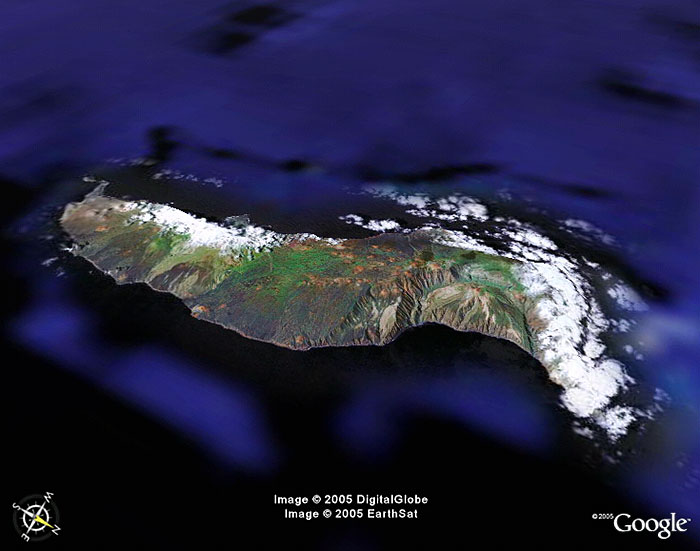
This is what we had feared. The final edict after many months of back and forth conversations and negotiations with various government agencies was absolutely "No Chumming".
Unfortunately Mexico has chosen to deliver this final message on site and at the beginning of the 2008 shark diving season with an actual Navy Frigate.
This leaves us as eco tour operators in an unusual spot and our divers wondering what's next?
In the short term no chumming means that while sharks will be seen this year (they are extremely curious animals and will come-non chummed-to the cages) we will be slower than usual. That's the short term.
The long term prognosis is grim indeed. Mexico needs shark tourism, it also needs to be benefited by shark tourism. Right now it is not benefiting. Right now divers pay the equivalent of $20.00 USD for permits to enter the Bio Sphere and that's it. They should be receiving a whole lot more. We're in full agreement with those within Mexico who see it that way.
Additionally, the very real specter of rampant shark fishing at this site once shark diving operations fade away is something that must be contended with. You may say it would never happen here, but 2.5 tons of shark fins were taken from the Socorro's this spring-right under the nose of the Mexican Navy base stationed at that Bio Sphere.
This is a clarion call. If Mexico is successful in essentially gutting the relatively nascent 3.1 million dollar white shark dive tour industry and these vessels cannot continue to educate divers, support field research, and continue operating in a sustainable manner-we will lose upwards to 30% of the entire Western Pacific White shark population to shark fishing in a matter of two years.
Left to their own devices shark fishermen have a strong financial incentive to harvest sharks even within protected Bio Spheres. We will submit to you that Mexico's government has their guns turned on the wrong people at this point.
Subscribe to:
Posts (Atom)