Thursday, April 15, 2010

Sharks International Conference

The organising committee for Sharks International would like to extend an invitation to attend this one-time event being hosted in Cairns, Queensland, Australia from 6-11 June 2010.

The aim of this conference is to provide a forum for the world’s leading shark and ray experts, along with students and up and coming early career researchers, to come together to share ideas, update information and report on the progress of the most recent scientific studies in the field of shark and ray ecology.

As these species become more affected by human and environmental factors on a global scale, international approaches to their study and management will be increasingly important. This conference is a first step in encouraging and developing international linkages between researchers from various regions.

To register for this event.

Massachusetts White Sharks - Research Talk

Aquatic biologist John Chisholm will discuss the Massachusetts Shark Research Program for the Division of Marine Fisheries on Friday at 7 p.m. at the Old Methodist Meeting House, Main Street, Wareham.

Chisholm will discuss the occurrence and biology of white sharks in waters in and around Massachusetts.

For more information, call 508-295-0211 or visit www.warehamland.org.

Shark Truth - Grassroot Efforts

My name is Claudia and I am the Founder of Shark Truth. We are a grassroots nonprofit promoting awareness around shark fin soup in the Chinese community.

Our goal is to Stop the Soup at wedding banquets (where shark fin soup is most popularly served) through our 'Happy Hearts Love Sharks' international wedding contest we just launched. We are looking for partners to give us a hand in promoting the contest - would you be interested in sending a message out to your network (blogs, newsletters, Facebook or Twitter)?

Happy Hearts Love Sharks


Wedding Contest 2010

Did you know that a wedding banquet serving shark fin soup to 300 guests can kill up to 30 sharks?
Through the 'Happy Hearts Love Sharks' wedding contest, we will reward couples who submit a video or photo entry of their pledge to Stop the Soup at their wedding banquet and promote shark fin soup alternatives.

Couples can enter now for a chance to our International Grand Prize: a waterproof digital camera and an adopt-a-shark package. The first 5 international couples to enter the contest will get the beautiful coffee table book “Sharks Up Close”, which captures the majestic, beautiful shark in photography.

Contest closes May 9th, 2010


Registration and contest details at http://sharktruth.com/wedding


Questions and comments? Email wedding-contest@sharktruth.com

Stop the Soup - Spread Shark Truth
http://sharktruth.com
http://facebook.com/sharktruth
http://twitter.com/sharktruth


Attached is a pamphlet file you can feel free to spread widely through your networks! More goodies can be downloaded here: http://sharktruth.com/media/media-kit

If you want to help us Stop the Soup or if you have any questions, please feel free to contact me directly. Shark Truth look forward to hearing from you!


Claudia Li, BBA
Founder & Co-Chair | Shark Truth

Saturday, April 3, 2010

Hawaii - Shark Fin Bill 2169 and what's in it

Complete and revised Shark Fin Bill SB 2160bill here.

Add your voice to this important issue here with an email or phone call this week.

A BILL FOR AN ACT

RELATING TO SHARK FINS

BE IT ENACTED BY THE LEGISLATURE OF THE STATE OF HAWAII:
SECTION

Sharks are one of the top predators in the marine food chain and play an important role in our ocean's ecosystem. Sharks have characteristics that make them more vulnerable to overfishing than most fish, and data from state, federal, and international agencies show a decline in the shark populations both locally and worldwide. Unlike other fish species, most sharks do not reach sexual maturity until seven to twelve years of age and then only give birth to a small litter of young. Thus, sharks cannot rebuild their populations quickly onnce they are overfished.

The practice of shark finning, where a shark is caught, the fin is cut off, and the shark is returned to the water, causes tens of millions of sharks to die a slow death each year. Some sharks starve to death, others are slowly eaten by other fish, and some drown, because most sharks need to keep moving to force water through their gills for oxygen. Shark fins are the principal ingredient in shark fin soup, and the demand for the delicacy has skyrocketed in recent years.

Despite state and federal laws to ban the practice of shark finning, fishers continue the practice on a massive scale. Since 1972 the number of blacktip sharks has fallen by ninety-three per cent, tiger sharks by ninety-seven per cent, and bull sharks, dusky sharks, and smooth hammerheads by ninety-nine per cent. The rapid reduction of sharks is disrupting the ocean's equilibrium.

Sharks are an essential element of the ocean's ecosystem, and by reducing the demand for shark fins, Hawaii can help ensure that sharks will not become extinct.

SECTION 2. Chapter 188, Hawaii Revised Statutes, is amended by adding a new section to be appropriately designated and to read as follows:

Shark fins; prohibited.

(a) It shall be unlawful for any person to possess, sell, offer for sale, trade, or distribute shark fins.

(b) Any person violating this section or any rule adopted pursuant to this section shall be subject to:

(1) Seizure and forfeiture of shark fins; and
(2) An administrative fine of not less than $5,000 and not more than $15,000. In addition, the violator may be assessed administrative fees and costs, and attorney's 1 fees and costs.
(c) The department may adopt rules pursuant to chapter 91 necessary for the purposes of this section.
(d) For the purpose of this section, "shark fin" means the raw or dried fin of a shark with the shark carcass removed."

SECTION 3. Section 188-40.5, Hawaii Revised Statutes, is repealed.

Sharks; prohibitions; administrative penalties.

(a) No person shall knowingly harvest shark fins from the territorial waters of the State, or land shark fins in the State, unless the fins were taken from a shark landed whole in the State.
(b) Any person violating this section or any rule adopted thereunder shall be subject to:

(1) Seizure and forfeiture of shark fins, commercial marine license, vessel, and fishing equipment; and
(2) An administrative fine of not less than $5,000 and not more than $15,000. In addition, the violator may be assessed administrative fees and costs, and attorney's fees and costs.

(c) Any criminal prosecution or penalty imposed for violation of this section or any rule adopted thereunder shall not preclude seizure and forfeiture pursuant to chapter 712A, or the imposition of any administrative fines and costs or attorney's fees and costs under this section.

(d) This section shall apply to the following vessels when fishing outside the territorial waters of the State:

(1) Vessels that hold a fishing license or permit issued by the State as a prerequisite to participation in the fishery, or that have owners or captains who hold a fishing license or permit issued by the State as a prerequisite to participation in the fishery;

(2) Vessels that are registered under section 200-31; or

(3) Vessels with federal documentation that lists as a homeport a location within the State;
provided that the enforcement of this section on these vessels outside the territorial waters of the State shall not apply if enforcement of this section is in violation of, or in conflict with, federal law.

(e) Notwithstanding anything to the contrary, this section shall apply only to vessels that off-load cargo in the State or its territorial waters.

(f) As used in this section:

"Land" or "landed" means when the shark or any part thereof is first brought to shore.

"Shark fin" means the raw or dried fin of a shark with the shark carcass removed.

"Whole" means the entire shark with its head and flesh intact, allowing for the removal of the blood, internal organs, and tail at sea."

SECTION 4. Statutory material to be repealed is bracketed and stricken. New statutory material is underscored.

SECTION 5. This Act does not affect rights and duties that matured, penalties that were incurred, and proceedings that were begun before its effective date.

SECTION 6. This Act shall take effect on July 1, 2010.

Thursday, April 1, 2010

Undersea Voyager Project - Alarming Squids

Back from the Sea of Cortez with a small crew filming Dosidicus gigas Scott Cassell sent in this front line eye opening expedition report on the health of our oceans:

Hello All!


I just returned from Baja after leading (and Presenting) an expedition for a National Geographic documentary on Humboldt Squid (Dosidicus gigas). I am not at liberty to discuss the documentary itself but I can tell you that all of my experiments were very successful especially the primary experiment.


The Primary Experiment was simple in concept but proved very challenging to accomplish. Tom Loomis, Sid Mitchell and I designed the experiment last fall as follows:


Take a real Salmon to an environment where no Salmon occur and present it to Humboldt Squid (Dosidicus gigas) as naturally as possible (suspended by invisible monofilament line from a blacked-out frame supporting the Salmon in a swimming posture) to see if the Dosidicus gigas would investigate it as a prey item, stalk it, attack it and eat it.


Sounds simple enough.... right?


Actually executing the experiment proved more difficult than expected due to a couple of pesky factors.


First - The region we worked in was Bahia De Los Angeles where a large increase in Dosidicus gigas density occurred simultaneous to the sudden disappearance of the squid in Santa Rosalia (which is normally where I work with friends (Pangeros that commercially fish for the Calamar Gigante... Dosidicus gigas) and they know the Dosidicus gigas behavior very well).


The fishermen in Bahia simply didn't know where to look in the daylight for Dosidicus gigas forcing us to work at night.


Second - The Dosidicus gigas were repulsed by white lights. During my night dives next to the Salmon I bathed it in white lights waiting to capture images of the Dosidicus gigas predating on the Salmon. Trouble is no one came. After 45 minutes I turned off all my lights and just hung in the dark alone with the Salmon. In moments I could see well enough to see dozens of Dosidicus gigas’ as their movements stimulated the algae to emit beautiful bioluminescence illuminating the Dosidicus gigas patrolling in a sphere all around me. Then a few came it fast and hit the salmon so I instantly turned on my lights to film them and they released the salmon and quickly faded out of light-range leaving me without the shots.


Third - When the Dosidicus gigas shoals were found we would deploy the Salmon but by the time the rig was in the water the Dosidicus gigas test subjects would swim off searching for food.

Our Solution; We had to figure out how to do an effective test while keeping the Salmon in the most natural situation possible. Then I remembered a prototype LED True-Red emitting light head that Deep Sea Power & Light (DSP&L) had asked me to test. I never thought about using it because by itself it did not emit enough light for my Sony EX-3 to see well enough to film with. Then I remembered that, right before this expedition, DSP&L loaned me a new low-light camera head that could transpose red-light into normal light spectrum image. So we modified the Salmon rig to support the camera and Red LED light 24” above the Salmon and removed the underwater cameraman (ME) from the equation making it an even more natural appearing situation.


We then went out to the ‘squid grounds’ and quickly found a Dosidicus gigas shoal and deployed the new Salmon rig. Within just minutes of submerging the rig (it did not have time to be lowered to it’s target depth of 60 fsw) it was hit by perhaps a dozen Dosidicus gigas reducing the poor 20 lb Salmon to non-existence in seconds. The Red-LED light was obviously either not seen by the Dosidicus gigas or not intrusive enough to quell their feeding ferocity. The entire event was recorded.


Why is this so significant?


The Dosidicus gigas are going to render the Pacific Wild Salmon species extinct (and possibly several more) within a few years and the scientific and government leaders refuse to take notice.


There has been much dispute over eye witness accounts from commercial Salmon fishermen that Humboldt squid were decimating the returning Salmon populations. Some scientists, media, politicians, California Department of Fish & Game and others have dismissed the Salmon fishermen’s claims and blamed many other factors for the historic decline of the Salmon.


We now have indisputable evidence that Dosidicus gigas will hunt, kill and eat Salmon even if the Dosidicus gigas have not encountered the ‘new’ species before.


With evidence in hand, I intend to rattle some cages and get the problem noticed. The end of this story is grim. With the historic decline of Tuna and Shark species the high fecundity of the Dosidicus gigas has reached wild-fire proportions.


Each Dosidicus gigas many rear up to 20,000,000 eggs and with fewer and fewer predators to keep them in check a massive and historic population explosion has already occurred and is about to reach world-wide plague proportions. The squid now reach as far as the Philippines, Japan, Sitka Alaska, Tierra Del Fuego, Chile and just yesterday for the first time I learned they are now in the Atlantic Caribbean region. To put this in perspective in the 1940’s they were only know to be off the Northern Pacific Coast of South America.


We must stop eating tuna.


We must stop eating sharks.


We must stop eating krill.


We need to eat Dosidicus gigas at an unprecedented rate.


We need to invest in new and environmentally empathetic fish farming methods.


We need to change our self image to that of a culture that leads the world by example.


Help me get the word out by sending me info on major groups and individuals that can have a voice.


The bottom line.


Simply protecting the Oceans is a death sentence for the seas of life. Even if completely successful now... a great multitude of Oceanic chemistry and ecosystems would still fail very soon.


We are now entering a time of historic environmental collapse that will shape human kind’s future and very survival. America must become the steward of the sea, repair damage and lead by example, instead of being the monster consumers we are.


I implore each of you to please become deeply involved in exploring how to change our path of eating fish, how we use energy and our waste production.


Over the next year I will be developing a new program, in collaboration with the Undersea Voyager Project, to investigate and report the condition of the seas and present methods and ideas for tangible change to repair the Dying Oceans.


Non-action is no longer a luxury we can afford. That time has passed.


I wish us all health, wisdom and courage.


Yours truly,


Scott Cassell
CEO
& Founder
Undersea Voyager Project
www.underseavoyagerproject.org

Wednesday, March 31, 2010

NIWA - White Sharks Deep Water Critters

As it turns out white sharks set even deeper diving records than first recorded with this weeks stunning news from NIWA, the National Institute of Water and Atmospheric Research in NZ.

“A big shark called ‘Shack’, the biggest shark we have tagged, at 4.8 metres, has set the world’s deepest great white shark dive record,” says NIWA Principal Scientist, Malcolm Francis. “And he made several other very deep dive records between 1000 and 1200 metres while crossing the ocean. Prior to this, we had recorded several at around 1000 metres, so it’s quite a substantial extension.”

NIWA's recent press release is a template for data sharing and once again reveals that New Zealand's white sharks are unique.

Complete article here.

Image: White shark from Isla Guadalupe, Mexico.

Monday, March 29, 2010

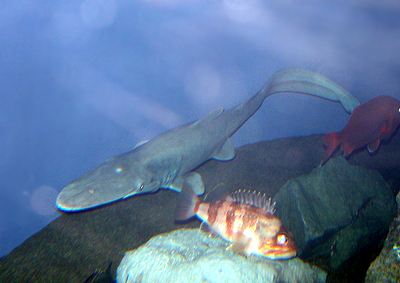
Goblin girl on... a new goblin shark held in aquarium!


Now is the season for goblin sharks! Before I continue to tell you about the exciting adventures of Goblin girl and Goblin boy, I just want to update you on the news that Tokyo Sea Life Park again has a young male goblin shark on display. He was caught on the 28th of March on ca 140 m of depth. The shark measures ca 1 m.

The news can be found, in Japanese, here:

http://www.tokyo-zoo.net/topic/topics_detail?kind=news&inst=&link_num=14370

Saturday, March 27, 2010

Smart Shark Conservation - Great Media

One of the smarter ideas for shark conservation can be found with the folks behind Shark Truth.

Claudia Li and Vivian Kwong decided to tackle the cultural and gastronomic issue of shark fin soup "one bowl at a time" with an informative website targeting wedding couples who decline shark fin soup at celebrations.

This is change from within a culture, and this duo should be congratulated for what inevitably is a tough uphill battle.

That battle recently got a boost with some very good media last week.

Congratulations to both for the website and the initiative!

Atlantis Resorts Shark Care in Dispute

When alcohol, breeding, and sharks come together generally the result is a toxic stew of gobsmackingly stupid behavior with sharks. Thanks to Jenny our web eyes for these videos purported to be from Atlantis Resorts in the Bahamas March 25th, 2010.

The question on everyone's mind, where was security?

Video One - The Discovery

I'm pettin' it, I'm pettin' it yo"


Video Two - Stupidity with Sharks

"I'm gunna pull your leg, I'm gunna punch you in the face"


Editors Note: Felix over at Oceanic Dreams suggested you contact the PR folks at Atlantis to inquire as to the ongoing safety of these animals and guests. Could be worth the phone call:

You can send an email or call Megan Marchesini - public relations contact for possible answers:

Megan Marchesini
Phone: 212-659-5203
Email: Megan.Marchesini@kerzner.com

Friday, March 26, 2010

Farallones Tagging Disaster - Follow Up?

In 2009 a film/research team badly mauled a white shark at the Farallone Islands.

What is not in dispute is the fact that a circle hook, very similar to the one seen here, was embedded deeply in the throat of a white shark.

The team went on to try and remove this hook by pushing bolt cutters through the gills of the animal and only succeeded in getting a fraction back leaving the animal with a hook still embedded in it's throat.

The resulting media storm over this event sent shock waves through both the research community and the commercial shark world. Only a few of the commercial shark diving operators on the West coast of the USA got in front of this issue, we were one of them. Others who are far more commercially invested in the Farallones said and did little in the public forum for reasons that remain their own.

Our long standing commercial and conservation efforts with sharks have been predicated by one mandate "do no harm to sharks." We support all research and commercial endeavors until they break that simple tenant.

The badly mauled shark at the Farallones was tagged with a real time GPS monitor and we were told the animal was "in great health." Unfortunately since December 8. 2009, all our efforts to get this real time data monitored by an independent source seemed to have hit a wall.

To date we have sent six emails to NOAA's and GFNMS regional managers and have been told the following:

The Gulf of the Farallones National Marine Sanctuary will work with an independent, qualified reviewer with expertise in white shark behavior, husbandry, and/or health to assess the status of the sharks tagged last Fall around the Farallon Islands.

b) The independent reviewer will assess the status of the sharks by reviewing footage of the tagging operations and comparing the tracking data from Dr. Domeier's tags with the tracking data from TOPP's research project at the Farallones over a year's timeframe. The GFNMS has already contacted Dr. Domeier for his data to begin the assessment.

c) The GFNMS will notify you as soon as that person has been identified and the work has begun.

d) The GFNMS will notify you of the results and post the results of the assessment on the Gulf of Farallones website (farallones.noaa.gov)

It has been five months since this tagging disaster and we have not heard anything from NOAA or the GFNMS staff in regards to this pressing matter and it is time that we did.

Editors Note: Fiji's Da Shark has weighed in on this issue (again) and we have to agree with his take, makes for great additional reading.

Hawaii - Shark Conservation Moving Ahead

After the disasters of Doha, where the world's top NGO's were left stymied by big commercial fishing interests and sharks were not protected, it is refreshing to see local conservation efforts working in places like Hawaii.

We have long been advocates, along with a few other forward thinking industry members, of regional shark conservation as a way of getting sharks protected by invested parties.

Stefanie Brindle owner of Hawaii Shark Encounters is leading a remarkable charge in Oahu to change a loop hole that allows tons of sharks fin to be landed and dried in the state for transshipment all over the world. Her effort is a classic regional effort with a hand from thousands of shark people all over the globe jumping in with letters and phone calls when needed to keep politico's on target.

This is the same
Stefanie Brindle whose company is also under assault by anti-shark diving forces on the island seeking to shut a decades long commercial enterprise down for reasons that belong in the 1970's and the movie JAWS.

Her ups and downs have been instructive to watch, and her non profit Shark Allies looks to be a new breed of shark conservation org leveraging media and conservation in a nice little package.

Congratulations to all who are working to get the job done in Hawaii and thanks to the many who responded to
Stefanie's latest call for letters and phone calls. Thanks.

Thursday, March 25, 2010

Excellent Conservation Messaging

The shark conservation world needs more directed PSA's. Specifically Asian language PSA's to bring home the point about sustainable shark fisheries, and declining shark populations.

Here's is one example of fine work with Asian language PSA's. Nicely done to all who were involved in this effort. Now, who's next?


Wednesday, March 24, 2010

Urgent - Hawaii Shark Fin Bill Needs a Push

If you have some time in your busy schedule over the next two days please add your voice to excellent efforts in Hawaii to help conserve sharks with a new bill SB2169:

Hello everyone,

For some reason the Representative that is the chair of our LAST
committee, Riki Karamatsu, is unresponsive and hasn't scheduled a hearing for our shark finning bill.

If you have the time today or tomorrow, please take a minute and send a message/call to to urge him to hear SB2169.

We have come so far with this bill and I can't believe it is stuck now! Very frustrating.

Tell him how important this is for Hawaii, but also the rest of the US/world.

Tell him that the desire for people to eat shark fin soup should not
override the decision to pass this bill. A delicacy should not cause
the destruction of the ocean... etc

Express yourself as strongly as you can and if you are from Hawaii
make sure you let him know that too.

We have been sending messages and have been stopping by his office. We
have given him photos, letters and videos.

Apparently he needs more pressure to be convinced. I think there are a couple of member in the House that really like to eat their shark fin soup that may have asked him to not hear the bill.

I will go to the capitol this afternoon to park myself outside his
office until he speaks to me.

Here is his info:

Jon Riki Karamatsu
Chairman of the House Judiciary Committee
phone 808-586-8490; fax 808-586-8494
E-mail repkaramatsu@Capitol.hawaii.gov

thank you
Stefanie

Goblin girl in a goblin shark accident!

Today blood was flowing in my office today. MY blood!


(If you look carefully, you will see blood stains on my dress!)

Three years ago I sent out the - for me - earth rocking news about a live goblin shark kept in captivity in Japan, to my fellow shark friends. I immediately got the reply from my friend Guzman in the Basque country "funny you write to me now about this, because only yesterday I got a specimen from a fisherman". The shark was a caught in the Bay of Biscay on the 9th of February 2007. It's an immature male, ca 115 cm long. I replied to Guzman and told him that the shark was mine! The shark was then put in a freezer and forgotten until last summer when Guzman found it again. He put it in formalin and we started to check for transportation. Yesterday he asked me to confirm the delivery address to my office and today I got an e-mail that I should confirm to him when it arrived. Only half an hour later I was called to the reception of my office, where a tube was waiting for me!


I was of course very eager to see it. Also, it is now wrapped in formalin drenched paper and plastic so I will soon have to find a suitable container and put it in alcohol. Because of the stench, I went out on a balcony and started to unwrap it. Suddenly I felt a sting in my finger and blood was flowing. My finger had got snugged on one of the needle sharp teeth. They are just like a fishing hook. I had to stop the bleeding before I was ruining the shark so I went to the bathroom to put my finger under cold water. When I pulled off the tight rubber glove I was wearing, blood and water sprayed over the whole room, over my nice dress, me... Everywhere! I felt like Carrie from the movie with the same name. I'm lucky my colleagues are used to me, but I've never looked like this in my office before. And it's usually fish blood.


Since it wouldn't stop bleeding my colleague put on a big bandage. I wonder if I will get a scar... Maybe a first inflicted from a goblin shark? Although dead...

Ok, you are allowed to laugh now!

Sunday, March 21, 2010

Brilliant Fakery? Or Real Deal?

The jury is out on this video. We were going to call it a big fake and then the tail fin appeared for a brief instant at 0:55, hard to fake a tail fin if you're towing a decoy behind your sail boat.

So we leave it to you, is this the real deal of a monster shark stalking a sailboat, or a complete fake?

Taking into account over the past 20 years of video at sea no one has come up with anything like this one and the kid in the video seems less than realistic:


Saturday, March 20, 2010

Deep-Sea News Scoop "Chimaera Country"

Deep-Sea News usually get's the goods on all things cool underwater. This week was no exception.

Sea Shepherd - Culinary Imperialism with a dark side of Racist Propaganda?

We have been less than fans of the continuing media antics of Sea Shepherd Conservation Society.

From patently faked media events such as Paul Watson being shot in the chest by Japanese whalers, to ongoing SSCS anti-Japanese propaganda that harkens back to the ugliest moments of WW2.

Governments, such as Australia and New Zealand, lack the will to confront this radical and somewhat disingenuous eco group who invent eco news ad hoc whenever it suits their cause. A cause which, after 20 years of effort, has shown no real conservation changes to international whaling, seal harvests or shark finning, an effort that has devolved into an odd brand of cultural imperialism against Japan and Asia.

Sea Shepherd is an eco group attempting to dictate the cultural and culinary norms of another culture with the use of rotten butter, faked news clips, and a skillful use of Internet.

Wagging the Conservation Dog at every opportunity SSCS has skillfully made a mockery of every domestic and international law on the high seas.

Only Canada has taken any kind of stance against SSCS radicalism, impounding and then selling off the SSCS vessel Farley Mowat, leading to SSCS complete withdrawal from Canadian shores.

We're not alone in our online distaste with Sea Shepherd as an organization that has failed to effect any real and lasting eco change for the past 20 years. Since 2004 the legion of non radicalized eco folks who are becoming anti-Sea Shepherd is growing steadily.

One only has to look at online postings, and even popular culture commentator South Park to begin to understand the level and depth of this movement.

Recently blogger Nae Hauf-Way Hoos posted their observations of Paul Watson at a recent rally in New Zealand attended by "small crowd." Their observations of this event and the radical and racist tone being spewed forth by Paul Watson is concerning if not outright frightening.

"There is a worrying undercurrent of anti-Asian racism that permeates Sea Shepherd’s publicity and arguments. Most people, rightly, oppose whaling: the Sea Shepherd campaign connects this genuine environmental concern to much older, and dangerous, currents in Australian and New Zealand politics: nationalism, especially ‘left’ nationalism, and the racism that accompanies it. Facing an environmental challenge like the slaughter of endangered whales, we start to see a choice between an internationalist approach, stressing the potential for a politics which can unite, and a nationalism which turns genuine concerns into props for reactionary and toxic ideas. Greens Senator Bob Brown – with his talk of “our” whales, as if New Zealand and Australia ‘owned’ these creatures – and his anti-immigrant comments, re-enforces a long tradition of anti-Asian racism in this part of the world."

Complete Post.

Thursday, March 18, 2010

Daniel Botelho - Capturing Underwater Grace

So they're not sharks, but they are beautiful, and they were recently shot by shark diver Daniel Botelho who joined us at Isla Guadalupe a few years ago.

Daniel Botelho is well known as a first class underwater photographer in Brazil and Europe.

We have come to know him as a first class guy as well.

Enjoy his series on Salifish Run off Isla Mujeres,México.

Nicely done Daniel!

Tigers, Dead Whales, and Aussies, Oh My!

One thing is for certain, wherever you have sharks you'll always have those who want to interact with them.

Recently folks in Australia decided to get into the interaction game and shot some amazing video. You cannot miss the sequence starting at 1.20 - it is pretty stuff.

Unfortunately the broader world does not seem to share the joys of these interactions (see You Tube comments). Perhaps when framed by the media as this clip was recently, the natural comment blow back is to be expected.

Wednesday, March 17, 2010

Shark conservation proposal defeated at UN meeting - No surprise

China, Japan and Russia helped defeat a U.S. endorsed proposal at a U.N. wildlife trade meeting Tuesday that would have boosted conservation efforts for sharks - is anyone surprised?

We have long been advocates of regional and commercial efforts to conserve sharks.

Some of the most effective recent campaigns have been targeted at the commercial sector like Alibaba.com who, under sustained media pressure, targeting partners in the USA eventually banned B to B sharks fins sales on their massive trade portal.

This is shark conservation for the new decade.

It is unfortunate that the latest meetings in Doha netted little for sharks but if the shark conservation world is serious about conserving these animals we'll have to do it with regional efforts. A prime example of how to do it can be found with Beqa Adventure Divers in Fiji and elsewhere.

It's not rocket science but it is a science, and it does take dedication beyond Facebook postings, and the tired litany of other high profile yet ultimately useless "save the" campaigns that are embedded in our digital age.

Commercial shark fin operators are out on the waters every day finning the animals we profess to care about. Meanwhile the shark conservation world works from laptops and web pages, producing PowerPoint presentations and statistics for disinterested government officials when boots on the ground efforts are what are really needed.

Real and lasting change comes from ownership in the same animals that the commercial sector currently claims as their own.

It's a radical thought, but as Doha has once and for all demonstrated to the shark conservation world, we cannot expect big government and business interests to make the changes necessary to conserve wildlife.

That legacy belongs to those who create safe havens for sharks, smart regional conservation efforts, and to those who shut down supply chain - now.

Monday, March 15, 2010

Beqa Adventure Divers - Pro Industry Media

The global shark diving industry is lead by a few forward thinking operations who lead by example. Consistency is the name of the game.

Positive shark media for our industry comes with solid relationships with good story tellers.

Showing that sharks are not playthings, or cheap props for a diver/filmmakers resume, is another of Beqa Adventure Divers forays into positive industry media, and a fine example of how to work with sharks in a manner that benefits all.

Kudos!


Friday, March 12, 2010

The Humane Society of the United States Joins Shark-Free Marinas to Reduce Killing of Ocean’s Great Predators

FOR IMMEDIATE RELEASE

The Humane Society of the United States Joins Shark-Free Marinas to Reduce Killing of Ocean’s Great Predators

‘Shark-Free Marina Initiative’ promotes catch-and-release

Note: There are Shark-Free Marinas in Harwich, Mass.; Key Largo, Fla.; Miami; Tequesta, Fla.; Vero Beach, Fla.; West Alton, Mo, Fiji, Tonga, and the U.K


(March 15, 2010) — The Humane Society of the United States has teamed up with Shark-Free Marinas in a campaign to significantly reduce worldwide shark mortality.

Fittingly, the effort is called the “Shark-Free Marina Initiative” and seeks the support of marina operators worldwide to prohibit the landing of any shark on their premises, thus encouraging catch-and-release fishing. To help publicize the plight of sharks and the need for their protection, The HSUS and SFMI are supplying signs and public information to participating marinas in the U.S. and the Caribbean.

“The Humane Society of the United States is pleased to join the efforts of the Shark-Free Marina Initiative,” said John Grandy, Ph.D., senior vice president of wildlife for The HSUS. “The HSUS works tirelessly to end animal cruelty, exploitation and neglect and is deeply concerned by the deteriorating status of shark populations.”

Luke Tipple, executive director of the Initiative, said, “The Shark-Free Marina Initiative welcomes the support of The Humane Society of the United States and its members to protect beleaguered shark species.”

The HSUS, the nation’s largest animal protection organization, strives to end the killing of sharks in sport tournaments around the United States, and works to raise public awareness about celebrating ocean life instead of destroying it. The Shark-Free Marina Initiative encourages marinas to adopt shark-friendly policies, preventing kill tournaments from using those facilities.
Facts Dozens of marinas in the United States, the Caribbean and the South Pacific have registered as Shark-Free Marinas since the initiative began in 2008. The HSUS also works to protect sharks by campaigning against shark finning, and the organization recently petitioned the National Marine Fisheries Service to list the porbeagle shark as endangered.

The Shark-Free Marina Initiative runs a Regional Ambassador program where anyone can get involved in their important work. Visit the SFMI Web site (sharkfreemarinas.com) or The HSUS Web site (humanesociety.org/protectsharks) for more information.

Other groups supporting the Shark-Free Marina Initiative include the Fisheries Conservation Foundation and Cape Eleuthera Institute.

Media Contact: Liz Bergstrom, 301-258-1455, ebergstrom@humanesociety.org

Saturday, February 20, 2010

MV Horizon at Isla Guadalupe - Film Production

For the next 20 days the MV Horizon will be at Isla Guadalupe with a film crew from Japan.

They are there to discover and document the "islands inhabitants."

Like the 30 day expedition with the BBC they did last year, the crew are sending back regular updates.

This week the film crew with the help of Captain Spencer witnessed something never before seen at Isla Guadalupe, changing the way we view the wildlife here once again.

Captain Spencers Log Day 4

Again we are off the boat before the sun even has a chance to wake up for the day. Away we go off to capture some more footage of the female elephant seal ready to give birth. Or so we thought... after hours of watching, looking and waiting we come to a sad realization that she is gone. Maybe she moved to another beach or maybe she gave birth over night. Nobody knows all we do know is that she is gone. As we wrap up the morning at the beach we get a rare look into the world of wild animals at their finest.

On the way back to the Horizon we spotted a baby Elephant Seal swimming on the surface, so we headed over to take a look and could immediately tell there was something wrong. Maybe he was sick, or injured, all we knew was that it wasn't looking good for this baby out in shark infested waters. As we followed behind the pup, four dolphins joined in on our curiosity. We thought they might try to take advantage of the wounded seal, but fortunately we were mistaken, the dolphin were actually helping the seal back to shore. As the pup struggled for air the dolphin repeatedly dove and lifted the young pup to the surface to breath. It was AMAZING! The dolphins actually were guiding the seal back to shore.

Never in my life would I think a dolphin had such compassion. After the seal made it to shore the dolphin gave a tail slap on the water, as if to say, "high five!" Then off they went into the wild blue. After lunch we spent time on the boat catching up on some editing and interviews. Then out of no where a 12 foot white shark decided it was sick of being cooped up in the ocean and breached 200 yards from the boat. It was awesome. To see such a large shark launch itself out of the water like that.

Now we know for sure the sharks are here. Maybe tomorrow we will put the cage in and see what is swimming below.


Adios
Captain Spencer

Friday, February 19, 2010

Shark Diver NZ - Video Blogging From Site

Last week, after some delay, we announced Shark Diver New Zealand. For many in the shark community who have their "ear to the ground" the announcement of Stewart Island and Oceania was a forgone conclusion (Mike aka Da Shark).

Unfortunately the discovery that the only operator in the region also runs a commercial shark fishing and finning operation caused us to remove our name from this operator and any further dealings with him.

While it is "legal" to catch both sharks and fin them in New Zealand we will not support any commercial shark diving operator who engages in this activity. The operator in question does several toms of shark fin each season while also attempting to make money showing people white sharks.

His vessel information:

Vessel NumberVessel NameOperator NumberOperator NameIMO NumberCallsign
62742Lady Anna9280045William Peter Scott, Beatrix Fredericka Scott
ZM2929


It's a simple choice. You either support shark conservation, or you're part of the problem.

For us it was an easy choice to make.

For others in our community you are now on notice. Do you support the conservation of sharks?

Transatlantic migration and deep mid-ocean diving by basking shark


Transatlantic migration and deep mid-ocean diving by basking shark -

Fine News for Lemon Sharks - Florida

News Release


February 18, 2010
Contact: Lee Schlesinger, 850-487-0554

The Florida Fish and Wildlife Conservation Commission (FWC) approved a rule Thursday to prohibit all recreational and commercial harvest of lemon sharks from Florida waters. The FWC took this action to protect lemon sharks, because they have a high potential to be overharvested.

Lemon sharks are often found near shore in shallow water, especially in Southeast Florida, where they aggregate in large numbers each year. This makes them easy to locate and raises the potential for large numbers of lemon sharks to be removed from the population with minimal effort by fishermen.

Lemon sharks also are susceptible to overharvest because of their life history characteristics. They are slow-growing, reaching sexual maturity at 12-15 years of age, and have a low reproductive potential, producing 6 to 18 pups per litter every second or third year. Juvenile lemon sharks experience a mortality of 40-60 percent.

Recently, some preliminary data from an ongoing tagging study found that at least 7.5 percent of tagged adult lemon sharks from a Southeast Florida aggregation succumbed to fishing mortality in one season. At that rate, the entire lemon shark aggregation could be harvested in a few years.

In addition, recent regulatory actions for other shark species might put more fishing pressure on lemon sharks in Florida waters, where 90 percent of known lemon shark aggregations occur. The harvest of lemon sharks will still be allowed in offshore federal waters adjacent to state waters.Healthy lemon shark populations are especially important to Florida's dive charter industry which provides ecotourism trips to see lemon shark aggregations in the winter months.

The FWC's lemon shark rule takes effect on March 23. More information about recent shark-management actions is available online at MyFWC.com/Rules, click on "Fishing - Saltwater."

Image:Christy Fisher

Thursday, February 18, 2010

Shark Hoax Enjoys Airtime - Embarrassingly so for Dale Kobetich

Not even April 1st yet and photographer/surfer Dale Kobetich unloaded a whopper of a shark tale on an unsuspecting surf and shark crowd this week.

In this semi tragic story Dale faces off with a deadly mako (the one in this image) and manages to take some stunning images in the process.

The problem with this story and sadly for Dale is that he mis-judged his audience...completely.

The shark image world is a pretty savvy place and anyone can tell this animal is as dead as they get. A dried out stage prop for a completely faked story of man vs shark in California.

Why did he do it?

Who knows, who cares, suffice to say Dale must be wondering the same questions right about now as well. With April Fools still a few months away, this story would have been a world class contender - instead it is a world class bogus effort.

Editors Note: Click here to see a live mako shot notice the difference?

Editors Other Note: Dale comes clean, admits fakery, of course we already knew that.

113 Nations Agree - Will it save sharks?

113 nations have signed on to conserve migratory shark species. This is being heralded as a landmark decision.

On the flip side we have seen this kind of thing before.

Nations banding together to work long ranging plans for animal conservation and who fall foul to enforcement issues or internal pressures from commercial fishing interests.

In short, while these announcements are always good news, the conservation world needs to radically change the way we do conservation.

Too often nation conservation consensus leads to little in the way of actual conservation, as is the case with blue fin tuna.

Good "news" for sharks does not always translate into actual protections for animals.

Wednesday, February 17, 2010

Goblin girl on... shark jewelry!

February is such a boring month! I have no new findings of goblin sharks to report of. And I wasn't able to go to the Convention on Migratory Species (CMS) shark meeting in Manila last week - I still haven't seen what the outcome of the meeting was. And since I didn't go to the Philippines I didn't get to swim with whale sharks - which I've only wanted to do since I first saw Valerie Taylor do it on TV. I was maybe 4 years old then.

But then Thomas Sabo came and brightened my day. And no, I WISH I was sponsored by them, since they're not cheap, but I'm not.

I have lots of shark jewelry (check my own page for photos) so I kind of ignored the sharks when I saw them online, but the pendant is adorable! I definitely want one of those - the one without the rocks. The shark looks very happy. And as always, a lot of attention has been made to the small details.

So far, I only bought the submarine and the carrier - like the one the diver hangs on. The sub reminds me of Alvin (can you have a sub as an idol? In that case "he" is mine!) and it brightens up my dark and snowy days.

Tuesday, February 16, 2010

Shark Tournaments - Change From Within

How do you effect conservation change?

That question is the million dollar or million shark question depending on which side of the conservation fence you are currently sitting.

Smart conservationists know that conservation change, real and long lasting change, does not come from direct action, protests, or petitions.

Conservation change comes from new ways of thinking, alliances with forward thinking individuals and groups, and effecting change from within.

That's why we support the Guy Harvey Ultimate Shark Challenge.

We know hard core shark folks will decry the "support" of any shark tournaments but the bottom line is this - until today no one had taken a leadership role combining shark research, shark conservation, and catch and release into a certified tournament model. A model that will soon become the accepted tournament model to replace the 300 or so catch and kill tournaments currently operating in the USA.

Think about it.

Shark tournaments will not stop because they are money making propositions. Asking anyone to stop making money is hard, demanding that they stop without a sustainable replacement is a fools errand.

To change the shark tournament world you will first have to come up with a tournament model that is so successful that everyone will want to copy it.

Kudos to the team from the Guy Harvey Ultimate Shark Challenge, and to Guy and his crew for supporting the evolution of shark catch and release tournaments in the USA.

Taking "marlin tournament model" into the world of ongoing shark research and conservation is the way you effect conservation change.

SFMI Regional Ambassador named for Honduras

The Shark-Free marina initiative would like to welcome and old friend of ours to the SFMI Ambassador program. Peter Wilcox is a Canadian born Dive Instructor and shark conservation advocate that has been working in the Bay Islands of Honduras for several years.

Pete’s organization the Shark Legacy Project was recently instrumental in pushing for a complete moratorium on shark fishing in Honduran Waters, a tentative status that for the moment protects all sharks from slaughter. Pete’s work is now really cut out for him as he works with the givernment and their officials to make this temporary bill permanent and regulated.

From Peter Wilcox Director of the Shark Legacy Project:

"We’ve had a major victory down here. After our meetings with DIGIPESCA they pushed up the passing of a bill that has now gone into practice. It puts a moratorium on the fishing of all shark species in all the waters of Honduras! Think that makes Honduras the first in the Caribbean to have a shark sanctuary! Part of the drive behind this measure was to cease use of sharks as a resource until research can be done to evaluate the population/species of sharks here. So finally, a government willing to step in before the problem gets unmanageable.

We met with the government this last weekend to discuss how we can assist in this research (as you may be able to guess they do not have much in the way of funding for their own research). We are travelling to Tegucigalpa this week to discuss further research and affiliations to benefit the goals of protecting sharks here."

As if his work isn’t already cut out for him we’ve asked Pete to step up for SFMI and represent the Initiative in Honduras.

Please support the Shark Legacy Project by visiting their website and spreading the news of their win through your social networks.