

The shark diving industry blog covering sharks, shark cage diving, shark conservation and things we find "amusing" since 2008 www.sharkdiver.com, www.sharkdivers.com, www.divingwithsharks.com
Sunday, July 19, 2009


How Sinking Cruise Ships Save Whales
 After a series of disastrous cruise ship sinkings and recent vessel groundings the United Nations Antarctic Treaty System is poised to set new limits on vessels operating in Antarctica.
The news rules will ban heavy oil and require vessel hull strength to be doubled.
In a strange twist of fate two of Japans whaling fleet vessels will no longer meet these new requirements and will presumably be banned from Antarctic waters, shutting down whaling for the first time in 20 years.
Presumably, as Japan also has political strength within the U.N.
Full Story
Goblin girl on... Endless Ocean!
 At the moment I'm looking after my three beloved godchildren while my sister got a well deserved weekend in a nice hotel with her husband. My plan was to finally get to play the Wii-game "Endless Ocean". You see, I found out that you can dive with... goblin sharks in the game! The children - twins of 6.5 years and a boy of 4.5 - found the game very boring. Lots of English text and then you are slowly swimming around. They went out to play with their friends instead, so I got the game all for myself and fell in some sort of trance... It almost felt like diving - without the pain in my ears that I always get after a few dives irl.
I've been finning around quite a good deal, but so far no goblin sharks. I need to get equipment to be able to dive deep, I guess. Now I'm waiting until I can put the children in bed so I can continue my quest!
I also have the game "Fishing Master". Somehow you will be able to see goblin sharks in the fish market, but so far I haven't found out how. Has anyone else tried these games?
Saturday, July 18, 2009
Shark Attack – Does Cage Diving Increase the Risks?
 Discovered at the Scuba Diving For Life Blog this week:
There is a massive debate raging about whether cage diving is causing shark attacks to increase in frequency.
The cage diving detractors say that we are conditioning sharks to associate humans with food because many of the cage diving operators use food thrown overboard into the water to attract the sharks closer to the boats. This practice is known as chumming. They also make use of bait on a hook to bring the sharks closer to the cage once the divers have climbed inside.
The reasoning is that when the sharks find humans in the water at other times they will be expecting food too and this causes attacks on swimmers and surfers in the area to increase.
South Africa is at the forefront of these allegations because the cage diving industry is based on the Western Cape shoreline there and the shark attack figures show an upward trend from the time that the industry was established and become more active. There have been nine attacks in all between the years 2000 and 2005 and three of them have been fatal.
Not a great number by any stretch of the imagination but more than there were before the time of shark cage diving which plunges about 100 000 people into the ocean per year to come face to face with these huge predators.
So if you want to go cage diving anywhere in the world, should you be worried from an ethical point of view that you might be the cause of a shark attack on a swimmer somewhere in future?What The Research Says
No less than the World Wildlife Federation has done research on this issue and they report that there is no scientific link between cage diving and shark attacks.
And the Shark Trust based in South Africa concludes the same thing from their research. Not enough evidence especially seeing as though most of the attacks take place away from cage diving locations.
The city of Cape Town has also done its research since 1998 and they also conclude that those who are talking about a causal link are clutching at straws.
So from the scientific community’s point of view there is no link between shark attacks and cage diving. So Why Are The Number Of Attacks Increasing?
There is no definitive answer to that but these are some of the theories put forward by the International Shark Attacks File (ISAF) foundation: There are simply more people swimming, surfing, body boarding and windsurfing in the ocean which means that the chances for an encounter with a shark are statistically increasing.
In addition, due to recent technological advances in the manufacture of wetsuits people are able to stay in the water for longer periods.
Something else that has improved is the efficiency with which shark attacks are reported and recorded worldwide in the last decade which could also account for a seeming up tick in attacks but which in reality was an under reporting in the past.
So for the moment (there might be some scientific evidence that proves to the contrary in future) there is no link between cage diving and shark attacks so if you want to go and experience these amazing predators at close quarters you can do it with a clear conscience.
If your nerves can stand it that is. . .
Friday, July 17, 2009
Bad Cephalopod...Bad Cephalopod!
When the Cephalopods are out in force, it is time to get out of the water:
Freediving With A Sea Wolf:The Beginning Of A Unique Journey
 What makes a shark conservationist "tick"?
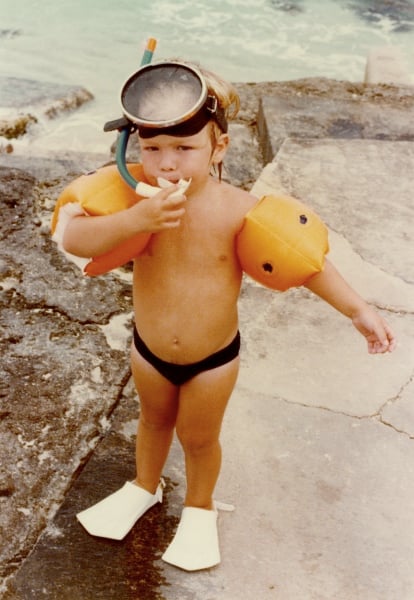
This week Felix Leander, son of Wolf Leander wrote an article for Deeper Blue that begins to answer the question of why some people want to conserve sharks.
Seems "Sympathy for the Devil" began at an early age in the Leander Clan:
In my family I had little choice not to develop a relationship with the Ocean. I was born in the Bahamas, and our back yard was literally a reef. Before I could walk my parents introduced me to the water - you could say even before that - my mom would dive while pregnant (not with tanks), and apparently I "saw" my first shark while in her belly - my dad loves to tell the story of her starting to paddle back to the boat like a crazy woman and that he had to grab her by the fin to slow down and relax.
After leaving the Bahamas, every vacation we took brought us to the Ocean - in those days you had to be 13 years old to be certified by PADI - which forced me to freedive until then. To my father's disappointed and my mother's delight (I became her buddy) I received my Jr. Open Water certification in Bonaire (which I still have to date). My SCUBA days did not last long, and by the time I was 15 I was once again relying on my lungs.
Complete Story
Guidelines set to deter shark, ray discards
 Good shark news from Argentina's Federal Fisheries Council :
The Federal Fisheries Council (CFP) has established fishing guidelines that aim to drastically reduce waste and discards of short-tailed river stingray (Potamotrygon brachyura) and sharks owing to the delicate state of these species in national waters.
The measures adopted are aligned with the International Action Plan for the Conservation and Management of Sharks (IPOA-Sharks), set forth by the United Nations Food and Agriculture Organization (FAO). Said Plan details the principles, legal framework, objectives and application procedures for the conservation and management of the resource.
Resolution 13/09 of the CFP, published in the Official Bulletin, prohibits the finning of sharks, a practice that consists of removing the fins - of high market value - and the subsequent discarding of the body.
In addition, it bans the use of bicheros or boat-hooks used in ray discarding manoeuvres, and puts forth the obligation of returning live sharks of more than 160 centimetres in length to sea.
Complete Story
Thursday, July 16, 2009
Alaska's Got "The Goo"
 The image you are looking at is "biological" and simply massive in size, currently floating through the Chukchi Sea between Wainwright and Barrow.
Known as "The Goo" scientists and Coast Guard officials do not have a clue to what this 25 mile slick is:
Nobody knows for sure what the gunk is, but Petty Officer 1st Class Terry Hasenauer says the Coast Guard is sure what it is not.
"It's certainly biological," Hasenauer said. "It's definitely not an oil product of any kind. It has no characteristics of an oil, or a hazardous substance, for that matter.
"It's definitely, by the smell and the makeup of it, it's some sort of naturally occurring organic or otherwise marine organism."
Something else: No one in Barrow or Wainwright can remember seeing anything like this before, Brower said.
Complete Story
Conservation Media With Bite
 Kudos to PEW Trusts for a whopper of a media stunt this week.
Gathering up a group of well known shark attack survivors to plead the case for shark conservation before congress on Senate bill is S. 850 was a brilliant idea and effective.
The media had a field day and this story got as much one day press as the Sotomayor confirmation hearings.
Unfortunately MSNBC decided to add a well know industry generated cage breach video to their coverage both online and on national television.
This videos appearance on a hot media topic presents, once again, our industry negatively to millions of viewers, policy makers, and the general public.
Wednesday, July 15, 2009
Great White Sharks in Tennessee: aquarium to hold screenings of white shark documentary

From the RTSea Blog this week:
From time to time, I have the pleasure of speaking about shark and ocean conservation issues at various venues, particularly aquariums. Sometimes it is a formal affair - a screening of my white shark documentary, Island of the Great White Shark - and sometimes it is a more casual event, often including groups of younger children - the all-important next generation of ocean conservationists.
 At the end of the month I will get to do both at the Tennessee Aquarium in Chattanooga, TN. I will arrive at the end of the month to do local media interviews and then on Friday, July 31st, I will be speaking with a group of Aquarium "day-campers" ages 7-10 and will conduct a private screening/Q&A with staff, volunteers, and patrons that evening.
On Saturday, August 1st, I will be conducting two public screenings and Q&A's with the Aquarium's visitors as part of their regular admission.
 The Tennessee Aquarium is a marvelous venue in that it is essentially two separate aquariums - one building devoted to a worldwide examination of freshwater (and not just guppies and trout; how about 10-foot long beluga sturgeons!) and another for saltwater. I visited the Aquarium for the first time in June and was very impressed with its scope and the dedication of its staff in getting people to appreciate aquatic life not only in their backyard but globally.
So, if you are in the area, come visit the Tennessee Aquarium on Saturday, August 1st. As many aquariums do this time of year, the Tennessee Aquarium piggybacks on the popularity of Discovery Channel's Shark Week and I am happy to be part of their campaign to educate the public to the reality of sharks, their importance, and the threats and challenges they face.
Maybe I'll see you there!
To learn more about the Tennessee Aquarium, visit their web site. Click here.
Hawaii Shark Diving - Meyer Study
 Back in May we posted an update on the Carl Meyer study that looked into Hawaii shark tourism and habituation of sharks to chum.
The study concluded that existing commercial shark diving operations pose little risk to public safety.
This landmark study has come at a time when a virulent anti-shark diving effort has been pushing to have commercial shark diving banned in Hawaii's waters.
The relentless anti-shark diving campaign has culminated on the island of Maui, which has no commercial shark diving in its waters, proposing a bill to ban it.
There's still time to save two very good shark diving operations in Hawaii. Follow the media trail and make a few of your own. The major news media has grabbed on to the Meyer study (which makes for great reading) and have positively reported the conclusion.
The news of this study should be posted to every chat room, scubaboard, and social network site for divers as soon as possible. The anti-shark diving lobby plays one card and one card only - fear.
Without the fear of sharks commercial shark diving wins on the argument of sharks=tourism=economy.
Help Hawaii make the right decisions about the future of off shore (3 mile) shark diving.
Kohn2
Miami Herald
Honolulu Star
KITV ABC
Monday, July 13, 2009
Garbage? What Garbage?
TED - Capt. Charles Moore of the Algalita Marine Research Foundation first discovered the Great Pacific Garbage Patch -- an endless floating waste of plastic trash. Now he's drawing attention to the growing, choking problem of plastic debris in our seas.
The power of images to open minds:
The power of images to open minds:
Earthquakes and Cephalopods
When you live in California as we do two things are certain, taxes and earthquakes. Last weeks 4.0 off the coast of La Lolla reminded us of a third thing...giant squids:
Saturday, July 11, 2009
Good News and Bad News About Sharks - Bahamas
 If you're a shark conservationist you'll be interested in the following Op Ed/Announcement by Larry Smith.
Compelling and reasoned discussion of the future of sharks and one direction for shark conservation:
Well folks, when it comes to sharks - we have some good news and some bad news.
The bad news is that sharks - like most other big fish in the ocean - are not long for this world if we continue overfishing on an industrial-scale.
The good news is that because driftnet and longline fishing are banned in the Bahamas, our shark populations are relatively stable. In fact, National Geographic described Bahamian waters as a relative "Eden" for sharks compared to the rest of the world.
Complete Post
"Soft Cage" Shark Encounters - Sharklife and Africa Dive
 An interesting technical development for the industry was announced today in South Africa.
"Soft cage" shark encounters. The company behind the innovation is not really a shark diving company at all but the conservation group Sharklife in tandem with a few industry insiders:
Sharklife has teamed up with Debbie Smith and her operation, Africa Dive, to run the soft-cage trips. After a 20-minute trip in our inflatable vessel, we dropped anchor and soon a group of black-tip sharks weaved their way under the boat. We were in luck. Sharks have a phenomenal sense of smell, but it can take an hour to lure them with chum — mainly pieces of sardine.
Grant and the team assembled the cage as we adjusted our masks and flippers and slid in. After less than a minute, I wanted out of the cage and plunged into the sea.
In the thrill of the deep blue, black-tip sharks performed a graceful ballet, swirling and twirling around us, tearing at the bits of sardine with ferocious speed.
Complete Story
Shark-Free Marina Initiative Launches in Cape Cod
 We are very excited to announce that our first Marina in Cape Cod has been registered! The Harwich Port Boat Yard has a rich maritime history and SFMI is glad to have their support.
A special thanks must go to Kate Metzler who took it upon herself to speak on behalf of SFMI, encouraging the marina to register, she even donated the signs that are now being sent to Cape Cod!
Thanks a lot Kate
- Luke Tipple, Director of SFMI
A little about the Marina:
Harwich Port Boat Yard is at beautiful Wychmere Harbor on Cape Cod, Massachusetts. This man-made harbor was once a horse race track, then cars were raced around once the advent of automobiles came about. Now, dredged (by hand in 1887) and channeled to accommodate boats to 65 feet, it provides access to Nantucket Sound and the islands of Nantucket, Martha’s Vineyard and Monomoy. Harwich Port Boat Yard began in 1932 as the Lee Ship building Company and then sold to Watt Small who began Harwich Port Boat Works. In 1977, Arthur Cote purchased the property and ran it until November of 2004, when John Our bought the business, changed the name, and has since worked hard to place his mark in Harwich maritime history. Our facilities improvements include a new bulkhead, a new boat ramp that can accommodate boats up to 45 ft., a new fuel system with capacities of 8,000 gallons of diesel and 4,000 gallons of gas. We have purchased a newer fork lift with negative lift capacity for smaller haul outs and some drysailing. We have 19 slips and seasonal moorings as well as transient slips and moorings when available. In the early spring of 2007 we installed a security camera system so our customers know their investment is being protected.
Please take the time to visit their site and drop in if you’re in the area
www.harwichportboatyard.com
Friday, July 10, 2009

Commercial Shark Season Closed - News
 Good news for sharks off the east coast of the USA about a comprehensive closure of commercial shark fishing species.
But is it too little too late?
The National Marine Fisheries Service closed the Atlantic commercial fishery for non-sandbar large coastal sharks on July 1, after catches in the first half of the year met the weight quota for 2009. The closure -- which includes all state and federal waters from Maine to Florida -- applies to silky, tiger, blacktip, spinner, bull, lemon, nurse, scalloped hammerheads, great hammerhead and smooth hammerhead sharks.
Shark species not listed, such as mako and thresher, can still be landed.
However, Mike Luisi, deputy assistant director of the Maryland Department of Natural Resources, said the closure would not have much effect on local fishermen.Complete Story
Three Shark Encounters at San Onofre
 San Onofre State Beach -- On June 7, 2009 Kevin Rust and several unidentified companions were surfing North of Old Man's, San Onofre State Beach. Air and water temperatures were estimated in the mid-70s and 60s Fahrenheit, respectively. The sky was clear with a mild 1 - 2 knot North-West breeze. It was 7:30 PM and they had been on the water about 2.5 hours. Several Dolphins were observed in the area prior to the encounter. The ocean was glassy calm going to high tied with 2 - 3 foot waves. The water was 8 - 10 feet deep with a primarily rocky ocean floor and some scattered vegetation. Rust recalled; "A few friends and I had been surfing for about 2.5 hours just a peak or so North of Old Man's peak at the San Onofre State Beach, along with the 40 or so other people there at the time. We were sitting in the line up about 100 yards off shore around 7:30 when a 4 - 5 foot Great White Shark jumped out of the water. It was about 50 feet away, farther out. It leaped about 3 feet into the air, came completely out of the water with its belly facing us, and crashed down ungracefully on its side. The belly was white, vertical tail, and a v-ed nose. No one really panicked. It was more awe factor than anything. We just pulled our hands and feet out of the water, made a couple straggler jokes, and that was that. It never resurfaced or made another appearance. I read Redmond's encounter for July 7, and it was the same circumstances, behavior etc., just 5.5 hours later. Same spot, I'll bet even the same shark." Please report any shark sighting, encounter, or attack to the Shark Research Committee.
San Onofre State Beach -- On June 7, 2009 Rudy Fontes was surfing at 'The Point ,' San Onofre State Beach. It was 7:15 - 7:30 PM and he had been on the water about 90 minutes. The water was 8 - 10 feet deep with a cobblestone reef bottom and an estimated temperature of 65 degrees Fahrenheit. The sky was clear with a light breeze and a air temperature in the mid-70s Fahrenheit. The ocean was glassy calm with a 3 - 4 foot swell. Fontes reported; "I had been surfing, but was now waiting in the line-up, maybe 100 yards off shore, between sets and looking out to the horizon. There were maybe a dozen others within 30 yards of me when an estimated 6 foot White Shark hit the surface of the water and became completely air borne above the water, maybe 5 feet above the surface. Its belly was facing all of us and you could see the shape of its mouth (jaw) very clearly. It was moving wildly as if it was attacking a fish or something from below the surface. an awesome site and we were all 'buzzzzing' for a while, never seen that before. I guess it swam off, that was the last of it." Please report any shark sighting, encounter, or attack to the Shark Research Committee.
San Onofre State Beach -- On July 7, 2009 Parker Redmond was surfing 'The Point' at San Onofre. It was 2:00 PM and he had been on the water about 10 minutes. Air and water temperatures were estimated in the low 70s and 60s Fahrenheit respectively. The sea was 'choppy' with a 2 - 4 foot South swell. Redmond recalled; " I was looking off towards Lowers and saw a 4 - 5 foot White Shark leap about 4 feet out of the water. Its tail was inverted just like the Discovery Channel sharks. I knew instantly what I had seen. It had a white underbelly and its back was grey. About 20 minutes after the shark breach 2 Dolphins cruised through the line-up. That made my encounter seem even more absurd, but I promise you it was definitely a White Shark." Please report any shark sighting, encounter, or attack to the Shark Research Committee.
Surfline Blog

Thursday, July 9, 2009
Wednesday, July 8, 2009
Shark Diving Industry? What Industry?
 We know several things about both Hawaii Shark Encounters and North Shore Shark Adventures.
Both are solid, reputable commercial shark diving operators, and both are facing the chopping block unless our "industry" get's off it's collective ass and jumps in to the rescue.
It is rare to ask for help, it is industry leadership to offer it and see it through.
So, any takers out there? Is there one operator, dive group, website, chatroom, gear site, or individual that will take up the cause for these guys and push back against the tidal wave of anti-shark diving sentiment in Hawaii?
We had some ideas about what might be done immediately this week. It is not too late.
Nishiki offers bill to ban shark tours.
By BRIAN PERRY, City Editor.
POSTED: July 8, 2009.
WAILUKU - Maui County has no tours available for visitors to plunge into the
ocean and watch sharks cruise by from the safety of submerged cages.
And Maui County Council Member Wayne Nishiki wants to make sure such an
activity doesn't come here.
"I think we need to take precautions," he said, adding that he's concerned
that if shark tours become established in Maui County waters, then surfers,
swimmers and everyone else who enjoys the ocean could be endangered.
Nishiki said he particularly objects to outsiders coming to Maui to exploit
a business opportunity without regard for the lifestyle or safety of residents.
"All they're interested in is the big buck and that's it," he said Tuesday.
Nishiki said he's seeking a county ordinance that would ban shark tours in
Maui County. He said the county has the power to do so by blocking business
licenses for the activity.
The South Maui council member introduced the shark tour prohibition during a
meeting Tuesday. The matter was referred to the council's Economic
Development, Agriculture and Recreation Committee, chaired by Jo Anne Johnson.
Nishiki said that although he would like the state Legislature to pass a
ban, he doesn't know how long it will take for the state to take action.
Nishiki's proposal included a copy of a Honolulu City Council resolution
urging the passage and enforcement of state legislation to ban commercial
shark-viewing tours and related activities.
He said he didn't want to see the Maui County Council pass only a resolution
because it would not have the force and effect of law.
Shark-viewing tours attract paying customers on Oahu's North Shore, but
there's a growing statewide movement to stop the tours from operating. Some
Native Hawaiians consider sharks to be ancestral gods, and they find it
offensive to have tourists feeding and viewing them for entertainment.
Surfers and environmentalists worry that shark tours might have the ocean
predators linking people with food, and scientists say luring sharks to
certain areas could disrupt the ecological balance in near-shore waters.
Shark Free Marinas - Fiji Initiative
 Kadavu, Fiji Islands – June 25, 2009 – The international Shark-Free Marina Initiative works with marinas, boaters and fishermen to develop policy designed to protect a vital component of the oceans health, our sharks.
The majority of shark species caught by recreational and sport anglers are currently listed by the IUCN as ‘Threatened’ (or worse) and each year an average of a ½ Million of these sharks are killed in the United States alone.
By encouraging non-lethal ‘catch-and-release’ shark fishing your patrons and clients can enjoy their sport while ensuring that shark populations are not further diminished. By promoting sustainable practices of ocean management we hope that sharks will be around to keep our oceans healthy for generations to come.
Currently we are working in Fiji at certifying all marinas and charter fishing boats as ‘Shark-Free Marinas’. Matava and Bite Me Gamefishing Charters was the first in Fiji to sign up and has agreed to promote, coordinate and distribute information about the Initiative. We hope that Fiji can be the first country to be proud to announce itself as a ‘Shark-Free Marinas’ Country!
Even if your facility is not frequented by shark fishermen, becoming a Shark-Free Marina is a valuable ‘green’ stamp and a promotional tool for your business.
You will receive a listing on the Shark-Free Marina website as well as the right to use the SFMI logo and signs for your own publicity. We are currently working on importing the stickers, posters and metal dock signs into Fiji for distribution to registered businesses, charter boats and marinas.
The SFMI website also has an education centre that we hope your clients will find useful, it includes tips on how to catch and release shark, a list of Endangered and Threatened species plus information on how they can help protect the ocean.
Neither Matava or SFMI is asking for your money, just your participation in saving the many valuable species of sharks in our local Fiji waters.
Please take the time to visit the SFMI website to find out more about how you can contribute to the future survival of our sharks while ensuring your business continues to thrive.
If I can be of any further assistance or help, just drop me a line.
Sincerely,
Stuart Gow
Fiji Regional Associate
Shark-Free Marina Initiative
Matava – Fiji’s Premier Eco Adventure Resort
Bite Me Gamefishing Charters
Simple Registration
This is a simple and free process that ensures your patrons and customers know your business cares about the worldwide problem of shark over-fishing and that your marina or charter fishing boat will not contribute to the problem.
To register simply:
Register online at www.sharkfreemarinas.com
Display a ‘Shark-Free Marina’ sign on the marina premises or on the charter boat.
About Shark-Free Marina Initiative
The Shark-Free Marina Initiative has a singular purpose, to reduce worldwide shark mortality. We encourage shark conservation at sport fishing and resort marinas by prohibiting the landing of any shark at the participating marina. The SFMI works with marinas, fishermen and like minded non-profit groups to form community conscious policy and increase awareness of the need to protect our sharks, our ocean and our legacy.
About Matava – Fiji’s Premier Eco Adventure Resort
Matava is the genuine eco-adventure lodge, beautifully set off the beaten track, minutes from the Great Astrolabe Reef on Kadavu Island. Our intimate resort has beautiful, comfortable bures, outstanding cuisine and offers a full range of adventure and cultural activities. Dive or take a course with our PADI dive professionals. Experience fantastic fish, pristine corals, Mantas and sharks. Try big game fishing, snorkeling, sailing, sea kayaking, trekking, and join in authentic cultural and village events! No roads, solar power, low carbon footprint make Matava the ideal and environmentally responsible location to relax and unwind.
About Bite Me Gamefishing Charters
Superb blue water game fishing for wahoo, sailfish and marlin with Bite Me Gamefishing Charters awaits you at Matava in Kadavu, Fiji Islands.As an active member of IGFA and The Billfish Association we also advocate tag and release of all billfish not deemed to be a National or World Record
Save a shark, eat something else - Op Ed
 From the Shedd Aquarium this week you have to love reasoned, well written responses to shark propaganda:
As Director of Sustainable Practices at Shedd Aquarium, I am disappointed that for the second year in a row, shark is being served at Taste of Chicago.
The Chicago Tribune article, "Shark Among Healthy Offerings at Taste of Chicago" (Entertainment) dated June 25, also raises a red flag over misconceptions about shark consumption.
Nearly 50 million sharks are killed each year for their fins, meat and cartilage, and another 50 million are accidentally caught by fishery nets and hooks intended for other species. This approximates to three sharks killed per second. A "red list" report from the International Union for Conservation of Nature (IUCN) found that 26 percent of all sharks and related species in the regional waters are threatened with extinction.
Avoiding shark meat and shark fin soup is one way we can help save shark populations worldwide, but we have much more work to do if these animals are still appearing on local plates.
Full Story
Mystery carcass may be legendary sea monster: expert
 Huzzah!
Proof positive that sea monsters exist at least in lake Okanagan, where the remains of a 1.3 meter "tailed critter"washed up on the shores recently.
Yes, we know we called the whole Bigfoot thing wrong, but damn, they held a press conference about it. What sort of crazy backwoods idiots hold a press conference about a rubber monkey suit encased in ice?
If you're into sea monsters, and we are, here's the news with DNA samples and everything:
A mysterious looking body found along the shore of Okanagan Lake might be the remains of the legendary Ogopogo, an expert says.
Dan Poppoff found the 1.2-metre-long carcass last month while he was kayaking in the lake, close to the B.C. Interior city of Kelowna.
The Kelowna resident immediately called Arlene Gaal, who has written three books about the legendary sea creature and documented sightings of the Ogopogo for the last 30 years.
A day later, he sent her a photo of the carcass.
"I told him he had my attention right away," Gaal said.
She told him to store the body in the freezer and has arranged for two scientists to analyze DNA from the tail.
The carcass had a spinal cord and vertebrae, which made it one of the first interesting discoveries she's seen in the last 30 years.
"This is something very important to the scientific community. What we're looking at is an unidentified species and this might open the door to this mystery," she said.
Like Scotland's mythical Loch Ness monster, evidence of the Ogopogo's existence is largely anecdotal.
Since 1978, about 1,000 sightings of the Ogopogo have been recorded in the Okanagan. Every year, at least five people come forward to say that they have seen the sea monster.
Two sightings have already been reported in 2009. Those who claim to have seen the animal say it resembles a whale in its size, the way it moves and the commotion it creates when it emerges from the water.
"We're looking at a definite large animal that is swimming in the Okanagan Lake. I'm sure of that," Gaal said.
Tuesday, July 7, 2009
Scott Cassell - Undersea Voyager
 The Undersea Voyager Project is one of our favorite submersible/conservation efforts right now. Recently the team was in Lake Tahoe making news and discoveries:
SOUTH LAKE TAHOE, Calif. — A team of submariners that spent the month of May exploring
Scott Cassell, the sub's captain and founder of the non-profit Undersea Voyager Project, says his team has plans for a five-year mission to gather information and develop ideas to help restore endangered bodies of water around the world.
The goal, Cassell says, is to collect data and attract sufficient attention to prompt people and governments to halt pollution and overfishing and take other actions to protect threatened bodies of water.
A two-person submarine spent the past month cruising Lake Tahoe, examining earthquake faults, ancient submerged trees and beds of invading clams that threaten the lake.
"I think it's a very useful tool," said John Kleppe, a
“It’s like playing cricket with hand grenades”
 With that memorable quote one of the most remarkable announcements in fisheries conservation was broadcast the planet this week, as maverick tuna baron Hagen Stehr told the world his team had Bluefin Tuna breeding in captivity.
Worldwide tuna stocks are down 70-80% as massive netting operations capture the last remaining tuna, netting in some cases 100% of the school.
The 60 million dollar Australian gamble to raise this valuable species in captivity has seen its share of set backs and disappointments with many "tuna pundits" saying it could not be done.
You can always bet on an Australian to come up with a solution to almost any problem.
Kudos.
Full Story
Chumslick - Blogger, Activist, Poet/Warrior
 We have been fans of the Chumslick Blog (written by an actual shark) for a while now.
Today the C.B jumped into the issue of commercial shark diving in Hawaii. Like us Chumslick understands the positive benefits of commercial shark diving encounters - done right.
Read the post.
If commercial shark diving in Hawaii is to survive the virtual onslaught of anti-shark diving sentiment being levied against it by a handful of islanders, politico's and malcontents, the following industry wide help will be needed.
1. 10 "30 second" pro-shark industry you tube videos featuring well known dive industry names
2. Letters from industry filmmakers and photographers to tourism Hawaii and government
3. Letters from wholesale and regional tourism companies who book Hawaii or the region
4. Pro Hawaii shark diving website that ties in all these elements
5. Pro bono distribution and op ed articles on scuba websites and industry news wires
This is not rocket science, it is Media 101. Hanging in the balance are two good shark diving companies with unblemished track records and thousands of satisfied customers.
As an industry member you can support these operations, without your support these operators future remains in grave doubt. What's a stake is the future of other sites when Hawaii closes down shark diving in their waters forever.
Monday, July 6, 2009
Death of a Titan - Puerto Nuevo, Mexico
At one of the longest running shark lists on the planet, the Shark-l, one poster Helmut Nickel comes up with unique shark media finds. This week his discovery of a dead white shark at a fishing camp in Mexico highlights the needs for stronger protections for these magnificent animals.
We blogged about sport take sharks last month in "One Shark".
We blogged about sport take sharks last month in "One Shark".
Movement to shut down shark tours in Hawaii grows
 What began as a terribly executed commercial cage diving roll out in Hawaii just a few months ago has devolved into a government sanctioned witch hunt...with no end in sight.
We have been tracking ongoing developments in Hawaii as they happen.
Hawaii shark diving operators now find themselves with an active opposition, on the wrong side of an obscure fisheries law, and facing an anti-shark diving champion in government.
What brought this negative tide was a skillful use of media by the anti-shark diving folks and a puzzling and very damaging media silence from the operators.
There's still time for the operators to roll out a sustained media campaign based on Shark Diving=Tourism=Economy. As each day goes by articles like this recent AP report just add fuel to the anti-shark diving lobby and seal the fate for the existing operators to the will of local and regional governments. Action taken early in an unfolding disaster can and will mitigate problems down the line.
The media tends to follow the story, that story can be shaped by either side of an issue but someone has to lead it. As each anti-shark diving lobby piece comes in two pro shark diving articles must go out. This issue, as far as politicians are concerned, revolves around who has the most votes.
The loss of Hawaii would be a blow to the industry in the western hemisphere. Already new rules and regulations for the Farallones now require divers, cages and vessels to be 140' away from white sharks at all times. Florida remains shut down to commercial shark diving after a 2001 decision there.
HALEIWA, Hawaii (AP) — Three women donned scuba masks and jumped into the waters off Oahu's North Shore, floating inside a submerged cage as about a dozen sharks glided toward bloody fish scraps tossed into the water by a tour company.
Tourist Kim Duniec said the experience of coming eye-to-eye with sharks was exhilarating. "Their eyes were scary, but they were still graceful, absolutely beautiful," the Beaver Dam, Wis., woman said.
Shark tours like this have become a popular visitor attraction in Hawaii, but a movement is gaining momentum to shut them down.
Some Native Hawaiians consider sharks to be ancestral gods and view feeding them for entertainment to be disrespectful of their culture. Surfers and environmentalists fear the tours will teach sharks to associate people with food — leading to an increase in attacks — while disrupting the ocean's ecological balance. Federal fisheries regulators, meanwhile, are investigating the tours on the grounds that they are illegally feeding sharks.
The anti-shark tour movement ignited when residents noticed a large metal cage mounted on a boat at a marina in front of a popular Hawaii Kai restaurant in March. They remembered Oahu's two shark tours used similar contraptions on the North Shore. The location of the tours helped fuel the opposition — Hawaii Kai is an affluent bedroom community on the other side of Oahu.
Full Story
Saturday, July 4, 2009
Goblin girl on... new locations for goblin sharks!
 I recently recieved a paper called "New Findings of Rare Fish Species from Families Mitsukurinidae (Chondrichthyes), Muraenidae, Lophiidae, Macrouridae, and Psychrolutidae (Teleostei) on Raises of the Atlantic Ocean with the Description of Gymnothorax walvisensis sp. nova" by A. M. Prokofiev and by A. M. Prokofiev and E. I. Kukuev 2009. They reported two findings of goblin sharks from the Mid-Atlantic ridge. The area is called Vavilov seamount (see pic to the left).
 When I searched for an other paper they referred to in the paper mentioned above, I found an other paper called "Insufficiently studied fishes of the open ocean - Ichthyofauna of Corner Mountains  and New England Seamounts" by Kukuyev from 1982. In this paper they tell about 9 goblin sharks that also were caught at the Mid-Atlantic ridge, but on a different location (see pic with small yellow dot in the middle, showing the location). The depth was 2000 - 4100 m (!). Not a diveable depth! It's always fascinating that something can live at these depths, that there is huge mountain chain that we can't see...
 and New England Seamounts" by Kukuyev from 1982. In this paper they tell about 9 goblin sharks that also were caught at the Mid-Atlantic ridge, but on a different location (see pic with small yellow dot in the middle, showing the location). The depth was 2000 - 4100 m (!). Not a diveable depth! It's always fascinating that something can live at these depths, that there is huge mountain chain that we can't see...
 We have a real heat wave in Sweden at the moment. I think I will stay inside - where it is not cold, but cooler at least! - and read the new book "Oceanic Anglerfishes - extraordinary diversity in the deep sea" by Theodore W. Pietsch...
For links to summary of the first paper and the full text of the second, see my personal homepage http://blogs.myspace.com/tenguzame
Friday, July 3, 2009
North Carolina Has a "Big Problem"
File this latest video under sewer monsters, new science, or whatever. WE have been saying for a while now that the nexus of sewer lines, dumped American Pharmacopoeia and feces is a "recipe for disaster".
Now ladies and gentlemen, we have proof positive of things scary underground in North Carolina of all places:
Now ladies and gentlemen, we have proof positive of things scary underground in North Carolina of all places:
Thursday, July 2, 2009
Oceans Magazine - Shark Diver
 This month Oceans Magazine featured Shark Diver and a first encounter story told by one of our shark divers Steve Hutchings.
DIVING WITH SHARKS
Written by Steve Hutchings, Courtesy of Shark Diver, www.sharkdiver.com
Photographs by Derek Heasley, www.scubabreaks.com
I saw Jaws when I was eleven, after which I was so petrified of the water I wouldn't go in the bathtub for a year. This is one of many thoughts swimming through my head as I step off the stern of the MV Islander and onto the top of a cage suspended three meters below the surface of shark infested waters. Our dive master, Luke Tipple, hands my mouthpiece to me, from which I'll be breathing surface-supplied air. I insert the mouthpiece and grab my underwater camera. With a deep breath, I slide into the cage below.
I share the cage with Jim, an American scuba instructor, and Leigh and Lisa, an English couple on a working holiday. Although I swam with reef sharks in Thailand three years previous, we're all rookie shark divers in these waters, having endured several months of comments like "Shark Bait"!? from our peers, united by our desire, and each of us having plopped down three thousand U.S. dollars with San Diego based Shark Diver to experience the oft-vilified, yet enigmatic great white shark.
We move around the cage for the first five minutes, searching for any signs of a great white. Scores of mackerel cloud our view, attracted to the two tunas that the crew set out to attract the sharks. Then, amidst the fish below our cage, I see a shark. He's smaller than I anticipated. About two meters long, he propels himself with slow, side-to-side movements of his tail. I watch, mesmerized as he disappears from sight.
Several more sharks appear sporadically over the next ten minutes before disappearing for half an hour. We begin to think we've seen our last shark on this dive. Luke taps the other cage with a metal bar, indicating the end of the hour long dive. I watch as the divers in the other cage ascend and wait for a new set of four divers to replace them. Nothing. I climb out of our cage, and when I reach the surface, Luke, in his Australian accent, says, "Steve, mate, do me a favor and go back under. There are sharks all around you and it's too dangerous to come up."
I panic, thinking there are too many sharks around the boat for our crew to handle and that the situation has deteriorated to dangerous. I let go of the ladder and fall back into the cage, dragged down by the forty pound diving belt, and land on my rear end. I'm still struggling to get off my backside, when a large female shark swims past our cage, two meters in front of us. The other three divers clamor to get their cameras in position. I'm still trying to get on my feet. That's when I see another shark, swimming directly toward me. My heart races as his snout gets bigger, and closer. Just as I'm convinced he's going to attack our cage, at less than a meter away, he veers to his right and swims past me, and I notice something about him that I've never seen in any pictures of a great white - a purple ring around his pupil. We stare at each other, eye to eye, until he's past our cage and disappears into the background.
I just made eye contact with a great white shark.
Such was our first dive at Guadalupe Island, off Baja California, about three hundred kilometers south of San Diego, on a five day, live-aboard diving expedition arranged by Shark Diver. Great whites congregate here, off Guadalupe, between August and December each year. The sharks seen here are resident sharks. Much like the resident orcas off Vancouver Island, marine biologists have named about sixty of the estimated two hundred sharks. Chica, Bruce, and the ever popular Shredder are some of the well-known sharks at Guadalupe, the latter being a favorite of many divers for his consistency and his aggressive attitude. On a subsequent dive he veered towards a male diver in the cage, who retreated backward. A female diver later recounted that she watched Shredder's pupil following the male diver as he swam past the cage, seemingly pleased that he intimidated the man.
I guess boys will be boys, no matter what the species.
Editors Note: Shark Diver takes interactions with great whites seriously. We always defer to the animals. Once in a while when the situation is deemed necessary by our dive operations manager we keep divers in cages when it is time for rotation. Distracting the deck crew when 5-7 animals are on site and "hot" is a recipe for disaster, as such such we have a standard policy of animals first.
Shark Diver remains an industry leader of safe shark encounters with a 100% safety record, no sharks in cages, no animals hurt. It's an industry record we're proud of.
Wednesday, July 1, 2009
Whale Sharks - Instant Tourism
 Off the coast of Louisiana large aggregations of whale sharks occur each year. At least one enterprising boat captain has decided to research "whale shark tourism" in tandem with shark researcher Eric Hoffmayer of the University of Southern Mississippi's Gulf Coast Research Lab:
The Associated Press NEW ORLEANS – A commercial fishing boat captain who spotted dozens of the world's biggest fish off Louisiana's coast turned his boat into a research vessel for a week this month, taking scientists and photographers to look for whale sharks. Seven whale sharks were identified, and three of the spotted fish were tagged; researchers were able to swim with some of them. They took video and still photographs, and skin samples for DNA work. The tags are designed to pop off and send information about the sharks' movements to a satellite after eight or nine months – earlier if the sharks dive so deep that water pressure might squash the tags.
RED LIST
Whale sharks are on the World Conservation Union's "red list" of threatened species. No one knows how many whale sharks exist, but researchers said the total may be as high as 500,000 – a small figure for fish.
Capt. Russell Underwood offered to host the whale shark expedition after spotting a group of at least 44 of the fish last year. Those found this month were about 55 miles off the coast.
Monday, June 29, 2009
Darien Island Panama, Shark Fin Loophole?
 One of the truly frustrating issues with fisheries regulations is the dreaded "loophole".
No matter how solid government sanctioned fisheries laws are there will always be a loophole somewhere in the wording that allows unregulated or marginal fisheries activities to continue.
Case in point - a recent scene of utter destruction on Darien Island, Panama:
Hundreds of juvenile sharks slayed for their fins yet nobody knows anything. Tourists witness the scene PANAMA. Panama Marvel Tours is a local tour company which explores the fauna and flora of Panama. On a recent trip, company director, Lory Forero de Proctor took two Americans – one a military man and the other a House worker - for a sea tour in Darien. They were in for a shocking experience.
The travellers departed from Punta Alegre to visit Cedro Island, a mineral-rich site in the Caribbean Sea. On landing, they decided to explore the island, only to find a scene of death. A huge area of the coast was covered with hundreds - if not thousands – of dismembered juvenile sharks. "Without noticing it at first, we were walking over their dead bodies," said Lory, disconcerted and ashamed the tourists had to witness this tragic sight. She said they saw nearby a small boat of indigenous people with fishing nets, which could mean that the sharks were victims of artisanal fin-fishing. But since there were no witnesses, this is just a theory.
Shark fining is the removal and retention of shark fins and the discard at sea of the carcass. In this case, the sharks were just tossed on the beach. The international demand for shark fins is enormous and represents big income in the economy but illegal and excessive catches are a threat to conservation of the species. La Estrella contacted the Aquatic Resources Authority of Panama (ARAP) to know where they stand on this matter but the person in charge of this topic was not reachable. A public relations employee told the newspaper that it could mean a case of illegal fishing.
She said ARAP has ports that regulate all fishing activities in Panama. She also remarked that the method seen in the pictures is not adequate and that it could contaminate the island. ARAP´s office of Inspection, Surveillance and Control said that had not received any prior report of this matter. They will now contact their regional office in Darien for them to go and inspect the area. Law 44 of 2006 sanctions the crime of illegal fishing with minimal fines - $100 – and seizure of the product.
Law 9 of March 16 2006 prohibits the practice of shark fining in Panamanian territorial waters. However it does not include the fishing of juvenile sharks, according to the PR person in ARAP. Reports of suspicious fishing activities can be made to ARAP´s Inspection, Surveillance and Control office at 800-7272.
Subscribe to:
Posts (Atom)