The shark diving industry blog covering sharks, shark cage diving, shark conservation and things we find "amusing" since 2008 www.sharkdiver.com, www.sharkdivers.com, www.divingwithsharks.com
When it comes to monthly calendars there are those who lean towards the ordinary - puppies, horses, small woodland creatures.
Then there's underwater photographer Klaus Jost who brings you the world of the white shark in his new 2010 underwater calendarfeaturing these simply amazing critters.
Call us biased (and we are), but we're never tired of seeing white sharks shot brilliantly. One look at this calendar and you can begin to see why.
These are the kind of stories shark diving folks like to read. Found on the Big Island Weekly Blog this week - kudos to Nick Whitney and team:
A whitetip reef shark research project has some Big Island photographers literally swimming with sharks in the name of science.
Nick Whitney, a postdoctoral scientist now with the Center for Shark Research Mote Marine Laboratory in Sarasota, Fla., started a Hawaii whitetip photo identification project in 2002 as part of his Ph.D. research at University of Hawaii at Manoa. The findings of the project, which required the help of several underwater photographers around the state, will be published in a scientific journal within a year and will be available on the Web site, http://www.whitetip.org.
"I was planning to do a telemetry (tracking) project on whitetip reef sharks to study their movements, but found that while it was easy to dive with them and take pictures of them, it was very difficult to catch them in places that were good areas for tracking," Whitney said. "I was also looking for a way to involve the community in my research, and since these animals are easy to photograph and have unique markings on their sides, photo-identification seemed like a great way to do that."
Whitney been involved with studies on tiger sharks, sandbar and Galapagos sharks in Hawaii. He said that while he's interested in all these species, whitetips are the most intriguing because there has been little research done on them. As an added bonus, they can frequently be seen while diving in shallow water and don't immediately swim away like other species.
Whitney was able to identify at least 178 individual white tips throughout the state. Most were only sighted once, but over 50 were sighted multiple times.
"A few individuals, usually adult females, have been seen repeatedly -- seven to 10, up to 13 times for one individual from 2001 to 2008. That was an adult female at the dive site called "Suckemup" near the Honokohau/ Pine Trees area on the Big Island," Whitney said.
The project revealed that whitetip reef sharks move around more than anyone expected.
"We found movements of as much as five to six miles to be more common than we expected, and one animal moved over 16 miles along the coast," Whitney said. "We also had two animals cross a relatively deep, 450-foot, channel between Molokini crater and Maui, which certainly isn't the same as an inter-island crossing, but our genetics study indicates that the inter-island channels are not significant barriers to gene flow. It turns out to be true that some sharks will return to the same area for years, but they're not always there and will often be absent for months at a time before returning."
On the Big Island, Cynthia Hankins, Dee Wescott, Vicky Newman, Bryce Groark and Porter Watson contributed photos for Whitney's project. Divers on other islands also contributed significantly. The Honokohau area was one of the spots where many of the Big Island images came from, Whitney said.
"We only got a few photos from other sites which were often a long way from Honokohau, which meant we had a very low probability of detecting any movements," Whitney said. "Fortunately we had a few very dedicated photographers working the Honokohau area and were able to find out that at least two females seem to repeatedly use this area as a place to gestate, and possibly give birth. Also most sharks give birth every other year, and that seems to be the case for whitetips as well, but our photos from Honokohau show that at least one female was able to get pregnant two years in a row. She was photographed very late-term in both years."
Hankins, a Kona resident, has photographed the Kona Coast from as far south as Paradise Pinnacle (Near Paradise Park) and as far North as Malae Point in North Kohala.
While Hankins says she can recognize some of the whitetips she photographs, the tracking and information gathering is best left to Whitney. She first learned of Whitney's research when a friend who knew of her shark fascination introduced her to the project. Whitney taught her about reef sharks and she provided him with sighting data and images to aid in his research, she said. Hankins has been forwarding him photos for the past four years, and encouraging other Big Island divers to do so as well.
Hankins said when she's taking photos for the project, it's important to get certain angles, so that Whitney can identify the different whitetips. Taking photos for scientific purposes requires a different approach than normal underwater photography.
"I recognize a few individuals by sight and have seen them repeatedly, frequently at the same couple of sites," she said. "I've also been adding tiger shark photos to a new page on Nick's sighting Web site. The tigers aren't seen as frequently as the whitetips, but I have seen the same animals on several occasions."
Hankins said she's seen and photographed pretty much everything one would expect to find in Hawaii waters -- and then some.
"I've seen most everything in the fish and creatures ID books for the Hawaiian waters. One day I found a new species of nudibranch (sea slug) which is sitting in a lab in California waiting to be described," Hankins said. "I've seen a juvenile humpback whale being attacked by 25 tiger sharks. I've watched octopus mating; Manta rays breaching; turtle trying to mate; eels attacking each other; and so many more amazing things."
When it comes to swimming with sharks, Hankins has her own rules of engagement.
"The whitetip reef sharks are pretty harmless if you don't provoke or disturb them. They are usually resting in the mornings, which is when I dive most often and we find them sleeping in the shadowy areas under arches, ledges or in lava tubes," Hankins said. "If you approach slowly you can get quite close. It's always exciting to see an animal as big as yourself with the ability to inflict damage. You always want to approach with a respect for their space and try not to disturb them or corner them."
Some of her other subjects, however, are not as friendly.
"The tiger sharks on the other hand are very scary. They are twice to three times the size of the whitetips and have a stealthy and menacing look," Hankins said. "I try to remind myself that they are not interested in eating me, they are just curious. None the less, the adrenaline always rushes and my heart pounds. Rarely will they linger for very long so the shots need to be quick."
Whitney cautioned that taking photos of sharks can be dangerous, if not done correctly.
"Any large, wild animal -- and many small ones -- has the potential to be dangerous in one way or another, but whitetips are very docile and I would even say 'tolerant' of human activity to a large extent. Over the course of trying to tag them and collect tissue samples for our genetics study I've done many things that should've gotten me bitten and didn't," Whitney said. "They're not teddy bears though. Grab one and hold on long enough and it will grab you back."
Although Whitney's completed his studies at UH-Manoa and now works in Florida, he wants to keep the whitetip reef shark project going. The long-term data complied is very valuable, he said.
"I hope to keep collecting photos and information and publish additional studies on whitetip reef sharks of Hawaii in the future," Whitney said.
Shark nets along the Gold Coast will not be removed, despite yet another young whale being caught in a net off Burleigh Heads on Tuesday - the fifth so far this migration season.
It took just an hour to free the seven-metre juvenile, which shark control program manager Tony Ham said was probably one of last year's calves.
"This animal was calm and quiet, even though it was windy and conditions were difficult, so that helped the release," he said.
"Happily the mother was there to keep an eye on the young whale, and that usually gives them an opportunity to calm down... so that's usually a good thing for us."Mr Ham said despite the number of young whales being tangled up this season, the shark nets will not be removed.
In fact the damaged net off Burleigh will be replaced before the end of the day.
Mr Ham denied the shark nets are being maintained simply because of political pressure and said their value in stopping shark attacks is well documented.
"The program has been in place since 1962 and in that time we've had one fatal attack on a protected beach, at North Stradbroke island in 2006," he said."There were a number of attacks prior to the program going in - some of those were pretty horrific and fatal.
"We believe the program does work."It does catch sharks and it does catch dangerous sharks (so) to remove the nets even for the whale migration season is not an option."Mr Ham said the argument that not many people swam in the surf during the migration season was simply wrong.
"We have people bathing on Gold Coast beaches year round," he said.
"People come to Queensland for the very reason that we have safe swimming beaches. "He said it was "unacceptable" to remove the safety equipment, particularly with school holidays coming up.
From the Shark Free Marinas Blog, more good news from Florida:
Another day another marina. This time it’s Captain Slates dive center, home to passionate scuba divers from all over Florida and a marina dock that services it’s boats. As a potential docking point for fishing boats with access to the rich fishing grounds of Key Largo this is a great addition to the Shark-Free Marinas program.
Their decision to join up makes an obvious point: although shark fishing, or any fishing, may not be a regular source of commerce for the marina, they should still register with SFMI. Consider the no-smoking sign, we see it everywhere and register subconsciously that smoking is bad for our health and the well-being of people around us. It is therefore not socially acceptable in public places. I mean really, who these days would light up a cigarette in an elevator? Most likely no-one, but yet there is a sign to make sure.
Shark-Free Marinas is like that. It sets socially responsible standards of conduct when dealing with threatened species of shark. The more marinas that register the more it becomes socially accepted that killing sharks is not good for our environment.
That being said not every single marina will be Shark-Free. But if 1 in 10 allows caught sharks then policing standards and fishing codes becomes that much easier, and everyone wins.
Thanks to Captain Slate for setting a standard, check out their business here: www.captainslate.com
The venerable Field and Stream Magazine weighed in on the issue of a recently free gaffed breeding aged Mako shark in part due to coverage from Peter Thomas at the L.A Times:
Okay. I'm about to get a little rowdy. This week, someone forwarded me a news article about a 748-pound mako shark caught in South Florida. My initial thought was "there's been a lot bigger caught this year," but I checked it out anyway. After watching the video below and reading the story, I have decided that these guys deserve the title of "Most Amateur Idiots on the Water." See for yourself. They didn't "catch" anything. They free-gaffed a hot mako.
What surprises me most is how fast the local news jumped to glorify these guys. The line that sums up the mentality of this crew is when "fisherman" Jamie Bunn says, "I vividly remember the quote 'we might as well gaff this thing, someone's dying today.'" Dude, you are an inspiration to anglers everywhere. Good work. I'm not the only one who thinks this whole dog-and-pony show is a disgrace. And guess what? This may have been illegal.
Florida anglers are being sharply criticized after apparently free-gaffing a 748-pound mako shark while fishing this week off South Florida...
Making note that no rods or reels appear to have been used in the capture of the mako, at least one shark conservation website claimed the anglers were in violation of state and federal law and implied it would follow through with authorities...
I've mentioned in the past that I'm very into shark fishing. Standards in practice when doing so is to have a rigged pitch-bait ready to go in case a fish shows up right behind the boat. This mako was eating a dead swordfish and these guys had plenty of stout rods onboard. So why not cut a piece of the sword, rig a rod, pitch it over and put your back into it for a couple hours?
Then my hat would have been off to you. Not too mention, free-gaffing a fish like that is asking for death, lost appendages, or at least some boat damage. Genius. -- JC
Editors Note: It is notable that Field and Stream Magazine and a series of fishing news outlets have all condemned this catch, showing industry leadership, kudos.
"FYI, The bill (banning commercial shark diving in Oahu) was thrown out and deferred to state."
Proving that Hawaii City Council members are not the same as those in Maui, Council members decided, after receiving an unprecedented amount of interest in the form of letters, emails, Op-Eds, and phone calls about commercial shark diving on Oahu to kill the issue before them and "punt it" back up to the state level and Rep Gene Wards office.
To refresh your memory the ongoing saga over the fate of commercial shark diving looks like this, dates are approximate:
3. April-2009 Several dubious and linked anti-shark diving websites spring up with loose ties to Cyber Diver Network, and Rep Gene Wards office.
4. May-2009 Long term U of H shark study by Carl Meyer et al shows sharks that are being interacted with 3 miles off shore are not habituating to vessels and following them back into shore as was charged by Rep Wards "Shark Taskforce." Wards office decides to ignore and discredit the study as bogus science, stirring up further controversy.
4. August-2009 Meetings are held with the commercial operators and Rep Gene Ward, pressure in the form of pro-shark diving business owners call Wards office, the theme of "it's the economy stupid" resonates.
5. August-2009 Maui City Council members watching Rep Gene Wards grandstanding, decide to ban shark diving. Shark diving that does not exists on Maui at this time. As one person states "they might as well ban time travel as well."
7. September-2009 Rep Gene Ward, sensing a hard political fight over the commercial shark diving issue, punts local issue of banning cage diving on Oahu down to Oahu City Council members.
8. September-2009 Oahu City Council members propose bill, receive sharp backlash from community, they quickly realize this is a "no win" bill on many levels.
9. October-2009 Oahu City Council members throw bill out and refer the entire issue of commercial shark diving and the fate of 40,000 seasonal shark diving tourists back to the state.
The post title seems like the magic bullet for shark finning, and in some ways it is. Tourism with sharks, because in our world sustainable "shark soup" looks something like this - and it lasts forever:
Hat Tip:Dorsal Fin Blog for the find and to shark diver Joe Prieto for shooting this stunning video.
L.A Times Pete Thomas is an outdoor writer who knows controversy when he sees it. He also knows conservation sense when he sees it as well. This week he covered the ongoing fall out of a video now on You Tube of what appears to be an illegal take of a breeding aged Mako shark off the coast of Florida this week.
His continuing coverage of the oceans at the Outposts Blog is a must read for ocean folks worldwide.
A conservation milestone was reached this month on the islands of Fiji as the Shark Free Marinas Inititiative was adopted by the 20th marina here.
Of course this milestone could not have been reach without a Regional Ambassador, Stuart Gow and the resort Matava who have been pushing the SFMI concept all over these islands in a tireless four month sign up campaign.
Kudo's to all in Fiji who, once again have shown industry leadership and who remain a "shining beacon in the hill" for conservation.
Yes, that's twenty Fijian operators that have made a commitment for Shark conservation by pledging not to allow any dead Sharks to be landed at their dock. And I just hear that one more has agreed to sign up - and counting!
Is that cool - or what?
This is foremost the direct personal success of Stuart and Matava who have taken the initiative, done most of the leg work and tirelessly promoted the concept.
But this is also a testimony to how much Fiji cares about Nature in general and Sharks in particular.
And finally, our thanks need to go to Patric and Luke who have come up with this brilliant initiative and have invested their time, energy and money into what is a fabulous example of smart and inclusive conservation!
Stuart tells me that thanks to a generous grant by PADI Project Aware, the signage is being printed and that it will be distributed within the next two weeks.
In case you did not know who Vic Hislop was, he's featured this month in Edit International magazine which poses the question "Are Sharks Targeting Humans?"
Vic Hislop Quote:
"When people put down shark cages for their thrill-seeking clients some of the burley (blood and cut up fish bait and meat) travels up to 40 kilometers away, say Hislop. These people would like you to think they are conservationists because they don’t kill sharks – but they are using thousands of edible fish as shark bait.He adds, Sharks pick up the scent, become aroused and are ready to eat by the time they reach the cage containing a human. If the cages were not strongly made, or fell off to the bottom, those stupid people would be goners in seconds. Meanwhile the sharks are not killed after the event. They are simply being trained to hunt humans.”
Editors Note: It is media quotes like these we are reminded of the commercial shark divers prayer - "Lord protect us from the small minded and the dim."
What started as an email this week about a breeding aged Mako shark "caught with a gaff" off the coast of Florida may well have documented a fisheries crime.
It’s not usually our style to let others speak for us but in this case I think a YouTube user said it the best:
"I have been big game fishing for 25 years and this is the most amateur kill i have ever seen. No wonder they have never seen anything like this before. They gaffed a green mako feeding on roadkill and were lucky they weren’t pulled in or worse, get there boat torn up after pulling him aboard. Drunken morons with no skills that are lucky that Mako didn’t tear them a new ass. What a disgrace, the fish deserved better. – YouTube user Zencaster"
While that is an interesting (and colorful opinion) I’d like to point out that the real issue here is that several fisheries laws may have been broken. First, watch the video…carefully.
IMPORTANT LEGAL RAMIFICATIONS Video time 1:10 (Reporters Voice): the crew wounds the shark with a gaff…
Here is the case to be made against the fisherman’s actions which appear to have been at least initialized by an illegal fishing method, free-gaffing or using a pole with a hook to capture the animal in such a way that it led to the animals harvest.
Case 1: How they might have broken the law in State Waters
The Florida Fish and Wildlife Commission manages their State waters (shore to 3 miles out) while being coordinated by the Atlantic States Marine Fisheries Commission (ASMFC) through an Interstate Fishery Management Plan. While the plan has undergone a series of recent revisions the current regulations clearly define that a shark may not be speared.
Current regulations define the term SPEARING as:
The catching or taking of a fish by bow hunting, gigging, spearfishing, or by any device used to capture a fish by piercing the body (gaff hooks .ed). Spearing does not include the catching or taking of a fish by a hook with hook and line gear, or by snagging (snatch hooking).
They further go on to clearly state:
Regulation #68B-44.003: Bag Limit Applicable to State Waters, Gear Restriction. (2) The harvest or attempted harvest of any shark in or from state waters by spearing is prohibited.
Thus in State controlled waters the fishermen might have broken the law by ‘free-gaffing’ the shark, ie they did not use a permitted method of capture, therefore they broke the law. Check out the regulations for yourself here: MyFWC.com or download the PDF version here: Current shark regulations (Note, even though there are currently amendments being discussed to these laws they only serve to strengthen the current regulations and do not in any case permit free gaffing sharks)
However: The video clearly starts with the disclaimer that they were 18 miles offshore, is this a loophole?
Case 2: How they might have broken the law in Federal waters
Federal waters are controlled by NOAA who run the Fisheries Office of Sustainable Fisheries: Atlantic Highly Migratory Species and have published the Guide for Complying with the Atlantic Tunas, Swordfish, Sharks, and Billfish Regulations (DOWNLOAD HERE)
Within this guide is given the strict instructions (click here for the most up to date digital version):
No person may fish for, catch, possess, or retain any Atlantic HMS (Highly Migratory Species .ed) with gears other than the primary gears specifically authorized in this part. Consistent with paragraphs (a)(1) and (a)(2) of this section, secondary gears may be used at boat side to aid and assist in subduing, or bringing on board a vessel, Atlantic HMS that have first been caught or captured using primary gears. For purposes of this part, secondary gears include, but are not limited to, dart harpoons, gaffs, flying gaffs, tail ropes, etc. Secondary gears may not be used to capture, or attempt to capture, free-swimming or undersized HMS. Except as specified in this paragraph (b), a vessel using or having onboard in the Atlantic Ocean any unauthorized gear may not possess an Atlantic HMS on board.
Let’s make sure you caught that:
Secondary gears (gaffs) may not be used to capture, or attempt to capture, free-swimming or undersized HMS
By capturing a free swimming shark without the use of primary gear they may have broken the law in both State and Federal waters leaving no real argument that could be made for where they were or what permits they were operating under.
Action
It is clear that these fishermen, knowingly or not, might have broken the law. As the NOAA documents clearly state: Since fishery rules frequently change, it is your responsibility as a fisherman to become familiar with the latest regulatory updates and to comply with the current official regulations.
Since the fishermen were so kind as to video and broadcast their video it should be an open and shut case for someone who knows fisheries laws.
SFMI will be writing to the following people and urge you to do the same:
NOAA’s Highly Migratory Species Management Division at: Phone: (301) 713-2347 Fax: (301) 713-1917 Email: Craig Cockrell (Craig.Cockrell@noaa.gov) or Peter Cooper (Peter.Cooper@noaa.gov)
JustNews.com (the agency that made the news report) Phone: 954-364-2500 Email: Click Here
From SFMI
I’d hazard that I’m not the first to pick up on these fine points of the law but if the video does indeed tell the full tale then these laws need to be enforced. If however the fishermen can provide video evidence of them using PRIMARY tackle (ie hook and line) to initialize the capture then they would be within their rights to have landed the shark. If this turns out to be the case then I will instead turn this report into a cautionary tale of how the media should be more responsible in reporting on shark harvests, particularly when dealing with species considered by some to be globally threatened. If you’d like to comment you can reach me at staff@sharkfreemarinas.com
Cheers, Luke Tipple Director of Shark-Free Marinas
Here's the website link and here's the product description, selling the dried spines of Thresher Sharks as an anti-cancer treatment for your doggie.
"The Anti-Cancer Supplement from the Sea!"
The company, Canine Caviar should know better and now with your help they can. Please send a polite email today asking owner Jeff Baker to stop selling dried sharks spine to consumers.
Anti-cancer treatments from sharks cartilage was debunked, and double debunked back in 1994 for humans, it looks like they have re purposed this medical fantasy for pets.
With the prescribed chew dosage of "one a day" and an estimated 72 million dogs in the USA you begin to see how this market driven demand might harm sharks.
Please send that email today.
Canine Caviar Pet Foods 3100 Airway Ave Suite 107 Costa Mesa, CA 92626 support@caninecaviar.com Tel: 714.223.1800 Fax: 714.223.1801 Toll Free: 800.392.7898
As the ongoing debate in Oahu about commercial shark diving rages on, a lone voice in the wilderness comes forth with probably one of the best counters to the issue of "Aumakua" we have seen yet.
The anti-shark diving lobby, increasingly using any excuse to ban shark diving in Hawaiian waters has put forth the tired and hackneyed "Aumakua defense."
To suggest to lawmakers native Hawaiians are "offended" that tourists cage dive with sharks is this arguments strong point.
The "Aumakua defense" is well worn in Hawaii, stopping developments, road signs, health care for the aged, and even access to clean drinking water. The defense works when politicians cannot see through proper and respectful use of Aumaku vs media hype.
Today one voice knocked aside the anti-shark diving "Aumakua defense" and offered up some well thought words on the matter.
Kudos to Hawaiian resident Scott Suzuki-Jones, here is his Op-Ed from this weeks Honolulu Weekly:
Despite the fear and fanfare, there is no reliable scientific evidence, empirical or anecdotal, showing that shark tour activity is hazardous or causes harm to sharks, to people taking shark tours, to people engaged in other water activities in deep-water, to people in or around the reefs, or to people on the beaches.
Shark tours are conducted in deep-water, miles from shore. Sharks encountered in deep-water are deep-water species, not near-shore or reef sharks. Deep-water sharks do not follow boats back to shore. They stay in the deep-water because that is their natural habitat.
People taking the tours are in protective cages in which they cannot be harmed by or do harm to the sharks. People stay in the cages and the sharks stay out.
Shark tours are not an offense to traditional Hawaiian culture or religion. Akua, God, is revealed to us spiritually, through our fellow human beings, and through every manifestation of Nature. Aumakua, our Hawaiian “saints,” reveal them selves and intervene on our behalf through specific manifestations in nature, such as sharks. If the Aumakua revealed in certain sharks were offended, they would avoid and refuse to participate in the activities related to shark tours.
Because Aumakua are revealed in sharks does not make them stupid. Aumakua are not animals or plants or inanimate objects. They are spirit-beings. They are the revered ancestors of human beings. To think otherwise is to cater to long-standing intellectual bigotry by non-Hawaiians that, because someone is Hawaiian, he or she is stupid.
If anything, I imagine Aumakua would approve of shark tours because they invariably instill in participants a reverence for nature in general, for the ocean in particular, and especially for the sharks encountered. In other words, in the Hawaiian scheme of things, shark tours would instill a greater reverence for Akua, God.
For those of us honestly concerned about protecting people from sharks in the ocean, all reliable empirical and anecdotal scientific evidence suggests we should ban all near-shore human activity in the ocean, as opposed to deep-water activity like shark tours. This means all human activity in the reefs, the open-water inside the reefs, and the open-water just outside of the reefs. Virtually all shark attacks occur in the reefs or in the open-water just outside of the reefs. The victims are almost always surfers and swimmers, and to a lesser-degree divers, especially divers who are spear fishing and drawing blood from their catch.
When sharks do venture into open-water inside the reefs, it is usually because they are following spear-fishermen, who are swimming back to shore with their bloody catches, or because of fish that surf-fisherman have hooked and are reeling into shore. Every experienced spear or surf-fisherman can tell you stories of catches they have lost to raiding sharks in the reefs and surf.
In other words, if we are honest about doing something to reduce the danger to people posed by sharks, we need to ban all forms of near-shore surfing, all forms of near-shore swimming, all forms of near-shore diving and all forms of near-shore fishing. Of course, this ban would be ridiculous, just as ridiculous as the proposed shark-tour ban.
If we are just as honest about protecting people in the ocean, and protecting the ocean environment overall, then we will have to ban motorized boating, Jet Skiing, and similar motorized ocean activities. Every year, more than a few people are killed, several people are catastrophically injured, and innumerable people suffer serious injury in Hawaii because of motorized boating and jet-skiing.
Compare that with the extremely low incidence of shark attacks and their related injuries and deaths. Further, these motorized ocean activities seriously endanger other people recreating in the ocean, they pollute the ocean with petroleum products, and they make deafening noise. This ban would also be ridiculous, if only because no elected official would ever get re-elected if they supported it.
Finally, if our motive is to protect the sharks, then we need to ban all forms of fishing and hunting for sharks and their prey, both of which have decimated the Earth’s and Hawaii’s shark populations in the last 50 years. And we would be well-served to remember this the next time we barbeque shark or ahi fillets over the grill during the holidays
When Jack Donlon first met Sean Paxton and Brooks Paxton II, none of them realized exactly what they were getting into. After hearing a radio spot for the ‘Are You Man Enough Shark Challenge’ and ‘Shark Fest 2009′ in early May, the Paxtons, aka ‘The Shark Brothers’, immediately contacted Donlon, the tournament and festival’s founder and director, to introduce themselves and to offer their support. After a first meeting, the trio agreed a collaboration made perfect sense.
Initially, the brothers were set to share their entertainment background and unique, hands-on experience with sharks, as part of an educational presentation for festival goers. By this time, as a result of a packed field of competitors and massive media coverage, the tournament (in its third year) and inaugural festival, being held in Fort Myers Beach, were attracting mainstream attention and wide-spread popularity.
View Official Lee County Resolution Recognizing the USC Tournament Directors
Then, just 11 days before the event, Jack Donlon was invited to meet with public officials of Lee County and Fort Myers Beach to discuss certain aspects of the tournament format. Although, he had made key changes for 2010, and already had in place specific rules designed to limit the number of sharks competitively harvested, Donlon, with close support from the Paxtons, decided it was as good a time as any for conversion to a 100% catch & release format for 2009. The three took part in a press conference that day at City Hall to make the announcement, which included news of an even more exciting tournament with bigger prizes and special categories for sharks caught, tagged and released.
Inspired by what was a sold-out tournament and huge festival attendance, Donlon and the Paxtons have formed a development committee to create what will be, ‘The Next Generation Tournament Shark Fishing Model’.
Strategic alliances in this ambitious effort include:
Mote Marine Laboratory and the Director of its Center for Shark Research – Robert E. Hueter, Ph.D
Lee County Commissioner – Ray Judah
Director of Shark-Free Marinas – Luke Tipple
Talks are also under way with international corporations and individuals interested in sponsoring an innovative effort like this. Donlon says that, ‘Specific details will be announced in the coming weeks, but I can tell you, it’s been completely re-branded as: “The Ultimate Shark Challenge”.
The new tournament will be a series of three invitational competitions with the last anglers standing going head-to-head in a Grand Championship showdown. The finale will be surrounded by the highly anticipated return of the two-day ‘Shark Fest’, which is a family-friendly, educational and entertaining event for all ages’.
Already plans are underway for a major television broadcast which promises to deliver an adrenaline-fueled mix of extreme angling, cutting-edge documentation, research and wildlife management efforts. The show will be co-anchored by the Shark Brothers and Marine Biologist, Luke Tipple who says, ‘In these days of technological connectivity we will, for the first time, be able to put spectators right into the action, above and below the water. Our viewers will experience the sheer power and raw beauty of these animals, while seeing scientists and anglers working in concert to protect and understand their world’.
The tournament’s organizers confidently claim, ‘For the first time, what we like to call, ‘A Love em & Leave ‘em’ shark tournament will be transformed into a true spectator sport. Our goal is to give participants and viewers the most interactive, entertaining and educational shark-infested, multi-media spectacle found anywhere on the planet’. This is not your grandfather’s fishing contest, but something completely new that will establish the leading edge of a responsible future for tournament catch & release shark fishing.
By breaking some long-held traditions, and embracing the future with an innovative commitment to the environment, ‘The Ultimate Shark Challenge’ will be a ground breaking wildlife interaction experience for all ages that will leave audiences cheering for man and beast, alike.
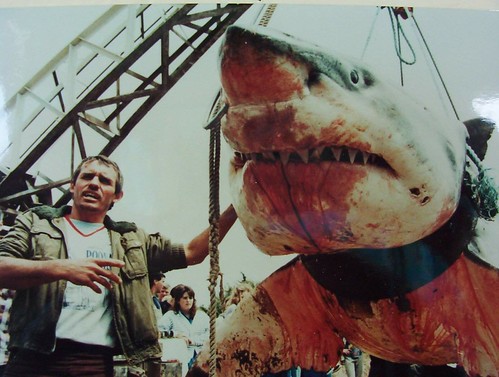
An Oregon fisherman from the town of Warren will pay a fine of $299.00 for harvesting a 12-foot Great White shark August 8, 2009 and gutting it on the docks at Depoe Bay.
Angler Jason W. Robinson, age 32, of Warren, Oregon, told an investigating state police trooper that he responsible for the shark, and that it become entangled in their crab gear and was pulled to the surface when they were bringing in a crab pot.
An OSP Fish & Wildlife trooper working on routine patrol at the docks responded to the location after hearing about the catch. The trooper saw what he believed to be a Great White Shark that was already gutted, according to Patricia Bauer with the Oregon State Police Fish and Wildlife Division.
"Our investigation indicated there was no obvious self-initiated attempt by Mr. Robinson to contact any authorities after he caught the shark before bringing it to the port. If our trooper wasn't at the right place at the right time then we believe he would have unlawfully kept the shark for his own personal interests," said Captain Walt Markee, director of the OSP Fish & Wildlife Division.
Robinson reportedly told the trooper that the shark had been gutted so it could be eaten.
Prior to seizing the shark to confirm it was in fact a Great White, the OSP trooper reports having shown Robinson a portion of the Marine Zone regulations on page 101 of the 2009 Oregon Sport Fishing Regulations prohibiting the possession of Great White and Basking Sharks and that one must immediately release them unharmed.
OSP Fish & Wildlife troopers took the shark to the Hatfield Marine Science Center On August 9th, where it was positively identified as a Great White by the National Marine Fisheries Service and ODFW.
On October 1st, Robinson was cited to appear in Lincoln County Circuit Court on October 8, 2009 for the violation offense of Unlawful Possession of Great White Shark.
Oregon State Police want to issue a reminder that anyone who discovers a dead Great White Shark or a Basking Shark should call the Oregon State Police toll free at 1-800-452-7888 to report the discovery and obtain further instructions.
Another blog post making the rounds on the Internet discusses "shark feeding" - once again.
While the conversation about chumming and habituating sharks is a perennial favourite, clearly more study needs to be done with operators enabling research at sites where sharks, people, and chumming occur.
Shane Pinder Blog
This is a continuation of the topic of shark feeding dives started in an earlier post.
Scuba Diving Forum posted a comment to that post that included a link to a very interesting article on the Shark Foundation site about a study on the impact on white shark cage diving.
The study concluded that chumming for white sharks does not condition or habituate them because the sharks don’t receive any food in the chumming process.
I wonder though if the research on white shark cage diving applies to the type of shark feeding done in the Bahamas and other parts of the Caribbean.
The conclusion that white shark cage diving does not result in the conditioning of white sharks to associate humans with food seems to hinge on the fact that white sharks are not fed during cage dives. The water is chummed with blood to attract them and the food on bait line is pulled away from them so that they never actually get a reward.
This is not what happens on shark dives in The Bahamas. The sharks do receive a reward (food). The article does refer to conditioning of three shark species in captivity -
“Conditioning has been demonstrated in a captive situation in the lemon shark, Negaprionbrevirostris (Clark 1959, Wright & Jackson 1964), nurse shark, Ginglymostomacirratum (Aronsonetal. 1967) and the bull shark, Carcharhinusleucas (Wright & Jackson 1964). ”
These species are all present in Bahamian waters.
The article also discusses the demonstrated learning ability of Tiger sharks (also present in Bahamian waters) - “The learning ability of sharks is also demonstrated under natural conditions. For two weeks a year in June off the shallows of Hawaii, tiger sharks (Galeocerdocuvier) congregate to feed on young albatross that take land on the waters surface whilst learning to fly (Martin 2003). Although the sharks initially have very little success in preying on the chicks, within 3-5 days they learn the technique needed to successfully capture the young birds and, on missing a prey item, to swim a short distance upwind to where the panicked bird will land (Martin 2003).”
The question is still whether or not the type of shark dives which involve sharks obtaining a reward (food) condition sharks to associate humans with food.
If these dives do create conditioning, does it follow that sharks are then more likely to attack humans in areas where they have been conditioned to associate humans with food?
From personal experience, I know that there are dives sites close to shark feeding sites where you can expect to see sharks even though no feeding is going on. In my experience, while the sharks at these sites have not been aggressive, they certainly hang around during the entire dive. They don’t appear to be bothered by such close contact to humans.
On dive sites that are not close to shark feeding sites, it is unusual to see any sharks. If you do happen to see a shark, it is usually only a glimpse of it as it cruising by in the distance. It doesn’t hang around.
Thanks to eagle eye blog reader John Willis who sent us the following link for a new film in production, "The Reef."
We'll let the producers notes explain this new shark film to you. Suffice to say unless there's a 30 minute moment where main characters discover an Asian Fin Raider fleet decimating regional sharks and save the day by protecting these magnificentanimals, we're pretty sure this will be a Jaws-light affair.
Tuesday, September 08, 2009 Some of my thinking behind the movie.
The production of this film is guided by three principles:
Suspense and Psychological Horror
The main principal of good horror and suspense is that the audience’s imagination is a much more potent tool than special effects and “monster” shots. In other words the best way to build fear and dread is by focussing on small events and leaving “space” for the audience’s imagination to run wild. Like Jaws, Alien and all good horror-thrillers, The Reef will generate suspense and tension by holding back the presence of the “monster” and focussing on the fears of the main characters.
Realism
Rather than being heavily theatrical, The Reef will be written as realistic as possible, sticking to its simple and raw premise without being burdened with artificial themes. I want the audience to feel this true event. I want them to think, imagine if this happened to me, what would I do?
Characters
We want to make sure that the four main characters in this tale are all real characters with natural vulnerabilities that the audience can and will empathise with them.
We have been critical of the Georgia Aquarium in the past and remain skeptical of the "scuba interactive whale shark exhibit" at this site.
But a new exhibit plans to educate the world to the plight of sharks and at first blush this looks interesting:
The world’s largest fish tank will soon offer visitors the world’s first look at a new exhibit, “Planet Shark: Predator or Prey.”
The new Georgia Aquarium exhibit opens Oct. 3, but we got the first look at it this week. (As always, I enjoy an up-close view of shark teeth and Shop-Vacs.)
It was developed in Australia and moved into the Aquarium’s 10,000 square foot exhibition space, where its first views include intimidatingly large shark models, a row of shark jaws, piles of shark teeth — and the message that sharks ought to be more afraid of humans than we are of them.
“Planet Shark” curators Craig Thorburn and Mike Bhana dedicated an entire gallery to fishing practices and consumer products that lead to the deaths of about 100 million sharks every year, according to Oceana, an ocean conservation organization.
“Sharks can easily sustain cultural uses by Pacific Islanders,” Thorburn explained as we walked through the exhibit. “They didn’t reckon on us, our fishing methods, our factory ships.”
For Thorburn, “Planet Shark” is a competitor in the race to capture imaginations. Sharks are an exciting, mysterious villain for movies and magazine covers, but in the U.S., you’re far more likely to be killed by a deer than a shark. His thought: if young, curious minds can learn about sharks, how they’re researched and how they’re portrayed, maybe their population will increase.
“Watch them, enjoy them, respect them,” Thorburn said. “They’re not meant to be cuddled, but they have just as much right to be here as we do.”
The regulations, enacted by NOAA’s Office of National Marine Sanctuaries, prohibit activities that would attract white sharks anywhere in the Farallones sanctuary. “Attracting” the sharks means any activity that lures or may lure a shark by using food, bait, chum, dyes, decoys (e.g., surfboards or body boards used as decoys), acoustics or any other means.
Found in North-Central California waters, white sharks feed on seals and sea lions, primarily during late summer and fall months. The sharks play an important role in the marine ecosystem by keeping fast-growing seal and sea lion populations in balance.
The new rules strengthen the ban on hunting and fishing for white sharks by allowing them to feed undisturbed and without distraction from intrusive human activities.
Getting within 50 meters (164 feet) of any white shark within two nautical miles of any of the Farallon Islands also is prohibited. The Farallones are comprised of three island groups, part of the Farallon Archipelago, approximately 27 miles from the Golden Gate and Point Reyes.
Designated in 1981, the Gulf of the Farallones National Marine Sanctuary encompasses 948 square nautical miles (1,255 square miles) of water off the northern and central California coast. Located just a few miles from San Francisco, the waters within the Gulf of the Farallones National Marine Sanctuary are part of a nationally significant marine ecosystem that supports a diversity of marine habitats and species.
NOAA understands and predicts changes in the Earth's environment, from the depths of the ocean to the surface of the sun, and conserves and manages our coastal and marine resources.
Dear Shark friends - please join me, David McGuire in this educational event and help support our efforts to understand and raise awareness for sharks of San Francisco and beyond.
Event: Sharktoberfest San Francisco- Celebrate the Shark - Shark Films, Art, Science and Sharks!
Branchinella latzi, missing from Ayers Rock since the 1970's, now scientists think they have an answer to this decades old mystery...and the answers are not pretty.
TOURISTS may have killed off a rare species of shrimp by relieving themselves on Australia's iconic Uluru, or Ayers Rock, according to a report.
Biologist Brian Timms said his research had showed one species of small inland shrimp living in pools atop the monolith had become extinct while another had thrived.
”The people going up the rock somehow have affected the animals which live in the pools, possibly by peeing on the rock and pooing on the rock,” Timms told state radio.
The Branchinella latzi species had not been seen on Uluru since the 1970s, and would have been susceptible to “enrichment” of the pool's water, he added.
”Certainly if (tourists) go up, they should be behaving themselves, not pooing on the rock,” Timms said.
However, a species of fairy shrimp had survived, probably because it was “widespread and tough”, according to Timms.
Australia is mulling a ban on tourists climbing the rock, which is a sacred part of Aboriginal tribes' creation mythology.
Tour operators claim visitors are often caught short on the arduous climb, and most had a “toilet roll tucked away” in case of emergency.
Thanks to their “tough guy” appearance, substantial size, and cute, adorable flippers, sharks have long been considered one of the most “huggable” animals of the sea. Indeed, who among us hasn’t ever thought about wrapping our arms around the warm, inviting cartilage of a Great White shark after a bad day at work or unsuccessful treasure hunt at the bottom of the sea?
But could those shark hugs be causing more damage than good? Potentially. A new study conducted by researchers at the University of California-Riverside suggests that hugging sharks may be hazardous to your health.
In the study, participants were dropped into the Pacific Ocean and asked to embrace a shark for a “full 90 seconds.” Surprisingly, 99 percent of the participants reported serious side effects following their hugs. These side effects included long, jagged flesh wounds, lost limbs and, in severe cases, even death.
In order to entice the sharks into showing up and receiving their hugs, scientists asked each participant in the group to wear a warm, fuzzy sweater. Also, a necklace composed of bloody fish chum.
To eliminate bias and provide a point for comparison, a control group of participants was asked to hug a stuffed placebo shark located in the break room of the UC-Riverside science lab. In sharp contrast, only one participant in this group was injured, and even that was chalked up to external variables (he slipped on a grape).
In order to verify the results of the experiment, the research team repeated the study several times over. Each time, the results were similarly dismal.
Now that the team has identified a potential link between shark hugs and health risks, the next step is to figure out the actual root cause. Of the many possibilities identified by the team, Dr. Pete Talborn, lead researcher for the study, has a “sneaking suspicion” that it “has something to do with radioactive plutonium injected into the sharks by communist Russia.”
Other potential, though less likely causes suggested by the team include flesh-eating bacteria, alien mind control, and “poisonous jellyfish disguised in shark costumes.”
Until further research is conducted, experts suggest that people refrain from hugging any and all types of sharks. However, they do note that the study only tested full-on two-armed hugs. As such, side hugs and one-armed lean-in hugs may not be harmful.
Editors Note: Ongoing humor from the Pleated Jeans Blog discovered this morning over coffee.
In August we covered an accidental take of a Great White off the coast of Oregon. The attached video lead to some outrage within the shark community and has culminated in a rare public necropsy this week during its dissection at Oregon State University's Hatfield Marine Science Center:
"It is a shame that the shark became entangled in the ropes and died, but the specimen still has a great deal of scientific and educational value," said William Hanshumaker, the OSU center's marine education specialist, who is coordinating the necropsy. "Top predators such as this are difficult to study and we don't know a lot about where they migrate or breed.
We watch a lot of expedition blogs here at Underwater Thrills. Most are garden variety expeditions exploring the flora and fauna of the non sharky kind.
Then there's this, a recent report from the Woods Hole Expedition to the Phoenix Islands Protected Area.
This post serves as a cautionary tale to the recent stunning news about Palau's newly announcedShark Sanctuary. Without enforcement Palau's sharks are still at risk, a combination of shark tourism dollars and NGO guidance will provide the operational capital and vessels to keep fishermen out of the region.
But some fish were scarce: divers saw fewer, much smaller sharks than were here in years past.Sharks are the targets worldwide of a lucrative trade in shark fins for the Asian market, and in many places there are almost no sharks left.
Fish biologist Greg Stone said, “We’re seeing the result of shark fishing that happened before PIPA was protected. We know that commercial long-lining fishing vessels came through in 2001 and 2005, and we saw some of this fishing happening at the time, but the Phoenix Islands were not a protected area until 2006.”
The problem is that sharks reproduce slowly and don’t grow quickly, so there are only young, small sharks on the reef. “The success,” said Greg, “is that there are many young sharks, and the Kiribati government has great surveillance systems in place to protect them and the reefs.”
Tukabu told our group, “Kiiribati has signed an agreement with the U.S. Coast Guard in Hawai’I to allow Kiribati officers on USCG ships, and they are authorized to arrest fishing boats here illegally – they have surveillance on the area, and inform our security system if boats are here illegally. The Kiribati government has recently fined two illegal shark fishing vessels five million dollars.” The scientists hope that this action will send a strong message: stay out of PIPA, and let the reefs be. Like the Phoenix, they will rise.
Our condolences to the people of American Samoa and surrounding islands who were slammed by a tsunami yesterday after an earthquake measuring 8.4 sent a tidal surge 15+ feet into the coastlines and city capitol.
When you "shuck oysters," you take the sharp point of an oyster knife and work it on the back end of an oyster until you find the "sweet spot."
Once you have found that spot you are generally rewarded with a satisfying pop, when the meaty inside of the oyster is revealed to all.
That's what new blue blogger Dorsal Fin does with mainstream media and sharks - poking at media hysteria to reveal the meaty inside of the story.
The Dorsal Fin Blog has impressed us from it's inception a few months ago. With its stark mandate "Shark News…without the sensationalism" this blog is a much needed addition to the world of shark news coverage.
Welcome Dorsal Fin, if this weeks blog post is anything like the next 2000, the world of shark media will soon change...for the better.
Congratulations to Palmas Del Mar Yacht Club for going "shark free" this month.
Our first marina in Puerto Rico registered last week, the Palmas Del Mar Yacht Club, a new 163 slip facility with regional industry leadership in mind.
Sail into a paradise as rich as the open sea in our new Yacht Club and Megayacht Marina. Our new Yacht Club is the only state-of-the-art Marina in the Caribbean linked to a complete resort community. Come aboard and be one of the first to reserve one of the 152 slips designed to serve yachts from 50 to 125 feet long.
The Yacht Club is also being designed with side tie mega-slips reserved for transient mega-yachts of up to 175 feet.
Scottish whisky liqueur Drambuie is rewarding 13 of its loyal bartenders by throwing them to the sharks – literally.
In the spirit of adventure that embodies Drambuie and its brand values of ‘risk, rebellion, passion and mystery’, they offered bartenders across the country the opportunity to win a trip cage-diving with sharks off the coast of Port Lincoln, South Australia.
The three winning venues - Rambutan in Sydney, Madame Brussels in Melbourne and the Forrest Centre Tavern in Perth – are currently at the Neptune Islands (70km off the coast of Port Lincoln) redeeming their prize.
“This promotion is similar to one they run in the UK, where bartenders are taken to Cape Town [South Africa] to experience the adventure-of-a-lifetime shark-diving,” said Drambuie senior brand manager Alison Sinclair. “It’s really exciting how well the bartenders have embraced the competition and the spirit.”
With an estimated wild population of close to 500 animals the birth of a Grey Nurse shark in Australia this week was a huge event. Attended by an aquarium diver from Australia'sUnderWater World the exceptionally rare birth was also caught on tape.
When it comes to Save Our Seas few NGO's strike as many positive chords for shark conservation media output as they do. We have been blogging about their continuing media efforts for a while now as the "conservation gold standard."
So it is with little surprise that we discover another media hit, this time featuring some of the least voices heard in the shark conservation discussion. Mostly due to the fact that in their world shark conservation speaks with the language of data sets and power point presentations.
Here in their own voices, none less passionate, are the shark researchers who are on the front lines of shark conservation worldwide.
After watching this video you have to wonder out loud how Discovery Networks failed as badly as they did with Shark Week 2009. Making compelling shark media is not rocket science, as we have been saying for a while it starts by "engaging the source," not arriving on scene with a hand made shark script fabricated in Los Angeles.
Kudos to all those who made this wonderful video, we could use many more:
In the ongoing political mess that has become Isla Guadalupe Mexican Navy officials have, for the first time, demanded that a vessel to return to Ensenada in the middle of it's shark operations.
The issue, a ban on all chumming, brought about by a video shot in 2008 is back on the table in full force (thank you Mr.Patrick Walsh).
We'll update you as soon as the details have become clearer, suffice to say this latest development is not a positive one for this newly minted Bio Sphere Reserve or the commercial shark diving industry at large.
We received the following email this morning. 1900+ blog posts later about sharks, shark diving and conservation, it would seem this blog has discovered a wider audience.
Thanks to all our readers, shark divers, and associated industry cranks (you know who you are) we could not have done it without you:
Congratulations Shark Diver Blog,
Your readers have submitted and voted for your blog at The Daily Reviewer. We compiled an exclusive list of the Top 100 scuba Blogs, and we are glad to let you know that your blog was included!
Congratulations to another Miami area marina who has gone Shark Free. This week was an exciting one for the Shark Free Marinas Initiative as marinas from as far away as Puerto Rico joined the effort.
Leadership begins with taking a stand and making a phone call. Kudos to all our Regional Ambassadors who made the call and used our online materials to ask marinas to make that change.
Please support Keystone Point Marina by dropping by their facility at 1950 N.E. 135th Street, North Miami, Florida 33181 and be sure to visit their website at www.keystonepointmarina.com

 55 - Number of days the Montera Oil Platform spill has been sending oil into the Timor Sea.