Monday, October 5, 2009

Shark Feeding – The Debate Continues

Another blog post making the rounds on the Internet discusses "shark feeding" - once again.

While the conversation about chumming and habituating sharks is a perennial favourite, clearly more study needs to be done with operators enabling research at sites where sharks, people, and chumming occur.

Shane Pinder Blog

This is a continuation of the topic of shark feeding dives started in an earlier post.

Scuba Diving Forum posted a comment to that post that included a link to a very interesting article on the Shark Foundation site about a study on the impact on white shark cage diving.

The study concluded that chumming for white sharks does not condition or habituate them because the sharks don’t receive any food in the chumming process.

I wonder though if the research on white shark cage diving applies to the type of shark feeding done in the Bahamas and other parts of the Caribbean.

The conclusion that white shark cage diving does not result in the conditioning of white sharks to associate humans with food seems to hinge on the fact that white sharks are not fed during cage dives. The water is chummed with blood to attract them and the food on bait line is pulled away from them so that they never actually get a reward.

This is not what happens on shark dives in The Bahamas. The sharks do receive a reward (food). The article does refer to conditioning of three shark species in captivity -

“Conditioning has been demonstrated in a captive situation in the lemon shark, Negaprion brevirostris (Clark 1959, Wright & Jackson 1964), nurse shark, Ginglymostoma cirratum (Aronson et al. 1967) and the bull shark, Carcharhinus leucas (Wright & Jackson 1964). ”

These species are all present in Bahamian waters.

The article also discusses the demonstrated learning ability of Tiger sharks (also present in Bahamian waters) - “The learning ability of sharks is also demonstrated under natural conditions. For two weeks a year in June off the shallows of Hawaii, tiger sharks (Galeocerdo cuvier) congregate to feed on young albatross that take land on the waters surface whilst learning to fly (Martin 2003). Although the sharks initially have very little success in preying on the chicks, within 3-5 days they learn the technique needed to successfully capture the young birds and, on missing a prey item, to swim a short distance upwind to where the panicked bird will land (Martin 2003).”

The question is still whether or not the type of shark dives which involve sharks obtaining a reward (food) condition sharks to associate humans with food.

If these dives do create conditioning, does it follow that sharks are then more likely to attack humans in areas where they have been conditioned to associate humans with food?

From personal experience, I know that there are dives sites close to shark feeding sites where you can expect to see sharks even though no feeding is going on. In my experience, while the sharks at these sites have not been aggressive, they certainly hang around during the entire dive. They don’t appear to be bothered by such close contact to humans.

On dive sites that are not close to shark feeding sites, it is unusual to see any sharks. If you do happen to see a shark, it is usually only a glimpse of it as it cruising by in the distance. It doesn’t hang around.

Have a look at the article posted by Scuba Diving Forum about the study done by the Shark Foundation. What are your thoughts?

  • Does this study help to confirm that shark dives in which sharks get food do not condition sharks to associate food with humans?
  • Do you think that shark dives that result in sharks being fed condition sharks to associate food with humans?
  • If sharks are conditioned by these types of dives to associate food with humans, does that make it more likely that shark attacks will occur?

Sunday, October 4, 2009

The Reef - When White Sharks Attack?

Thanks to eagle eye blog reader John Willis who sent us the following link for a new film in production, "The Reef."

We'll let the producers notes explain this new shark film to you. Suffice to say unless there's a 30 minute moment where main characters discover an Asian Fin Raider fleet decimating regional sharks and save the day by protecting these magnificent animals, we're pretty sure this will be a Jaws-light affair.

Just in time for 2010.

The guiding principles of THE REEF

Tuesday, September 08, 2009
Some of my thinking behind the movie.

The production of this film is guided by three principles:

Suspense and Psychological Horror

The main principal of good horror and suspense is that the audience’s imagination is a much more potent tool than special effects and “monster” shots. In other words the best way to build fear and dread is by focussing on small events and leaving “space” for the audience’s imagination to run wild. Like Jaws, Alien and all good horror-thrillers, The Reef will generate suspense and tension by holding back the presence of the “monster” and focussing on the fears of the main characters.


Realism


Rather than being heavily theatrical, The Reef will be written as realistic as possible, sticking to its simple and raw premise without being burdened with artificial themes. I want the audience to feel this true event. I want them to think, imagine if this happened to me, what would I do?


Characters


We want to make sure that the four main characters in this tale are all real characters with natural vulnerabilities that the audience can and will empathise with them.

Saturday, October 3, 2009

Planet Shark : Predator or Prey - Georgia Aquarium

We have been critical of the Georgia Aquarium in the past and remain skeptical of the "scuba interactive whale shark exhibit" at this site.

But a new exhibit plans to educate the world to the plight of sharks and at first blush this looks interesting:

The world’s largest fish tank will soon offer visitors the world’s first look at a new exhibit, “Planet Shark: Predator or Prey.”

The new Georgia Aquarium exhibit opens Oct. 3, but we got the first look at it this week. (As always, I enjoy an up-close view of shark teeth and Shop-Vacs.)

It was developed in Australia and moved into the Aquarium’s 10,000 square foot exhibition space, where its first views include intimidatingly large shark models, a row of shark jaws, piles of shark teeth — and the message that sharks ought to be more afraid of humans than we are of them.

“Planet Shark” curators Craig Thorburn and Mike Bhana dedicated an entire gallery to fishing practices and consumer products that lead to the deaths of about 100 million sharks every year, according to Oceana, an ocean conservation organization.

“Sharks can easily sustain cultural uses by Pacific Islanders,” Thorburn explained as we walked through the exhibit. “They didn’t reckon on us, our fishing methods, our factory ships.”

For Thorburn, “Planet Shark” is a competitor in the race to capture imaginations. Sharks are an exciting, mysterious villain for movies and magazine covers, but in the U.S., you’re far more likely to be killed by a deer than a shark. His thought: if young, curious minds can learn about sharks, how they’re researched and how they’re portrayed, maybe their population will increase.

“Watch them, enjoy them, respect them,” Thorburn said. “They’re not meant to be cuddled, but they have just as much right to be here as we do.”

Complete Post

NOAA Gives Great White Sharks More Protection in Gulf of the Farallones Sanctuary

New regulations to protect the great white shark are now in effect in NOAA’s Gulf of the Farallones National Marine Sanctuary, a marine protected area just west of San Francisco.


The regulations, enacted by NOAA’s Office of National Marine Sanctuaries, prohibit activities that would attract white sharks anywhere in the Farallones sanctuary. “Attracting” the sharks means any activity that lures or may lure a shark by using food, bait, chum, dyes, decoys (e.g., surfboards or body boards used as decoys), acoustics or any other means.


Found in North-Central California waters, white sharks feed on seals and sea lions, primarily during late summer and fall months. The sharks play an important role in the marine ecosystem by keeping fast-growing seal and sea lion populations in balance.

The new rules strengthen the ban on hunting and fishing for white sharks by allowing them to feed undisturbed and without distraction from intrusive human activities.

Getting within 50 meters (164 feet) of any white shark within two nautical miles of any of the Farallon Islands also is prohibited. The Farallones are comprised of three island groups, part of the Farallon Archipelago, approximately 27 miles from the Golden Gate and Point Reyes.

Designated in 1981, the Gulf of the Farallones National Marine Sanctuary encompasses 948 square nautical miles (1,255 square miles) of water off the northern and central California coast. Located just a few miles from San Francisco, the waters within the Gulf of the Farallones National Marine Sanctuary are part of a nationally significant marine ecosystem that supports a diversity of marine habitats and species.

NOAA understands and predicts changes in the Earth's environment, from the depths of the ocean to the surface of the sun, and conserves and manages our coastal and marine resources.

Sharktoberfest San Francisco - Celebrate the Shark

Bay Area residents are invited to Sharktoberfest San Francisco - Celebrate the Shark!

Dear Shark friends - please join me, David McGuire in this educational event and help support our efforts to understand and raise awareness for sharks of San Francisco and beyond.

Event: Sharktoberfest San Francisco- Celebrate the Shark - Shark Films, Art, Science and Sharks!

What: Fundraiser

Start Time: Friday, October 16 at 6:30pm

End Time: Saturday, October 17 at 6:00pm

Where: Aquarium of the Bay, San Francisco

To see more details and RSVP, follow the link.

Thursday, October 1, 2009

Branchinella latzi - Death by Tourism?

Branchinella latzi, missing from Ayers Rock since the 1970's, now scientists think they have an answer to this decades old mystery...and the answers are not pretty.

TOURISTS may have killed off a rare species of shrimp by relieving themselves on Australia's iconic Uluru, or Ayers Rock, according to a report.

Biologist Brian Timms said his research had showed one species of small inland shrimp living in pools atop the monolith had become extinct while another had thrived.

”The people going up the rock somehow have affected the animals which live in the pools, possibly by peeing on the rock and pooing on the rock,” Timms told state radio.

The Branchinella latzi species had not been seen on Uluru since the 1970s, and would have been susceptible to “enrichment” of the pool's water, he added.

”Certainly if (tourists) go up, they should be behaving themselves, not pooing on the rock,” Timms said.

However, a species of fairy shrimp had survived, probably because it was “widespread and tough”, according to Timms.

Australia is mulling a ban on tourists climbing the rock, which is a sacred part of Aboriginal tribes' creation mythology.

Tour operators claim visitors are often caught short on the arduous climb, and most had a “toilet roll tucked away” in case of emergency.

Complete Story

Health Alert: Hugging Sharks May Result in Lost Limbs, Death

Thanks to their “tough guy” appearance, substantial size, and cute, adorable flippers, sharks have long been considered one of the most “huggable” animals of the sea. Indeed, who among us hasn’t ever thought about wrapping our arms around the warm, inviting cartilage of a Great White shark after a bad day at work or unsuccessful treasure hunt at the bottom of the sea?

But could those shark hugs be causing more damage than good? Potentially. A new study conducted by researchers at the University of California-Riverside suggests that hugging sharks may be hazardous to your health.

In the study, participants were dropped into the Pacific Ocean and asked to embrace a shark for a “full 90 seconds.” Surprisingly, 99 percent of the participants reported serious side effects following their hugs. These side effects included long, jagged flesh wounds, lost limbs and, in severe cases, even death.

In order to entice the sharks into showing up and receiving their hugs, scientists asked each participant in the group to wear a warm, fuzzy sweater. Also, a necklace composed of bloody fish chum.

To eliminate bias and provide a point for comparison, a control group of participants was asked to hug a stuffed placebo shark located in the break room of the UC-Riverside science lab. In sharp contrast, only one participant in this group was injured, and even that was chalked up to external variables (he slipped on a grape).

In order to verify the results of the experiment, the research team repeated the study several times over. Each time, the results were similarly dismal.

Now that the team has identified a potential link between shark hugs and health risks, the next step is to figure out the actual root cause. Of the many possibilities identified by the team, Dr. Pete Talborn, lead researcher for the study, has a “sneaking suspicion” that it “has something to do with radioactive plutonium injected into the sharks by communist Russia.”

Other potential, though less likely causes suggested by the team include flesh-eating bacteria, alien mind control, and “poisonous jellyfish disguised in shark costumes.”

Until further research is conducted, experts suggest that people refrain from hugging any and all types of sharks. However, they do note that the study only tested full-on two-armed hugs. As such, side hugs and one-armed lean-in hugs may not be harmful.

Editors Note: Ongoing humor from the Pleated Jeans Blog discovered this morning over coffee.

Wednesday, September 30, 2009

Oregon Dead White Shark - Public Necropsy

In August we covered an accidental take of a Great White off the coast of Oregon. The attached video lead to some outrage within the shark community and has culminated in a rare public necropsy this week during its dissection at Oregon State University's Hatfield Marine Science Center:

"It is a shame that the shark became entangled in the ropes and died, but the specimen still has a great deal of scientific and educational value," said William Hanshumaker, the OSU center's marine education specialist, who is coordinating the necropsy. "Top predators such as this are difficult to study and we don't know a lot about where they migrate or breed.

"


Complete Story

Expedition to the Phoenix Islands Protected Area - Shark Update

We watch a lot of expedition blogs here at Underwater Thrills. Most are garden variety expeditions exploring the flora and fauna of the non sharky kind.

Then there's this, a recent report from the Woods Hole Expedition to the Phoenix Islands Protected Area.

Never heard of it?

The Phoenix Islands Marine Protected Area is the largest protected marine area in the world. It was formed in 2008 thanks to the efforts of the Island nation of Kiribati, the New England Aquarium and Conservation International.

This post serves as a cautionary tale to the recent stunning news about Palau's newly announced Shark Sanctuary. Without enforcement Palau's sharks are still at risk, a combination of shark tourism dollars and NGO guidance will provide the operational capital and vessels to keep fishermen out of the region.

Here's the recent expedition blog post talking about the sharks of the Phoenix Islands Marine Protected Area:

But some fish were scarce: divers saw fewer, much smaller sharks than were here in years past. Sharks are the targets worldwide of a lucrative trade in shark fins for the Asian market, and in many places there are almost no sharks left.

Fish biologist Greg Stone said, “We’re seeing the result of shark fishing that happened before PIPA was protected. We know that commercial long-lining fishing vessels came through in 2001 and 2005, and we saw some of this fishing happening at the time, but the Phoenix Islands were not a protected area until 2006.”

The problem is that sharks reproduce slowly and don’t grow quickly, so there are only young, small sharks on the reef. “The success,” said Greg, “is that there are many young sharks, and the Kiribati government has great surveillance systems in place to protect them and the reefs.”

Tukabu told our group, “Kiiribati has signed an agreement with the U.S. Coast Guard in Hawai’I to allow Kiribati officers on USCG ships, and they are authorized to arrest fishing boats here illegally – they have surveillance on the area, and inform our security system if boats are here illegally. The Kiribati government has recently fined two illegal shark fishing vessels five million dollars.” The scientists hope that this action will send a strong message: stay out of PIPA, and let the reefs be. Like the Phoenix, they will rise.

Tsunami American Samoa - Angry Oceans

Our condolences to the people of American Samoa and surrounding islands who were slammed by a tsunami yesterday after an earthquake measuring 8.4 sent a tidal surge 15+ feet into the coastlines and city capitol.

This is the worst natural disaster in American Samoan history, to donate to relief funds please go here:


Tuesday, September 29, 2009

The Dorsal Fin Blog - Shucking Media Oysters

When you "shuck oysters," you take the sharp point of an oyster knife and work it on the back end of an oyster until you find the "sweet spot."

Once you have found that spot you are generally rewarded with a satisfying pop, when the meaty inside of the oyster is revealed to all.

That's what new blue blogger Dorsal Fin does with mainstream media and sharks - poking at media hysteria to reveal the meaty inside of the story.

The Dorsal Fin Blog has impressed us from it's inception a few months ago. With its stark mandate "Shark News…without the sensationalism" this blog is a much needed addition to the world of shark news coverage.

Welcome Dorsal Fin, if this weeks blog post is anything like the next 2000, the world of shark media will soon change...for the better.

Shark Free Marinas Initiative - Puerto Rico

Congratulations to Palmas Del Mar Yacht Club for going "shark free" this month.

Our first marina in Puerto Rico registered last week, the Palmas Del Mar Yacht Club, a new 163 slip facility with regional industry leadership in mind.

You can find out about their marina at the website: palmasdelmaryachtclub.com

Sail into a paradise as rich as the open sea in our new Yacht Club and Megayacht Marina. Our new Yacht Club is the only state-of-the-art Marina in the Caribbean linked to a complete resort community. Come aboard and be one of the first to reserve one of the 152 slips designed to serve yachts from 50 to 125 feet long.


The Yacht Club is also being designed with side tie mega-slips reserved for transient mega-yachts of up to 175 feet.

Are you a marina owner/manager? Follow their example and register your facility with Shark-Free Marinas today.

Want to get involved with SFMI? Visit our Regional Ambassadors page for more info.

Monday, September 28, 2009

Alcohol and Shark Diving - Mixing Success

As shark media marketing folks we like this:

Scottish whisky liqueur Drambuie is rewarding 13 of its loyal bartenders by throwing them to the sharks – literally.

In the spirit of adventure that embodies Drambuie and its brand values of ‘risk, rebellion, passion and mystery’, they offered bartenders across the country the opportunity to win a trip cage-diving with sharks off the coast of Port Lincoln, South Australia.

The three winning venues - Rambutan in Sydney, Madame Brussels in Melbourne and the Forrest Centre Tavern in Perth – are currently at the Neptune Islands (70km off the coast of Port Lincoln) redeeming their prize.

“This promotion is similar to one they run in the UK, where bartenders are taken to Cape Town [South Africa] to experience the adventure-of-a-lifetime shark-diving,” said Drambuie senior brand manager Alison Sinclair. “It’s really exciting how well the bartenders have embraced the competition and the spirit.”

Complete Story

Grey Nurse Shark Birth - On Tape

With an estimated wild population of close to 500 animals the birth of a Grey Nurse shark in Australia this week was a huge event. Attended by an aquarium diver from Australia's UnderWater World the exceptionally rare birth was also caught on tape.

Complete Story


Save Our Seas Foundation - Positive Shark Media

When it comes to Save Our Seas few NGO's strike as many positive chords for shark conservation media output as they do. We have been blogging about their continuing media efforts for a while now as the "conservation gold standard."

So it is with little surprise that we discover another media hit, this time featuring some of the least voices heard in the shark conservation discussion. Mostly due to the fact that in their world shark conservation speaks with the language of data sets and power point presentations.

Here in their own voices, none less passionate, are the shark researchers who are on the front lines of shark conservation worldwide.

After watching this video you have to wonder out loud how Discovery Networks failed as badly as they did with Shark Week 2009. Making compelling shark media is not rocket science, as we have been saying for a while it starts by "engaging the source," not arriving on scene with a hand made shark script fabricated in Los Angeles.

Kudos to all those who made this wonderful video, we could use many more:


Thanks Mike in Beqa for posting this first!

Isla Guadalupe - Vessel Ordered to Leave?

In the ongoing political mess that has become Isla Guadalupe Mexican Navy officials have, for the first time, demanded that a vessel to return to Ensenada in the middle of it's shark operations.

The issue, a ban on all chumming, brought about by a video shot in 2008 is back on the table in full force (thank you Mr.Patrick Walsh).

We'll update you as soon as the details have become clearer, suffice to say this latest development is not a positive one for this newly minted Bio Sphere Reserve or the commercial shark diving industry at large.

Underwater Thrills:Swimming with Sharks - Top 100

We received the following email this morning. 1900+ blog posts later about sharks, shark diving and conservation, it would seem this blog has discovered a wider audience.

Thanks to all our readers, shark divers, and associated industry cranks (you know who you are) we could not have done it without you:

Congratulations Shark Diver Blog,

Your readers have submitted and voted for your blog at The Daily Reviewer. We compiled an exclusive list of the Top 100 scuba Blogs, and we are glad to let you know that your blog was included!


Cheers,

Angelina Mizaki
Selection Committee President
The Daily Reviewer

Shark Free Marinas - Keystone Point Marina Miami

Congratulations to another Miami area marina who has gone Shark Free. This week was an exciting one for the Shark Free Marinas Initiative as marinas from as far away as Puerto Rico joined the effort.

Leadership begins with taking a stand and making a phone call. Kudos to all our Regional Ambassadors who made the call and used our online materials to ask marinas to make that change.

Please support Keystone Point Marina by dropping by their facility at 1950 N.E. 135th Street, North Miami, Florida 33181 and be sure to visit their website at www.keystonepointmarina.com

Are you a marina owner/manager? Follow their example and register your facility with Shark-Free Marinas today.

Want to get involved with SFMI? Visit our Regional Ambassadors page for more info.

Sunday, September 27, 2009

Hydrolagus melanophasma - Try not to laugh

We have been avoiding this one since it broke last week, but after careful consideration, here it is.

Yes this is shark news, and yes it is science so try not to laugh:

A new ghostshark species has been identified off the coast of Southern California, and it’s darker and weirder than any shark we know.

The purplish black ancient relative of the modern shark comes packed with a suite of odd features that give its taxonomical family the name chimaera, after the mythical beast made from the parts of many animals.

“It’s a big weird looking freaky thing,” said ichthyologist Doug Long of the California Academy of Sciences. “They have some shark characteristics and they have some that are very non-shark.”

Perhaps the most intriguing feature of the newly described species, Hydrolagus melanophasma, is a presumed sexual organ that extends from its forehead called a tentaculum.

“They have this club on the top of their head with spikes. People think it’s used for mating,” Long said. “It’s like a little mace with little spikes and hooks and it fits into their forehead. It’s jointed and it comes out. We’re not sure if it is used to stimulate the female or hold the female closer.”

The species is yet another example of the tremendous, unknown biodiversity that still exists near heavily populated regions like the Los Angeles coastline. It was actually “discovered” long ago in the sense that museum specimens of the fish existed at Scripps Oceanographic Institute. But it wasn’t until a team of researchers from the Pacific Shark Research Center and the California Academy of Sciences came together to examine the odd creatures that they realized they were looking at something new.

Complete Story

Iemanya Oceanica Seeks Divers For Shark Research

The Los Angeles-based nonprofit shark organization, Iemanya Oceanica, is looking for people willing to swim with sharks for research.

Iemanya Oceanica is organizing a shark-tagging research expedition to Baja California next month and is seeking up to 20 scuba divers/snorkelers from Southern California to help.

Iemanya -- named after a Brazilian goddess of the sea -- partnering with the CICESE Research Institute in Baja and Dr. Rachel T. Graham, a world-renowned shark scientist, will travel to a known population of whale sharks in Bahia de Los Angeles on the Sea of Cortez side of Baja California.

Their goal is to apply satellite tags to two to three whale sharks during the five-day expedition, departing from the Los Angeles area on Oct. 15.

Interested divers should contact Iemanya Executive Director Laleh Mohajerani.

Saturday, September 26, 2009

Palau Shark Sanctuary - Tourism/Conservation Leadership

We began our blogging year with a series of startling conservation posts from the tiny island nation of Palau, highlighting worst case shark scenarios in the form of two senate fisheries bills:

SENATE BILL S-44 proposes:
“To amend Title 27 of the Palau National Code to allow for the commercial fishing of sharks within Palau’s Exclusive Economic Zone, to impose a tax on the export of sharks and tuna-like species, and for other related purposes.”

SENATE BILL S-50 proposes:
“To exempt, for a period of five years, the export of tuna and tuna-like species caught using the group purse seining or handline fishing method from Palau’s fish export tax, to allow for an alternate transshipment port for fish caught using the group purse seining or handline fishing method, and for other related purposes.”

These two combined bills would have had a devastating effect on Palau's already struggling shark populations allowing unrestricted finning and catch for sharks.

What a difference a few months can make. This week in a stunning reversal and worthy of much praise for both leadership and political will Palau's President announced a universal 230,000 sq.mile Exclusive Economic Zone Shark Park in it's waters.

In terms of an immediate tourism booster the commercial shark diving world is thrilled to hear this news. As we have known for close to 20 years, shark are big, sustainable, business models that help local communities move from fishing to tourism.

Kudos to all the NGO's, local conservation agencies, and countless "others" who sent emails to Palau's government talking tourism and shark conservation. More Kudos to the government of Palau who made one of the boldest moves in the history of shark conservation, setting the bar past any and all regional expectations.

Let's go shark diving!

You can learn more at the Palau Shark Sanctuary web site and blog. To write congratulations to President Toribiong, the address is: Office of the President, P.O. Box 100, Koror, Palau 96940.

Thursday, September 24, 2009

Dear Isla Guadalupe Operators - What part of this is wrong?

O.K folks it's time for "The Chat -Version Two."

As you may recall we have been blogging about the absolutely moronic series of piss poor media hits members of our own industry have been streaming to the planet via You Tube, Facebook, mainstream media and more. It has been a bad year for operators who have been handing the anti-shark diving lobby the story that we, as an entire industry, are little more than idiotic thrill seekers bent on getting folks killed.

Since the beginning of 2009, full cage breaches, tiger shark media disasters, and image gaffs have been blasted to every major media outlet on the planet.

Is anyone out there listening? Does anyone care?

Clearly not.

Shark Week 2009 displayed the worst in a series to date to an estimated 30 million viewers. A stunning media achievement, alas setting the sharks we know at this very site back to the stone age in terms of the public perception of them.

Well done industry guys!

So it is with little surprise to this blog that we discover yet another remarkably stupid video placed on You Tube under the guise of "conservation". We're pretty sure the folks who actually shot this video are meant well, and they are completely unaware of the ongoing fluid and tenuous situation with Mexican lawmakers who are asking for this site to be shut down.

UPDATE: This video was not enabled by any operator at Isla Guadalupe it was shot on a private vessel shooting with National Geographic, adding an interesting twist to the shark media landscape at this pristine shark site.

Here's why this video fails on all levels except for the gratuitous "lookee here" factor:

1. Mexican park authorities do not sanction out of cage diving at this site.

2. Mexico's anti shark diving lobby (Green Party) who are looking for reasons for closure, and who, as recently as 2007/8, called for a complete ban on shark cage diving.

3. Anti-shark diving lobby, who once again have been handed a media win and who will use this video to further their efforts at maligning our industry.

4. Apart from a small group of shark diving insiders, this video places patently false expectations on white shark encounters.

There's a number of alternate reasons why this video should be pulled, but it becomes exhausting to go over them - yet again. Suffice to say none of the operators we have spoken with think this is anything but a poorly done shark stunt that will harm all the operators at this site.

Shark conservation is not shark stunt work. Let's get that straight.

Note: The person behind this stunt is also well known for his deep involvement in production Shark Porn. Shows that ultimately serve to demonize sharks to the general public.

Here is his CV.


Tuesday, September 22, 2009

New shark research begins at Cape Eleuthera

CAPE ELEUTHERA, Bahamas -- At the Cape Eleuthera Institute (CEI) the last survey for the baited video validation study was completed in early June and the results were quickly worked up to be presented at the annual American Elasmobranch meeting in Portland,
Oregon at the end of July.

Edd Brooks, the shark program manager, presented on the seasonal abundance, demographics and habitat use of the Caribbean reef sharks in the waters off Cape Eleuthera.

The second half of the summer saw the start of a new study aimed at quantifying the effects of longline capture on post-release survivorship and behavior of Caribbean reef sharks. The project began with the rearrangement of CEI’s array of 32 acoustic receivers and the deployment of 15 acoustic transmitters on Caribbean reef sharks.

This new type of transmitter transmits the depth of the shark as well as the average three-dimensional acceleration of the shark giving an overall measure of activity. Digital hook timers monitor the exact hooking duration of the candidate shark prior to the transmitter being deployed.

In addition to the attachment of the accelerometer a blood sample was taken from all sharks giving a snapshot of the physiological stress that an animal experiences across different hooking durations.

Thank you to the Save Our Seas Foundation for supporting us for another year, and also many thanks to the numerous Island School families who have also jumped onboard and supported this important work.

Cage Diving Farallones - New Regulations

Editors Note: The following email came from the Office of National Marine Sanctuaries and finalizes eight years of public input and research data. The final rule bars commercial shark diving operators to a 164' foot distance from white sharks with minor concessions to static decoy use.

It is time operators at this site consider what constitutes commercial shark diving:

To protect one of the most important white shark populations in the world, NOAA/Office of National Marine Sanctuaries has enacted new regulations to ensure sharks are not disturbed.

Within Gulf of the Farallones and Monterey Bay National Marine Sanctuaries Federal law prohibits:

1. Attracting a white shark anywhere in Gulf of the Farallones or Monterey Bay National Marine Sanctuaries.


Attract or attracting means the conduct of any activity that lures or may lure a white shark in the Sanctuary by using food,bait, chum, dyes, decoys (e.g., surfboards or body boards used as decoys), acoustics or any other means, except the mere presence of human beings (e.g., swimmers, divers, boaters, kayakers, surfers).


2. Approaching within 50 meters (164 ft.) of any white shark within 2 nautical miles of any of the Farallon Islands.

Attached you will find a flyer. Please hang it if you know of a great location with high visibility. Also, please forward this email onto interested parties that we may have overlooked.

Thank you,

Sage Tezak
Gulf of the Farallones National Marine Sanctuary

--
Sage Tezak
Conservation Science Specialist
Gulf of the Farallones National Marine Sanctuary
991 Marine Dr, the Presidio
San Francisco, CA 94129
(W) 415.561.6622 x306
(F) 415.561.6616
Sage.Tezak@noaa.gov

Hawaii - Politicians ignoring research data?

In the ongoing battle to preserve two shark diving operators from a small minded, fear based lynch mob who have run roughshod over Maui's politicians, the golden rule of the political set rears it's ugly head - "Ignore research data at your own peril."

Maui city council members glossed over and dismissed a recent study by Carl Meyer and Kim Holland proving sharks were not following commercial shark diving operators back to shore, a key anti-shark diving complaint.

But it gets worse. Not just happy to ignore research data some politicians, no doubt guided by anti-shark diving fear monger talking points, have denounced the data, attacking the two researchers in question and by proxy the University of Hawaii!

The Romans had a saying for this kind of behaviour "don't kill the messenger" and today blow back for "killing the messenger" in the form of an Op Ed reminded politicians in Oahu (hopefully more enlightened than Maui) of the golden rule of the political set:

Shark Tours - Study shows no increased risk

I am obliged to respond to Greg Knudsen's inaccurate characterization of our research paper concerning North Shore shark tours.

Three points:

1) The paper was not based solely on data from tour operators.

2) The operators' information was provided prior to the recent turmoil; there was no incentive for false reporting.

3) The paper was only published after review by independent experts. Soon-to-be-published results of shark tracking research show that sharks found at the tour sites don't come close to shore.

Several elected officials such as Mr. Knudsen took public positions on this topic before they had sufficient objective information or after listening to "instant experts." Apparently, ego now prevents them from changing their minds even though the scientific facts do not support their opinions. Objective data indicate that the tours do not cause increased risk to humans and do not significantly impact the biology of sharks. The tours do provide local employment and they probably increase the general public's appreciation of marine life and how worthy these resources are of our respect and protection.

Kim Holland, Ph.D.
Researcher, Hawai'i Institute of Marine Biology

Shark Free Marinas - Old Bahama Bay Marina

The Old Bahama Bay Marina, located at the West End of Grand Bahama, originally signed on the campaign in March, but made it official on Sept 10, 2009.

Management wanted to wait for all the right people to be there for the hanging of the signs. Nathan Moody( Director of operations) , Jackie Carroll ( General manager) , Sharon Whymms ( Marina attendant) and Luther Ferguson ( Director of transportation) joined regional associates Jillian Morris and Duncan Brake in hanging 2 signs at the marina.

GM Jackie Carroll was very excited about the movement and anxious to learn more about what she can do to help these magnificent animals.

This marina is also the location where most diving operations clear customs before they head to Tiger Beach, so their joining the campaign is a huge victory for sharks and for shark diving.

Thanks to Jillian Morris and Duncan Brake for their terrific efforts in Bahamas. If you are interested in working as a Shark-Free Marina Regional Ambassador like them check out this page. -LT

Nantucket Shark Divers - Sustainable Media?

Editors Note: Rarely do we change blog entries. Today we did in the best interests of the industry.

The original post was about poor media handling, a subject we have been on more than once and once again faced with as images surfaced of industry members doing questionable things with sharks.

The owner of Nantucket Shark Diving, who we have been supportive of pulled the images today realizing his role in the global shark diving world was not just limited to Nantucket.

Kudos mate, that's industry leadership!

Our original post also had a small quote from a lengthy letter by the Humane Society USA which we will re-post here. As it turns out the Humane Society, in what can only be described as a "senior moment" sent a letter to the rabid anti-shark diving folks and politicians on both Maui and Oahu lending their weight against the entire commercial shark diving industry:


"Feeding wildlife of any species is detrimental to the species, as has
been demonstrated in instances as varied as feeding dolphins and
feeding bears. While I am sure that there are conscientious operators
who do not chum for/feed sharks, there are certainly instances in
which the ban is being violated. It is hard when a few rotten apples
spoil the whole barrel, but regulations are unfortunately directed to
the lowest common denominator (i.e., the need for automobile speed
regulations is not because most people are not sensible, it is because
some are reckless and there is a need to curb the behavior)."

For a conservation organization that works on shark issues, we're not sure how the Humane Society reconciles our industries efforts to preserve sharks via conservation efforts worldwide.

Instead here's a quick letter from NSD, who despite some early media malfunctions, have grown into one of the only operations on the East coast for great shark diving:

Nantucket Shark Divers is gearing up to become a full circle shark diving operation starting up in June of 2010. We will keep you updated with our progress. With an abundance of sharks in the area and warm offshore waters found within 10 miles of the shoreline this is a prime destination to dive with sharks on the Northeastern seaboard. Our operation specializes in taking: divers, researchers, topside viewers, and photographers out to view sharks using a respectful and humane approach to our expeditions. On a side note as a shark dive operator in the area I feel it is important to mention the recent media activity centered around the presence of great white sharks in Cape Cod waters in early September 2009.

I was very pleased to see the vast majority of legitimate media taken from the event was centered around the positives of having these sharks around our coastline. Not focusing on the minute dangers these sharks posed but the remarkable possibility to research and witness these endangered animals themselves. To me there seems to be a more positive outlook on sharks within the past few years, moving from a highly negative outlook toward a public interest and involvement through favored conservation by the public due to the dyer circumstances of sharks being brought to the public eye. I believe sharks are seen more as something to be protected and left alone in recent years than something that must be killed, and very deservedly so.

This has to be largely due to the amount of research and familiarity we have begun to see pertaining to these animals. The spectacle of white sharks around the beaches of Cape Cod brought on interviews about research and science, not danger and fear. Hundreds if not thousands of people drove to the beaches to catch a glimpse of the animals out of pure curiosity not horror, and most of the locals in the area simply replied "they've always been here" when asked about the sharks swimming just off the beaches. As an operator in the area I feel it is strongly important to point out that we do not condone any sort of behavior that interrupts the natural behavior of sharks. For us it is all about providing a way for the public to become knowledgeable about one of the worlds most endangered and critical animals by showing them the animals themselves. There is no room for irresponsible operators or actions with sharks as it does a huge disservice to the animals and businesses themselves.

The last thing these misunderstood animals needs is more media aimed to portray them in a negative light. Just for the record all of our shark diving occurs 10 or more miles from any beach, no fishing of any kind is allowed, and close contact with sharks is prohibited by divers. For more detailed information about our operation and what we can offer please visit www.brohrer.blogspot.com

Cheers,
Bryce Rohrer

Volunteers, sponsors sought for tiger shark tagging project

Tigers in Bermuda and a nascent research program could use your help this week:

It costs $6,000 to sponsor a shark, but along with adopting the animal, they are also given the opportunity to meet their shark in its environment.


The more sponsors they are able to find, the more sharks they can tag, which means more information for the researchers.

Sponsors are offered regular updates on their sponsored shark, and are even invited to join Mr. Aming in tagging the animals.

"It's not every day you get to reach down and pet a tiger shark," said Mr. Aming. In order to tag the sharks, they are first caught with rod and reel, and brought close to the boat only when they are exhausted.

"You obviously don't want an 800 lb shark full of energy and right next to the boat," said Mr Aming. "These are dangerous sharks. They're not as bad as most people say, but they can kill you."

After the shark is brought alongside the boat, it is cinched to a specially designed stretcher and brought on-board the boat, where it is measured and tagged, before being released.

He said the tag costs $3,000 and tracking time costs $20 per shark, per day and while Mr. Aming has already found several sponsors, including Lindos Markets, he's still looking for more.

"Every scientific project always needs more funding," he said. "We've got a bunch of local sponsors. Some are friends, some are keen fishermen."

The tagging project started last year, with the team tagging three sharks in a test run of the equipment.

Complete Story

ARKive - Seeking Images for Conservation

ARKive (www.arkive.org) is calling on divers and underwater photographers for their help in gathering images of all the world’s threatened marine animals and plants.

ARKive promotes conservation and builds environmental awareness through wildlife photographs, films and sound clips – which are being pledged by many of the world’s top photographers and filmmakers. The aim is to produce a global, centralized record of all 16,928 species on the IUCN Red List of Threatened Species. This will provide an invaluable conservation tool - a quick, easy and free online source of information for anyone keen to learn more or to help with conservation efforts.

Films and photographs are an emotive, powerful and effective means of building environmental awareness. They bring every species to life and demonstrate quickly and simply what makes them so special. Thinking about the non-divers - would they know what the Indonesian speckled carpet shark looks like, does it really have speckles? Does a spotted hand-fish really have hands? And what on earth is a Banggai cardinalfish or a seadragon?

Many divers, amateur and professional alike, take fabulous photographs of a broad range of threatened species, so this is an opportunity to work with ARKive and help the wide variety of amazing animals and plants that give pleasure to so many divers. Photographs and video give these threatened species a face, they give those who won’t ever be lucky enough to see them in the wild the chance to understand their characteristics, their biology and the threats they are currently facing.

Threatened marine species make up just ten percent of the current material held in ARKive, reflecting just how hard these films and photographs are to collect, so the divers underwater images are urgently needed to help fill the watery gaps in the rapidly growing library.

TV presenter and passionate diver, Kate Humble, is a keen supporter of ARKive. “I love that first plunge, the first glimpse through the mask of the underwater world,” says Kate. “And I know I am privileged to have experienced the ocean’s depths, many others are not so fortunate. So I encourage divers to donate their images to give ARKive the best means possible in their quest to raise awareness for the world’s underwater creatures.” Her celebrity scrapbook on the ARKive website focuses on diving and includes some of the species she has been lucky enough to see whilst underwater for pleasure and work (such as when filming Springwatch).
Professional shark photographer and regular ARKive contributor Andy Murch says, “Many of my shark images have been used in conservation campaigns to help push through legislation aiming to protect animals at risk. It’s hard to raise support for an animal that has no face in the media and good images can make a huge difference. I feel ARKive is a shining example of what can be done to bring attention to the plight of the world’s endangered species. A project of this size is too large for individual photographers to take on but it is an obvious cause for us to contribute to.”

The ARKive team are searching for a huge variety of marine materials and are keen to see the photograph captured from the cage when the diver comes face to jaws with a huge great white off South Africa or South Australia. They too will be mesmerised by the classic silhouette of swirling hammerheads filmed whilst gazing up into the clear blue waters of the Pacific. From the mighty pelagics that every diver longs to witness and photograph, right down to the camouflaged and almost impossible to see pygmy seahorses of the Pacific Ocean, ARKive is interested in them all – and the more unusual and obscure the species, the better.

A list of the ‘most wanted’ images is published on the ARKive website and to check out if your species appears on the Red List see www.relist.org.

Anyone wishing to donate images can e-mail ARKiive’s media research team – arkive@wildscreen.org.uk, or upload to www.flickr.com/groups/arkive using the tag ‘marine’.

So far around 38,000 films and images have been given a safe-haven in the ARKive digital vault. More than 3,000 media donors are actively contributing to the project, from major broadcasters, film and photo libraries to conservation organizations and academic institutes, as well as many individual filmmakers and photographers. All media is donated freely on the understanding that it will be used as a resource for scientists, conservationists, educators and the general public, and not for commercial purposes.

Cage Diving Trip Report - 2009

Editors Note: Pam Vaughn joined us in 2009 at Isla Guadalupe, Mexico. As a shark fan who had only experienced sharks on the television, her many face to face encounters with the great whites here fundamentally changed her in ways that only experiential travel with "charismatic megafauna" can:
<

First I want to thank you and the entire crew of Shark Diver and Horizon for a fabulous "vacation". The atmosphere aboard the ship was definitely 5 Star! Every detail seemed to be taken care of, thus creating a very homey environment.

I had never considered Shark diving and it was not on my bucket list of things to do. I had never even put my head in any ocean. The best I had done was wade in the ocean. The ocean is a powerful force and one that contains many secrets including beauty, tragedy, and life lessons. My friend, Sudip asked me one day if I wanted to go shark diving as it was something he always wanted many to do. At first I thought, "No way!" My hesitation did not come from the likelihood of facing a great white shark. My hesitation was I had never been in the ocean much less diving. I listened to what he had learned from Patric of Shark Diver and my interest was tweeked.

I decided it was definitely something I wanted to do so we made plans for an August trip. Patrick kept in touch with us all along the way which for me was very helpful. His enthusiasm spilled over and soon I couldn't wait to go. Patric was awesome in answering all my questions and explaining how they accomplished the dives with nubies like me. Without giving away my age I truly thought I would be the oldest person on the trip. No way ! We had a 74 year old PRO on board. I am sure some of his pictures will be all over the world by now.

The crew was outstanding and very knowledgeable. They seemed like friends before we were even out of the harbor. I have to say the food on board was outstanding. We had gone sportfishing the day before and brought our "catch" to our chef extraordinaire.

For several days WE had the best sushi I have ever had!

When it was time to take my first dive I found myself for the first time in a "wet suit". Now getting one of these suits on takes some doing and often help. The staff was always there to help you in AND out of your suit. I also discovered a new use for hair conditioner. Mixed with water in a spray bottle and applied to the sleeves and legs of the suit made for a smoother climb into the wet suit. And the bonus was conditioning while you were diving.

Martin, the dive master was very patient and reassuring as he instructed us (5 nubies) in the art of cage diving. He was always mindful of our safety and when we were not in the cages he would point out various things of importance. He did so in the evening as we looked at our fotos! Initially I was a bit uncomfortable in the water but with each dive I gained more confidence.

When I saw my first great white shark in "the wild" I couldn't believe the grace and beauty of each shark. Each one seemed to have it's own personality and was identified by unique markings. Many of the sharks were well known to the crew and most had names. Sometimes I thought they were parading for the audience in the cages. Occasionally I got the feeling there was almost a game type atmosphere with the hang baits. I was completely captivated and our 1 hour dive rotations went by quickly. I never seemed to tire of seeing the sharks. The visibility was great and I could see them way below our cage. At times I was so captivated by them I forgot to snap a photo.

At one point a small boat came up along side of the Horizon. We were privileged to meet Mauricio and his crew. Mauricio is a well known shark researcher with an obvious passion for protecting the great white. We learned so much from talking with him and his crew. He is a dedicated young man that deserves all the support we can give him. He readily shares his knowledge with those he meets and his passion for sharks is infectious. After returning home I watched the DVD, "Island of the Great White Shark" and then I really was in awe of Mauricio"s accomplishments. I also saw the bond he has with the crew of the Horizon. They work together for a common goal.

I am definitely proud that I went shark diving. It was one of those moments in life that change you forever. I hope that the Great White Shark will be protected for all generations to see, not in a zoo but in their own environment.

Thank you for a wonderful experience,

Pam Vaughn

Minneapolis, MN

Monday, September 21, 2009

SharkDiver.com on Facebook

SharkDiver.com is now on Facebook and you can follow us via a growing number of online outlets with this new badge (click image).

Shark Divers official and unofficial blog Underwater Thrills is debuting our new shark badge this week.

For those of you who are regular followers we would like to say thanks. Keep spreading the word about sharks, shark conservation and commercial shark diving.

Feel free to use this badge to direct others to our sites, both on Facebook and on the Internet.

The world of sharks is a constantly changing place, we stay on top of it so you don't have to.

Let's go shark diving!

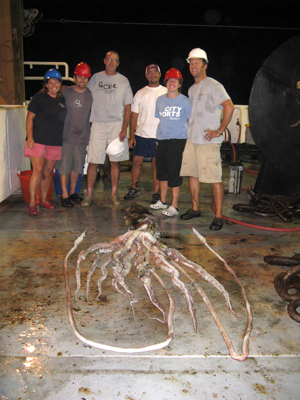
Deep Sea News - Architeuthis Caught

Quick, what's 19.5 feet long and over 109 pounds of raw muscle?

The answer to that question can be found this week at Deep Sea News , one of the coolest blue blogs running right now. A place for all things "deep sea discovery":

Scientists from NOAA’s Fisheries Service have captured a giant squid while conducting research off the Louisiana coast in the Gulf of Mexico. This is only the second known giant squid obtained from the Gulf of Mexico – the first was collected in 1954 off the Mississippi Delta where it was found floating dead at the surface.

This giant squid was collected on July 30, during a 60-day scientific study where scientists from NOAA’s Southeast Fisheries Science Center and the Department of the Interior’s Minerals Management Service were studying the availability and diversity of sperm whale prey. The scientists were aboard the NOAA research vessel Gordon Gunte when the squid was caught in a trawl pulled behind the research vessel at a depth of more than 1,500 feet.

Shark Conservation - Like Monty Python?

Speaking last week with a well known shark conservationist who's been "in the game" for the past decade, his lament to us was about "the game". Where once the very idea of conserving sharks was a far cry in a distant forest, today "the game" is a much crowded playing field.

We had to agree.

If you wanted a quick overview of the world of shark conservation look no further than Monty Python. As a cautionary tale to those who would join "the game" we would like to say the following, welcome - results matter.

People's Front of Judea anyone?

Friday, September 18, 2009

Shark Diver:The Movie - Sold Out

Shark Diver:The Movie 2009

What began as a last minute idea with a few industry film guys, and an opening in the 2009 commercial shark diving calendar has culminated in a sold out expedition.

Thanks to all the shark divers who called us from as far away as Brazil and continue to call - this trip is now full.

To those of you who will be joining us, we'll see you all in San Diego on the morning of the 12th.

Bring your cameras, we have some ground breaking fun in store for you during the "Time of the Titans."

Let's go shark diving!

Thursday, September 17, 2009

Aquarium Shark Diving - A Growing Trend

The world of commercial shark diving is growing. Countries, tourism boards, and dive operators from Fiji to the Maldives are realizing safe and sustainable shark tourism works.

None more so than commercial aquariums worldwide who are offering caged and non caged shark encounters at one of the fastest growth rates in the entire industry.

Case in point the Dubai Aquarium built as an interactive site, offers non caged dive experiences with sharks.

Where the global trend towards safe and sustainable shark encounters in all forms is growing, Hawaii is still debating banning all shark tours in Oahu, using similar language to a recent ban in Maui that failed to provide exemptions for aquarium based shark tours there:

The Shark Dive at Dubai Aquarium is indeed a once-in-a-lifetime experience. Where else do you have the largest collection of Sand Tiger Sharks in the world swimming right next to you while Giant Groupers edge closer and thousands of smaller fish species swim along? After having been an onlooker of the aquatic animals in the aquarium, you now have hundreds of mall visitors who gaze into the tank at you. And the comments from visitors have been varied: “I was surprised at how peaceful it is on the dive,” said one shark diver.

Another added: “You see it on television; sharks circling overhead, but you never appreciate just how spine-tingling that is until they are circling over YOUR head! What an adrenalin rush!”

Mr Arif Amiri, Chief Executive Officer, Emaar Retail, said: “The Shark Dive is one of the several close encounters of our animals that visitors can experience at Dubai Aquarium & Underwater Zoo. Their response to the experience of diving in the aquarium and spending time with the diverse aquatic animals has been overwhelming.

Maui Bans Shark Tourism - Maui Ocean Center in Crosshairs?

Here is the wording of a recent ban on shark tours Maui City Council members and a virulent anti-shark diving lobby have been congratulating the passage of this week.

Unfortunately it seems NO ONE in Maui stopped and asked the pertinent question "are there currently any shark tours in Maui?".

The law as it was written does not provide a loophole for land based shark tours - a growing marketplace for shark tourism worldwide.

The answer of course is yes, Maui does have shark tours, and this week the venerable Maui Ocean Center found themselves in the cross hairs of a new law that makes their business illegal as of this week.

Land based or aquarium based shark tours account for $40-50 million dollars in annual global revenues for the shark tourism industry. Maui City Council members have effectively shut this kind of tourism and subsequent aquarium development out of Maui with the passage of this draconian bill.

The term "ocean waters" is this bills failure. The Maui Ocean Center pumps "ocean waters" into its aquarium. It could be argued that the bill fails to specifically address land based shark tour operations with a targeted proviso.

A cautionary tale for City Council members in Oahu who may or may not understand the many ways tourists seek shark encounters, and the many ways shark tourism providers enable safe, sustainable shark adventures:

Maui Anti-Shark Tour Law

SECTION 1. Findings and purpose. The council finds that the oceans are used by city residents and visitors for numerous aquatic activities, including fishing, boating, swimming, surfing, canoe paddling, and snorkeling. The council further finds that sharks have great cultural, historical, and spiritual significance for many Native Hawaiians. The council believes that shark tours, the practice of charging residents and visitors to venture into ocean waters to view sharks attracted by fish feeding, raises public safety concerns for ocean users, is disrespectful of Hawaiian culture, alters the natural behavior and distribution of sharks, and may be disruptive of ocean ecology and the natural environment. The purpose of this ordinance is to ban shark tour operations.

Shark Tour Operations

Definitions:

"Fish feeding" means to introduce or attempt to introduce into the ocean water any food or other substance for consumption by fish.

"Shark tour operations" means the maintenance of an office, the collection of a fee or other financial consideration, the distribution, marketing, or advertising of tickets for sale, or the conduct of any other business activity conducted by a person for the purpose of enabling customers to venture into ocean waters to view sharks attracted by fish feeding; provided that this term does not include educational or cultural expeditions or endeavors for which a fee is not required.

Prohibition:

It is unlawful for any person to engage in shark tour operations.

Wednesday, September 16, 2009

Coelacanth (Latimeria chalumnae) - 50 Seconds

You often read about Coelacanth (Latimeria chalumnae) the stuff of deep sea legends. Today with ROV technology theses critters are no longer the oceanic legends they once were.

Here's 50 seconds of deep sea bliss with the Coelacanth for your review:

Fiji - Evolving Shark Tourism 2

Object lessons in shark tourism media are what the folks at Beqa Adventure Divers seem to be about these days - as they continue with a brilliant 2009 shark year rolling out conservation initiatives for Fiji's sharks, pro shark PSA's, and now a short series for local television on sharks.

Once again we tip our hats to an operator who, working in third world conditions, has managed to promote sustainable shark diving and conservation locally, regionally and internationally.

Note: This blog, Shark Divers and Shark Divers have no formal affiliation with the operators in Fiji, the owners, or staff. We do not book their shark tours and receive no compensation from them in any form as has been "discussed" by members of the dive community.

When we see something that works within the shark diving industry, we blog about it.