Showing posts with label isla guadalupe conservation fund. Show all posts

Saturday, December 29, 2012

Isla Guadalupe White Shark Trip Report 2012


All my life I have wanted to dive with great whites.

My dad took me to see Jaws when I was about 10 years old – maybe he thought it would be fun to scare the kids? Well, I loved it, couldn’t get enough of sharks after that.

So to be fortunate enough to actually get to go on a trip with Shark Diver was the opportunity of a lifetime. And it was really really amazing.

I had not been able to convince anyone I knew to come with me, so I went on my own. It didn’t matter though, there were several others on the boat who also came on their own. We also had a family of 4, plus a couple (who turned out to be avid travelers and divers, with many entertaining stories to tell).

OK, early on the first morning (after a rocking and rolling 20 hours on the open ocean to get there), my new dive partner and I were standing on the back deck, no one else around (they were all either still in bed, or having breakfast inside, or getting ready to dive).  I was trying on my wetsuit for the first time, which was dry – and I was dry – so this was not an easy task. As I was bent over wrestling with the leg of the suit, a great white shark breached clear out of the water, hit the deck railing (hard – I mean, these things are 12 ft + long), and splashed back into the water. I was about 2 feet from the railing, and I saw it's belly!!!!!  We had no time to be scared, it was about a second or two at most. With the colour drained from his face, my dive partner looked at me, walked into the centre of the deck, and said quietly, "holy #$%&#! we're all gonna die."

The poor guy had come to Guadalupe Island to get over his fear of great white sharks… so, not a good way to start! He was convinced we were about to be eaten. But then he started to joke about it, saying that pretty much nothing else could top this experience of seeing a great white jump out of the water right in front of us. And it’s true. I will always remember that split second, putting me into the realm of a very minimal group of people in the world who have ever witnessed a great white shark breach.

We were grouped in pods of 4 for our dive rotations, which went hourly – this meant we had on average 5 hours a day in the water. Ample time to see white sharks! (and get very pruney fingers soaking in water all that time)  There was a half hour break (no divers in the water) at noon for lunch. The cages went in the water at 7am, and basically they let us go in until 5pm or 6pm or whenever we were all too exhausted to get back in the cage.  In our initial trip information from Patric, it said that some people skip their rotations and others could get extra cage time – I wondered why people would travel all that way and just stay on the deck! But experiencing it was very tiring! And yes, I did end up skipping at least one rotation, and then on the last day I didn’t do the last couple of hours that were an open rotation. I could hardly pull myself out of the water towards the end of each day; I was completely drained, but in a great ‘once in a lifetime’ way!

The crew worked their butts off making sure each of us had the perfect trip. We were safe at all times. We ate enormous amounts of food (which was fantastic). Some of us had food allergies or sensitivities, and chef Mark made sure to cook individual meals for those folks (including me, no wheat and no meat). Although I must admit I had a small piece of the raspberry glazed Cornish game hen served one evening, and it was delicious.  Most of us went to our lower-deck bunks around 8pm each night because we could hardly keep our eyes open by then. And surprisingly, there was no drinking at all. Well, I think a couple people had a few, but remember, we were on the ocean and the boat never stopped rocking. Our stomachs were often feeling a little woozy at times, but most of us were good at re-balancing ourselves by looking at the horizon (this little tip worked well for me). However, I gave up trying to shave my legs on day 2, because I kept bumping against the shower wall as the boat tipped from side to side. 

We saw 9 great whites over the 3 dive days, 2 of which were ‘new’ to divemaster Martin – they had not previously been identified. Being September, the female sharks are not (usually) in Guadalupe, but we did see one – the rest were males. They are nothing like in the movies and on tv – these sharks were calm, docile, just slowly cruising by our cages, sometimes a little closer than anticipated, but I never felt scared! One of them came so close to me I stopped breathing in my ventilator and couldn’t even take a photo. I was mesmerized by every tiny detail I could see of its skin, and eyeball (yes, it was that close!) Having a great white shark look you in the eye is what the word awesome was really meant for.

I was in a true state of awe, for sure! It’s difficult to describe the feeling of getting to do the one thing that has always been on my bucket list. Long before anyone called it a bucket list. As a kid, I thought it was just always going to be a dream. Going on this trip was exhilarating and I have so many adventurous stories and memories – and it’s kind of nice to have some bragging rights once in a while too. J  But it doesn’t have to be a ‘once in a lifetime’ trip … I’m already planning my next trip to Isla Guadalupe.

About Shark Diver. As a global leader in commercial shark diving and conservation initiatives Shark Diver has spent the past decade engaged for sharks around the world. Our blog highlights all aspects of both of these dynamic and shifting worlds. You can reach us directly at sharkcrew@gmail.com.

Monday, November 26, 2012

Bravo Mauricio - Isla Guadalupe Great


About Shark Diver. As a global leader in commercial shark diving and conservation initiatives Shark Diver has spent the past decade engaged for sharks around the world. Our blog highlights all aspects of both of these dynamic and shifting worlds. You can reach us directly at sharkcrew@gmail.com.

Monday, September 24, 2012

2012 Isla Guadalupe White Shark Trip Reports


Aug 26 -31, 2012 Isla Guadalupe Trip Report 

Mark Denstedt is a return Shark Diver and now part of our shark diving clan. We plan on getting him face to face with Tigers in the Bahamas next;)

The sharp slap of small ocean swells against the hull of the Horizon crack the night air. The loud rumble of the engines begin to slow into a deep throated purr. The inky black of night slowly gives in to the small slivers of sunlight. And suddenly there it is!

From out of the gloom, the dark silhouette of Isla Guadalupe fades into view from it's shroud of mist.

It's around 5:30am and I'm standing in my favorite spot aboard the Horizon at this time, the bow. I can never get enough of the stunning sunrises out here away from the din of civilization. There before me is the shape of Isla Guadalupe, my second time out here with Sharkdiver and the Horizon. And it's every bit as awe inspiring as it was the first time. Even now I have goosebumps thinking about it.

As the boat secures itself and both crew and aspiring shark divers begin to stir,and  from out of no where it hits you! There it is!! The reason you've travelled across 200 miles of ocean and it's the most beautiful thing you've experienced so far. The smell of Chef Mark's cooking!

Ok, ok, maybe that's not the reason for doing this but it's a damn close second if you ask me.

Obviously the real reason is seeing Great White Sharks doing what they do up close and personal. And boy did we get that on this trip. Day 1 there was a total of 14 white sharks spotted and identified by the end of the dive rotations for the day. At one point there 6 within viewing range of the cages. Already this trip has easily surpassed my first time out in 2010. In between rotations we had a full White Shark breach about 3 feet off the port side directly in front of one heck of a startled diver struggling to pull on his wet suit! We had a couple of the local seals come out and play around the cages for the entire day with the smaller of the two very curious about the cages and us. So curious in fact that he wound up pretty much in the cage! He poked me several times from behind with his nose startling me each and every time. He did the same thing to Richard a few times on his dives. Maybe it was because we're Canadian.

The second and third days were more quiet as far as the shark spotting went but the seals were back entertaining us and a couple of dolphins cruised by for a couple of minutes on Day 2. And we did see another 4 White Sharks.

Day 3 no seals but another 3 White Sharks were spotted with one being a rather large female. When she cruised our cage several times she was breath taking in her mass and girth. Myself, Trent and Matt just looked at each other wide eyed shaking our heads in wonder from the confines of our cage. And there was yet another full White Shark breach this time about 200 yards away but every bit as amazing as the first!

All in all I think we saw somewhere in the range of 20 sharks over the 3 days, I'm sure Martin has the exact number spotted. In any case this being my second trip out here it definitely one upped the last trip! I'm still unable to convey with words just how incredible it is to see a White Shark swimming less than six inches away from you, or the feeling I get when one makes eye contact with it's big beautiful blue eyes. It's at once a little frightening, a lot of exciting and a lot of goosebump raising. I don't know that I'll ever not be completely overwhelmed by the experience. It's kind of humbling and man, that burst of adrenaline you get when a Great White Shark seems to just materialize from out of no where is nothing short of incredible! I can not recommend this trip and Shark Diver enough. Yes there are other companies that do this trip, but at the same time there isn't. There is only Shark Diver.

Once again I extend my thanks to Patric, the crew of the Horizon; Martin,Carey,Dan,Mark,Carolyn,Nick,Kyle and Stephan, and most importantly the incredible group of divers that allowed me to share in their experiences out there. Once again I've made some new friends from this trip.

Last nite after one last dinner with Jay, Leo and my fellow Team Canada friends I walked back out to H&M Landing to watch the Horizon leave for the start of a new adventure with a new batch of divers. A couple of tears filled my eyes and a lump caught in my throat as I watched her head out. I was sad that once again my journey has come to an end but excited for the people aboard getting to experience the beauty and excitement of everything this trip has to offer.

Farewell Horizon, see you again in a couple of years,

Mark Denstedt

About Shark Diver. As a global leader in commercial shark diving and conservation initiatives Shark Diver has spent the past decade engaged for sharks around the world. Our blog highlights all aspects of both of these dynamic and shifting worlds. You can reach us directly at sharkcrew@gmail.com.

Monday, April 16, 2012

Guadalupe Island Cage Diving 2012 - New Dates Added!

Shark Diver is adding dates to our 2012 white shark diving season at Isla Guadalupe.

We're experiencing record bookings interest again this year and selling our the prime season dates from Aug-October as fast as they go up.

It could be that a decade later Guadalupe is now understood as the premier white shark encounter site on the planet.

Or it could be the rave reports we get back from our divers every single season thanks in most part to the amazing US dive crew and vessel the M/V Horizon:

James Woodhead from the UK

Jack Mears in 2011

Or it could just be that folks want to go see a shark and scratch that Bucket List, either way we're here to help with the announcement of Aug 12-16 now open for business.

Early August dates feature the most males up in the north bay. These are scrappy animals. Bruce, Shredder, Mau, all vie these waters for dominance. Think of it like an Elk Rutting Season when the males gather to establish who's the biggest and baddest animal on site, because in a few short week the breeding aged females arrive in October looking for a "migration buddy."

After a decade of operations here we are still in awe of these animals, still like the early days out there, we're here to learn, here to admire and here to explore.

Join us, and let's go shark diving!

Saturday, January 8, 2011

Seal Predation Video at Isla Guadalupe 2010

Filmed with CICIMAR shark researcher Dr.Mauricio Hoyos at Isla Guadalupe in 2010 and featuring an Elephant seal (M. angustirostris) with grievous wounds sustained by resident white sharks.

Welcome to the cycle of life.

Wednesday, October 20, 2010

The LAST Space 2010 Isla Guadalupe - Seriously

We have been sold out for the 2010 white shark season at Isla Guadalupe for many months.

The 2010 season has been one of double digit white shark days, great weather, and thrilled divers.

Our Oct 29-03 departure has one last minute space that just opened.

One of our returning shark divers has developed a scheduling conflict and cannot join us, so this is your chance.

If you have been wanting to join us and cannot wait until 2011, please contact us at Shark Diver.

Lets go shark diving!

Wednesday, September 15, 2010

Guadalupe Island - Diving With Great White Sharks 2010

When Drew Grgich called us many months ago to book a shark diving adventure we knew we had a budding Shark Diver on the line.

His enthusiasm for sharks you could "feel" all the way from Arizona.

He was also a non certified diver, one of the many we "train" to become Shark Divers each and every season.

Today Drew can call himself an Official Shark Diver having encountered the top shark species at the best site for them on the entire planet.

This is his 2010 trip report with image by Christy Fisher:

Day One (and a half)


We came from all over - - Michigan, New Jersey, Nebraska, the Bay Area, Vancouver, Maryland, and Arizona - - and all of us had one goal in mind … swimming with Great Whites. Mind you, none of us had death wishes so our goal was to do this swimming carefully ensconced in a steel cage. Nonetheless, we would be in the water with them and thus, they would be in the water with us! Our journey began in San Diego out of H&M Landing. Our vessel was the MW Horizon, an 88-ft. dive boat.

We boarded at about 10:30pm and were underway just after midnight. The first night was spent in fitful sleep while trying to detect whether or not the queasy feeling in our stomachs was the beginning of seasickness or just nerves. We arrived in Ensenada the next morning at around 9am. A quick check with Mexican customs officials sent us on our way to Isla Guadalupe, the fall home of some 100+ Great White sharks. The trip was uneventful if long - - 18 hours long to be exact. We were told that the ride was among the smoothest our captain had experienced. A few of us succumbed to seasickness but for the most part, all was well. We saw some remarkable sights - a blue whale, a thin whale, pods of fast moving and high jumping dolphins.

What I remember most about that day is how excited I was.

Few people in life are blessed with the sure knowledge of knowing exactly what they want most in life and even fewer get to experience that desire. For me, my most fervent wish was going to happen in a matter of hours. That's pretty heady stuff!

Day Two

At around 3am, the engine shut off when we arrived at our destination. I went up top a couple of hours later and was not surprised to see other early risers. We attempted to wrestle our cameras into taking decent photos - - not an easy feat at 5am before the sun had even made a token appearance - - and imagined that the murky waters surrounding us were teeming with sharks, each hungry for the first shift of divers.

The shift happened to include me!

Our divemaster, Martin Graf, took me into the cage and had me try a regulator for the first time. I did okay with the regulator but before Martin would declare me dive-worthy, I had to flood my mask and clear it through my nose. I gave it a good effort but sadly, I panicked when my first attempt resulted in a nose full of salt water. I shot to the surface and for a brief moment, wondered if I was going to be able to succeed. Martin was extremely patient and knew exactly how much space to give me in to get over my fears. My second attempt was successful. The secret was to get a steady rhythm breathing through my mouth to gain confidence, close my eyes, and exhale through my nose while tipping the mask.

We didn't have to wait long. The first Great White appeared within a few minutes, circling the cage a few feet below us in its graceful way. That shark was followed by another shortly behind. Both sharks hovered below and made lazy trips around the cages and all too soon, our first hour's rotation was over. All of us were fortunate on this trip. Two people had to cancel so this meant we had 10 divers instead of 12. The cages fit four people each. This meant that we could effectively have as much dive time as we wanted.

I took an extra shift that first day so I had five hours in the cages. We saw seven different sharks the first day. Most kept a respectable distance from the cage but some ventured close enough to touch if we were really inclined to do so. No one was. :) We knew that they were different sharks as the patterns of markings around their gills and fins serve as a sort of fingerprint. These sharks are in turn named by the people who first see them. Scientists do this so that they can identify populations and measure data points such as the number of years that they have been coming to the island, how much the sharks are growing, and how many sharks are seasonal residents.

Some come every year while some visit more irregularly. For the record, the sharks we saw on Day One were Jacques, Bite Face, the Russian, Johnny, Cris Cross, and a new unnamed male. We don't know who gets to name that shark . . . the suspense is delicious. :) The highlight of Day One -- aside from the fact that I was diving with Great Whites! -- was a rotation where Jacques circled the cage for the entire hour. I was able to shoot forty minutes of video going from one side of the cage to the other. Some passes were within inches of my video camera - - I got some great shots!

Day Three

The next morning, I took the first rotation of the day along with two other brave souls. We saw some sharks but they were far below. We tried a variety of tricks to attract the shark's attention - - stomping our feet, hitting the cage ladder with some of our lead weights, singing show tunes - - but nothing enticed the sharks closer that first shift.

Following shifts were much more productive. I spent the first three hours of the day in the cages and shot more video. I grabbed another three shifts after lunch for a total of six hours in the cages. There were two highlights on day two. The first was that I happened to be looking in the exact direction necessary to witness a full breach. This is when the shark completely propels itself out of the water while in pursuit of prey. The prey happened to be a seagull and it got out of the way just in time to escape the leaping shark. I was one of two people onboard who saw the breach and it was truly a magnificent sight.

It was a smaller shark - - maybe 6-8 feet - - but it was a full breach!! The second highlight was more ignominious. We saw a new shark -- Gunther -- who was kind enough to - - - well, poop - - - directly in front of the cage next to us. It was amusing to see and pleased the 10-year old children inside my cage mate and I . . . until the current pulled us directly into it. I can thus say that I was blessed enough to be pooped on by a Great White.

Day Four


I only took half of the sharkwatch shift. It was okay - - nothing really when compared to the first couple of days. I took two more shifts for the day before we had to leave. We did get a great couple of close passes by Bite Face and Jacques. This was especially memorable for me as Bite Face was a featured shark on Expedition Great White, a show about scientists tagging Great Whites at Isla Guadalupe. It was fun to see the satellite tags that they had attached to Bite Face to track him. It is also cool to know that if they show his progress in a future show, one of the lines will cross where I saw him. :)

We left for home following the morning drives and have a rough patch of choppy water to look forward to. I'm writing this as we make our slow way north across the Pacific. I can honestly say that there are four events in my life that top my list. The first would be my wedding with really, a tied two and three being the births of my kids. Close behind would be this trip. I was a little worried that I'd be petrified of going into the water with the sharks but I didn't have even a lick of fear. The sharks are obviously curious about we monkey folks in the cage - why would they stick around if they weren't?

They certainly did not make any attempts to harm us and I didn't hesitate to hang my arms out of the cage to hold my camera for a better picture. That said, I wasn't stupid - - - no dangling legs over the side of the cage, for example.

Final Tally on how many hours I dove - - 15.5 hours!

My favorite Martin Graf quote - Sharks are like babies. There are only two types of items to a shark -- things that fit in their mouth and things that might.

Thursday, September 2, 2010

2010 Shark Diving Report - Cage Diving at Guadalupe

For our divers 2010 has been the Trip of a Lifetime so far. Celebrated with email blasts to friends and Facebook posts to the world.

These lucky divers have met the most charismatic, studied, and filmed white sharks on the planet.

For newly minted Shark Diver Craig Reynolds, nothing but his own Great White Blog to recount his adventures this year would do:

Day 1 – CRAZY PEOPLE – When you tell people you’re going on a shark dive, you can almost guarantee that you’ll get a fairly similar reaction from most people.


“You’re crazy,” they’ll say. Well, yeah. I work in advertising, don’t I? Why do you think they have a show called Mad Men??


I mean, when you tell people you’re willing to parachute out of a perfectly good plane, they still look at you somewhat admirably, cushioning their judgment by saying something like, “oh, I could never do that.” But cage diving falls into a different category. When it comes to sharks, people have been conditioned to fear them for a long time.


I think we can all thank Stephen Spielberg for that.


Complete Series Posts.

Wednesday, August 11, 2010

Monday, December 21, 2009

Guadalupe Island Television Documentary Wins Journalism Award

In the summer of 2009 Shark Diver was asked to enable a three part television documentary with conservation NGO WildCoast.

The end result was seen by millions of viewers across Mexico. Today two reporters from Mexico's Televisa, who covered Wildcoast in this multi part series shot at Isla Guadalupe, have been awarded for journalistic excellence in environmental and science reporrting.

The award was in part for positively featuring the resident white sharks, shark tourism, and Mexican lead shark research at this Bio Sphere reserve.

The three part series was shown first in Mexico City to several million viewers and across Mexico in the fall of 2009. The industry got some great quotes from Captain and owner Greg Grivetto of Horizon Charters with on site shark footage shot by Richard Theiss from RTSea Productions.

Kudos to the entire team from Wildcoast who worked so hard to bring positive conservation messaging to Mexico and to all the people featured in this informative series.

Wednesday, September 2, 2009

SharkDiver.com - International Lifestyle Magazine

This month the uber cool International Lifestyle Magazine covered Isla Guadalupe and SharkDiver.com.

The article, by author, writer and adventure persona Jim Cornfield features the world of big animal shark diving with stunning images by Juanmi Alamany who shot with our crews back in 2008.

Shark Diver was the first commercial shark diving company to initiate and support full scale shark research efforts in tandem with Mexico's CICIMAR, and U.C Davis, California at Isla Guadalupe.

As a proof of concept this ongoing shark research effort has now been adopted and is supported by 90% of the operators that use this pristine site. Divers can now donate to research efforts via the Isla Guadalupe Conservation Fund and media sources like Televisa, Mexico are now producing programs that feature this collaborative effort.

See magazine online here.

Wednesday, June 10, 2009

2004 Isla Guadalupe...10.00am

Found this classic video clip from Shark Diver and Sterns Bullen. Back in 2004 we had a smaller, very aggressive shark on site for a number of weeks:

Saturday, June 6, 2009

Isla Guadalupe - Scientific American

Scientific American spent a week with the crew of the Horizon and Shark Diver at Isla Guadalupe in 2008. The resulting media highlights operations that work in tandem with regional shark research teams for a better tomorrow:

A windless dawn rises over Isla Guadalupe, 150 miles west of the Baja California coast. Rolling slightly in a gentle Pacific swell, our 80-foot trawler Horizon motors toward the island’s north end. The skipper, Greg Grivetto, is standing the final watch of a 20-hour passage from San Diego.

He glances down through the bridge windows at the dozen or so passengers gathered on Horizon’s foredeck. We’re shaking off sleep, gabbing, sipping coffee, eager to catch sight of our first landfall on this remote volcanic rock. In the distance, sunlight outlines the arc of Guadalupe’s northeast inlet. There, deep in flat, dark water, something is also stirring, and everyone onboard is thinking about it.

It is Carcharodon carcharias, the great white shark.


Full Story

Isla Guadalupe Conservation Fund

In 2006 the Isla Guadalupe Conservation Fund website was launched to support ongoing Mexican lead shark tagging and research at this remote and pristine island.

Shark Diver created and initiated the website and outreach for this fund in conjunction with Nautilus Explorer, Horizon Charters and Islander Charters - three excellent and forward thinking commercial shark diving operations in the region.

The result today is over $70,000 in generated donations. The work needs to continue. That is why we're asking divers who have been to I.G and who have encountered the magnificent great whites at this island to consider donating to this fund today.

You can give back to regional efforts and make a difference. The sharks need you. Thanks to RTSea Productions for the video and to the many divers who have already donated to this fund.

Special note to Mike Lever of NEX who has tirelessly pushed for donations:

Monday, April 27, 2009

Juanmi Alemany - "In Search of the Great White"

Not long ago the crews of Shark Diver introduced underwater photographer Juanmi Alemany to the white sharks of Isla Guadalupe, Mexico.

For a commercial shark diving company like ours fully supporting efforts that show sharks in a positive light has been a big part of our operation. Juanmi's shark images will serve to enlighten and educate thousands of viewers in the coming months. Kudos.

Juanmi's white shark expo opens in Spain from May through June. If you happen to be in town please feel free to join him, here's the invite:

Hi Shark Diver,

I am pleased to be able to invite you to the opening of the exhibition "In Search of the Great White." After much work the next day will be presented May 15 at 20.30 hours in Conference Room of the Convent in Granadilla de Abona. Please forward this email to all the people you think they would like to attend. A big hug, I hope to see you there.

Yours,
Juanmi Alemany

C / Garajonay 2
38600 Granadilla
S / C de Tenerife / Spain
Phone: 649.50.39.62
www.mundosmarinos.com

Thursday, April 2, 2009

Shark Diver - Men's Journal March

In case you missed us in March, we almost did, writer Travis Marshall covered shark diving and the ongoing politics of Isla Guadalupe, Mexico.

Shark Diver has been outspoken about this site from our inception. Guided by the principal that it is up to the operators on any shark site to protect and engage.

As front line sentinels we are often the first to notice problems or political issues that directly impact the sharks we work with. Last years ban on chumming at the island was one of those moments.

As we have long advocated within our industry shark diving operators can no longer afford the luxury of "fence sitting" at shark sites. We need to be engaged on the commercial level, the conservation level and the political level for the betterment of sharks both locally and regionally.

At Isla Guadalupe many of the forward thinking operators have done this organically, but much more work needs to be done.

When we first proposed this "idea" many years ago we were laughed at by many. The funny thing about "ideas" is that they often take on a life of their own - when the global reality of sharks becomes apparent to all.

Thursday, March 26, 2009

Island of The Great White Shark Documentary - U.K

Island of the Great White Shark is a pro-shark, pro-industry, documentary by RTSea Productions. It has been shown to rave reviews across the United States and has recently began it's european tours.

This week IGWS was featured in UK's Lifestyle Magazine. The article is touches many of the standard conservation themes cementing the role of eco tourism at Isla Guadalupe, in tandem with ongoing and supported shark research, as a template for worldwide shark diving operations.

Kudos to Richard for this film and to the many operators at Isla Guadalupe who had a hand in it's creation. Without the ongoing support of forward thinking shark operations these kinds of films cannot be made.

Sadly, major media sources remain uninterested in straight talk films about sharks that celebrate, as commercial shark diving operators do, the beauty - not the "beast" of the shark.

Read the article online here pages 8-9.

Tuesday, February 17, 2009

Shark Research in Action CICIMAR

Since 2004 shark researcher Mauricio Hoyos has been doing battle with wind, rain, unstable fishermen, and a critter infested "love shack" on the north end of Isla Guadalupe, Mexico.

He also makes do with a tiny seasonal budget, Mexican politics, and rampant equipment failures.

Why, you may well ask, would anyone put themselves though this kind of privation all in the name of shark research?

Because it is important. It's important that a Mexican lead program spearheads efforts at what has become the most robust and accessible white shark site on the planet. It's important that several of the local shark operators support this effort, and they have, to the tune of thousands of dollars in materials and conservation websites like the Isla Guadalupe Fund.

It is important because the second phase of any successful commercial shark site is, stewardship. Without ongoing research and data these sharks remain at the whim of politicos and shark fishing agendas. Proof of migration, proof of feeding patterns, proof of behavior patterns all feed into the larger plan for site stewardship.

Maurico Hoyos is doing his part to ensure these magnificent animals, at this rare and pristine shark site, remain for generations to come.

As rare as this site is to white sharks, Mauricio and his ongoing efforts are to the world of shark research. Kudos.

Wednesday, January 21, 2009

Shark Tourism-RTSea

Editors Note: One of the many reasons why we work with RTSea Productions and have come to count on the friendship and guidance of Richard Theiss has been his innate ability to look at complex issues from many points of view. His perspective on the shark diving industry comes on a global scale and his conclusions are sound policy statements that get to an industries sustainability and longevity:

Lately I have been fortunate to have the opportunity to screen my white shark documentary, Island of the Great White Shark to large crowds, to discuss shark issues with the audience, and be interviewed by newscasters. Their questions and comments would be wide-ranging, expressing a variety of opinions. While I tend to avoid op-ed positions (I find I get long-winded as you can see) and prefer to enlighten people with the facts, sometimes I feel compelled to express just where I stand.

Eco-tourism:
Eco-tourism has taken an interesting journey, evolving from the hunting safaris of the past into photo safaris to its current position as a conservation-minded endeavor. In the process, it has moved from a high adventure, risk-your-life type of activity to that of ecological enlightenment. This is not to say that it is without risk - from inclement weather, to a charging animal, to tenuous or hostile political environments in some developing countries. But those involved in eco-tourism who choose to promote it as a thrill-seeking, dangerous activity are behind the curve regarding its future and in the end can do more damage than good.

This is particularly true of shark diving. Many leading NGOs have turned towards shark eco-tourism as a possible new strategy to pursue. While past strategies of regulation and prohibition have produced legislative results, eco-tourism offers an additional supportive approach by providing countries or businesses with economic alternatives to curtailed anti-conservation activities while also providing a means to educate the general public with first hand experiences.

However, the NGOs commitment to eco-tourism becomes shaky when safety protocols are not strictly enforced, resulting in aberrations like some of the incidents or activities that have received broadcast media or YouTube attention - like riding, grabbing or playing "kung fu" with passing sharks or cage breaches due to unsafe bait handling. The days of high testosterone, "face the malevolent monster" are at an end and undermine the efforts of those who are working hard to build a general public consensus regarding the importance of shark conservation.

I have personally seen how shark eco-tourism can be beneficial, as I brought out in Island of the Great White Shark at Isla Guadalupe. Those shark diving operators who have been a model of effective eco-tourism have supported the island's "biosphere" status financially, supported Mexican shark researchers both financially and logistically, and have acted as unofficial watchguards in the absence of Mexican enforcement due to the country's limited resources.

Criticisms of Eco-tourism:
Eco-tourism is not without its critics and many of their concerns are not based on the welfare of the participants but on the animals themselves. Here are the two most common complaints often levied against shark eco-tourism and my take on the issues:

1. The animal's normal feeding behavior is being disrupted.


Well, to be honest, I have my concerns when feeding takes place pretty much year-round. I am concerned with sites like Stingray City in the Caymans and other similar spots where the potential for negative feeding behavior is possible because of an endless stream of tourists with bait in hand. These sites need specific scientific study to determine if there are detrimental effects taking place.

At a site that I am familiar with, Isla Guadalupe, this same complaint has been used by certain political forces in Mexico who are determined to rid the island of all boat activity. In this case, I believe it is a weak argument. When hang bait is used to attract the sharks, a certain number of them succeed in occasionally catching the bait being wrangled by the crew, but we are talking about bonito or tuna carcasses (the sharks often spit out bony tuna heads) - not a major source of nutritional quantity or quality. For the 3-4 months that the sharks are at the island, this activity does not supplant their normal feeding behavior (primarily pinnipeds and whole tuna) or leave them starving the remaining 8-9 months when they migrate.

I recently had the opportunity to discuss this issue with shark researchers at the Scripps Institution of Oceanography. The consensus was that a specific study would be needed for a definitive answer (researchers don't like to guess) but the feeling was there is probably some behavior modification regarding the sharks "recognizing" the presence of shark diving boats but a negative impact on their feeding habits from hang baits alone was a bit of a stretch.

2. Animals will associate humans with their food/bait.


With regards to sharks, the fear is that providing bait to sharks will make them associate humans with their food and become more aggressive to divers, surfers or swimmers - in essence that we're teaching the sharks to eat people. While a specific scientific study would be needed on a site-by-site and/or species-by-species basis to determine it once and for all, I can at least add my anecdotal observations.

In all my years of shark diving, I have yet to see any shark become specifically aggressive towards the divers in cages or myself (where I am often more exposed to the sharks) when conservative baiting is present. This is not to say that I am willing to put my arm in front of a floating bonito while a white shark bears down on it and expect the shark to swim around me. Nor will I place myself in the midst of a group of frenzied reef sharks tearing apart a large piece of bait and act surprised if I get nipped accidentally. But with all the various prey and various scents that sharks detect and recognize, to assume that a shark will equate fish blood to human prey is an A equals B logic that my experiences just don't support.

The Shark's Role as Predator:
In building public awareness in shark conservation it is critical that we build consensus based on truth. And the truth is that to maintain a healthy eco-system nature needs its predators - even the big, fearsome ones from sharks to grizzly bears to lions, tigers and so on. Many of these animals benefit from the "warm and fuzzy" factor. We look at the mother polar bear and her cubs strolling across the Arctic ice and we get all soft inside, forgetting the fact that the polar bear is a ferocious predator - a role defined for it by many, many years of evolution.

Sharks do not have the warm and fuzzy factor working for them. They live beneath the waves in their own realm and for centuries all man has been able to do is scratch the surface of that realm and form attitudes steeped in ignorance and fear.

So at one end of the attitude spectrum there is "sharks are killers" and "the only good shark is a dead shark." What we must do is to educate people as to the important role that has been defined for these animals through millions of years of evolution. For some of our larger sharks, their role as predator and scavenger may not be a pretty one, but it is absolutely vital in preserving the intricate weave that we call the marine eco-system.

Unfortunately, I have sometimes seen the spectrum move too far in the other direction. For some people, their enthusiasm as shark advocates pushes them to ascribe social or human-like traits to sharks that don't really exist. To promote sharks as cuddly puppy dogs who smile at our approach is not a responsible position based in fact and can ultimately be dangerous not only to the cause of shark conservation but literally to any person who interacts with a shark, forgetting at a crucial moment the animal's refined sense of self-preservation, of flight or fight. Timothy Treadwell tragically lost sight of this while studying Grizzly Bears.

This circles back to my earlier comments about shark diving. As a professional filmmaker, I am paid to take a calculated risk in filming and sometimes exposing myself to an animal that might choose to defend itself aggressively. Eco-tourists who pay to see these same animals should do so in a safe environment. If we promote some of our most maligned sharks as gentle, loving and smart (in human terms), we are setting up the cause of shark conservation for the inevitable backlash when someone is injured in an unprovoked (or provoked) shark/human interaction.

Let's be true to the facts, true to the sharks, and true to the belief that people can rally behind a cause like shark conservation without being misled, no matter how sincere the intentions. The truth shall, in this case, set the sharks free!

Tuesday, January 20, 2009

L.A Times-Island of the Great White Shark

From this mornings L.A Times Outpost Blog, for shark conservation fans in Southern California:

A reminder that a free screening of the documentary "Island of the Great White Shark," by RTSea Productions, will be shown at 7 p.m. Wednesday in the MLK auditorium of the Santa Monica Public Library. Filmmaker Richard Theiss, executive producer and cinematographer for the project, will be in attendance and will conduct a question-and-answer session after the film, as well as discuss his experiences filming great whites and other sharks. The screening of this 45-minute film is part of an ongoing lecture series sponsored by Heal the Bay's Santa Monica Pier Aquarium.

Theiss, who four years ago joined an eco-tourism charter to Mexico's Guadalupe Island and the surrounding waters to observe the great whites, became passionate about this subject and began documenting the work of shark researcher Mauricio Hoyos Padilla. The resulting film from this trip details the important role great white sharks play in a balanced ecosystem and also focuses on the marine scientists dedicated to studying and protecting these sharks.

"These are absolutely magnificent creatures living on a razor's edge of possible extinction. And there are some very dedicated people working tirelessly to prevent that," Theiss said. "This is a story that needed to be told."

Millions of sharks, including great whites, are killed each year for their fins, as accidental catches on commercial fishing vessels and for souvenir jaws and teeth.

Admission to the screening is free on a first-come, first-served basis. The main library is at 601 Santa Monica Blvd., with a pay parking structure available on 7th Street, north of Santa Monica Boulevard. For directions to the library, visit www.smpl.org/depts/branches/index.htm. For other information, visit www.healthebay.org/smpa or call the aquarium at (310) 393-6149.

-- Kelly Burgess

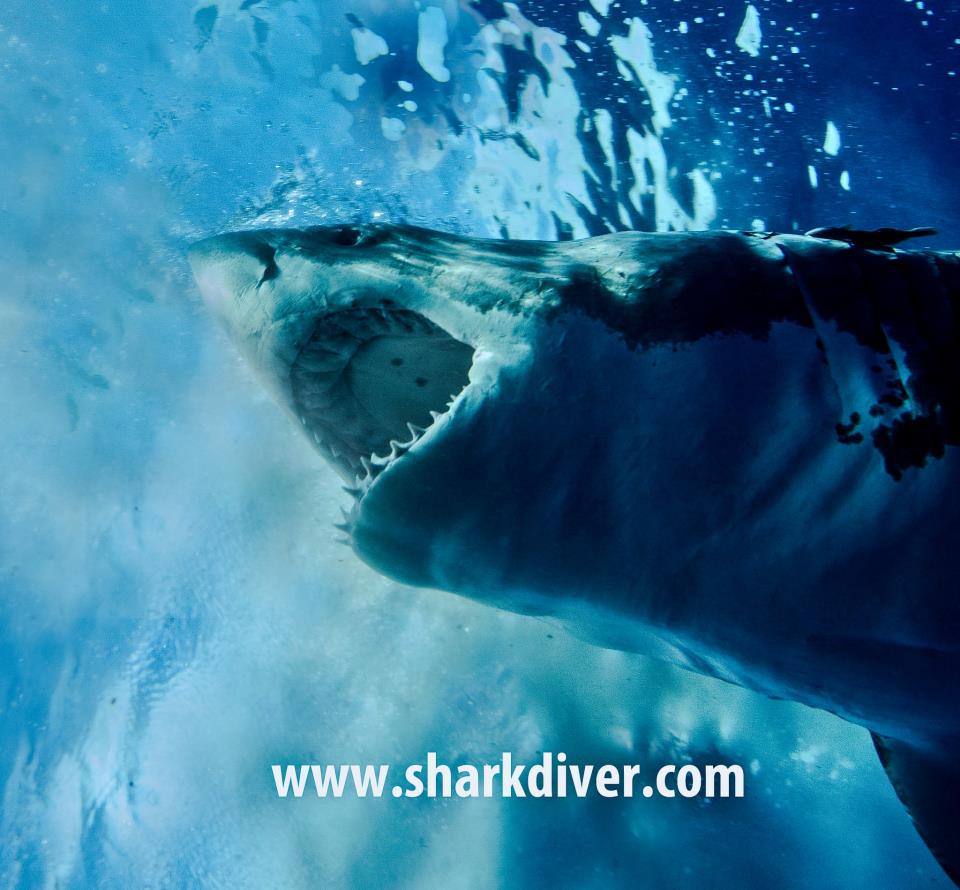
Photo: Great white shark off the coast of Guadalupe Island. Credit: Sharkdiver.com