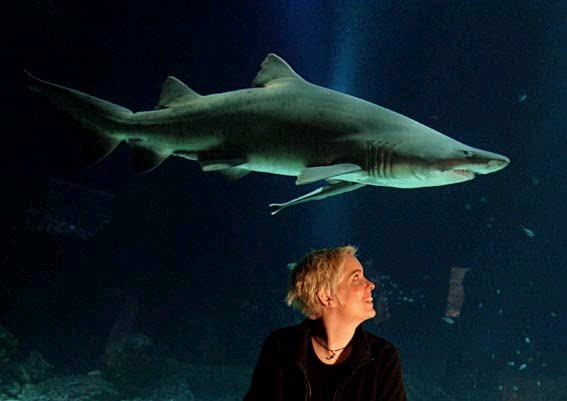
Saturday, September 25, 2010

Shark Diving Industry Trends - Black and White

Coming home from a shark shoot in the Bahamas this morning I have been mulling over the series of emails and phone calls that I received over the past few days.

At hand a recent expose of a well known SA shark diving operator/conservationist and images that depict sharks being mauled over baiting practices that are inconsistent with the words “shark diving operator” or even “conservation.”


The expected blow back has been heated even by industry standards with counter allegations and straw man defenses put forward by those whose friendships with the SA operator seek grey areas in what is a glaring black and white issue.


Collateral Damage


After seeing images that Wolfgang “sat on” for many months while he tried to affect SA baiting changes quietly, the response to his expose reveals an industry disconnect that needs to be remedied. Every time a shark is mauled by poor baiting practices, a shark becomes stuck in a cage, a shark is teased into tearing into a baited wetsuit for film and television, or baited into all manner of situations for film and television that further “the vicious shark” scenario - our entire industry is diminished.


We are, supposedly, the industry leaders, the conservationists, the ones who are on the front lines for sharks. So why is it o.k. to allow them to be tangled in ropes, crash into cages, or be filmed in the worst case scenario for productions time and again?


Honest mistakes in any wildlife industry can be tolerated and even understood with industry leaders, but brushed aside, enabled, and even apologized for?


Friendships within our industry are legendary but all too often cloud the greater good.


When websites like the recent STOP Shark Cage Diving SA attract media attention I want to know, as an industry member, that the allegations contained are absolutely false. I want to be certain that we are doing our level best for the sharks on a commercial level.


Are we?


Personal Attacks


Changes within any industry are painful but oftentimes necessary. When wildlife is at stake any expose is painful. Wolfgang was not personally attacking anyone with his images; he was trying to effect change. Testifying to what he witnessed firsthand as a potential catalyst. Those who came to the defense of his graphic black and white images of a tangled shark with a bloodied face and missing teeth missed a point, and in turn have diminished their ability to speak effectively on shark conservation issues. Putting friendship ahead of the very thing they profess to care about, the sharks.


You cannot have it both ways. There is no such thing as a Judas Shark in our industry, or at least there never should be.


Every industry negative Shark Week show, You Tube video, still image and media report resonates on for years, affecting our ability to speak for sharks in a credible manner. Better an industry insider take the reins to try and change practices then a main stream media outlet or even a complete industry outsider with an agenda.


What Next?


How about we consider change for a moment?


What harm would it be for the SA operator to come forward and say “Yes, as frontline resource users who have long advocated for the removal of sharks nets, we will change what we do…for the sharks.”


As a media guy allow me to suggest this course of action would be a huge win and media worthy. SA shark operators modifying shark diving operations to make a broader point about shark conservation and improved animal husbandry in the region.


What harm would come from the media, and the world, understanding that our industry is adaptable, flexible, and has the very best interests of sharks and the environment in mind.


Instead? The last 72 hours has seen a circled wagon mentality, base accusations flying back and forth, and all manner of simian grunting and chest beating under the banner of “mind your own damn business.”


Have we been here before? You bet we have.


Someone even suggested the tangled sharks were the fault of the photographer. Shooting the messenger, in the face of stark and graphic images in this case, is as productive as shooting yourself in the foot revealing the true face of this ugly industry disconnect.


This is not leadership. This is not our industry, and those who saw Wolf’s images and who can find a way to defend them need to take a serious look in the mirror, it is gut check time. We all profess to love sharks but that love for sharks starts at home - with our industry.


For Want of a Few Leaders


Industry leadership is conferred by doing. We cannot self anoint a leadership mantel upon friends and industry cohorts in the hopes the broader community will go along. There is also no grey area when stark black and white images, video or negative media reports about our industry come forward. Real leadership requires those in the crosshairs of either unfortunate circumstance or self inflicted wounds to stand and be counted - to be leaders.


This is one of those moments. So let’s get busy and leave the old school dive industry “I just want a pat on the back at DEMA this year,” garbage behind.


Postscript: Just finished reading an open letter to operators in SA addressing this issue head on. Kudos to the operator in question who initiated this email. Leadership.


Note: This blog has featured the dive site and operator positively in the past. Here, here, here and here .

That Travel Chick Joins Shark Diver 2010

That Travel Chick aka Fort Lauderdale's Amanda joined us at Guadalupe Island in 2010 for the ultimate shark encounter.

Her site series is a must read for budding shark fans worldwide:

Countdown to the Great White Shark dive


It all started when I was 7 years old. My pop-pop (grandpa) would take me to the beach every week to collect shells. Thats what you do when you grow up in south Florida. One day I came across a shark’s tooth. I asked my mom to take me to the library (no internet back then) to see what type of tooth it was. I quickly learned it was a Tiger Shark. Gorgeous creatures by the way. In no time, I came home with every shark book I could find to learn more. I became a bit obsessed with sharks. Not much has changed since then. I started to read more and more about Great Whites. As a kid, I had a big love of dinosaurs and of course the T-Rex was my favorite, so it wasn’t hard for me to quickly fall in love with both the Tiger and Great White shark.


Since then, I’ve had dreams of swimming with a Great White. More occasions then not, being told I’m out of my mind, crazy, nuts, stupid. You name it, I’ve been told I am. I am stubborn and never listen. I constantly in the ocean swimming with nurse sharks and touching them when people swim the other way. I can’t help it. I just love all sharks. The way the move is so beautiful and graceful and so powerful. They feel amazing and to feel their muscles as they move is even more breath-taking.


I’ve been wanting to do a Great White shark dive for years but the trip to South Africa or Australia is loooong. Being a Shark Week geek, I never miss an episode and have seen many taking place in Mexico at Guadalupe Islands. I did some research and came across Shark Diver among a few others. I ended up with Shark Diver because the owner, Patrick, was a lot of fun to chat with, actually takes action on helping save the sharks and his package is all-inclusive. I also saw them on Shark Week. I decided that this was the year. I wasn’t going to wait any longer. What better way then to go for my birthday. I couldn’t have thought of a better gift to myself.


Complete series post.


Image Christy Fisher

At the start line - Tracking sharks

Off the coast of Ireland Blue sharks (Prionace glauca) come under scrutiny:


THE ODYSSEY undertaken by two female blue sharks from Irish waters around the north Atlantic this winter is being tracked by University College Cork (UCC) scientists, following a successful tagging project off the south coast.


The two sharks were named Granuaile and Queen Méabh by the UCC team during the encounter off Cork’s Old Head of Kinsale a week ago.


While blue sharks have been tagged here before, this marks the first satellite-tracking of the fish with archival “pop-up” tags. Such tags detach after a specific time period, having collected and stored data on temperature, depth and light as the sharks migrate.


UCC scientist Dr Tom Doyle of the university’s Coastal and Marine Resources Centre hopes that the two sharks will “capture the imagination of Irish school children” during their voyage and will also raise awareness about the need for conservation.


Dr Doyle, who is an expert in tracking marine species including leatherback sea turtles and oceanic sunfish, says both sharks face a “real challenge to survive and reproduce in the coming years”, as blue sharks were caught for their fins.


Complete Story.

Tuesday, September 21, 2010

Off to the Bahamas - Sharks

We're on another tight project schedule for Shark Divers this week somewhere in the Bahamas.

Once again sharks are the primary focus for us and we'll be sure to throw a few pithy conservation quotes in for the mass audience.

We'll update you when we get back from the always exciting shark filled waters of the Bahamas.

Our 2010 white shark season with the extra date is almost sold out, congratulations to Sarah from L.A and Paul from the U.K who joined us on our just announced Oct 9-14 expedition to Isla Guadalupe.

We have two more spaces left for that departure at a $300 discount, join us.

While we are offline we'll do a neat hand off to Da Shark in Fiji who is back online and has a few things to say about Wolfgang's recent industry expose.

Should be an interesting week.

Image by Christy Fisher.

Monday, September 20, 2010

Monday - Back to the Roman Galley, Row!

A very good friend sent in an image of "his cubicle" this week and I was struck by the sameness of the cubicles that preceded his.

An endless parade of corporate cubicles...what a depressing sight on a Monday.

If there's an outlet for corporate misery it has to be You Tube. So, to all you cubicle workers both great and small, know that your plight was once much worse than it is now and here to highlight that is your Ben Hur moment from 1925.

"Deep-locked in the heart of each ship, a hell of human woe"


When One Shark...

Great story from Australia today as one image sets the table for stronger regional shark protections:

A PHOTO of a grey nurse shark with a gang hook protruding from its eye has helped convince the State Government that more needs to done to protect the endangered species on the Mid North Coast.


The government has assured environmental groups it will consider tightening fishing restrictions off South West Rocks where the critically endangered sharks exist.


At the same time, greater protection for grey nurse shark colonies may follow off Coffs Harbour as the government reviews its Solitary Island Marine Park policy.


Environmental groups have welcomed news that Primary Industries Minister Steve Whan will look at tightening fishing restrictions.


Fish Rock and nearby Green Island near South West Rocks were declared as critical habitat for the sharks in November 2002, resulting in fishing and diving regulations.


Complete Story.

Follow up Blog Post.

Shark Feeding Zeitgeist Monday

We will be posting Wolfgangs industry observations about Tiger feeding today. In a case of Monday Sharky Zeitgeist Why Sharks Matter covered the same issue from a different angle.

Commercial shark diving and research. It is hard data that helps our industry counter the hysterical anti-shark diving sentiment that often finds its way into the media mainstream:

Saturday, September 18, 2010

Red Truck Fly Fishing - Why We Fish

As the CEO of a shark diving company I have what many consider an "odd hobby" that has nothing to do with sharks, conservation, or even the dive world.

It is a hobby that has found me over the years at 12,000 feet chasing Golden Trout
on the side of a mountain, and on backwoods "roads" in the western states where only a Toyota 4Runner could navigate. It has found me on more rivers and lakes then I care to remember all over the planet, on snow lined banks in the dead of winter where the deep freeze crystallizes the earth, and sleeping trout slurp buggy nymph patterns. It has found me camping overnight on stream sides where the morning dew coats everything in a rain forest like embrace of perfect wetness.

My hobby is more than a hobby.

Over the years it has turned me into an entomologist, a naturalist, a geologist, and a river keeper. Up until now I have not been able to share my hobby with those outside the fly fishing world because it is a world that is hard to describe and even harder to capture visually...until now.

The good folks over at Red Truck Fly Fishing have managed the impossible and have captured my other world in fantastic and riveting detail.

Welcome to my other world:

Friday, September 17, 2010

Oceana, Gulf Oil, and Sharks

Thanks to Shark Diver Gabriel Beyrent for the Oceana media find this morning:

Oceana have deployed underwater sensors in the area where a B.P oil rig exploded and collapsed nearly five months ago, spewing 200 million gallons of oil into the Gulf of Mexico.

They have used underwater cameras to check out an area called the Alabama Alps. They have sent divers down to look for evidence of dead sea life on the floor of the Gulf. Now scientists will be going shark fishing next week to see what effects, if any, the nation's worst oil disaster has had on those creatures.

"I think the picture is still cloudy,'' said Michael Hirshfield, the chief scientist at Oceana, an international conservation group.

Hirshfield made his comments earlier this week aboard the Oceana Latitude as it was about 20 miles off the shore of Mobile, Ala. The ship is expected to dock in St. Petersburg this weekend as the crew gets ready for the next leg involving sharks.

On Tuesday and Wednesday, scientists from Oceana and the National Aquarium will team up to head into the Gulf to fish for sharks. "We'll have to see what we can catch,'' said Elizabeth Wilson, a marine scientist and fisheries campaign manager for Oceana. "Our hope is we can find hammerhead and bull sharks.The sharks will be measured, logged and tagged and released back into the Gulf. If they are ever caught again, researchers can compare the original data. They can see how much they have grown, where they have moved to, and if they have suffered any ill health effects."It's a big unknown, but it is definitely something that I am concerned about,'' Wilson said of possible consequences from the oil in the Gulf.

The 170-foot Latitude vessel has been at sea in the Gulf since earlier this month and will be at sea until early October, except for the brief pit stop in St. Petersburg.

Thursday, September 16, 2010

2010 Isla Guadalupe Season Sold Out - But Wait There's More!

Our 2010 Isla Guadalupe white shark season has been "sold out" for quite a while.

In fact we have been actively booking 2011 shark diving dates since August, that's why the sudden news of a "off calendar date" that has just come on the market is good news.

Horizon Charters and the MV Horizon have opened Oct 9-14 2010 to interested divers, and we have sold 9 of these coveted spaces since yesterday.

Departures are from San Diego, Ca bypassing the traditional long bus rides into and out of Mexico.

The 2010 season is unique because of the limited loads we are taking, 12 instead of 16 divers, and for the $300 discounts we are offering to last minute divers.

Interested?

Please contact us asap, these last three spaces will be gone by the end of next week. Discounted dates include everything listed on our website including wetsuits, permits, and unlimited beer and wine.

Our 2010 shark diving season has been one of the best on record. White shark diving seasons like these are not to be missed with some of the bigger females cruising the waters of Point Norte at this time.

Let's go shark diving!

MPA Update and appeal for assistance: Maldives

In June 2009 as part of its commitment to CBD’s Programme Of Work on Protected Areas the Maldivian government gazetted three new MPA’s; two in Baa Atoll and one in South Ari Atoll. At 42km² South Ari MPA is the largest MPA in the Maldives. It encompasses a stretch of epipelagic reef that forms the primary whale shark aggregation site in the Maldives and one of only a couple of sites in the world where whale sharks can be consistently encountered year round.

Over the last 10 years South Ari’s reputation as a site that can reliably provide opportunities for people to swim with whale sharks has grown and now supports one of the largest whale shark-focused tourist industries in the world attracting between 60,000 and 90,000 visitors per year. Unfortunately despite the existence of codes of conduct, with no monitoring or enforcement to back them up the volume and behaviour of tourists seeking encounters is currently unregulated. As such tourist encounters are unsafe and invasive and long term are likely to prove unsustainable in their intensity.

The Maldives Whale Shark Research Programme is an NGO that since its inception in 2006 has been researching whale sharks and conducting community outreach in South Ari atoll and elsewhere in the Maldives. Working alongside the local community the MWSRP lobbied the Maldivian government for this area of South Ari to become an MPA and provided the whale shark data that helped to define its boundary.

Citing an acute lack of resources the Maldivian government has been unable to follow up the declaration of South Ari MPA with the actions needed to develop the proposed collaborative management structure. This is unfortunate as it is an area with a huge amount of potential. With an ever-present iconic species, existing tourism infrastructure, receptive local island communities and the successful piloting of a tourist contribution funding mechanism, South Ari has all the ingredients for a sustainable, self-financing, community led solution.

We believe this false start belies the potential of the MPA to become a model upon which a network of collaboratively managed MPA’s in the Maldives can be based. The MWSRP would like to use this portal to invite any person or parties to get in touch that would be interested in helping us to build upon the strong bonds with have forged with the local communities and the national government and help us to assist the South Ari community to source the expert guidance and funding needed to take this MPA to the next level.

Richard Rees
Director

Maldives Whale Shark Research Programme (charity no. 1130369)

Maldives: +960 7542243

richard@maldiveswhalesharkresearch.org
http://www.mwsrp.org/

Dorsal Fin Scoop - Sharks in the Bay Area

The Dorsal Fin Blog got the scoop on a new media piece (NBC) on whites in the Bay Area. Tis' that time of year once again when "The Man in the Grey Suit" prowls the coastlines here:

View more news videos at: http://www.nbcbayarea.com/video.

STOP Shark Cage Diving - Target S.A

A new website is making the rounds with a familiar logo and a familiar theme.

Fear.

STOPsharkcagediving.com offers up a non scientific page of anti-shark diving hysteria with the help of a few industry generated videos from You Tube. A WHOIS search finds the owner(s) of this page have opted to remain anonymous.

Here's the homepage propaganda:

We as ocean lovers know sharks are not out to get us, we co-exist, and through conscious raising of awareness we will fight this pseudo-environmental practice making millions of dollars in the name of environmental research. We are not against research, we support boat-based shark viewing and free-diving, but we are vehemently against the cage and the taunting of these great creatures with bait to try get a good photo for your holiday album. Just watch a few of the cage-dive videos on YouTube and see for yourself, most people wouldn't even treat a large dog like that, taunting it repeatedly with food until it snaps. The only people who seem to support it are those who make a fat profit. Remember, us surfers and spearfishermen are the ones who remain in the waters daily, without a cage, and any change in behaviour is going to affect us, not you.

Wednesday, September 15, 2010

Guadalupe Island - Diving With Great White Sharks 2010

When Drew Grgich called us many months ago to book a shark diving adventure we knew we had a budding Shark Diver on the line.

His enthusiasm for sharks you could "feel" all the way from Arizona.

He was also a non certified diver, one of the many we "train" to become Shark Divers each and every season.

Today Drew can call himself an Official Shark Diver having encountered the top shark species at the best site for them on the entire planet.

This is his 2010 trip report with image by Christy Fisher:

Day One (and a half)


We came from all over - - Michigan, New Jersey, Nebraska, the Bay Area, Vancouver, Maryland, and Arizona - - and all of us had one goal in mind … swimming with Great Whites. Mind you, none of us had death wishes so our goal was to do this swimming carefully ensconced in a steel cage. Nonetheless, we would be in the water with them and thus, they would be in the water with us! Our journey began in San Diego out of H&M Landing. Our vessel was the MW Horizon, an 88-ft. dive boat.

We boarded at about 10:30pm and were underway just after midnight. The first night was spent in fitful sleep while trying to detect whether or not the queasy feeling in our stomachs was the beginning of seasickness or just nerves. We arrived in Ensenada the next morning at around 9am. A quick check with Mexican customs officials sent us on our way to Isla Guadalupe, the fall home of some 100+ Great White sharks. The trip was uneventful if long - - 18 hours long to be exact. We were told that the ride was among the smoothest our captain had experienced. A few of us succumbed to seasickness but for the most part, all was well. We saw some remarkable sights - a blue whale, a thin whale, pods of fast moving and high jumping dolphins.

What I remember most about that day is how excited I was.

Few people in life are blessed with the sure knowledge of knowing exactly what they want most in life and even fewer get to experience that desire. For me, my most fervent wish was going to happen in a matter of hours. That's pretty heady stuff!

Day Two

At around 3am, the engine shut off when we arrived at our destination. I went up top a couple of hours later and was not surprised to see other early risers. We attempted to wrestle our cameras into taking decent photos - - not an easy feat at 5am before the sun had even made a token appearance - - and imagined that the murky waters surrounding us were teeming with sharks, each hungry for the first shift of divers.

The shift happened to include me!

Our divemaster, Martin Graf, took me into the cage and had me try a regulator for the first time. I did okay with the regulator but before Martin would declare me dive-worthy, I had to flood my mask and clear it through my nose. I gave it a good effort but sadly, I panicked when my first attempt resulted in a nose full of salt water. I shot to the surface and for a brief moment, wondered if I was going to be able to succeed. Martin was extremely patient and knew exactly how much space to give me in to get over my fears. My second attempt was successful. The secret was to get a steady rhythm breathing through my mouth to gain confidence, close my eyes, and exhale through my nose while tipping the mask.

We didn't have to wait long. The first Great White appeared within a few minutes, circling the cage a few feet below us in its graceful way. That shark was followed by another shortly behind. Both sharks hovered below and made lazy trips around the cages and all too soon, our first hour's rotation was over. All of us were fortunate on this trip. Two people had to cancel so this meant we had 10 divers instead of 12. The cages fit four people each. This meant that we could effectively have as much dive time as we wanted.

I took an extra shift that first day so I had five hours in the cages. We saw seven different sharks the first day. Most kept a respectable distance from the cage but some ventured close enough to touch if we were really inclined to do so. No one was. :) We knew that they were different sharks as the patterns of markings around their gills and fins serve as a sort of fingerprint. These sharks are in turn named by the people who first see them. Scientists do this so that they can identify populations and measure data points such as the number of years that they have been coming to the island, how much the sharks are growing, and how many sharks are seasonal residents.

Some come every year while some visit more irregularly. For the record, the sharks we saw on Day One were Jacques, Bite Face, the Russian, Johnny, Cris Cross, and a new unnamed male. We don't know who gets to name that shark . . . the suspense is delicious. :) The highlight of Day One -- aside from the fact that I was diving with Great Whites! -- was a rotation where Jacques circled the cage for the entire hour. I was able to shoot forty minutes of video going from one side of the cage to the other. Some passes were within inches of my video camera - - I got some great shots!

Day Three

The next morning, I took the first rotation of the day along with two other brave souls. We saw some sharks but they were far below. We tried a variety of tricks to attract the shark's attention - - stomping our feet, hitting the cage ladder with some of our lead weights, singing show tunes - - but nothing enticed the sharks closer that first shift.

Following shifts were much more productive. I spent the first three hours of the day in the cages and shot more video. I grabbed another three shifts after lunch for a total of six hours in the cages. There were two highlights on day two. The first was that I happened to be looking in the exact direction necessary to witness a full breach. This is when the shark completely propels itself out of the water while in pursuit of prey. The prey happened to be a seagull and it got out of the way just in time to escape the leaping shark. I was one of two people onboard who saw the breach and it was truly a magnificent sight.

It was a smaller shark - - maybe 6-8 feet - - but it was a full breach!! The second highlight was more ignominious. We saw a new shark -- Gunther -- who was kind enough to - - - well, poop - - - directly in front of the cage next to us. It was amusing to see and pleased the 10-year old children inside my cage mate and I . . . until the current pulled us directly into it. I can thus say that I was blessed enough to be pooped on by a Great White.

Day Four


I only took half of the sharkwatch shift. It was okay - - nothing really when compared to the first couple of days. I took two more shifts for the day before we had to leave. We did get a great couple of close passes by Bite Face and Jacques. This was especially memorable for me as Bite Face was a featured shark on Expedition Great White, a show about scientists tagging Great Whites at Isla Guadalupe. It was fun to see the satellite tags that they had attached to Bite Face to track him. It is also cool to know that if they show his progress in a future show, one of the lines will cross where I saw him. :)

We left for home following the morning drives and have a rough patch of choppy water to look forward to. I'm writing this as we make our slow way north across the Pacific. I can honestly say that there are four events in my life that top my list. The first would be my wedding with really, a tied two and three being the births of my kids. Close behind would be this trip. I was a little worried that I'd be petrified of going into the water with the sharks but I didn't have even a lick of fear. The sharks are obviously curious about we monkey folks in the cage - why would they stick around if they weren't?

They certainly did not make any attempts to harm us and I didn't hesitate to hang my arms out of the cage to hold my camera for a better picture. That said, I wasn't stupid - - - no dangling legs over the side of the cage, for example.

Final Tally on how many hours I dove - - 15.5 hours!

My favorite Martin Graf quote - Sharks are like babies. There are only two types of items to a shark -- things that fit in their mouth and things that might.

PEW Trusts - Homerun Shark Media

Advocating for sharks, smart media. Well done to PEW Trusts for bringing the issue of shark conservation to the forefront using an unlikely media vehicle.

These outspoken advocates have the facts and do not "oversell" the need to protect sharks:

Monday, September 13, 2010

Captains Log - Clean up on Decks 12-40

Captains Log

"Arrived in port today. Bit of a mess on decks 12-40, actually, the engine rooms got a spot of water in it as well. Come to think of it, we're also missing a few windows, deck chairs, and what is that smell?"


Shark Diver Celebrating 10 years in 2011

In 2011 Shark Diver will be celebrating 10 years in the shark diving business. A milestone to be sure and time to take stock of the many years we have spent on shark adventures that have taken us around the world.

Time to take stock as well of the lasting relationships we have made with some of the brightest folks in the industry.

Folks who have brought moments to the life this business that would not have happened without them.

One of these people is Chris Bahnsen, a freelance writer who covered us and Isla Guadalupe back in 2004 for Advanced Diver Magazine.

It was, as it turned out, the beginning of a fine relationship with mainstream media and the beginning of many more articles to come on this pristine island, the research team from CICIMAR, and Shark Diver.

To date over 60 print articles, many mini documentaries, and the full length feature Island of the Great White Sharks have been generated with our company. Some, like the article featured hereare lighthearted looks at the thrill of diving with sharks.

Other media hits have been serious efforts with sharks, research and tourism in tight focus.

It has been an incredible decade, and it could not have happened without the interest, goodwill, and outright joy our divers, you, have shown us over the years.

More to come in the next few months as we look back at a decade of shark diving with Shark Diver.

Sunday, September 12, 2010

Mote Marine Labs Spearheads Shark Effort

(Reuters) - A team of U.S. scientists and environmentalists met with Cuban officials this week to discuss a proposed alliance, including Mexico, to protect the Gulf of Mexico's declining shark population.


The meetings were a product of both improved U.S.-Cuba relations and concern that only a joint effort by the three nations that share the gulf can protect sharks, whose numbers are said to be down as much as 50 percent for some species.


"The Gulf of Mexico is one ecosystem, it's not just the U.S. gulf. The shark is a highly migratory fish that moves between the countries and it is troubled," said Pamela Baker, gulf policy advisor for the New York-based Environmental Defense Fund, which is spearheading the effort along with the Mote Marine Laboratory in Sarasota, Florida.


Shark populations have fallen worldwide, primarily due to overfishing to satisfy China's demand for shark fin soup, which is rising as China becomes more prosperous, scientists say.


An estimated 73 million sharks are being killed annually mostly for their fins, the EDF said in a recent publication.


Still unknown, said shark expert Robert Hueter at the Mote Marine Laboratory, is the effect of the massive BP oil spill this summer in the Gulf of Mexico.


Complete Story.

HSI Supports Shark Finning Workshop

PUNTARENAS, Costa Rica (September 10, 2010) – A two-day international workshop on shark conservation, hosted by Costa Rica’s Fisheries Authority INCOPESCA and supported by the NGOs Pew and Humane Society International, took place in the Costa Rican port of Puntarenas. The workshop, which focused on the technical aspects of landing sharks with their fins naturally attached to their bodies, was attended by delegates from 13 North, Central and South American countries.

The “fins-attached” method has gradually been gaining international recognition because it is the best response to end the practice of shark finning and ensures fewer shark catches. The United Nations General Assembly, the International Union for the Conservation of Nature and the review process of the UN Fish Stocks agreement have all recommended “fins-attached” policies.

Facts:
Sharks are apex predators whose survival affects all other marine species and entire ocean ecosystems.

"Finning" refers to the act of cutting off a shark's fins and throwing the rest of the shark back into the sea. It is estimated that tens of millions of sharks are killed to supply the wasteful demand for shark fin soup every year.

For hundreds of years, shark fin soup has been served as a symbol of social status and a traditional way for the elite to display their wealth in Eastern Asian. Countries such as China (including Taiwan and Hong Kong), Singapore, Malaysia, Japan and Thailand import thousands of
metric tonnes of shark fins each year.

The practice of shark finning is global and has led to severe declines in shark populations. Unlike other fish species, sharks produce very few young and mature slowly and consequently, overexploited populations can take years or even decades to recover.

Most fishing nations do not have finning bans in place, while others require that carcasses be retained, but allow the fins to be removed from the carcasses at sea provided that, when landed and weighed, the fins weigh no more than 5 percent of the weight of the shark. This has resulted in lengthy disagreements over the 'correct' weight ratio of the fins. Furthermore, doubts have been raised about the availability of sufficient resources to monitor compliance, which would require the weighing of every shark catch that arrives at dock.

Fins-attached policies require no weighing, therefore facilitating compliance. Shark conservation is greatly enhanced by fins-attached policies, as fishers have to store every shark that they catch, reducing the total catches and ensuring full usage of the carcasses and decreased wastage.

Saturday, September 11, 2010

Goblin girl on.... diving with Herman!

A couple of weeks ago, I made something I've dreamed about for ten years now. It's not as cool as what most of the other people here get to do, but for me, in Sweden, this is about the best that you get!

Over the years, TV and newspapers that want to interview me have "dragged" me to our local aquarium here in Gothenburg. I always have to do the same thing: stand next to the tank or walk in the tunnel and stare at Herman - the resident sand tiger and KING of the tank. The aquarium is ten years old now and ever since they opened I've wanted to get into that tank!

We were filming a children's program that will be shown on Swedish telly in spring. Only, this time, instead of just gazing at Herman and the others, I was allowed to finally dive into the tank. I was in safe hands as I wasn't alone. My good friend Klas, who works at the aquarium, was with me. The last thing he said to me wasn't "Watch out for the sharks". No, it was "Remember they see EVERYTHING outside that window - LOOK GOOD!".

So down we went. Like ten times?! (Remember we were filming!) I'm such an inexperienced diver and those shallow depths... I was more like a yo-yo - trying to look GOOD! - than anything else.

Then he came, Herman. Out of the dark like a slow moving ghost. The other sharks: nurse, zebra and black tips kept their distance all the time. Even the often sulky sawfish was staying away. No, it would be impossible for anyone around to miss that Herman is the king of that tank.

I could of course understand that the guys filming me wanted me to be closer to the window, but that would mean no sharks close to the camera (we had no uw-cam) so I kept my distance. Maybe it's not the best time to practice your buoyancy when you are in a tank full of sharks, but since it's so seldom I get wet with a tank on my back, I took the opportunity (still trying to look GOOD). I think both me and Herman was kind of surprised when I suddenly were about to drop down on his head!

I've learned one very important thing from Manny Puig (we went snorkeling with great hammerheads once. Did I tell you about that?): always keep someone else in between you and the sharks! At least someone more experienced. So, I was very happy that Klas was with me when Herman decided to show us that we were invading his private space with our presence.

Like before, he came slowly towards us. Klas was little bit closer to him, when he suddenly turned 180 degrees, making a sound like a gun went off! It looked very much like when you see them testing the shark pod - only Klas hadn't done anything. Afterwards he told me that this is Herman's way to show that he is not too happy with us being there.

Anyway, we continued our dive for quite a while and nothing more happened. Then I had to break the surface a few times (for the show), but by then my ears were making so much unpleasant noise that it's only now that I start to hear ok again.

So, IF Herman had wanted to eat me he could easily have done that! And no, I wasn't really behaving "like you should around sharks", as I - as a very lousy diver - must have been making signals and noise like those of a whole shoal of wounded fish! Maybe he is just lazy and doesn't want to peel his food, but I think he knows me... After all, we've been seeing each other for ten years now ;-)


(The photo is an old one, showing me and Herman on one of our first dates.)

Brain Cells and Bull Sharks - Wowza!

When we posted our challenge/half baked Internet observations to the science blog Southern Fried Science last week about Juicing Tweaked Bulls we never dreamed anyone would pick it up and run with it.

Yet run with it someone did, and the end result was quite remarkable.

Kudos to Giant Brain Christie Wilcox who's blog Observations of a Nerd took our rather pathetic post and made sense of the whole Bull shark testosterone mythos/phenomenon.

Who is Christie?

Christie Wilcox is a science writer/ blogger who moonlights as a graduate student. She blogs about whatever she feels like, usually relating to scientific news, interesting biological phenomena, and adorable creatures.

Christies post delves deeply into the zeitgeist of testosterone loaded Bulls. A commonly held belief that was cemented into the public's mind after this episode on Shark Week in 2002 "Bull Shark: World's Deadliest Shark."

Thank you very much Mr.Nigel Marvin and your millions of water cooler minions who went on to regurgitate this off the cuff shark factoids like some sort of never ending shark gospel.

For her shark smart, well researched post, Christie is now featured on this hallowed blog as a "blog to follow." Mainly due to the fact blogs like hers make ours look all science-y and stuff, and second off, hers is far more eloquent.

Nicely done Christie.

Bahamas National Trust - Shark Sanctuary?

If the folks from Pew and the Bahamas National Trust have their way the Bahamas might be declared a shark sanctuary sometime soon.

That would be a good thing.

What is the current value of shark tourism to the Bahamas?

An industry study done in 2008 revealed the value of shark tourism to the Bahamas was roughly $78 million per year with over 44 thousand safe human/shark interactions per year by dive industry members.

That's where this recent article by the Tribune and associated quotes that went with it had us concerned. Not one shark diving industry member was mentioned in it, and no statistics concerning our industry either regionally or internationally were mentioned.

The shark diving industry has a lot to do with the perception of sharks and to tourism in the Bahamas. In short, regional industry players must be front and center with this push to protect sharks.

Perhaps it is time for Bahamas operators to get quoted and get out in front of this issue?

Thursday, September 9, 2010

No Your Limits - Project Great White 2010

No Your Limits was created with one simple goal: to inspire people everywhere through stories of wounded warriors using adventure to overcome adversity. Evey day, the men and women of our armed forces face down the dangerous job of ensuring our freedoms, and fighting for the freedom of others, in places around the world. Some return with a variety of injuries and disabilities physical and emotional.

Many of these wounded warriors have found adventure and adrenaline to be a very powerful part of their ongoing recovery. Our mission is to create opportunities for these warriors to find further healing through some of the biggest adventures out there.

The first "mission" of No Your Limits is an adventure unlike any other: the wounded warriors of NYL will travel to Isla Guadalupe in the Pacific Ocean, and swim with the most fearsome predator in the water, the Great White Shark.

Leading the expedition will be the experienced professionals of Shark Diver, who bring decades of experience to the adventure. For five days, the NYL crew will explore the waters that have become known as a "gathering place" for great white sharks. Filming the expedition will be a documentary film crew, which includes one of the most talented underwater photographers working today.

Future missions will follow the NYL warriors and crew from the jungles of Central America to the roof of Africa. The soldiers profiled in No Your Limits refuse to let their lives be defined by adversity. Instead, they choose to surf, to cast, to climb, and to leave any preconceived idea of what’s possible far behind. We hope you will support NYL and our ongoing mission to provide and share these inspirational stories of adventure.


Project location: San Diego, CA

RTSea Blog - Basker Warning Flags

From the RTSea Blog today, Baskers off the California coast have now been declared by NOAA.

So what does this mean?

NOAA, the U.S. National Oceanographic and Atmospheric Administration, took a slightly unusual step by declaring the eastern North Pacific's basking shark a "species of concern." While it sounds a bit like a suspect in an unsolved homicide, what the designation actually does is recognize that the basking sharks that migrate along the coast from Canada to the central coast of California are not recovering in numbers as expected since the taking of basking sharks commercially was curtailed in the 1970s.

The importance of a government scientific agency taking a step like this is that it essentially greases the wheels for marine scientists to consider the basking shark as a study subject. With NOAA's acknowledged concern, the designation can assist scientists in seeking funding for research projects.

Complete Post.

Wednesday, September 8, 2010

Ron and Val Taylor - Shark History CNN

Two passionate divers and filmmakers who have seen first hand the public's perception shift towards sharks based on the media's portrayal of them. Today, 30 years after JAWS, both are committed conservationists and back in the media sharing their experiences:

"The Asian market just can't get enough of sharks fin; the price has gone way up. Even Australian fishermen are taking shark fins now in the Great Barrier Reef.Some species of sharks are protected, like the Great White Shark... but with other species of sharks there are no restrictions."


Shark Free Marinas - Endorsed by Slash

The Shark Free Marinas Initiative is gaining momentum with a new series of celebrity endorsements and additions to the growing advisory board.

This month Slash, legendary guitarists from Guns'n'Roses, had some green words and is now joined by Nigel Barker and Bill Maher in support.

"I would like to encourage the fishing community to adopt the Shark Free Marina Initiative to help reduce worldwide shark mortality, one marina at a time. It is important to me as a father and concerned human being, that we do all we can to address the wasteful destruction of these amazing and important animals. We must ensure that sharks are around for future generations. Simply put, a healthy ocean needs sharks. Please join our impressive array of marinas that are prohibiting the landing of any shark at their docks. Together, we can save millions of sharks per year and set a new global standard for how we treat our allies in the sea."

- Slash, August 2010

Shark Pseudoscience - Juicing Tweaked Bulls

A challenge over at Southern Fried Science has us talking Bull this week.

Bull sharks (Carcharhinus leucas) and testosterone to be exact.

A leisurely swim through the Internets murky back canals of sharky science reveals a plethora of quotes about testosterone and Bull sharks:

"Their aggression is fueled by testosterone. The bull shark has one of the highest testosterone levels of all animals."

"Bull sharks have the highest levels of testosterone measured in any creature, land or sea."

"No animal on earth has the testosterone levels of a bull shark, and that includes animals like the big cats of Africa, elephants, and grizzly bears."

Which has lead to a flood of online question from body builders, based on a video game (we could not make this up) about "juicing" Bull sharks for a cheap, fast, and legal(?) source of
testosterone.

Read about it here, and here and here.

In fact a Google search for "Bull shark testosterone sale" returns over 3000 results.

Is it science? Or like many shark related pseudo-cures is it just plain Bull?

As the brainchild for this online discussion seems to have been generated by a video game we're calling this one pseudo-Bull, and passing it on to the good folks over at Southern Fried Science in a pathetic attempt to get in on their latest science challenge.

Kind of like those paper-mâché volcano's you see at science fairs. Yes they look cool and all, but everyone knows you made it up at 4.30am the night before, when your bigger science fair project got eaten by your pet Bull shark...all juiced up and raging on testosterone no doubt.

SHARKS — Do We Really Need Them?

Dr Mahmood Shivji with the Guy Harvey Foundation penned an outstanding Op Ed this week:

For the longest time after the 1975 blockbuster “JAWS” gave us a spine-tingling ride, there was an often used saying that “the only good shark is a dead shark”. This man- against-beast thriller and its many progeny shark horror flicks still pervade the public’s psyche, anointing all sharks as human-eaters and keeping many beach-goers out of the ocean.

The public and media’s morbid fascination with sharks as killing “machines” continues today. There is a steady stream of media coverage when fishers catch and drag back a large shark for photo-ops. In some minds, catching and killing a large shark is almost heroic and fashionable, and a testament to man’s superiority in the “battle” against the beast.

Meanwhile, the enormous toll taken on shark numbers worldwide due to indiscriminate fisheries continues unabated. All this shark killing causes some to wring their hands in anguish about longer-term ecological impacts. Others say “what’s the big deal if sharks are killed?”

Who’s right? Should we care if many of the oceans large sharks are exterminated? Is there really enough of an impact on the marine environment to worry about?

Complete Post.

2010 Shark Diving Report - Cage Diving at Guadalupe

For our divers 2010 has been the Trip of a Lifetime so far. Celebrated with email blasts to friends and Facebook posts to the world.

These lucky divers have met the most charismatic, studied, and filmed white sharks on the planet.

For newly minted Shark Diver Craig Reynolds, nothing but his own Great White Blog to recount his adventures this year would do:

Day 5 – SAFETY SIGNALS – Yesterday was a total spoiler with each dive topping the one before it. Twice, one of the smaller younger sharks – which generally seem more adventurous than the larger and presumably more experienced adults – came head-on right up to the open-view area of the cage, only turning away when there was no where else to go, or perhaps when it realized that there was no food in our hands, only cameras.


In one instance I was holding the camera in one hand and holding on to the corner bar with the other but was forced to let myself fall backwards when the shark quickly pulled an abrupt u-turn and swung his tail toward the cage. Unsure of what kind of force that might generate against my fingers, my instinct was to not find out...


Complete Series Posts.