Tuesday, June 9, 2009

The End of The Line - New Doco

If you go off the coast of San Diego and drop in a cage looking for blue sharks, you'll spend a lot of time looking for them. Since 2000 the population of adult animals has plummeted. A new documentary looks at this phenomenon in a global perspective using science - not green hysteria to bring home the message:

The End of the Line, the first major feature documentary film revealing the impact of overfishing on our oceans, had its world premiere at the Sundance Film Festival in the World Cinema Documentary Competition. Sundance took place in Park City, Utah, January 15-25, 2009.


In the film we see firsthand the effects of our global love affair with fish as food.


It examines the imminent extinction of bluefin tuna, brought on by increasing western demand for sushi; the impact on marine life resulting in huge overpopulation of jellyfish; and the profound implications of a future world with no fish that would bring certain mass starvation.


Filmed over two years, The End of the Line follows the investigative reporter Charles Clover as he confronts politicians and celebrity restaurateurs, who exhibit little regard for the damage they are doing to the oceans.


One of his allies is the former tuna farmer turned whistleblower Roberto Mielgo – on the trail of those destroying the world's magnificent bluefin tuna population.


Filmed across the world – from the Straits of Gibraltar to the coasts of Senegal and Alaska to the Tokyo fish market – featuring top scientists, indigenous fishermen and fisheries enforcement officials, The End of the Line is a wake-up call to the world.


Monday, June 8, 2009

Shark Shot of the Week

What would you do when presented with a 30 foot shark in the water?

If you're Paul Semmens
you jump in and go meet the critter face to face.

No, Paul is not mad, he's a just a "shark guy". There's no rhyme or reason for wanting to dive with a 30 foot Basking shark except for the joy of the "moment":

Photographer Paul Semmens captured images of the shark from the ferry The Scillonian which runs between Penzance and the Isles of Scilly as it fed close to the surface on plankton.

The size of the creature is revealed by the distance from the dorsal fin to the tail fin which is half its total length.


"It was around seven metres - over 30-ft long - a big one - but they do get bigger," Mr Semmens said. "June is often a good month to see basking sharks because the sea has warmed up and the algal blooms which they feed on are growing.


"I've seen over 20 of them off Cornwall recently - which is an average number. A couple of years ago there were over 300 spotted in one day which was a record."


Complete Story

World Oceans Day - 6.8.2009

The Ocean Project would like to remind you to wear "Blue" today and celebrate World Ocean Day:

To help promote our collective ocean conservation message on and around World Oceans Day, we urge our Partners to "Wear Blue and Tell Two."

Beginning this year we can all start to associate the color blue with World Oceans Day. This event has been unofficially celebrated for more than a dozen years but this year marks the inaugural World Oceans Day, officially recognized by United Nations resolution as June 8th each year.

Fine Shark Television - BAD

South Pacific is a simply gorgeous piece of underwater film making, shot by the BBC and producer Jonathan Clay.

Naturally you do not shoot the entirety of the South Pacific without a visit with sharks - and the good folks over at Beqa Adventure Divers provided the site, animals, and adventure for this crew.

South Pacific is currently airing in the U.K in an 8 part series to rave reviews.

Keep your eyes open for this glorious piece of underwater eye candy as it makes the rounds to a high definition, 80 inch flat screen, with surround sound, near you.

If you have been waiting to acquire an 80 inch flat screen consider this fair warning. Kudos again to BAD for being involved in this shoot.

Sunday, June 7, 2009

Need a Good Reason to Imbibe?

Found on the Internet over at our new favorite blog Oh, for the love of Science. Sometimes blog posts are perfect just the way they are. When this happens we re post the whole thing:

wine shark trust wines Need a Good Reason to Drink?


How often do you get to say that you are doing something good by drinking? Well, up through World Oceans Day on June 8th (yes, I only just found out about this) , Shark Trust Wines will be donating 30% of your total purchase to The Ocean Project, the world’s most extensive network for advancing ocean education and action. All you have to do is type TOP into the coupon code. Of course, you probably want to donate as much money as possible to The Ocean Project, so you should probably stockpile up on wines. At $10 a bottle, that won’t be hard!

Your options are:

  • SIX GILL Syrah
  • REEF SHARK Red
  • WHALE SHARK Chenin
  • GREAT WHITE Chardonnay

Any other time, Shark Trust Wines donate 10% of profits to organizations that deal with shark conservation and research. Included on the list are the National Aquarium, Georgia Aquarium, Florida Aquarium, Shedd Aquarium and Mote Marine Laboratory. So drink up! (Like you needed an excuse to pour yourself a good glass of wine…)

Saturday, June 6, 2009

Sea Shepherd - Throwing Rocks For Media

Sea Shepherds ongoing international disappointment continues as a recent media tirade slammed South Africa's Marine and Coastal Management (MCM) officials who are now being labeled as "bloodthirsty tyrants" and "mad-dog killers".

Their crime, according to Sea Shepherds titular head Paul Watson, was the unfortunate mass euthanasia of a pod of beached whales.

Watson, whose organization circulated the media tirade, has called MCM a "disgrace to the nation" and said MCM official Mike Meyer had carried out a "savage, merciless, cold-blooded massacre".

Wait a Minute!

This is the same Sea Shepherd who just a few months ago was embroiled in a completely faked whale saving news story that this blog uncovered and then covered again as the story unfolded to its sad conclusion.

Sea Shepherds "Vanessa Pearce" claimed on national news that Sea Shepherd crews were actually on site of a mass Sperm whale standing in Tazmania. She went as far as claiming that Sea Shepherds vessel the Steve Irwin was on site with "actual whale saving gear" but was turned away by Park Rangers leaving the animals to suffer while shadowy figures used chainsaws on recently dead animals.

The entire story turned out to be bogus, but this is Sea Shepherd a direct action eco org that revels in throwing media bombs to maximum audience exposure and little effect.

At the recent tragic stranding in South Africa nothing could be done to save these animals from of lack of resources, ocean conditions, and time. It is to be noted some 120 local volunteers heroically tried to save whales in icy and rough conditions - to no avail. South Africa's Marine and Coastal Management staff are not "bloodthirsty tyrants" and "mad-dog killers" as Paul Watson has publicly charged. They made a tough decision, in tough conditions to put long suffering animals out of misery.

That takes guts, and foresight.

Perhaps Watson and company should spend less time throwing media rocks at glass houses and actually invest in that hypothetical "whale saving gear" his staff claims on Nine-MSN Tazmania to have on board the Steve Irwin.

They could have used it in South Africa recently.

Demand more from your eco org.

Isla Guadalupe - Scientific American

Scientific American spent a week with the crew of the Horizon and Shark Diver at Isla Guadalupe in 2008. The resulting media highlights operations that work in tandem with regional shark research teams for a better tomorrow:

A windless dawn rises over Isla Guadalupe, 150 miles west of the Baja California coast. Rolling slightly in a gentle Pacific swell, our 80-foot trawler Horizon motors toward the island’s north end. The skipper, Greg Grivetto, is standing the final watch of a 20-hour passage from San Diego.

He glances down through the bridge windows at the dozen or so passengers gathered on Horizon’s foredeck. We’re shaking off sleep, gabbing, sipping coffee, eager to catch sight of our first landfall on this remote volcanic rock. In the distance, sunlight outlines the arc of Guadalupe’s northeast inlet. There, deep in flat, dark water, something is also stirring, and everyone onboard is thinking about it.

It is Carcharodon carcharias, the great white shark.


Full Story

Isla Guadalupe Conservation Fund

In 2006 the Isla Guadalupe Conservation Fund website was launched to support ongoing Mexican lead shark tagging and research at this remote and pristine island.

Shark Diver created and initiated the website and outreach for this fund in conjunction with Nautilus Explorer, Horizon Charters and Islander Charters - three excellent and forward thinking commercial shark diving operations in the region.

The result today is over $70,000 in generated donations. The work needs to continue. That is why we're asking divers who have been to I.G and who have encountered the magnificent great whites at this island to consider donating to this fund today.

You can give back to regional efforts and make a difference. The sharks need you. Thanks to RTSea Productions for the video and to the many divers who have already donated to this fund.

Special note to Mike Lever of NEX who has tirelessly pushed for donations:

Friday, June 5, 2009

Shark Diving Gear - Must Have?

This industry blog get's a lot of emails each week. Here's one of the stranger ones:

Dear Sirs,

Aqua Nautas helmets are special helmets that any participant can use during any underwater activity.

With Aqua Nautas helmets, the participants will not need any regulators, scuba tanks, weights or any other diving gears, nor need to regulate their breaths. They can breathe normally just as breathing on the surface. Any ages of 12+ can use these helmets. Participants do not even have to take off their prescription glasses!

As we all know, Shark cage diving is an excellent and fun activity; but unfortunately it is limited mostly to scuba divers or people that know how to regulate their breath or snorkeling. This makes it difficult and fearsome for many other tourists/participants to enjoy this great activity. This is where our helmets can help increase your sales. Our helmets will give the opportunity to those feared or non experienced participants to do and enjoy this great activity easily.

In addition, by using our helmets, the participants faces and smiles will be completely visible in the pictures, thus this will also increase Photo/Video clip CD sales of your company. Aqua Nautas helmets can operate either with Scuba tanks or low pressure air compressors.

We believe that Aqua Nautas can be a great addition to your current excellent activity, and will increase your sales. I am attaching a picture for your reference

Please visit us for more information at www.aqua-nautas.com

Should you wish to receive further information and pricing, please do not hesitate to reply to this very e mail, and we will gladly get back to you with a quotation.

Many thank in advance and looking forward to your kind reply.

Bardia Shahbakhshi

Thursday, June 4, 2009

Group Launches National Shark Tagging Effort

All we can say is - "Ach Aye, Kudos Lads!"

The Scottish Sea Angling Conservation Network (SSACN) recently announced the launch of the Scottish Shark Tagging Programme (SSTP) which will provide a central location for gathering the data necessary to fight for the protection of the shark, skate and ray species found within Scottish coastal waters.

Over the past few years, the stocks of many species of shark in Scottish waters have become severely depleted and the SSACN has long campaigned for Scottish governments to provide real leadership outside the commercial sector and work with them to develop programmes aimed at regenerating the stocks of interest to recreational sea anglers.

So far there has been a high degree of reluctance to act, though now the EC has recently adopted a Community Plan Of Action for sharks which places the emphasis on the member states to gather data for a deeper understanding of sharks and their role in ecosystems and fisheries, there may be additional pressure to do so.

“The SSTP programme will help fill many of the serious gaps which remain in our understanding of shark biology” said Ian Burrett, SSACN's Project Director, “Tagging is one of the few non-destructive assessments of sharks available and will help provide some of the much needed data for species migrations, growth rates, stock populations, make-up and fluctuations.”

The SSTP will initially combine the current Common Skate and Tope data gathering efforts of SSACN and other groups, and then extend them to include additional species such as Bull Huss, Spurdog and Rays. The resultant data will be made available via an interactive website to allow immediate feedback regarding previous captures, distances travelled etc.

SSACN will be running a series of special tagging events each year to promote the tagging programme and to raise the awareness of the need for shark protection.

Wednesday, June 3, 2009

Undersea Voyagers Project - Tahoe

We got the following update from Scott Cassell today who has been in Lake Tahoe for the past month:

Greetings D.E.L.I.V.E.R. Team,

I am proud to announce to the D.E.L.I.V.E.R. Team that the first mission of the Undersea Voyager Project (TAHUV) was a success.

With Bob Oberto resigning from the UVP the UVP Team pulled together and scrambled to put a new list of scientists and researchers together quickly. They were successful and integrated the new science team seamlessly into 11 submersible dives.

We achieved much, made several discoveries (i.e. 3 ‘new’ ancient trees were discovered, and potentially a new species of Protist) and we had a lot of fun. I am extremely proud of the UVP Team.

Dive targets successfully explored with scientists in situ ranged from:

• Two Earthquake Faults (Dr. Schwickert, UNR)
• River/Lake interface (Geoffrey Schladow, UCD)
• Volcanic Mud Flows and Tsunami Mega Ripples (Neil Rondorf, SAIC)
• 2,000-year-old ancient trees (Dr. Andrew Klesh, UM, Dr. Daniel Brothers, UCSD, Dr. Letti Ramirez, CSUEB)
• Possible discovery of a new species (or re-finding an old one) of Protist (Dr. Christopher Kitting, CSUEB, Scott Valentine, LTCC).

And from the original list of scientists the UVP Team was able to dive Dr. Graham Kent, SIO, UCSD on the ancient trees as well.

A total of 58 submersible dives were performed and 33 SCUBA dives.

The UVP team was also successful with performing two live broadcasts from the submersible underwater! One on Fox 40 Morning Show and one on Good Day Sacramento. In both live broadcast, the reporter was able to dive in the sub and talk to the Anchor team back at the broadcast stations whom watched in real time.

Media attention was amazing! I was on the following programs promoting the UVP mission:

• Australian Broadcasting Network News
• KTHO AM 590 with Tom Singerline
• Wave Magazine
• Fox 40
• Fox News
• KOWL Radio with Howie (twice)
• Good Day Sacramento (Twice)

I am writing 8 articles at the moment about the TAHUV for both printed and Internet magazines and several TV groups have approached us to be on their talk shows over the next month.

I also initiated the ‘Youth Undersea Ambassador’ program. Three teenage kids were selected based on scientific programs they are active in, personality and support from parents and their principals. These kids performed a series of dives in the submersible (including piloting it) and were involved in data collection and observations of targets. Each was also trained in being a ‘Submersible Support Swimmer’ which included venting the submersible’s ballast system for the beginning of each dive and blowing the ballast system for surfacing and recovery. They are obligated to deliver lectures to their student peers and/or community based on the UVP mission on “What it is like to be a young Explorer / Scientist” three times this year. The program has been highly successful and the community of Lake Tahoe has been greatly supportive of it.

The TAHUV was filmed in both High Definition and in 4K Red Camera. We will use this outstanding footage for promotion (including for the D.E.L.I.V.E.R. program if the Team wishes) of the UVP, the production of two documentaries and one short IMAX teaser.

The UVP team consisted of:

Scott Cassell, President, Founder and Chief Sub Pilot
Shawna Meyer, Co-Founder (not present)
Will Kohnen, President of SeaMagine Hydrospace & Interim Vice President
Peri Best, Expedition Manager
Reds Regan, Expedition Coordinator, Artist
Julie Regan, TRPA Liaison Officer
Professor Scott Valentine, South Lake Tahoe College, Science Liaison
Dr. Jeff Wachs, D.O. UVP Team Medical Doctor
Dr. Andrew Klesh, Team Engineer, Space & Sea Interface Officer
Jenna Whisenand-Palacio, Media & Public Relations
Tom Loomis, Local Tahoe Region Liaison
Greg Mikolesek, Photographer and Diver, Viking & VR Liaison
Ivo Kocherscheidt, UVP Historian and Photographer
Steffen Schultz, Film Maker, Producer, Strange Media Productions
Robert Alan Martin, Film Maker, Producer, California Academy of Arts, Sausalito, CA
Nathan Garofalos, Film Maker, Producer Red Camera (IMAX Teaser)
Ildiko Nemeth, Foreign Affairs Officer
Paul Wilton, Machinist
Leslie Wilton, Artist
Steve Blair, Icthyologist, Assistant Curator - Aquarium of the Pacific

Youth Ambassadors
Nichole Phelan, Marine Biology, Geology student
Sid Loomis, Marine Exploration, Geology student
Mattie Ordway, Marine Biology, Ecology student


Support Volunteers
Dr. Andrea Donnellan, Website Designer and Master
Jim Phelan, Tahoe City Marina General Manager and Nichole’s Father
Adam & Wendy Muskovitz, Best Rent Tahoe
Jeanne Merkelbach, Tahoe Keys Resort and Marina
Ed Roe, Fire Fighter - Engineer, City of South Lake Tahoe
Carey Loomis – Transportation, Logistics and Sid’s mother
Robert Ordway – Diver and Maddi’s father
Adam Compton, relief Sub Pilot – SeaMagine

I am currently still in Lake Tahoe assisting in the editing of a short ‘trailer’ for the UVP and writing the documentary with Nathan Garofolos (which he will edit over the next three months)

We are in the planning stages of the one-month-long California Undersea Voyage (CalUV) in which we will perform survey dives completely around the Channel Islands with scientists and teachers from local institutions. Many of these dives will be broadcast in real-time to educational institutions and classes. Estimated time for this expedition is late summer.

The UVP is now open for business and I am proud to be a part of the D.E.L.I.V.E.R. Proposal. This will be a good year!

All the best to you all,

Scott Cassell
Founder
Undersea Voyager Project
www.underseavoyager.org

Name This Guy - Win $1000

If you happen to live in Grand Rapids, Michigan do not forget to release your 5 foot long Sturgeon...otherwise the Department of Fish and Game will put a bounty out on you.

That's the story of this fellow here, know him? If so you get the bounty, and the bounty is $1000.

Sturgeon are protected by law in Grand Rapids and keeping one is punishable with jail time from 30 to 180 days, fines from $500 to $2,000, court costs and $1,500 restitution to the state.

Great Googly Moogly - that's one hell of a fine, one so big you would think that local fishermen would take heed.

Not this cat.

Onlookers reported the angler snagged the fish in the tail and fought to bring it in. He was fishing on the east side of the Grand River just downstream from the dam. Once he landed the fish, they encouraged him to return it to the river. Despite the catcalls and scorn from onlookers, he put the Sturgeon in his truck and drove away.

Shark Fishing Tournaments - June

The 24th annual Mako Mania shark tournament is ready to hear about the Shark Free Marinas Initiative.

Anyone live in the region?

As a reminder the SFMI provides regional conservation teams with the information and contact material you need to effect change at your marinas.

With a few clicks of a mouse you can send invitational material to join the SFMI and you'll have the staff at SFMI to help you with the media.

Shark tournaments like these are major financial boosters for their regions and should continue - this is not a protest.

Changing from a "shark kill" to "catch and release" is an easy way to go green and is good for offshore breeding aged sharks.

The organization behind the Mako Mania Tournament has a long history of green initiatives from artificial reef building to local scholarships.

If there was one shark fishing tournament that "understood green" these guys would be it.

Oceana - Homerun Shark Conservation

Proving "masters of the message" NGO Oceana has recently launched a new campaign featuring January Jones (Mad Men) in an easy to understand campaign to save sharks.

Here's why we like it:

1. Straight forward messaging
2. Simple visuals
3. Good tag lines

Effective shark conservation starts with credible sources and track records - Kudos to Oceana for this latest effort and to the Bimini Shark Lab for enabling this production.

Eating Shark Productions

Tuesday, June 2, 2009

Sharkin' - Bling Style, Yo!

Another reason to subscribe to the Chum Slick Blog. Some might call this a "time suck" we call it "Gold Standard You Tube":

Guy Harvey - The Future, One Tag at a Time

Here is the quote of the month from Guy Harvey returning from a recent hybrid shark diving and research trip to Tiger Beach, Bahamas aboard the Gulf Stream Eagle:

''We should tag every one of these animals to see where they go,'' Harvey said. ``The ultimate would be to have the species protected or -- if not -- this area of the Bahama Bank could be [designated] no shark fishing. This is the beginning of what will hopefully be a 20-year study where we involve the Bahamian government, researchers from various institutions [and] dive operators.''


A concise reading of the future of commercial shark diving and of shark conservation. Some operators have come to understand and accept this future, some have even embraced it with local conservation and science initiatives that return much needed tracking data for conservation.

Tiger Beach, Bahamas is at a crossroads. It is impressive that industry leaders are now coming forth to set the conservation agenda, leveraging partnerships with research and tourism to seek a better future for one of the worlds most remarkable shark sites. Kudos.

Full Story

Monday, June 1, 2009

Tiger Shark 1 - Sea Horse 0

Apparently in Fiji when a horse dies they add it to the food chain. In this case one very hungry Tiger. Shame no one jumped in with a camera for the underwater POV:


Mike you know anything about this?

Friday, May 29, 2009

Study: Shark-cage dive tours safe on Oahu North Shore

Great news coming out of The Hawaii Institute of Marine Biology and a two year study that refutes many of the "wild hair allegations" swirling around the anti-shark diving debate on Oahu:


HONOLULU — A scientific study has concluded shark-cage dive tours on Oahu's North Shore pose little risk for recreational ocean users in nearshore waters.


The Hawaii Institute of Marine Biology conducted the two-year study.It found sharks tagged during tours overwhelmingly stay far out to sea and don't follow tour boats back to shore.


The study also found the tours are frequented by Galapagos and sandbar sharks, which are rarely involved in attacks on humans. Marine scientist Carl Meyer said at an informational briefing at the state Capitol that when it comes to offshore caged shark-diving tours, there is no evidence of any risk to nearshore recreational users.


The tours have been operating since 2001.

The New PT Barnum - Sharks

Where there's a market and demand - people will find sharks:

CHICO — For Holland native Philip Peters, a decision to spend several times a day hugging a shark was the safer career choice.

A self-described daredevil, Peters used to travel with the Ringling Bros. and Barnum & Bailey Circus, performing death-defying stunts. He spent years being thrown out of canons, on the flying trapeze and "wheel of death," and wrestling with lions and tigers.

"I saw too many hospital rooms in that time and I was looking for something safer, so I started sharks and it is safer, believe me," Peters said with a laugh.

Interested in moving the sharks he planned on interacting with, Peters began researching traveling tanks. After much research, Peters developed a complex filtration system enabling him to transport a 7,000-gallon saltwater tank.

That tank is currently at the Silver Dollar Fairgrounds this week for Peters' 20-minute show, the only current traveling shark show in the country. For two-to-four shows each day, Peters amazes a delighted crowd by diving into the tank and swimming with four sharks.

Complete Story

Thursday, May 28, 2009

Two young girls needed - reenactment filming (South Miami)

We got sent this last week. Wonder if Tourism Miami is curious about this and the potential impacts of the shows topic on 29.1 million viewers.

Going out on a limb here but we think this show is is not going to be "World's Worst Sunburns":

This is for a reenactment for a Discovery Shark Week show!

Filming will take place on Wednesday May 20th at Black Point Marina in South Miami.

Acting experience not necessary! Will only take a couple hours.

We need two young girls with long brown hair - either sisters, or look a bit like sisters, but the hair needs to be the same. Late teens, early twenties at most.

Please contact ASAP by emailing us at sbb05d@fsu.xxx

Include a recent photo and a contact phone number!

Wednesday, May 27, 2009

9-ft. Bull Shark Caught St. Petersburg Pier

Another reason for the Shark Free Marinas Initiative:

ST. PETERSBURG — The Pier Aquarium's shark exhibits were open to visitors Wednesday morning, but the real show was right outside.


Two young men were showing off a 9-foot female bull shark they caught hours before at the Pier. The carcass was in the back of a small pickup truck, blood dripping onto the pavement. A small crowd snapped digital photos.


"It was either him or us," 19-year-old Joshua Lipert of St. Petersburg told an onlooker. "Look who lost."


His fishing buddy agreed. "It was a dogfight," said Robert Korkoske, 16, who helped reel in the shark.Using a 100-pound Dacron fishing line and sea rays for bait, the young men fought the animal for two hours from the northeastern end of the pier before landing it about 6:15 a.m., they said.


They dragged it to a small beach on the western end.


A trophy kill, they called it.


"We like to cut the jaws out, hang them on the wall as a souvenir," said Korkoske, who said the pair have caught several sharks before.Though the shark had not been put on ice and was outdoors for hours after the kill, Lipert said he would offer the meat to relatives. Taking it to a taxidermist was too expensive, he said.


Butch Ringelspaugh, curator of exhibits for the Pier Aquarium, estimated the shark weighed 350 to 500 pounds.He wasn't surprised to find a shark that size swimming around the Pier. "This is bull shark territory out here," Ringelspaugh said.


Still, he noted the irony that the museum educates the public about the importance of protecting sharks. While bull sharks are not endangered, state law limits the catch to one a day. They are among the most dangerous sharks in the world, Ringelspaugh said.


The curator would have preferred it if Ringelspaugh had released the shark, which he estimated was 15 to 25 years old. At that age, a healthy female could be pregnant, Ringelspaugh said.


"The thing is, it takes a long time for them to reach sexual maturity, and by the time they do, very few of their young will make it to adulthood," he said. "Sharks as a whole are definitely down in numbers. Over 100 million sharks a year are killed by humans."


Brent Winner, an associate research scientist with the Florida Fish and Wildlife commission, dropped by and took a blood sample to study for mercury. He turned down an offer to take the whole shark, but later offered his opinion on killing it: "It's his right to kill that fish. But you would hope that someone doesn't kill for trophy alone."


Based on weight, age, and the plumpness of its belly, Winner believed the shark was pregnant with six or eight pups.


Help find a solution


SFMI concedes that this particular Bull shark was caught from a pier, yet principle of a Shark-Free Marinas remains the same. The St Petersberg Pier is adjacent to the City of St. Petersburg Municipal Marina.


To help Shark-Free Marinas be heard please print the “Invitation to Register“, found in our Support Tools section, and post it with a personal cover letter to:


Marina Manager
St. Petersburg Municipal Marina
300 2nd Ave. S.E.
St. Petersburg, FL 33701


Or email to: Marina@stpete.org


Please remember they are a business and we will not condone slander of any kind. Instead let the manager know why your business is important and why they have an obligation to monitor their patrons activities. As this is a municiple marina community concerns will be taken to council for a decision, so be polite and be heard.

Altering tourney to no-kill sure to kill off shark event

This morning an Op Ed appeared in the FT.Myers News-Press about a recent pressured decision to change a local sport kill shark tournament to a catch and release event. Here was the authors final summation:

So chalk this one up to the anti-fishing animal rights activists and fraidycat tourism boosters. It's not a victory for conservation. It's a loss for sport fishing.

We would like to refute this summation, as the author misses some big points. The folks who did the pressuring missed some big points as well, media follow up.

It is one thing to get a tournament to go catch and release but you have to explain your position to your region with the media. Failure to do this allows Op Eds like this one to grab the conversation and misdirect the intent of the change. Fair warning.

This mornings Op Ed misses the point that shark tournaments are now going "shark free" all over the USA and beyond with some creative and regional efforts. For example "catch, tag and release" events are growing in popularity in Montauk while some tournaments will soon feature "golden tags" on sharks worth $10,000 each. Catching the largest shark is always a game of chance. Typically these are the regions breeding aged sharks and more often filled with pups destroying future generations.

The desire to switch to catch and release is not a "shark hugger" phenomenon it's an evolution. From the first days of the Marlin Movement to today's no sport take was a journey that at first, a few brave fishermen and like minded conservationists brought about to save fish stocks.

Marlin Tournaments are big money draws and regional boosters. Sharks can be too.

Moving away from one tourism and fishing paradigm to another does not mean a loss...as we have seen with the Marlin folks in fact, it means a win.

Goblin girl on... something that made her sick!

I work for the government, at the Swedish Board of Fisheries. That means that I usually have to defend the fishermen and the fishing industry, but I also have certain freedom to work for the better of the environment - which sometimes means going against the fishing interest. I know that many of my "shark hugging" friends have problems with even seeing a dead shark, but I still believe that a sustainable fishery is ok. The problem is that very few - if any - fisheries on sharks are sustainable.

When I did my masters thesis on spiny dogfish at the university I even had to kill the sharks myself! It was a tough journey to make from when I was six, nearly crying my eyes out when my guppies died, not daring to even touch them if they jumped out of the aquarium, to bludgeoning my beloved sharks to death and then gut them. But you learned to do it and it was a comfort for me that the bodies went to consumption. And they had gone the same way even if I hadn't done my study.

So what makes me sick? Well, you saw earlier this week that the fate of the mantas made me really sad. Is it something that really makes me sick, it's pure waste! If you have the stomach for it, watch the video below. Then remember that this happens to a 100 million sharks every year. And still many of those sharks are taken care of in different ways. Sometimes only the fins - which is a great waste! -, sometimes the whole body. This basking shark got caught in a trawl off Iceland and the fishermen just wants to get rid of it. They mutilate it, but doesn't kill it. Such a big animal can take a month to die, lying on the sea floor, starving to death. That makes me SICK!

Tuesday, May 26, 2009

Shark

Brian Darvell - Sounding The Alarm

We have come to respect and appreciate Brian Darvells "on the ground" reports of continuing Asian demand for sharks. This week he added a comment to Goblin Girls post that was shocking in it's detail.

Mantas are in trouble. Here's his first person report:

The Chinese slaughter mantas in their thousands for their gill rakers for use in traditional 'medicine'.

The largest Chinese medicine market in China, in Guangzhou - a whole block of shops on three floors of the most amazing things. These included literally tonnes of dried seahorses - shops-full at a time, and similarly manta gills, 10s of thousands that I saw - boxes piled high.

This is NOT a small, subsistence market, by any means. It is a massive, commercial operation that somehow has evaded notice. It can be added to the foul practices of using bear bile, tiger bone, seahorses etc etc for the magical, culturally-sanctioned, devastation of wildlife of all kinds. If it moves - eat it.

It is about time that the centrality of Chinese activity in these matters was addressed properly, instead of pussyfooting around trying not to offend. Culture or long tradition is no longer an acceptable defence for anything, anywhere, now where commercial exploitation is involved. True subsistence use is hard to find, and altogether negligible in impact.

Monday, May 25, 2009

Shark Free Marinas - Empowering Change

Shark conservation has been described as a million ants taking down an Elephant. Regular folks taking on the responsibility to lift their phones and make a call for change, or send an email for change to enact shark conservation policy.

It works.

In so many cases from Alibaba.com to the recent House Bill in the US Senate thousands of shark lovers reached out to effect those changes - the million ants taking down an Elephant.

At it's heart that is the power behind the Shark Free Marinas Initiative, you.

The Initiative gives you the tools you need to make lasting and immediate shark conservation change in your region. Not a petition, but actual online tools to send to your local marinas, local news outlets and local government agencies.

Change begins when you see something you feel compelled to act on - a dead shark strung up at a local marina is what got this initiative started in the Bahamas and two locals took up the banner - Duncan Brake and Jillian Morris. Through them and their remarkable efforts the Bimini Sands Marina became the first in the region to go "shark free" and this was while the SFMI website was still in development.

Join us. Shark Conservation starts locally, you make those changes to save sharks - the initiative will give you the tools you need to be successful and actually start saving sharks this week.

Change begins with you. Now and forever. Welcome to the Shark Free Marinas Initiative.

Saturday, May 23, 2009

Goblin girl... on eating manta rays!


Of all the shark related news I get in my inbox, this article made me gasp: Manta rays next on restaurant menus as shark populations plummet . Then I started to wonder why I had such a strong reaction and the simple answer is "they are so beautiful!". How utterly banal, coming from me... One of my highest dreams is to dive with mantas. So far I've only seen them in the aquarium in Lisbon, Portugal, but ever since I first saw them in books at the age of 4, I've been devoted to them.

I once went to Norway to upgrade some electronic tracking equipment. The Norwegians have a different view, of for example whales, from many other countries. They still hunt whales and eat whale steak. My Norwegian colleagues tried to provoke me by saying "we now have so many dolphins, we should hunt them and eat them as well!". To their utter frustration I just answered "go ahead, but stay off the sharks", and then the discussion died out.
Many people will probably not share my ideas, but I have struggled so many years now for sharks, that I'm fed up with all "rescue operations" of "cute"animals. (Ok, I have a soft spot for manatees, I'll admit as much.) Tigers kill more people every year than shark does - still people fight for tigers right to existence. And the friendly dolphins who helps people back to shore... what about all the people that they might take further out from shore - who will be missed as "drowned" and never lives to tell that story?! I even know a guy who nearly got raped by a dolphin! And I've seen terrible footage of a group of dolphins killing an other dolphin from an other specie by taking turns blocking it's blow hole!

I'm not against any animals as such. I only think that it's better to work really hard for something that you believe in. Me, I'm into sharks. Sooo many others are doing their best to help other animals that are their favorites. I will certainly not go out with a harpoon myself, but I stay away from dolphin friendly tuna, since I know that it is much more dangerous to sharks and other sea creatures. The problem is to find dolphin unfriendly tuna these days, so I tend to eat tuna only once in a while.

But as you can see... even I can be banal, wanting to save something just because it's beautiful!

Friday, May 22, 2009

Mark The Shark - CBS 4 Miami

The Shark Free Marinas Initiative Director, Luke Tipple, was recently interviewed by CBS 4 Miami concerning "Mark The Shark".

"Mark the Shark" operates from the Sea Isle Marina in Miami, and one look at their site you can see how they would be a nice fit for the new initiative.

Sea Isle Marina has a history of adopting green initiatives. They were one of the first in the region to adopt the Florida based Clean Marina program and it is hoped they might see the wisdom and positive media in being the very first large marina in the region to adopt the Shark Free Marinas Initiative.

The initiative would stop large, breeding aged animals, like a recent 12 foot, 1000lb shark brought back this week by "Mark The Shark" from entering the marina.

An adoption of this program would be a win for the sharks as these animals typically end up in a local dumpster after film crews and locals have left. A win also for the regional marinas whose dedication to green initiatives would be proudly on display for both the public and the mainstream media.

Editors Note: The reporter Natalia Zea did a great job with this piece - but as happens with news articles some of the "facts" were attributed to the Shark free Marinas Initiative incorrectly.

The Shark Free Marinas Initiative did not stop a recent Ft.Myers shark tournament from going "catch and release". That entire effort must be attributed to the Shark Safe folks in Ft.Myers whose diligent efforts resulted in precedent setting change. Kudos.

Creature From The Black Lagoon!?

This summer Universal Studios is pinning hopes, dreams, and ticket sales on their all new interactive show:

Creature From The Black Lagoon - The Musical!

We could not have made this up if we tried. No this is not an Underwater Onion and yes, that is the actual show poster.

The show features lead actors wearing 120lb Black Lagoon monster suits "gargling" through plaintive songs of...love?

On behalf of Universal Studios Hollywood, I am very excited to share with you that “Creature From The Black Lagoon – A Raging Rockin’ Show” will debut on July 1, 2009!

The hip, musical stage adaptation of the Universal horror classic movie boasts an all-original score, acrobatic choreography and dazzling Broadway-level production values thanks to an award-winning theatrical production team.


You're tempted to see this in person but the idea of actually spending money for a "Raging Rockin" remake of this film classic seems a bit off putting.

Kind of like paying money to see a train wreck, at night, in the rain.

Any ideas for next seasons line up?

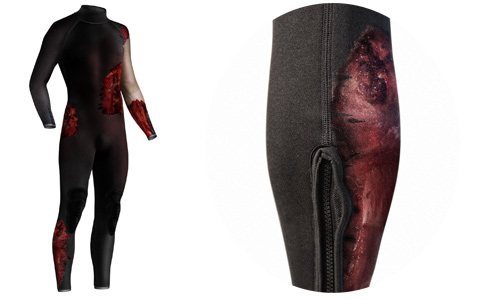
Shark Divers - New Wetsuit Fashion

Oh, the horror. It took a Dutch fashion designer to do away with wetsuit design as we know it and create this (click image):

The wetsuit - created by Dutch designer Diddo Velema - makes it look like the wearer has been savaged by a shark thanks to a unique printing process.

Custom inks are used to add the gory textures which appear like a torn wetsuit, ripped skin and wounds going down to the bone.

Diddo, who has a design studio in Amsterdam, said: "Wetsuits are both functional and protective, but why must they all look the same?"

Note: They all look the same to keep you warm, not make a fashion statement.

Ft.Myers Beach - Positive Change

The shark conservation movement has often been described as a "thousand ants taking down an elephant".

In the past two years some long lasting and precedent setting victories from Alibaba.com to the recent decision by the Maldives to ban all shark fishing has been attributed to this army of shark conservationists.

It all starts with "One". One idea, one blog, one website, one initiative.

"One".

Recently this army trained their sights on the "Are You Man Enough?" shark tournament in Ft Myers Beach, Fl. The resulting media, websites, blog posts, and phone calls stirred local politicians to effect rapid and precedent setting change.

The tournament will no longer feature dead trophy sharks which is a win. Instead catch and release will allow sharks to be fished sustainably.

Tracking this shark conservation army back here are some of the posts that made for this change alerting media and others to pick up phones and start making calls.

Kudos to all who made this change. Here's a short list and by no means complete:

Shark Safe Rally - The "One"

Oceanic Dreams

Neil Hammerschlag

Chum Slick

Loves Sharks

Underwater Times

Care2 Networks


Southern Fried Science

Dive Photo Guide

Scuba Board

Charity News

Beqa Adventure Divers


Florida Blog


The list of news outlets who followed this story lent a lot credibility to this effort. The final summation came from Gary and Brenda Adkison who wrapped up this change nicely.

Thursday, May 21, 2009

"Mark The Shark" - Buffalo Hunter

Bison were hunted almost to extinction in the 19th century. They were hunted for their skins, with the rest of the animal left behind to decay in the hot sun of the American plains.

At one point from 1870-84 long kill trains packed with drunken "day hunters" wound through seemingly unlimited plains herds shooting as many animals as over heated gun barrels would allow.

The Bison were quickly reduced to a few hundred animals from millions in just a few years.

Who were these men? What was the early 19th century mindset that allowed for millions of dead and dying animals to litter the American plains?

You need look no further than Miami and a fellow by the name of "Mark The Shark" - he is by definition a modern day Buffalo Hunter - killing breeding aged animals for the sport while leaving the carcass to rot after the film crews and onlookers have gone home.

While latter day Buffalo Hunters thought their resource would never end "Mark The Shark" knows all too well the state of today's oceans. His motivations for killing sharks, one might argue, is a bit more sinister.

Marketing.

By killing a displaying a 12 foot 1000lb Tiger shark in Miami recently "Mark The Shark" leverages free advertising and books more fishermen. Modern day Shark Hunters who pay to repeat an act from the past.

Buffalo hunting ended when we ran out of animals to shoot. Today the thought of killing a 12 foot Tiger shark expressly for snapping a few images or to promote ones business is completely out of step with where people and the evolution of wild care are going. The world has changed.

At one point in history someone must have seen the last Buffalo kill train leaving the station to the great American plains and thought "enough is enough".

To "Mark The Shark" we say enough is enough - unlike the Buffalo Hunters of times past who shot to kill, Marks business can practice "catch, tag and release". The choice is his to make, as opposition to dead, breeding aged animals left rotting in the hot Florida sun grows.

Tuesday, May 19, 2009

Shark Free Marinas - Official Website


For Immediate Release

Tuesday 19th May, 2009

Shark-Free Marina Initiative to reduce worldwide shark mortality

www.sharkfreemarinas.com

Shark- Free Marinas has a singular purpose, to reduce worldwide shark mortality. Today the not-for-profit company launches its strategy which intends to prevent the deaths of millions of vulnerable and endangered species of shark. The initiative aims to win over the fishing community by working with game fishing societies, tackle manufacturers, competition sponsors and marinas to form community conscious policy.

In the last five years over a half million sharks on average were harvested annually by the recreational and sport-fishing community in the United States alone. Many of these were breeding age animals and belong to vulnerable or endangered species. Research has shown that removal of adult sharks from the population is occurring at such an extreme rate that many species stand no chance of survival, severely damaging the delicate ecological balance of the oceans ecosystem.

“There’s a lot of talk about the atrocity of shark fining and fishing worldwide” says the SFMI’s Board Director, Marine Biologist Luke Tipple “but not a lot of measurable action towards reversing the damage. The time has come to stop simply ‘raising awareness’ and start implementing sensible management techniques to protect vulnerable species of sharks from inevitable destruction.”

The Shark-Free Marina Initiative works by prohibiting the landing of any caught shark at a participating marina. By promoting catch-and-release fishing the sport of shark fishing can actively participate in ongoing research studies and collect valuable data. The initiative is based on the Atlantic billfish model which banned the mortal take of billfish in response to population crashes in the 80’s.

“Although the number of sharks killed by recreational fishermen each year is dwarfed by commercial catches, the current crisis facing shark stocks requires action wherever possible.” says marine scientist and SFMI Advisor Edd Brooks “We are not asking fishermen to stop fishing, only asking them to start releasing their catch.”

Collaborating with the Cape Eleuthera Institute in the Bahamas and the Fisheries Conservation Foundation in the USA the SFMI has had an early impact with interest from marinas and non-profits nation-wide. Currently Shark-Free Marinas is able to subsidize the cost of signs and literature but hope that future investment will help make a nationwide impact.

“Shark-Free Marinas is a necessary response to the culture of mature shark harvest” says Tipple “Our effect will be immediate, measurable and, together with saving millions of sharks, will establish a new global standard for responsible ocean management.”

Visit the Shark-Free Marina website at www.sharkfreemarinas.com or contact the Director at staff@sharkfreemarinas.com

Sunday, May 17, 2009

Bucky Dennis - Shark Killer Media

This is all that is left of a record shattering, 1,060lb pregnant hammerhead - deliberately stalked and killed by Floridian fishing guide, Bucky Dennis.

Last week we suggested that this targeted kill went by without much noise. As it turns out we were wrong.

Regionally, fishermen, guides, and shark advocates came forth to say "no more". This is a good thing as the "times-are-a-changing" and dead record sharks are less than well received these days. Kudos to all who raised a voice and to Mote Marine labs for refusing to take the carcass.

In the end where ever you have records you'll have those who want to break those records. Be it fishing for pregnant hammerheads (these animals have a predictable pupping season and weigh more) or pogo'ing around the planet...backwards.

Articles like this weeks St.Petes Times set the tone for further discussion and greater awareness to "targeted kills" such as this. Record agencies like the IGFA who, in essence cause and sanction these kills year after year, should consider taking pregnant animals off the list. In fact an interesting clause to take away previous records if animals are found to be pregnant would stop this practice all together.

Bucky Dennis is only a symptom of a larger problem and one that ultimately has a solution within the IGFA.

Food for thought. Here's Bucky in action:

Stuart Cove - Pro Shark Media 101

Hard not to be impressed with commercial shark operator Stuart Cove, Bahamas. As a template for "How to do Shark Media 101" today's ABC News GMA piece was a cornucopia of pro shark images, data, and industry quotes.

As a commercial shark diving operator you can do pro shark, pro industry media. As Stuarts Cove has aptly demonstrated you need to pick your partners well.

Running with the three tenets of shark media, host country, sharks, and divers this weekend Stuart Cove rolled out a great piece that carefully balanced all three and delivered an industry home run:

The divers feed the sharks small amounts of food to better observe them, but they're careful not to disrupt the ecosystem. A scientist from a Vancouver university who studies these Caribbean reef sharks estimates the food from the divers has about as much impact on the sharks' diets as eating one grape a day would have on a human's diet.

Complete Story

Saturday, May 16, 2009

Sharks - Market Demand

Back in 2001 the state of Florida banned chumming for sharks and ended a nascent statewide commercial shark diving industry. Tourists and shark divers then flooded the Bahamas which enjoys a robust commercial shark diving footprint and enhanced revenue stream for local hotels and restaurants.

Back in Florida demand for safe shark encounters did not go away. Enter land based shark tourism, the future of shark encounters worldwide, as more aquariums and theme parks open their enclosures to the public:

Sharks and Idiots - A Dark Nexus

You have to read the news of a recent bull shark attack in the Bahamas this week twice. At first this is your standard story of a speereo who had unwittingly brought on a 7 foot bull shark with a freshly speared grouper (ambrosia for sharks). This is a typical shark/human story that usually resolves its self without anyone getting hurt.

Then Mr. Luis Hernandez went on to recount what happened to him, telling a local reporter the circumstances that lead up to his unfortunate mauling:

Luis Hernandez, who was in the mood for fish, had just speared a grouper at a local reef when he spotted the shark.

"The first thing I thought was, 'Wow, nice shark!" he said. "So I swam a little closer and thought about spearing it, but decided to let it go. I just poked it so it would get out of my way."

But the shark wouldn't leave. It eventually lunged at him, sinking its teeth into his arm.

Clearly his shark tale puts this encounter back on Mr.Hernandez who, after spearing a grouper, decided to engage a 7 foot bull shark. In the realm of good ideas, with wetting your finger and applying it to a light socket being say, a "one" - Mr. Hernandez executed a perfect "negative 20" with his shark stunt and paid the ultimate price.

Sharks are not playthings. They are predators. Your first reaction to a wild, baited bull shark, should never be "Wow, nice shark!". Sadly this is not the first time someone has made a miscalculation with a baited bull as this video from You Tube reminds us:

Tammy Jo Anderson - Op Ed Guam

Tammy Jo Anderson is the education coordinator for UnderWater World Guam and an advocate for sharks. This week she offered a well thought out Op Ed on the reasons for keeping wild shark populations. Here is an excerpt:

Sharks are a different story.

These fish have been swimming our oceans for millions of years before even dinosaurs were walking around on the planet. Sharks have survived massive changes in climate and numerous other hazards to make it to today.

Now, the main thing that is threatening their existence is us.

Complete Story

Friday, May 15, 2009

Dr.Steve Turnbull - We Know Him!

Funny - you play around in the shark world long enough and you start seeing names of people you have met, or worked with, or both.

In this case shark diver/shark researcher Dr. Steve Turnbull is in a news article this week about a basker that washed up near his hometown of St.John's, Canada.

We met Steve at Isla Guadalupe a few years ago.The article makes great reading and as it turns out Steve's genuinely nice fellow:

Steve Turnbull, a shark researcher at UNBSJ, said little is known about the basking shark, which is a vulnerable species. Because 25 per cent of its weight is liver, the prehistoric beast was almost hunted to extinction for its oil.

"He's an early arriver," Turnbull said. "Usually they come in with the food source," in the summer.Warmer waters bring plankton and the gaping mouths of the basking sharks.


While it's a hulking beast and has a row of tiny teeth, the basking shark is a harmless filter feeder. "They open their mouths and everything goes through," Turnbull said as he inspected the shark.


Complete story

Vanishing Salmon - A California Thing

As avid fly fishermen we have seen the effects of vanishing salmon in Northern California first hand - it's not a pretty sight. There are some first rate habitat and wildcare orgs out there tackling this serious and growing problem head on. One of them is SPAWN who have our complete support. Regional efforts for wildlife are sometimes where your best efforts make the most sense - even if these are not sharks:


QUEST on KQED Public Media.

Cause and Effect - Shark Mortality

Going out on a limb here with this absolutely unscientific theory about "sport caught shark mortality". It's an observation, nothing more, but it has historical precedent. Here goes:

The Storming of the Bastille, Paris occurred on the 14 July, 1789. While the prison contained only seven prisoners and therefor was of no value to anyone, its fall was the flash point of the French Revolution, and it subsequently became an icon of Democracy. Heady stuff.

The attack on the Bastille was lead, apparently, by a topless woman who was followed by some 500o screaming men waving small arms. She became known as the "Mother of the Revolution" and this opens the discussion to the power of women's, ah, breasts, to cause men to do seemingly irrational things.

Moving ahead.

Sport caught sharks have little value aside from the actual shark image and if current statistic hold true 98% of sport caught sharks are in fact caught by men. So why do they do it?

Back in 1980 the first "telling image" from Florida of a sport caught shark was transmitted to the world. This image caught the imagination and interest of millions as it made the front page of newspapers.

As you can see this was one impressive shark.

For sport caught sharks in Florida this was the dawn of the shark fishing era. Men from all over the state poured into the oceans like Drover Ants catching and killing as many sharks as they could all for that elusive dockside photo opportunity.

Like the unknown and unnamed "Mother of the French Revolution" this woman and this image became known as the "Mother of the Shark Fishing Revolution", a legacy that lives on to this day.

Today sport caught sharks are a regular feature in many marinas, public piers, and at fishing events worldwide.The reason for this mostly male activity remains as elusive as the the first day it was conceived, but I have a suspicion that it may have something to do with what I am terming "The Bastille Effect".

Oh, you laugh now, and perhaps even throw a few snide comments about mental astuteness for conservation ideas and childish responses to images found on the Internet - but.

As you can see this "Bastille Effect" is all pervasive and it is fast becoming a hard fact of the sport caught shark world. These are the images we typically see of sharks brought back to marinas for photo opportunities.

Like I said this is a totally unscientific theory and merely an observation at this point.

Clearly more observation is needed.

Apologies in advance to offended feminists worldwide.

No this is not a serious post.

Thursday, May 14, 2009

Hawaii - Tours Pose Little Risk

Three cheers for reporter Christie Wilson with Honolulu Advertiser who, bucking recent media trends in Hawaii, has introduced a story about what is not happening with commercial shark diving operations in Hawaii.

As we have been covering, politicians and anti-shark diving groups reacting to a tragically poor operator roll out in Hawaii Kai have called for a complete ban on all operators in the region.

To close existing commercial shark diving loopholes, this growing anti-shark diving group is demanding legislators to:

"(1) prohibit use of public facilities such as parks, piers, ramps, and harbors by shark tour operations;
(2) prohibit advertising of commercial shark tours in any print and electronic media; and, (3) prohibit commercial use of shark cages or other devices designed to place humans in close proximity to sharks or within shark habitats."

Citing a recent research study today regional commercial shark diving operators came back (finially) with the one thing they had at their disposal - research data:

"When it comes to offshore caged shark diving tours, there is no evidence of any risk to nearshore recreational users," said marine scientist Carl Meyer. "People need to understand there are already sharks in these initial shark-feeding areas and if these shark tours were a real problem, we would have seen it manifested by now by an increase in attacks.

"The study reports other factors that make the tours a minimal public safety risk include the fact shark-diving tours mimic the activities of crab-fishing vessels operating in the same area for more than 40 years, and that inshore recreational stimuli, such as a surfer paddling on a surfboard, "are substantially different from the conditioning stimuli associated with tour operations ... and, hence, unlikely to stimulate a conditioned feeding response."

Editors Note: THIS is one reason why operators work in tandem with shark researchers. To exclude shark research within operations is to blind yourself to important data about the animals you make a living with.

Additionally, ongoing data sets provide impartial answers to questions and accusations leveled by the anti-shark diving lobby at our industry members. These accusations are typically taken from a well worn "play book" of "raw meat hysteria".

The operators in Hawaii have a long way to go - but today, they just began the road back to credibility in the public eye. Kudos to all involved in both this study, and to reporter Christie Wilson.

Update: Reporter Leila Fujimori from Hawaii's Star Bulletin also ran with this story this morning. Kudos.