The shark diving industry blog covering sharks, shark cage diving, shark conservation and things we find "amusing" since 2008 www.sharkdiver.com, www.sharkdivers.com, www.divingwithsharks.com
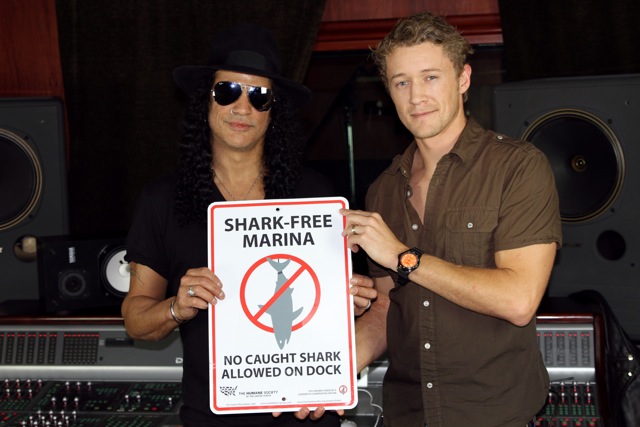
Slash with Luke Tipple the Director of the Shark-Free Marinas initiative in 2011.
When celebrities get together behind a worthy cause only good things happen as is the case with the SFMI and a new series of PSA's highlighting the sport take of sharks in the USA and worldwide.
What began as a good conservation idea has, in the capable hands of Luke Tipple and What We Do Media, become so much more.
Kudos to the early adopters who, without their support, this enterprise for sharks might not have gotten off the ground and to the Humane Society USA for their backing and support.
Join the Shark-Free Marinas in your state and help save sharks one marina at a time. Together we can put a dent in the estimated 200,000 sharks needlessly killed each year in the United States alone and help fishermen discover the sustainable option of catch and release shark fishing.
One of the joys of having an iPhone 4 is the ability to snap shots like these, or perhaps it's a burden - the jury is still out on that.
This character was selling Nooks at the local Barnes and Noble book store the other day. You might remember that Barnes and Noble is close to bankruptcy for reasons that go well beyond the economy.
Back to the Nook Dude.
Dressed in his finest Harry Potter meets Friday the 13th Freddy Sweater I was summoned to his counter top with a witty, "Hey ya wanna see a Nook?" come on line.
Actually, I didn't want to see his Nook, nor did I care for the sweater. In fact I found the whole set up threateningly anti-Nook.
Look folks if you're going to sell some high tech gizmo, especially to passers-by like me, dress your Nook crew for success.
Also let's try a different sales line, like, I dunno, "What, you're still using paper?" anything but what I was subjected to last week.
Folks over at Tel Aviv University discovered a critter that eats toads, salamanders, frogs and just about any amphibian it comes across, employing stealth and a particularly toxic venom.
They even made a video of a classic predation by an insect called the Epomis beetle.
Warning: If you have a soft spot for Bufo bufo this video is not for you, read about the research study here:
Thanks to the ever watchful Dorsal Fin Blog for this video catch of the week.
Yes the 70's were groovy, and none more than this beer commercial featuring a shark, a diver chick, and that perennial aluminum flavored brew - Colt 45.
Proving once and for all that sharks and Billy Dee Williams can be used to sell almost anything:
Yes, it's a fishing show but one that pretends to be nothing more than that.
Along the way Wade and his small crew deliver the goods with some gripping encounters of the toothy kind.
As the series gets picked up for another season we hope that Wade and company consider the deeper waters of the ocean for their next adventures...down there mans worst piscivorousnightmares are waiting to be discovered.
We have been watching the unfolding tragedy in Playa del Carmen with great interest. Both as a object lesson in shark site development and as an internal discussion within Mexico as to the fate of it's sharks.
As you might recall a new shark site featuring Bull sharks (Carcharhinus leucas) exploded onto the scene a few years ago with great fanfare. Shortly after, a series of regional takes by fishing interests surprised many.
These takes devastated the local shark population.
The good news is that these few animals did not die in vain as a new NGO, Xooc, has taken on this regional tragedy and has produced a mini documentary about it. The first step, and may we say, great step in protecting these animals.
Kudos to everyone involved, this is first rate work:
Icelander Sean Stiegemeier has been covering volcanic activity for a few years now and his latest effort compresses time, beauty, and raw nature for 2.19 seconds of video bliss.
Over at Pete Thomas Outdoors he's got Bigfoot, or at least a recent video from Alaska of a Bigfoot like creature. We used to be big fans of cryptozoology, now, not so much.
Fact is with 6 billion folks on the planet, many of which are sporting video enabled cameras, why do we always have to sit through these terrible videos, and another thing, why has no one come up with bones, skin, or dried remains of these critters?
While many within the research blogging community have completely exonerated Dr.Michael Domeier and Chris Fischer for the current condition of Junior, a shark with 2.6 pounds of rusting hook left in his esophagus, ABC News just completed an investigation of the events that most likely lead to this animals current condition.
While the exoneration has proposed that a shark attack, not a rusting hook, is responsible for the condition of this animal we are not buying it. We are also not buying into the notion that just because this animal is "still tracking" means this effort was a success. The animals current condition is grave, this is not the same once robust shark, and the debate about it's condition and ultimate responsibility needs to be addressed clearly and without any further internecine agendas by ridiculous bit players in California.
What is not up for debate is the half-assed attempt by one or more within the shark research community to discredit Dr. Domeier for the wound on the side of this animals face. It was a sorry side show to the animals overall diminished condition and frankly a disservice to a protected species within a national marine sanctuary where new prohibitive regulations keep all persons 164 feet away from white sharks at all times.
The ABC News investigation used clips from the show as Junior was caught and details the 1.2 hours this animal spent in the care of a team of self-styled shark tagging experts who, by all accounts, were learning as they went along, reacting to an unfolding series of cascading disasters with "televised precision".
Watch Chris Fischer the owner of Fischer Productions and one of the shows crew members, as he realizes that they are in the middle of a disaster with cameras running celebrate the eye of the hook coming free from Junior after heavy duty bolt cutters are pushed through the gills, yelling "Super Sweet!".
Super Sweet? This animal is being left with a huge foreign body inside it's throat, and yet the crew seems to think this is cause for celebration, it was anything but. The shows cast members also renamed the shark to "Lucky", a purely fictionalized attempt at audience redirect.
Moments like these are the reason why this brand of research, using film crews for science, should not be allowed back at the Farallones. It is also the reason why Sanctuary Manager Maria Brown who refused to be interviewed by ABC for this piece, should be fired from her post and replaced by a manager who is less star struck, and more interested in long term non invasive work with a protected species.
Maria's handling and media appearances over this event have been poor at best, at worst actionable by NOAA.
It shatters the imagination that this is the same Maria Brown who shepherded in the new rules and regulations that keep visitors to sanctuary waters 164 feet away from white sharks. Yet within months of those new rules granted this well heeled, for profit film crew, who also had thousands of dollars in promotional product placement agreements with companies like Costa Sunglasses, unprecedented access to the these same animals with baited hooks.
This month Maria Brown continues to consider a return by Dr.Domeier's team to hook 11 more sharks within Sanctuary waters, playing politics once again, when the debate over the condition of Junior has not even been discussed with any serious thought and more than a healthy dose of career saving cover your ass.
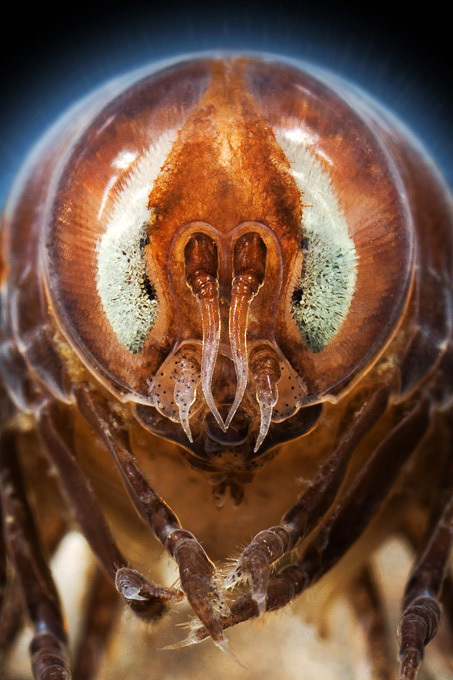
Alexander Semenov spends a lot of his time with the creepier things in life, such as this Hyperia galba here.
Commonly known as a jellyfish parasite (who knew) these critters are found hitching a ride on and sucking the life's juices from jellies.
You can read all about them here a favorite parasite with the research community (again who knew).
Alexanders website deserves a special look and keep your eye out for a stunning face to face encounter with Nereis virens - the clam worm.
The next time you look at any ocean critter and think that life in the ocean is better than, say, life in a aquarium? Make sure you spend some time with the parasites that infest said critters before you make that distinction, at least in the aquarium they don't suffer the wrath of Sacculina!
If you want to know what's going on in the oceans - ask a commercial fisherman. Apparently shrimp boat captains are reporting a "plague of sharks" ripping up nets and taking catches away from boats along the gulf coast.
While this is not news to some, for those in the shark community this news is interesting.
Wouldn't suggest you go diving in this shark soup anytime soon though:
What started several years ago as a "conservation concept" born from the shark diving community has, in the capable hands of Luke Tipple, become so much more.
Welcome to the newly invigorated Shark-Free Marinas Initiative now with more participating marinas and PSA's featuring Slash, Guy Harvey, Alex Baldwin, Elizebeth Berkley, Nigel Barker, Jim Toomey, Bill Maher with the full support and backing of the Humane Society of the USA.
The Shark-Free Marinas Initiative now features a new division called Shark-Friendly Marinas a natural expansion of the original concept:
We'd like to register every marina as Shark-Free, however some state laws or private companies have policies which do not allow for a complete ban on killing sharks. In these cases we offer the Shark-Friendly classification which discourages the intentional killing of sharks.
The SFMI's early start was a rocky one. Thanks to several members of our own community who adopted this concept and brought into being by acting as self motivated boots on the ground, actively transforming marinas in their region to become Shark-Free.
To those few early adopters, Kudos, your leadership, your dedication to sharks allowed the Shark-Free Marinas Initiative to grow into what it is today.
The hard work is still to come and this month the SFMIhas announced it's 201 Florida Focus with the help of Guy Harvey and the Guy Harvey Oceans Foundation to invite Florida marinas to become Shark-Free and Shark-Friendly.
Another shark campaign?
Yes, the Shark-Free Marinas Initiative is smart, targeted, and has the benefits of saving sharks now.
Join the shark conservation army and ask your local marina to become Shark-Free this month.
This time the Grey nurse shark (Carchariastaurus) in Australia where a recent change in fisheries policy is taking this species off the protected list and open to fishing pressure.
What makes this particular case actionable is the fact this is a reversal of set conservation policy introducing an open fishing zone where these animals are known to aggregate and breed.
If this sounds like politics once again creeping into shark conservation, you have a good ear for bad conservation policy.
You can get the full scoop and send a well timed email to Fisheries Minister Katrina Hodgkinson this week at the Grey Nurse Blog.
Note: The image is from Montague Island circa 1964, when sharks were considered the enemy and images like these served to prove that point. We have come a long way since then, let's not let fisheries policy in Australia slide back at the hands of a few misinformed policy makers.
We have been supporters of changes coming to shark tournaments in the USA for a while. After close to a decade of failed zero sum policy by many within the conservation community seeking to have all shark tournaments "shut down," the realization that we must inhabit a middle ground for successful conservation is dawning on many.
The middle ground is a two pronged approach by members of the tournament fishing community and forward thinking conservation members to embrace circle hooks, and catch, tag and release tournament models.
It's a conservation strategy that works with the fishing community instead of marginalizing them, embracing a multi million dollar sportfishing community by allowing leadership to make important and long ranging conservation decisions based on science and best fishing practices.
This week that conservation strategy is spreading to Ocean City and only good things can come of it.
The big news this year is that the Guy Harvey Ocean Foundation has signed on as a major sponsor of the OC Shark Tournament Release Division. Through his foundation's involvement, Harvey hopes to provide an increased level of shark conservation while demonstrating to the fishing industry that release tournaments with large cash payouts can be both successful as well as a wise alternative to traditional events that result in dead fish to being brought back to the scales.
OCEAN CITY -- For a long time, most tournament directors relied solely on the weight of dead fish at the dock to determine the winners of their event. But today, as more fishermen recognize the need for catch-and-release fishing, many tournament directors are responding by increasing the emphasis on release categories in their events. But properly running a release tournament, or even just a release division, is no easy task.
For a release division in which no physical evidence of the fish will be brought in, there must be rules and procedures to ensure the validity of each catch. Winners need to be properly verified just as losers need to be assured that they lost fairly.
Equally important is the need for anglers who engage in catch-and-release fishing, tournament or not, to do so with due regard to the survivability of their catch.
There's not much point in releasing a fish that's going to die anyway. This is particularly true in tournaments that result in a sudden increase in the amount of fishermen targeting species of fish that might already be pressured from other sources.
Since tournament anglers will likely be fishing at the top of their game, the average catch-and-release rates per angler go up during tournaments and, therefore, the need for proper release techniques is important.
With all this in mind, on Saturday, May 21, myself and the other the directors of the 31st Annual Ocean City Shark Tournament will be conducting a shark release clinic on the docks at the Ocean City Fishing Center from 4-7 p.m.
Battle tested over the past decade by our crews against weather, white sharks, tigers, whale sharks, deep water critters and the odd hammerhead in remote places.
This is the 100% cotton crew t-shirt and we now have a new shipment in. Our last shipment was sold out in three weeks thanks to the guys at Marine Corps Base Camp Pendleton!
We have them in large and XL with a few smalls kicking about the offices as well.
Perfect for your next shark expedition with Shark Diver, or that next shark themed backyard BBQ this summer, or the shark fan in your life.
The left front breast says Shark Crew in big letters.
Cost $25.00 with shipping.
To get one - or twenty - email us at sharkcrew@gmail.com
From the RTSea Blog this week another reason to watch television.
It's said that good things are worth the wait. I'm hoping that is the case with an episode of Hooked that airs this Friday on the National Geographic Channel.
It's been just a little over a year ago when I traveled south to Baja, Mexico with my good friend, Scott Cassell, to study and film the Humboldt squid - a predator whose numbers have been exploding in the Sea of Cortez.
Michael Hoff Productions, which produces the series Hooked for Nat Geo, sent a crew down to Baja to document our efforts to film the squid and conduct some important experiments and observations with guide Dale Pearson, boat captain Tom Loomis, and marine biologist Steve Blair that would illustrate the voracious nature of this squid and what that means for marine ecosystems and many commercial fisheries.
The program focuses on Scott, as he has a long history of studying the Humboldt squid up close and in the wild. And that can be dangerous; Scott has had several broken bones and lacerations due to the tremendous force of the squid's formidable beak.
Having not seen the finished program, I am hoping that it clearly presents the issues regarding the expansion of the squid's range without becoming too melodramatic. But having spent some time with these creatures, I can tell you from experience that they are not to be underestimated. In fact, after having spent many years filming large sharks, this was the first time in a long time where my adrenaline was really pumping. Dangling from a steel cable 50 feet down in 250 feet of water, at night wearing anti-shark chain mail and peering through my viewfinder with only the dim glow of red underwater lights, only to have a 5 to 6 foot squid charge you suddenly - well, it's a little disconcerting.
So, shameless promotion: if you're watching cable this Friday night, tune in to the "Squid Invasion" episode of Hooked on the National Geographic Channel (May 13th, 9:00pm).
Congratulations to the fine folks over at Southern Fried Science who yesterday became the first of the Blue Bloggers to break into the mainstream with pick ups by Gawker, Huff Post, The Daily Beast and now the full court media.
Unfortunately if you're looking for that article on the SFS site this morning you'll have to wait until the "smoldering ruin" that was once their servers come back online. It would appear that a Gagzillion viewers being pushed from all over the planet has crashed everything, hard.
After a few years in the blogging game, with insightful posts on science, research, and deep ocean critters, it took one off the cuff observation about Floridians, sex, and the legal system to fire up the imagination of millions.
Nicely done!
Hopefully the stat counter on your site was not totally fried so we may all know what the final count was, is there a number bigger than a Gagzillion?
On October 1, 2010 a new law went into effect in Florida. As with most laws involving sex this one was poorly worded as if the actual paper these worlds were written on might in fact burn though the desks of lawmakers.
It was passed quickly and unanimously.
An act relating to sexual activities involving animals; creating s. 828.126, F.S.; providing definitions; prohibiting knowing sexual conduct or sexual contact with an animal; prohibiting specified related activities; providing penalties; providing that the act does not apply to certain husbandry, conformation judging, and veterinary practices; providing an effective date.
Unfortunately as the fine folks over at the Southern Fried Science Blog pointed out today, the law makes having sex between humans...illegal (see helpful graphic).
As it turns out we humans are by definition animals. But don't tell that to 80% of the religious conservatives that infest Florida's legislature for they clearly do not want to hear it.
Enjoy your next conjugal visit Floridians, as of this year "getting busy" has been redefined to "accepted animal husbandry practices, conformation judging practices, or accepted veterinary medical practices."
Sure makes even the idea of sex awfully blanddon't it?
This weekend the quaint city of Punta Gorda, Florida will be invaded not by sharks, but by shark hunters. On Saturday, May 14 and Sunday, May 15 the second annual Guy Harvey Ultimate Shark Challenge will be held at Laishley Park Marina on the banks of the Peace River.
With $15,000 in cash and prizes up for grabs, there should be no shortage of experienced anglers in search of the big one. Thirteen teams of either two or three entrants are already registered. Organizers hope even more will be tempted to join in the search of the Gulf of Mexico and Charlotte Harbor Estuary for the notorious saltwater predators.
Twelve different species of sharks will be targeted by the competitors and each catch must be at least five feet long in order to be eligible for points. This is a catch and release tournament and part of what distinguishes it from others is an emphasis on conservation and scientific research. Each boat will have a trained observer on board to ensure the proper release of captured sharks. Furthermore, these observers will place satellite tags on various types of desired sharks, including tiger sharks, bull sharks, and hammerheads. These devices will enable researchers to follow the travel patterns of the sharks upon their release.
While the action is underway on the water, the Ultimate Shark Challenge also promises to provide excitement back on land. The weekend will see a festive atmosphere at Laishley Park in support of the fishing tournament. Here updates and highlights of the fishing competition will be broadcast for interested spectators on a LED screen. The event's numerous sponsors will showcase fun demonstrations and product giveaways. Fishing seminars will be offered for those not bold enough to enter this year's competition. Several attractions will be set up for visitors' amusement, including Mote Marine's popular mobile aquarium, which features a 1200 gallon fish tank and displays on sharks, sea turtles, and shells. Admission is free and live music, food, and refreshments will be available to liven the experience.
In 2004 I was fortunate enough to get face to face with the Salmon sharks (Lamnaditropis) of Gravina Bay in Alaska on a private shark diving adventure on board the M/Y Triton that we set up.
These critters are the sporty little cousins of the white sharks and not much is known about them, by sporty I mean jumping out of the water and tearing up local shoals of salmon kind of sporty - fun to watch.
So it was with great interest that I read about regional aggregation sites of these amazing animals in British Columbia in and around Haida Gwaii, in Queen Charlotte Sound this week.
In a paper published last year, and tabled last week with the Cohen Commission in Vancouver, Dr. Williams states an estimated 20,000 blue and salmon sharks gather in a relatively small area each summer.
That's a lot of sharks. Of course there's been some stunning tagging research done on these animals in the region, but you might never know about it because this team does not have a television show, nor do they seek the limelight like a "moth to a flame" as some do in the shark research community.
When it comes to shark researchers we prefer the quiet professionals, they just seem to be more...credible.
Since when did a "net caught sharks" menace anyone?
Only in the UAE where the offending animal was summarily beaten to death with sticks.
Crew Fight off Shark
A Policeman has told how he beat a savage shark to death with a stick after it tried to attack him and his crew in UAE waters.
Mustafa Al Hammadi feared he had bitten off more than he could chew, when his hobby turned to horror, as he battled the 8ft-long, 3ft-wide, 300kg beast. “It tried to attack us. All of us had to struggle to control it. It was ferocious,” the 43-year-old Emirati told 7DAYS.
Al Hammadi’s big catch got trapped in his net as he fished with four other amateur anglers in darkness off the coast of Khor Fakkan.
“We had gone to put out the nets and at about 8pm we saw the net was suddenly being pulled down. I did not understand what was going on. When I pulled it up with the help of the others, we found this huge shark inside. I was shocked.”
He said the sharp-toothed creature was thrashing about and started lunging towards them.
The terrified crew grabbed a stick and beat it repeatedly on the head to control it.
Al Hammadi said the shark he fought off is known as Dheeba in Arabic.
“This kind of shark is dangerous. They jump out of the water and attack livestock on board boats. They can even attack humans,” he said.
Mustafa who is a policeman with UAE immigration department, said he had not seen Dheeba sharks in UAE waters before despite having fished the area for the last 12 years.
“They are probably entering UAE water through the Gulf of Oman by following the smaller fish,” he said.
‘RARE CATCH IN UAE’
A marine expert from Dubai Municipality said Dheeba are very rare in the UAE. “They used to be spotted during pearl diving days. They are not seen nowadays and are restricted to Gulf of Oman and Indian Ocean,” Mohammed Abdul Rahman Hassan, head of marine environment and wildlife section at Dubai Municipality said. He said they are nocturnal and dangerous. “They are manhunters and are huge. I have not come across such species in the UAE in recent times,” he said.
Al Hammadi sold his big catch for Dhs100 to an Omani man. “No one eats it in the UAE. But people from Oman like them,” he said.
KUALA LUMPUR, Malaysia (AP) — A Malaysian state plans to ban shark fishing in a bid to bolster tourism and conserve a species hunted mainly for fins that are used to create a culinary delicacy, an official said Monday.
Masidi Manjun, tourism, culture and environment minister in eastern Sabah state on Borneo island, said local activists and foreign tourists have complained about cruel shark finning activities by local fishermen.
He said the state government is aiming to impose the ban starting next year. It would make Sabah the first state in Malaysia — one of the world's top shark-catching countries — to impose such a ban.
While there is no official data on the shark population, Masidi estimated only 20 percent of sharks spotted in the state 15 years ago are still in Sabah waters.
"There are only four coastal areas now where sharks can be spotted," he told The Associated Press. "If we don't do something about it, sharks may disappear from our waters completely. We will also lose tourism dollars."
Tens of millions of sharks are killed across the globe every year, mainly for their fins. Activists say finning is inhumane and a threat to the ocean ecosystem because fishermen slice the fins off the shark and toss the fish back into the water to die.
Shark fin soup, widely sold across Asia, can sell for more than $80 a bowl and is often served at weddings and banquets as a symbol of wealth.
Restaurant operators in Sabah oppose the ban, saying that sharks are also harvested for their flesh, skin and bones, which can be made into soup.
"We conserve our sharks here, but then they swim out to the South China Sea and get caught by Chinese or Vietnamese fishermen instead. What is the point?" said Sabah Restaurant Association chairman Lim Vun Chen.
Masidi said the state would not ban the importation and sale of shark fins for now but would educate consumers on the cruelty of shark finning. Sabah's government has already taken shark fin soup off the menu for official functions, he said.
Tourism is a major revenue earner for Sabah, which is famed for the rich biodiversity in its rain forests and dive sites teeming with coral reefs and marine life.
Traffic, a wildlife trade monitoring network, says up to 73 million sharks are killed annually. Malaysia ranks among the world's top 10 shark-catching countries, according to the International Union for Conservation of Nature.
The last two years have been banner years for shark conservation.
What used to be a few small and impassioned voices out in the wilderness has turned into a veritable tsunami of groups, Facebook petitions, and thousands of individuals calling for shark protections worldwide.
That's the good news.
On the heels of this movement have come the "sharkitarians" those whose personal agendas and misguided passion have created a subculture of angry infighting, ugly assertions, and a new sideways conservation paradigm of "anything for the sharks".
This has included, but not limited to, stealing shark conservation ideas, concepts, websites, names, slander, tribal groupings, and personal attack efforts unrelated to sharks or conservation in anyway.
We have been at the center of this unhappy storm of discontent, and seen it happening over the past two years to many others. It has become so pervasive, so absolutely non-productive and toxic, that many of shark conservations "true architects" have been leaving for the exits as fast as they can.
These are the real innovators, the website designers, the conservation concept developers, and the outside-the-box thinkers.
Left behind is a growing eco-chamber of circular thought. Where ideas and media quotes like, "if we kill all the earths sharks we'll run out of oxygen to breathe" go unchallenged. To be repeated without any critical thought or real conversation about the impact of this particularly moronic statement on policy makers.
Folks, this is a crises, you may not see it now, but it is happening and the exits are reeling with the onslaught of departing bodies.
It has happened again this week and the loss was acute and a blow to the shark conservation movement, let's all take a moment to mourn the loss of Mark Thorpe.
Are we going to continue with this loss of the best and brightest?
Hopefully not, because there's 73 million important reasons we can think of to change the way we're doing business with each other right now.
Unfortunately there are those who would use our global $400 million dollar industry for their own ends.
Some are well known shark experts based in Florida, whose Pavlovian response to cameras pushed into their face is to spout anti-shark diving rhetoric ad nauseam - without any empirical data to back them up.
Others are media based hatchet men, who use fear, industry images and soundtracks to boost ratings, trolling the basest of human emotions to slander operations without providing balance, nuance, and research (yes research) to highlight our industry.
Against these seasonal onslaughts of Shakespearean intrigue towards a thriving global industry stand a few blogs who take to task the failings of these few well voiced and misguided individuals, and we ask that you take a stand as well.
Collectively we have the horsepower to push back against those who might seek to harm our industry. The media consistently calls upon a few outside our community for quotes about shark diving because no one else has stood up to be heard.
In a media vacuum the small minded will always work from the nearest "shark contact rolodex" and it is high time we changed that, as the current rolodex is filled with misinformation, slander, and moronic statements.
It is also high time we started pushing back when we see stories like those that appeared out from the primordial ooze last week in Australia. Fashioned by a 1970's era media hack by the name of AnthonyHoy Media who's entire "shark diving research department" came from a dog eared copy of Jaws he found in a rubbish bin at the back of a bar he had been frequenting last month.
Fortunately there's Mike aka Da Shark, or as we like to call him "The Shark Diving Industries Rottweiler," who is more than happy to lead by example and take to task those who would seek to use the hard work and dedication of many within our industry for their own sad ends.
And the award for "Garbage Driven, Lowest Common Denominator Gotcha Media" goes go...Anthony Hoy Media, for his two part expose on the shark diving industry this week.
Here we go again, when some like Mr.Media Hoy decide to cover our industry nothing good comes of it because folks like Mr.Hoy are ratings driven, not fact driven.
Of course there's no mention by Mr.Hoy of any of the pro-industry research studies about commercial shark diving in this two part bacchanalia of moronic quotes and broad based assumptionsconcerning sharks, shark behavior, and the global shark diving industry.
In fact not one current study cited at all, and this is what passes for journalism in Australia?
Could we expect anything less from a paunchy over-the-hill reporter attempting to make a name for himself as his career flat lines? Anthony Hoy, reporting from the Neptune Islands, off Port Lincoln, South Australia, shows graphic Great White Shark footage that brings into question whether cage shark diving operations are training Great Whites to associate boating activity and related noise with feeding, and are therefore increasing the incidence of shark attack.
Favorite Anthony HoyReporter Quote: "Are your bait-and-trained sharks more dangerous, more antagonistic, and more likely to attack when not fed?"
Note:Anthony Hoy contacted us today demanding that we post the second part of his two part expose. We declined, citing the fact we thought his work was absolute trash and refused to give him or his attempts at gotcha media any more attention than it already had.
Anthony Hoy's Response?
"I'll do my own posts, pointing out what a half-baked operation you run. You talk about balance, you halfwit....there's plenty of balance in the piece I've referred to, which you're too biased to run."
Really classy reporter, so glad he's in the media.
For the industry members he slandered this week we're pretty sure they're not so pleased.
If you want to know where to find white sharks always ask the local fishermen, in this case a sizable animal makes an appearance in the Southern hemisphere last week:
Was Dr.Domeier the target of nefarious and truly dark individuals seeking to tar and feather him with public opinion?
Is Dr.Domeier completely free of blame for the current condition of Junior, a white shark with 2.6 lbs of hook left in his esophagus in 2009?
According to David Shiffman who has acquired the 1.17 second tape all of us were seeking, the answer is yes to all three questions.
After wading through this "sewage of a debate" and watching the main accusations unfold by less than credible spokespersons for the California research community, I am dead certain of a few things in regards to Junior.
1. Someone (not so intelligent) did in fact send these images of Junior out to select blogs to create some noise. Ours was one of them.
2. The intent was to make the case that the hook used to capture Junior in 2009 by Dr.Domeiers team caused this wound. A case we did not agree with. This was never about what caused this wound and our blog coverage and statements online will back that up.
The end result, no so surprisingly, is a complete and utter vindication of Dr.Domeier and Chris Fischer for the current state of Junior once the 1.17 seconds of live video came to light (congratulations to David for the acquisition). Even though this is an animal that is no longer in any kind of breeding condition, and is an animal that is seriously underweight.
The main accusation against Domeier and Chris Fischer (such as it was) was framed in absolutes when wildlife is far more nuanced than that. Cause and effect may trigger unintended consequences, all of which should have be discussed and carefully reviewed - but never was.
For the nefarious and truly dark individuals who brought this image and half-witted accusation to light, add to that moronic, I would suggest that you forget about this animal, forget any further attempts at your moral shock at this animals condition, and forget any attempts at getting Sanctuary Manager Maria Brown to change the way she conducts business within a National Marine Sanctuary.
That dog won't bark anymore.
You have fired your only shot, and missed the mark, and completely lost the moral high ground.
In fact, it is over.
The debate and discussion over Juniors current state should have been about the following:
1. Hybrid shark film and television research within a National Marine Sanctuary and the causes that lead to a very bad mistake with a white shark being hooked in the throat.
2. The continuation of said research after a tagging disaster and subsequent media gaffs, cover ups, and flat out cover-your-assery that boggled the imagination.
3. The overall current diminished condition of an animal that was hooked in the esophagus with 98% of the hook left in the esophagus in 2009.
If I sound a bit put off, the fact is, I am.
What should have been all about a protected white shark within a National Marine Sanctuary devolved into a sideshow of lies, bullshit, titanic egos, moronic assumptions, and one very big vendetta that has now backfired on those who set it loose.
For Junior, all this land based "much ado about nothing" will not help his condition and thanks to this half assed side show we'll never get any serious minded discussion about the state of this animal.
The real tragedy here is about one shark. Not pricked egos, television shows, ratings, or someones next research paper.
Is this the best we can do? Apparently so.
Mike "Da Shark" in Fiji has an excellent wrap, and yes I agree, if the identity of EcoShark1 ever comes to light you'll know we'll be writing about it.
Patrick Williams an investigatory journalist, finds himself on a twisting path of mysterious and bloodcurdling events as he delves deeper into a story of a honeymoon couple's mysterious disappearance from the sleepy town of Gans Bay, situated only 100 km from the southernmost tip of the African continent.
The remote fishing village has of late, become the centre of a burgeoning great white shark cage dive industry, and against logic and rational judgment , he is drawn into a tangle of incidences where the reality facing him is more grim than he could have ever anticipated in his wildest dreams.
Down in the deep, propelling her heavy spindled shaped body though the frigid waters of the Cape, is the Submarine, the legendary Great White Shark everyone thought was long dead and gone…….
Frank Boon, a Great White Shark scientist, avid shark conservationist and diver, finds himself caught between trying to protect the shark or possibly having to kill it due to public pressure. A witch- hunt of what's said to be "largest shark ever sighted" is staged after a horrific incident off a beach in Hermanus, not far from Cape Town.
Fear grips all involved as the obscured reality of death and malevolence slowly unravel to a showdown between man and beast.
Heart stopping, fast paced and real. It felt like the shark was about to swim right out of the pages. Jytte Fredholm – International Wildlife Photojournalist.
I have known Craig Ferreira personally and professionally for many years. Passionate, intense and full of surprises, Craig has found a new way to channel his immense creative energies by writing a debut novel about the world that he knows best – great white sharks.“The Shark” is crime fiction that’s heart pounding, testosterone-driven, unique and as unpredictable as the subject of the title. - Mark Kaczmarczyk, Documentary Filmmaker
Craig Ferreira is synonymous with sharks, even though he has seen more white sharks than the rest of the world; he still acts, as it's his first time when he spots one. He lives and breathes white sharks. - Fredrik Öström, Captain – Swedish Military Intelligence
A fascinating and exciting story – just keep writing. - Peter Benchley, author of Jaws and The Deep.
PARIS (AFP) – A single reef shark can be worth nearly two million dollars in tourism revenue over its lifetime, according to a study released Monday by researchers in Australia.
The analysis from the Pacific island nation of Palau shows that sharks -- hunted worldwide for their fins, a Chinese delicacy -- are worth many times more to some local economies alive than dead.
"Sharks can literally be a 'million-dollar' species and a significant economic driver," said lead author Mark Meekan, a scientist at the Australian Institute of Marine Science.
"Our study shows that these animals can contribute far more as a tourism resource than as a catch target," he said in a statement.
Sharks have reigned at the top of the ocean food chain for hundreds of millions of years.
But because they mature slowly and produce few offspring, the consummate marine predators have proven vulnerable to industrial-scale fishing.
Tens of millions of the coastal and open-water sharks are harvested every year to supply a burgeoning appetite for meat and especially shark-fin soup.
The researchers found that the annual value to the Palau tourism industry of an individual reef shark at one of the country's major scuba-diving sites is 179,000 dollars (121,000 euros) a year, or about 1.9 million dollars (1.3 million euros) over the animal's lifetime.
Shark diving accounts for about eight percent of the tiny country's GDP and 14 percent of its business tax base. It also generates more than a million dollars annually in salaries.
In 2009, Palau became the first country in the world to declare all of its territorial waters to be a shark sanctuary, followed last year by Honduras and The Maldives.
The US state of Hawaii, the territories of Guam and the Northern Marianas, and the Republic of the Marshall Islands have all banned the possession, sale or distribution of shark fins.
"Shark tourism can be a viable economic engine," said Matt Rand, a shark expert at the Washington-based Pew Environment Group, which commissioned the research.
"This study provides a compelling case that can convince more countries to embrace these animals for their benefit to the ocean and their value to a country's financial well-being."
About a third of open-water sharks face extinction, according to the International Union for the Conservation of Nature (IUCN).
Regional studies have shown that when shark populations crash the impact cascades down through the food chain, often in unpredictable and deleterious ways.
Thanks to Dan Holstein on Facebook who uncovered the true horror of local dive shop/shark hunter Shark Bite Charters out of St.Johns USVI.
It would seem the gregarious local owner has discovered the mother load of regional Tiger sharks off the shores of the USVI and is now in the process of killing as many as he can get his hands on, then proudly posting videos of his conquests online.
In the many years I was diving in the USVI we never saw a Tiger shark, if this is a newer phenomenon or not, either way it is shocking.
While the rest of the planet moves in lockstep to try and save dwindling shark populations with the Bahamas serving as a prime example of first rate shark management and tourism opportunities with sharks, the discovery of an operation like this is both disheartening and tragic.
Let's see if there's some local dive shops who can do something about this ongoing slaughter.
Update: Don't try posting anything on their Facebook page, to date over 300 posters have made their opinions known, Shark Bite Charters is deleting any post that is critical of their operation.
Having lived in and been diving the USVI (US Virgin Islands) and BVI for many years I can attest that sharks are just not part of the eco system in this Lesser Antilles chain as elsewhere in the world.
Finding a juvenile Tiger shark (Galeocerdocuvier) in these waters is an exceptional and very rare event. Which makes the following video so sad to watch.
As a commercial shark diving operator I am frankly stunned at the treatment of this animal and the 1970's approach to filming and documenting sharks underwater. The death of this animal was unnecessary, ignorant, and a stark waste of a magnificent resource.
Ironically on exactly the same day this animal was being killed I was in the Bahamas with a Brazilian film crew (without cages) documenting the Tigers of Tiger Beach for an upcoming documentary about these wonderful animals.
We still have a long way to go to change minds and attitudes towards sharks:
An international team of scientists, led by the Institute for Ocean Conservation Science at Stony Brook University, has used DNA to determine that groups of dusky sharks (Carcharhinus obscurus) and copper sharks (Carcharhinus brachyurus) living in different coastal regions across the globe are separate populations of each species. Both are large apex predators that are heavily exploited for the shark fin trade, which claims tens of millions of animals every year to produce the Asian delicacy, shark fin soup.
Many of these species are declining as a result of this fishing pressure for their fins.
DNA research projects were conducted by a collaborative international team of scientists from the United States, Australia, South America, Asia, New Zealand and southern Africa. The scientists collectively analyzed part of the mitochondrial DNA in nearly 400 sharks sampled from all over the globe.
This research was funded by The Pew Charitable Trusts through a grant to the Institute for Ocean Conservation Science at Stony Brook University. Sequence data were collected in the Field Museum's Pritzker Laboratory for Molecular Systematics and Evolution, operated with support from the Pritzker Foundation. Additional sequence data were collected at the Guy Harvey Research Institute with operational funds and a grant from the Save Our Seas Foundation. Funding was also provided by the Turner Fellowship Program and the Tinker Foundation.
For more information on "Global phylogeography of the dusky shark, Carcharhinus obscurus: implications for fisheries management and monitoring the shark fin trade," visit here.
For more information on "Phylogeography of the copper shark (Carcharhinus brachyurus) in the southern hemisphere: implications for the conservation of a coastal apex predator," visit here.
Look up the world "enthusiastic" in the dictionary and you'll see an image of Magnus Greenacre from New York.
We got to meet him and his two dive buddies, Matt Todd and Kathryn Deveraux earlier this month in the Bahamas for some quality time with sharks.
As Magnus wrote this week:
This was one of those perfect trips when weather, sharks, and the company of some fine shark divers conspire to deliver a memorable adventure.
To say this was a trip of a lifetime would just not do it justice. After opening my eyes on a dreary Monday morning to find myself in a fuzzy walled cube, I decided that it was time to take a trip that I will remember forever: Shark Diving.
I found Sharkdiver.com, emailed Pat, and within 10 minutes already had a response....the rest is history.
Day one, we woke up to a fully cooked breakfast of scrambled eggs, bacon, pancakes, banana bread and all the coffee a worn out Manhattan Workaholic could desire......oh, and 4 tiger sharks ominously circling the boat. The team gave us the full run down and before we knew it we were surrounded by Lemon and Tiger Sharks. The only way one can truly appreciate a sharks beauty is to be in the water with them. As exciting as day 1 was, there were six more days to follow of equal awe and amazement.
I hope my pictures speak volumes of the six days that followed...
It’s been a week since I returned home from my trip with Pat and Sharkdiver.com and I am already planning my next shark adventure.
Thanks again to Pat and his Crew for a life long memory, story, and friendship.

 Slash with Luke Tipple the Director of the Shark-Free Marinas initiative in 2011.