Saturday, July 24, 2010

RTSea Interview - Responsibility in Filmmaking

Richard Theiss took time out this week to share his thoughts on filmmaking, sharks and the industry.


"In speaking engagements, I have often said that shark conservation is a tough sell. To be sure, there are dedicated shark advocates who understand both the important role that sharks play in a healthy marine ecosystem and the many threats these animals now face – but that represents a small number compared to the general viewing audience. Sharks are not afforded the “warm and fuzzy” factor that many terrestrial animals enjoy – the cuddly bear, the cute fur seal, or the seemingly wise and sociable whale. Sharks can seem cold and, as predators, lie just below the surface – waiting for us. That’s a tough image to work around."

Friday, July 23, 2010

Shark Walker - The Gateway Commercial Shark Diving Drug

The Shark Walker. The industry could use about 100,000 of these spread across every major city on the planet. Imagine the conservation branding on these nifty gateway shark diving experiences?

Next stop? Isla Guadalupe.

Captain Bill - 20 Seconds of Fame

The clock is ticking...


I Just Gotta Say - Smart Conservation Messaging

Now THIS is smart conservation messaging and I like it. Fact is we have been hammering away at the Asian community with western conservation messaging for far too long. I am not convinced that non Asian spokespeople can change hearts and minds in Asia no matter how desperate or worthy the cause might be.

Engaging the global Asian community on their own terms, in their own language, confers respect and strategic understanding.

From Shark Savers?

Yes, and a radical departure from Shark Angels a conservation concept I (and many others) had a hard time wrapping my head around.

This PSA is the brain child of Wildsphere Productions.

Welcome to a steaming bowl of of smart conservation messaging, with hopes for second helpings soon. Nicely done.


California Shark Fishing and the IGFA

As a commercial shark diving operator and a shark conservationist I am unsure how long the IGFA can continue to run with a catch and kill model for record holding with sharks.

It would seem easy enough to apply a set of new catch and release standards for records that were incentivised by the fishing industry. Perhaps if the IGFA added a new category with an iPhone app that allowed fishermen to instantly record and send in their virtual catches...at sea?

The IGFA will soon find themselves in direct conflict with a host of newer and more activist shark conservation groups should they choose to stick to catch and kill modelling with sharks.

The ocean environment of 2010 is a different place from 1939 when the IGFA came into existence.

Perhaps now is the time for new thinking, and new directions?

Video here.

Shark Media Done Right USA Today

Nice to see USA Today running a well balanced commercial shark tourism piece this week. The ongoing development of Isla Mujeres into a world class whale shark destination (one might suggest THE destination) has been a quiet triumph for the entire industry.

As we have long said whale sharks, Rhincodon typus, represent instant tourism wherever they are found in concentrations that allow divers a 90% chance of encounters.

This mornings news from Mexico affirms the best of what the industry has to offer.

Wednesday, July 14, 2010

Pilot Episode - SharkDiver The Movie

Indian River commissioners reject regulation of shark fishing from shore

INDIAN RIVER COUNTY — A county proposal to regulate shark fishing from shore may be dead in the water.


After two months of debate, the County Commission majority voted Tuesday to reject County Attorney Alan Polackwich’s draft ordinance without asking for a revision.

“(Am I) disappointed? I can’t understand it,” Carlton condominium manager Doug Distl said. “This is Indian River County. We’re known for recreation, retired citizens and good things.”


Distl, who had sought an ordinance to ban the chumming and baiting for sharks off swimming beaches, said he didn’t want the county to gain new recognition as a shark fishing destination.


He said he would focus now on getting the Vero Beach, Orchid and Indian River Shores councils to regulate shark fishing through municipal ordinances.


In a 3-2 vote, commissioners approved a motion by Vice Chairman Bob Solari for “no ordinance,” effectively rejecting Polackwich’s draft.


Complete Story.

Tuesday, July 13, 2010

The Face of Commercial Shark Fisheries

Kudos to photographer Alex Hofford for documenting the commercial shark fishery in Japan.

As to his image and video expose of Japan's involvement with sharks?

Why are folks getting so riled about this?

Aside from the obvious, yes this is a commercial shark fishery. This is what it looks like.

Let's delve into what's being done about it specifically on the money side.

The shark conservation world does not have the money it needs to effect conservation change. Unlike the fisheries side which has millions at its disposal. Millions generated daily with scenes like these.

For the most part the shark conservation movement is still running with non budgets that limit most efforts trying to stop the shark crises. Fund raising strategies that are governed by three sad, worn out, and laughable tactics:

1. Street level begging from large funds and wealthy donors.

2. Sales of plush toys and T-shirts at dive shows.

3. Entry level begging from the general public.

That's it. This is how we fund the global push back to a multi million dollar industry with well established trade agreements, partners, and the ability to modify conservation efforts like CITES - at will.

If the recent CITES debacle was not a global wake up call to conservationists, then I fear image and video exposes like Alex's will do no better.

Still, shark groups sprout up every single day with great ideas and conservation goals, stymied by lack of funding. This has lead to the reliance on "The Petition." As French serfs were to 15th century Feudal Lords (who were also presented with petitions), the conservation movement sends shark petitions out for just about everything these days.

Last week I was asked by nine different groups circulating four petitions to help save sharks. The week prior it was six petitions. While I am certain at least one petition has made a difference in my decade long inundation with these well meaning requests, I know of many more that have been discounted and left by the wayside by those with the power to effect real and lasting conservation change.

As the French peasantry discovered in the late 17th century, it takes a revolution, not a petition to effect change. The shark conservation movements revolution will be lead by those who develop strategies for long term conservation funding that deliver uninterrupted funds.

Funding is the key to saving sharks.

Until that time, until conservationists can match, dollar for dollar, the kind of unrivaled commerce with sharks we saw coming out of Japan this week, we will remain angry with the images, frustrated with CITES, and witness to the global decline of a magnificent species.

Oh, and we started our own petition this week, if you want to sign it.

Got a dollar?

SharkDiver The Series - Trailer

SharkDiver - Directors Notes

SharkDiver is the journey of a scientist training his mind and body to adapt and be ready for a life threatening dive with Great White Sharks. We’re dealing with real people and real events, to ensure a smooth, engaging flow ‘SharkDiver’ will follow a structured treatment as Luke trains and learns each lesson. Intentionally lacking a formalistic script I allow the characters full freedom to use their own words. They’re experts who know the subject matter better than we can script.

To engage the audience I’m adapting a proven technique from similar documentary dramas, the same technique which made ‘OWNED’ an award winning film. I use three shoulder-mounted cameras, blocking through each scene multiple times with different camera angles to capture moments missed through traditional ‘camera on sticks’ style. Unaware of the cameras position the characters are free to feel their character. While the hand/shoulder held ‘shaky camera’ may seem trivial, a simple look at the first 5 minutes of Saving Private Ryan stands as testament to the emotion that may be conveyed through camera style.

In ‘SharkDiver’ I create a stark contrast between the presumably safe environment above the water and the traditionally dangerous water scenes. Paradoxically the surface style will evoke an almost claustrophobic state of mind, causing an edginess in the audience until we dive underwater where we switch to longer cuts and smoother pans, soothing the audience while in reality Luke’s risking life and limb to follow his dream. Subliminally the audience will experience an increasing comfort level underwater while in the presence of sharks, a message that will promote our goal of conservation and education of the aquatic realm and it’s Apex Predators.

Monday, July 12, 2010

The Ultimate Free Diving Adventure 2010

In October/November 2010, Fred Buyle and William Winram invite you to embark on an expedition of a lifetime.

Join them on a 10 day live-aboard expedition and freediving course that will start in San Diego California and finish up in Cabo San Lucas Mexico.

Fred and William are teaming up with World Champion freediver Pierre Frolla and Marine Biologist and TV personality Luke Tipple to bring you this unique expedition based breath-hold diving adventure.

The one-way format of this trip gives us the time to intimately explore remote areas of the Baja coast as well as offshore destinations interacting with some of the oceans top species from whales to sharks this expedition will do it all.

2010 Expedition Team Leaders

Fred Buyle
World renowned underwater photographer and 4 time world record holder, Fred Buyle has been freediving since his childhood. He is a committed educator and environmentalist, assisting scientists in their research through his exceptional breath-hold diving skills.

William Winram
Considered one of the best overall competitive breath-hold divers in the world, William is also an avid conservationist. He has been using his breath-hold skills in shark-tagging expeditions along with fellow waterman Fred Buyle, to assist marine scientists in their efforts to protect these widely endangered animals.

Luke Tipple
A marine biologist passionate about the ocean and its conservation he has been involved with the Ocean since the age of 5. Luke has worked and dove with over 12 species of sharks and is considered an expert when working with Apex predators. He is also the Director of the Shark Free Marina Initiative.

Friday, July 9, 2010

Budd Riker Talks Sharks - An Industry Original

From Budd Rikers blog Follow Your Camera this week. Stories of those who first left the confines of the cage to discover the wild and wonderful world of sharks.

It is to these first pioneers that a global 400 million dollar industry was born.

Budd Riker


I received a post in my Facebook account about an article in the online version of the Pasadena Star News regarding shark diving. My comments in the article were taken from a discussion I had with the author, Margo, about what attracts divers to sharks. Reading this got me reminiscing about my earliest shark diving and how I got started leading groups of divers to see sharks in the wild.


In the early 80’s I was the owner of a dive store that, coincidentally, was in Pasadena California. Always looking for new adventures for my dive friends (my customers were always my diving buddies too), I began taking divers to the Coronado Islands in Mexico aboard Dick Howard’s Hustler dive boat to feed….morey eels. We brought along anchovies and showed divers how to feed the eels, bring them out of their lairs, without losing fingers. I had learned this technique from the divemasters in Bonaire, actually. We ran many successful trips and many divers got a close-up, new found respect for these maligned animals. It really was fun!


After a year or two of this activity, I was lamenting with Dick on his boat, “What do I do to follow up morey eel feeding and keep my divers excited and learning?” “What about shark diving?” Dick blurted. Now, remember, this was early 1982 and shark diving was virtually unheard of. “You’re out of your mind!”, says I. But, after talking more about it I started to think it was not a bad idea. So, I contacted Jack McKenney, a filmmaker friend and borrowed his cage, put some dates together, picked a small group of close dive friends, and 4 weeks later we were on our first trip. We chummed for about 3 hours while the Hustler drifted along with a sea anchor and, voila, we had plenty of blue sharks all around us. We even had a visit from a couple of Makos.


That was the beginning of an adventure that would last a few years as I brought customers out to see sharks, first hand, in the wild in cages (the divers were in the cages). What grew out of this experience was a profound new attitude and respect for sharks, and marine life in general, from all who were fortunate enough to join in. I even ran into a fisherman/diver in another dive shop who was boasting about catching blue sharks on hook and line. “Hey”, I said to him. “You wanna really be macho and dive with the blues? Why not join us on one of our trips?” He did, and he never fished for sharks again! I am quite proud of that!


I chronicled my experience with the blue sharks in an article I titled, Into the Blues and submitted it to Steve Werner at Outdoor Photographer Magazine, a new photo magazine that remains my favorite to this day. Steve’s rejection letter contained words of reckless, crazy and liability…. Steve, you actually made me feel on top of the world….


A lot of time has passed and shark diving is still an amazing adventure. SharkDiver.com and many other organizations are bringing the plight of sharks everywhere directly to those who can help them the most, you and me! No longer viewed as eating, destructive machines, sharks are seen for what they really are. Majestic, awesome, even spiritual creatures that have earned a place on this planet. I hope all of the divers who joined me in those early days, and all the divers who have enjoyed encounters with sharks, are doing all they can to save these animals from disappearing forever.


For more information, visit shark blogs like SharkDiver.com and RTSeaBlog

Wednesday, July 7, 2010

Killer whale plays with dog on fishing boat - reaction

A new/old video is making the rounds. It features a dog barking at a young killer whale (Orcinus orca) in Alaska.

What stuck me was the reaction this video is having on people across the web. For the most part folks are satisfied to believe this orca is "playing with" the dog, a curiosity based on some form of communication, or in some extreme postings a mutual cross species love.

Few who have seen this video it seems have considered this animal might in fact be looking at the dog as a potential meal. The vast comment base have concluded this is anything but a predatory investigation.

My view is more balanced. Animals, especially whales, are capable of a vast array of complex behaviours. Humans, on the other hand consistently "box in" different species to fit into emotional categories.

Whales are good, sharks are bad, and the emotional baggage each animal is assigned will determine our global conservation responses to them.

July 7, 2010 HI gov. vetoes bill aimed at banning shark feeding

Quid Pro Quo

Some better news coming out of Hawaii for the entire shark diving industry this week. It would seem for now the specter of Hawaii enacting any laws banning commercial shark diving is off the table.

Sadly, the island of Maui in a fit of anti-shark diving zeal, made the mother of all tourism mistakes earlier this year. A mistake that has not been adopted by the state as a whole.

Has this anything to do with recent legislation banning shark fins and the intimate involvement of one of Hawaii's commercial shark diving companies making that legislation a reality?

No one is saying, but we have our suspicions. Chalk this one up to Hawaii politics with a double win at the end of a very long road.

Tuesday, July 6, 2010

Divers, others can do their part to save sharks

Ty Sawyer and Budd Riker get some fantastic conservation quotes this week in an online article about the Maldives and sharks. Kudos to both, great media.

SHARKS. When most people think of being in the water with them, they react with fear. But, if you talk to scuba divers who make a point of seeking them out, they'll react with such words as "graceful, compelling" and even "beautiful."


Ty Sawyer, long time diver and editorial director for Sport Diver Magazine, encountered his first shark at 15. In the 32 years since, his passion for diving with sharks has not waned.


"Given any opportunity, I will jump in the water with sharks," says Sawyer.


"It is absolutely thrilling to see this well-honed ancient predator in the water doing its thing. When you see them in action the water becomes electrified and it is hard to take your eyes off of them."


As with many terrestrial apex predators like tigers and lions, sharks have an inaccurate, bad reputation. The more we learn about sharks, the more we learn it's not we who should fear them, but they who should fear us.


What sharks need is our understanding, not our fear. This goes beyond understanding their behavior, but also their value. There is no better way to gain that understanding than by seeing them in their own habitat. You can only do that by diving. Many who dive with sharks, like veteran diver and underwater photographer Budd Riker, discover that they are graceful and powerful animals, more curious than ferocious.

Image by Christy Fisher

White Shark Underwater Video Boot Camp

What: Underwater video workshop with noted cinematographer Richard Theiss

Where: Isla Guadalupe, Baja

When: October 10th – 14th

You’ve spent thousands of dollars on underwater video equipment and now you’re wondering, “What do all these buttons and switches do?” And how will you make a video that your family and friends will be truly interested in or perhaps even moved by where you’ve been and what you’ve done?

If you or any of your friends have been tinkering with underwater video - either as a hobby or with hopes of becoming a serious filmmaker, here's an opportunity to learn some skills while at the same time getting a chance to behold one of the most magnificent of ocean predators.

Shark Diver, in association with RTSea Productions, will be holding an Underwater Video Boot Camp aboard the MV Horizon as we make our way to Isla Guadalupe, Baja to cage dive with great white sharks. These amazing sharks migrate to Isla Guadalupe during the fall months and we will be there during the height of the season (Oct. 10th thru 14th); so you can expect plenty of frisky male and large female sharks.

The Underwater Video Boot Camp is a comprehensive look at underwater documentary filmmaking, designed to not only help make your videos technically better but to also deliver powerful and dramatic messages to best suit your medium of interest: television, online, and more. In fact, much of what you'll learn is just as applicable above the waterline as below.

1. Tips on focus, iris, gain, white balance, manual and auto functions.

2. Effective underwater filming techniques – working with light

3. How to develop a dramatic storyline or powerful message

4. Effective editing – cinematic or MTV style?

5. Video formats – making the right choice for distribution (YouTube, online, TV).

In addition, Boot Camp members will be eligible for a "mini-film festival" by submitting a 5-minute video of their trip. The videos will be judged by a panel of independent UW videographers and the winner will receive a FREE trip to Isla Guadalupe in 2011.

Your Instructor: Richard Theiss is a cinematographer whose work has been utilized by Discovery, National Geographic, A&E, Google Ocean, and others. He is one of the leading videographers of Isla Guadalupe’s great white sharks and has produced an award-winning documentary,Island of the Great White Shark.

All of this is included in the regular trip price of $3100!

Sign up today by calling Shark Diver at 415-235-9410.

Who knows? You could be the next Jacque Cousteau, Steven Spielberg, or James Cameron waiting to be discovered!

Sunday, July 4, 2010

Shark Free Marinas Fiji - 24 is a Good Number

Got an email from Mike in Fiji this week with more good news about shark conservation.

From the soft launch of the Shark Free Marina Initiative last year Mike (Da Shark) has shown how the concept works and it's broad appeal beyond US shores. Mostly due to his efforts the SFMI has grown to include a high percentage of local marinas in his region.

SFMI works with existing fisheries bases to educate and adjust behaviors of fishermen for the ultimate benefit of regional shark populations.

This week makes 24 marinas in Fiji who have joined the SFMI to ask local fishermen and sport fishermen not to bring dead sharks, or shark parts back to their marinas.

Adding to the list are:

Copra Shed Marina

Waitui Marina

The SFMI is an innovative shark conservation tool for use by anyone worldwide. The concept works and after a year of field testing has shown appeal not only in the USA but globally as well.

Regional shark conservation efforts start with initiatives that show metrics for success. SFMI endeavors to deliver lasting shark conservation and education, one marina at a time.

Saturday, July 3, 2010

Deadly pursuit: The moment diver comes face to face with killer shark

Only the Daily Mail could come up with a 1970's shark headline like this.

It might even sell a few more papers.

Kudos to underwater photographer Brian Skerry (we're huge fans) for getting in the shark conservation messaging he did and great quotes by Doc G talking about shark declines in the region.

Also continuing fantastic Oceanic White Tip images coming out of Cat Island (just a wild guess) in the Bahamas.

In all a balanced piece with a major media outlet seemingly biased towards selling shark horror and not the actual shark. While the article tries to paint sharks badly the images and direct quotes tell a different story.

Thursday, July 1, 2010

Sylvia Earle - Death Row Whale Sharks?

OCEAN SPRING, Miss. – Dr. Eric Hoffmayer, a University of Southern Mississippi research scientist at the university’s Gulf Coast Research Laboratory, has joined forces with world-renowned oceanographer Dr. Sylvia Earle and Mission Blue to study the impact of the Deepwater Horizon oil spill on Gulf of Mexico whale sharks.


Hoffmayer and Earle recently spent three days in the Gulf of Mexico where they discovered an extraordinary gathering of more than 100 feeding whale sharks 90 miles south of Grand Isle, La., and approximately 60 miles west of the oil spill.


“This may be one of the largest gatherings of whale sharks in the northern Gulf of Mexico observed by science,” explained Earle.

Hoffmayer and Earle photo identified scores of whale sharks and tagged four of them. One of the tags was equipped with satellite tracking sensors. Those sensors allow anyone to follow the shark over the Internet via www.GTOPP.org and Google Ocean.


“Whale Sharks are presently considered a ‘vulnerable species,’ which is a mere single notch down from being considered an endangered species,” said Hoffmayer.


Earle, who is currently an explorer-in-residence at National Geographic, is a highly respected and influential oceanographer. “I can only hope to do in my career a fraction of what she has done. Hopefully her involvement will help bring resources to the study of these threatened animals,” said Hoffmayer.


Whale sharks are filter feeders, meaning they siphon marine organisms at the surface of the water as food. With dispersed oil floating on the water surface, whale sharks will ingest the chemical substance along with their food.


“Some have said that these are death row whale sharks in the Gulf of Mexico, and that could be true,” said Earle. “Because of their feeding habits, skimming right at the surface where the oil accumulates, they’re in harm’s way.”


Indeed, since the tagging expedition, Hoffmayer has heard reports of whale sharks swimming in oil near the Deepwater Horizon spill site. “I don’t think there is any question we’re going to lose whale sharks to this oil spill. That’s why we need to tag these sharks so that we can determine how they are impacted by the oil,” said Hoffmayer. “Whale sharks are gentle giants that grow between 40 to 50 feet long and aren’t aware of the oil spill around them,” explained Hoffmayer. “They are very susceptible to the oil because they spend so much time at the surface of the water.”


The entire Whale Shark tagging expedition was captured by film director Robert Nixon and an Insurgent Media film crew which is filming Mission Blue, a feature documentary following Earle on her quest to protect the world’s oceans.


“Interacting with these death row whale sharks was a transformative experience. We may not be able to save these gentle giants from the oil. We do hope our underwater footage of Dr. Hoffmayer tagging whale sharks will galvanize the public to act to save the oceans, our life support system,” declared Earle.


For more information on the research underway by Hoffmayer visit here.


For more information on Insurgent Media and Mission Blue, contact director Robert Nixon at

RHNixon@me.com


About The University of Southern Mississippi


The University of Southern Mississippi, founded in 1910, is a comprehensive doctoral and research-extensive university fulfilling its mission of being a leading university in engaging and empowering individuals to transform lives and communities. In a tradition of leadership for student development, Southern Miss is educating a 21st century work force providing intellectual capital, cultural enrichment and innovation to Mississippi and the world. Southern Miss is located in Hattiesburg, Miss., with an additional campus and teaching and research sites on the Mississippi Gulf Coast; further information is found at www.usm.edu.

T-Minus Six Weeks to the Start of White Shark Season

In six weeks from now the crew of Sharks Diver will be at Isla Guadalupe beginning another spectacular commercial white shark season. This is the main even we have waited for all year long, another season with many of our favourite animals at the best site on the planet to interact with one of the oceans tops predators.

We have been fortunate enough to spend nine years here, and I have considered myself one of the most fortunate to own a company that allows me access to these magnificent animals year after year.

The 2010 season will feature an Underwater Boot Camp with Richard Theiss and RTSea Productions, offering novice to beginner underwater filmmakers the chance to film sharks and learn how to make documentary style films.

Here's a small sample of his work:

Oilmegeddon Video When Oceans Catch Fire

Wednesday, June 30, 2010

Gulf Coast Whale Sharks - Worst Fears Realized

When the Gulf oil platform exploded and sank we began ongoing whale shark coverage in the region on the 25th of April.

That coverage culminated in a first person interview with Dr.Hoffmayer from the Gulf Coast Research Lab on May 24th.

Our blog coverage lead the major media in the ongoing and salient Gulf whale shark story.

Read Whale Sharks - Prime Time.

Sadly, some of the worst fears of this team have been realized this week as Whale sharks have been seen in the most toxic areas of the Gulf oil region struggling to survive.

"Our worst fears are realized. They are not avoiding the spill area," said Eric Hoffmayer, the University of Southern Mississippi scientist who found the large aggregation last week. "Those animals are going to succumb. Taking mouthfuls of oil is not good. It is not the toxicity that will kill them. It's that oil is going to be sticking to their gills and everything else."

As with 90% of shark research stories this one is frustrating for one basic fact. Despite many requests for tag funding that might have allowed Dr.Hoffmayer and his team to fully understand the movements of these animals he was unable to secure the number of tags needed to get the work done. Now his work will be one of "intuitive guesswork" for the next few seasons as he and his team try and understand the effects of oil on these magnificent migratory animals.


Complete Story.

Monday, June 28, 2010

Photographer captures amazing images of waves breaking underwater the "Tipple Clan"

The Tipple Clan, who are they?

We all know Luke Tipple, consummate waterman, marine biologist, show host and shark conservationist, but what about his brother?

Today's Telegraph U.K featured the other half of the creative family behind the Tipple brand. Kudos!

Telegraph U.K

Mark Tipple took the stunning shots of swimmers and surfers emerging underwater engulfed in clouds of whitewater while being frequently rocked by the waves himself.

The 29-year-old captures the split second moments off the Australian coast and regularly gets beaten in the head by his 5kg, specially adapted camera for his troubles.


Mr Tipple, from Sydney, Australia, came up with the idea of photographing waves underwater after becoming frustrated with "normal" surf photography, and wanted to capture the moments from a different perspective.


He said: "During a flat spell in Sydney I shot a few small waves with people swimming off to the side.


"The results were pretty graphic and led to people swimming becoming the focus of the series, which was against my initial intention but looked great.


Mark Tipple took the stunning shots of swimmers and surfers emerging underwater engulfed in clouds of whitewater while being frequently rocked by the waves himself.


The 29-year-old captures the split second moments off the Australian coast and regularly gets beaten in the head by his 5kg, specially adapted camera for his troubles.


"Most of the people I photograph are just enjoying themselves at the beach and I ask them if they'd mind being in a picture.

"I tell them what I'm doing and show them a few photos and mostly they're amazed.

"Most of the time I come off worse than the people I'm shooting, generally I'm looking sidewards to track where they are in relation to where the wave is, and tend to pay more attention to them than the wave; which can rock me pretty hard.


"I'm pretty comfortable underwater from years of surfing, and can ride out the waves breaking overhead.


"Most of the credit has to be paid to the camera though, I'd be lying if I didn't say that most of the time I hold the shutter down and point in the general direction of the people.


Complete Story.

The Bull Shark Tagging Programme - Fiji!

From Da Shark in Fiji. His operation remains a world leader in shark conservation initiatives.

Da Shark

This is Juerg's poster for his presentation at Sharks International.

The Program comprises much more than tagging only.

Over the years, it has naturally evolved into a multi-faceted project exploring all the different facets of what we do here in Fiji, from trying to answer strictly biological and conservation-oriented questions to optimizing our procedures in view of always improving safety but also, reducing our impact on the animals and the reef. This has already led to the publication of several papers, with more in the pipeline.

As always, it is work in progress and subject to change as we gain new insights.
This is such a time where we are re-defining our priorities and formulating new initiatives, some of which will surprise, and hopefully, excite you.

Keep watching this space!

Sunday, June 27, 2010

GPS tracks shark's 1100km journey

Having spent 15 days at Stewart Island this year in the company of these critters I can say this is amazing news indeed.


The deep-sea secrets of the great white shark are being revealed
through a tagging system which has tracked one predator more than 1100
kilometres in 11 days.

Grim, a 2.8-metre great white shark, is the first of its kind to be
successfully tagged with a hi-tech GPS system. A Department of
Conservation team placed the tag on him off Stewart Island in March.

Late last month he decided to abandon his island lifestyle, bolting
into the South Pacific.

Marine biologist Clinton Duffy, who has led the team on Stewart Island
for the past five years, said the data being received from Grim's
transponder was amazing.

Grim became the second shark to be fixed with a SPOT5 tag after the
first attempt in 2007 failed after 18 days.

The tag is drilled into the first dorsal fin and provides accurate
position data to 350m every time it breaks the surface.

Duffy said Grim left Stewart Island late on May 28 and by yesterday
had travelled 1147km, putting him 350km northeast of the Chatham
Islands.

Grim was travelling much farther east than other sharks studied.

While the reason for that remained unknown, the data being received
from the tag meant theories about the great white's migration habits
could be confirmed or thrown out, Duffy said.

"He's certainly gone a long way east compared to our other sharks and
what we don't know is if he's going to turn around out there."

The data would also allow the team to study where the shark stopped on
its trip, its speed and its feeding habits, he said.

During the research 46 individual sharks have been identified at
Stewart Island.

Many of these were tagged with $5000 pop-up archival tags that are
attached to the shark using a long pole.

The chip stores data on depth, temperature and light levels and is
useful for long-distance mapping, but cannot record precise locations.

Great White Shark caught off Mass. coast

(NECN) - A Great White Shark was captured on Stellwagen bank on Saturday morning.

The crew of the SWEET DREAM II, a sportfishing charter boat out of Gloucester, Mass. tagged and released the 7-foot Great White. The identity of the shark was confirmed by Dr. Greg Skomal, according to the vessel's captain, Capt. Bruce Sweet.

The video of the shark, provided by Capt. Sweet, is looped in the companion video player.

Friday, June 25, 2010

Is Sea Shepherd really saving whales?

With the announcement of a not-so-surprising impasse at this years IWC meeting Southern Fried Science takes a hard look at the "other effort" to curb whaling.

The data reveals activist conservation that is more about the media byte than saving whales.

Are we really being effective, or can whale conservation folks break free of the cycle of impasse and group think?

Southern Fried Science

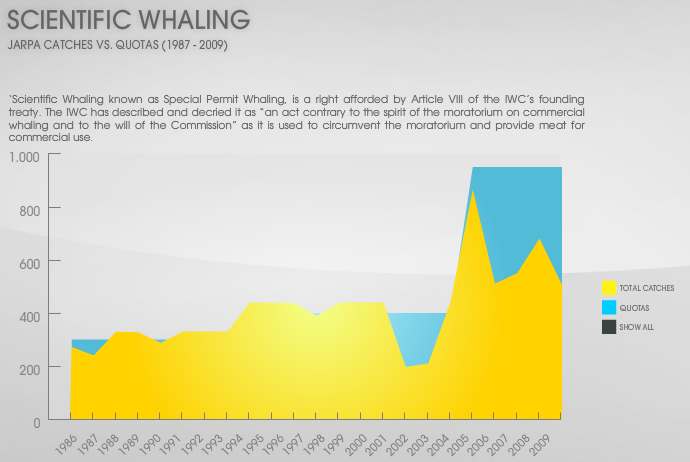
Sea Shepherd claims that their actions in the Southern Ocean opposing Japanese whaling fleets has effectively reduced the number of whales killed. What always rubbed me the wrong way about these claims is that they always compare their success against the Institute for Cetacean Research (the Japanese organization that oversees ‘scientific whaling’) Quotas. So at some point you have to ask the question, in absolute numbers, has Sea Shepherd really reduced the number of whales killed?

To answer that we need three pieces of information:

  1. When did Sea Shepherd begin it’s campaign against Japanese ‘scientific whaling’?
  2. What are the ICR quotas for that time frame?
  3. What are the absolute catches for that time frame?

Sea Shepherd provides a comprehensive timeline for their whaling campaigns that indicates serious opposition in the Southern Ocean began in December 2002.


For the two other questions, we turn to Whale and Dolphin Conservation International, who have produced a truly exceptional interactive graph of the history of whaling since the inception of the International Whaling Convention by the numbers. The relevant figure is reproduced below:

From this graph, we can see that Sea Shepherd began its campaign when whale catches were at their lowest, and catches have increased since then. Despite their claims of preventing whaling, we can see that more whales were killed per year after 2004 than any year before 2004. In other words, more whales are dying on Sea Shepherd’s watch.


Complete Post.

Nations fail to agree on curbing Japan whale hunt

AGADIR, Morocco — Japanese officials and environmentalists traded blame Wednesday as nations failed to reach a deal to curb whale hunts by Japan, Norway and Iceland—countries that kill hundreds of whales every year.


The 88 nations of the International Whaling Commission held two days of intense closed-door talks on a proposal to ease the 25-year-old ban on commercial whaling in exchange for smaller kills by the three countries that claim exemptions to the moratorium on hunting for profit.


About 1,500 animals are killed each year by Japan, Norway and Iceland. Japan, which kills the majority of whales, insists its hunt is for scientific research — but more whale meat and whale products end up in Japanese restaurants than in laboratories.


A key sticking point appeared to be that the agency declared a whaling sanctuary in 1994 in the Southern Ocean south of Australia, but Japanese ships hunt freely there because the agency has no enforcement powers.


Australia has already launched a complaint against Japanese whaling at the International Court of Justice in The Hague, the U.N.'s highest court.

Acting IWC chairman Anthony Liverpool said in an open meeting Wednesday that "fundamental positions remained very much apart."


Complete Story.

Monday, June 21, 2010

Shark revenge? If you scream like a Girl/Monkey it is.

Currently making the rounds. The fisherman get's points for trying to recover his gear from the sharks mouth. Loses same points for screaming like a girl/monkey when he is bitten.

Coffee Warning: Do not watch this video with any hot liquids in your hand.


Saturday, June 19, 2010

Shark Diver


South African White Shark Permits - Industry News

A row is brewing in the lucrative shark-cage diving industry after several established businesses in the Western Cape were unsuccessful in renewing their operating permits.

The Department of Environmental Affairs allocated 14 shark-cage diving permits on June 4. Eight are for Gansbaai, three for False Bay, two are for Quoin Point near Agulhas, and one is for Mossel Bay. A total of 26 applications were received, of which 14 were from new entrants.

All decisions are subject to the outcome of an appeals process, and the department said no permits would be issued until this process had been completed.

Speaking on condition of anonymity, several operators said the allocations would mean job losses, financial ruin and instability in the industry.

"This is a high-risk tourism industry, which attracts mostly foreigners. We cannot have inexperienced people who do not have sufficient resources when there are lives at stake," one operator said.

The operators added that the government's priority seemed to be race and gender, rather than credibility and safety.

Departmental spokesman Zolile Nqayi said eight of the existing permit holders had been "provisionally" successful, while six new operators had been granted permits provisionally.

"Applicants were scored across a variety of categories, including transformation, their operational plan and readiness to start operations."

Certain existing operators had been excluded on the basis of not using their permits enough, not having submitted the required documentation, or inadequate information.

Complete Story.

Friday, June 18, 2010

Shark Diver in the Wall Street Journal

This week Shark Diver enjoyed some great coverage in the WSJ. Thanks Sue S for the article, hopefully we'll see you this fall at Isla Guadalupe!

Guys Just Want to Have Fun

Ask Marc Van Driessche about a recent vacation, and he will describe an adrenaline-charged shark-diving expedition off the Mexico coast with two menfriends. While he enjoyed his up-close encounter with Bruce, a great white shark the size of a bus, the family stayed home.Sue Shellenbarger discusses the rise of the "mancation," trips for men that go beyond traditional golf or fishing outings. What's in? Extreme sports, such as shark diving and machine-gun shooting.


As much as he loves his wife and two young sons, Dr. Van Driessche, a Mukilteo, Wash., chiropractor, says some vacations are better taken with other guys.


Pop culture has a term for it: the mancation. More men are getting away from family, work and household duties for trips with male friends who will watch your back, push you if you lose your nerve, and take care of themselves if they get seasick, Dr. Van Driessche says. They are departing from traditional male golf outings or fishing trips to engage in extreme sports, from off-road racing to machine-gun training. Also, more men are heading to destinations long regarded as more alluring to women—many with added "man caves" and other mancation-style amenities, such as poker tables and cigar bars.


The trend shouldn't be confused with the bachelor-party stereotype of drunken bar crawls or partying at casinos, says James Hills, founder of mantripping.com, a two-year-old Web site that helps men plan their trips. Nor are they "singles trips" aimed at finding partners, he says.


Instead, more men are using trips to deepen friendships, teach each other skills or push each other into adrenaline-charged activities that their families prefer to sit out. Others want to recapture the camaraderie of high school or college sports, or escape what they regard as an increasingly female-dominated world. A shift toward rising individualism in marriage is fueling the trend, by making separate getaways more acceptable to spouses.


Complete Story.

Thursday, June 10, 2010

Concerns keep many away from shark-kill tournament

Guy Harvey Ultimate Shark Challenge resonating through the entire sport fishing industry.

By Terry Tomalin

Twenty years ago, Florida had a dozen or more fishing tournaments that targeted sharks.


But as shark populations declined worldwide, so did the number of tournaments that resulted in shark deaths. On the eastern shore of Tampa Bay, the 5-year-old Blacktip Shark Shootout has enjoyed success but not without controversy.


"We are not a straight slaughter shark tournament," said Phil Pegley, who helped organize the Apollo Beach-based event scheduled for this weekend. "We try to limit the number of sharks killed and only weigh in the ones that count."


Unlike many species of sharks, blacktips are not considered overfished.


"As a species, blacktips are actually in pretty good shape," said Mote Marine Laboratory's Bob Hueter, one of the nation's leading shark experts. "But it is not the number of sharks these tournaments kill, it is the message that they send."


Many species of large coastal sharks, including the hammerhead and tiger, are in trouble, Hueter said. Years of overfishing and a poor public image thanks to the movie Jaws have put sharks on many anglers' hit lists.


"Kill tournaments are definitely not the way to go," he said.


Complete Story.

Wednesday, June 9, 2010

Goblin girl... on a Goblin boy update!

You might remember my new friend, Goblin boy?

Well, after soaking in alcohol at the Natural Museum here in Gothenburg for a few months, in a borrowed jar, he is now with me in my sharky office.

Strangely enough some of my colleagues both think I'm crazy and that he is ugly (!). I don't know what they are talking about.

Doesn't everyone have dead sharks in their offices?!

Sunday, June 6, 2010

Gulf Oil Slick Mystery - Where's The Oil?

It hard not to get frustrated at BP's handling of the Gulf oil disaster, when even basic questions like "where is the oil going?," cannot be answered.

But wait, there could be an answer if only someone would think out of the box - behold this nifty gizmo here.

It's a satellite tag used to track wildlife, like sharks, turtles, tuna. Every time the antenna breaks the surface waiting satellites download position data. It also floats 24/7 when not attached to a critter.

What if BP bought 10,000 of these and dropped them into the major parts of the slick?

Well then you would have a real-time understanding of where the oil was spreading and where it was going, instead of headlines like these that just make you want to break something in frustration.

If we can track a single Bluefin tuna clear across the Atlantic ocean, surely we can real-time a major oil disaster?

Hong Kong's Sharkfin and Marine Products Association

Hong Kong's Sharkfin and Marine Products Association says there are no whale shark fins on display in Hong Kong (Rhincodon typus).

But Brad Norman says otherwise using images from a recent expedition to capture the imagination and the bandwidth of the media.

Herald Sun

The fins of the gentle giants, the same species that delights snorkellers off Western Australia's Ningaloo Reef every autumn, are sold for $300 each and used as window displays in shark fin shops in Hong Kong's Sheung Wan market district.


The Sunday Herald Sun last week joined an expedition to the Chinese territory to expose the trade in the world's biggest fish, which is listed as vulnerable to extinction by the World Conservation Union.


Full story here.

Friday, June 4, 2010

Expedition Great White National Geographic Premier

A hundred sixty miles off the coast of Baja California, a team of
world-class anglers, led by Costa pro Chris Fischer, will land one of the
most challenging fish imaginable: the great white shark. Unlike any other
catch ever attempted, they'll lift an SUV-sized shark onto a platform,
mount a long-lasting tracking tag by hand, take measurements and DNA
samples, and release it unharmed... all within minutes. Marine biologist
Dr. Michael Domeier uses advanced tracking devices to help uncover how
this predator lives, with the ultimate goal of conserving and protecting
this endangered species.


Expedition Great White premieres on the National Geographic Channel on
Sunday, June 6, with new episodes showing each week through July. Check
your local listings, and visit National Geographic Channel online for more
behind-the-scenes of this epic adventure.

Guy Harvey Ultimate Shark Challenge - Impacts

Effective conservation change is often a battle of ideas. Changes to set-in-stone ways of doing business takes leadership.

One of the intended consequences of leadership is the transfer of new conservation ideas far and wide.

The Guy Harvey Ultimate Shark Challenge is over in Florida but the media effects now resonating on the East coast, home to the shark kill tournament model, is just beginning.

Here's to new beginnings.

(June 3, 2010) By Russell Drumm - Shark tournaments are an anachronism, critics say, at least the kind of kill contests inspired by the movie “Jaws” and by the exploits of Capt. Frank Mundus, Montauk’s own Monster Man, a fact he acknowledged with regret in retirement and worked hard to change.


Now, two self-proclaimed “shark huggers” from the East End have set out to inspire contest organizers here to abandon their old ways and adopt a “greener” catch-and-release approach to shark tournaments that seems to have gained a foothold in Florida.


Citing the differences between Southern and Northern fishing tournaments, local fishermen said this week that they had no problem with the catch-and-release concept, but questioned whether it was practical or economically feasible.


April Gornik and Rav Friedel, longtime environmental advocates from North Haven and Montauk, respectively, have joined with the Humane Society of the United States to introduce a model pioneered by Sean and Brooks Paxton, entertainers and conservationists known who call themselves “the shark brothers.”


The Paxtons are pushing a concept that involves a very fast chase boat, or boats, responding to the radio alert of “Shark on!” during a tournament. The boats speed to the location of a hook-up to videotape the action, including the successful tagging and release of the shark.


Sean Paxton was quoted as saying that the chase-boat-video approach was an effort to keep fishermen and spectators engaged by “taking the spectacle of dead sharks out of the sport and replacing it with a live video.”


On Tuesday, Ms. Gornik said the Paxtons helped host the Guy Harvey Ultimate Shark Challenge held off the west coast of Florida in April and May. She said they were working to replace the “strung-up shark money shot” with action videos.


The brothers have been working on a film about the late Frank Mundus, and following the success of the Florida tourney, they planned to visit Captain Mundus’s home port to share their ideas with the Star Island Yacht Club, the host of Montauk’s largest shark tournaments.


On Monday, Ms. Gornik echoed John Grandy, senior vice president of the Humane Society, who said in a telephone interview last week that the society’s more confrontational approach — banner-towing airplanes flying the society’s message over Montauk Harbor — was not getting the message across.


The Humane Society and Wendy Benchley, the widow of Peter Benchley, the author of “Jaws,” endorsed the Guy Harvey green tournament. Dr. Harvey is a trustee of the International Game Fish Association and founder of the Guy Harvey Ocean Foundation, a conservation group that promotes catch-and-release fishing.


Ms. Gornik said it was too late to change tournament plans for this year, but that she and Mr. Friedel had donated thousands of Mustad brand circle hooks to the Montauk Marine Basin for its 40th annual shark tournament scheduled for June 25 and June 26.


The snell, or shank, of a circle hook is curved as the name implies, and therefore less likely to snag in the gut or throat of fish. Circle hooks are more likely to be set in the jaw, causing less damage to the animal to be released back into the wild.


“Our main aim is to reduce mortality, not to keep people from having fun or making money,” Ms. Gornik said. She added that the traditional shark tournament scene was a jarring contrast to efforts to reverse the dramatic decline in shark populations around the world. Hawaii recently became the first state to outlaw the sale of shark fins, most of which are sold in Asia for shark-fin soup.


“Can America please not stand for that? We’re over the ‘Jaws’ thing,” Ms. Gornik said.


“Without taking on fishing per se, this approach supports the notion that sharks are in trouble,” the Humane Society’s Mr. Grandy added.


Carl Darenberg Jr. said the tournaments held from the Montauk Marine Basin had been billed as “tag-and-release” for years. “It’s always based on that. There are more releases than catches, and the weights are high,” he said, meaning that the minimum size for the various species has been kept relatively high to prevent the taking of juvenile fish.


“I think down the road we will go to more of the release type of tournament. The trouble is finding room for observers.”


He was referring to the fact that Southern tournaments run entirely on a catch-and-release basis use trained observers to ride on every boat to certify that landings are done by the book. All observers are trained and certified by the International Game Fish Association. Mr. Darenberg said finding rooms for 100 or more observers in Montauk during the summer would be a challenge.


“I think circle hooks are a good idea. We should all be using them,” he said.


“It’s an economic thing,” said Jack Passie, former president of the Montauk Boatmen and Captains Association. “The Star Island tournament attracts a huge crowd in the middle of June when not many people are around. The bar and store business is phenomenal.”


“The people are attracted to the sharks that come in. In my own opinion, the few sharks that are brought in don’t make a big difference in the overall picture.”


“The thing that bothers me is the yahoo from the city who thinks he’s going to come out and win $500,000, catches the biggest fish he’s ever caught, brings it in, and it’s a 125-pound blue shark” that should not have been killed, Captain Passie said.


“It’s a different mentality around here,” said Michael Potts, captain of the Blue Fin IV charter boat in Montauk. Captain Potts has been taking anglers offshore to compete in shark tournaments for years. He agreed that observer participation in the catch-and-release scenario would be difficult for “six-pack” boats licensed to carry a maximum of six anglers.


“What if I have a six-person charter? Where would the observer go?”


“It’s a mindset more than anything,” Captain Potts said. “I’m not saying it won’t work, but things take time to catch on.” He said green tournaments would reduce the interest in a lot of charter boat customers because they would not have anything to take home.


“You catch a top-of-the-line mako, and you can’t take it home,” Captain Potts said. Such tournaments, he said, “are not going to be charter boat-driven. The economy is tough, and to get a lot of people to put up money with zero chance to take home fish to eat narrows the field.”


On the other hand, the veteran charter captain said he had participated in catch-and-release tournaments. “The people enjoyed it, participants enjoyed it, and we did, too. It was enjoyable not to have to attempt to kill anything, no gaffs, harpoons, guns, just pliers. I would do it,” Captain Potts said.


The Star Island Yacht Club hosts the largest shark tournaments in Montauk. The first is scheduled for June 18 and June 19. Rich Janis, the tournament organizer, said yesterday that changing the tournament format, although perhaps inevitable — “obviously it’s headed in that direction” — was a complex issue.


He said the demographic of the participants was different than at the Southern tournaments, meaning that contests lasting more than two days are precluded here.


“They come from all walks of life,” he said of those participating in the Montauk tournaments. “There’s the retired guy with a lot of money, but also the 8-to-5 blue-collar guy who either can’t get an extra day off work or who arranges his vacation around it.”


Mr. Janis said the video boat idea would be a challenge in the Star Island contest with 200 boats fishing over hundreds of square miles of ocean. But mostly, he said, the hoisting of dead sharks, although the tournaments’ draw, gave a false impression.


“Two hundred boats fish two days. That’s 400 boats fishing to bring in maybe 20 or 25 sharks. The makos and threshers are consumed,” he said, and the blue sharks, not high on the menu in most households, are nonetheless donated — cut, packaged, and frozen — to Long Island food pantries. “These groups lose sight of that,” he said.


Mr. Janis said Star Island had accepted Mr. Friedel’s donation of 5,000 circle hooks and that they would be made available to tournament participants.