Kudos to Grind TV for the story and to Chuck Patterson for a once in a lifetime moment with whites that showed the world how interacting with these wonderful critters can be done without the hype:
Me my Shark and I from Chuck Patterson on Vimeo.

The shark diving industry blog covering sharks, shark cage diving, shark conservation and things we find "amusing" since 2008 www.sharkdiver.com, www.sharkdivers.com, www.divingwithsharks.com
Me my Shark and I from Chuck Patterson on Vimeo.
 Outdoor reporter Peter Thomas surprised us this week with his latest expose on sharks.White sharks and growing population numbers off the California coast.
It might come as unwelcome news to swimmers and surfers, but great white sharks appear to be mounting a comeback off California.
"I think there are more sharks," Christopher Lowe, a professor at Cal State Long Beach and director of the university's Shark Lab, said during an exclusive phone interview. "And that's not a bad thing; it's a good thing."
It's the first declaration by a prominent shark researcher that a recovery of the embattled great white shark -- the world's most notorious predator -- seems to be occurring. The City of Cape Town, in conjunction with the Shark Spotters Programme, has designed three new signs to improve shark safety on Cape Town’s beaches. These signs seek to increase awareness about the presence of sharks (Great White sharks in particular), and to guide beach users on the workings of Shark Spotting Programme.
“Significant improvements have been made to the shark warning system used by the shark spotters, and the City urges the public to familiarise themselves with this system,” said the City’s Mayoral Committee Member for Community Services, Councillor Brett Herron.
The new signage can be found on beaches monitored by shark spotters, where the flag warning system is utilised, namely: Noordhoek Corner (the ‘Hoek’), Glencairn, Fish Hoek, Clovelly, St. James, Kalk Bay and Muizenberg. The signage is designed to be highly visible and has been strategically placed to ensure that it is accessible to all beach users.
The following changes have been made to the shark warning system:
All flags now have a shark printed on them. This is to ensure that beach user are able to differentiate between the shark spotting flags and other,
Signs indicating a ‘high risk’ have been placed on Jaggers Walk at Fish Hoek Beach – a site where the most recent shark attacks have occured. However, beach users are reminded to always be vigilant and exercise caution when they swim at any beach.
The modified shark spotting information sign explains the meaning of the colour-coded shark warning flags; shows information on shark spotter duty shifts; provides general visibility conditions; indicates the date of the last shark sighting and lists emergency services contact details.
A new ‘Shark Smart’ sign conveys general information on sharks in Cape Town waters as well as advice on using the ocean. These will be erected in the near future.
The Red Flag now indicates a general shark alert, and is raised when a shark has been observed in the area in the past two hours, when an increased presence of sharks has been observed, or when conditions conducive to increased shark activity exist e.g. high fish activity or whale strandings. This flag will be lowered only when the alert is no longer necessary and will be flown in conjunction with one of the other spotting flags.
The City appeals to the public to please locate and familiarise themselves with the new signs on the beach and the Shark Spotting Programme. Beach-based shark spotters are also available to answer any questions related to shark safety, and informational brochures can be obtained from them or the Save Our Seas Shark Centre in Kalk Bay. For recent shark activity and more information please visit www.sharkspotters.org.za
The public should continue to apply caution at the beach. Swimmers must immediately leave the water when warnings are sounded and not return to it until the shark spotters have given the all-clear.
In addition, the public are encouraged to:
1.Swim in groups
2.Ensure that they are visible to others when swimming
3.Ensure that they do not swim when there are marine mammals
4. Ensure that they do not swim if a marine mammal or carcass has washed up onto the beach
 We have been big fans for the past couple of years of The Scottish Shark Tagging Programme (SSTP).
 Once again "provoking thought" with David Shiffman over at Southern Fried Science this morning.
 News came in last week of a "sleeping white shark" found upside down on the surface off the coast of Chatham by local fishermen.
 people to participate in. There are single and multi-day passes and industry delegate passes, so you can build your schedule accordingly - watch some of the very best ocean films from international filmmakers, take in premiere photo exhibits and discussion panels on a wide range of ocean exploration and conservation subjects, or you can even get out in the field or get wet with some of the top experts in their field.
 Also, for all you beginning or emerging underwater video filmmakers, I will be conducting an Introductory Underwater Video Workshop that includes 2 dives in Monterey Bay's famous kelp beds along with a classroom workshop.
 Opportunities for Shark Research, Conservation and Outreach work with the South African Shark Conservancy in 2010 and 2011.
Volunteer Positions are available to work with the South African Shark Conservancy commencing November 2010 and throughout 2011.
SASC is a non-profit organisation dedicated to promoting the conservation and sustainable utilisation of marine resources through research, education and outreach. Since its inception in 2007, SASC has developed partnerships with academic and conservation organisations around the globe, and has become well-known in South Africa for its inclusive and holistic approach to conservation and management initiatives.
SASC offers interns the opportunity to become involved in a unique and exciting approach to marine conservation. Our research and outreach projects are specifically designed to promote a holistic approach to conservation, working with various fishing sectors, research institutes and governmental organisations. Join our internship programme and gain valuable insight into the conservation management of sharks and other living marine resources.
SASC is looking for volunteers with a biological background or interest in shark biology and conservation for a period of one to three months commencing from November 2010 and throughout 2011. If you interested in joining our team and would like more details and an application, please send an email to tamzyn@sharkconservancy.org.
Please refer to our website www.sharkconservancy.org or join our Facebook group for more details about our current projects and events.
Kind regards,
Meaghen McCord
Managing Director (SASC)
For this research expedition, Oceana has chartered the Oceana Latitude, a 170 foot vessel capable of sailing in both shallow and deep waters, and adapted to serve as a diving platform. The expedition, led by oceanographer Xavier Pastor, vice president for Oceana Europe, will set sail from
“The Deepwater disaster is a horrible experiment on the
Oceana’s scientists from both sides of the Atlantic will begin their work in the
“Most of the public’s attention has been on the visible oil on the surface of the Gulf and the beaches and marshes,” said Dr. Hirshfield. “Oceana wants the public to understand the impacts of the unseen, underwater oil that is damaging marine wildlife and habitats in the Gulf and will likely continue to do so for years to come.”
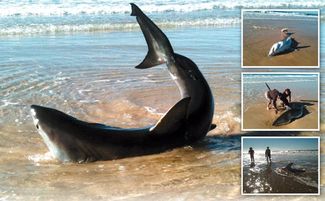 Sad news from Australia this week as a beached and eventually de-jawed white shark was documented:
Ruth grabbed her camera phone and captured something few Coffs Coast locals have ever witnessed.
“I was walking along Hungry Head Beach on Friday morning when I stumbled across the shark, well out of the water in the high tide zone,” Ms Fahey said.
Then the bizarre and nerve-jangling rescue attempt began as two men attempted to haul the ocean’s top predator back to safety.
“As it was threshing about, they tried first to dig the sand away beneath it to refloat it but ended up man-handling it back into the water. It was still very sluggish when they got to knee deep water so the surfer waded it out until he was waist deep.”
Complete story.
 For the most part the following shark conservation news went under reported by the conservation world this week.
Lawsuits vs Awareness Campaigns
 Scientists and South Australian cage-diving operators are collaborating in a world-first project to ensure the State’s eco-tourism activities take good care of Australia’s protected white sharks.
The research, led by Flinders University and SARDI shark ecologist, Dr Charlie Huveneers, will provide important information to help the State Government manage the growing industry which relies on the survival of the threatened species. Its outcomes will also help inform similar cage diving operations around the world in places such as New Zealand, South Africa and Mexico.
Dr Huveneers’ team and cage operators are working together over the next year to tag ten white sharks which inhabit the area around Australia’s main cage-diving operations off the remote Neptune Islands, 75 kilometres from Port Lincoln. Two 3.5 metre white sharks have been tagged to date.
“Berleying activities at the Neptune Islands have recently been increasing. However, the impacts of such activities are still poorly understood, and there is a need to investigate how berleying might affect white shark behaviour and movements” Dr Huveneers said.
“Previous studies in South Africa indicated that white sharks became ‘habituated’ to berleying rather than ‘conditioned’. As a result, sharks might become less attracted to berley,” he said.
“The white shark cage-diving industry at the Neptune Islands attracts a large amount of tourism to South Australia and Port Lincoln. It is important to ensure that this industry is sustainable and that it does not negatively impact on the white shark population frequenting the Neptune Islands.
“Sharks also play an important role in the ecosystem with the removal of top predators having shown to cause cascading effects down the food web.”
“Our research will hopefully provide crucial data which will help the Department for Environment and Heritage and PIRSA Fisheries to assess if the current level of berleying undertaken by the white shark cage-diving industry around the Neptune Islands is impacting on shark behaviour.”
Dr Huveneers says the team is using fine-scale positioning technology accurate to within one metre to track the sharks. Sharks are tagged with an acoustic tag as they swim past the boat allowing researchers to record their positions in relation to the cage-diving boats for a period of up to 45 days.
 Two news reports on sharks and the ongoing shark crises today that made front page news worldwide.
| Grant Butler with your best bets for Shark Week |
 A post over at Da Sharks blog about Eric Ritter caused me to think out loud about Sharkitarianism.
 The films called Dark Tide. It stars Halle Berry as a shark diver supposedly at Isla Guadalupe, but the entire shoot is happening in South Africa, or is it?
 Off the coast of Massachusetts it's white shark tagging season and apparently the "hunting" is good.
And with more and more great whites appearing off the Cape, these three men from different walks of life have the unique opportunity to unmask one the region’s most mystifying species.
“This has nothing to do with the public, nothing to do with seals; it really has to do with advancing science,’’ said Skomal, 48, a state biologist from Marion. “There’s nobody else along the East Coast of the United States who has the opportunity to do this.’’
Kudos to the entire shark team, complete story here.
 Thanks to the Guy Harvey Foundation and tagging work being done in Bermuda through the invitation of veterinarian Dr. Neil Burnie, who has independently running a tiger shark research effort, the once elusive world of Bahamas tiger sharks is opening up.
 RTSea has an interesting take on sharks this week. Drug resistant bacteria?
 Chris Palmer and Peter Kimball just hit a home run over at Huff Post today talking Shark Week and the ongoing debate about wildlife television.
Dr Andrea Marshall, also known as Queen of the Mantas from the BBC’s 2009 documentary film, has attached a satellite tag to a giant 4meter manta ray off the coast of South America. This ambassador for Brazilian manta ray conservation is the first manta ray in the Southern Atlantic Ocean to be satellite tagged and another first for Andrea, who originally discovered and tagged this second species of manta ray, Manta birostris, in 2009 in Mozambique.
The tagging is a fundamental part of a comparative worldwide research campaign called ‘Ray of Hope’ funded by the Save Our Seas Foundation (SOSF) and conducted by the Marine Megafauna Foundation (MMF), which is investigating the behaviour and movement patterns of the newly-described giant manta ray. Andrea and colleagues Dr. Simon Pierce and Dr. Juerg Brunnschweiler are travelling to several locations across the globe, teaming up with local researchers or dive operators along the way to locate these mysterious and severely understudied mantas. In Brazil Andrea is collaborating with the Laje Viva Institute and researchers from their ‘Mantas of Brazil’ project.
“This achievement is a piece of manta research history but more than that it is the start of my collaborative work in South America on this species which is currently the only research being conducted on manta rays in the southern Atlantic Ocean. It is a really important step in trying to understand how this species uses the coastline of Brazil, if it travels distances offshore, where their seasonal movements take them and what threats they face on their journeys,” said Andrea.
The tag was deployed last week on a large mature male at Laje de Santos, the largest documented aggregation site for the Manta birostris species in the Southern Atlantic Ocean, and is programmed to stay on the manta ray for 180 days. For the next six months the tag will accompany the manta on its journey through the oceans, functioning like a mini-lab and storing data critical to the investigation. As well as recording the water temperature through which the manta swims and the depths the animal reaches, it also records the light levels and its GPS position every time it breaks the surface, information used in determining the individual’s actual track.
Almost nothing is known about the lives of manta rays in South America and Andrea hopes the study will help answer a series of questions aimed at providing invaluable information for managing the region’s manta ray population and better protecting them from fishing pressure and other human induced threats such as shipping traffic. “As we continue to learn more about these ocean giants, I also continue to learn and grow as a scientist. Patience is an important skill in field research as is the determination to see difficult projects through to completion. In the end, persistence will pay off, and although we sometimes feel that we are racing against time, we are ultimately at the mercy of the animals that we study and the elements of nature. Sometimes sitting back and waiting for them to come to us is the only solution,” said Andrea.
The research is funded through the Save Our Seas Foundation (SOSF).
 One of the hallmarks of this blog and the many blogs we link to is "provoking thought." The past 2000 posts at this blog have featured more than its share of ideas, concepts, and industry analysis.
 Da Shark over in Fiji has unearthed an interesting paper that suggests we can manage shark fisheries instead of banning them.
 Richard Theiss took time out this week to share his thoughts on filmmaking, sharks and the industry.

