Casa Caletas in Costa Rica advertises itself as Honeymoon Getaway Resort:
"An in imaginable different kind of place where exclusivity and its good taste join hand in hand with the magic of a paradise-like scenery, awaits for you at Casa Caletas. Located on the beautiful and unexplored Gulf of Nicoya in Guanacaste, only five minutes from Playa Caletas airport and 30 minutes away from Punta Islita Airport, make Casa Caletas the perfect location for your leisure on the beautiful beaches of Coyote, Caletas, Manzanillo and Ma Pais."
But don't tell the local wildlife in the adjectent Caletas-Arío Refuge where accusations of toxic spraying and a recently surfaced video highlights the need for NGO's in the region to remain ever vigilant against damage to the refuge.

The shark diving industry blog covering sharks, shark cage diving, shark conservation and things we find "amusing" since 2008 www.sharkdiver.com, www.sharkdivers.com, www.divingwithsharks.com
Friday, August 6, 2010


White Shark Diving Mexico T-Minus 10 Days
To celebrate close to a decade of on site operations at Isla Guadalupe we thought we would re run another of RTSea Productions on the great whites. This video is currently featured in Google Earth.
In 10 days time another Shark Diver expedition kicks off with 12 very excited divers.
They have no idea what they are in for.
For those interested we have exactly 9 spaces left for our 2010 season and are 20% sold out for 2011.
In 10 days time another Shark Diver expedition kicks off with 12 very excited divers.
They have no idea what they are in for.
For those interested we have exactly 9 spaces left for our 2010 season and are 20% sold out for 2011.
Shark Week 2010 - Yes I Actually Liked This
Shark Week - You know it is refreshing, after two years of ranting, to actually like a show on Shark Week and this is one of this years stand outs. Is it possible to do mainstream shark productions without the hype?
Yes, yes it is.
This is smart shark television, well done Discovery, well done Stuarts Cove, well done sharks.
By the way anyone who says that commercial shark diving is not good for sharks should watch this piece, this is pro shark, pro industry messaging of the highest order.
Yes, yes it is.
This is smart shark television, well done Discovery, well done Stuarts Cove, well done sharks.
By the way anyone who says that commercial shark diving is not good for sharks should watch this piece, this is pro shark, pro industry messaging of the highest order.
Opportunities for Shark Research, Conservation and Outreach work with the South African Shark Conservancy in 2010 and 2011
 Opportunities for Shark Research, Conservation and Outreach work with the South African Shark Conservancy in 2010 and 2011.
Volunteer Positions are available to work with the South African Shark Conservancy commencing November 2010 and throughout 2011.
SASC is a non-profit organisation dedicated to promoting the conservation and sustainable utilisation of marine resources through research, education and outreach. Since its inception in 2007, SASC has developed partnerships with academic and conservation organisations around the globe, and has become well-known in South Africa for its inclusive and holistic approach to conservation and management initiatives.
SASC offers interns the opportunity to become involved in a unique and exciting approach to marine conservation. Our research and outreach projects are specifically designed to promote a holistic approach to conservation, working with various fishing sectors, research institutes and governmental organisations. Join our internship programme and gain valuable insight into the conservation management of sharks and other living marine resources.
SASC is looking for volunteers with a biological background or interest in shark biology and conservation for a period of one to three months commencing from November 2010 and throughout 2011. If you interested in joining our team and would like more details and an application, please send an email to tamzyn@sharkconservancy.org.
Please refer to our website www.sharkconservancy.org or join our Facebook group for more details about our current projects and events.
Kind regards,
Meaghen McCord
Managing Director (SASC)
Oceana Announces Launch of Gulf of Mexico Research Expedition to Assess Long-Term Impacts of Deepwater Horizon Oil Spill
For this research expedition, Oceana has chartered the Oceana Latitude, a 170 foot vessel capable of sailing in both shallow and deep waters, and adapted to serve as a diving platform. The expedition, led by oceanographer Xavier Pastor, vice president for Oceana Europe, will set sail from
“The Deepwater disaster is a horrible experiment on the
Oceana’s scientists from both sides of the Atlantic will begin their work in the
“Most of the public’s attention has been on the visible oil on the surface of the Gulf and the beaches and marshes,” said Dr. Hirshfield. “Oceana wants the public to understand the impacts of the unseen, underwater oil that is damaging marine wildlife and habitats in the Gulf and will likely continue to do so for years to come.”
Thursday, August 5, 2010
"Blood in the Water" A look at ill informed shark media
Why Current TV decided in 2007 to run with the Blood in the Water expose is beyond anyone's guess, suffice to say they stepped into an long standing global industry issue with a somewhat biased look at the industry in Hawaii.
Unfortunately this entire video expose falls flat when you realize this is a classic media hit piece designed to instill fear of sharks and commercial shark diving. From the choice of music, fun upbeat surfer music, to dark and sinister shark music, to the actual quotes by locals it is evident that Hawaii has a long way to go when it comes to understanding the global commercial shark diving industry.
Can we have a honest and open debate about our industry minus the sand box level of shark fright, moronic factoids devoid of in depth analysis, and video clips that serve no real purpose but to instill fear?
Research Note: Research data from the Farallones and tagged white sharks in that region off the California coast have shown up at Hawaii's North Shore exactly where Hawaii Shark Encounters ran into a much larger female several years ago. Where uniformed locals come to believe operators attract animals like these, research exposes the real story of generations long Pacific migratory patterns that are just now being discovered.
Blood in the Water is another in a series of ill timed, ill informed and hysteric anti-shark diving media pushes that fail to deliver substantive facts, data, and information to a public that needs it.
Unfortunately this entire video expose falls flat when you realize this is a classic media hit piece designed to instill fear of sharks and commercial shark diving. From the choice of music, fun upbeat surfer music, to dark and sinister shark music, to the actual quotes by locals it is evident that Hawaii has a long way to go when it comes to understanding the global commercial shark diving industry.
Can we have a honest and open debate about our industry minus the sand box level of shark fright, moronic factoids devoid of in depth analysis, and video clips that serve no real purpose but to instill fear?
Research Note: Research data from the Farallones and tagged white sharks in that region off the California coast have shown up at Hawaii's North Shore exactly where Hawaii Shark Encounters ran into a much larger female several years ago. Where uniformed locals come to believe operators attract animals like these, research exposes the real story of generations long Pacific migratory patterns that are just now being discovered.
Blood in the Water is another in a series of ill timed, ill informed and hysteric anti-shark diving media pushes that fail to deliver substantive facts, data, and information to a public that needs it.
Howard Hall - Defining The Underwater Experience
Da Shark over at the BAD Blog found this gem, shot by Howard Hall and company (calls the guy his friend, lucky) these are the underwater moments that define the industry and reset the bar.
Kudos.
Sit back, take a long sip of coffee and enjoy:
Kudos.
Sit back, take a long sip of coffee and enjoy:
Wednesday, August 4, 2010
Great White shark washes up on beach - Australia
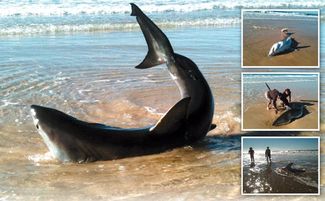 Sad news from Australia this week as a beached and eventually de-jawed white shark was documented:
THE sight of a shark washed up on a stretch of sand locals call Hungry presented more than a few challenges for professional photographer Ruth Fahey. And it wasn’t just any shark, it was a great white, no less!
Ruth grabbed her camera phone and captured something few Coffs Coast locals have ever witnessed.
“I was walking along Hungry Head Beach on Friday morning when I stumbled across the shark, well out of the water in the high tide zone,” Ms Fahey said.
Then the bizarre and nerve-jangling rescue attempt began as two men attempted to haul the ocean’s top predator back to safety.
“As it was threshing about, they tried first to dig the sand away beneath it to refloat it but ended up man-handling it back into the water. It was still very sluggish when they got to knee deep water so the surfer waded it out until he was waist deep.”
Complete story.
Shark Conservation - Message to Shark NGO's
 For the most part the following shark conservation news went under reported by the conservation world this week.
For us this was interesting if not revolutionary news:
RIO DE JANEIRO (AP) -- A Brazilian environmental group sued a fish exporter for $790 million Monday, alleging the firm has illegally sold the fins from 280,000 sharks since 2009 to meet demand in Asia where they are a culinary delicacy.
In Brazil, it is illegal to separate shark fins from the carcasses, and in May government agents reported finding 3.3 tons of shark fins during a single raid on the company sued by the Environmental Justice Institute.
Lawsuits vs Awareness Campaigns
That's not so surprising, as most have little to no funds to work with. We have been highlighting that problem for a while. There are however quite a few NGO's who have money, and their "awareness campaigns" ring hollow against an ongoing global shark crises.
The Environmental Justice Institute in Brazil has just fired the first shot and lead the way in what could well be a new paradigm for shark conservation. As the Environmental Justice Institute knows along with any group who's been in the shark conservation world for a while, the shark fin traffickers are not hiding. Their warehouses are not underground, their fishing fleets do not operate under cover of darkness, and for the most part they do not worry about the trade in fins.
This has to stop, and one way to make it stop is to hold the traffickers accountable for laws already on the books via lawsuits. So, the next time you see a top tier NGO asking for money for what amounts to an awareness campaign, think again.
Demand action in the form of lawsuits that target individual companies. As we have long said, the shark conservation world does not understand trade. Trade is business. Businesses can be seriously impacted when you look at the problem from the business and trade side of things.
Shark Mafia?
For too long, and thanks to some well placed and highly public media bubbles, the shark conservation world and the general public has come to believe that all shark fins, the entire trade is run by a global shark mafia. In conversations I had recently with an NGO talking about disrupting the trade I was hit with this question, "aren't you afraid they might come and do something to you?"
My response was "who are they exactly?" In my world "they" are folks like the following small company in Vietnam:
Ms Dieu Hanh
HX Export Center
405/2 Xo Viet Nghe Tinh str., Binh Thanh dist.,
Ho Chi Minhc city, Viet Nam
Tel: 848 5117992 - Fax: 848 5117829
Email: E-mail:hanhle_hxexpco@vnn.vn
You want to take down the shark fin trade, take down the trade by looking at trade from the business side.
The Environmental Justice Institute knows that shark fin companies can ill afford lawsuits and that successful prosecution of just one company will send a clear and unambiguous message to the rest.
Beats another repetitious awareness campaign any day of the week. By now even folks who get their news via rudimentary roof top carrier pigeons know there's a shark crises going on.
Kudos to The Environmental Justice Institute for the effort and the direct action lawsuit.
Note: There is one fine example of an awareness campaign that should continue to be funded and deserves note. WildAid's China campaign is about targeted awareness and over the past seven years has made serious and lasting inroads to curb shark fin use in China and Asia.
Tuesday, August 3, 2010
All we can say is...Wow!
We rarely get tired of those rare moments where dead whales and sharks mix.
Port Douglas Queensland Australia. Local Line Burner fishing magazine writer 'Sharky' Shane Down swam with a dozen Tiger sharks and Bull sharks which were feeding on a sperm whale carcass which drifted in from the Pacific Ocean and landed on one of our local outer reef systems on the Great Barrier Reef. 'Sharky' can be seen riding the sharks and gets within inches as they gorge themselves on the carcass. It is totally amazing footage and shows sharks feeding in their natural environment. You will see a compressed 2.5 minute version but there is more footage and even additional footage of Shane interacting with Tiger sharks which has never been seen. Contact us if you believe you can use the footage for Television/Production purposes at info@fishingportdouglas.com.au
Port Douglas Queensland Australia. Local Line Burner fishing magazine writer 'Sharky' Shane Down swam with a dozen Tiger sharks and Bull sharks which were feeding on a sperm whale carcass which drifted in from the Pacific Ocean and landed on one of our local outer reef systems on the Great Barrier Reef. 'Sharky' can be seen riding the sharks and gets within inches as they gorge themselves on the carcass. It is totally amazing footage and shows sharks feeding in their natural environment. You will see a compressed 2.5 minute version but there is more footage and even additional footage of Shane interacting with Tiger sharks which has never been seen. Contact us if you believe you can use the footage for Television/Production purposes at info@fishingportdouglas.com.au
Industry News - Commercial Shark Diving Study
 Scientists and South Australian cage-diving operators are collaborating in a world-first project to ensure the State’s eco-tourism activities take good care of Australia’s protected white sharks.
The research, led by Flinders University and SARDI shark ecologist, Dr Charlie Huveneers, will provide important information to help the State Government manage the growing industry which relies on the survival of the threatened species. Its outcomes will also help inform similar cage diving operations around the world in places such as New Zealand, South Africa and Mexico.
Dr Huveneers’ team and cage operators are working together over the next year to tag ten white sharks which inhabit the area around Australia’s main cage-diving operations off the remote Neptune Islands, 75 kilometres from Port Lincoln. Two 3.5 metre white sharks have been tagged to date.
“Berleying activities at the Neptune Islands have recently been increasing. However, the impacts of such activities are still poorly understood, and there is a need to investigate how berleying might affect white shark behaviour and movements” Dr Huveneers said.
“Previous studies in South Africa indicated that white sharks became ‘habituated’ to berleying rather than ‘conditioned’. As a result, sharks might become less attracted to berley,” he said.
“The white shark cage-diving industry at the Neptune Islands attracts a large amount of tourism to South Australia and Port Lincoln. It is important to ensure that this industry is sustainable and that it does not negatively impact on the white shark population frequenting the Neptune Islands.
“Sharks also play an important role in the ecosystem with the removal of top predators having shown to cause cascading effects down the food web.”
“Our research will hopefully provide crucial data which will help the Department for Environment and Heritage and PIRSA Fisheries to assess if the current level of berleying undertaken by the white shark cage-diving industry around the Neptune Islands is impacting on shark behaviour.”
Dr Huveneers says the team is using fine-scale positioning technology accurate to within one metre to track the sharks. Sharks are tagged with an acoustic tag as they swim past the boat allowing researchers to record their positions in relation to the cage-diving boats for a period of up to 45 days.
Serendipity - Two Shark Crises Media Reports
 Two news reports on sharks and the ongoing shark crises today that made front page news worldwide.
CNN covers Matt Rand from PEW explaining how the crises is unfolding:
"At one time, shark fin soup was considered a delicacy for the elite. But as Asia grows in population and wealth, the demand for shark fins has gone through the roof. According to the United Nations, shark fin imports to Hong Kong and Taiwan alone rose 214 percent from 1985 to 1998. This has had a disastrous impact on shark populations globally."
The Sydney Morning Hearld covers a company accused of illegally killing 280,000 sharks:
"A conservation watchdog accused a Brazilian company of illegally fishing 280,000 sharks which were killed to feed Asia's appetite for sharkfin.The Environmental Justice Institute, a Brazilian group, on Monday lodged a suit against seafood exporter Sigel do Brasil Comercio demanding $US800 million ($A883 million) in environmental damages."
Premature Weapons Discharge - Florida
When guns and sharks do not mix. Kudos to Dorsal Fin Blog for the video find and Oceanic Dreams for the re post.
First With Giant Squids? - Not So Fast Brady Barr
Brady Barr, show host extraordinaire, National Geographics resident Herpetologist, winner of the Wild Animal Show Host Hall of Fame Bite Moment (see video, no really see it).
You'll also remember Brady from last year with what looked to be a dead Tiger shark, and an image touted to be Brady swimming with the animal. Except the animal was tied by the tail hanging nose down in the water and Brady's bubbles were heading towards the surface.
These days Brady and National Geographic are claiming to be the first ever team to place a camera on a Giant Humboldt Squid in the Sea of Cortez, unfortunately this whopper of a claim like so many of Brady Barrs animal stunts is 100% false.
Brady Barr and his team are, simply put, liars.
The actual first ever camera on a squid moment goes to Scott Cassell who was also the first to work with these incredible animals several years ago, and who is the go to source for most of the squid productions in the region. He and his team were the first to develop cameras on squids and the first to document deep water squid behaviour in the region.
Just setting the record straight for anyone in production who cares to know. Now on to Brady and another magical moment with wild animals.
You'll also remember Brady from last year with what looked to be a dead Tiger shark, and an image touted to be Brady swimming with the animal. Except the animal was tied by the tail hanging nose down in the water and Brady's bubbles were heading towards the surface.
These days Brady and National Geographic are claiming to be the first ever team to place a camera on a Giant Humboldt Squid in the Sea of Cortez, unfortunately this whopper of a claim like so many of Brady Barrs animal stunts is 100% false.
Brady Barr and his team are, simply put, liars.
The actual first ever camera on a squid moment goes to Scott Cassell who was also the first to work with these incredible animals several years ago, and who is the go to source for most of the squid productions in the region. He and his team were the first to develop cameras on squids and the first to document deep water squid behaviour in the region.
Just setting the record straight for anyone in production who cares to know. Now on to Brady and another magical moment with wild animals.
Monday, August 2, 2010
White Shark Tagging Video Chatham
Chatham - While the shark sightings keep rolling in, it's not clear exactly how many great white sharks are out there, officials have said, because sharks could be sighted more than once. Williams said the Division of Marine Fisheries doesn't count the number of sightings because "that's just not valuable data."
Complete story.
Complete story.
Discovery Channel - New Management New Direction?
Discovery Networks released the first in a series of internal video conference calls with their new Director of Programming, Matt Mann.
Apparently Mr.Mann is no fan of Shark Week for reasons that boggle even our very lively imaginations here at Underwater Thrills, and we thought this was about making sharks look bad.
Kudos to George P for the video find.
WARNING: Foul language, coarse syntax, and a few slams on MythBusters in this video.
Apparently Mr.Mann is no fan of Shark Week for reasons that boggle even our very lively imaginations here at Underwater Thrills, and we thought this was about making sharks look bad.
Kudos to George P for the video find.
WARNING: Foul language, coarse syntax, and a few slams on MythBusters in this video.
Shark Week Media Machine - What a Few Pieces of Flair Will Get You
Shark Bite Beach 2010
Ironic Spoiler Alert - how the media overreacts to shark attacks, brought to you by Shark Week 2010 and a show called Shark Bite Beach.
How does Shark Week get this kind of positive media promotion? With a 5 dollar T-shirt and a holographic poster apparently. Sigh.
Now the question we're all asking, who shot this?
Ironic Spoiler Alert - how the media overreacts to shark attacks, brought to you by Shark Week 2010 and a show called Shark Bite Beach.
How does Shark Week get this kind of positive media promotion? With a 5 dollar T-shirt and a holographic poster apparently. Sigh.
Now the question we're all asking, who shot this?
| Grant Butler with your best bets for Shark Week |
The Problem With "Shark Identities"
 A post over at Da Sharks blog about Eric Ritter caused me to think out loud about Sharkitarianism.
Distilled down to its simplest form Eric Ritter's entire raison d'être is sharks. Not necessarily such a bad thing as many fine folks identify with sharks and use that passion to ultimately do fantastic things for the species in one form or another.
What Ritter and far too many others, as far as I am concerned, suffer from is what Da Shark has aptly coined Sharkitarianism, a complete shark identity.
Without it, these people who are in every facet of our industry, would be just "regular folks" with job descriptions ranging from welders, to bank clerks.
With Sharkitarianism people interact with sharks to heighten an identity, or to become someone new, more exciting, more interesting.
These people use sharks, they do not interact with sharks. Sharks are a conduit for media attention, industry attention, and attention at dive shows. Sharks are the unwilling silent partner to grander ego ambitions, a dangerous stage set by which those who suffer from Sharkitarianism perform stunts with sharks calling these stunts shark awareness, or worse shark conservation and research.
Sharkitarianism is a bane to our industry.
To be a self styled sharkman or professional shark diver (unless you're Christin Zenato who is a complete professional) is the highest point of conceit in a relationship with these animals that should always have a moment where the dive gear is rinsed, put away, and you go back to your life, not take that life back into the terrestrial world seeking gratification for deeds done, days, weeks, months and even years ago.
This deep identity attachment to sharks clouds judgement, shuts down rational thought, and causes the individual to pursue sharks in ever more creative means to fill and build their ego, maintaining the identity.
Sharkitarianism.
As an industry member take a step back today consider your shark identity, are you Sharkitarian?
Sunday, August 1, 2010
Halle Berry at Isla Guadalupe? Well, Actually South Africa
 The films called Dark Tide. It stars Halle Berry as a shark diver supposedly at Isla Guadalupe, but the entire shoot is happening in South Africa, or is it?
The film’s synopsis:
Sara (Halle Berry) is a modern-day adventurer, deeply drawn to close encounters with the magnificent White Sharks who rule the primal predator shore of isolated Guadalupe island. When her husband chooses ambition over his wife's safety in a split second encounter with the jaws of death, her marriage nearly breaks apart.
A year later, a monsoon season voyage back to the same island becomes an escalating series of terrifying underwater confrontations and gut-wrenching emotional challenges. Testing her courage in the face of nature's ultimate terror, she shows herself as tough as the men she is attracted to; and perhaps bravest of all Sara endures and changes the terms of the contest with mankind's most feared underwater predator.
Controversy and Industry Leadership
Alison Kock, a Save Our Seas Foundation shark conservationist near Simon's
Town, where the scenes were shot, told the Daily Mail: "After reading the
script we decided it was not something we would like to put our names to.
"Our mandate is to try to change people's perceptions of sharks. The first
script that we got sounded very much like it had a thriller aspect to it and
a personal kind of aspect to it as well.
"But fighting off a shark, or surviving a shark attack - we couldn't see the
positive side of that, as much as we tried."
More production images here.
Sea Shepherd Giving Up C4H8O2 - Left With Taunts?
Yes, it has been a while since we poked at the increasingly irrelevant and bloated Sea Shepherd Conservation Society. Mainly due to the fact that poking at a dead conservation corpse is about as much fun as...well poking at a corpse.
One story that did get our attention this week was SSCS sudden reversal from the use of C4H8O2.
As a mainstay in the SSCS arsenal of moronic direct action tools, Paul Watson and company have touted the use of Butyric acid as it's direct action darling. Where Greenpeace were afraid to go SSCS would step boldly - Direct Action!
So why the sudden and very public reversal/spin on the use of C4H8O2?
This is a question best left for those that follow this org religiously (we happen to love this guy) and one we'll leave to the SSCS experts to debate long after this non profit (?) has disbanded.
Fun Times Instructional Video
With SSCS now out of anything media worthy to hurl at Japanese whalers, we would like to offer the following instructional video on how to taunt your conservation opponent. Sadly whales will be killed once again during the 2011 Antarctic research hunt, and once again Sea Shepherd's reality television show will be there to...well, we're not sure what they will be there to do, but the following video might help the Shepherds in their ongoing Whale War - now in season number four with the highest ratings to date!
One story that did get our attention this week was SSCS sudden reversal from the use of C4H8O2.
As a mainstay in the SSCS arsenal of moronic direct action tools, Paul Watson and company have touted the use of Butyric acid as it's direct action darling. Where Greenpeace were afraid to go SSCS would step boldly - Direct Action!
So why the sudden and very public reversal/spin on the use of C4H8O2?
This is a question best left for those that follow this org religiously (we happen to love this guy) and one we'll leave to the SSCS experts to debate long after this non profit (?) has disbanded.
Fun Times Instructional Video
With SSCS now out of anything media worthy to hurl at Japanese whalers, we would like to offer the following instructional video on how to taunt your conservation opponent. Sadly whales will be killed once again during the 2011 Antarctic research hunt, and once again Sea Shepherd's reality television show will be there to...well, we're not sure what they will be there to do, but the following video might help the Shepherds in their ongoing Whale War - now in season number four with the highest ratings to date!
Shark Image of the Week
 Off the coast of Massachusetts it's white shark tagging season and apparently the "hunting" is good.
“It’s a team effort. We’re all equally important — not one guy better than the other,’’ said Chaprales, 58, of Marstons Mills, who was a commercial fisherman for 40 years off Cape Cod and claims a perfect record tagging fish with his harpoon. “Greg’s the biologist, my son drives the boat, I do the tagging, and George does the flying.’’
And with more and more great whites appearing off the Cape, these three men from different walks of life have the unique opportunity to unmask one the region’s most mystifying species.
“This has nothing to do with the public, nothing to do with seals; it really has to do with advancing science,’’ said Skomal, 48, a state biologist from Marion. “There’s nobody else along the East Coast of the United States who has the opportunity to do this.’’
Kudos to the entire shark team, complete story here.
Understanding Tigers like Guy Harvey Does
 Thanks to the Guy Harvey Foundation and tagging work being done in Bermuda through the invitation of veterinarian Dr. Neil Burnie, who has independently running a tiger shark research effort, the once elusive world of Bahamas tiger sharks is opening up.
Or are they Bermudas tigers?
Recent tagging data is showing a migration pattern that is interesting to say the least.
For the past decade the question of where these animals vanished to periodically was on commercial shark diving operators minds in the region.
Last year Guy Harvey's Dr. Mahmood Shivji, and company decided to find out. They reported back with an in depth discussion on conservation, marine protected areas, and current tagging with Dr. Neil.
Last month a tiger was sport caught in Bermuda setting off a storm of controversy, tigers are also sport caught with relative impunity in Bahamian waters as well.
With this latest data interesting questions about protection for these animals comes up. As commercial shark diving operators ourselves we have long advocated and enabled in depth shark research at the primary dive sites we operate in. Understanding the animals we work with is the key to working with the resource beyond just the commercial which leads to greater protections backed by in depth site data.
Local efforts to shepherd and steward sharks is the hallmark of commercial shark diving in many places worldwide. Kudos to the work being done by Dr.Neil, Guy Harvey, Dr. Mahmood, and others who are in a race to uncover the once secretive world of tigers.
Only good things can come of this latest discovery.
Wednesday, July 28, 2010
"I ain't never seen so many gators in my life."
Guy Harvey gets some unintended brand recognition in this remarkable video from Georgia this week.
Sharks Bite Back Without Biting: study finds deadly bacteria
 RTSea has an interesting take on sharks this week. Drug resistant bacteria?
Could be another reason not to eat these critters.
"Drugs given to humans could simply be excreted and eventually find their way into the ocean. Or bacteria in humans could acquire the resistance, be excreted, and then colonize fish that sharks eat, or the sharks, themselves. Some antibiotics are routinely dumped into aquaculture to help prevent infections -- that could be a source for some of the resistance."
Complete post.
Shark Week -- Education or Just Entertainment?
 Chris Palmer and Peter Kimball just hit a home run over at Huff Post today talking Shark Week and the ongoing debate about wildlife television.
Many years ago I wrote an Op Ed for a local San Diego paper titled "When Filmmakers Attack."
The article, written five years ago, was way ahead of its time looking into the the ongoing production slide at Isla Guadalupe, Mexico.
In the ensuing 5 years since then at Guadalupe many productions have sought lowest common denominator anti-shark programming with no end in sight. Note to the underwater cameraman who shot this garbage, and you call yourself pro-shark? Waddaya, new?
Chris Palmer knows of what he speaks as the author of the book "Shooting in the Wild: An Insider's Account of Making Movies in the Animal Kingdom" he has the insiders eye to wild animal productions.
With the obvious value of these productions to behemoths like Discovery Networks there's little chance we'll see substantial changes anytime soon, but its nice to have voices like Chris Palmer adding weight and mainstream media to the discussion.
Kudos.
Tuesday, July 27, 2010
A Ray of Hope for Manta Rays in Brazil
Dr Andrea Marshall, also known as Queen of the Mantas from the BBC’s 2009 documentary film, has attached a satellite tag to a giant 4meter manta ray off the coast of South America. This ambassador for Brazilian manta ray conservation is the first manta ray in the Southern Atlantic Ocean to be satellite tagged and another first for Andrea, who originally discovered and tagged this second species of manta ray, Manta birostris, in 2009 in Mozambique.
The tagging is a fundamental part of a comparative worldwide research campaign called ‘Ray of Hope’ funded by the Save Our Seas Foundation (SOSF) and conducted by the Marine Megafauna Foundation (MMF), which is investigating the behaviour and movement patterns of the newly-described giant manta ray. Andrea and colleagues Dr. Simon Pierce and Dr. Juerg Brunnschweiler are travelling to several locations across the globe, teaming up with local researchers or dive operators along the way to locate these mysterious and severely understudied mantas. In Brazil Andrea is collaborating with the Laje Viva Institute and researchers from their ‘Mantas of Brazil’ project.
“This achievement is a piece of manta research history but more than that it is the start of my collaborative work in South America on this species which is currently the only research being conducted on manta rays in the southern Atlantic Ocean. It is a really important step in trying to understand how this species uses the coastline of Brazil, if it travels distances offshore, where their seasonal movements take them and what threats they face on their journeys,” said Andrea.
The tag was deployed last week on a large mature male at Laje de Santos, the largest documented aggregation site for the Manta birostris species in the Southern Atlantic Ocean, and is programmed to stay on the manta ray for 180 days. For the next six months the tag will accompany the manta on its journey through the oceans, functioning like a mini-lab and storing data critical to the investigation. As well as recording the water temperature through which the manta swims and the depths the animal reaches, it also records the light levels and its GPS position every time it breaks the surface, information used in determining the individual’s actual track.
Almost nothing is known about the lives of manta rays in South America and Andrea hopes the study will help answer a series of questions aimed at providing invaluable information for managing the region’s manta ray population and better protecting them from fishing pressure and other human induced threats such as shipping traffic. “As we continue to learn more about these ocean giants, I also continue to learn and grow as a scientist. Patience is an important skill in field research as is the determination to see difficult projects through to completion. In the end, persistence will pay off, and although we sometimes feel that we are racing against time, we are ultimately at the mercy of the animals that we study and the elements of nature. Sometimes sitting back and waiting for them to come to us is the only solution,” said Andrea.
The research is funded through the Save Our Seas Foundation (SOSF).
Dolphin-safe tuna: conservation success story or ecological disaster?
 One of the hallmarks of this blog and the many blogs we link to is "provoking thought." The past 2000 posts at this blog have featured more than its share of ideas, concepts, and industry analysis.
To many this blog is unique, compelling, and daily feed. To others who prefer blogs that are simple "look-at-me-and-what-I-did-this-week" formats, what we do and say here is cause for much industry grumbling.
Grumble away.
This week a post by the ever interesting David Shiffman over at the Southern Fried Science Blog gets to the heart of conservation. What is conservation success?
He tackles one of conservations "sacred cows" Dolphin Safe Tuna. For those currently in the shark conservation world this look back at the success or failure of Dolphin Safe Tuna is a cautionary tale about conservation success and the reality of laws without overall enforcement.
For the Dolphin Safe folks Davids look into this world is perceived as a threat, for us there are no "sacred cows." We should, as conservationists, be able to look at, review and modify the efforts we put forth for better conservation.
Fine post, great reading. Provoking thought.
Monday, July 26, 2010
Captains Log - Slight Damage

Sunday, July 25, 2010
To Ban or not to Ban...That is the Question
 Da Shark over in Fiji has unearthed an interesting paper that suggests we can manage shark fisheries instead of banning them.
Heresy! to many within the shark conservation world whose "line in the sand" more often then not ends with bans on all manner of shark fishing from tournament to the commercial.
Here's what he had to say about it, a fine read and food for thought.
Saturday, July 24, 2010
RTSea Interview - Responsibility in Filmmaking
 Richard Theiss took time out this week to share his thoughts on filmmaking, sharks and the industry.
"In speaking engagements, I have often said that shark conservation is a tough sell. To be sure, there are dedicated shark advocates who understand both the important role that sharks play in a healthy marine ecosystem and the many threats these animals now face – but that represents a small number compared to the general viewing audience. Sharks are not afforded the “warm and fuzzy” factor that many terrestrial animals enjoy – the cuddly bear, the cute fur seal, or the seemingly wise and sociable whale. Sharks can seem cold and, as predators, lie just below the surface – waiting for us. That’s a tough image to work around."
Friday, July 23, 2010
Shark Walker - The Gateway Commercial Shark Diving Drug
The Shark Walker. The industry could use about 100,000 of these spread across every major city on the planet. Imagine the conservation branding on these nifty gateway shark diving experiences?
Next stop? Isla Guadalupe.
Next stop? Isla Guadalupe.
I Just Gotta Say - Smart Conservation Messaging
Now THIS is smart conservation messaging and I like it. Fact is we have been hammering away at the Asian community with western conservation messaging for far too long. I am not convinced that non Asian spokespeople can change hearts and minds in Asia no matter how desperate or worthy the cause might be.
Engaging the global Asian community on their own terms, in their own language, confers respect and strategic understanding.
From Shark Savers?
Yes, and a radical departure from Shark Angels a conservation concept I (and many others) had a hard time wrapping my head around.
This PSA is the brain child of Wildsphere Productions.
Welcome to a steaming bowl of of smart conservation messaging, with hopes for second helpings soon. Nicely done.
Engaging the global Asian community on their own terms, in their own language, confers respect and strategic understanding.
From Shark Savers?
Yes, and a radical departure from Shark Angels a conservation concept I (and many others) had a hard time wrapping my head around.
This PSA is the brain child of Wildsphere Productions.
Welcome to a steaming bowl of of smart conservation messaging, with hopes for second helpings soon. Nicely done.
California Shark Fishing and the IGFA
 As a commercial shark diving operator and a shark conservationist I am unsure how long the IGFA can continue to run with a catch and kill model for record holding with sharks.
It would seem easy enough to apply a set of new catch and release standards for records that were incentivised by the fishing industry. Perhaps if the IGFA added a new category with an iPhone app that allowed fishermen to instantly record and send in their virtual catches...at sea?
The IGFA will soon find themselves in direct conflict with a host of newer and more activist shark conservation groups should they choose to stick to catch and kill modelling with sharks.
The ocean environment of 2010 is a different place from 1939 when the IGFA came into existence.
Perhaps now is the time for new thinking, and new directions?
Video here.
Shark Media Done Right USA Today
Nice to see USA Today running a well balanced commercial shark tourism piece this week. The ongoing development of Isla Mujeres into a world class whale shark destination (one might suggest THE destination) has been a quiet triumph for the entire industry.
As we have long said whale sharks, Rhincodon typus, represent instant tourism wherever they are found in concentrations that allow divers a 90% chance of encounters.
This mornings news from Mexico affirms the best of what the industry has to offer.
As we have long said whale sharks, Rhincodon typus, represent instant tourism wherever they are found in concentrations that allow divers a 90% chance of encounters.
This mornings news from Mexico affirms the best of what the industry has to offer.
Friday, July 16, 2010
White Shark Predation Footage Catalina Island 2010
A small white shark and a successful seal predation at Catalina Island last week. WARNING bloody footage.
Thursday, July 15, 2010
Watermen and Women in a Kickass Exploration of Film
Kudos to the team behind this. Eye popping fun at 150'
Wednesday, July 14, 2010
Indian River commissioners reject regulation of shark fishing from shore
INDIAN RIVER COUNTY — A county proposal to regulate shark fishing from shore may be dead in the water.
After two months of debate, the County Commission majority voted Tuesday to reject County Attorney Alan Polackwich’s draft ordinance without asking for a revision.
“(Am I) disappointed? I can’t understand it,” Carlton condominium manager Doug Distl said. “This is Indian River County. We’re known for recreation, retired citizens and good things.”
Distl, who had sought an ordinance to ban the chumming and baiting for sharks off swimming beaches, said he didn’t want the county to gain new recognition as a shark fishing destination.
He said he would focus now on getting the Vero Beach, Orchid and Indian River Shores councils to regulate shark fishing through municipal ordinances.
In a 3-2 vote, commissioners approved a motion by Vice Chairman Bob Solari for “no ordinance,” effectively rejecting Polackwich’s draft.
Complete Story.
Tuesday, July 13, 2010
The Face of Commercial Shark Fisheries
.jpg) Kudos to photographer Alex Hofford for documenting the commercial shark fishery in Japan.
Kudos to photographer Alex Hofford for documenting the commercial shark fishery in Japan.As to his image and video expose of Japan's involvement with sharks?
Why are folks getting so riled about this?
Aside from the obvious, yes this is a commercial shark fishery. This is what it looks like.
Let's delve into what's being done about it specifically on the money side.
The shark conservation world does not have the money it needs to effect conservation change. Unlike the fisheries side which has millions at its disposal. Millions generated daily with scenes like these.
For the most part the shark conservation movement is still running with non budgets that limit most efforts trying to stop the shark crises. Fund raising strategies that are governed by three sad, worn out, and laughable tactics:
1. Street level begging from large funds and wealthy donors.
2. Sales of plush toys and T-shirts at dive shows.
3. Entry level begging from the general public.
That's it. This is how we fund the global push back to a multi million dollar industry with well established trade agreements, partners, and the ability to modify conservation efforts like CITES - at will.
If the recent CITES debacle was not a global wake up call to conservationists, then I fear image and video exposes like Alex's will do no better.
Still, shark groups sprout up every single day with great ideas and conservation goals, stymied by lack of funding. This has lead to the reliance on "The Petition." As French serfs were to 15th century Feudal Lords (who were also presented with petitions), the conservation movement sends shark petitions out for just about everything these days.
Last week I was asked by nine different groups circulating four petitions to help save sharks. The week prior it was six petitions. While I am certain at least one petition has made a difference in my decade long inundation with these well meaning requests, I know of many more that have been discounted and left by the wayside by those with the power to effect real and lasting conservation change.
As the French peasantry discovered in the late 17th century, it takes a revolution, not a petition to effect change. The shark conservation movements revolution will be lead by those who develop strategies for long term conservation funding that deliver uninterrupted funds.
Funding is the key to saving sharks.
Until that time, until conservationists can match, dollar for dollar, the kind of unrivaled commerce with sharks we saw coming out of Japan this week, we will remain angry with the images, frustrated with CITES, and witness to the global decline of a magnificent species.
Oh, and we started our own petition this week, if you want to sign it.
Got a dollar?
SharkDiver The Series - Trailer
SharkDiver - Directors Notes
SharkDiver is the journey of a scientist training his mind and body to adapt and be ready for a life threatening dive with Great White Sharks. We’re dealing with real people and real events, to ensure a smooth, engaging flow ‘SharkDiver’ will follow a structured treatment as Luke trains and learns each lesson. Intentionally lacking a formalistic script I allow the characters full freedom to use their own words. They’re experts who know the subject matter better than we can script.
To engage the audience I’m adapting a proven technique from similar documentary dramas, the same technique which made ‘OWNED’ an award winning film. I use three shoulder-mounted cameras, blocking through each scene multiple times with different camera angles to capture moments missed through traditional ‘camera on sticks’ style. Unaware of the cameras position the characters are free to feel their character. While the hand/shoulder held ‘shaky camera’ may seem trivial, a simple look at the first 5 minutes of Saving Private Ryan stands as testament to the emotion that may be conveyed through camera style.
In ‘SharkDiver’ I create a stark contrast between the presumably safe environment above the water and the traditionally dangerous water scenes. Paradoxically the surface style will evoke an almost claustrophobic state of mind, causing an edginess in the audience until we dive underwater where we switch to longer cuts and smoother pans, soothing the audience while in reality Luke’s risking life and limb to follow his dream. Subliminally the audience will experience an increasing comfort level underwater while in the presence of sharks, a message that will promote our goal of conservation and education of the aquatic realm and it’s Apex Predators.
SharkDiver is the journey of a scientist training his mind and body to adapt and be ready for a life threatening dive with Great White Sharks. We’re dealing with real people and real events, to ensure a smooth, engaging flow ‘SharkDiver’ will follow a structured treatment as Luke trains and learns each lesson. Intentionally lacking a formalistic script I allow the characters full freedom to use their own words. They’re experts who know the subject matter better than we can script.
To engage the audience I’m adapting a proven technique from similar documentary dramas, the same technique which made ‘OWNED’ an award winning film. I use three shoulder-mounted cameras, blocking through each scene multiple times with different camera angles to capture moments missed through traditional ‘camera on sticks’ style. Unaware of the cameras position the characters are free to feel their character. While the hand/shoulder held ‘shaky camera’ may seem trivial, a simple look at the first 5 minutes of Saving Private Ryan stands as testament to the emotion that may be conveyed through camera style.
In ‘SharkDiver’ I create a stark contrast between the presumably safe environment above the water and the traditionally dangerous water scenes. Paradoxically the surface style will evoke an almost claustrophobic state of mind, causing an edginess in the audience until we dive underwater where we switch to longer cuts and smoother pans, soothing the audience while in reality Luke’s risking life and limb to follow his dream. Subliminally the audience will experience an increasing comfort level underwater while in the presence of sharks, a message that will promote our goal of conservation and education of the aquatic realm and it’s Apex Predators.
Monday, July 12, 2010
The Ultimate Free Diving Adventure 2010
 In October/November 2010, Fred Buyle and William Winram invite you to embark on an expedition of a lifetime.
Join them on a 10 day live-aboard expedition and freediving course that will start in San Diego California and finish up in Cabo San Lucas Mexico.
Fred and William are teaming up with World Champion freediver Pierre Frolla and Marine Biologist and TV personality Luke Tipple
 to bring you this unique expedition based breath-hold diving adventure.
The one-way format of this trip gives us the time to intimately explore remote areas of the Baja coast as well as offshore destinations interacting with some of the oceans top species from whales to sharks this expedition will do it all.
2010 Expedition Team Leaders
Fred Buyle
World renowned underwater photographer and 4 time world record holder, Fred Buyle has been freediving since his childhood. He is a committed educator and environmentalist, assisting scientists in their research through his exceptional breath-hold diving skills.
William Winram
Considered one of the best overall competitive breath-hold divers in the world, William is also an avid conservationist. He has been using his breath-hold skills in shark-tagging expeditions along with fellow waterman Fred Buyle, to assist marine scientists in their efforts to protect these widely endangered animals.
Luke Tipple
A marine biologist passionate about the ocean and its conservation he has been involved with the Ocean since the age of 5. Luke has worked and dove with over 12 species of sharks and is considered an expert when working with Apex predators. He is also the Director of the Shark Free Marina Initiative.
Friday, July 9, 2010
Budd Riker Talks Sharks - An Industry Original
 From Budd Rikers blog Follow Your Camera this week. Stories of those who first left the confines of the cage to discover the wild and wonderful world of sharks.
It is to these first pioneers that a global 400 million dollar industry was born.
Budd Riker
I received a post in my Facebook account about an article in the online version of the Pasadena Star News regarding shark diving. My comments in the article were taken from a discussion I had with the author, Margo, about what attracts divers to sharks. Reading this got me reminiscing about my earliest shark diving and how I got started leading groups of divers to see sharks in the wild.
In the early 80’s I was the owner of a dive store that, coincidentally, was in Pasadena California. Always looking for new adventures for my dive friends (my customers were always my diving buddies too), I began taking divers to the Coronado Islands in Mexico aboard Dick Howard’s Hustler dive boat to feed….morey eels. We brought along anchovies and showed divers how to feed the eels, bring them out of their lairs, without losing fingers. I had learned this technique from the divemasters in Bonaire, actually. We ran many successful trips and many divers got a close-up, new found respect for these maligned animals. It really was fun!
After a year or two of this activity, I was lamenting with Dick on his boat, “What do I do to follow up morey eel feeding and keep my divers excited and learning?” “What about shark diving?” Dick blurted. Now, remember, this was early 1982 and shark diving was virtually unheard of. “You’re out of your mind!”, says I. But, after talking more about it I started to think it was not a bad idea. So, I contacted Jack McKenney, a filmmaker friend and borrowed his cage, put some dates together, picked a small group of close dive friends, and 4 weeks later we were on our first trip. We chummed for about 3 hours while the Hustler drifted along with a sea anchor and, voila, we had plenty of blue sharks all around us. We even had a visit from a couple of Makos.
That was the beginning of an adventure that would last a few years as I brought customers out to see sharks, first hand, in the wild in cages (the divers were in the cages). What grew out of this experience was a profound new attitude and respect for sharks, and marine life in general, from all who were fortunate enough to join in. I even ran into a fisherman/diver in another dive shop who was boasting about catching blue sharks on hook and line. “Hey”, I said to him. “You wanna really be macho and dive with the blues? Why not join us on one of our trips?” He did, and he never fished for sharks again! I am quite proud of that!
I chronicled my experience with the blue sharks in an article I titled, Into the Blues and submitted it to Steve Werner at Outdoor Photographer Magazine, a new photo magazine that remains my favorite to this day. Steve’s rejection letter contained words of reckless, crazy and liability…. Steve, you actually made me feel on top of the world….
A lot of time has passed and shark diving is still an amazing adventure. SharkDiver.com and many other organizations are bringing the plight of sharks everywhere directly to those who can help them the most, you and me! No longer viewed as eating, destructive machines, sharks are seen for what they really are. Majestic, awesome, even spiritual creatures that have earned a place on this planet. I hope all of the divers who joined me in those early days, and all the divers who have enjoyed encounters with sharks, are doing all they can to save these animals from disappearing forever.
For more information, visit shark blogs like SharkDiver.com and RTSeaBlog
Wednesday, July 7, 2010
Killer whale plays with dog on fishing boat - reaction
A new/old video is making the rounds. It features a dog barking at a young killer whale (Orcinus orca) in Alaska.
What stuck me was the reaction this video is having on people across the web. For the most part folks are satisfied to believe this orca is "playing with" the dog, a curiosity based on some form of communication, or in some extreme postings a mutual cross species love.
Few who have seen this video it seems have considered this animal might in fact be looking at the dog as a potential meal. The vast comment base have concluded this is anything but a predatory investigation.
My view is more balanced. Animals, especially whales, are capable of a vast array of complex behaviours. Humans, on the other hand consistently "box in" different species to fit into emotional categories.
Whales are good, sharks are bad, and the emotional baggage each animal is assigned will determine our global conservation responses to them.
What stuck me was the reaction this video is having on people across the web. For the most part folks are satisfied to believe this orca is "playing with" the dog, a curiosity based on some form of communication, or in some extreme postings a mutual cross species love.
Few who have seen this video it seems have considered this animal might in fact be looking at the dog as a potential meal. The vast comment base have concluded this is anything but a predatory investigation.
My view is more balanced. Animals, especially whales, are capable of a vast array of complex behaviours. Humans, on the other hand consistently "box in" different species to fit into emotional categories.
Whales are good, sharks are bad, and the emotional baggage each animal is assigned will determine our global conservation responses to them.
July 7, 2010 HI gov. vetoes bill aimed at banning shark feeding
 Quid Pro Quo
Some better news coming out of Hawaii for the entire shark diving industry this week. It would seem for now the specter of Hawaii enacting any laws banning commercial shark diving is off the table.
Sadly, the island of Maui in a fit of anti-shark diving zeal, made the mother of all tourism mistakes earlier this year. A mistake that has not been adopted by the state as a whole.
Has this anything to do with recent legislation banning shark fins and the intimate involvement of one of Hawaii's commercial shark diving companies making that legislation a reality?
No one is saying, but we have our suspicions. Chalk this one up to Hawaii politics with a double win at the end of a very long road.
Subscribe to:
Posts (Atom)