The shark diving industry blog covering sharks, shark cage diving, shark conservation and things we find "amusing" since 2008 www.sharkdiver.com, www.sharkdivers.com, www.divingwithsharks.com
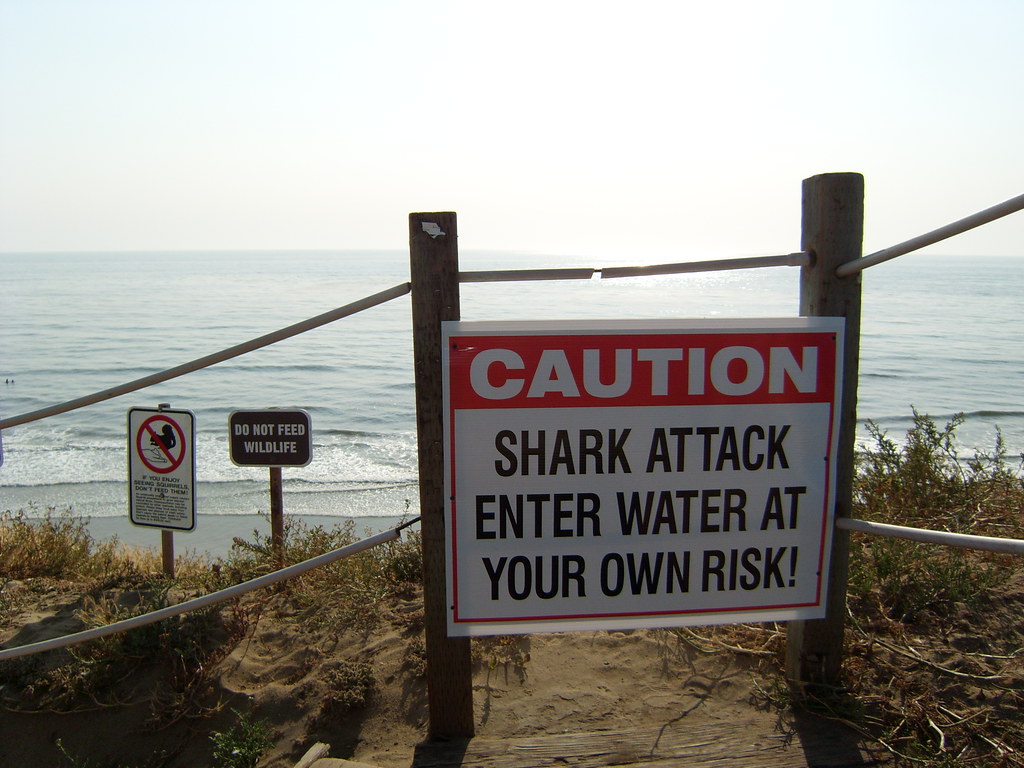
A horrific shark attack in Port St.John, South Africa has prompted calls for the installation of shark attack prevention facilities or shark nets.
The animal identified in this attack was a Zambezi or Bull shark, common to the area. South African authorities continue to be mired in a 1970's attitude towards their near shore sharks species regarding them as a "problem" with shark nets being a "solution".
Shark nets have been roundly condemned worldwide with many anti shark netting programs being likened to the clear cutting of rain forests. Sharks and many other animal species ranging from dolphin to whales are trapped by these 24/7 killers of wildlife.
Right now government officials in Port St.John are also wrestling with the cost of such a project without first taking lessons from other sites world wide where "solutions" to shark "problems" are less intrusive for sharks and in most cases less expensive for authorities:
1. California-Since the early 80's California has gone against the conventional wisdom of shark nets in high traffic areas where both White sharks and people mix. Instead California instituted protections for white sharks, and began a long term education of local populations towards these animals. Today, even after rare shark attacks on humans, the sharks are not demonized but understood to also have a natural stake in the waters as well as humans. Beaches with sharks feature year round warnings and the public is educated.
2. Australia-In Queensland, Australia where Box Jellyfish sometimes kill humans beach side playpens are set aside. These are often large net enclosures that allow swimmers full access to the ocean in set areas with life guards, ceding the natural ocean to wildlife. This would be the optimal solution for Port St.John's waters.
A combination of education, and set aside swimming zones that were netted would work in a cost effective manner for both the government of Port St.John and for oceanic wildlife.
Cost effective shark programs require a willingness to see sharks as proper stake holders in waters where humans and sharks mix. For too long many South African authorities have seen their sharks as "others" to be managed and eradicated. Let's look at this entire issue from the flip side and manage human populations first. A win for all.
We blogged about "newly discovered" Whale shark aggregations in the Gulf of Mexico back in August of 2008.
These unique and seasonal sites have long been known to the shark research community since 2002-but are just now getting the major media's attention.
Whale sharks represent "instant tourism" opportunities for many communities across the planet. The ease in which these animals allow for human interaction and the relative benign nature of these critters make for exciting shark encounters. For the still devastated Gulf Coast region local dive shops have been slow to look into "shark tourism gold" off their shores:
NEW ORLEANS — It was such an unusual sight that the commercial fishing crew in the northern Gulf of Mexico took an hour out of their work day to count the whale sharks swimming around and even rubbing their sandpaper-like backs against the boat.
The crew stopped at 44 to avoid double-counting the dark-bodied fish, some up to 50 feet long, opening and closing their wide mouths as they vacuumed in plankton, fish eggs or small fish southwest of Morgan City, La.
It was the largest sighting in a record year for a study of the world's largest fish that began in 2002 at the University of Southern Mississippi's Gulf Coast Research Laboratory in Ocean Springs, Miss.
"As far as your eye could see in every direction, you just saw fish after fish after fish after fish," said David Wesley Underwood of Pensacola, Fla., a deckhand on his uncle's boat, the Norman B. Complete Story
Ok, I guess I SHOULD comment on the EU plan of action for sharks that was released on the 5th of February, but since both my hard drive and I decided to crash on the same day (no worries, it was just a cold for me and I had a recent back up of my hard drive so I didn’t loose that much data), I haven’t had the time or energy to go through it yet. I will return to it later.
So, my blog today will be about sharks in captivity. I have to admit that I have a very split opinion about this. Or maybe not… Let’s say I have an opinion. Here it is:
I love sharks! I love to swim with them, dive with them, watch others dive with them on tv and I like to see them ”live” in aquariums. For you, it might be the last statement that is the hardest to understand (since this is a blog which I guess mainly people who likes to go diving with sharks read. I often meet people who think that it is crazy to go diving with sharks!).
All my holidays I tend to plan so that I will either be able to swim with sharks or see them in nice aquariums.
But - there is always a but - I want the sharks to be healthy in the aquariums and I like diversity above ”mass consumption”.
I realize that any aquarium most likely is too small to be an ideal place for a shark. They should be allowed to swim freely in the ocean. Still, I think that letting people see sharks with their own eyes makes them more willing to help saving them. Sharks are not as easy to love as a seal pup or a smiling dolphin (I don’t know about that really – I have loved sharks ever since I could talk, but many people tell me about their fear of sharks). You have to work harder to make people as aware and fascinated as you are yourself. One way is to show them sharks on tv, an other to have them on display in aquariums.
But not all aquariums are ok. The film clips below were shot in Denmark. So far that is my favourite shark aquarium in the world. I guess the tank is a bit crowded, but the sharks look fine. No bruises or nasty wounds, no strange swimming patterns and a high diversity. I’ve been to several aquariums in the US where there have been lots of sharks – in fact, they have been lying in droves – but just 2 or 3 species. Those aquariums have not impressed me at all – although the sharks look ok. I don’t know if it’s because we in Scandinavia have to buy all our tropical sharks and ship them for lots of money to our aquariums – and therefore we can’t afford to overcrowd our tanks - whereas aquariums in Florida just go out with some fishing gear and takes as many sharks as they want. It could be that the sharks give birth to pups in captivity as well, but monocultures are boring and makes me a bit sick.
I went to a shark aqaurium in Germany. The tank was big and not too crowded with the four sandtigers that they had, but it also contained a poor lemon shark that was swimming in circles just above the floor. You could see a circle in the sand where it had been spinning around. That was very sad to see! Especially since I have since learned that you can cure this behavior with the correct medicine!
There is an other reason why that dive below was so excellent. As a biologist I know that nature is unpredictable. You might pay a lot of money to go very far away to end up with… scrubbing the boat from fishblood and not seeing a white shark for a whole day (that happend to me in South Africa in 1995). In an aquarium I know that I will have sharks around me – for sure! Also, since I took up diving I became what we in Sweden call an “ear child”. After a few dives I get ear infections and are not allowed to dive anymore for a while. If you spend a lot of money to go on a diving holiday you don’t want to get ill! Especially not before you have seen those sharks! Luckily I can snorkel ok and many sharks prefer that, but still there are some adventures where you will have to dive to see the sharks. The hammerheads off Cocos Islands are at the moment just a dream dive for me.
So, do I think that it is ok to have any specie of sharks in captivity? No I don’t think so. Some species adopt better than others to being held in captivity. That said, given the chance, I would gladly watch the captive whale sharks in Georgia, the white sharks that they have had in Monterey and the goblin sharks in Japan. I know it’s not politically correct, but if that is my best chance to see them “live” at all, I’m in.
In the best of worlds I would just have to grab my snorkel and jump into the water and be surrounded by sharks. For me here in Scandinavia, it isn’t as easy as that.
P.S. Since over 18 years I share my life with a pet tarantula. Yup, 18 years. In the wild, she would probably not have lasted more than a few years. Now we can look forward to say, 45 years together… Sometimes the sharks might be safer from predators – like humans - in aquariums… D.S.
Voices and lots of them. Until now the driving forces behind new shark fishing regulations that would require vessels to come back to port with shark carcass, as well as fins, have been NGO's.
It is time for regular folks to step up to the plate. Once in a long while do issues like these come up for debate, discussion and action.
Make your voice heard. It is estimated that forcing near worthless shark carcass to return with shark fishing vessels in EU waters will curtail upwards of 30% of this out of control fishery. That's an excellent start.
Woke up this morning to a veritable media buffet of shark conservation coverage regarding shark fisheries efforts with the EU.
Over 122 media outlets (not including blogs) have covered this story which is pro shark and pro conservation.
For all the negative shark press these papers put out pushing shark hysteria it is to be noted they also do an excellent job when the news is needed most:
Over the past 20 years, the total E.U shark catch has increased by nearly 35%, to more than 800,000 tonnes. As a result, some of these beautiful species are threatened with extinction, such as the Spurdog.
This week angler, and kayaker, Michael Night decided after seeing several large sharks kayaking one day-to catch one.
The story that follows is a classic case of using the "shark myth shield" to do bad things to sharks. In this case after seeing these magnificent animals from a kayak, Mr.Night went about baiting, hooking and dragging one up a local beach, his reason?
Mr Knight caught this critter not only for "the sport of it" but to dispel the myths about sharks "I wanted to show people that they are out there all the time and they don't cause any harm," he said (sound of wet palm slapping forehead).
This statement boggles the imagination and is unfortunately much of the excuse we are seeing worldwide for humans conducting themselves in a manner with sharks that is abjectly inappropriate. The misguided attempt to dispel a nebulous "myth about sharks".
Next time Mr.Knight...grab a mask and snorkel instead.
"NIMBY" is an acronym used by the Pentagon during the height of our mis-adventures in Iraq. It's stands for "not in my backyard", and what, you may ask does this have to do with shark diving?
Recently "Da Shark" from Beqa Adventure Divers told a film crew they would not use his operation to access sharks. Essentially the entire shark production was little more than exploitative "shark porn" with a tailor made shark script from L.A.
These scripts are typically produced by non shark people and attempt to bend sharks into the script, not work with the animals as the operators know them. This particular shows script has made the rounds within the industry and has been denounced by everyone who has seen it.
Here is the complete post from Beqa's blog this week.
This is also "Da Sharks" personal take on the industry as a whole. "NIMBY" also stands for industry leadership in this case. As operators we have become the unwitting gate keepers for the ongoing perception of sharks. In the final summation it is up to us to look at our dive sites less as Biological ATM Machines and more as complete shark sanctuaries.
Da Shark:
We're all in this together.
I refuse to believe that the Channels cannot treat predatory Sharks in the very same way they have finally learned to treat the terrestrial apex Predators: as iconic, endangered, fascinating and essential elements of their habitats. It obviously works commercially or they wouldn't be airing those shows - Right?
Fiji would have some wonderful Shark stories to tell, combining huge Sharks with grassroots Conservation and ancestral beliefs, all set against the magical backdrop of the South Pacific - it sure wouldn't take a rocket scientist to weave that into a fascinating narrative.
But alas, all we get is more requests for the same, tired, endlessly re-hashed garbage. How does that dovetail with the new green image those guys are trying to portray?
Felix over at the excellent blog Oceanic Dreams posted a return email from Bimini shark researcher Doc Gruber this week.
The email was in response to a TV producer who wanted an expert opinion on the subject of diving with, and feeding, 'dangerous' sharks; specifically, how these activities affect or alter shark behavior, and also whether Dr. Gruber would consider cage-free shark diving a "hazardous" activity. Posted emails like these serve to enlighten our community and help guide future conversations about sharks and television and the industry as a whole. Kudos.
Typically questions like these are stacked for eco-edutainment programming that feature bad things with sharks. Doc Grubers response serves as a template for well reasoned and pro shark thought on the matter. It's hard to fault the opinions of a guy whose entire life has been spent in the company of sharks:
"I feel that shark dives produce several very beneficial outcomes for humans and sharks. First exposing divers to sharks, safely and professionally - and in a beautiful environment will inevitably turn fear into fascination. Quickly these people become ambassadors for shark conservation. Further it produces jobs and income for areas and folks that need the work - especially in an economy such as the Bahamian one.Tourism in the Bahamas is the country's life blood, and sharks are a draw". Complete Post
Actual organic messaging opportunities that tie-in daily tea use with shark fins: 1
You are looking at "brilliance in a cup" a way of getting an eco message across an entire culture without the use of bull horns, placards, or expensive bus shelter posters. By enabling and messaging a culture's other consumables you back door your conservation message in a culturally benign manner. In many cases two and three times a day per consumer as tea use in Asia is a daily ritual with many repeat tea sessions.
We like it and kudos to designer Pablo Matteoda from Argentina. We're pretty sure this is a case of unintended consequences, but like most marketplace widgets, your market is defined by users and right now we know a waiting market of roughly 800 million.
We have been trying to get a post out about Google Earths new Ocean. More to the point the stunning content interface that is sure to be be a game changer in the months to come. Thus far our efforts have come up short.
Enter Peter Etnoyer from the Deep Sea News blog. Sometimes you just flounder around trying to encapsulate how utterly striking new technology is. And then sometimes you just give up and say with gratitude "yeah, like he said":
Etnoyer on Google Earth
Ever since yesterday’s release of Google Earth 5.0, I have been trying to convince myself that playing with the new Ocean layer is part of my job. It seems to be working. I’m a graduate student who occasionally gives talks to high schools about the deep-sea.
I’ve tried before to use Google Earth as a presentation platform. When the projection was right, I could spin the globe the Gulf of Alaska to the Gulf of Mexico effortlessly. We would go island hopping on the digital globe, jumping back and forth between the Powerpoint, the DVD player, and Google Earth. Now, I won’t have to. It’s all there together.
We got the following email this week and naturally, passed on this project.
We have also harped on this industry subject ad nausem. Suffice to say as long as industry members provide the media with the negative shark images and video that sell advertising, there remains little incentive to produce better shark programming.
It's not that the desire for better shark programming does not exist or that Discovery Networks are essentially evil. They are not. Discovery buys some fantastic shows from truly visionary production companies. It would seem though that no one has shown Discovery how to do shark productions better, cheaper, and more cohesively. Until that day comes expect more of this:
Hello,
We are producing a new show for the Discovery Channel called “XXX.”
The show is an adrenaline-packed series that highlights extraordinary incidents caught on tape! I am interested in possible footage you may have of incidents where the sharks got “too close”. For example, we are doing another story of two cage divers off the coast of Mexico that had a Great White shark get its head stuck in the cage and they had to escape out the top. Can you think of any incidents like this, or similar, that was caught on tape?
We would love to license this footage from you, and of course you would be compensated for the use of the material. We sometimes also like to couple the video with on-camera interviews with the people involved. Also, keep in mind that this is a Discovery Channel show, and will in no way be sensationalized. We want to educate our viewers on the beauty and power of the Great White!
I look forward to hearing from you as soon as possible. Please let me know if you have any questions, as I would be happy to answer them for you.
What was once a surfers secret, became a researchers secret, and now is the open secret.
San Onofre, California, is a verysharky place.
If you have ever had the absolute pleasure of being in the company of shark watcher Ralph Collier from the Shark Research Committee (as we have) he'll tell you the reason why.
According to him most the critters you will find at San Onofre over the next three months are juveniles who are there for the annual Grunion Run. The Grunion (small bait fish) are filled with high calorie eggs, think of these little fish as "white shark power bars" and the whites who are swimming these waters are scooping them up by the mouthful in an all-you-can-eat three month shark buffet.
As for the surfers? Unless you are paddling out to the lineup wearing a pair of vintage silver sequinedMicheal Jackson Thriller Glovesyou should be fine.
It was no surprise to read another blog post from the surf community about this seasonal event because if it's any date over the next three months "Mr.White" is at San Onofre
We spent the last couple of days with Greg Davis owner and coder extraordinaire of the rapidly exploding scuba board Dive Buddy. The question on the table was blogging and content. One of our major issues with eco blogging or industry blogging is cross pollination.
Let me explain. For the most part scuba boards are insular, they want to keep their communities insulated from the outside and that is how they monetize their sites. This also fosters, to a degree, "group think".
At the same time salient industry thought, eco news, local dive news, and more happens outside these communities. The only way for this content to get in is if someone brings it in and that is the crux of the matter.
In many cases community members blog outside their scuba communities and do not have the time or effort to move these posts back into the scuba board. We are losing the conversation by blocking this tide of industry thought and discussion. Enter Greg Davis.
We joined his site in 2008. What struck us at first were the divers who had been attracted to his site with it's ease of navigation and ability to communicate with others. This, as it turned out, was simply a great crowd of divers.
"If you build it, they will come" as the saying goes, and Greg built it, the scuba community.
Back to blogging. So this weekend we discussed cross pollination and Greg built a program that allows outside blogs to automatically post to Dive BuddyIn a word brilliant. The blogger gets what amounts to double Google points for content, the Dive Buddy members get fresh new content to discuss, disagree with, or add to (the foundation of community) and Dive Buddy once again becomes more user friendly knocking down the oldschool scuba board paradigm of keeping members insular.
The entire program is still in Beta, but the idea is there. If you are a dive shop anywhere in the world, shark diving operation, or industry member who blogs about the industry, dive sites, eco news check out "the house that Greg built". In today's world content (good content) is king. The rise of serious online communities are driven by industry content and those few industryvisionaries who capitalize on it-driving the industry conversation forward on a variety of topics.
A few months ago we had a few things to say about the ill conceived and ill timed PETA Shark Week campaign featuring this image.
This week PETA announced a pro shark campaign in Florida to coincide with annual shark migrations and the negative hyper media that usually follows in it's wake.
This smart media tactic piggybacks on a natural shark event and effectively allows PETA to insert it's messaging into the local conversation.
Singer Island, Fla. -- The annual migration of hundreds of sharks off the South Florida coast has prompted PETA to create a pro-shark banner that will fly over Singer Island's beaches on Saturday from 12 noon to 3 p.m.The banner, which reads, "Sharks Aren't the Only Predators. GoVegetarian!," is part of PETA's campaign to raise awareness about the plight of sea animals who are killed for food.
Every year, more than 50 million sharks and billions of other sea animals are killed and consumed by humans, while sharks killed fewer than a dozen people last year.
PETA wants those who are concerned about predators in the water to think about the terror and pain that sharks experience as they bleed to death after their fins are hacked off to be made into "delicacies" such as shark-fin soup and shark steak. Many species of shark and other fish have been decimated by overfishing. According to an international team of scientists, 29 percent of fish species have "collapsed," or declined by 90 percent.
"Sharks are much more likely to be attacked by humans than the other way around," says PETA Executive Vice President Tracy Reiman. "The most dangerous predators of all can be found lined up at the all-you-can-eat seafood buffet."
We have been following the efforts of a small group in India in tandem with a few well known NGO's who are reversing the wholesale slaughter of whale sharks in their region. Replacing the "one time take" instead with new whale shark tourism initiatives.
In our world whale sharks represent "instant tourism". In places where whale sharks aggregate divers throng from all over the planet to interact with these gentle giants. In many cases a daily rate of $200USD per diver is not uncommon. For a place like India $200USD represents a yearly wage for many impoverished fishermen rapidly providing the incentive for further protection of this species and others.
Existing whale shark dive protocols and ease of interaction with these animals allows operations to focus on the marketing and sales aspect of bringing whale sharks to divers. For India this program could be ramped up in a short period of time.
This organic and quite remarkable effort has paid off. Now, more often than not, whale sharks accidentally caught in nets are released with the help of a local team from "Save Whale Shark".
India Today writer UdayMahurkar detailed the story of whale shark conservation in a simply terrific article this morning:
In September last year, fisherman AmrutlalChauhan and helpers spread their nets in the sea near the Saurashtra coast, hoping to catch some fish. But what got trapped in the net took them by surprise. It was a 20-ft whale shark. A timely call was made to the local ‘Save Whale Shark’ campaign activist DineshGoswami who along with personnel of the forest and fisheries departments came to the spot to cut the nets open and set the giant fish free.
At DEMA this year we were discussing the state of shark tourism with a number of tourism representatives from all over the world.
As we have long pointed out shark tourism enables local populations to sustainably manage sharks. The value of shark tourism in places like the Maldives is US$2.3 million a year-an estimated at 100 times more than the export value of that islands shark meat.
This is an industry drumbeat that's been gaining acceptance over the years and is now being adopted by forward thinking NGO's.
Unfortunately in many places this paradigm has also become a race between local fishermen who harvest sharks, for both fins and quick profits, and the newly developed and existing shark tourism operators in the region.
No where is this more aptly highlighted then recently in Malaysia and Mabul Island. This week State Tourism, Culture and Environment Minister Datuk Masidi Manjun took the extraordinary step of calling for an investigation of shark fishing activities in the region. This is to applauded and kudos to the minister for this stance.
If Mabul Island and surrounding region is to retain it's sharks, local efforts in tandem with government are the key:
"Nature lovers and the global conservation community are fast becoming very influential lobbyists whose action could hurt the State's tourism industry in the long run if they decide a boycott of Sabah to protest against activities perceived to be cruel to whales and sharks," minister quote.
On a recent media swing through You Tube we came across this eco tourism "gem". It's always important to keep a predators food source on top of your head when promoting wildlife tourism.
This particular operation is set to expire any day now:
Without a doubt the recent and horrific shark attack on a swimmer in South Africa last week ignited several wide ranging debates in the press about everything from shark culling, to raw sewage discharge, and even the controversial use of shark nets.
Herald Online reporter Dineo Matomela should be noted for his coverage which looked systematically into the causes, the sharks, and the over all shark situation in the region.
Makes for facinating reading and a template for non sensational shark journalism-tackling the issues of humans and sharks in a thoughtful manner:
A ZAMBEZI shark was responsible for attacking and killing a Port St Johns lifeguard at the weekend, Natal Sharks Board head researcher Geremy Cliff said yesterday.
He said warm waters along the Eastern Cape coast in summer attracted the sharks. Seasoned lifeguard Sikhanyiso Bangilizwe, 27, was attacked by the shark on Saturday afternoon while swimming with a friend at Second Beach.
He was bitten on the shoulder, right arm, back and buttocks. Cliff said an examination of Bangilizwe‘s body had established that a Zambezi (bull) shark had attacked him.
The Lumocet is a new pedal powered wet sub that will be making it's debut soon on a proposed transatlantic voyage. Think Wright Brothers with a side of Indiana Jones meets McGuyver:
Inventor Ted Ciamillo plans to pedal nearly 2,000 nautical miles from the Cape Verde islands to Barbados at a depth of around two metres, surfacing at night to sleep under a tent erected on top of the sub, according to New Scientist magazine.
Editors Note: Every once in a while along comes a tech storyline made for television. If these guys make it even half the distance they are planning the end result will be a thrill a minute programming-cue the adventure, cue Nat Geo.
File this post under shark "awareness". After news this week that a research team on South Africa's Breede River caught and tagged what is now the largest Bull shark on record, locals who swim and fish in these waters are quoted as seeing this as a good thing:
Cape Town - Cool-headed Witsand residents have accepted their toothy marine neighbour with some pride and are not about to be scared away from their beloved Breede River by any shark, big or small, they say.
Witsand hit the headlines this week after a huge four-metre female Zambezi shark, heavily pregnant with at least four pups, was caught about 5.5km upriver from the estuarine fishing village. Locals said they were more amazed than frightened at the appearance of the shark, estimated to weigh around 650kg.
For some it was proof of what they had believed for years, after regular sightings of large shadows under the water and mysterious disappearances of fish from fishing lines.
Responding to a recent tsunami of bad shark press in Australia, South Africa, and elsewhere this month, writer Linley Boniface takes on the issue of sharks and the media:
I never thought I'd say this, but I am bored with sharks. This summer, it has been impossible to open a newspaper or turn on the TV without being subjected to yet another daring shark escape story.
On closer inspection, these yarns have invariably turned out to involve nothing more thrilling than an exceptionally timorous surfer paddling for safety after spotting a fishy shadow pottering quietly along the shoreline, minding its own business.
While sharks in Australia do, as the Australians rather wonderfully say, "take" the occasional swimmer, Kiwi sharks are about as predatory as a newborn ladybug. Occasionally, a shark will accidentally graze a surfer's calf with a tooth, while yawning: cue national panic and the mass closure of beaches.
Silliest of the many absurd shark reports the media has pestered us with this summer was one from Radio New Zealand. The national broadcaster quoted Constable John Paul Tremain as urging people to stay away from beaches near Dunedin because a large shark had allegedly chased a couple of surfers from the water.
RNZ said Constable Tremain did not know the "exact size or breed of shark" - terrifying news in itself; someone is breeding the things! - but was convinced it was "lurking with intent".
Lurking with intent? Intent to do what? The sea is where sharks live: sharks no more lurk in the sea than I lurk in my house.
It's a commercial shark diving industry sore point we have harped on for a while now.
The ban on chumming and shark diving in Florida waters was poorly conceived back in 2001. This complete ban was conducted under a negative media storm by a well organized anti-shark diving lobby.
At the time a nascent US shark diving industry was comprised of just two operations.
Today Florida's waters teem with commercial shark diving species. An estimated 10-20 million dollar tourism industry sits idle as hotels and restaurants across the region shut down under one of the worst recessions in recent history.
Meanwhile, Florida's sharks are relegated to weekly news reports that do little to dispel the Jaws mythos with recent titles like "Shark Frenzy Caught on Tape" and the ever popular "Shark Alert". The state of Florida's-state of sharks-is at an all time low with an ever present perception that the waters of Florida are filled with rapacious predators waiting to strike.
The reality could be further from the truth and only the commercial shark diving industry can, if given a chance, work to dispel that media fabrication about sharks.
It is high time Florida reconsidered commercial shark diving operations off it's waters. Done right, with serious and lasting species interactive protocols, and even the threat of fines for industry infractions, Florida could ramp up a shark diving industry in less then two years that would feed local communities desperately needed tourism dollars.
If the ban on shark diving in Florida was in part done to stop the fear of shark attacks on humans, we would suggest the bans goals have failed. It is time to rethink sharks in Florida.
An excited team with the South African Shark Conservancy caught what is now the largest Bull Shark on record in South Africa.
In a scene worthy of any action film, team members were towed 2 189km up the Breede River before the critter became tired enough to load up with tags and release:
Long-standing fishermen's tales of huge Zambezi sharks in the Breede River have been confirmed - and huge means just that.
Last week, researchers on an expedition to confirm the presence of this species - also known as bull sharks - not only caught one of these sharks, but the catch proved to be a world record at 4m (13 feet) and weighing more than half a ton. Complete Story
Team tracking discoveries:
1.This Zambezi shark - who we have named NyamiNyami (the Zambezi River god) is the largest of its kind known to science, measuring 4 metres total length. The previous known maximum length for this species was 3.4-3.5 metres;
2.The discovery of NyamiNyamirepresents a significant range extension for Zambezi sharks in South Africa, as they were only known to occur to Cape St. Francis in the Eastern Cape;
3. NyamiNyami appeared heavily pregnant, suggesting the Breede River may serve as an important nursery ground for these sharks.
Editors Note: The tracking data coming back from this female is invaluable to the understanding of this species behaviour. Needless to say you do not want to be a fisherman in that region...or do you?
Filmmaker and show host Scott Cassel with the Undersea Voyager Project has long hypothesized that the wholesale collapse of the shark populations in both Mexico and along the west coast of the USA has lead to a veritable oceanicplague of giant squids.
His theory is bearing fruit, as untold numbers of these super predators are being found as far north as Oregon in population densities never before seen. As Scott recently told us "these animals breed at a rate of millions, if you take their primary predator out of the loop, they will explode on to the scene and dominate the niche the sharks vanished from".
Scott has a way of being right about his observations on the ocean:
BODEGA BAY, Calif. (CBS) In Mexico, they are called the "red devil" and "the beast" in Central America. They are jumbo squid: deadly, fast moving creatures with tentacles that can suck the life out of a human being.
The squid are devouring parts of large populations of native fish in Northern California.
The Monterey Bay Aquarium Research Institute has been tracking the population explosion of the squid. In just a few years, they have gone from occasional visitor to numbering possibly in the hundreds of thousands.
"It's a stout, very muscular animal, very high speed, excellent vision," said Karl Menard of the Bodega Bay Research Laboratory. "They are called the jumbo flying squid for a reason. They can actually leap out of the water and project themselves into the air into schools of nearby fish.
O.K, so we just finished a post about why direct action campaigns against cultural food items are most often ineffective.
Then there's the curious case of this food item which, by the looks of things, is allowing the blowfish population off the coast of Japan to remain intact:
Blowfish testicles have left seven Japanese ill, one critically, renewing public fears over the dangerous delicacy.The group ate raw meat and baked testes of blowfish - known in Japan as fugu - at an upscale restaurant on Monday in Tsuruoka, an old castle town 350 kilometres north of Tokyo.
They were treated at a hospital for numbness in the hands and legs and other symptoms. One of them was in a critical condition yesterday.
Something for all you natural predation people out there. Local California white shark hotspot, AnoNuevo, has installed high definition Elephant Seal Cams on it's island.
As part of a HD failed venture to bring 24/7 wildlife programming to the world the camera system will allow the public and researchers to monitor these ungainly critters from the comfort of your desktop (ours is running right now).
For the shark world, you just may catch a natural predation, if you are lucky.
"I know how much positive correspondence we get from people all around the world who are absolutely captivated by the video. In New York, people said they would leave the video running on their desktop day in and day out because it was so refreshing to hear the sound of the elephant seals chattering," said Alan Friedman, chief information officer for California State Parks.
This morning David McGuire posted an excellent and very well thought out look into the pitfalls of direct action animal campaigns when the greatest divide is cultural.
To distill this thought down, imagine 22 Chinese Americans waving protest signs outside a McDonalds directed at the predominately white customers inside. "Meat is murder" "Cows are killed inhumanely for this meat". You begin to see why this divide becomes almost impossible to bridge while the salient fact of whites telling Asians what they should and should not eat remains on the table for discussion.
That's not to say it cannot be done. Following the masters of the game WildAid and their campaign strategy of mass communication with members of the Asian community is effective. The subtext here is campaign effectiveness:
Having briefly observed and filmed the Chinese Flower Parade kicking of the New Year in San Francisco, I was amazed at the colors, smells and richness of the Chinese community. San Francisco has the largest Chinese Community in the USA, and a walk down Stockton Avenue is a walk into Asia.
A demonstration by the Shark Safe Project and aided by COARE approached shark fin soup restaurants and came out on the streets passing out information, but the shark activists were overwhelmed by the sheer magnitude of Chinese Americans flooding the narrow streets of Chinatown. Most passersby appeared indifferent, a few were angry, most just passed on without making eye contact. Even so, a hard core group of activists, many from out of the area gathered to pass out information for sharks.
Now I'm back at home after a meeting with my fellow "fish geeks"- or as we more officially are called "the expertgroup on fishes". We are 7-8 biologists who currently works on an update of the Swedish red list for 2010. There are national red lists around the world as well as a global red list following guidelines from IUCN (= the International Union for Conservation of Nature). The red list list both commercial and non commercial species and the system is designed to determine the relative risk of extinction.
I've been a member since before the update in 2005 and I must say that it isn't easy to do these assessments. We use all data we can find from surveys, landing data from fisheries and other sources, but the red list works best for animals on the savannah! We can't say that there are exactly 253641 spiny dogfish left in our waters and that last year it was 398526. We are not even totally sure that there is just one population of spiny dogfish in the NE Atlantic! Still, the spiny dogfish is one of the few elasmobranch species that we at least have SOME data on. For many of the skates and rays we don't have a clue of age for sexual maturity (which means that we don't know the generation time which is an important factor in the assessment) and we lack landing data specified down to species. All we know is that they are probably late in getting in mature and long lived.
Ever since I made my masters thesis on spiny dogfish (back in 1997) I have tried to make my colleagues set a quota on it in our waters. I mean, an animal that is 12 - 14 years old when it becomes sexual mature and that carries it's pups for 18-20 months (!), can't possibly tolerate a heavy fishing pressure. But since we are part of the European community, we have had to wait until EU finally set a - much to high - quota in 2007. In 2003 came a report most commonly referred to as DELASS (=Development of Elasmobranch Assessments). After having analyzed data and made several models, the conclusion of the report was that in 25 years the population of spiny dogfish in the NE Atlantic might have been fished down with as much as 95-98 %!
With this knowledge, the spiny dogfish was listed as EN (endangerd) on Swedens red list for 2005. The IUCN shark specialist group held a workshop for the NE Atlantic elasmobranchs in 2006 where spiny dogfish got listed under the highest criteria CR (critically endangered). (See figure below for explantions.)
We do these assessments to point out to those responsible that action needs to be taken, but it's not legally binding. The ideal situation is that the red list is blank - that all species are sustainably exploited or not threatend by habitat destruction etc. For some species, the situation is getting better after their debut on the red list, but for sharks action is very slow. Therefore we need people like you, reading this, to take action. Sign that petition, send an e-mail to that shop selling shark products or to a politician that has some power or make an activity celebrating the International year of the shark. Tell everyone that it's not ok to exterminate the sharks!
I'm VERY sad to say that it seems like the spiny dogfish will be listed on CR on the Swedish redlist for 2010. I've done everything I could to change it's dire situation. And it wasn't enough!
It's official and thanks to the many who helped us get here. Our little accidental industry blog reached a milestone last week and turned 15K for the month.
We decided a face lift was in order to celebrate this unlikely event so here's the old/new Underwater Thrills:Swimming With Sharks. More changes on the way as we get some cool new widgets and banghoffers loaded up here.
For now, welcome friends, lovers, and the odd assortment of cranks who hate everything we have to say and yet...end up just copying us anyway. We love you too!
Editors Note: That very cool image up there? None other than Gabriel Beyrent shot that scene with filmmaker Richard Theiss behind the lens.
Over the years the commercial shark diving industry has done a magnificent job with the media. Aside from a few recent stunning set backs for our industry, for the most part, shark tourism is still viewed in a positive light.
That is until the anti-shark diving folks start playing the media game as well:
Video Post: Stupid people in South Africa sell the chance to jump into a cage for a cheap thrill while they tease sharks from the safety of a boat. These idiots take tourist to ’shark alley’ and tease these majestic animals. Sharks are the top of the food chain, and the operator is a jerk to tease them. If this is somehow appealing to your ego I’d like to knock your lunch on the floor; see how you like it.
What happens to the next diver doesn’t feed the sharks? Now sharks expect man to show up with fast food which might be a human life. I’ll bet these jerks taste like fish. Take a look at what happens in this video. I can only hope the government of South Africa takes immediate action against the exploitation of Nature’s most magnificent predator before the next attack happens to kill out of total frustration. Not if, but when that days comes you will see how the media vilifies the shark… again. Who is really to blame for that death? It’s coming, just a mater of time. Sharks are patient unlike man.
Dateline NBC had the perfect opportunity to condemn these money grubbing jerks, but not a word about how stupid this is, no out cry for antagonizing the animals, nothing about the exploitation, nothing about what losers these so-call dive boat operators are. Once again MSNBC and Ann Curry drop the ball. Grow a pair Ann or go back to soft news where you belong.
Close call? Not for the shark, it was just bad luck on that day. Maybe next time luck will change hands, after all that is what it will take to stop this madness. One more example of how selfish stupid people think; they somehow have the right to do whatever gets them excited, no mater what logic tells us. Who gives them the right to profit this way? This is wrong, nearly dead-wrong for these adrenaline junkies and I hope you will make your voice heard. Please use social bookmarks to spread the word.
Ever since having become a Member, we've been working on a concept enabling us to create a positive buzz for Sharks all across Fiji. We are lucky insofar that Shark Conservation ties in beautifully with Fijian Culture as for many indigenous Fijians, Sharks are sacred and killing them is Taboo. As an example, many of our feeders hail from Beqa Island and are thus protected by the Shark God Dakuwaqa.
From the guys over at A Couple Dives this week. Having the loophole closed on the sharks fin trade in US waters is a victory. Commercial fishing vessel hold space is filled quickly with the worthless shark carcass causing vessels to spend more time in port, burn fuel, pay for crews and source markets for shark meat which do not exist at this time-this is the win: Earlier this month, the Humane Society of the United States and Humane Society International issued a statement thanking Congresswoman Madeleine Bardallo (Guam) for introducing legislation that would close a loophole on shark finning. Bordallo re-introduced the Shark Conservation Act (HR 81) that closes a loophole that was supposed to be taken care of by last year's HR 5741 which stalled in the Senate until their session expired. The act now requires that all sharks taken in U.S. waters must have the fins naturally attached. The new legislation alters previous legislation that currently permits a vessel to transport fins that were obtained illegally as long as the sharks were not finned aboard that vessel. Patricia Forkan, president of Humane Society International, applauded Bordallo's actions.
"Each year, tens of millions of sharks worldwide have their fins cruelly cut off at sea and are then thrown back overboard to die a lingering, painful death."
"Shark finning threatens the survival of essential marine species, and we commend Congresswoman Bordallo for addressing this cruel and wasteful practice."
Shark finning was banned in the U.S. by the Shark Finning Prohibition Act of 2000, but enforcement is complex and the loophole allows circumvention of the law. The Shark Conservation Act must still make its way through the halls of Congress and on to the Senate for final passage and implementation. To motivate your congressperson, you can make your voice heard through Oceana.org's Wavemakers web page which will forward your personal email to your elected representative.
So, I have my sisters four year old standing next to me trying to make a hostile take over of the computer so I will have to be quick! (Maybe he is still angry with me since I knocked him out the first time I tried playing wii this afternoon. By the way, I hope to be able to report later about my experience of goblin shark diving in the game "Endless ocean", or as it is called in the U.S., "Forever blue".)
I'm very flattered to have been asked to contribute to this nice blog. I will go out lightly by presenting a short video clip, that proves why I'm qualified to post on a shark diving blog - even if the videoclip is from an aquarium. (Also, I want to try how it works using blogger - I'm used to myspace).

 A horrific shark attack in Port St.John, South Africa has prompted calls for the installation of shark attack prevention facilities or shark nets.