Back in 2006 we fabricated a shark cage system for the M/Y Triton, perhaps one of the prettiest private yachts working right now. Private cage systems for yachts offers the ultimate freedom to the yacht owner to conduct cage operations on the fly when sharks are present.
In the case of the Triton her cage has seen service from Alaska (Salmon Sharks) to Mexico and beyond.
This is the cage we built in use at Isla Guadalupe with the crew of the Triton, enjoy:

The shark diving industry blog covering sharks, shark cage diving, shark conservation and things we find "amusing" since 2008 www.sharkdiver.com, www.sharkdivers.com, www.divingwithsharks.com
Friday, August 20, 2010


Thursday, August 19, 2010
North Shore Hawaii - Commercial Shark Divers Charged?
 Shark Industry Watch 8.19.2010
A federal undercover investigation uncovered alleged criminal activity at two of Oahu’s North Shore shark tour companies.Five shark tour employees have been charged with illegal shark feeding.
Law enforcement officers, who posed as visitors, posing as pretended to video tape their shark tour adventures but instead, they allegedly, caught tour operators red-handed.
Complete Story.
Fire NOAA's Jane Lubchenco -Today!
 This woman is menace to your oceans.
As NOAA's Director during Americas foremost ecological disaster she proudly wore, and then hid behind, a pair of glided policy handcuffs of her own design as if they were some sort of magic talisman.
Life is defined by moments of crises when people in positions of power are called upon to act beyond their constraints, rise above them, and lead.
Not so for Ms.Jane Lubchenco who, during the Gulf Oil Disaster misrepresented facts, stalled, berated independent researchers, and towed the BP corporate line whenever and wherever possible.
From NOAA's low ball estimates on oil leaking into the Gulf, 5000 barrels a day, to outright data suppression, her time as NOAA's Chief demonstrated a lack of will, lack of understanding, and a not so carefully concealed Academic C-Y-A Dance that all but shocked anyone who has been monitoring the events as they unfolded.
Her tenure at the job during and after the crises has been piss poor at best, at worst may well let BP walk away from responsibility to existing oil still in the Gulf, oil her offices say does not exist.
As Hurricane Katrina was to Brownie Brown, another next to useless public servant, Ms.Lubchenco should pack her Disney lunch box with the picture of Ariel on it and begone from Washington, begone from ocean policy, and begone from any position that requires her to be in leadership.
President Obama unwisely chose a global warming advocate for NOAA's Chief, never imagining that policy wonks make poor generals in times of crises.
Wednesday, August 18, 2010
Monterey Bay White Shark Research - Nine Years
 The premier white shark husbandry and tagging project for juvenile animals is celebrating nine years of cutting edge work in Monterey.
This week Sea Notes posted a summary worth reading:
This summer is the ninth year of our White Shark Project. Through this work we have been able to display five juvenile great whites in our Outer Bay exhibit and have tagged and tracked these sharks, and nearly 40 others in the field, to learn more about the movements of these young animals along the coast.
This year, with the Outer Bay exhibit about to undergo a transformation, we won’t try to bring a shark to Monterey; but the field work continues.
From our previous research results we’ve seen that some young white sharks tagged in the southern California region move to, or return to, warmer winter waters off Baja California. We’d like to know if they return to California and regularly make this south-north migration, but the size of the young sharks limits the tag we can use, and thus how much information we can gather.
Complete Post.
Smart Conservation - Shark People Take Note
How do you get 500K (and counting) people to change perceptions on a Plastic Bag Initiative?
When you're smart, like the folks over at Heal the Bay, you produce something like this highly entertaining Mockumentary. You want to be watching for the "vast cement rivers," segment and the "home to" quote, classic.
Folks on the front lines of shark conservation should take note. For the past four years shark PSA's have focused on the blood and gore of shark fining but it is time for a fresh look at this and another take.
Blood and gore is a one trick pony and we could be mining an audience outside the traditional shark conservation crowd, a broader reach with a viral video like this is always a good thing.
Kudos to the Heal the Bay folks and yes, we signed the petition:
When you're smart, like the folks over at Heal the Bay, you produce something like this highly entertaining Mockumentary. You want to be watching for the "vast cement rivers," segment and the "home to" quote, classic.
Folks on the front lines of shark conservation should take note. For the past four years shark PSA's have focused on the blood and gore of shark fining but it is time for a fresh look at this and another take.
Blood and gore is a one trick pony and we could be mining an audience outside the traditional shark conservation crowd, a broader reach with a viral video like this is always a good thing.
Kudos to the Heal the Bay folks and yes, we signed the petition:
Tuesday, August 17, 2010
Mysterious 'corkscrew' kills dozens of seals on east coast
 The Corkscrew mystery is back and we're not saying its a shark that is causing all the seal damage we're just saying is all.
Almost a decade after first reports of corkscrew seal deaths by researchers on the East coast not much is known about dead seals that wash ashore with a corkscrew pattern missing from the fat layer surrounding them.
And now dead seals are washing ashore in Britain as well, cue the mystery music please.
As a lot of production companies crawl through this blog trolling for ideas (we know you do), here's one that would make a great Shark Week 2011 episode and you may have it with our blessings:
Corkscrew Killers
We happen to have the show treatment already written out, the dive sites picked, and the research contact list...that's if you want it of course.
Further reading Corkscrew Killer Blog.
French - Bon or Damn Fine Film
If you got 40 minutes this week you could be spending it in the company of sharks in Fiji:
The Shark Con - Industry Backlash and Opportunity?
 The Shark Con.
As predicted it has aroused quite a L'orage du merde among members of the shark diving and shark conservation community.
If the litmus test for industry anger and backlash could be measured in email terabytes, then this "documentary" would win all manner of awards.
Having not seen the film but watched the evolution of it within the industry I am struck at how fast some of those involved with the film are running for the hills. Disavowing their on screen presence and soft pedaling their way out the back door.
You either support a film or you do not. As far as media is concerned you are defined by it.
This is a statement we made about this production team and their circle of friends in 2009, and it still stands to this day.
Far too many within our industry try and have it both ways, acting as conservationists and then wholeheartedly endorsing, supporting, and enabling shark productions that, in a time of a well defined shark crises, do nothing for sharks and everything for those that buy and sell shark productions for profit.
There are persistent rumors that some featured in this film had its intent misrepresented on the front end, thereby were sandbagged for their on screen quotes.
Regardless of the films doco circut run and laurels for "being selected," the current news (?) that has many in a righteous fury is that this film is now going to see a prime time run on a major network.
Opportunity?
The opportunity exists for those involved with this film to step back and reconsider.
It is one thing to produce a well researched, well balanced documentary with serious voices who can speak to the often byzantine and complicated issues of commercial shark diving, shark conservation, and shark media. It is another to Michael Moore your way though a tantamount wildlife issue in the time of crises with "colorful onscreen characters."
The Shark Cons responsibility to a wider uninformed audience is to present real and lasting facts.
As the industry knows, the general public, as far as shark facts are concerned will believe almost anything regurgitating factoids about sharks around office water coolers for years to come. It is conservations greatest challenge surmounting these man made hyper perceptions we often see on Shark Week, making The Shark Con an uncertain commodity in a time of wildlife and oceans crises.
Read Public Knowledge, Attitude, Behaviour Towards Sharks and Shark Conservation.
One year ago this same team enabled this production on the Today Show, leaving many to wonder if they possess the media wisdom to truly pull off - The Shark Con:
Visit msnbc.com for Breaking News, World News, and News about the Economy
Today's Sharks: Smart, Tagged, and in Short Supply
 Scientific American did a great piece this month with Doc Gruber in the Bahamas on sharks, research and conservation.
Sci Am jumped into the shark conservation arena with Shark Diver on 2008, but this latest article hits all the right notes.
Kudos.
"Many sharks have good learning capacity, which is one way we measure intelligence," says Samuel Gruber, a marine biologist at the University of Miami's Rosenstiel School of Marine and Atmospheric Science (RSMAS), who discovered in 1975 that lemon sharks could learn a classical conditioning task 80 times faster than a cat or rabbit. "I was shocked to find that they could learn so rapidly," he says.
Wednesday, August 11, 2010
How to interact with white sharks - California
No screaming, no panic, no fear. This is Homo Sapien and a tagged Carcharodon carcharias meeting in the open ocean off the coast of California this week.
Kudos to Grind TV for the story and to Chuck Patterson for a once in a lifetime moment with whites that showed the world how interacting with these wonderful critters can be done without the hype:
Kudos to Grind TV for the story and to Chuck Patterson for a once in a lifetime moment with whites that showed the world how interacting with these wonderful critters can be done without the hype:
Me my Shark and I from Chuck Patterson on Vimeo.
Guadalupe Island and Shark Tourism Documentary Short
Perhaps one of the best English version conservation shorts done of the pristine Bio Sphere in Mexico called Isla Guadalupe.
Video by Oceans Aloft.
Featuring shark diving operations by Shark Diver and Horizon Charters.
Video by Oceans Aloft.
Featuring shark diving operations by Shark Diver and Horizon Charters.
Shocking White Shark Video - Isla Guadalupe
With the start is the 2010 white shark season just a few days away we thought we would return to a shocking white shark video shot with our divers in 2003.
The only known footage of it's kind, or at least posted to You Tube.
WARNING: Not for the squeemish, or for those about to eat lunch:
The only known footage of it's kind, or at least posted to You Tube.
WARNING: Not for the squeemish, or for those about to eat lunch:
Tuesday, August 10, 2010
White sharks making a comeback off California, expert says
 Outdoor reporter Peter Thomas surprised us this week with his latest expose on sharks.White sharks and growing population numbers off the California coast.
Rising shark numbers? Appearntly so.
From Peter Thomas Outdoors:
It might come as unwelcome news to swimmers and surfers, but great white sharks appear to be mounting a comeback off California.
"I think there are more sharks," Christopher Lowe, a professor at Cal State Long Beach and director of the university's Shark Lab, said during an exclusive phone interview. "And that's not a bad thing; it's a good thing."
It's the first declaration by a prominent shark researcher that a recovery of the embattled great white shark -- the world's most notorious predator -- seems to be occurring.A longstanding statewide ban on fishing for white sharks, an increased survival rate among young white sharks because of fishing gear restrictions, and an expanding sea lion population as a prey source are chief reasons for the comeback.
Lowe, who has performed extensive tagging of juvenile white sharks off Southern California and has pored over data dating back generations, said personal observations and increased incidental catch rates of small white sharks by commercial fishermen help support his contention.
Salvador Jorgensen, leader of the white shark research team at Stanford University's Hopkins Marine Station, did not disagree with Lowe's assessment but was more guarded when asked for a response.
Complete story.
South Africa - City erects new shark signage at its beaches
 The City of Cape Town, in conjunction with the Shark Spotters Programme, has designed three new signs to improve shark safety on Cape Town’s beaches. These signs seek to increase awareness about the presence of sharks (Great White sharks in particular), and to guide beach users on the workings of Shark Spotting Programme.
“Significant improvements have been made to the shark warning system used by the shark spotters, and the City urges the public to familiarise themselves with this system,” said the City’s Mayoral Committee Member for Community Services, Councillor Brett Herron.
The new signage can be found on beaches monitored by shark spotters, where the flag warning system is utilised, namely: Noordhoek Corner (the ‘Hoek’), Glencairn, Fish Hoek, Clovelly, St. James, Kalk Bay and Muizenberg. The signage is designed to be highly visible and has been strategically placed to ensure that it is accessible to all beach users.
The following changes have been made to the shark warning system:
All flags now have a shark printed on them. This is to ensure that beach user are able to differentiate between the shark spotting flags and other,
Signs indicating a ‘high risk’ have been placed on Jaggers Walk at Fish Hoek Beach – a site where the most recent shark attacks have occured. However, beach users are reminded to always be vigilant and exercise caution when they swim at any beach.
The modified shark spotting information sign explains the meaning of the colour-coded shark warning flags; shows information on shark spotter duty shifts; provides general visibility conditions; indicates the date of the last shark sighting and lists emergency services contact details.
A new ‘Shark Smart’ sign conveys general information on sharks in Cape Town waters as well as advice on using the ocean. These will be erected in the near future.
The Red Flag now indicates a general shark alert, and is raised when a shark has been observed in the area in the past two hours, when an increased presence of sharks has been observed, or when conditions conducive to increased shark activity exist e.g. high fish activity or whale strandings. This flag will be lowered only when the alert is no longer necessary and will be flown in conjunction with one of the other spotting flags.
The City appeals to the public to please locate and familiarise themselves with the new signs on the beach and the Shark Spotting Programme. Beach-based shark spotters are also available to answer any questions related to shark safety, and informational brochures can be obtained from them or the Save Our Seas Shark Centre in Kalk Bay. For recent shark activity and more information please visit www.sharkspotters.org.za
The public should continue to apply caution at the beach. Swimmers must immediately leave the water when warnings are sounded and not return to it until the shark spotters have given the all-clear.
In addition, the public are encouraged to:
1.Swim in groups
2.Ensure that they are visible to others when swimming
3.Ensure that they do not swim when there are marine mammals
4. Ensure that they do not swim if a marine mammal or carcass has washed up onto the beach
1000 Over in Scotland - Conservation in Action
 We have been big fans for the past couple of years of The Scottish Shark Tagging Programme (SSTP).
SSTP celebrated a milestone last week with the 1000th shark tagged and released in regional waters. It was this unhappy looking fellow who did the catching.
Seriously, this is a 1000th tagged shark victory smile?
The you read on and discover he's from Amsterdam, that explains it.
We digress.
Kudos to the entire effort over at SSTP and for the new website, looking good, helping sharks.
Shark Conservation: The problem, the goal, and how to get there
 Once again "provoking thought" with David Shiffman over at Southern Fried Science this morning.
Where we tend to point out issues with the shark conservation movement that either work or do not, assuming that folks know what we're talking about, David has gone in depth and drilled down to the essentials.
We tend to agree with David on a lot of things, because he thinks strategically and often.
The shark conservation world needs critical thinking. Reacting is good, but you can only get so far "reacting to" a global shark crises.
Read Davids post today.
When it comes to critical and startegic thinking out loud this is about as good as it gets.
Monday, August 9, 2010
Sleeping White Shark Found? Not Likely
 News came in last week of a "sleeping white shark" found upside down on the surface off the coast of Chatham by local fishermen.
When touched with a gaff the critter suddenly sprang to life swimming off into the depths.
We, on the other hand, might suggest what the fishermen found was a gravely ill female shark with what looks like a seriously distended belly.
Perhaps from a recent whale meal, or a blockage in its stomach that caused gas build up.
"Peering through the afternoon fog late last month, the island charter-fishing captain assumed he was looking at the bloated white underbelly of a dead whale floating motionless seven yards away. But drawing closer, his eyes widened: The tail cut out of the water vertically, not flat like a whale’s."
Either way this is not normal for whites and hopefully this animal survived.
Complete story.
Sunday, August 8, 2010
BLUE Ocean Film Festival & Conservation Summit
From the RTSea Blog this week, if you happen to be on Moneterey at the end of this month there's an event you have to attend:
The BLUE Ocean Film Festival & Conservation Summit will be taking place in Monterey, CA from August 24th through the 29th - and, flat out, it is an event not to be missed for the dedicated ocean conservationist to the mildly curious.
Only in its second year, the festival has grown tremendously in scope and recognition because of the wide range of films, conservation events, and just plain fun and fascinating events for people to participate in. There are single and multi-day passes and industry delegate passes, so you can build your schedule accordingly - watch some of the very best ocean films from international filmmakers, take in premiere photo exhibits and discussion panels on a wide range of ocean exploration and conservation subjects, or you can even get out in the field or get wet with some of the top experts in their field.
This year, the festival's 2010 Dr. Sylvia Earle Award will be presented to Dr. Carl Safina, director of the Blue Ocean Institute, who is one of our most dedicated and eloquent environmentalists and who will be giving a special presentation on the status and future implications of the Gulf Oil Spill. There will be other great speakers, like Jean Michel Cousteau, Dr. Sylvia Earle, and many other recognized heavyweights in the field, along with a variety of important seminars and panel discussions. I am pleased and honored to once again be participating in and moderating a Shark Conservation Discussion Panel and I will be joined by Peter Knights (WildAid), Laleh Mohajerani (Adoptashark), Stefanie Brendl (Hawaiian Shark Encounters), and Dr. Greg Stone (Conservation International).
 Also, for all you beginning or emerging underwater video filmmakers, I will be conducting an Introductory Underwater Video Workshop that includes 2 dives in Monterey Bay's famous kelp beds along with a classroom workshop.
The films that will be shown range from major productions like Disneynature's Oceans, National Geographic and BBC productions to short films and online-dedicated videos (I have one in this category that will be screened and two that received honorable mentions) - over 60 films total.
The festival events will be taking place in venues throughout the city, including the Monterey Bay Aquarium, one of the festival's major sponsors. So you can really plan quite a time for yourself.
The BLUE Ocean Film Festival & Conservation Summit. Come for a day, come for a week. It's going to be one heck of an event.
The BLUE Ocean Film Festival & Conservation Summit will be taking place in Monterey, CA from August 24th through the 29th - and, flat out, it is an event not to be missed for the dedicated ocean conservationist to the mildly curious.
Only in its second year, the festival has grown tremendously in scope and recognition because of the wide range of films, conservation events, and just plain fun and fascinating events for
 people to participate in. There are single and multi-day passes and industry delegate passes, so you can build your schedule accordingly - watch some of the very best ocean films from international filmmakers, take in premiere photo exhibits and discussion panels on a wide range of ocean exploration and conservation subjects, or you can even get out in the field or get wet with some of the top experts in their field.
This year, the festival's 2010 Dr. Sylvia Earle Award will be presented to Dr. Carl Safina, director of the Blue Ocean Institute, who is one of our most dedicated and eloquent environmentalists and who will be giving a special presentation on the status and future implications of the Gulf Oil Spill. There will be other great speakers, like Jean Michel Cousteau, Dr. Sylvia Earle, and many other recognized heavyweights in the field, along with a variety of important seminars and panel discussions. I am pleased and honored to once again be participating in and moderating a Shark Conservation Discussion Panel and I will be joined by Peter Knights (WildAid), Laleh Mohajerani (Adoptashark), Stefanie Brendl (Hawaiian Shark Encounters), and Dr. Greg Stone (Conservation International).
 Also, for all you beginning or emerging underwater video filmmakers, I will be conducting an Introductory Underwater Video Workshop that includes 2 dives in Monterey Bay's famous kelp beds along with a classroom workshop.
The films that will be shown range from major productions like Disneynature's Oceans, National Geographic and BBC productions to short films and online-dedicated videos (I have one in this category that will be screened and two that received honorable mentions) - over 60 films total.
The festival events will be taking place in venues throughout the city, including the Monterey Bay Aquarium, one of the festival's major sponsors. So you can really plan quite a time for yourself.
The BLUE Ocean Film Festival & Conservation Summit. Come for a day, come for a week. It's going to be one heck of an event.
Friday, August 6, 2010
Playboy and SharkDiver.com - The Video
A few years ago reporter Thayer Walker joined us at Isla Guadalupe, Mexico on assignment for both Playboy magazine and their online channel. What ensued was just plain shark diving fun with the world's top shark species the Great White.
While Thayer did not arrive with the bunnies we had hoped he would (you owe us Thayer) he did come away with a unique story told from the front lines of cage diving in Mexico. The shark behind him was none other than Shredder and any lesser reporter might have run away, not Thayer.
Behold professionalism in action and in the face of 1500lbs of raw muscle and show stealing shark talent.
Video shot by RTSea Productions, who else could get these shots?
While Thayer did not arrive with the bunnies we had hoped he would (you owe us Thayer) he did come away with a unique story told from the front lines of cage diving in Mexico. The shark behind him was none other than Shredder and any lesser reporter might have run away, not Thayer.
Behold professionalism in action and in the face of 1500lbs of raw muscle and show stealing shark talent.
Video shot by RTSea Productions, who else could get these shots?
Casa Caletas Resort Owner Accused of Toxic Spraying in Wildlife Refuge
Casa Caletas in Costa Rica advertises itself as Honeymoon Getaway Resort:
"An in imaginable different kind of place where exclusivity and its good taste join hand in hand with the magic of a paradise-like scenery, awaits for you at Casa Caletas. Located on the beautiful and unexplored Gulf of Nicoya in Guanacaste, only five minutes from Playa Caletas airport and 30 minutes away from Punta Islita Airport, make Casa Caletas the perfect location for your leisure on the beautiful beaches of Coyote, Caletas, Manzanillo and Ma Pais."
But don't tell the local wildlife in the adjectent Caletas-Arío Refuge where accusations of toxic spraying and a recently surfaced video highlights the need for NGO's in the region to remain ever vigilant against damage to the refuge.
"An in imaginable different kind of place where exclusivity and its good taste join hand in hand with the magic of a paradise-like scenery, awaits for you at Casa Caletas. Located on the beautiful and unexplored Gulf of Nicoya in Guanacaste, only five minutes from Playa Caletas airport and 30 minutes away from Punta Islita Airport, make Casa Caletas the perfect location for your leisure on the beautiful beaches of Coyote, Caletas, Manzanillo and Ma Pais."
But don't tell the local wildlife in the adjectent Caletas-Arío Refuge where accusations of toxic spraying and a recently surfaced video highlights the need for NGO's in the region to remain ever vigilant against damage to the refuge.
White Shark Diving Mexico T-Minus 10 Days
To celebrate close to a decade of on site operations at Isla Guadalupe we thought we would re run another of RTSea Productions on the great whites. This video is currently featured in Google Earth.
In 10 days time another Shark Diver expedition kicks off with 12 very excited divers.
They have no idea what they are in for.
For those interested we have exactly 9 spaces left for our 2010 season and are 20% sold out for 2011.
In 10 days time another Shark Diver expedition kicks off with 12 very excited divers.
They have no idea what they are in for.
For those interested we have exactly 9 spaces left for our 2010 season and are 20% sold out for 2011.
Shark Week 2010 - Yes I Actually Liked This
Shark Week - You know it is refreshing, after two years of ranting, to actually like a show on Shark Week and this is one of this years stand outs. Is it possible to do mainstream shark productions without the hype?
Yes, yes it is.
This is smart shark television, well done Discovery, well done Stuarts Cove, well done sharks.
By the way anyone who says that commercial shark diving is not good for sharks should watch this piece, this is pro shark, pro industry messaging of the highest order.
Yes, yes it is.
This is smart shark television, well done Discovery, well done Stuarts Cove, well done sharks.
By the way anyone who says that commercial shark diving is not good for sharks should watch this piece, this is pro shark, pro industry messaging of the highest order.
Opportunities for Shark Research, Conservation and Outreach work with the South African Shark Conservancy in 2010 and 2011
 Opportunities for Shark Research, Conservation and Outreach work with the South African Shark Conservancy in 2010 and 2011.
Volunteer Positions are available to work with the South African Shark Conservancy commencing November 2010 and throughout 2011.
SASC is a non-profit organisation dedicated to promoting the conservation and sustainable utilisation of marine resources through research, education and outreach. Since its inception in 2007, SASC has developed partnerships with academic and conservation organisations around the globe, and has become well-known in South Africa for its inclusive and holistic approach to conservation and management initiatives.
SASC offers interns the opportunity to become involved in a unique and exciting approach to marine conservation. Our research and outreach projects are specifically designed to promote a holistic approach to conservation, working with various fishing sectors, research institutes and governmental organisations. Join our internship programme and gain valuable insight into the conservation management of sharks and other living marine resources.
SASC is looking for volunteers with a biological background or interest in shark biology and conservation for a period of one to three months commencing from November 2010 and throughout 2011. If you interested in joining our team and would like more details and an application, please send an email to tamzyn@sharkconservancy.org.
Please refer to our website www.sharkconservancy.org or join our Facebook group for more details about our current projects and events.
Kind regards,
Meaghen McCord
Managing Director (SASC)
Oceana Announces Launch of Gulf of Mexico Research Expedition to Assess Long-Term Impacts of Deepwater Horizon Oil Spill
For this research expedition, Oceana has chartered the Oceana Latitude, a 170 foot vessel capable of sailing in both shallow and deep waters, and adapted to serve as a diving platform. The expedition, led by oceanographer Xavier Pastor, vice president for Oceana Europe, will set sail from
“The Deepwater disaster is a horrible experiment on the
Oceana’s scientists from both sides of the Atlantic will begin their work in the
“Most of the public’s attention has been on the visible oil on the surface of the Gulf and the beaches and marshes,” said Dr. Hirshfield. “Oceana wants the public to understand the impacts of the unseen, underwater oil that is damaging marine wildlife and habitats in the Gulf and will likely continue to do so for years to come.”
Thursday, August 5, 2010
"Blood in the Water" A look at ill informed shark media
Why Current TV decided in 2007 to run with the Blood in the Water expose is beyond anyone's guess, suffice to say they stepped into an long standing global industry issue with a somewhat biased look at the industry in Hawaii.
Unfortunately this entire video expose falls flat when you realize this is a classic media hit piece designed to instill fear of sharks and commercial shark diving. From the choice of music, fun upbeat surfer music, to dark and sinister shark music, to the actual quotes by locals it is evident that Hawaii has a long way to go when it comes to understanding the global commercial shark diving industry.
Can we have a honest and open debate about our industry minus the sand box level of shark fright, moronic factoids devoid of in depth analysis, and video clips that serve no real purpose but to instill fear?
Research Note: Research data from the Farallones and tagged white sharks in that region off the California coast have shown up at Hawaii's North Shore exactly where Hawaii Shark Encounters ran into a much larger female several years ago. Where uniformed locals come to believe operators attract animals like these, research exposes the real story of generations long Pacific migratory patterns that are just now being discovered.
Blood in the Water is another in a series of ill timed, ill informed and hysteric anti-shark diving media pushes that fail to deliver substantive facts, data, and information to a public that needs it.
Unfortunately this entire video expose falls flat when you realize this is a classic media hit piece designed to instill fear of sharks and commercial shark diving. From the choice of music, fun upbeat surfer music, to dark and sinister shark music, to the actual quotes by locals it is evident that Hawaii has a long way to go when it comes to understanding the global commercial shark diving industry.
Can we have a honest and open debate about our industry minus the sand box level of shark fright, moronic factoids devoid of in depth analysis, and video clips that serve no real purpose but to instill fear?
Research Note: Research data from the Farallones and tagged white sharks in that region off the California coast have shown up at Hawaii's North Shore exactly where Hawaii Shark Encounters ran into a much larger female several years ago. Where uniformed locals come to believe operators attract animals like these, research exposes the real story of generations long Pacific migratory patterns that are just now being discovered.
Blood in the Water is another in a series of ill timed, ill informed and hysteric anti-shark diving media pushes that fail to deliver substantive facts, data, and information to a public that needs it.
Howard Hall - Defining The Underwater Experience
Da Shark over at the BAD Blog found this gem, shot by Howard Hall and company (calls the guy his friend, lucky) these are the underwater moments that define the industry and reset the bar.
Kudos.
Sit back, take a long sip of coffee and enjoy:
Kudos.
Sit back, take a long sip of coffee and enjoy:
Wednesday, August 4, 2010
Great White shark washes up on beach - Australia
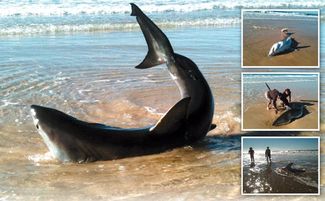 Sad news from Australia this week as a beached and eventually de-jawed white shark was documented:
THE sight of a shark washed up on a stretch of sand locals call Hungry presented more than a few challenges for professional photographer Ruth Fahey. And it wasn’t just any shark, it was a great white, no less!
Ruth grabbed her camera phone and captured something few Coffs Coast locals have ever witnessed.
“I was walking along Hungry Head Beach on Friday morning when I stumbled across the shark, well out of the water in the high tide zone,” Ms Fahey said.
Then the bizarre and nerve-jangling rescue attempt began as two men attempted to haul the ocean’s top predator back to safety.
“As it was threshing about, they tried first to dig the sand away beneath it to refloat it but ended up man-handling it back into the water. It was still very sluggish when they got to knee deep water so the surfer waded it out until he was waist deep.”
Complete story.
Shark Conservation - Message to Shark NGO's
 For the most part the following shark conservation news went under reported by the conservation world this week.
For us this was interesting if not revolutionary news:
RIO DE JANEIRO (AP) -- A Brazilian environmental group sued a fish exporter for $790 million Monday, alleging the firm has illegally sold the fins from 280,000 sharks since 2009 to meet demand in Asia where they are a culinary delicacy.
In Brazil, it is illegal to separate shark fins from the carcasses, and in May government agents reported finding 3.3 tons of shark fins during a single raid on the company sued by the Environmental Justice Institute.
Lawsuits vs Awareness Campaigns
That's not so surprising, as most have little to no funds to work with. We have been highlighting that problem for a while. There are however quite a few NGO's who have money, and their "awareness campaigns" ring hollow against an ongoing global shark crises.
The Environmental Justice Institute in Brazil has just fired the first shot and lead the way in what could well be a new paradigm for shark conservation. As the Environmental Justice Institute knows along with any group who's been in the shark conservation world for a while, the shark fin traffickers are not hiding. Their warehouses are not underground, their fishing fleets do not operate under cover of darkness, and for the most part they do not worry about the trade in fins.
This has to stop, and one way to make it stop is to hold the traffickers accountable for laws already on the books via lawsuits. So, the next time you see a top tier NGO asking for money for what amounts to an awareness campaign, think again.
Demand action in the form of lawsuits that target individual companies. As we have long said, the shark conservation world does not understand trade. Trade is business. Businesses can be seriously impacted when you look at the problem from the business and trade side of things.
Shark Mafia?
For too long, and thanks to some well placed and highly public media bubbles, the shark conservation world and the general public has come to believe that all shark fins, the entire trade is run by a global shark mafia. In conversations I had recently with an NGO talking about disrupting the trade I was hit with this question, "aren't you afraid they might come and do something to you?"
My response was "who are they exactly?" In my world "they" are folks like the following small company in Vietnam:
Ms Dieu Hanh
HX Export Center
405/2 Xo Viet Nghe Tinh str., Binh Thanh dist.,
Ho Chi Minhc city, Viet Nam
Tel: 848 5117992 - Fax: 848 5117829
Email: E-mail:hanhle_hxexpco@vnn.vn
You want to take down the shark fin trade, take down the trade by looking at trade from the business side.
The Environmental Justice Institute knows that shark fin companies can ill afford lawsuits and that successful prosecution of just one company will send a clear and unambiguous message to the rest.
Beats another repetitious awareness campaign any day of the week. By now even folks who get their news via rudimentary roof top carrier pigeons know there's a shark crises going on.
Kudos to The Environmental Justice Institute for the effort and the direct action lawsuit.
Note: There is one fine example of an awareness campaign that should continue to be funded and deserves note. WildAid's China campaign is about targeted awareness and over the past seven years has made serious and lasting inroads to curb shark fin use in China and Asia.
Tuesday, August 3, 2010
All we can say is...Wow!
We rarely get tired of those rare moments where dead whales and sharks mix.
Port Douglas Queensland Australia. Local Line Burner fishing magazine writer 'Sharky' Shane Down swam with a dozen Tiger sharks and Bull sharks which were feeding on a sperm whale carcass which drifted in from the Pacific Ocean and landed on one of our local outer reef systems on the Great Barrier Reef. 'Sharky' can be seen riding the sharks and gets within inches as they gorge themselves on the carcass. It is totally amazing footage and shows sharks feeding in their natural environment. You will see a compressed 2.5 minute version but there is more footage and even additional footage of Shane interacting with Tiger sharks which has never been seen. Contact us if you believe you can use the footage for Television/Production purposes at info@fishingportdouglas.com.au
Port Douglas Queensland Australia. Local Line Burner fishing magazine writer 'Sharky' Shane Down swam with a dozen Tiger sharks and Bull sharks which were feeding on a sperm whale carcass which drifted in from the Pacific Ocean and landed on one of our local outer reef systems on the Great Barrier Reef. 'Sharky' can be seen riding the sharks and gets within inches as they gorge themselves on the carcass. It is totally amazing footage and shows sharks feeding in their natural environment. You will see a compressed 2.5 minute version but there is more footage and even additional footage of Shane interacting with Tiger sharks which has never been seen. Contact us if you believe you can use the footage for Television/Production purposes at info@fishingportdouglas.com.au
Industry News - Commercial Shark Diving Study
 Scientists and South Australian cage-diving operators are collaborating in a world-first project to ensure the State’s eco-tourism activities take good care of Australia’s protected white sharks.
The research, led by Flinders University and SARDI shark ecologist, Dr Charlie Huveneers, will provide important information to help the State Government manage the growing industry which relies on the survival of the threatened species. Its outcomes will also help inform similar cage diving operations around the world in places such as New Zealand, South Africa and Mexico.
Dr Huveneers’ team and cage operators are working together over the next year to tag ten white sharks which inhabit the area around Australia’s main cage-diving operations off the remote Neptune Islands, 75 kilometres from Port Lincoln. Two 3.5 metre white sharks have been tagged to date.
“Berleying activities at the Neptune Islands have recently been increasing. However, the impacts of such activities are still poorly understood, and there is a need to investigate how berleying might affect white shark behaviour and movements” Dr Huveneers said.
“Previous studies in South Africa indicated that white sharks became ‘habituated’ to berleying rather than ‘conditioned’. As a result, sharks might become less attracted to berley,” he said.
“The white shark cage-diving industry at the Neptune Islands attracts a large amount of tourism to South Australia and Port Lincoln. It is important to ensure that this industry is sustainable and that it does not negatively impact on the white shark population frequenting the Neptune Islands.
“Sharks also play an important role in the ecosystem with the removal of top predators having shown to cause cascading effects down the food web.”
“Our research will hopefully provide crucial data which will help the Department for Environment and Heritage and PIRSA Fisheries to assess if the current level of berleying undertaken by the white shark cage-diving industry around the Neptune Islands is impacting on shark behaviour.”
Dr Huveneers says the team is using fine-scale positioning technology accurate to within one metre to track the sharks. Sharks are tagged with an acoustic tag as they swim past the boat allowing researchers to record their positions in relation to the cage-diving boats for a period of up to 45 days.
Serendipity - Two Shark Crises Media Reports
 Two news reports on sharks and the ongoing shark crises today that made front page news worldwide.
CNN covers Matt Rand from PEW explaining how the crises is unfolding:
"At one time, shark fin soup was considered a delicacy for the elite. But as Asia grows in population and wealth, the demand for shark fins has gone through the roof. According to the United Nations, shark fin imports to Hong Kong and Taiwan alone rose 214 percent from 1985 to 1998. This has had a disastrous impact on shark populations globally."
The Sydney Morning Hearld covers a company accused of illegally killing 280,000 sharks:
"A conservation watchdog accused a Brazilian company of illegally fishing 280,000 sharks which were killed to feed Asia's appetite for sharkfin.The Environmental Justice Institute, a Brazilian group, on Monday lodged a suit against seafood exporter Sigel do Brasil Comercio demanding $US800 million ($A883 million) in environmental damages."
Premature Weapons Discharge - Florida
When guns and sharks do not mix. Kudos to Dorsal Fin Blog for the video find and Oceanic Dreams for the re post.
First With Giant Squids? - Not So Fast Brady Barr
Brady Barr, show host extraordinaire, National Geographics resident Herpetologist, winner of the Wild Animal Show Host Hall of Fame Bite Moment (see video, no really see it).
You'll also remember Brady from last year with what looked to be a dead Tiger shark, and an image touted to be Brady swimming with the animal. Except the animal was tied by the tail hanging nose down in the water and Brady's bubbles were heading towards the surface.
These days Brady and National Geographic are claiming to be the first ever team to place a camera on a Giant Humboldt Squid in the Sea of Cortez, unfortunately this whopper of a claim like so many of Brady Barrs animal stunts is 100% false.
Brady Barr and his team are, simply put, liars.
The actual first ever camera on a squid moment goes to Scott Cassell who was also the first to work with these incredible animals several years ago, and who is the go to source for most of the squid productions in the region. He and his team were the first to develop cameras on squids and the first to document deep water squid behaviour in the region.
Just setting the record straight for anyone in production who cares to know. Now on to Brady and another magical moment with wild animals.
You'll also remember Brady from last year with what looked to be a dead Tiger shark, and an image touted to be Brady swimming with the animal. Except the animal was tied by the tail hanging nose down in the water and Brady's bubbles were heading towards the surface.
These days Brady and National Geographic are claiming to be the first ever team to place a camera on a Giant Humboldt Squid in the Sea of Cortez, unfortunately this whopper of a claim like so many of Brady Barrs animal stunts is 100% false.
Brady Barr and his team are, simply put, liars.
The actual first ever camera on a squid moment goes to Scott Cassell who was also the first to work with these incredible animals several years ago, and who is the go to source for most of the squid productions in the region. He and his team were the first to develop cameras on squids and the first to document deep water squid behaviour in the region.
Just setting the record straight for anyone in production who cares to know. Now on to Brady and another magical moment with wild animals.
Monday, August 2, 2010
White Shark Tagging Video Chatham
Chatham - While the shark sightings keep rolling in, it's not clear exactly how many great white sharks are out there, officials have said, because sharks could be sighted more than once. Williams said the Division of Marine Fisheries doesn't count the number of sightings because "that's just not valuable data."
Complete story.
Complete story.
Discovery Channel - New Management New Direction?
Discovery Networks released the first in a series of internal video conference calls with their new Director of Programming, Matt Mann.
Apparently Mr.Mann is no fan of Shark Week for reasons that boggle even our very lively imaginations here at Underwater Thrills, and we thought this was about making sharks look bad.
Kudos to George P for the video find.
WARNING: Foul language, coarse syntax, and a few slams on MythBusters in this video.
Apparently Mr.Mann is no fan of Shark Week for reasons that boggle even our very lively imaginations here at Underwater Thrills, and we thought this was about making sharks look bad.
Kudos to George P for the video find.
WARNING: Foul language, coarse syntax, and a few slams on MythBusters in this video.
Shark Week Media Machine - What a Few Pieces of Flair Will Get You
Shark Bite Beach 2010
Ironic Spoiler Alert - how the media overreacts to shark attacks, brought to you by Shark Week 2010 and a show called Shark Bite Beach.
How does Shark Week get this kind of positive media promotion? With a 5 dollar T-shirt and a holographic poster apparently. Sigh.
Now the question we're all asking, who shot this?
Ironic Spoiler Alert - how the media overreacts to shark attacks, brought to you by Shark Week 2010 and a show called Shark Bite Beach.
How does Shark Week get this kind of positive media promotion? With a 5 dollar T-shirt and a holographic poster apparently. Sigh.
Now the question we're all asking, who shot this?
| Grant Butler with your best bets for Shark Week |
The Problem With "Shark Identities"
 A post over at Da Sharks blog about Eric Ritter caused me to think out loud about Sharkitarianism.
Distilled down to its simplest form Eric Ritter's entire raison d'être is sharks. Not necessarily such a bad thing as many fine folks identify with sharks and use that passion to ultimately do fantastic things for the species in one form or another.
What Ritter and far too many others, as far as I am concerned, suffer from is what Da Shark has aptly coined Sharkitarianism, a complete shark identity.
Without it, these people who are in every facet of our industry, would be just "regular folks" with job descriptions ranging from welders, to bank clerks.
With Sharkitarianism people interact with sharks to heighten an identity, or to become someone new, more exciting, more interesting.
These people use sharks, they do not interact with sharks. Sharks are a conduit for media attention, industry attention, and attention at dive shows. Sharks are the unwilling silent partner to grander ego ambitions, a dangerous stage set by which those who suffer from Sharkitarianism perform stunts with sharks calling these stunts shark awareness, or worse shark conservation and research.
Sharkitarianism is a bane to our industry.
To be a self styled sharkman or professional shark diver (unless you're Christin Zenato who is a complete professional) is the highest point of conceit in a relationship with these animals that should always have a moment where the dive gear is rinsed, put away, and you go back to your life, not take that life back into the terrestrial world seeking gratification for deeds done, days, weeks, months and even years ago.
This deep identity attachment to sharks clouds judgement, shuts down rational thought, and causes the individual to pursue sharks in ever more creative means to fill and build their ego, maintaining the identity.
Sharkitarianism.
As an industry member take a step back today consider your shark identity, are you Sharkitarian?
Sunday, August 1, 2010
Halle Berry at Isla Guadalupe? Well, Actually South Africa
 The films called Dark Tide. It stars Halle Berry as a shark diver supposedly at Isla Guadalupe, but the entire shoot is happening in South Africa, or is it?
The film’s synopsis:
Sara (Halle Berry) is a modern-day adventurer, deeply drawn to close encounters with the magnificent White Sharks who rule the primal predator shore of isolated Guadalupe island. When her husband chooses ambition over his wife's safety in a split second encounter with the jaws of death, her marriage nearly breaks apart.
A year later, a monsoon season voyage back to the same island becomes an escalating series of terrifying underwater confrontations and gut-wrenching emotional challenges. Testing her courage in the face of nature's ultimate terror, she shows herself as tough as the men she is attracted to; and perhaps bravest of all Sara endures and changes the terms of the contest with mankind's most feared underwater predator.
Controversy and Industry Leadership
Alison Kock, a Save Our Seas Foundation shark conservationist near Simon's
Town, where the scenes were shot, told the Daily Mail: "After reading the
script we decided it was not something we would like to put our names to.
"Our mandate is to try to change people's perceptions of sharks. The first
script that we got sounded very much like it had a thriller aspect to it and
a personal kind of aspect to it as well.
"But fighting off a shark, or surviving a shark attack - we couldn't see the
positive side of that, as much as we tried."
More production images here.
Sea Shepherd Giving Up C4H8O2 - Left With Taunts?
Yes, it has been a while since we poked at the increasingly irrelevant and bloated Sea Shepherd Conservation Society. Mainly due to the fact that poking at a dead conservation corpse is about as much fun as...well poking at a corpse.
One story that did get our attention this week was SSCS sudden reversal from the use of C4H8O2.
As a mainstay in the SSCS arsenal of moronic direct action tools, Paul Watson and company have touted the use of Butyric acid as it's direct action darling. Where Greenpeace were afraid to go SSCS would step boldly - Direct Action!
So why the sudden and very public reversal/spin on the use of C4H8O2?
This is a question best left for those that follow this org religiously (we happen to love this guy) and one we'll leave to the SSCS experts to debate long after this non profit (?) has disbanded.
Fun Times Instructional Video
With SSCS now out of anything media worthy to hurl at Japanese whalers, we would like to offer the following instructional video on how to taunt your conservation opponent. Sadly whales will be killed once again during the 2011 Antarctic research hunt, and once again Sea Shepherd's reality television show will be there to...well, we're not sure what they will be there to do, but the following video might help the Shepherds in their ongoing Whale War - now in season number four with the highest ratings to date!
One story that did get our attention this week was SSCS sudden reversal from the use of C4H8O2.
As a mainstay in the SSCS arsenal of moronic direct action tools, Paul Watson and company have touted the use of Butyric acid as it's direct action darling. Where Greenpeace were afraid to go SSCS would step boldly - Direct Action!
So why the sudden and very public reversal/spin on the use of C4H8O2?
This is a question best left for those that follow this org religiously (we happen to love this guy) and one we'll leave to the SSCS experts to debate long after this non profit (?) has disbanded.
Fun Times Instructional Video
With SSCS now out of anything media worthy to hurl at Japanese whalers, we would like to offer the following instructional video on how to taunt your conservation opponent. Sadly whales will be killed once again during the 2011 Antarctic research hunt, and once again Sea Shepherd's reality television show will be there to...well, we're not sure what they will be there to do, but the following video might help the Shepherds in their ongoing Whale War - now in season number four with the highest ratings to date!
Shark Image of the Week
 Off the coast of Massachusetts it's white shark tagging season and apparently the "hunting" is good.
“It’s a team effort. We’re all equally important — not one guy better than the other,’’ said Chaprales, 58, of Marstons Mills, who was a commercial fisherman for 40 years off Cape Cod and claims a perfect record tagging fish with his harpoon. “Greg’s the biologist, my son drives the boat, I do the tagging, and George does the flying.’’
And with more and more great whites appearing off the Cape, these three men from different walks of life have the unique opportunity to unmask one the region’s most mystifying species.
“This has nothing to do with the public, nothing to do with seals; it really has to do with advancing science,’’ said Skomal, 48, a state biologist from Marion. “There’s nobody else along the East Coast of the United States who has the opportunity to do this.’’
Kudos to the entire shark team, complete story here.
Understanding Tigers like Guy Harvey Does
 Thanks to the Guy Harvey Foundation and tagging work being done in Bermuda through the invitation of veterinarian Dr. Neil Burnie, who has independently running a tiger shark research effort, the once elusive world of Bahamas tiger sharks is opening up.
Or are they Bermudas tigers?
Recent tagging data is showing a migration pattern that is interesting to say the least.
For the past decade the question of where these animals vanished to periodically was on commercial shark diving operators minds in the region.
Last year Guy Harvey's Dr. Mahmood Shivji, and company decided to find out. They reported back with an in depth discussion on conservation, marine protected areas, and current tagging with Dr. Neil.
Last month a tiger was sport caught in Bermuda setting off a storm of controversy, tigers are also sport caught with relative impunity in Bahamian waters as well.
With this latest data interesting questions about protection for these animals comes up. As commercial shark diving operators ourselves we have long advocated and enabled in depth shark research at the primary dive sites we operate in. Understanding the animals we work with is the key to working with the resource beyond just the commercial which leads to greater protections backed by in depth site data.
Local efforts to shepherd and steward sharks is the hallmark of commercial shark diving in many places worldwide. Kudos to the work being done by Dr.Neil, Guy Harvey, Dr. Mahmood, and others who are in a race to uncover the once secretive world of tigers.
Only good things can come of this latest discovery.
Subscribe to:
Posts (Atom)