Thursday, May 8, 2008

Pygmy Whale Research-Dissection Blog

This was sent in by one of our blog fans who discovered researchers in New Zealand about to dissect and blog about a Pygmy Right Whale.

These rare critters do not seem to be a part of any main whale evolutionary tree.

The blog is fascinating, and at times a bit gruesome but it does shed light into the world of whales.

Make sure you are not eating lunch... and thanks Ellen!

Wednesday, May 7, 2008

Freakish Mystery Surround "Seal Shootings"

O.K, so it's not like the media gets things wrong all too often, but this is just too creepy. As you know we have been following recent events in Oregon where several caged seals were "shot to death" apparently in response to record low Salmon stocks.

Today an autopsy revealed that all 6 dead, caged, animals had not been shot at all...here's where it gets bizzare, read on:

Exam indicates sea lions weren't shot to death in Oregon

PORTLAND, Ore. (AP) — Federal fisheries officials now say the six sea lions found dead in traps on the Columbia River apparently were not shot to death.

Spokesman Brian Gorman of the National Marine Fisheries Service said Wednesday that preliminary results of a necropsy found no evidence of recent gunshot wounds but found numerous shallow puncture wounds in one animal consistent with sea lion bite marks.

Gorman says X-rays found metal fragments in soft tissue near the neck of two animals.

He says a metal slug was found in the blubber of one animal, but neither the fragments nor the slug appear to be fatal and may have been from old wounds.

The agency is still trying to determine how the animals died near the Bonneville Dam.

The Big Question-Just how do 6 caged seals end up dead in one single night?

Stay Tuned.


Island of The Great White Sharks-Boston

Richard Theiss and Mexican shark researcher Mauricio Hoyos recently presented the new white shark documentary Island of The Great White Shark to rave reviews in Boston last week.

After 3 years of intense filming Richard and Mauricio completed what has been hailed as one of the "best shark documentaries in the past five years".

NPR Television was invited to review the film last week and interviewed the pair.

The film attempts to present white sharks in a positive light for the first time. Typically white sharks are presented as little more than eating machines with no thought to solid research and story lines.

Island of the Great White Shark will be screening in a major city near you summer of 2008. Stay tuned for a complete list of screening dates.

Ocean Pillage-High Tech Sales

This morning we got the following spam email-with a twist. Here's what's interesting about this one:

1. The sheer amount of ocean/wildlife product for sale "direct to consumer"

2. The method of sale (email)

When people in the eco community throw around numbers like 100 million sharks taken each year just for their fins, one would be well reminded after reading this email how that comes about.

Those that harvest from today's oceans no longer have to rely on old school distribution methods and even government regulations. Today, with a click of a mouse, 600 tons of sea product can be traded direct to consumer overnight:

we can offer,

100 tons of squid illex tentacles seafrozen of jigger vessel packing 1 x 20 abt without eyes and beak Price usd 1700 c+f china port

300 tons of squid illex tentacles seafrozen of jigger vessel packing 1 x 20 abt with eyes and beak Price usd 1400 c+f china port

600 tons squid tubes seafrozen of jigger vessel ask !!!

ask for more products available

Our Best Rgds
Gustavo Suarez
Salinas Seafood Arg
SALINAS_SEAFOOD@SPEEDY.COM.AR
SALINAS-SEAFOOD@SPEEDY.COM.AR
SALINAS.SEAFOOD@GMAIL.COM
SKYPE:SEAFOOD-ARG

Tuesday, May 6, 2008

Fijiian Sharks Rare and Rarer

Something interesting from Fiji this week. The local papers there always have great shark stories.

Spotted rare baby shark surfaces

A FRIDAY night fishing trip became exciting after a baby shark was caught just off the waters of Naqara Island and Wainadoi jetty.

The shark was brownish-yellow and had black spots. The man who caught it is Horace Morell of Vatia, Labasa. Mr Morell, who now resides on Naqara, said he had seen other sharks but not one of this colour and shape.

"I was surprised because I have never seen a shark with spots and yellow. I smacked it but my wife said to let it go. I threw it back into the sea. Instead of swimming away, it circled the boat and came back so I caught it again and put it in a cage.

"I haven't decided what to do with it yet but I think I will keep it for a while. I used fish bait to catch it. It has a small mouth and gills. It looks like a Leopard shark because of its black spots but I am not sure."

Mr Horace said he wanted to get in touch with shark feeders of Beqa who might be interested.

He said he was able to put his hand in the shark's mouth. His wife Mele said it was also the first time for her to see that kind of shark.

She said they might give it to someone willing to look after it. In the meantime, they have not weighed their options on whether to sell it for research.

Beqa Adventures Divers Limited operations manager Andrew Cummings said the description of the shark could mean it was either a Leopard or Zebra shark. He said it was a particularly uncommon find in Fiji waters but said the shark was harmless.

Bionic Dolphin-Cool Tech

If there's one thing we love about the oceans and covering this subject it's stories like this one.

Researchers and staff at the Clearwater Marine Aquarium
rescued a young Bottlenose dolphin last year who's tail was unfortunately lost to a crab trap.

What they did with her after that is nothing short of amazing:

"CMA's
marine life stranding response team is one of the nation's most successful. Many of
the sick or injured animals we rescue are released after rehabilitation, but some become permanent CMA residents, due to the extent of their injuries. Residents include dolphins, sea turtles and river otters. The most amazing rescue story of all is Winter's."


State: No chumming for sharks near beach

Recently state regulators in Alabama drafted new laws banning "bloodbaiting" 300 yards from beaches and swimmers in an effort to protect them from sharks?


May, 2008
By RYAN DEZEMBER
Staff Reporter

Aiming to protect beachgoers, state regulators say they expect by the middle of this month to enact a ban on chumming for sharks and other within 300 feet of the beach.

The law, which was drafted by the Alabama Department of Conservation and Natural resources with input from Orange Beach officials, generally prohibits anyone from targeting sharks by chumming or bloodbaiting, whether it's with fish parts or synthetic attractant.

With state budgets slashed how are they going to enforce this new regulation?

You Know You're Doing Well When...

This morning one of our blog fans sent in a link to another sharky website. We're not going to mention it by name-but it was nice to see they have all but completely copied our format.

In the dive industry and the shark diving industry there are leaders, dreamers, and all the rest.

Our little shark blog hit the Internet back in December with it's off hand brand of looking at the people in shark diving industry and the oceans eco side.

It was a hit. Thanks to our readers who liked what they saw and wanted more.

We're happy to see "others" out there copying what we do. In a strange way having someone copy you is a nice compliment. In a strange way.

It would be nice to see them come up with something original for a change as well, but like we said there's the dreamers and all the rest. Heck we'll take the compliment;)

Monday, May 5, 2008

Sharks and Neptunic-Black and White Bliss

Jeremiah Sullivan-the genius behind Neptunic Shark Suits recently returned home from several new "adventures with sharks" which we're sure you'll be seeing and hearing about in the weeks to come.

He did have time to send in this image which sums up these sharky adventures nicely.

Is it just us, or do sharks always look better when you take the time to shoot them in black and white?

With the exception of Wolfgang, no one does this brand of underwater photography better.

Shark Diving-New Website for Six-Gills

If you were not at the Northwest Dive Travel Expo last weekend you missed one of the most exciting dive operations to hit the West Coast in the past 5 years.

Hydrus has pioneered Six-Gill caged shark feeding encounters in the waters off of the Pacific Northwest. Thus far Team Hydrus has played host to many of the old timers in the film and dive industry who are always first to "sniff out" the next big thing. Howard Hall and company to mention some names.

"We were the first team in history to successfully attract and dive with Six Gill Sharks in shallow water while the animals were feeding. Over a 5-year period we created a one-of-a-kind program to attract Six Gill sharks. During those years we documented animal behavior never seen before by scientists, started documenting the behavior of individual animals, designed and build many custom pieces of equipment to enhance the observation experience, and conducted a “proof of concept” event at the Seattle Aquarium, which helped them start their Six Gill Shark research program."

Dust off those camera housings and seal up that dry suit...it's Six-Gill time!

Salmon Wars-Seals in Crosshairs

This ugly eco news was almost inevitable. With salmon stocks up and down the California and Oregon coast disappearing at an alarming rate, the natural predator gets the bad rap.

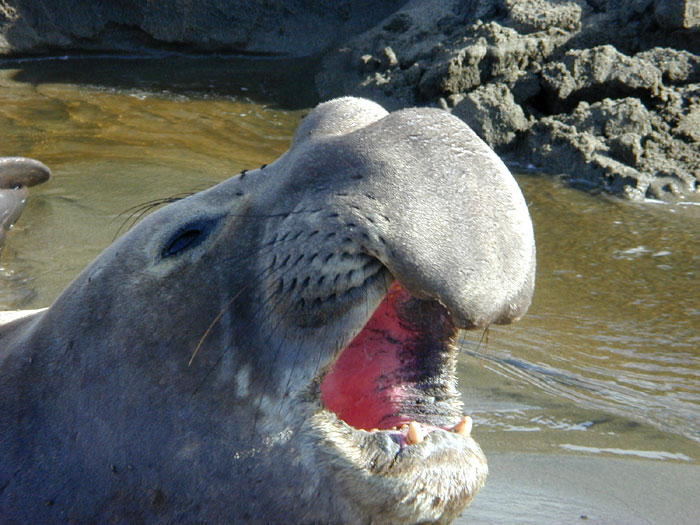
In this case the seal. Sadly several elephant seals were also shot on California's central coast this week as well.

Sea lions shot dead on Columbia River as salmon battle rages

PORTLAND, Ore. (AP) — For years, the sea lions lounging at the Bonneville Dam have had easy pickings from salmon waiting to go up fish ladders to upriver spawning grounds.

Over the weekend, the federally protected sea creatures were themselves easy prey for a gunman who shot and killed six of the sea lions as they lay in traps meant to humanely catch them.

State and federal authorities were investigating the shootings, which came less than two weeks after an appeals court issued a temporary injunction against authorities killing the salmon-gobbling mammals. Agents have been trapping them instead, but trapping will be suspended during the investigation, said Rick Hargrave, a spokesman for the Oregon Department of Fish and Wildlife.

Fishermen and American Indian tribes have pushed to protect the salmon and remove the sea lions, by lethal force if necessary.

The carcasses of the four California sea lions and two Steller sea lions were found Sunday around noon below the Bonneville Dam on the Columbia River on the border of Oregon and Washington.

The six animals appear to have been shot by somebody on the Washington side during the night, said Brian Gorman, a spokesman for the National Marine Fisheries Service.

Sunday, May 4, 2008

Giant Stingrays-Elasmo Thai

When this came across our desk this morning all we had to say was Holy Cra%@!

Yes this is what you think it is, and no this has not been photoshopped. Researchers and fishermen in Thailand landed a simply monster freshwater stingray-what they did with it after this photo finish is anyone's guess.

April 29, 2008—Recreational fishers and biologist Zeb Hogan (wearing cap) hold a live, 14-foot-long (4.3-meter-long) giant freshwater stingray the fishers caught in the Bang Pakong River in Chachoengsao, Thailand, on March 31, 2008.

After weeks of combing remote Southeast Asian rivers for giant freshwater stingrays—possibly the largest freshwater fish in the world—Hogan finally found the creature near a Thai city. To his surprise, she gave birth soon after capture. (Read full story.)

There are accounts of freshwater stingrays growing as large as 1,000 pounds (450 kilograms), which could make them the largest freshwater fish in the world, Hogan said. Hogan runs the National Geographic Society's Megafishes Project, an effort to document 20 or so freshwater giants.

The giant river rays are extremely difficult to catch, as they bury themselves in mud when hooked. They routinely break fishers' lines and bend finger-size hooks straight to escape capture.The ray's deadly barb, located at the base of its whiplike tail—and wrapped in a cloth in this picture—can easily puncture skin and bone.

Two Shark Attacks-Two Worlds

After the shocking and sad news from Solana Beach last week more news came in of another fatal attack-this time on a American surfer in Mexico.

The reaction on the US side to the unfortunate event in Solana was anything but vengeance for the shark. In fact the media and the California public, for the most part, understood the white sharks place in the oceans.

Not so on the Mexican side of the border. The shark attack at this site has been met with baited hooks and overall hysteria.

Two shark attacks-two worlds.

Mexico's hunt for shark that killed second California surfer draws protest

ACAPULCO -- Authorities used baited hooks to catch sharks today near a Mexican beach where a U.S. surfer was killed in an attack. Adrian Ruiz, 24, of San Francisco bled to death after being bitten on the thigh Monday while surfing off Troncones beach west of Acapulco.

Mexico's Navy and maritime authorities said they have strung about 200 yards of lines with baited hooks near the beach in an attempt to catch sharks that may be using the area as a feeding ground.

Emergency personnel are warning beachgoers about sharks' presence near the largely undeveloped oceanfront, said local civil defense Director Jaime Vazquez.

It is not clear what species was involved in Monday's attack, but Navy Cdr. Arturo Bernal said that helicopter overflights had sighted two great white sharks nearby.

Saturday, May 3, 2008

Cool Dive Website of the Week

You probably need to go online today and see this one if you dive, like to dive, know someone who dives or care about diving in general.

The sites got a great dive community, nice divers, and in depth dive site info.

Webmaster Greg has things running smoothly and updates on a regular basis. Cool features as well.

Dive in.

Busting a Shark Myth Wide Open

This image and story have been making the rounds on the Internet like a Nigerian Bank Email. Unfortunately both image and story are completely fake.

It's a classic Underwater Onion.

YOU HAVE TO READ THIS FIRST BEFORE LOOKING AT PICTURE.

Family on vacation in Australia for a week and a half when husband, wife and their 15 year old son decided to go scuba diving. The husband is in the navy and has had some scuba experience. His son wanted a picture of his mom and dad in all their gear so he got the under water camera ready to go. When it came to taking the picture the dad realized that the son looked like he was panicking as he took it and gave the 'OK' hand sign to see if he was all right.

The son took the picture and swam to the surface and back to the boat as quick as he could so the mom and dad followed to see if he was OK. When they got back to him he was scrambling onto the boat and absolutely panicking. When the parents asked why, he said 'there was a shark behind you.' The dad thought he was joking but the skipper of the boat said it was true but they wouldn't believe him. As soon as they got back to the hotel they loaded the picture onto the laptop and this is what they saw.

Thursday, May 1, 2008

Giant Squid Video-Autopsy

The Giant Squid autopsy from New Zealand we blogged about earlier this week now has a video for your review. Thanks to the good folks at current.com for sending this in.

While it's not an alien autopsy, it might as well be.Rumor is these are also tasty critters:

Shark Diving Video-Oldies Rule!

A lot of people ask us what cage diving with Great White sharks is like. It's moments like this. Shot in 2004 at Isla Guadalupe, Mexico with Sterns Bullen (fearless shooter) cage left with a frisky 12 footer:

White Sharks in Shandong China?

Almost certainly.

One year ago this news report surfaced about a massive shark taken off the shores of Shandong China.

The story was being used at the time as a propaganda piece:

"A super large shark, which is 4.5 meters long, 2.6 meters round and weighs 630 kilograms, was caught by fishermen in Rizhao, east China's Shandong province on Monday morning. Such a big shark is extremely rare. It indicates the coastal waters' quality has been improved."

If you look at the area on a map, the shark was likely taken in the Bohai Sea which makes us wonder what white sharks are doing in this area in the first place?

Deep Water Sharks-NOAA

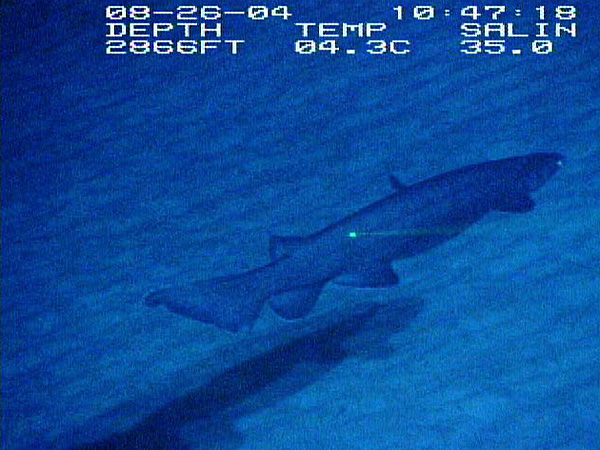
Back in 2004 researchers with NOAA shot this ungainly looking critter around 3000 feet deep.

They think it is a new shark species and is close to 22 feet long. Yes, that is a green laser being used to gauge the size of the animal and the distance from the submarine.

What's fascinating about this fellow is the tail set up-which is completely unlike anything seen previously-even with deep water shark species.

Unfortunately they have not seen another one like this in the past 4 years of deep water exploring. Unlike the Blunt Nosed Six Gill which seems to be everywhere. Some deep water sharks seem to be as rare as some of their top water cousins.

Sharks and The U.K Media

The Times recently covered shark attacks worldwide with a completely hysterical and not surprising bias. The following quotes were taken from that article.

By employing broad unsupported statements about sharks and the use of the classic "but experts have said" they continue to propagate fear in the reader about sharks. What we have here is a failure to communicate.

Quotes from the article:

1. " Another theory suggests that the killer shark off California may have been trying to protect a newborn pup".

2. "But experts have said that great white females are more likely to eat their offspring than protect them".

3. " Some argue that thriving seal populations are attracting sharks to tourist areas, especially during March and April when female sharks arrive in the warmer waters between California and Mexico to give birth".

When will media begin to report these unfortunate events from the sharks P.O.V?

Wednesday, April 30, 2008

Island of The Great White Shark-Documentary

By now you have heard about the new white shark documentary-Island of the Great White Shark. Richard Theiss spent the last 4 years documenting the research work that Shark Diver started with the help of Mexico's CICIMAR and U.C Davis.

The project is almost complete and sheds light on white shark tracking and behaviour at the island that was unknown until this data was gathered.

Here's a short clip:

Giant Squids-Cool New Research

And you thought we would never get around to blogging about the Giant Squid again.

The AP reports today that researchers in New Zealand, home to perhaps more giant squids than any other place on the planet (betcha didn't know that) have concluded that their critters have the largest eyes of any animal on the planet.

Take that Mr. Blue Whale.

WELLINGTON, New Zealand (AP)
— Marine scientists studying the carcass of a rare colossal squid said Wednesday they had measured its eye at about 11 inches across — bigger than a dinner plate — making it the largest animal eye on Earth.

One of the squid's two eyes, with a lens as big as an orange, was found intact as the scientists examined the creature while it was slowly defrosted at New Zealand's national museum, Te Papa Tongarewa. It has been preserved there since being caught in the Ross Sea off Antarctica's northern coast last year.

"This is the only intact eye (of a colossal squid) that's ever been found. It's spectacular," said Auckland University of Technology squid specialist Kat Bolstad, one of a team of international scientists brought in to examine the creature.

Tiger Beach-Bahamas Rare Event

For the past 8 days Shark Diver's Luke Tipple has been the dive safety operations manager for a simply massive film crew, shooting Tigers and Dolphins in the Bahamas.

The shoot spans three continents and is styled after Blue Planet. While they are still in production we cannot give you any more details, we'll update you as soon as we can.

We can share with you this image he sent into the office this morning.

What you are looking at is "Raw Nature" to quote Luke (*add Australian accent here) a green turtle who lost out on a turtle vs tiger encounter off Tiger Beach last week.

It looks like this little critter had quite the rough time of it. When you're a turtle and you show up to Tiger Beach, it's like driving through a bad neighbourhood. Always keep your doors locked, drive fast, and do not stop for gas late at night.

Saturday, April 26, 2008

Strange Sharks-Photoshop? No Way!

We get quite a few emails from blog readers each week. Some with images like this one, others with offers for cheap V!@gara delivered to your door.

This particular image was sent in from Sarah who lives in the U.K-wanting us to identify this unlikely looking critter.

At first we said "Unicorn Shark?"

Then it occurred that this critter had to be a deep water species, and if there's anything we know about deep water sharks (we know a fair bit) anything is likely down there.

Here's what we found out about this shark:

Almost nothing except about 300 posts, arguments, half stories, wild rumors and the like. Seems this critter has generated a lot of talk and is perhaps from Japan.

Whatever this critter is, we hope it gets to be about 20 feet long and shows up on our chum line one of these days. If that happens we'll probably need a handful of that cheap V!@gara.

Shark Attack in San Diego

This tragedy while unfortunate is the result of life off the California coast.

These waters are sharky, and perhaps more sharky than anyone cares to admit.

It's also a testament to the white sharks ability to not choose humans as a prime prey source. After observing these animals for over 6 years now I have come to realize they will spend a lot of time "watching and observing" suspected prey items before attacking-most often they choose not to.

Off the shores of Nor Cal I often meet surfers who say they have never seen a white shark. My response is always "that's not to say they have not seen you".

White sharks very rarely make mistakes. This particular set up, with a swimmer in a black wetsuit, in the morning, along the shoreline, lagging behind a pack of other swimmers met more than one criteria for this shark to make a tragic mistake.

It is sad anyway you look at it.

Friday, April 25, 2008

Maps and Statistics of Confirmed Unprovoked Shark Attacks

You may be asking about the image to the right here. As one would expect there's at least one person on this planet who maps out all "recorded" shark attacks on the planet.

Hey, it's the age of the Internet, if they have blogs about cheeses of the world, you just knew someone had to have this.

The interesting thing about this map and the links on it-is the low numbers of shark events worldwide. Here's the breakdown.

Perspective On the San Diego Shark Attack

One of the better looks at this entirely sad event on Solana Beach this morning comes from the Daily Green Blog.

What is believed to be a great white shark attacked and killed a 66-year-old swimmer off Solana Beach, San Diego Friday, leading to a beach closure, mourning among friends and relatives, and rampant media attention.

Such fatal attacks have been relatively rare.

A single swimmer in the South Pacific was the only person to die from a shark attack in 2007, but total shark attacks rose nearly 13% over 2006, according to statistics released in February by Florida Museum of Natural History at the University of Florida.

The number of fatal shark attacks hit a 20-year low. In 1987, there were no fatalities. (There were four deaths each in 2005 and 2006, and seven in 2004.)

“It’s quite spectacular that for the hundreds of millions of people worldwide spending hundreds of millions of hours in the water in activities that are often very provocative to sharks, such as surfing, there is only one incident resulting in a fatality,” the lead author, George Burgess, said at the time. “The danger of a shark attack stays in the forefront of our psyches because of it being drilled into our brain for the last 30 years by the popular media, movies, books and television, but in reality the chances of dying from one are infinitesimal.”

The number of shark attacks overall increased from 63 in 2006 to 71 in 2007, a nearly 13% increase, continuing a gradual upswing during the past four years.

“One would expect there to be more shark attacks each year than the previous year simply because there are more people entering the water,” Burgess said. “For baby boomers and earlier generations, going to the beach was basically an exercise in working on your suntan where a swim often meant a quick dunking. Today people are engaged in surfing, diving, boogie boarding and other aquatic activities that put them much closer to sharks.”

Often, about half of the world’s attacks occur in United States mainland and Hawaiian waters, but the proportion was greater in 2007, Burgess said. Last year’s total of 50 attacks returned to 2000 and 2001 levels of 53 and 50, respectively, after dropping from 30 to 40 for each year between 2003 and 2006, he said.

There also was an upswing in attacks along the Florida coast, jumping from 23 in 2006 to 32 in 2007. There has been a gradual increase in human-shark skirmishes in the Sunshine State since they dropped from 37 in 2000 to an 11-year-low of 12 in 2004, he said.

Within Florida, Volusia County continued its dubious distinction as the world’s shark bite capital with 17 incidents, its highest yearly total since 2002, Burgess said. Attractive waves off New Smyrna Beach on the central Atlantic coast are popular with surfers, he said.

Additional U.S. attacks were recorded in Hawaii – seven — marking a five-year-high, along with South Carolina, five; California, three; North Carolina, two; and Texas, one.

Elsewhere, there were 12 attacks in Australia, up from seven in 2006 and 10 in 2005, but down slightly from the 13 attacks recorded in 2004. There were two attacks each last year in South Africa and New Caledonia, with single incidents reported in Fiji, Ecuador, Mexico and New Zealand.

Most of those attacked (56%) were surfers and windsurfers, followed by swimmers and waders (38%) and divers and snorkelers (6%). The one 2007 fatality was a snorkeler from France visiting the Loyalty Islands archipelago in French New Caledonia.

“We advise not getting yourself isolated because there is safety in numbers,” Burgess said. “Sharks, like all predators, tend to go after solitary individuals, the weak and the infirm, and are less likely to attack people or fish in groups.”

Shark-Attack Victim ID'd

Update. Very sad news.

The swimmer killed in a fatal shark attack this morning off the coast of Solana Beach has been identified by a family friend as 66-year-old Dave Martin. Martin is a retired veterinarian who has lived in Solana Beach since 1970. The announcement was made at a press conference held in Solana Beach.

Shark Attack in California-Posts

To get an idea of the public's response to this tragedy we pulled some comments from the L.A Times site who seem to have the best coverage and are thus far staying away from the Fox News style hype which is permeating the other 365 articles and news reports out there at this time.

Here's what people are saying:

1. This shouldn't be a surprise to anyone. It is a tragedy, yes, but the way human beings are distroying this planet, plants, animals, & wildlife are all suffering. This is a perfect example of the selfishness of the people of our planet...taking advantage of the earth's bounties, killing, distroying and maiming and then complaining about it. This is a sad reality of life in the 21st Century.
Submitted by: Shari
11:34 AM PDT, April 25, 2008

2. Unfortunately dbx's comment about justice is the way Fish and Game usually sees it. They follow public opinion, and there are usually outcries to kill the shark after attacks. I am an avid free diver and we know the risks and respect the environment we go into, it is of course a tragedy, but sharks must stop being portrayed as bloodthirsty, brainless killers. The more people understand them, the less fear there will be of them.
Submitted by: koby
11:28 AM PDT, April 25, 2008

3. This is a tragedy, and I'm sorry for the attack victim and his family. At the same time, it is ridiculous to think that another attack could be prevented by locating and trapping the shark. This type of response seems hysterical and ignorant to someone like myself who has been surfing for the last 15 years in Northern California, where shark sightings and attacks are much more common. Humans are not part of any shark's natural diet. Attacks on humans are rare, and the idea that a single shark would attack humans more than once before it continues on its migratory path, assuming it's a White shark, is ridiculous.
Submitted by: Isaac McGowan
11:27 AM PDT, April 25, 2008

4. Entering the Ocean is a wilderness experience. Even so, an attack by a predator on a human is so random and so rare its shocking when it happens. My condolence to the Gentleman's family & friends.
Submitted by: Tri guy
11:25 AM PDT, April 25, 2008

5. Any habitate other than our own, should be used with causion. A shark like a grizzly bear are preditors and weather they are in the wilds or in a facility of training, they are still wild animals. We need to respect that fact. If you step into a den of vipors you need to know that you are going to get bitten. It is a fact of life. We need to remember that FACT. It is not your God given right to do what you want. My heart always goes out to the victums and their families at their time of greif. May God give them strength to make it through this hard time.
Submitted by: Rhonda in So. Cal.
11:24 AM PDT, April 25, 2008

6. I agree with Mike. Surfers and Open Water swimmers know the risks of their sports. They respect and love the ocean. I hope the killed swimmer did not suffer too much. Fish and Game should be known as search and destroy. They have little understanding of wildlife except as seen from behind the barrel of a long range rifle.
Submitted by: Pita
11:18 AM PDT, April 25, 2008

7. I know there were great white shark sitings off of san onofre a few years ago. I wonder if they are starting to make their way south from oregon/washington area...
Submitted by: matt s.
11:10 AM PDT, April 25, 2008

8. What a tragedy. I grew up going to Solana Beach. I never would have guessed a shark attack would happen there.
Submitted by: Dan
11:06 AM PDT, April 25, 2008

9. we have to trap the shark to bring him to justice and teach nature that democracy will prevail at all cost.
Submitted by: dbx
11:05 AM PDT, April 25, 2008

10. Going to the beach is never a bad thing but we all have to sit back and think here. Trying to trap a shark. For what reason? Once we set foot in the water, we are no longer in our habitat. We must respect the animals of the sea and know that we are swimming at out our own risk. My prayers do go to the individual who lost his life never the less.
Submitted by: Mike USMC
11:01 AM PDT, April 25, 2008

Shark kills man swimming with triathletes in S. Calif.

At 8.00am this morning we started getting calls from the media for comment. Expect an unfortunate result for the sharks coming from this as the media spins this entirely sad event up.

Most of the reporters/assignment producers who contacted us were looking for anti-shark quotes. We politely refused. Our sympathies go out to the family of the swimmer.

Check back for updates.

SOLANA BEACH, Calif. (AP) — A shark on Friday attacked and killed a swimmer who was training in the ocean off San Diego County with a group of triathletes, authorities said.

A man between 55 and 60 years old was swimming at Tide Beach around 7 a.m. when he was attacked, according to a statement on the Solana Beach city Web site.

The man, whose identity was not immediately released, was taken to a lifeguard station for emergency treatment but was pronounced dead at the scene, the statement said.

Swimmers were ordered out of the water for a 17-mile stretch around the attack site and county authorities sent up helicopters to scan the waters for the shark.

"The shark is still in the area. We're sure of that," Mayor Joe Kellejian said.

It was unknown what kind of shark was involved.

Solana Beach is 14 miles northwest of San Diego.

Shark attacks are extremely rare. There were 71 confirmed unprovoked cases worldwide last year, up from 63 in 2006, according to the University of Florida. Only one 2007 attack, in the South Pacific, was fatal.

The last fatal shark attack in California, according to data from the state Department of Fish and Game, took place in 2004, when a man skin diving for abalone was attacked by a great white shark off the coast of Mendocino County.

USA to end controversial shark 'finning'

Sometimes there's good news for sharks. This would be one of those days.

The oceans just got a little safer for sharks. Fishermen must bring their shark catches to shore with fins still attached, the US fisheries service has decided.

The new rule, put forward last week, aims to prevent fishermen from slicing fins off vulnerable species and discarding the rest at sea.

"Finning", as the practice is known, is illegal in the US and elsewhere, but the ban is difficult to enforce. Right now, fishermen may land piles of fins separate from shark bodies, so long as the fins weigh less than 5% of the total catch.

Shark meat fetches much lower prices than do fins, which are the main ingredient in the prized Asian soup. The discrepancy encourages cheating as it is hard to identify the species of a shark based solely on its fins.

Shark Shield Technology-A Testamonial

A quick word about the Shark Shield. Recently a nasty lawsuit and media storm over the Shark Shields ability to deter sharks and effectiveness has surfaced.

The details are here.

We would like to weigh in on this technology. For the past two years the crew of Shark Diver have used these dive units in a variety of places and situations with several different species of sharks, including big macro predators.

The result is always the same, deterrence. In short these units work, each time and every time. For an operation that introduces divers to sharks in baited situations it's nice to know that you have an additional layer of dive security on site. For the film crews we work with they insist on multi-layer shark security when filming. These units allow us to offer that.

Shark Diver Disclaimer:

These units are never to be used as a first layer of shark diver security. Knowing the animals you will be encountering, the area you are diving, and having rock solid diver safety protocols should be your first and foremost consideration. Always leave the area if you have baited sharks and they are acting in a manner that causes concern. Shark Shields should be pre-tested on the animals you will be encountering prior to commercial use to gauge response.

Shark Capture Causes Traffic Jam

What is it with Floridians anyway?

Perhaps the most shark crazy bunch of people on the planet right now with perhaps the exception of China.

Let us qualify that, coastal Floridians.

LOWER MATECUMBE KEY -- All the Miami fisherman wanted to do was measure the lemon shark he had caught and then release it back into the open sea.

Instead, James Fuqua caused a traffic mess on the Overseas Highway when about 50 people parked their cars haphazardly on the road and waded into shallow waters to take pictures, touch the shark or simply get a closer look.

To make matters worse, the gawkers trampled hundreds of native plants -- sea oats, sea-oxeye daisies and sea grapes -- that had been planted in a volunteer beach restoration project over the weekend.

All this for a lemon shark?

Thursday, April 24, 2008

Found On The Internet-People are Less Sharky

Thanks for taking this poll
Which is your most ideal ocean vacation destination?
shark cage at Guadalupe Island
384
(13.76%)
buffet line on a cruise ship in Alaska
465
(16.66%)
lounge chair on the beach in the Bahamas
525
(18.81%)
kayaking along the fjords of Chile
174
(6.23%)
on the couch at home watching the Discovery Channel
1212
(43.43%)
Total Replies : 2791

Shark Diving and Feeding Raises Concerns, for Sharks and Divers

Voice of America recently tackled the open debate about shark diving and it's effects.

Sadly the piece, aired last week, is just a standard regurgitation of what has come many times before.

When tackling the complex issue of wild animal encounters-it would seem the media is less interested in fact finding and more interested in "commonly held shark notions".

Most of these "notions" are out of date and out of touch and not substantiated by any science or on site observations at all.

Here's the point. Operations like Rodney Fox in Australia have actually supported research to answer the burning question of "habituation" of white sharks to chum. It was a great project and yes there's actually an answer to that question now, we'll let the Foxes tell the world when they are ready.

This is how our industry will counter far flung and unsubstantiated claims about sharks and shark diving. In the end shark diving does change perceptions of sharks to thousands each and every year.

While the shark diving "industry" does have it's mavericks, those who push limits of wild animal encounters, it is good to be reminded that the entire industry is still growing and developing. Changes will happen as time moves forward. Accidents, as this industry grows, will happen as well. That is the nature of developing wild animal encounters.

In the end, and in the final summation, research to answer basic questions about sharks and shark diving will not only help the industry along, but it will provide those on the outside with a broader understanding of what we do and what these animals are doing there as well.

Media, instead of just reaching for the same old tired comments about an industry that, beside itself, has managed to introduce thousands of people, safely, to a wild predator that needs our help as much as any other wild animal in today's oceans.

Food for thought.

Wolfgang Leander and Son-Shark Family

There are precious few "originals" in our dive industry these days.

Even more so when you add sharks into the mix.

Here's one "absolute original" that we just had to introduce you to this morning. Hope you enjoy him.

From the Oceanicdreams Blog:

Usually when my dad and I get together sparks fly at one point or another – this time was no different: me giving him dirty looks or him giving me the stink eye when I would not get close enough for the shot of him in-between three large tiger sharks feeding on whale meat. But this trip just reaffirmed something to me: my dad LOVES sharks and is truly passionate about these magnificent animals.

For a long time I have quietly sat behind and listened to the conversations on various shark groups, seen scientists bicker, film makers becoming famous, Shark organizations refusing to work together and people fighting over credit of campaigns; I have come to wonder if these people are really passionate about sharks or about the fame and exposure for themselves or the organizations they represent.


I know one thing, my old man does not care if his photos are published, if his face is on a movie poster, if someone else takes credit for a campaign; (sure you might argue that you need the fame and exposure to get the message out – but it can be done together)…the only thing he cares about are sharks and spending as much time as possible with them. It is so deep that he got seriously depressed when he found out that some of the tiger sharks in both Aliwal Shoal and Tiger Beach were killed.

William Winram, world class freediver and waterman, said something to my dad that stuck with me: “You are an inspiration”…Wolf was the first one in the water and last one out…mind you he is 67.


And while I am sure the sparks will continue to fly I am very proud of having him as my father and consider him one of the few people that are truly truly passionate about sharks and their fate…

Wednesday, April 23, 2008

Palladium Neodymium-Hope For Sharks

What you are looking at may just save millions of sharks in the coming years. Researchers have discovered some metals actually cause sharks to be "repulsed" in salt water (if you live in a canal region with loads of Bull sharks, sorry)

Thanks Underwater Times for this story.

Sharks in captivity avoid metals that react with seawater to produce an electric field, a behavior that may help fishery biologists develop a strategy to reduce the bycatch of sharks in longline gear.

Shark bycatch is an increasing priority worldwide given diminished populations of many shark species, and because sharks compete with target species for baited lines, reducing fishing efficiency and increasing operating costs.

A recent study by NOAA scientists and colleagues on captive juvenile sandbar sharks showed the presence of an electropositive alloy, in this case palladium neodymium, clearly altered the swimming patterns of individual animals and temporarily deterred feeding in groups of sharks.

Shark Diver Hits 100,000,000!

Without a doubt the most watched shark diving video on You Tube right now was shot at Isla Guadalupe and we were in the middle of it in 2007 with white shark researcher-Mauricio Hoyos.

The video has hit over 100,000,000 views and shows no signs of stopping anytime soon. It has also launched the career of aspiring wild animal show host Luke Tipple.

You may also know him as the Dive Operations Manager for Shark Diver and Islander Charters.

What made this video a hit?

Good question. This was a grand experiment in Web 2.0 for us here at Shark Diver. We knew that the right video at the right time with a compelling story would draw interest. It also had a lot to do with how this was marketed on the net.

Without giving too much away-having the right partners, in this case the boys from 689 Design, made all the difference. Adam and Zander are pure genius, they know what works, they know timing, and they (thanks to us) also know Great White sharks.

So, in case you're one of the few shark fans who have not seen the video, here it is yet again:

Wednesday, April 16, 2008

White Shark Projects-Tragedy Update

15 April 2008

White shark viewing and diving continues

You will, by now, have heard the tragic news of the accident in Gansbaai on Sunday, 13 April. Our shark diving and viewing boat was capsized by a freak wave during an otherwise ideal sea-going day. Thanks to the prompt and efficient reaction of local emergency services and our crew, the incident was contained. Sadly, three lives were lost, and our deepest sympathy goes to their next of kin.

Be assured that all safety measures were in place. As always, White Shark Projects operates to the strictest standards as laid out by the shark cage diving and viewing industry and the South African Government's Marine and Coastal Management. Indeed, these are the basic requirements of an operator’s exemption and/or permit.

We would also like to assure you that our diving and viewing continues as usual. Existing and future bookings are not affected by the accident and visitors are assured, as always, of a wonderful experience.

Yours sincerely

Charmaine Beukes

Sales and Marketing

Email: charmaine@whitesharkprojects.co.za

Mobile : +27 (0) 83 728 4833

Reservations: +27 (21) 405 4537


Tuesday, April 15, 2008

Australia+Crocs+Bungee Jumping=Video

What do you get when you add an Aussie, a video camera, a world class bungee outfit and a 15 foot Saltwater Croc on an otherwise uneventful day over the Murrybundi River?

The answer is some amazing You Tube Video:


Of course if you believe everything on You Tube we can't help you.

McSeals Go Missing-McKiller Whales Blamed

If there was any doubt after reading this latest news that the Great White shark is only the second most impressive oceanic predator...we're not sure how much convincing you need.

Seems off the coast of Scotland McKillers are gobbling up seals faster than $1.00 Fillet-o-Fish sandwiches.

Killer whales blamed for decline of Scottish seals

Attacks by killer whales may be helping to drive the sudden and mysterious decline of seals around the northern coasts of Scotland, new research suggests.

British populations of harbour seals (also known as common seals) are falling steeply, with numbers in Orkney and Shetland dropping by 40 per cent in the five years to 2006.

So far, the declines are unexplained, but a new theory is that killer whales, or orcas, the bulky, black-and-white predators which are in fact the largest members of the dolphin family, have increased their taking of seals to such an extent that it may be causing populations to shrink.

The harbour seal is one of Britain's two native seal species, the other being the bigger grey seal. But while grey seal populations remain buoyant, harbour seal numbers are tumbling, especially in the Northern Isles, where nearly half of them live. Surveys in Orkney and Shetland in 2001 found 12,635 animals, but when the counts were repeated in 2006, they showed that numbers had plunged to 7,277.

Monday, April 14, 2008

Tragedy in South Africa-Shark Boat Update

We got this comment from Lauren regarding our first post:

"Actually, the boat had just finished doing a shark dive, and were getting ready to go back to shore. There were plenty of sharks in the water, according to our daughter who was a volunteer on the boat."

Three tourists who died in a shark-diving boat accident were identified on Monday by Western Cape police.Two men from the United States and one from Norway died when their shark-diving boat capsized near Kleinbaai on Sunday,

The two Americans who died in the accident were named as Cassey Scott Lajeunesse, 35, from Maine and Christopher Tallman, 34 from California.

Kenneth Roque from Moss in Norway was the third victim.

"Nine crew members and nine other tourists survived the incident and were treated for injuries and shock" said police spokesperson Andre Traut.

Traut said three death inquest case dockets had been registered.Gansbaai police were investigating the exact circumstances surrounding the incident.

On Sunday, National Sea Rescue Institute (NSRI) spokesperson Craig Lambinon said the boat that capsized was a 36 foot White Shark Projects boat. Chairwoman of the Great White Shark Protection Foundation, Mariette Hoply, said the shark-cage diving boat had anchored just before a freak wave struck it around 10am on Sunday, causing it to capsize.

The boat's crew had not started shark-cage diving when the wave struck. - Sapa

Sunday, April 13, 2008

"MythBusters Shark Week 2008"

Of course the crew here of Shark Diver knows more about this than we will let on:

On a March afternoon, Savage is busy with a 3-foot-long metal rod, a variable-speed drill and red string. He can't hide the "it's always Christmas Day" enthusiasm on his face as he works on his latest contraption: a device to simulate how an injured fish acts in the water. It is for a myth to be explored in an episode to air on the cable channel's "Shark Week" this summer.

The "Shark Week" episodes will be filmed in the Bahamas. A few weeks earlier, the team was in Alaska to examine myths associated with the far north. The last new episode, which aired Feb. 20, was the show's 100th. A new batch of original episodes will begin airing in July, and the crew is preparing those shows now.

S.Africa White Shark Boat Capsizes, 3 Killed

S.Africa Boat Capsizes, 3 Killed

CAPE TOWN, South Africa (AP) — Two Americans and one Norwegian tourist on a South African shark cage diving adventure drowned Sunday when their boat was hit by a freak wave, tourism and rescue officials said.

The 10 passengers and nine crew members onboard were flung into the water when the boat capsized under the wave. Nearby boats rescued 16 people who were taken to a hospital with minor injuries, officials said.

The two Americans and one Norwegian were pronounced dead at the scene, said the head of the Great White Shark Protection Foundation, Mariette Hopley.

The accident happened in Gansbaai, which calls itself the Great White capital of the world because its waters are teeming with sharks. The small town, about two hours from Cape Town, attracts thousands of tourists each year who are lowered into the water in metal cages to view the sharks.

Hopley said the boat had just anchored around 10 a.m. and was preparing to lower the first cage into the water when the freak wave hit. She said there were no sharks in the immediate vicinity at the time.

She said it was the first accident since the advent of shark cage diving in Gansbaai in 1991.

Blow Your Mind-Shark/Sea Horse Pics

A few weeks ago intrepid underwater explorer Karl Stanley took his submarine down the Cayman Trench with some Nat Geo guys for another deep water shark adventure.

Let's back up a bit...

What would you do with a dead racehorse in Roatan, Honduras?

If you're Karl, someone "donates it" to you and you quickly drop it down 1700' and then drop your home made submarine down 1700' to see what arrives to feed on it. Karl wrote:

"National Geographic came down to shoot Six Gill sharks for a special on them- I sank a horse and we saw 5 sharks- we were actually in the middle of a Six Gill feeding frenzy, and they bit the sub".

The next series of images are nothing short of amazing. Like we told you years ago-the animals at this site are simply huge. Last time we got to see these monster Six Gills all we had were a couple of pigs heads...and don't ask us how we got them!

Bill at Congress-Act To Save Sharks?

A new bill is sitting in Congress that might require the bodies of all sharks taken in US Waters to also have fins with them and vice versa.
Shark Diver is in full agreement with the actions taken on this bill but it needs your support.
Here's how you can help today:

US citizens wishing to express support for this important bill should also contact their Representatives in Congress click www.house.gov and type in your zip code.

Many conservationists believe the bill could be improved by adding a requirement that sharks be landed with their fins attached. Those who agree with this should mention their support for a fins-attached requirement in their letters to Congress.

Thanks all, Sonja

Sonja Fordham
Policy Director, Shark Alliance and
Shark Conservation Program Director, Ocean Conservancy
c/o Pew Environmental Group
Level 21, Bastion Tower
5 Place du Champ de Mars
1050 Brussels, Belgium
T: +32 (0) 2 550 37 44/45
M: +32 495 10 14 68

Saturday, April 12, 2008

Salmon Futures $40/Lb? You Betcha!

Well, it has come to pass. The once magnificent salmon runs from San Francisco to Oregon are now officially gone. With a one year "temporary ban" in place...and who are we kidding here, fishermen and a 500 million dollar industry have been wiped out overnight.

The same old war horses who got us into this mess are now trying to fix it. The solution is 500 million for fish replanting and habitat reconstruction, 10 years of good will, and a few prayers of forgiveness to the almighty.

SEATTLE — Failure. Disaster. Devastation.

Those words can describe the utter loss of commercial and sport ocean Chinook seasons in 2008 in most of Oregon and California. But through all of the gloom, Oregon emerged from the historic closure with a small victory: a 9,000-fish coho quota for sport fishermen.

The historic closures due to low returns to much of the West Coast rivers, primarily the Sacramento, was marked only by a lot of angst, a few simple votes, a quiet audience and much regret as the Pacific Fishery Management Council met in Seattle to decide the fate of not just sport and commercial fishermen, but also several coastal ports and towns for years to come.

"Ocean Adventure: Immerse Yourself in Nature"

Sea Watch is doing their part to preserve the Sea of Cortez. Leading by example and working with Conapesca to introduce legislation banning fishing with compressors and hookah in the continental and ocean waters of Mexico. This can only be good news for a body of water almost stripped of wildlife over the past 15 years.

From the Blog Ocean Adventure: Immerse Yourself in Nature

The destructive fishing methods that utilize hookah divers with nets and harpoons, that has devastated the reefs of the Sea of Cortez over the last 10 years are being banned by a new regulation adopted in norma 064. This regulation if enforced will stop the killing of over a 1000's tons of reef fish yearly in the waters of BCS.

Here is a letter dated 2/07/08 from a CONAPESCA official.

I refer to your request for information on prohibiting fishing underwater in any of its forms, with scuba equipment and / or equipment hookah in the Regulation Mexican Official NOM-064-CFSP-2006, about systems, methods and techniques that are prohibited for catching fish in the waters under federal jurisdiction of the United Mexican States, which was published in the Diario Oficial de la Federación for public consultation on May 8, 2007.

In this regard I wish to inform you that based on the technical opinion of the National Fisheries Institute (INP), as well as the recommendations contained in the Carta Nacional Pesquera (Fisheries law), the application was deemed appropriate, so the Norma Oficial Mexicana referenced will be published in the (Diario Oficial de la Federación ) shortly and provides for the prohibition of fishing underwater with scuba equipment and / or hookah equipment in continental waters and in marine waters.

In conformity with the above, under the heading of NOM-064 grouping systems, methods, techniques and fishing gear that are prohibited for commercial fishing, sports and recreational fishing, didactic and household consumption, including the method of fishing with harpoons and fítoras from the shore or from boats using the technique of diving with a compressor (hookah) in marine waters and in continental bodies of water, except as authorized by the Secretariat based on the technical opinion of the INP.

In regards to the steps to its publication, once approved at the Third Meeting of the Consultative Committee for Standardization of Responsible Fisheries, on August 23, 2007, a document entitled "Response to the comments and changes made to the Draft Norma Oficial Mexicana PROY-NOM-064-CFSP-2006, about systems, methods and techniques prohibited for fishing in waters under federal jurisdiction of the United Mexican States, published on May 8, 2007, "as well as the corresponding regulation, were forwarded to the Coordinación General Jurídica de la SAGARPA (legal) for their opinion, under the procedure established by the same Coordination together with the Oficialía Mayor de la SAGARPA. Once they have issued their opinion, both documents will be sent the Comisión Federal de Mejora Regulatoria (COFEMER) for the purpose of obtaining an opinion referred to in section 69-L of the Federal Act on Administrative Procedure, and then be able to publish them in the Diario Oficial de la Federación.

Atte. Lic. Belinda Cedillo Tirado
Director of Legislative
General Directorate of Fisheries and Aquaculture Management
CONAPESCA-SAGARPA